 Smart Girl Dumb Questions
20 Oct 2026 · 1h 14m


 Add vo to ChatGPT or Claude to ask about everything you hear
vo listened to this episode to put together the overview and transcript, so there may be the odd mistake.
The episode compares the 1920s and 1929 crash to today’s economy, arguing that a market downturn is not a single “terrible day” but a slow unraveling driven by leverage, policy choices, and confidence loss. It also discusses why money feels more central now, how AI/robotics could change work and wealth distribution, and what financial innovations (SPACs, semi-liquid private-asset funds) could be the next risks.
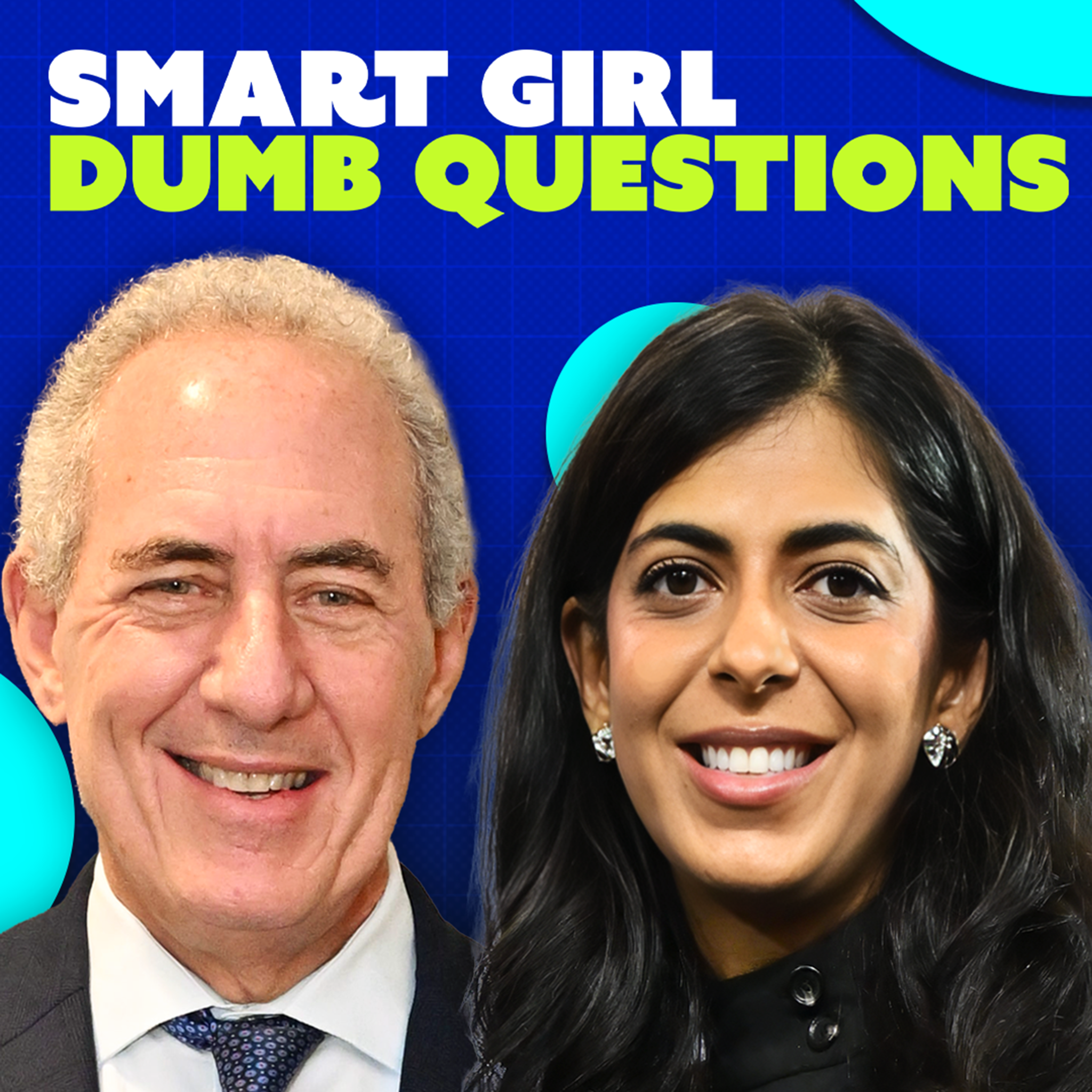
Naima Raza (host) and Andrew Ross Sorkin, journalist (New York Times DealBook; CNBC Squawk Box) and author of Too Big to Fail and 1929. Sorkin’s background includes reporting on business and markets; he also writes about economic history and policy.
1929’s stock surge (up ~90% in 1928–Sept 1929) was fueled by democratized stock trading and heavy lending/margin. The Great Depression followed policy failures (Hoover tariffs, austerity, gold-standard constraints) plus bank runs and leverage. Modern parallels include FOMO amplified by social media, inequality, and “story stocks” valued beyond fundamentals.
John Raskob (Empire State Building; credit expansion; proposed 5-day work week), Elon Musk’s “AI and robotics eliminate poverty” remarks, SPACs (blank-check failures), and “semi-liquid” private-asset products that can gate withdrawals.
0:00Want to be the one who's always in the know about the game, the scores, the plays? Here's a tip. The Apple Sports app. Just pick your favorite teams and get automatic live updates without even knowing their schedules. And when your team scores, it shows up right on your iPhone lock screen, making it easy to check in anytime. So rule the group chat and download Apple Sports for free on the App Store or find it on your new iPhone.
0:23Andrew Ross Sorkin: Sierra has all the best active and outdoor brands for the super athletic stuff, like running gear for cruising up the trail. Woo! And the super-athlet-ish stuff, like fishing gear for chilling by the creek. Nice cast. Fitness apparel to push for higher reps. You got this! And golf balls priced so you can afford to lose one. Or a few. Head to Sierra or Sierra.com for the brands you want at the prices that let you do it all. From athletic to athletic-ish, Sierra's got it. Hi, guys. It's Naima. And this week, I'm sharing one of my favorite Smart Girl Dumb Questions episodes with Andrew Ross Sorkin.
1:00We talked about the economy, why it feels so terrible these days, and whether we're headed for some kind of Great Recession or Great Depression. We taped it back in January, but it felt relevant now more than ever, especially with these elections ahead. So I hope you'll enjoy it. I hope that I'll see you next week for an all-new Smart Girl Dumb Questions. And I hope that if you're in the United States of America and you can vote, that you do vote. Is it actually painful for you when you're writing? Totally. Yeah. Is it more or less painful than your very bougie dentist office that has a massage chair.
1:30Before we started taping, Andrew Ross Sorkin disclaimed that he lives a fancy life.
1:34Andrew Ross Sorkin: I have the greatest dentist. When you go there, I'm going to get in trouble for saying this. I mean, people are just going to be lambasted. You lie on a massage table and they clean your teeth while you're lying there. But I'm going to make it crazy. Are you ready? What do they do? Shampoo your hair? If you want, for an extra fee. Is there a happy ending? I'm just kidding. No, but close. What is it? They will massage your feet. No. No joke. You let a dentist who touches people's feet touch your teeth? Different person. One person cleans your teeth. The other person massages your feet. and because you're focused on your feet, you don't focus on them doing all the crazy things in your mouth.
2:25Andrew Ross Sorkin: It's unbelievable. Andrew. I don't know. I feel like this is something that - I've just lost all credibility. You were so disarmed by the podcast name. See, it worked. You just revealed your deepest secret. I just gave it to you right there. That's it. Right there. Andrew Ross Sorkin of Dealbook fame. Smart girl. Dumb Questions. Is 2026 going to be a year of a market crash? I'm Naima Raza. This is Smart Girl Dumb Questions. And today my guest is the prolific journalist, Andrew Ross Sorkin of New York Times Dealbook and CNBC Squawk Box fame. Andrew, thank you so much for being here. Thank you for having me.
3:05It's so prolific that you've given us TV shows like Billions or the book Too Big to Fail, which was made into a film. And this book, now a New York Times bestseller, 1929.
3:15Andrew Ross Sorkin: Thanks. It's great. It's actually a great book. I hate having - It's actually a great book. It's actually a great book. I'll take it. By the way, I hate having people on book tour, but I really enjoy this book. Thank you. So for people who are like, what the hell happened in 1929? Yeah. Give us the headline, the deck, maybe the lead. Okay. Backstory is 1920s, probably the craziest decade of the last, frankly, several hundred years. I would actually say the modern America that you live in today is largely a function of the 1920s. Automobiles come of age. By the way, Charles Lindbergh planes are coming of age.
3:52Andrew Ross Sorkin: Radio is coming of age. So there's sort of this excitement about technology. All the buildings you see in New York City were built in the 1920s. Chrysler Building, Empire State Building. The Waldorf Astoria actually moved to Park Avenue. 230 Park Avenue, if you ever drive through that building, You know when you're driving towards Grand Central, like literally physically through a building? Right. Oh, that little – Yep. 1929 as well. So it all happened then. And layer on top of that, the idea this was the first time that ordinary Americans could trade stocks for real. The democratization of the market.
4:29Andrew Ross Sorkin: And they could bet on all of this in large part because Wall Street decided we're going to lend people money so that they can buy into this dream. and that is really the story of sort of the roaring 20s and what happens the stock market between 1928 and september 1929 goes up 90 percent and if you know and there were days like year on year where it was up 100 oh yeah it was wild i mean it was completely sort of this wild period of time and it was extraordinary and then of course people were so overextended the valuations were so high there was all sorts of political debates about whether things had gotten completely out of control.
5:09Andrew Ross Sorkin: And invariably, as things do, what goes up must come down. October 1929, it does. It does. And then it propels us into the Great Depression. It does. But that's the other big thing for me that was a surprise in a way. I think a lot of people think like there was some terrible day in October of 1929, and then somehow the Great Depression happened. It wasn't really like that. It was that October happened, and it sucked all the confidence out of the system. And then that was really just the first domino of a series of dominoes, mostly policy choices in Washington by President Hoover and the Federal Reserve and others, including tariffs, by the way, in 1930, that then walk us into 25 % unemployment, 9 ,000 banks going out of business in 1932, 1933.
5:56And then a multi-year process to get out of it with the New Deal and a world war. Okay, so I have listened to you on other interviews because you are on book tour, which means that you are in the market right now. This is true. You're a bit cute about it, Andrew, because you don't ever want to say whether we are, in fact, in 1929. Right. Oh. You never want to say if we're just -
6:21Andrew Ross Sorkin: Well, I'll actually go for you. Oh, yes. No, because I don't actually think - Because we're massaging your feet. Because you're massaging my feet. I don't think we're in 1929. I don't think it's preordained that we have to have a crash that sort of leads to something that's as cataclysmic as the Great Depression. But I probably think we're at least, it's more like we're in the 90s. Maybe we're in like 1996 or 97. And in 98 or 99 or 2000, there's a crash. The question is, does it have to be cataclysmic like 29 or 2008? And I don't think we know the answer yet. Okay. And I'm actually hoping that it won't be that bad.
7:02I have one wild card in my head that could change all of this and make it worse than
7:08Andrew Ross Sorkin: all of those things. Okay. Let's keep that as a cliffhanger for people to keep hanging. But I don't know. Okay. Okay. We're going to get to your wild card. I have to remember to ask you that. There's so much I want to talk to you about, about what analogies we can bring from 1929 into the late 2020s. I want to talk about the state of journalism, which was under kind of rethinking in the years of this book. and also certainly is now. But by the way, all the journalists were on the payroll back then too. I know, that was so wild. Right? And at some point I have to ask you, what was going through your mind when Alex Karp was gyrating on stage next to you at the Dealbook Summit recently?
7:40But let me start -
7:41Andrew Ross Sorkin: We can talk about that too. Someone did an AI thing where they had him like doing pushups on the - Yeah, did you, I was gonna ask you if you saw that. And I actually thought that was real. When I first saw it, I'm like, wow, he is so fit. I really have to go to yoga more. I wouldn't have been surprised if he had done that, but that was not real. He was doing handstand push-ups. Handstands on the chair. Sora is amazing. Sora is amazing. Would you have challenged him to a duel? No, I just would have started counting. Yeah, that's the right thing to do there. So as you mentioned, the 1920s, where this book kicks off, it is like the Roaring Twenties.
8:15There are towers to the sky. There's lots of champagne flowing, even though it's the Prohibition, which is like a wild aspect of this time. and it feels like a roaring 20s moment right now in America in a weird way in a certain part of
8:32Andrew Ross Sorkin: the country in a certain part of America I was gonna say I think it's like by the way but that was actually very much like the 1920s too yeah it was only a certain part of America it was New York and some of the big cities that were feeling this sort of hop in their step next to people who are really struggling totally and this feels like right now or maybe this has always been the thing I don't know, but it now feels like - No, I think the inequality issue was, if you just look on the ratios of inequality, 1920s are very much like now. Really? Yes, because look, there was a period of time called in the 50s, 60s, and 70s where the inequality happily was compressed.
9:08Right.
9:09Andrew Ross Sorkin: And some people look back and say that was the ultimate American dream. But then unemployment at that time was like 2.53%, right? So the lowest unemployment we ever had was I believe 1954 and was 2.5%. It was really the advent of unions. But look, part of it was the United States was a monopoly power. Everybody else was out of business around the world. And so you could charge monopoly rents. And then when you go back and look, and really wasn't to the 19, wages start to stagnate in the 1980s, which I think if you go back and look, is tied almost directly to the fact that the rest of the world all of a sudden started to compete with the United States again.
9:48Andrew Ross Sorkin: Right. And so I sometimes wonder whether the sort of 1950s, 1960s American dream, which was sort of a leave it to beaver, you know, a dream which was, you know, if you know. Yeah. Wait, what is I don't know what leave it to beaver has any. Sorry, I didn't grow up in the US. I have no idea about this. The Leave it to Beaver version of the American dream was sort of a paint by numbers situation. If you go to school and you do okay, you're going to get a job and you're going to get a house with a picket fence and you're going to get a wife or a husband and two kids and a dog. And it was all going to be just fine.
10:26Andrew Ross Sorkin: By the way, some people would say that was a very white dream, by the way, back in the day. But all I'm saying is it's possible that that period of time is actually a historical aberration, not the norm. But these days, like in our roaring 20s, it seems like instead of like towers to the sky, we have rockets to Mars. Instead of flapper dresses, we have, you know, balloon trousers. I'm sure you're very aware of the fashion trends. I don't know about balloon trousers. Balloon pants. I'm not wearing. Are you wearing balloon trousers? I was wearing them for the last interview. I'll show you after.
10:56Andrew Ross Sorkin: Can men wear balloon trousers? Yeah, for sure. Really? Yeah. Who makes them? I mean, all kinds of people. There's a really good, there's one company called Fried Rice that has a store in Seattle. Fried Rice is in there? They make like cool printed. Okay. Yeah, it's very trendy. I got something to do after this. Yeah, next time you go see that fancy dentist, you're gonna have like little ankles showing for your foot guy. Yeah. Okay. This is gonna be like a running joke throughout the show now. No, we're gonna let it go. We're gonna let it go. I see how this is gonna go. But I was reminded reading your book of these polls that the Wall Street Journal does with NORC or whatever.
11:26They ask people, what values are, quote, very important to you? Have you seen this in the latest one they did in 2023?
11:34Andrew Ross Sorkin: I don't think I did. I'm going to show it to you. I'm pulling up a chart and people will see it if they're watching on YouTube or whatever. Okay, this is now smart girl, smart questions. So I don't know what to do here. So between 1998 to 2023, patriotism and religion fall from about 60%, a little above 60 % to 40%. Having kids goes from being very important 60 % of people down to 20 % of people in 2023. Community involvement goes up and then right after the pandemic, it just drops down. So it goes from 40 to 60 to 20, kind of, or 30-ish. And then one thing goes up. Money. Money. Money. It goes from 30 % of people to 50 % people saying it's very important between in 1998 and 2023.
12:20And I just feel like having spent eight years in the 1920s, do you think this would be similar?
12:32Andrew Ross Sorkin: Clearly the money side, yes. Community involvement, not necessarily. Yeah, I thought it was so interesting. The characters in your book, a lot of them are like, one of the lines was he wanted to give his wife the life she felt she deserved or something. No, so that's what I was going to say. And religion, look, John Raskob, you mentioned spaceships and some of these buildings going up. John Raskob built the Empire State Building. He was the Elon, I think of him as Elon Musk, very much of the 20s. But he was a devoted Catholic. So I don't think that he would sit here on the religion end and say, not important.
13:09Andrew Ross Sorkin: I think the money thing is clear. And I think part of it, look, the human sort of element of this is sort of a FOMO. They didn't call it FOMO in the 1920s, but that's what it was. It was you see your neighbor doing better than you're doing, and you're like, I'm a little jealous and envious of that, and I want that. And all of a sudden, this lottery ticket was available to people, and they thought, this is my way out. This is what I'm doing. As someone who deals with money all the time, who's covering through deal books, swap box, you hobnob with billionaires. I don't know about that, but sure.
13:42Andrew Ross Sorkin: Do you not? Not really. But you have billionaire friends. Do I have billionaire friends? I don't know if I have a – I don't think – I have billionaire friends. Do you? Yeah, you don't have billionaire friends? Most of my friends are from high school, and a couple of them are doing well, but I don't think we're there yet. Your book party had a lot of rich people. Yes. Yes. Yes, that's true. Friendly. Yeah. In the milieu. In the milieu. Do you think that money has become our new God in the 2020s? So I think there's two things going on. So I think money on one end has become just a necessity to keep up.
14:26Andrew Ross Sorkin: And I think this gets to the whole sort of affordability crisis that people feel. And given that inflation is so high and wages haven't kept up, people just need actual money. Like money, there is an element of money makes the world go around. You need it. But I also think, I wonder whether it's a social function of social media. The sort of FOMO, YOLO, everybody can see everybody and also see what you can't have. I think that makes money even more. Makes you more thirsty for it. Makes people more thirsty for it. Because I think a lot of people, this is now pre-social media. Tell us about the old days.
15:11Andrew Ross Sorkin: No, I was going to say, I think a lot of people didn't see it. It wasn't as visible. If you were walking down the streets of New York City, you didn't see what was going on inside the homes of these people and how fancy it really was or how ornate it was. You weren't staying at some ornate, fancy hotel, so you didn't know what that looked like, right? And you didn't even have access to the same schools that some of these people had. You couldn't stay and go. You didn't see it. There were gates also. There were gates. You just didn't see it. And now you pick up TikTok and you can tour all of these things and it's constantly in your face.
15:46Andrew Ross Sorkin: And so I think it creates both a FOMO and a resentment. Yeah. I want to play this clip. You mentioned Elon Musk. Okay. This is a clip with him. He's much more chill than he was when he was on stage with you in 2023 at DealBook. Okay. Just low bar. But this is him speaking at the Saudi American Investment Forum that recently happened. But AI and humanoid robots will actually eliminate poverty. And Tesla won't be the only one that makes them. I think Tesla will pioneer this, but there will be many other companies that make humanoid robots. But there is only basically one way to make everyone wealthy, and that is AI and robotics.
16:23Andrew Ross Sorkin: Say, like, in the long term, where will things end up? Long term, I don't know what long term is. Maybe it's 10, 20 years, something like that. For me, that's long term. My prediction is that work will be optional. Optional. Optional.
16:40So... Because that's crazy.
16:42Andrew Ross Sorkin: Right. Then he goes on to say about money. I always recommend people read yin banks' culture books to get a sense for what a probable, positive AI future is like. And interestingly, in those books, money is no longer... doesn't exist. It's kind of interesting. And my guess is if you go out long enough, assuming there's a continued improvement in AI and robotics, which seems likely, the money will stop being relevant at some point in the future. What do you think of that? I mean, I'm not smart enough. No, come on. Here's my concern. I do imagine that AI is going to change our world, and I imagine robotics will change our world.
17:31Andrew Ross Sorkin: I don't know if that's going to happen in 10 or 20 years. But the thing I would – that I'd worry more about is I imagine the spoils of all of this, going to this idea that nobody's going to need money, is going to accrue to the shareholders and owners of the AI and robotic companies. Unless you genuinely believe that all of it's going to get redistributed through some kind of universal basic income or something else that I don't know about. And most of those people that, whether it's Jensen or Elon, I think are capitalists. I don't think that they're going to be parting with the cash so quickly and saying, hey, we're just going to give it to everybody.
18:14Andrew Ross Sorkin: I'm not sure how that piece of it would work. I would love to talk to him more about that. I think he talks about the term universal high income. And I think Elon is certainly a capitalist, but also probably believes in some kind of, like I always say about Elon, it's like someone who cares deeply about humanity gives no fucks about humans. Yeah, that sounds about right. By the way, I was going to say, prior to the success of ChatGPT, Sam Altman used to talk all the time about UBI. And he did that pilot in Oakland, right? He was doing that. Maybe we're all living in some kind of UBI utopia, but I just don't know what that ultimately feels like or looks like.
18:57Andrew Ross Sorkin: And I do think that Elon has, in terms of his timelines, have always been aggressive, let's just say. Did his 1920s corollary suffer from that too? John Raskob. No, John Raskob was like Elon only in a different way. John Raskob, so famously, he's the one who actually changed the culture of America, actually, around credit and debt. So he was working at General Motors, running General Motors, and he decided, how are we going to sell more cars in America? We're going to loan people money so they can buy cars. Prior to that, it was like a moral sin to take a loan. People didn't even like to get a mortgage back then.
19:36Andrew Ross Sorkin: Right. And once they started buying cars from General Motors with a loan, then Sears Roebuck clocks what's going on. They say, we're going to do this. And then Wall Street says, okay, well, now we can do this too. And it really did change the whole psyche of taking on credit. So that was sort of his first invention. He then becomes an extraordinary investor, makes a small fortune, is then inventing the idea of the equivalent of maybe one of the first mutual funds that ever existed in the financial space. He then, by the way, like Elon, decides, ah, I'm going to get into politics and supports. He loses.
20:13Andrew Ross Sorkin: He's on the wrong side. He ends up losing to Hoover. He supported Al Smith for president, but then decides to spend basically all of his money for years trying to undermine the reputation of President Hoover, secretly by the paying journalists and creating all sorts of secret schemes. Then he builds the Empire State Building, and he was like a philosopher king in that every journalist in America would come talk to him. And finally, he comes up, and I don't think he gets enough credit for this. we now have a five-day work week. He wrote a paper in 1929 that we should have, back then people worked six days a week.
20:50Andrew Ross Sorkin: The stock market was actually open on Saturdays. Everyone worked on Saturdays. And he had this idea that we should not work on Saturdays, not because he wanted to be nice to people, but because he thought that actually would create a bigger consumer economy. If you had the weekend, more people would buy cars because they could go places. They'd buy gardening equipment. They would do different outfits to go to different events. Oh, interesting. And the other thing that's fascinating is this is the time, the 1920s, or the time where I will say celebrities become uglier, which is to say they stop being just athletes.
21:19Or I should say, that's not kind. Celebrities become less good looking. They stop being actors and athletes and Hollywood starlets.
21:26Andrew Ross Sorkin: It's not all the beautiful people on the covers of magazines. It's now. The deal book crowd. It's the business folk. The business folk. No, it was true. This is when financiers, for the first time, are on the cover of magazines and newspapers. And they became their own version of a celebrity. It wasn't Babe Ruth anymore. It wasn't some beautiful actress. And people cared what they thought about everything, like the way we do now. Oh, yeah. We care about what Elon thinks about everything. Right. We all care about what Elon thinks about now. And you know what Sam Altman thinks. And all the people are – Jamie Dimon, they're on the cover of these magazines.
22:00Andrew Ross Sorkin: That really started in the 20s. So Forbes magazine starts in 1917. Time magazine starts in 1923. The New Yorker starts just a little bit later than that. Yeah, and the New York Times have been around for a while at this point. How much of that creation is just money doing money's thing versus media doing media's thing? Oh, that's a great question. You know, I think it's probably like everything in life, a combination of both. clearly the business community realizes that they need to reach people. So they want to take advantage of the medium. And to the degree you think that media and journalism are trying to reflect what people are interested in.
22:49Yeah, that was a shiny object.
22:51Andrew Ross Sorkin: That was a new shiny toy. Yeah. No joke. But one of the billionaires who we're so fascinated by, Mark Cuban, is somebody who's like a capitalist who is a proponent of universal basic income for caregivers, which I think is actually like a great agenda for the Republican Party to try to seize and implement right now. What I was shocked by is that when you have Doge and people like David Sachs and all these people from the AI world who've been immersed in some of the thinking about UBI have such an agenda in Washington, there didn't seem to be any forward movement on that kind of social safety net at all.
23:29for this massive technological shift.
23:31Andrew Ross Sorkin: I do hope that if we all don't have jobs, the class or the jobs that we have today, that ultimately we are our caregivers to each other. Like that would be what you'd hope for. And then we would, as a society, pay out in whatever form, barter or whatever it is. That's what you'd want. So this crash that happens, that sparked in 1929, but actually takes a long time to go on. You talk about in your book as the collapse was not a moment, but a relentless unraveling. Yeah. relentless. Can the cause of it be pinpointed, even if the timeline of it isn't pinpointed? Well, so I can identify the cause, but the cause is the confluence of four, five, or six different things, the crash being sort of the first component part of it.
24:20Andrew Ross Sorkin: So you have the sort of confidence sucked out of the system with a bunch of people who've now lost their homes or mortgaged their houses or out of work. But that's still a relatively small group of people. Interestingly, the stock market by the end of 1929 that year is only down 17%. I know. That was wild. But that was like a head fake for the President of the United States and for everybody else who looked at the market as some kind of barometer of how things were going. Because what it missed was you could look at it and go, oh, things are okay. Except that all of the people who had bought on margin and taking out these massive loans, they weren't able to get back to the 7 % even to the 17 % because they'd already had to sell their homes to pay for the losses when the stock market went down 50%.
25:07Andrew Ross Sorkin: The bank didn't say, you can just hold on to that until it comes back up again. They said, you can't afford to do any of this anymore because you owe 10 times that. So the leverage is a huge cost. It was the leverage that was a huge cost. So that's the first sort of piece of it. then you get into the 1930s and hoover had promised farmers who he had tried to get to vote for him back in 1928 that he was going to implement tariffs that was his whole thing this whole thing was like hey guys you vote for me i will help you i'm going to put tariffs on the table by the way every economist like today goes to washington begs the man says please don't do this you're going to just destroy things every economist or every capitalist everybody everybody everybody economists the bankers yeah i had diaries of these folks literally they're talking about how they're on their knees begging this man do not do this of course trade drops by 60 a year later yeah okay so that's a huge cause so that's to throw that into the mix then you have a separate situation going on where he's by the way deciding to raise taxes he's also interestingly uh trying to jawbone this is interesting sort of trying to jawbone folks into believing that the economy is better than it actually is.
26:21Andrew Ross Sorkin: It's sort of very, by the way, it's very Trumpian and even very Biden-like in that, you know, people feel what they feel, they see what they see, and yet you have people out there telling you that it's not that way. But that seems like, I mean, I had Paul Krugman on and we did this whole episode on, are we counting the economy wrong? Because it feels like that all the time. Like these indicators are not useful indicators for my own experience of life. And I feel lied to by government, right which doesn't help trust so he was an optimist seller totally so you have this optimism seller on one end by the way the tariffs are not helping the farmers so now the farmers are having their own problems that's by the way hitting some of the smaller banks as right because of the farm debt because of farm debt so now they're having their own problems the federal reserve is sitting around on their hands thinking well we can't really do anything about this when the truth is the lesson that we learned, we learned it actually in 2008, though I think Ben Bernanke actually learned it because he did his PhD thesis at Princeton on the Great Depression, is when you have a problem like this, you have to throw money at the problem.
27:25Andrew Ross Sorkin: The US did the opposite. They went into sort of austerity mode. Yeah, they need to go into pandemic mode where they were writing checks. Writing checks. Now, the other big debate that was happening during this period, though, was it wasn't clear the Fed technically could print money the way they do today, because back then we were still on the gold standard. So every dollar that we printed needed to be connected to gold. And there was a big debate, could we get off the gold standard? But nobody really wanted to do that. And then there were other things that didn't happen either, which was you could tell that the banks were gonna start to struggle.
27:59Andrew Ross Sorkin: You had these bank runs happening. And the right answer probably was to implement something like the FDIC, something where you could insure deposits. But nobody wanted to, Hoover didn't wanna do it, By the way, Roosevelt didn't want to do it. They all thought there was a terrible idea because they thought it was going to create a moral hazard because there would be no differentiation between a bank that took on crazy risk and was mismanaged entirely and some bank that was doing all the right things because the government, the taxpayer, was ultimately going to bail you out. Do you think that's true?
28:34I mean, we've seen these bailouts of banks that have done that. I mean, I know like Silicon Valley Bank, they wiped out the equity.
28:40Andrew Ross Sorkin: I think the answer is that it has ultimately been to the benefit of the country for us to have some safety net. It's not a safety net, by the way, that protects every account in its entirety. But for the average American that has whatever savings they have, a good part of it, if not all of it, is protected. Okay. I want to take a creative out of here because I have so many questions about this FDIC thing. So$250 ,000 is protected, right? Now. Back then, I think it was$10 ,000. Okay. It was so little. Yeah. But if you have like$251 ,000, should you keep$1 ,000 in a different bank or under your mattress?
29:18Doesn't the bank – don't they actually really insure it beyond the$250 ,000? Haven't they actually bailed out banks that protect it more?
29:27Andrew Ross Sorkin: Yeah, it depends where your bank is though. I mean if you were – I live in New York City, so there's only sort of the big five banks in the country that are here now. Yeah, if I lived in a little town with a small bank that could maybe go out of business at some point, yeah, they wouldn't be protected. And they'd be too small to fail. Right. So people would let them fail. So they would protect your$250 ,000, but they wouldn't protect the rest. It's interesting. I imagine if you have more than$250 ,000 at J.P. Morgan or Bank of America, I think those banks at this point are too big to fail. And those banks will be protected likely by the government in some way.
30:11This is not financial advice to anyone less than I could. It is not financial advice.
30:14Andrew Ross Sorkin: If there's like a little disclaimer thing. Yes, let's do that. And that could be totally wrong about this. So get out your salt shaker. Okay. So there's so much going on here that seems very similar to the 2020s, right? in terms of tariffs, in terms of leverage and financial innovations. We have crypto. It's great innovation. All the things. All the things. All the things. The poor banking structure. And also what feels a little bit in your pages as this kind of like castrated government. Like there is a group of people in the Fed sitting around and doing things. But the real things happen at these like Park Avenue homes where the financier of the day is like calling in people and running in the world.
30:52It's like these amazing rooms where it happened. But like this idea that the market always goes up, it's like, yeah, but it's incentivized to always go up. And we're incentivized to always find financial innovation, leverage, democratization, other ways of new instruments to keep this market going up. Like how do we know the value of the actual things in the market?
31:14Andrew Ross Sorkin: Oh, so I'm not – okay. Look, if you buy a – let's do something very basic. You buy a farm. Okay, yes. You know me so well, yeah. You buy a farm. Yes. And at least over the years, let's say you had some cows on your farm. Yeah, I'm not going to make you do like a discounted cash flow of my future farm earnings for our audience. But isn't it like now stocks are a little bit more like art? Like the value is in the eye of the beholder. I think there's certain stocks that are in the eye of the beholder. And particularly in like private markets, like venture capital. Oh, goodness. So, yes. So, right now, look, there's a public market, the stock market, which ostensibly should have some kind of price discovery because a lot of people should be buying and selling these things and hopefully there's some relevance to what's happening in reality.
32:15Andrew Ross Sorkin: In the private markets, whether it's venture capital or private equity or private credit, people aren't buying and selling every day. And so the people who are deciding what something is worth on any given day, any given moment, are the people who own it. There is a marked to make-believe situation that is happening in America right now. No question. And then the question is, does that come undone? Or some people would say that it's a feature, not a bug, that these things can be held for a very, very long time at these marked to make-believe prices until they almost grow into them. Or like they get taken private again, then they come back on public.
32:51But just to give an example, like Rent the Runway.
32:54Andrew Ross Sorkin: Yes. Or, you know, some of these companies that came up as quote unquote tech companies and got venture capital and, you know, love the company, no shade on the company. But like its market capitalization today is far lower than equity it raised. I don't even know. Like it might be that the founders, I don't know either way, but it might be that the founders walked away with money off the table that is more than the current. Yeah, there's a lot of what I call a story stock. A story stock is a company that has a great story that people want to buy into. They want to believe the dream. And by the way, like every major AI company right now is a story stock, private or public, doesn't matter.
33:32Andrew Ross Sorkin: It's a story stock. People are believing something. You have to believe that these companies in 2028 or 2030, you know, for open AI stock or the valuation for open AI. Which is how much right now? Oh, goodness. It's on its way potentially to a trillion dollars. We'll see. But their plan is to be profitable by 2030. And on their plan, they would be losing$75 billion a year in 2028. So you have to basically have a swing, a$75 billion a year swing to profitability in the course of two years to get there. Yeah. That requires a lot of faith. And then there's a huge amount of real estate and other rush coming up under it, like the AI infrastructure plans of America.
34:24All of the commitments. Oracle, all these companies, CloudWeed, they've all just, I think, suffered a sell-off this week even. Yeah, because everybody who said, who's going to...
34:32Andrew Ross Sorkin: Because OpenAI and Anthropic and every other big hyperscaler is going to have to pay the folks who are building the data centers money to do this. And the question is, will they have the money to actually do all of this? And that's a real question. Do you have an answer to the question? I don't think we really know yet. I think it, look, here's the, so what they're looking at, just so it doesn't seem totally absurd, is they're looking at their own growth rate right now. Right, of course. And they're going, amazing. Yeah. And they're going, oh my goodness, things are going up by five, 10 X a year.
35:07Yeah. And so if we stay at five or 10 X a year, we're in the money. It's not even a hockey stick. It's just a line at some point. But if it doesn't, and that's what we don't know. We don't know. So I want to do a quick lightning round where we walk through the other financial crises that have happened in recent years. And I want three things from you. Okay. What caused it, what we learned from it, and what we failed to learn from it.
35:31Andrew Ross Sorkin: Okay. Okay? So 2000 - These are smart questions. Don't - The name of the show is just so wrong. Okay. I'm sorry. 2000 to 2001, the dot-com crash. What caused it was just severe overvaluation and a realization more than anything else that there was a problem. That problem was identified in part by some of the telecom companies, fiber in the ground and things. Because by the way, those guys couldn't pay for what they're doing. So there's a little bit of leverage in there, but not the kind of leverage that ultimately 2008 or 1929 spawned. Okay, so unrealistic valuation more than leverage. More so.
36:13What did we learn?
36:14Andrew Ross Sorkin: But leverage is a piece of it. Yeah. I think we learned that you got to be careful about the dream. You got to be careful about the dream. Pets.com was a dream. But by the way, the thing that's so crazy and why this is so hard to predict about is you go look at Amazon. I remember covering Amazon back then and there were headlines that would say Amazon.com or amazon.bomb because this was a company that did con con i didn't hear that correctly yeah because people didn't believe it was it didn't make money the company didn't make money i mean you could some people would say that that company i don't want to say it was like open ai because open ai had to continue to raise new money constantly amazon wasn't raising money continually but nobody ever really seen a company that just didn't really make money and yet was valued as highly as it was, they had not created AWS yet.
37:09Andrew Ross Sorkin: And so, you know, you see that on one end and you see pets.com on the other. And you go, okay, who are you going to believe in? And how do you know? It's hard to know. So what did we not learn from that crisis that we should have learned? Well, the other thing that happened during that period, though, is we also realized there were some things that were taking place in the financial machine of it all. This goes to sort of the Wall Street piece. you know back then analysts were writing these fluffy reports about the companies and were getting paid for the reports because they were doing the ipos i mean this goes there's sort of there was a bit of a financial chicanery situation going on this is anytime the markets get sort of super hot wall street oftentimes does things that they should not be doing so they're selling their own future financial block basically a little bit yeah i mean this is you know back in the day henry Blodgett.
38:02Andrew Ross Sorkin: This is what Henry Blodgett got in trouble for. He was working at Merrill Lynch, and he was an analyst, and he was writing these reports. And he was telling people that certain stocks were better than they probably were, in part because he knew that - He'd be doing the transaction. That Merrill Lynch was going to be doing the IPO, and they were getting bonuses based on how many IPOs they were getting. And so some of those things I think we did learn from. So some shenanigans. But you always need to be watching for the shenanigans on one end. Right. Okay. Okay. So then the global financial crisis to 2008.
38:33I'm going to skip over the Asian financial crisis and the Russian and all that.
38:35Andrew Ross Sorkin: Way over leveraged. Yeah. This goes maybe to the American dream. We totally doubled down on housing. We all believed that everybody should get a house. Then we did policy things that sort of made it – created crazy incentives for banks to provide loans that they shouldn't have been providing. Maybe the truth is also that we blame everybody else. the American public took on loans that they shouldn't have taken on either. There was like a moral hazard. There was a serious moral hazard. And then, you know, most of the banks sort of started to have FOMO about each other and started to just sort of got wild and out of control.
39:14Okay. What did we learn and what did we not learn?
39:17Andrew Ross Sorkin: We learned that you need to have much higher capital requirements and you need to really be minding the store and that you need to change the incentive structure for all of these things and i think actually largely in the aftermath of of that period we we did that yeah wouldn't we not learn yeah
39:39well i think there's a real question about the people who were involved in it for the most part
39:46Andrew Ross Sorkin: many of them still have their jobs and so did they learn something from this no accountability was there accountability yeah and look i would argue it's almost a political issue the bailouts in fact what ben bernanke did and what the government did i would argue is actually a very good thing from an economic perspective it was the right thing to do some people don't believe that it pisses people off a lot like but i believe what happened in 2008 in some ways led to a complete shift in America around their thinking about experts, expertise. For sure. Some people will tell you that there's a direct line between 2008 and the election of Trump in 2016.
40:29Yeah. I think that's not, I mean, I would kind of concur probably. There's a lot of distrust in the system.
40:36Andrew Ross Sorkin: A lot of distrust. Yeah, a lot of distrust. I think actually a lot of distrust, I mean, by the way, we had a whole second set of distrust during the pandemic. But I think a lot of distrust started after 2008. 100%. What about COVID-19, the 2020 recession? That was like kind of a less blamey. It was less blamey. And I'll tell you why it was less blamey. I remember being shocked that pandemic happens and all of a sudden we start bailing out everybody. I mean, PPE loans. We're even bailing them out before. The airlines, everybody gets, it was literally like Oprah with her, you know, you get a car, you get a car, you get everybody, you get a car.
41:13And there was no pushback.
41:16Andrew Ross Sorkin: And I remember being shocked by that because having lived through 2008, I remember all the finger pointing, everybody saying, and in retrospect, I think it was because everybody got a car. Meaning in 2008, part of what was happening was it seemed like the banks were getting the money and the individuals were not, right? Hank Paulson, Ben Bernanke's view was that the most practical, efficient way was we give the money to the banks and then the banks, it eventually will come out. It'll trickle down. It'll trickle down into the system. Yeah. Right? And of course, homeowners and others were saying, well, it's not trickling down to me.
41:50Right. In the pandemic, we just started sending checks to everybody.
41:55Andrew Ross Sorkin: So nobody really had a place to complain. Right. Okay. Yeah. I mean, that's kind of the way that America does accountability. Like I had very tragically a friend who passed away in the Miami Surfside building. um my college roommate and i and you know if you look at yeah it was terrible and um and her brother lost his parents and his sister in that night and i i think about it a lot because you know fast forward there have been these payouts you know like a 10 million person maybe i can't remember what the payout was but like you don't i still like to this day don't really know who's accountable Who did the building code structure change?
42:39Like are homeowners associations under different obligations now to consider? You know, like it is something about the way we do accountability, which is so broken, which is like, yeah, kind of like we pay out reparation. I mean, there's so much of that happening in this book in Europe, et cetera. But like we don't like plug the problem.
42:59Andrew Ross Sorkin: Well, but I will say that it is often true. Interestingly to me, after 929, we didn't have accountability in that, you know, most of these characters did not end up in jail. A couple of them did get arrested and two of them end up in jail, but oddly for other things. But we did actually get some form of accountability in the form of the SEC for the first time. So insider trading all of a sudden is illegal. All that was totally legal back then. I mean, all the manipulation, the shenanigans, there was nothing wrong with it. People didn't even think it was amoral back then. Right. We didn't get into that.
43:38Andrew Ross Sorkin: But then you had Glass-Steagall, which broke up the banks in terms of commercial banks, investment banking, added FDIC insurance. 1940, you get the Bank Act. Now you have capital requirements. So things did happen that changed the game. After the crisis in 2008, and by the way, after 2001, things did happen. And Eliot Spitzer, of all people, is responsible for the fact that so many bankers, the analysts are no longer allowed to do what happened in that period of time. So there were things. Then 2008 comes along. We get Dodd-Frank. We get stress tests. We get all sorts of other legislation. And the truth is that changed how banks loan money and has inspired what is now maybe the scarier part today, which is we have a whole new industry called private credit.
44:31Andrew Ross Sorkin: And so most of the loans pre-2008, if you were a business, you'd go to a big bank. You'd say, give me a loan. Now you don't go to them. You actually go to these private companies that are basically not regulated because Dodd-Frank has nothing to do with them. And they loan you the money. And as a result, we now live in a less transparent world because we're always fighting the prior war and we're missing the next one. It's like failure of the last analogy. When I look at all of these things, I think there is often this financial innovation instrument. There's a Band-Aid put on and there's a new thing that comes along.
45:04Always. And as Winston Churchill is so idealizing in this book, the American -
45:10Andrew Ross Sorkin: Well, he thinks this is a feature, not a bug, 100%. He's like, it's not meant to prevent these crises. It's meant to survive them. And he writes to his English critics, they're dummies. They should be following the American way. What do you think is the financial innovation that we're seeing now? Or what is the leverage or the thing that exists right now in our market that is dangerous? A little cliffhanger. We'll be right back.
46:03Tell 10 of your friends to hate watch it too. Numbers are numbers, people.
46:32Andrew Ross Sorkin: From athletic stuff like a full court pickup game, swish, to athletic stuff like a half mile stroll. Get those steps in. Head to Sierra or Sierra.com for the brands you want at the prices that let you do it all. From athletic to athletic, Sierra's got it. What do you think is the financial innovation that we're seeing now? Or what is the leverage or the thing that exists right now in our market that is dangerous? And this could be your wild card that you alluded to earlier or it could be something else. Let me throw the wild card in a second. So I think there's a whole bunch of new financial products.
47:06Andrew Ross Sorkin: Look, a couple years ago was really the sort of popularization of SPACs, these blank check companies. That was sort of a new product. A lot of people got excited about that. They thought that was like a lottery ticket. And invariably, we didn't have the right guardrails around them. The product, a SPAC could work if you actually incentivize people right, properly. You have the right transparency around who's getting the fees, how much they're getting, why this is working, when they can sell, how they can make projections. But we didn't do any of those things. Yeah. These are specialized purpose acquisition vehicles.
47:41Andrew Ross Sorkin: Basically, they would raise money. They're called a blank check company because you would raise money for a blank check. And then they would go out and buy something. And then you would basically get whatever they bought. Yeah, but the people who led the SPAC were making 20 % up or down. They were taking money out almost irrespective of what was happening. And Trump's true social, that company is also a SPAC. That was an example of it too. Exactly. And most of them, I mean like 90 % of the SPACs basically failed. Are done. Okay. So that's an example of something. What about something that's happening right now?
48:14Andrew Ross Sorkin: So one of the things that's happening right now is after the Genius Act, there's a whole new move to basically make private equity investments and venture capital investments and private credit available to the public. So effectively taking what are private assets, whether it could be a podcast company, it could be a nursing home, it could be a hospital, it could be a apartment building, whatever it is, and making them available so that they're wrapped up like in a fund that then you could buy in the retail market. The difference is most public companies have to disclose what's going on in each company.
48:51Andrew Ross Sorkin: This won't be like that. It'll still be like a private equity fund. So there'll be sort of private assets without the disclosure in the public markets. What's even more complicated about them is a lot of them are described or are called semi-liquid vehicles. Not to get you really confused, but you're so smart asking all these smart girl, smart questions that they're semi-liquid because you can buy them. looks like a stock. You can buy it on any day. But if too many people decide to sell it at the same time, the fund can say, excuse me, we're not allowing you to sell the stock today. They can force you to hold.
49:30Andrew Ross Sorkin: They can force you to hold. They can put up the gates. They can put up gates because the only way they can actually send you cash when you sell you is either they actually have to sell down the assets they have, which are hard assets, which they can't typically do, or more people have to give them money. And some people would say that it looks like a Ponzi scheme, if you will. So, and that's going to be a new product. And that's like the next big thing. And I'm sure that some will work and some won't work. And at some point in life, some regulator will say, you know what? These products are not bad products, but they just have to be done slightly differently.
50:07Is there anything that is like feels risky now, but is going to be completely normal in 20 years? Like the way leverage buyouts. I think those will actually
50:15Andrew Ross Sorkin: be. I think everybody will have a piece of those. I just think the difference is if you're, the problem with those instruments is if they tell you that you can't get your money back and you're retiring and you need the money, that's no good. It may be that the right approach to those kinds of instruments is to say, you know what, they're part of like a target dated investment fund and based on your retirement age. And for the last 10 years of the fund, you can't be in those because you can't get your money out. Something like that. But let me throw one major wild card into this whole scenario, which is if in fact we have some kind of crash crisis or something else, the lesson that we keep getting taught is we need to throw money at the problem.
51:01Andrew Ross Sorkin: The government needs to throw money at the problem. The Federal Reserve needs to throw money at the problem. And so far that has seemed to work out just fine. back in 1929 when you would have wanted to do this we had a budget surplus in this country okay we now have so much debt yeah meaning i'm talking about sovereign debt forget about the corporate debt we now have so much the u.s government has so much sovereign debt that i wonder whether there's some red line that at some point there's a crisis we say you know what we're going to write a check for a trillion,$2 trillion to this or whatever it is.
51:39Andrew Ross Sorkin: And at some point, the investor class that buys treasuries, that buys bonds says, excuse me, I see what you're doing. We like you people. We're very happy to continue loaning you money, but you're going to have to pay us a lot more for the risk that we're taking. And if the interest rate starts to really fly, all of a sudden you can get into a vicious cycle where you can really get into an austerity situation, like for a whole country. So that's the thing. That is the wild card. And I just don't know when you hit that red line. I always thought we would hit that line a long time ago. And it may just be that the world is relative and that people say, well, the US is still better.
52:23Andrew Ross Sorkin: It's doing better than Europe. That's a big variable between 1929 and 2026, which is like, it's not a monopoly by America anymore. It's a kind of, you have this multipolar world order that's emerging. You have real champions potentially out of, you know, AI coming out of, you have resource constraints that are not relying on America. That's the piece of this puzzle that I think is like the true unknown unknown. So you think that's scarier than like an AI bubble? Are we in an AI bubble? We're probably in an AI bubble and the AI bubble probably will pop, but that doesn't mean that AI will not be with us 20 years from now.
52:59Andrew Ross Sorkin: Like the internet bubble popped and the internet's even more important than it is today. So the flip side of AI, which maybe goes back to your tape with Elon Musk is there's the AI bubble and what happens if it fails. There's also the like, what happens in success? Oh yeah, you've been reading the culture box. Right? Yeah. Because in success, you know, if we don't, we're not needed, then what? So that's why that one may be more of a double-edged sword than I fully appreciate. You do. What about crypto? How risky is crypto? I mean, look, what I don't know is Bitcoin has held up all of this time.
53:38Andrew Ross Sorkin: I always, you know, Warren Buffett and Charlie Munger used to call it rat poison.
53:45Andrew Ross Sorkin: It is a belief system. It is. There is a, you know, the cynics or the naysayers would tell you that, you know, you get quantum computing going and all of a sudden the encryption that makes Bitcoin work can be broken, can be hacked or something happens. And then what happens to that money? Having said that, it's still a small piece of the puzzle. It's only a couple trillion dollars. So it's not that the whole economy comes undone, but I think if the air really came out of that part of the world, it would also invariably come out of other parts too. Your last book, Too Big to Fail. Yep. So the banks were too big to fail.
54:26They were. The big banks were too big to fail. What is the modern entity that is too big to fail? Whether it's a singular AI company, whether it's a stable coin, whether it's a specific type of fund or the idea of a poor country?
54:39Andrew Ross Sorkin: I think some of the banks are still too big to fail. Back then, the phrase was only used in the context of financial institutions. Now we talk about cities, municipalities, states, countries, too big to fail. I do think that maybe cloud computing, oddly enough, has become too big to fail. So the last time that there was an AWS outage or something where the whole world for three or four hours has stopped, those companies largely are now too big to fail. If they were to fail, we would have – they're like electricity. And is that a good use of taxpayer money to bail out the too big to fails? I think ultimately it is because the truth is, what's the alternative?
55:21Andrew Ross Sorkin: They're providing either water or the equivalent of electricity to everybody. And so if they're a choke point in like the entire society, it's a little bit like airlines. We bailed out airlines during the pandemic because you need those planes in the sky for the entire economy to work because people need to get from place to place to place. Otherwise, the whole thing sort of breaks down. It presumes that the entire economy needs to work. That's like the big, I mean, sometimes like early on in crypto, when I was at Stanford and all my friends were like buying Bitcoin and I didn't, I made some really bad decisions in my life, but financially, but great emotional decisions.
56:01I remember thinking like at the end of all of this and particularly with DAOs and things that, oh, like at the end of this, we're all going to be in this like barter universal, like kind of like the culture books-ish kind of world. I don't know if it's so techno-optimistic. I've never been to Burning Man. But I haven't either. But I'm told that that's the barter society. Yeah. But I think that there is a world in which we move back to that. Like if AI liberates workers or aka steals their job, however you want to say it, like if we can create a system where people can become guitarists and work as a barista because they have health insurance, aka Madrid, you know is that a better society like do you need to be doing the things that we as new yorkers think is just so fucking normal to do i think i'm gonna go to burning man this year just just
56:49Andrew Ross Sorkin: to figure this out i think i'm going on a journey a spiritual journey i can't give you an answer can i come back next year this isn't really dumb can we go can we both go to burning man and then do the show from there and discuss yes we'll have to barter to have people podcast for us at all things and provide that. Okay, does the government have like more ability to fight off a future crisis or less than in 1929 or 2008? We were talking about this and you're about to respond.
57:22Andrew Ross Sorkin: I think more because the world is, well, it depends how the crisis unfolds. If it's specific to us, probably more because you might even have allies of ours trying to help us. if it's everybody all at once in a sort of true global crash crisis, maybe a lot less. Interesting. Who do you think has more trust right now? You operate in the intersection of media, business, government, and to cover it, see what's happening. We're all on the floor. Yeah, everyone's on the floor. We're on the floor. Yeah. The individual - Is there a basement? Yeah. Can you fall off the floor? You can fall off a floor into the basement.
58:02I mean, there's this real, like anger at billionaires these days. And I was seeing that there are a thousand new billionaires minted in the last five years. Right. 400 of them immediately after 2020. Like in the year 2021 was the highest number of billionaires ever minted.
58:18Andrew Ross Sorkin: By the way, we're going to have a whole bunch more in 2026. Really? Yeah. Why are you becoming one after Burning Man? No. Oh. Because Anthropic and OpenAI. Oh, they're not already? Because they're all going to go public. Right. And so they're actually, to the extent that they are billionaires now, they're going to have their liquidity event. Yeah. So they actually could be genuine billionaires, if you will. Yeah, not paper billionaires. There's a very powerful scene in your book. There's this moment in 1912 where J.P. Morgan, Jean Pierpont Morgan, is testifying. And he's asked about his own power.
58:52Andrew Ross Sorkin: Yes. And what does he say? He doesn't think he has power. Yeah, he says, I do not know that I do or something. So I remember reading that and thinking to myself, that's pretty much how I think most people feel, even the people who have the most power in the world. And you think that's still true today? I do. And when you look at like... I think if you were to sit here with Elon Musk or Jeff Bezos and say, do you feel on any given day that you actually have power, like true power? They don't even think they're successful. Yeah. It's a very strange, it's like a mind-deaf, only because, no, people think that, you know, if you have all this money and you have these titles in your business card that you should feel successful, you should feel powerful, you should also feel responsibility for the great power that you have.
59:44Andrew Ross Sorkin: Some obligation. The obligation, all those things. It's not that I don't think they feel that, but I think on a day-to-day basis, I think that they don't. At your book party, a lot of old guard people, Michael Bloomberg, whatever, Blankfeet, et cetera. But then there's the young crowd, Sam Altman, Mark Zuckerberg, etc. Do you see a difference between that generation or are they all in the JP Morgan I don't feel successful I do not know that I have the power I think, look I'm of the view that most people of the sort of shoot the moon success one of the reasons that they're that they've been able to shoot the moon is that they it comes from, they're still trying to prove themselves Yeah, the insecurity There is that And they're trying to get to the top of the mountain And even when you think that they're at the top of the mountain, they're not just like skiing down the mountain.
1:00:33Andrew Ross Sorkin: You're not like I'm done. They started the next one. I got to get to the next one or I got to stay at the top of the mountain. And so they feel some kind of pressure even though the rest of the world doesn't feel that they should feel that pressure. Yeah. And I don't think the money – I'll say this. I don't think the money is emotional armor. In fact, I almost think it's like anti-armor. I often think about that because I think the public looks at these people and says, oh, screw them, and you can say whatever you want and this and that. And they feel it on the other end. Like they feel the speed bump in like a – it's like there's no suspension on the car, really.
1:01:12Andrew Ross Sorkin: I think that's true. But you said about the responsibility of the young versus old. Do you think there's a generational shift at all or less more? because it seems like in the last, you know, we started this 1998 to 2023, you know, all these other norms, religion, patriotism, everything has gone down. I don't know because a lot of people who've sort of given to philanthropy and done a lot of the things that, you know, take a Michael Bloomberg, who I actually think has done extraordinary things. Most of the philanthropy that he was doing at this sort of level he's doing it has actually been in the last, call it, decade or two of his life.
1:01:46Andrew Ross Sorkin: Same thing with Warren Buffett. I was gonna say, but call me when Elon Elon Musk is 60 years old or 65, whether somehow it shifts then. And I don't know the answer. These guys want to live to be 260. So we'll call you that. Oh, yeah. So maybe it's going to be a different. The timeline will be different. We'll see. OK. I want to do a lightning round on media, which happens in this book. And then I want to talk to you about Dealbook. And then we're going to get out of here. But OK. Do the media have more trust in 1929 or in 2025? Media had more trust in 1929. Really? OK. Did they trust their... Probably for the wrong reasons.
1:02:18Yeah, because they were bought and paid for.
1:02:20Andrew Ross Sorkin: Well, they were bought and paid for, but the reason they had more trust was that people didn't have any real sense that they were bought and paid for. Yeah. And there weren't as many media outlets. And so the amount of communication, the amount of technology that we have today to be able to question everything at any given moment. By the way, one of the reasons we had a crash in 29 was because the technology sucked, literally, because the stock market itself, the exchange, oftentimes the stock prices during the crash were on the billboard, big board, were actually wrong. They were like hours off.
1:03:00Andrew Ross Sorkin: The reason why – remember when you see all those pictures, those famous pictures of people in 1929 standing outside the New York Stock Exchange like on the covers of the newspapers? The reason thousands of people are there is because they've come down there to find out what's happening to their money literally because you couldn't find out. And so today you have it on your phone. And the only reason I say that is I think people trusted the media then because it was the only thing you could trust. Yeah, it was your path to information. There wasn't a hundred other places you could go. There's this line in the book where one of the reporters says, quote, since becoming a journalist, I've heard the advice to believe nothing until it has officially been denied.
1:03:37Andrew Ross Sorkin: I love that. I love that too as a journalist. Do you think there's truth in that? Pretty much. The public also like they have all these, you know, they're suspicious of the media. Right. They could be suspicious. Oh, your book party, Andrew Oswergen, you had these billionaires there. Sure. Or are you in the pocket of, how do you think about that as you do your job? I mean, as you said, you have, your friends are from high school. Journalists have no friends, famously, right? Oh, you mean just, how do I think about like access, proximity, coverage? Look, I think my job is to be the ultimate fair weather fan.
1:04:17Andrew Ross Sorkin: So if you do something good, I am very happy to say attaboy. And if you do something bad, I am, my job is to hit you over the head. Yeah. And that's the gig. And I do think that access to some degree is important insofar as being able to actually capture the nuance. I do want to know these people. I do want to know these people. I know, by the way, I also know journalists who don't want to know anybody. They prefer to be as far removed as humanly possible, to have no connection or relationship with that person. And by the way, I think there's a value to that too. So I think you can have a big tent on this.
1:04:56But I think it's important and I think that hopefully people respect and listen to some of the things that I report and say because I understand the
1:05:11Andrew Ross Sorkin: nuance of the person's motivation or their incentive system. So there's sort of – you can see it on both ends of it. And disclosure is everything. It's like – And I think disclosure is super important. And also like the ethical standard you hold yourself to because you know all this information about the markets, but you can't trade an individual stock. I don't own any individual stocks. If you did, do you think you would outperform Nancy Pelosi?
1:05:36Andrew Ross Sorkin: No, I'd probably screw it up. I mean, I have a running joke that actually the long term policy of CNBC and The New York Times has probably advantaged me. What would you have bought? Like go back in time so you're not moving any markets. So the only thing that I was right about was when I think I was in middle school. Jesus, you're shocking. I told my father to buy Nike. Oh, really? And it was a great idea. Oh, wow. Did he? And I think he did. Oh, wow. Good for you. When you go to Burning Man, when we have this epiphany in Burning Man, you're going to be, you know, then you'll see what's coming next.
1:06:14Right. The barter system, all the stock.
1:06:16Andrew Ross Sorkin: I assume there's lots of drugs involved. Exactly. Okay. Do you think it's possible that all of these systems are just broken? like capitalism, media, the way the distrust is so high right now. Do you think capitalism is broken? So I don't believe that capitalism is broken. I think that the current version of the way we're regulating it, managing it, handling it as a society is a little off kilter and we need to sort of redirect it. That goes to tax policy, that goes to some of the social safety net stuff that goes to some of the rules of the road that goes to some of the competition stuff but i ultimately think that that capitalism much more so than i think any real effort socialism over time and i i think i'm saying this almost empirically like not as an opinion is seems to have been the more successful route do you think some of these moves that donald trump is making like 10 % of, oh my gosh, Intel or a percentage of NVIDIA sales to China to be determined.
1:07:17Are those good movements in the capitalist system?
1:07:20Andrew Ross Sorkin: I am more in the Ken Griffin camp, who by the way is a Trump supporter historically, that these kinds of things typically end badly. Did you invite Donald Trump to deal book this year? I did not. Would you like Donald Trump there? Sure. I'd love to interview the president. I interviewed the president just over the summer on television. But over the course of your career, you've had multiple interactions with him or just? Oh, yeah. He used to come on Squawk Box. Oh, my goodness. Many, many, many years ago, maybe a decade and a half ago when The Apprentice was on, he used to come on. We used to have a thing called Trump Tuesdays where he would call into the show.
1:07:58Andrew Ross Sorkin: And we'd talk about real estate, the Kardashians, whatever was going on. Didn't he once, Truth Social, something very angry about you? Oh, more recently. You're no good on TV, Andrew Rossworkin. More recently, I had said something that he did not like. Yes. And you repaired. Have you ever repaired? Who knows? Maybe he'll come to Burning Man too. Maybe we'll bring the president to Burning Man. I, in every episode of Smart Girl Dumb Questions, ask my guests who know so much, much more than me, what they are dumb about. Yes. Do you have such a thing? I'm dumb about so many things. It's kind of crazy.
1:08:41What's a question that you have that you haven't asked out loud or you haven't bothered to figure out over eight years of writing a great book about it?
1:08:46Andrew Ross Sorkin: So I'm uniquely dumb about music. Oh. So I grew up in New York listening to things like Z100. Z100. It's a radio station? It's like a pop radio station. Like WPLJ 95.5. So when people talk about music around me, I'm like a dunce because I just have no idea about anything. We have an episode for you with Jacob Collier. Okay. And he explains music. He explains music? Like rhythm, melody, harmony. I'm also a dunce about music. They gave me the triangle in world music class and in Indonesian music class, I had the gong because it was like a regulated one time per song situation. Did you ever play an instrument?
1:09:32The triangle and the gong.
1:09:34Andrew Ross Sorkin: That's it. Nothing. Okay. I played the saxophone in middle school, but was so worried that I was going to screw up the rest of the band that oftentimes I wouldn't blow into them. Oh, my gosh. Because I was so scared that I was going to make the whole thing so terrible. I have empathy for you. Thank you. And I need it. Because I'm with you on that. Thank you so much, Andrew Osbrook. Thank you for having me. is called 1929. It is excellent. I recommend it because I never have book people on the show. And it is great. Thank you. You can find him on Squawk Box, on CNBC, on Dealbook, at the New York Times, and on the socials.
1:10:12Your Instagram is blowing up. Thank you so much, Andrew.
1:10:15Andrew Ross Sorkin: Thank you so much. It is so weird how every one of my podcasts, even the ones about financial crises, end up talking about feet. Do you think my podcast is a foot fetish? Anyways, I love Andrew Ross Sorkin. He is so talented. I love the kind of storyteller he is and how nerdy he is. The fact that he spent eight years kind of in the archives pulling together this book and the parallels it draws to today. I entered this conversation kind of dumb about financial crises and what causes them. Having a sense of the headlines but less of the story. I left the book certainly much smarter about 1929. And I left this conversation much smarter about the underlying similarities between all of these things.
1:10:57And with so many more questions about our hubris, the hubris of our markets, like the possibility of our government to actually regulate these. And also like really curious about the wild card that he talked about, sovereign debt and this big game changer of how like the geopolitical world order, which is something I know something about, has to do with the financial order of things, which is something I know very little about. So tons of questions about that. I hope Andrew will come back on the show. But you know, probably he's just busy at Burning Man getting a foot massage for the next year or so.
1:11:27But that's it for today's episode of Smart Girl Dumb Questions. I want to know what you think. Do you think that the AI bubble is about to burst? Do you think crypto is frothy? Do you think the wildcard situation is going to come true? What are your dumb questions? Send them all to me. I'm Naima Raza 101 at gmail.com. You can leave a comment below. You can call our hotline at 1-855-MY-DUM-Q and leave me a voice note. and your question could be on the show. Today's episode was produced with Desta Wunderad of Wonders Studios and Melissa Lee Gibson and mixed and engineered by the awesome Johnny Simon.
1:11:58Our theme music is by David Kahn. Special thanks to Claudia Riccardi and Healy Cruz. I'm Naima Raza. See you next week on Smart Girl Dumb Questions.
1:12:06Andrew Ross Sorkin: I'm just worried I'll never be able to write another book again. What is... I think I loved at the end of your... at the end of the book, it's like no part of this book might be used as artificial intelligence. yeah but but because ai was too late for me yeah this book but my only point is i feel like in five years from now people will like there'll be bajillions of books because you just write it with ai i know you had the archives i think that archival sensibility but by then people will find a way to digitize out the stuff
1:12:45I love you.
1:13:15Here's a tip. The Apple Sports app. Just pick your favorite teams and get automatic live updates without even knowing their schedules. And when your team scores, it shows up right on your iPhone lock screen, making it easy to check in anytime. So rule the group chat and download Apple Sports for free on the App Store or find it on your new iPhone.
1:13:36Andrew Ross Sorkin: Fall never arrives all at once. First the air, then the light. And slowly the things you love begin to find each other. A jacket meets a dress. A hoodie slips beneath a blazer. An old cap finds a new scarf. Because you don't simply step into the season. You create it layer by layer until it finally feels like fall. Find fall your way at Ross.
1:14:04Finding a doctor is hard enough. Finding the right doctor, even harder. Someone who takes your insurance, has an available appointment when you need one, and feels like someone you can actually open up to. That's where ZocDoc comes in. Download the ZocDoc app to search and compare doctors by specialty, insurance, and availability. Read real patient reviews, find the right fit for you, and book instantly. Because getting seen by the right doctor matters. ZocDoc. Ready to be seen? Download the ZocDoc app today.
We’re playing you one of our favourite episodes: a conversation with Andrew Ross Sorkin from January 2026. Nayeema asks: When did money become God? Are we due another market crash? What did we learn (or fail to learn) from the 1929, 2008 and other economic crises? And would they bail out OpenAI and Anthropic now — is AI the new “too big to fail?”
Make sure to get Andrew’s book (which Nayeema thinks is “actually great.”
Send us your “dumb questions” on IG/TikTok @smartgirldumbquestions or by calling 1-855-MyDumbQ.
Make sure you’re following Nayeema and the show on YouTube, Instagram and TikTok.
And obvi: SHARE THE SHOW WITH YOUR FRIENDS, YOUR GROUP CHAT, YOUR MOM and YOUR FINANCE BRO FRIEND.
Learn more about your ad choices. Visit megaphone.fm/adchoices
Scan the code with your iPhone camera
Listen in the app.