Ask ChatGPT

 Solo Founders
18 Nov 2026 · 58m · 25 chapters
Solo founder’s journey building Context.dev (formerly Brand.dev) from a side project to a venture-scale company that raised about $9M, including fundraising tactics, solo-founder philosophy, product/complaint-driven iteration, and pricing/metrics lessons.
Yahia Bakour built multiple startups solo/independently. Early: joined StockAlarm.io as a teen (17), helped grow it to ~20k MRR, later sold it. Also built an AI customer research tool (Essence), then worked at Acquirer and a public solar company. Now runs Context.dev.
Written by AI. May contain mistakes.
Yahia discusses his initial goals with earnings and the implications of success.
“What are you actually building right now with Context.dev?”
Exploration of the challenges faced by solo founders and the fundraising process.
“And then from there, it kind of expanded to where we serve like company data, like info about what the company does, what industries operates in, like nice code, SIC codes, a bunch of niche stuff as well.”
Yahia shares the journey of Context.dev from an idea to a developed product.
“And I had this like 200 IQ play where I would like reach out to him, I get a job, et cetera.”
Yahia recounts his early involvement with startups and lessons learned.
“So you really, you aligned on it early on.”
Discussion on Yahia's transition from Stock Alarm to his next ventures.
“We were starting to sell it and I was like, okay, ChatGPT came out.”
Yahia emphasizes how customer complaints can signal valuable insights.
“Like if you genuinely have no customers or if you have a few and they're like not very serious about it, it's very different depending on the stage.”
Insights on how to prioritize customer needs and validate ideas effectively.
“Because it's like, okay, they're not paying you.”
Learn how customer willingness to pay can guide product prioritization.
“Like if they pay, hate the thing, and then churn, that's actually perfectly okay, right?”
Discover the lessons learned from testing different pricing tiers early on.
“hey, we're only onboarding X number of people over the next couple of weeks.”
Explore how different customer demographics influence pricing and retention.
“I'm curious if you have any more comments or thoughts on that in terms of pricing tiers and what you've learned on different pricing tiers and the types of customers that they attract.”
Identify key metrics that are crucial for tracking growth and retention.
“there's a lot of talk and discussion and certainly lots of founders are kind of working through this on their own around usage-based pricing, sort of how to think about different tiers and things.”
Understand the moment of recognizing the scalability potential of a startup.
Learn about the mindset shifts required when moving to a venture-backed model.
“And in terms of the web index and sort of scraping the internet, what was the, had you thought about that before this business sort of came to be?”
Discover insights on team building from the perspective of a solo founder.
“You think you said you were over 10K MRR before you brought somebody else onto the team.”
Explore the balance between chaotic decision-making and customer needs.
Discover how to foster a sense of agency in team members to drive innovation.
“What's about sort of the company or the way you're trying to build it and putting it out there to people that kind of encourage this and attracts those types of people?”
Understand the unique challenges and strategies of hiring as a solo entrepreneur.
“Like obviously we're so small, like we're under, we're seven plus intern.”
Examine the benefits and responsibilities of being a solo founder in a venture scale startup.
“So I thought that was very cool at the time.”
Learn how to communicate a startup's vision effectively to both customers and investors.
“If you're building a company and it's venture scale, you're basically committing.”
Uncover insights and strategies for successful fundraising as a startup.
“Or they just, it'd be like, this is not for me.”
Learn effective fundraising tactics and the importance of showcasing customer case studies.
Explore how storytelling and daily practice can enhance your communication skills.
“So I wanted to, I had three goals of the case studies.”
Understand the importance of competitor awareness and maintaining objectivity.
“if I put this word in front of that word, this is going to be a banger versus not.”
Examine the challenges and advantages of being a solo founder in the startup landscape.
“I mean, starting a company sucks, right?”
Learn about the essential mindset and steps to successfully start a company.
“And I wish somebody had told me that back then because I felt all this pressure of like, I need this mission for why I need to build a company.”

Get the gist, explore an idea or ask about something said.
 Claude
On Solo Founders, what are the key points of this episode?
Searching your listeningAutomatic transcript. May contain errors.
0:00I had set this goal of like, I want to hit 10k a month. I hit that and I was like, I feel absolutely nothing. Would money help me? I thought about it. I'm like, well, I've always wanted to build like a search index. Bootstrap, it would take me 10 years to build any type of web index. I could raise and do it like tomorrow. Context.dev is an API. It's infrastructure to get data from the internet into your software really fast. Even when I was fundraising, I don't think any of my investors asked me why I'm solo. I took a very blunt approach during fundraising, actually. I would just straight up screen share my Stripe.
0:26What's the bear case for solo founders? There really is no scapegoat. Like the company is you at the beginning and will be you for a very long time. What's the case for solo founding of that case? If you know you're going to do it alone, it's just very comfortable to make the hard decisions, right? If you're making on capital, I think it's a no-brainer to do it solo. What are you actually building right now with Context.dev? Yeah, Context.dev is an API. It's infrastructure to get data from the internet into your software really fast. I should also note that we use Context.dev. We have founders who are customers of context.dev who say really nice things about it.
1:04And it's just a really sort of miraculous product in terms of how it works, but also in terms of sort of the way it just does what it says it's going to do and it does it well. I think we have a lot of sort of ground to cover here in terms of everything from you bootstrapping companies before this sort of became a company that you hadn't necessarily anticipated building. but maybe you could start off and just maybe take us back to what you were doing before you started building your own companies this company is specific actually started in the smallest way possible back then i had this idea of like you know when you sign up for any piece of software you usually you sign up with julian at solo founders for example i had this idea of like okay this whatever piece of software you sign up for should know two things about your julian at solo founders if there's a little bit more info let's say solo founders only has one person named julian it's you immediately so how do you auto personalize software on onboarding there's like economic value in it of boosting conversion rates boosting onboarding conversion rates adding like a magic moment but mostly i thought it'd be really cool so we had originally the company started as brand.dev it was an api to get logos from any website so like you sign up and you see a logo and i kind of expanded to do colors so people can build brand kits like let's say your marketing automation software.
2:21People would ask for that. And then from there, it kind of expanded to where we serve like company data, like info about what the company does, what industries operates in, like nice code, SIC codes, a bunch of niche stuff as well. And it kind of took off from there where this weird thing happens where when you sell data, where so one piece of data, people ask for more and then pay more for it. And they kind of just flow from there. Eventually, we added scraping search and got into YC and the whole thing happened. you said that you kind of started this off though more as a side project wasn't the thing that you necessarily expected to raise you know millions of dollars for and build it sort of this venture scale thing and before we hit record you said this is your big swing so maybe you take maybe take us back to like what some of your not so big swings were um and why you started working on businesses in the first place everybody has different reasons for getting into building things and starting companies and i think it's really useful for people to understand like what kind of person they're listening to when they're listening to this podcast there's such a wide spectrum in terms of what motivates people and what gets them to actually go into old startups oh man i mean okay i'm gonna say i don't think i've said this publicly actually before but first company i got involved with was stock alarm.io it's like a stock market app you get a phone call you say like hey call me when the price of tesla is above 800 bucks right and the main emotion there is everyone's missed out on a stock that they were aware of at some point so if you set an alert you get a phone call or a text message or something um back then i was in college and I remember I wanted to work at Meta.
3:50And I saw a post on Facebook or on LinkedIn of somebody who said, hey, I built this thing. It does stock market alerts. This was StockLine, it was like the original founder. And I had this like 200 IQ play where I would like reach out to him, I get a job, et cetera. Except I had actually built my own system to do all of this. So I actually signed up for the app, used it. It wasn't great. I sent him a long list of feedback, got on a call with him and then nothing came of it but two months later he's like hey this thing is stuck we're only like a few hundred bucks a month um do you want to join and then if you can manage to make it grow you'll become like a co-founder right so i negotiated a deal in the background he told me that actually they thought the thing was dead and there was no hope for it but uh through about six months we managed to get it to about 20k of mrr roughly and then that was like my first startup so um yeah became a co-founder for that and and were there other co-founders or was it a solo founder at that point so there were other co-founders but when they saw it growing that's when they like kind of jumped back in full force well that happens uh that happens for sure um okay that's interesting so you you had this why did you want to work at meta what was that what was the the reason for that i think it was like peer pressure was just the cool thing to do um but once you start working on startups it's just so much more interesting honestly like i ended up working at amazon afterwards and then after two years of doing that you just get like very bored truthfully like it's it's extremely unfulfilling after a certain point because the thing becomes kind of easy to do yes you do new challenges but it's like all kind of trivial um building a startup there's just so much chaos so it's a lot more entertaining so that's a very interesting way to get into a startup and co-found a startup is when something's already kind of, you know, in existence, you sort of join as like maybe a slightly later stage co-founder, even though, of course, like the thing about startups is that oftentimes they might exist for months or even a year or more, but they might not have actually had that sort of inflection yet where things are actually starting to work.
5:53So when you were sort of going into that, and I think this is actually really potentially if you're down to talk about it, you know, I think that a lot of people probably will encounter similar scenarios in their life right where they meet somebody and maybe that person says hey like we need help maybe it ends up becoming something it becomes like a co-founder type relationship what would what would you do differently or what kind of things would you ask or encourage people to think about uh when a scenario like that you know happens to them i think it's really important to pick like one goal and go after it in this case growth solves everything like you just need to be like ruthless about what you pick as your goal um You're building a business, so revenue is typically the goal.
6:33So as long as you're pretty ruthless about that, everything else is kind of a detail. It's like, hey, negotiate that, okay, if I can get it to X amount of revenue, then I become an equal co-founder. If the thing is actually very close to the beginning where it's not even a real business yet. Or if it's further along, then you can negotiate something else. But I think it's really important to pick one kind of clear, unambiguous goal rather than something that's a proxy metric. Did you have one? Revenue. Okay. So you really, you aligned on it early on. It worked out in that regard and you ended up becoming equal co-founders.
7:07Yep. That's really cool. What was it like for you in terms of making that decision? Like, did you want to be a co-founder for that, in that company because you found that interest? You kind of independently had to come up with a similar idea and then you discovered this. I think it's always useful for people to hear kind of like sort of a case study for a scenario that they might encounter, you know in their lives i was 17 there was very little introspection i was like this sounds interesting and also building a company is fascinating it sounds so scary till you start doing it turns out like the hard part is the stuff that you don't even think about and then the rest is like super trivial um so for us or for me specifically when i made that decision it was like and why not yeah like if the thing doesn't grow then you're kind of where you started which isn't so bad and then if the thing does grow then it's phenomenal very cool um so what happened like so you see so you joined this you're 17 or so years old um how old was the other person like 26 okay so you were much you were much younger that's really cool um you you you you become equal co-founders then what happens um i mean we kept growing it there was we're deciding whether to raise funding or not but everyone kind of had the feeling that okay this is not what we're going to do for a very long time.
8:22Like there was a path to go venture scale there, but we all had kind of different motivations for working on it. We all had different ideas of where to take it. We ended up honestly just selling it. So fully bootstrapped exit. Hey there, we hope you're enjoying this episode of the Solo Founders Podcast. If you haven't already subscribed, you should make sure to do so so that you can get every episode as we release them each week. And of course, we always appreciate it if you share the Solo Founders podcast with friends. It's what causes this show to grow and help more people. If you are already building a startup or considering building a startup solo, you should apply for the Solo Founders program.
9:01We bring Solo Founders to San Francisco to build Solo together for three months. We work closely with each company and we invest$100 ,000 as well. You can learn more at solofounders.com slash program. And without further ado, let's get back into the Solo Founders Podcast. At what point did you realize you wanted to go and work on something else with that immediately after? Pretty much immediately. Yeah, so what happened then? We were starting to sell it and I was like, okay, ChatGPT came out. This was a mistake in hindsight, but I really wanted to build something with AI. And I didn't really think deeply about it, but I was like, okay, for Stock Alarm at the time, we're getting 400 emails a month from customers or leads.
9:40They were asking for stuff, complaining about things. I was like, it's kind of a headache to prioritize. So if I analyze all of that data and then just turn it into plots on a graph to see what people are asking for most over time. So that was Essence. It was an AI customer research tool. And pretty quickly realized game companies would want it. Because people, game companies, release games on Steam, get thousands of reviews a day. How do you turn that into like qualitative data into quantitative data on a graph so you can track everything? And then like three months into building that, I got an activist shop for it.
10:10And I very quickly realized I'm like, I hate this. I hate the product they built. It's like the tech was so fascinating, but I just did not enjoy working on it. And you could tell based off whether you enjoy talking to customers or not, whether it's the right business for you. So sold that rather quickly as well. But that was fully solo. Cool, cool. And did you go work at the Acquirer for a little bit? Yeah, I worked at the Acquirer. And what was that like? It was good. I mean, they're a solid company. They'd raised like a pretty big seed round at the time. It was like an acqui-hire. But yeah, pretty quickly realized that wasn't for me either.
10:40So I took a break after. I worked at a public company for a while. It's like a public solar company. It was the most niche job ever. We were just doing stuff internally that would immediately reflect on like earnings. It was very cool to use AI internally to do things for like a company without actually, you know, reselling it like B2B SaaS. But I took some time to think about what I wanted to work on. And I started with something very small, which was context.dev and back then brand.dev. So we did the logo API thing. That actually grew quite nicely. it took about it takes a while for people to trust you in their infrastructure so that was like an experience but i could tell it's something i wanted to do because what happened is somebody would sign up you know they'd hop on a call with me they at the beginning they kind of complained a lot about the product which is a very good sign because they did not leave they complained and they complained constantly so i had i remember my first customer who's still actually a customer really big company in India they have 500 employees they wanted to pull brand colors off of websites so they would send me these long emails of like this is wrong this is wrong this is unacceptable and then I wouldn't respond because I forgot to or something and I wasn't thinking super serious and then they'd resend another email and they resend another one oh my god this is like a signal that there's something here so I made them happy and then the same thing kind of happened over and over and over we kept expanding kind of I say we it was just me but uh kept adding more and more stuff until eventually i was like okay i just need to go full time on this could you share a little bit more about specifically this this aspect of um if people are complaining it might actually be a good thing because because i think and and sort of what what did you learn from the complaints and and sort of how would you how would you sort of uh advise other people to like look at complaints and sort of like realize if it's like a complaint that you should actually listen to or you should prioritize like what have you what have you learned from that I think if you're very early stage, you're still figuring out what the product is.
12:36Like if you genuinely have no customers or if you have a few and they're like not very serious about it, it's very different depending on the stage. But at least very early stage, you should listen to those complaints because the worst feeling in the world, I think, is when you get on a call with someone, they clearly do not care about it. They're just trying to be nice. And they're like being polite to you and giving you like, eh, maybe this, maybe that. Or if you use the dreaded word of design partner, right? like that in my opinion is like something's going off because they should be paying you and if they're paying you they're taking it seriously and then they're complaining and then you're listening to that implementing it repeatedly making them happy and then seeing if there's a way for them to pay more either by delivering more value or whatnot do that 10 ,000 times and you have like a pretty good business PLG wise at least if it's enterprise then a couple hundred times I guess say more about the design partner perspective yeah I mean this is my take I don't know if you guys do this or whoever does this, but design partner is kind of a dreaded term for me.
13:32Because it's like, okay, they're not paying you. So that means they actually do not care enough about the problem. I have problems right now. Our business is scaling pretty fast. So I have infra problems that I wish somebody would solve. So I literally talked to a friend of mine yesterday. I'm like, I will pay you$20K a year. Just do this one thing for me. And he has a ton of customers, so he doesn't actually care that much about me. But I feel like if you don't meet someone who has that sort of conviction in their own problems, then probably a bad sign. If they churn, that's fine. Like if they pay, hate the thing, and then churn, that's actually perfectly okay, right?
14:09As long as they're kind of pissed about it. But if they're not even willing to pay for the problem to be solved, especially if it's a lower price point, it's kind of a pretty bad sign in my opinion. I'm surprised that people don't even try and pre-charge more, you know? I mean, like there's one solo founder that we work with in the program who, you know, he has a wait list that he actually you have to pay to join the wait list. I think that's really good. Now, obviously, not every so smart. Maybe not every company can do that or something, but I think more could than than do. And and it really helps him prioritize because if somebody is like, I want to use this, it's OK.
14:42Well, are you going to pay to be on the wait list? And they say no, that it's like, well, do you really want to use it? Well, maybe you do, but it's not quite as much as the person who's willing to pay for it to get on there. and sort of be prioritized. So I think that that's actually something that we've seen is really helpful is that you could actually prioritize who you're going to onboard. Or if you tell people, hey, we're only onboarding X number of people over the next couple of weeks. The people who are pre-ordering are the ones who are getting onboarded this week. Will you do it? That seems to work really well.
15:12Not, again, I'm sure that there are some examples where it wouldn't, but I feel like more people should try. 100%. And even if it's like, if you're selling like enterprise software for example um you can always get someone to sign an LOI or some MSA that says hey if we don't deliver by this date and the way you get someone to commit get people to commit something to the relationship that way they have like a stake in it in some way um I found to be very valuable when you when you got started with what was originally brand.dev became context.dev what were you thinking about in terms of pricing is obviously you hate you hate people who are using the thing and they're not paying for it but you know you want it you want to sort of not have that design partner relationship you want to have actual customers what were the sort of the original sort of framing around pricing and then what did you learn from that um as you as you sort of went through the first couple of weeks couple of months of having paid customers yeah i think at the very beginning i was trying everything truthfully there was like zero method to the madness i was just like throwing stuff i remember at one point for example um and this was maybe two months in i hopped on a call with someone and they're like hey yeah we don't think you can handle our volume i'm like what's your volume and they were like 500 000 requests a month that's that's super easy like why don't you think that it was like oh i looked at your pricing page it only goes up to like 30 000 or 50 000 i was like okay and then the next day i went up on i went to my pricing page and i added a thousand dollar a month tier just for fun to see what would happen but you know 2.5 mil requests per month or something like that and then a month went by nothing happened i was thinking about taking it down and then one day this ceo of like a big private company signs up pays it invites 10 of his team members and i never hear from him again and they're still customers they still use it to this day i was like holy crap like why did he do i reached out to him like three times until i finally responded he's like yeah i just never wanted to worry about it and solves our problem i don't want to hit any limits so um just make sure we have no limits and charge us extra okay great but you wouldn't have found that out if you didn't have a thousand dollar a month pricing tier for example so that was like an interesting move we did early on otherwise it's just about analyzing usage patterns figuring out the business model figuring out like how you're going to make margin a lot of people in our industry for example make money per request we make money on predicting volume effectively so when you look at our pricing tiers it's like very cheap if you're within the tier it gets cheaper the more you commit to per month but if you go above your tier it's like 3x the pricing because you're supposed to right size to the next tier um so coming up with that math took a while and and also it has to align with like your business model because for us we pre-commit to a lot of compute to run these like servers to do whatever in this case browser rendering and scraping and whatnot um but yeah it helps that's interesting and so a couple things to pull on there like threads to pull on the first one is sort of you know people who are spending more money sometimes are actually maybe the least demanding in terms of actually your time.
18:08I'm curious if you have any more comments or thoughts on that in terms of pricing tiers and what you've learned on different pricing tiers and the types of customers that they attract. And then the next thing maybe we'll shift to is sort of that model of usage-based pricing and sort of these different caps and things, because I think that this is something that a lot of people are trying to figure out, learn from others on. So maybe if you want to start first and talk a little bit about sort of what you've learned about the different types of pricing tiers the types of customers they attract there is definitely a correlation people who pay more generally don't like ask for way too much um but it's not just that like for example we've recently had a wave of migrations from competitors and some of those people who migrated or have extreme scrutiny on the product like they will nitpick the hell out of it they will decide what they do like and don't like in my opinion some of those yeah that are just like a bit of a lost cause but for others it's it's worth pursuing them because if you make them happy everyone else is so easy like everything they think of is kind of covered by everyone else and those aren't necessarily the highest paying customers they're normally somewhere in between it's like very serious um one of them is actually a famous indie hacker on on you know i'll give him a shout out site gpt panu um he migrated to us uh the guy sent me like i swear to god 30 messages i was like we need to win him you know it was kind of like the at the time i had maybe one or two people like this is a priority we need to make him happy he's very happy now and he uses us he uses us for his second product squad which was awesome but i remember that feeling of like okay if i make padu happy everyone else is easy and that was true other people would come in they're like oh you already have this we needed it or i didn't realize i needed it so that was cool that's really cool so focus on people who are extremely opinionated and discerning if you think that what their opinion is about or discerning about will be things that ultimately kind of impact all of the other potential future customers or many of the other ones.
19:55That's really cool. And then in terms of the pricing, there's a lot of talk and discussion and certainly lots of founders are kind of working through this on their own around usage-based pricing, sort of how to think about different tiers and things. What are things that you've learned about that? I know you kind of talked about how if you kind of exceed your usage within the tier, that really changes sort of the per call sort of price afterwards. But what are some things you've learned or good advice that you've gotten about this? I think the best advice, okay, so I think every business is completely different.
20:32And if you have a business similar to mine, then this is very good advice for you. There's something in here at least because there's so much nuance. But I remember first week of YC, I had, there was my partner who's like very good at enterprise. He actually helped me a ton with that. And then my visiting partner who had interviewed me, he was a PLG guy. His name is Finbar. He's awesome. remember i booked an office hours with him separately and i showed him all my graphs and he looks at my graphs and i remember he like scrolls down he's like hmm your turn actually doesn't matter and i was like well what do you mean churn doesn't he's like because i was freaking out about it it's like no this doesn't matter he clicks like three more buttons like net revenue retention this is the only thing that matters for you you need people to be willing you need to find the people who are willing to pay more over time and figure out how to get them to pay more over time and give them enough value to do that and that was like the entire priority for yc um and we 5x during that time.
21:20It was awesome. We already came in with a pretty good revenue. What was the thing that you learned about sort of other aspects of your metrics over the, you know, the preceding months after that conversation? Not even necessarily in terms of fundraising or anything like that, because obviously that's sort of downstream of actually like having a good business or a business has momentum. But what were the sort of metrics that you were really looking at that you thought about that you hadn't necessarily considered? One of them was churn versus net revenue retention uh were there others that you've that you've considered and and sort of given maybe more weight to than you had originally had in the in the beginning i track everything so we track like even our visitor to sign up rate on the website is like 10 insane but like we track how people sign up are they signing up and using us via agents or not via agents what is the all of the subset of metrics on those over time um who's activating who's expanding etc mostly activate activation time and how long it takes people to activate and then how long it takes people to convert for us to very long time so kind of a lot of traditional advice doesn't apply to us because like our average time to convert is 21 days for example the median time to convert is 10 days and we have people who signed up six months ago who were top of mind for them when the problem came up and then suddenly they're one of our biggest customers like it comes out of nowhere um so it's been i've been trying to figure out the right metric to keep track of for that but like having some sort of brand awareness figuring out who's actually checking in on you over time even if they're not an active paying customer even if they're not necessarily an active user in the first place they're checking in when they do have the problem they tend to convert so we're trying to get people check in more at what point did you realize that you were building something that was much bigger than maybe you initially anticipated i mean you kind of started this off it seems like something you said this this needs to exist i think this is a really interesting idea really interesting opportunity you built it you said to yourself this was not necessarily something you were starting off as a venture scale business and it's clearly become one you've raised a whole bunch of money um i'm curious like at what point you realized two things one that this is bigger than maybe you had considered uh and then also that you actually wanted to go in that direction yeah okay two separate completely separate things actually so realized it could be really big early on like the the fact that people were complaining non-stop i'd have some calls where somebody's like i'm gonna try to build this on my own i'm like congrats like and here's a list of things you should build with it and then within two weeks they come back and they're like a lifelong customer that has happened actually quite a lot early on now now not so much for some reason but stuff like that would happen we'd have gigantic companies sign up like um clarna's on our home page so i can mention them but like they came out of nowhere signed up and it's like one dude in his apartment in new york talking to like a team of eight in belgium or germany you know talking about volume and doing all this stuff i was like wow this is this is cool like there's it should not have happened but it is happening and there's like a bit of signal here um but we got a lot of large companies using us a lot of small companies who love us and i thought to myself i'm like i could definitely do this like 10 000 or 100 a thousand more times like it's pretty easy for me to get all of these people to join and like us and use us and get value from us and feel that they're actually underpaying us in a way like that's kind of important and then the second question of like when did i want to go venture scale i had set this goal of like i want to hit 10k a month right like that was kind of the arbitrary goal in everyone's head um and then i remember i hit that and i was like i feel absolutely nothing like i'm like like uh like i was like i wonder how we can 10x from here and it was just you at that time yeah yeah and i was like i wonder how we can 10x from here i was like okay i thought about the mental model of like hitting 100k a month or something i was like i'm probably gonna say the same thing then i was like would money help me i thought about it i'm like well i've always wanted to build like a search index web search like we have a bunch of web indexes now and we're actually scraping a lot of the internet and doing that um i was like I've always wanted to do that.
25:20So I do need a lot of money for that. And I kind of modeled out the math. I was like, okay, bootstrap. It would take me 10 years to build any type of web index. I could raise and do it like tomorrow. So it made sense to go down that route. It's really cool. And in terms of the web index and sort of scraping the internet, what was the, had you thought about that before this business sort of came to be? Or what was sort of the backstory there? I just thought it would be really cool to do. I was like, there's like what, eight funded companies currently going after it, all extremely well funded, all like very legit and doing great things.
25:56I was like, I think I could do that. And then we actually are making like pretty significant progress very quickly. And we're winning on like a lot of benchmarks, which is very cool because we started so recently. So, but back then, I was like, why not? What have you learned from sort of, you've been involved sort of in the indie hacking communities for a while. What have you learned from that? Do you feel like people kind of discount in venture scale startups that they shouldn't? And I guess the converse of that, like, what would you say are things that you should abandon if you're going from sort of the indie hacker mindset to, you know, trying to build something that's, you're building something that's venture scale?
26:36Yeah. I think the main thing people discount is that, you know, when you're an indie hacker, an indie hacker, you have no resources. You have nothing. You literally cannot spend on ads, for example. So you have to come up with ways to grow without it. And then when you go venture scale, that doesn't necessarily change. Like some businesses, ads just don't work. There's slippage. You can't, you can only put so much money in before the thing stops actually scaling. So for example, when, when we rebranded to context.dev, we nuked our SEOs. It was just like people kept think of us as a brand company so it's like context makes more sense um i got the domain for 4k from some guy in lithuania so it was nice but um when i did that i was like okay we have no seo we have no aeo we need to grow like hell we're going through ic what can i do like the only option is we need to go viral on x repeatedly and there there's no other way to do that than to just become like a better writer and think of new things to launch and think of new things to write and become kind of intuitive at it.
27:32And that came from the mindset of being an indie hacker. It's like, I have no tools. I just need to figure out a way to go viral. And they do that all the time, right? The thing that you had to drop was like fear of spending money to grow. Like there is a certain math to venture scale and it's very uncomfortable at the beginning, I would say. When you were sort of building this, you got to a pretty good scale in terms of customers. You think you said you were over 10K MRR before you brought somebody else onto the team. What were you thinking about? Did you have anybody on the team when you bootstrap these companies other than co-founder for the first company or co-founders?
28:09And sort of what have you learned about building teams? So I think building teams depends very heavily on the founder or founders. So I think solo founding is actually a very good idea because you can just shape the company to your personality, to your will, to kind of like what works for you. So I'm a fairly chaotic person. and if you look at my team it's all like hyper talented people who are quite chaotic but somehow all together we work very very well so every single person on the team is is uh special in some way shape or form and just very the word cracked is overused but i think of it in that way um but yeah i think the sorry what was your other question we'll get back to it but what's chaotic about you uh just like we we shift fire we can shift priorities very quickly we have like no attachment to what we're doing in terms of like hey you know customers really want this they want this across the board we think it's going to work we're going to ship it right like we just shipped a people search api which is kind of out of scope for doing a web search uh scrape api thing and then we ship this thing we ship the company search and suddenly you could see like 30 percent of the customer base adopted it instantly and paid more and upgraded it's like something that wouldn't necessarily make sense if you sit and think about it and like really um you know sit and ponder we just thought about it for like two days like hey we can build it in a week and we just you know sent it so that's that's in some ways it's chaotic but in many ways it's also like moving where you know where you need to go to serve your customers better i mean that feels very customer centric versus you know what i think of chaotic i think of somebody who's doing things for for not necessarily always like the most logical reasons it feels fairly logical are there and maybe you're giving an example of things where things have gone really well but are there times where you feel like the chaos has kind of been something where like maybe it hasn't taken you in the right direction or something or i'm just curious about the way you describe chaotic so like for example i saw a sudden charge on our brex card and i was like hey man what are we doing he's like yeah i bought 40 katanas we're sending them to a bunch of companies in sf like sure whatever oh so stuff like that happens daily it turns out to be correct but in the moment i'm like is this like this feels like too much is going on because everybody has enough agency to do that where like i have one engineer he's in dubai um and he visits india sometimes and one day i just start seeing all these shared slack channels pop up and i'm like dude what's going on like where are you getting it's like yeah i just decided to buy like 30 boxes donuts and go around india different tech offices he's like this 19 year old kid um very very good but he decided this on his own so we had a bunch of new customers that's actually how we got um super memory oh that's so cool how like is there something that you did that kind of is it sort of the first person that you hire that kind of kind of you encourage them and they sort of had a certain attitude that kind of led to this or is it something that you continually do to encourage people to feel like this is something that's like part of what you're trying to build with context that kind of you know what I mean because like part of it is like you have role models you see other people doing things that makes you feel like oh that's something I should do or I could do but I'm curious like if there are other things that you've done as you've built the team that kind of make people realize that this is the type of company that you want to build where people can go and get katanas or they can go and start sending donuts all over the world.
31:24What's about sort of the company or the way you're trying to build it and putting it out there to people that kind of encourage this and attracts those types of people? I think I filter for it very well. Like obviously we're so small, like we're under, we're seven plus intern. Tried to get him to drop out, but he said no. So I'm waiting for him. but yeah no I sort of filter for it it's like extreme agency is very important in a startup because the last thing you want to do is follow people are doing all day you want them to just come up with an idea ship it and then trust them that it's a good enough idea like for example yesterday I got a text from I got a text on slack it's inspo.context.dev one of the engineers my team had scraped a few hundred thousand website screenshots and built like a design a style guide finder for agents so that if your agent wants to build like a whiskey website it can just look up whiskey websites and see what all the whiskey websites have in common and copy their styles and like build some some type of reference guide for it so we just shipped it this morning and it went like a little bit viral it wasn't extreme but like stuff like that happens a lot where people will just be like this is very cool it's tangentially related i'm gonna go build it and then it could be very good for the business um one of those was uh i could talk about this forever we've done like a lot of random things but one of them was yappers.context.dev um the intern i had hired before when it was still brand.dev he came to with me to sf um when i was going through ic he would just build stuff right he would do stuff for customers one day he spent like six hours on this thing i honestly thought it was stupid at the time i was like dude you're tracking everyone's everyone every famous like a tech person in sf's twitter account and seeing like and basically clearly ranking them right he's like no man it's gonna go viral it's like dude this is a waste of time can we get back to the important stuff it's like no no i'm like okay let's just ship it we shipped it and we get back to work and my phone starts blowing up this thing i got viral in sf it got like five 400k ish views in a few hours um guillermo was retweeting it theo was retweeting it was like a moment where it kept going viral for a few weeks after and all the while at the bottom left of it it says built by context.dev and people just click on it and then go and subscribe and it's like mindshare.
33:35So I thought that was very cool at the time. That's cool. And when you, when, when you made these first hires, like, how did you think about that as a solo founder? I mean, you know, ultimately there's something really different about building a team as solo when you, you know, if you have co-founders, you already kind of have, I mean, you have a team, right? And then you're building onto the team. But when you're solo adding that first person or those first people, I think it's just a pretty different dynamic. So I'm curious, you know, how you thought about that i have a set of non-negotiables it's like you need to be able to take bad news really really well like you cannot be all defensive about it and i you know i also take bad news very well so if i'm doing something wrong and somebody calls me out on it and they're right or even if they're wrong like it's we have that culture where it's like it's very important for you to be able to say your mind without any sort of uh hey i'm the ceo be cool to me but the other thing is agency is really important a high quality bar is very important and then like what i enjoy working with this person is extremely important in the early days so yeah can you share a little bit more about sort of how you suss out things like you know a lot of people say oh yeah i can take i can take you know yeah you don't have feedback so like yeah yeah so the way i interview is i will i will pick a topic i'm very knowledgeable about like let's say front-end tech or back-end or infra or you know something where it's like they're they somewhat know something and you're just asking them questions like okay um why does like a very simple question why does react exist and you have two answers really you either answer why it exists or why you think it exists or you can just say you don't know and saying you don't know is very important because that means you under pressure you can at least tell the truth and at some point in when you're asking somebody enough questions about something you know very deeply and they don't know very deeply they're gonna have to say they don't know and it's very important to get to that point early enough in an interview to so say okay this person feels comfortable enough with me to tell me this even though it's a high pressure situation that's like a good sign for example um otherwise can this person think creatively you you kind of model complex scenarios and ask them to think about where they what they change and what part like more system design stuff um we don't do any type of lead code thing but obviously it's like a startup but yeah that's cool and i'm curious um at one point i think before we started recording you kind of were like yeah well obviously I'm I'm gonna be a solo founder or something something along those lines you kind of were like it's it's ridiculous to even maybe consider it and I'm definitely sort of putting words in your mouth so can you share a little bit more kind of what you meant by that like it felt it felt like it felt like it was almost inevitable that you would be a solo founder um when we were when we were talking before we hit record what what why are you a solo founder like what have you learned uh that kind of caused you to feel like this is the way for you to build a company?
36:23If you're building a company and it's venture scale, you're basically committing. It's like a marriage, right? You're committing to, it's a marriage. You're committing to do this thing for the next 10 years. If you do it, if you know you're going to do it alone, it's just very comfortable to make the hard decisions, right? Like let's say you need to pivot or you need to pivot a lot or you need to change the idea or move in a direction that makes no sense to anyone but yourself. It's very easy to do it when you're solo. And if you're taking on capital, I think it's a no-brainer to do it solo, if you can, if you're that type of person.
36:56That's fascinating. Say more about the capital and being solo. Because historically, obviously, that's not really been in vogue. We're seeing far more solo founders now than ever before. But I'm curious why you specifically said, if you're taking capital, solo is actually better. if you have a personality for it it means you the personality for it means you can say no to people you can like hold your ground have conviction in what you're doing and also make like tough decisions um and i just find taking capital is a bit of responsibility right you're you're using other people's money giving you other people's money etc but um i don't know i feel like it's a lot more responsibility you have to take it seriously and if you're taking it seriously like it makes sense do it alone if you can for sure um even when i was fundraising like i I don't think any of my investors asked me why I'm solo.
37:50Some investors did, but remember, I'd just be like, there's no other way. It's how I'm going to do it. Yeah, it's interesting. I feel like that is a fear that people have had, but I never really hear that come up. You know, this idea that like, why are you? And I honestly don't even think I had that happen with solo founders that I worked with years ago before. And now it's obviously, I think, becoming more common to be a solo founder. But even three years ago with solo founders, it didn't feel like that, or four years ago, it didn't feel like that was the actual thing. Sometimes they were curious about what the hiring might look like in the future, because I think that if you only have maybe one person on the team, who might the next people be?
38:31But I think they would ask that question, even if that person had co-founders. Yeah, I mean, then it just becomes, how do you guys know each other? Do you get along? and then some investors will probably play some. I've heard of them playing like games where it's like pressure on someone during a call to see who, like that sounds exhausting. Yeah, yeah, okay. I'm really curious when you kind of think about kind of expansion of vision at a startup, you know, clearly you dropped brand.dev as your brand because you felt like it was constraining and you felt context was maybe a better way of sort of describing a broader view of kind of what you could be.
39:11How do you think about sort of being specific in the early days to something while also sort of showing that you have an openness to going bigger and broader and both communicating that to customers and also communicating that to investors? Because it's two different types of folks that you need to communicate, I suppose, in terms of kind of what you're doing today and kind of what you might be doing in the future. In terms of communicating, customers is the most important thing. It's very hard to not raise funding if you hit a million in ARR within a few weeks. You'd have to really mess that up.
39:50But communicating with customers is the priority and figuring out what resonates with them. So for us in the early days, I mean, again, I wasn't planning to go venture scale, but brand.dev just made people, it made a lot of people just not care. Or they just, it'd be like, this is not for me. but some people when they look at it they're like i know exactly what i need this for like i've been looking for this like we built something in-house and it sucks i'll replace it today and getting that reaction is very important so that's why being specific was great at some point we got to the point where and i just had a feeling that i could avoid losing a single customer and actually get them to pay more and grow and give them more value that way um so expanding to context that worked out beautifully it was a big risk though but i think it's important to start very specific like more specific than you think you should and then if you're fundraising um you know when i was fundraising when i when i was fundraising i feel like i fundraise from very good investors who very smart and they could ask very pointed questions they would ask me things that um i did not expect to necessarily be asked so depending on who you're raising from you might have to lead them to the water and explain the vision spend everything for other people you might actually get very specific questions and just answer them and might be more technical than you think but i think focusing on customers revenue growth etc is the priority and when you when you were going out and raising i think it was about a nine million dollar round um when you went out to do that uh how many i'm always curious like how many of the people came in and they already kind of had a pretty strong sense of this is something that we believe in kind of and and we're now determining whether or not we think this is like the person the team sort of the way to actually go and accomplish that uh versus how many people were like kind of coming in with like i'm pretty open-minded but i hadn't necessarily given this much thought and and have you noticed any trends in terms of the types of people that you ultimately ended up working with i'd say maybe 20 of the people i fundraised from or even talked to in general um uh came in with some preconceived notion of what we do and they were kind of bought in and they just wanted it was like a vibe check from me yeah um the vast majority they would hop on and they actually were really anti the idea right because it's not there are a ton of competitors and they're all very well funded and i had to sit there and kind of i mean it's actually very fun conversations because they were great but i would basically tell them hey here's why i'm doing it here's what's going on um here's why we're gonna win here's how we're growing etc and i took a very blunt approach during fundraising actually um i would uh just straight up screen share my stripe like i would be like you know the deck's three pages let's just let's just skip it here's stripe here's what we're doing here's why i'm building this etc um but yeah and and ultimately though the people who ended up joining they fell into both categories they're the people who had a perspective they're the other people who were like we think this is a bad idea because there's lots of competition um that sort of thing yeah those people it was easier to convince when you show how many people have migrated in the past like month or two actually say more about that because ultimately i think that um there are some companies including one company it's in solo founders um where they have these well-funded competitors um actually i can just i can just say the name it's called workers io um they have these well-funded competitors um they uh you know one of them one of those competitors raised like 200 million dollars that sort of thing uh they ultimately have lots of customers coming from that competitor to to their product um is that a core part of like what you were telling people not just the stripe dashboard and saying hey here's our revenue but we're actually talking about that dynamic of the shift and how did you how did you talk about that when that was happening i made it very simple i was like okay small customers here's what small customers care about here's what would big customers care about here's why we fill both and if they care about this extra thing it's a no-brainer and then i would show a countless example after example and we even took a different approach with um like uh most businesses when they do case studies they feature their largest customers right they make a polished case study etc it's like you know what we have so many and i actually like what all of them are doing like some of them are gigantic companies some of them is just one dude building something bootstrapped we're just going to feature them all and i pumped out like a hundred case studies from people all authorized and i'd have to reach out to every person individually and kind of convince them to do it and whatnot we pumped out so many and so many of them were migrations that the conversation wasn't really me convincing the investor to be just opening tabs and being like here's one here's one here's one here's one um so it worked really well that's super cool so the case studies i i want to hear more about this because i think that startups could probably do a lot more with this and you're right like when i think about case studies typically it's somebody trying to find the most impressive logo even though that maybe they love the product maybe that customer loves the product but like they could actually just be going and just sort of flooding the zone with just all of the love um were those case studies those were all public at that point yep every single what what did you learn about case studies other than we should just do lots of them like what what are some things that go into a case study in your mind very specific to your business like we are sort of we're above like raw infra right we're not a database we're like web scraping web search data from the internet monitoring batch infra etc um so for us you can combine any two of those to make a new use case.
45:08So I wanted to, I had three goals of the case studies. Number one, a lot of people trust us. Number two, both big and small companies trust us. And number three, they trust us for a whole lot of use cases that make no sense when you put them together until you look at the product as a whole. So it's like, okay, I can combine these three things to do this. So that's what, that's where we went with the case studies. It's how we made the questions um how we kind of wrote them etc and is that also driven a lot of traffic for you in general or has that been sort of just a nice side effect where people get there and they they then discover all the case studies or is that actually like something that that is a great magnet for you doesn't drive traffic but it makes it so if you're ever talking to someone and they're like how do i know you can handle our scale you know we now power context seven by upstash so i send them that case study or the one by zero or like oh how do i know you handle this use case i send them three of those case studies so it's like oh okay these these people are trusted they're used people like them etc you can reach out to the person who we interviewed for the case study and just talk to them directly so it's helped a lot with closing deals that's cool too because ultimately i think that i imagine that some people will reach out after they read a case study but also just seeing that that's all up there makes it easier for people to not have to do the reach out unless they really really want to like get you know formal verification that this is something that you know that is true uh it probably just makes it a lot easier for people that's great it's really cool what what other things have you learned about um about sort of storytelling uh that you feel are important there's a book called the artist's way um it has this the entire point of the book or i think a key part of the book is um i haven't read it i just know this from the book by the way so not to be like philosophical or anything but it talks about uh you have to write 750 words a day and the the reason to write it is because if you want to become a writer you just need to write even if you're pretty shit at it so one of the main things about storytelling is you just need to write something every day so i force myself to tweet every day that's my writing um but i think i got like 9 000 tweets before the like a month or two before i got into YC, I start going viral.
47:19It would be like banger after banger after banger, and people would pay attention and then follow you. And then you kind of see what resonates where it's like you almost get an intuition of like, okay, if I write it this way, if I put this word in front of that word, this is going to be a banger versus not. And that is sort of my version of storytelling, right? Like I don't write books. I don't do, write, you know, large essays. I just do tweets, which make people feel something very quickly. And that tends to work. and when it comes to sort of storytelling to maybe potential teammates uh what how do you think about like telling the story of the company kind of where you want to take this as a team uh that sort of thing so my attitude is i'm very blunt so i even when i recruit people i make sure they're not like start yes we're growing very fast everything's dandy things will not be dandy like straight up i think the pitch i gave every single person on the team is we will be dead in four months we raised nine mil they could tell we won't be but you know we're either dead or we're not and we need to keep moving forward and things will not always be great they'll actually turn shit very quickly so it's kind of like i like to be open people's eyes when they join the company of like this is a startup it's gonna be intense but at the same time we're doing something really cool like it's not every company where you can do the stuff we do and you don't get as much agency other places you can just do whatever and here's the type of people we have and they're all very smart and they have a very high quality bar i kind of just talk about the different examples like the way I did earlier.
48:44And people tend to get very, very excited or they don't want to join. And if people get excited, or people should join. That's cool. Do you do case studies around teammates or is the company just too small at this point? Too small? I probably should, honestly. Yeah, I definitely should. It feels like that's always a really good thing to give people. I mean, obviously people can look at each other's Twitter accounts or something or X accounts, but be able to see kind of like what, you know, what the company is truly like in an authentic way, I think is always great. That's really cool. We have maybe a few more questions here.
49:18Typically, we love to ask sort of about the bear and the bull case for solo founding. So we'll do that in a moment. But I'm really curious, when you kind of think about competition, it clearly wasn't something that you thought about when you're getting started because you just got started and you started to see this pull what how do you think about being sort of competitor aware um thinking about what other people are doing versus just kind of because like ultimately you're in you're in a market where other people are kind of you know evaluating solutions evaluating options like what do you do based off of that like what what have you learned about sort of competitors and thinking about them and sort of relating to them to customers or potential customers I think people tend to get very polarized I think you have to just be very um objective like competitors can have phenomenal ideas they can have horrible ideas when you're talking to customers about them definitely don't shit talk competitors that's like a very bad thing like what I say is like okay they're great but have your agent benchmark us both that way it's like an objective measure of who's better if that's what they care about or if they care about like a personal relationship you can suss that out very quickly as well but um um i don't know we don't really think much about competitors like if they come up with a good idea we'll do it too if they come up with an idea that makes no sense so we won't just do it blindly you know and then we kind of just come up with our own thing and do it and if they copy it it's like who cares yeah totally well listen this has been awesome um i'd love it if we just do the the customer questions here which is the first one is sort of the bear case for solo founding i know that you're really pro solo founding um but i'm curious what sort of things maybe words of caution or things you would say sort of against solo founding if you sort of had to do that.
51:03The bear case. I mean, starting a company sucks, right? And starting it alone double sucks. That should be enough of a reason to. It really is all on your shoulders. How is it double sucked for you? I'm curious. Yeah, I mean, if you make a bad decision, it's literally all on you, right? Like there's no, oh, my co-founder. You don't have that scapegoat. And even if you have a co-founder, you shouldn't have a scapegoat. but um there really is no scapegoat like the company is you at the beginning and will be you for a very long time if it dies it's you know maybe not your fault maybe your fault but like you could have pivoted or something so there's always that right so that that's a very intense feeling to have i guess that naturally flows to like what the case for solo founding is i mean is is it just is it just the the opposite of that so like that's like it's just you sort of in a down sort of tone versus it's just you like like there's a positive there so could you share a little bit more about the case for solo founding in that case the case for it is it's your company you can do whatever you want and hopefully you make very correct decisions but um you make decisions that make sense to other people that make sense to you and turn out to be true or wrong if you make them very quickly it works out great i don't know i think the amount of i'm someone with very high agency and i find it great that i have uh kind of the room to do that being a solo founder so yeah that should be enough on its own i think can you think of a decision that you know that you made maybe early on and or it doesn't even have to be it could be more recent um that you made that you feel like maybe people would have disagreed with or if you had co-founders you could have seen it potentially it's hard to know the counterfactual but like i'm curious if there's something in particular or if you just like the idea of knowing that you don't even have to think about that early on yeah i have not introspected on this at all like there's so many things um changing the name changing the brand yeah changing the domain i think i did that in like i bought the domain and i did it in like two hours i just swapped everything out um oh i had i hired a designer to make like a new page and stuff but yeah i mean that was great applying to yc getting in raising the round who we're going to raise from how to answer certain questions what the company is what the mission of the company is to have a mission like why we're doing this all of that is just mute points like you just decide to do it and you do it say that okay so that that's interesting maybe this is the last question does a company need to have a mission sure i mean you can you just said you just said like maybe it doesn't need to have a mission or something so i want to hear more about this yeah i mean our mission is like make something people want i mean that's why c's quote too obviously but um we make stuff people want in the order they want it the way they want it within like some boundary that we set which is uh we get data from the internet right that's kind of our mission um we definitely want to be the best etc but like i don't know all this is platitudes so i don't think you need some sort of mission that you repeat every single day i don't i think that i think that different people will find different types of motivation and things right you know i think it's really important this is probably goes to the the nature of solo founding do you actually know what your type of motivation is because you know i think that you saying just wanting to make something people want to continue you to make it better and have sort of an area around, you know, data as sort of the way to do that, that makes a lot of sense for you.
54:16There are some people who are probably very like oriented towards a mission, but God help them. Like it's, it's a difficult, that's a difficult, difficult type of path too, right? Because then you could potentially get a little bit more product kind of locked in a little, a little myopic on that. It's at least that's the risk. So, so I think that, you know, there are different types of people. And I think that the thing that's so great about having conversations with you and so many of the other folks in the solo founders uh community is that it shows people that there's not a wrong answer for this right sure like what you just said there could completely resonate with one person they could say thank god i don't have to have like uh you know like this mission where i said you know ever since i was five years old i really wanted to like go and work on this problem but you also have something that's like really fulfilling that you really care about that you feel like is true to you and and then you know other people might not resonate with that.
55:06And I think that's just as good. But I'm curious if you have any sort of parting thoughts for folks who are listening to this. Let's say they're at the stage where they're maybe talking to potential co-founders, not because they necessarily think that they need one, but because they're sort of in the exploration stage themselves. What's some advice you would have for them about starting a company and sort of like things that things that you might um you might have told like a an earlier version of yourself yeah i think okay so uh kind of a tanger but it'll lead into it um when i was fundraising people would ask me all the time like why are you building the company right they want to care and i would just like truthfully you know everybody had all these deep reasons and for me it was just like this is genuinely not boring it was just very fun to do it's very fulfilling i could see myself doing this forever if the company gets stuck like i'll i'll tough it through because it's it's very entertaining and very fun.
56:02Like it's very cool to build a company. And I wish somebody had told me that back then because I felt all this pressure of like, I need this mission for why I need to build a company. I need to like, I want to go to the moon since I was a child. It's like, you don't need all that. Just like make something people want, that they're willing to pay for, that they really love. Make sure you have enough fight in you to like see it through is very important. And then make sure you're prepared for like 10 years of suck. And if you have all three of those, like go build a company. even having a co-founder it's cool if you find a really good one it doesn't really matter if you don't as long as you make something that becomes a business and grows this has been amazing if you enjoyed this conversation we would love it if you could share solo founders with everyone you know particularly people who are considering starting companies solo or who are already doing it the entire goal of what we do is to normalize solo founding encourage more people to solo have found instead of end up with co-founders of convenience.
56:59If you'd like, and we'd really appreciate it, you can go leave a review on Apple. You can go give us a thumbs up. You can subscribe on the YouTube channel. Anything helps. And of course, if you are starting a company or considering starting a company, you should go look at the Solo Founders Program. We work together with you in San Francisco alongside of a bunch of other solo founders. The idea is it's much better to be solo together than to be solo alone. I'll spend a lot of time helping you. And we also invest $100 ,000 in your company. So if you're excited to learn more about that, go check out solofounders.com slash program.
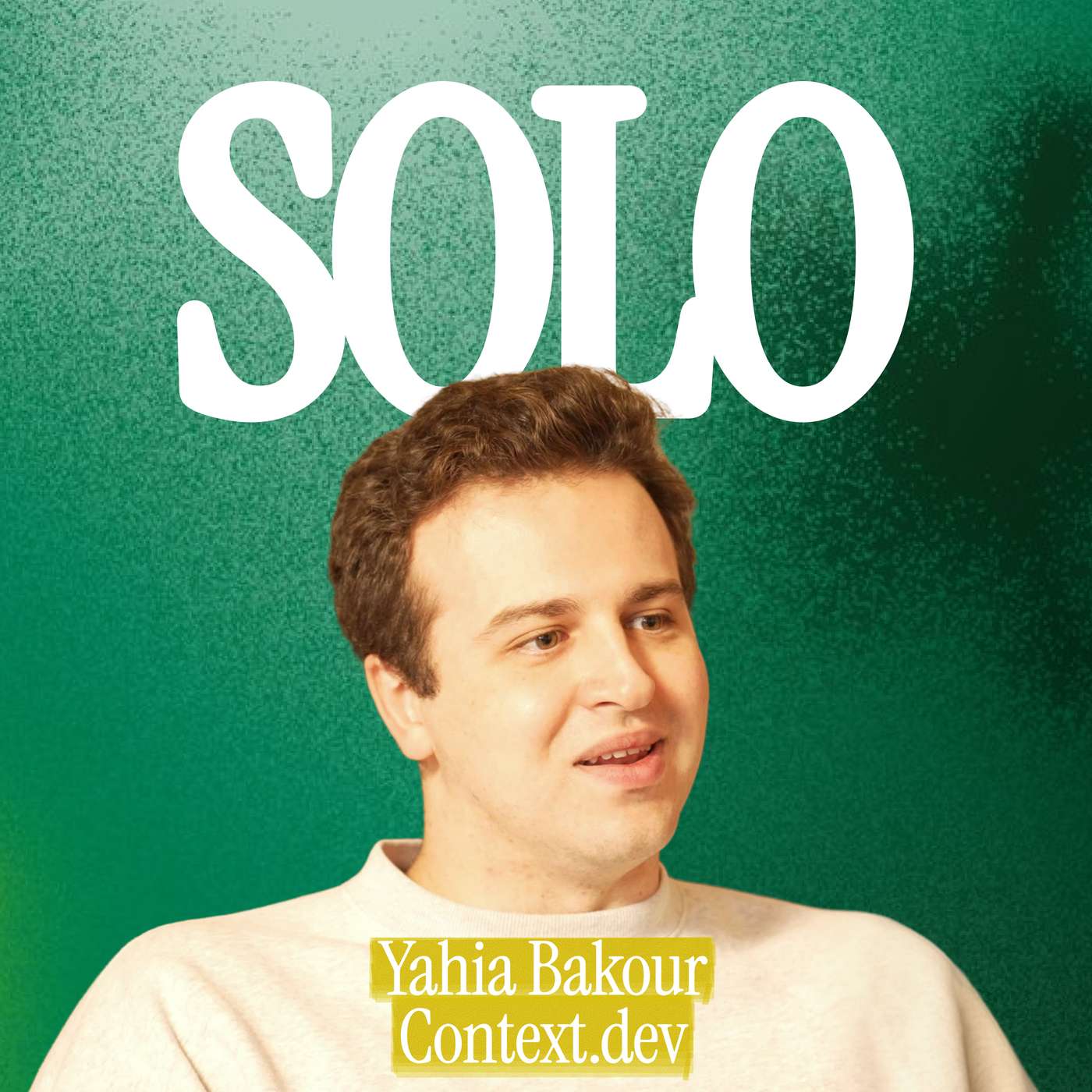
Yahia Bakour raised $9M for Context.dev by screen-sharing his Stripe dashboard. It started as a side project: an API that returned a company's logo. Customers kept asking for more, and it became infrastructure that gives AI agents the internet, backed by a seed round led by General Catalyst. He tells Julian why complaining customers are the ones to keep, why he hit $10K MRR alone and felt nothing, and why you don't need a grand mission to start.
Topics covered:
- Starting with the smallest possible product
- Why complaints from early customers are a good sign
- Why "design partner" is a warning
- The $1,000 a month plan he added for fun
- Churn versus net revenue retention
- Hitting $10K MRR alone and deciding to raise
- Growing with no budget: daily writing and viral side projects
- Hiring as a solo founder
- Why solo makes hard decisions easier
- Raising in a crowded market with a Stripe screen-share
- A hundred customer case studies
- Whether a company needs a mission
Guest: Yahia Bakour, founder of Context.dev, an API that gets data from the internet into software and AI agents.
Apply to the Solo Founders program: https://solofounders.com/program/r/the_podcast
Newsletter: https://solofounders.beehiiv.com/