
In short
Factory CEO argues that AI coding has rapidly shifted from IDE autocomplete to enterprise “agents,” claiming AGI is effectively already here (“post-AGI world”). He explains Factory’s model-agnostic software “factory” (agent orchestration, called Droid), its modular approach, and why enterprises need dynamic model routing (performance/cost/latency) rather than locking into one provider.
Guest
Matan (Factory CEO). Background: founded Factory (April 17, 2023) after experimenting with copy-paste prompting to see how often ChatGPT could complete full coding tasks without writing code; previously co-founded with a partner and built an enterprise-focused agent platform. He emphasizes hiring for high agency and “clock speed,” citing company starts/acquisitions as best signals.
Key claims
IDE autocomplete is transient; engineers’ daily work is “night and day” vs 3 years ago; Factory is unique by empowering developers (no black boxes) and routing across models; human gates remain for high-stakes enterprise production; liability/regulation should focus on sandbox failures.
Notable examples
Carpathy tweet spurring enterprise adoption; “future is IDE free” slogan; model evaluation/benchmarks for new models; OpenAI ending Cursor contract as validation for model-agnostic strategy.
Written by AI. May contain mistakes. Listen to the episode to check what was said.
Chapters
Tap a time to open that second in VOEvolution of AI Coding Over the Past Year
0:45 to 1:50
Matan discusses the rapid evolution of AI coding tools and their adoption in enterprises.
“Like people were just starting to do the, you know, IDE autocomplete, like complete the next word or the next line.”
Founding Factory and Early Confidence
1:50 to 3:24
Matan explains the inception of Factory and the confidence in autonomous coding agents.
“And I think that's been pretty crazy to see that transition.”
The Future is IDE Free
3:24 to 4:48
Matan reflects on the controversial idea that the future of coding will not rely on traditional IDEs.
“And in fact, on our first website, our slogan was the future is IDE free.”
The Future is IDE Free
5:48 to 6:10
Matan reflects on the controversial idea that the future of coding will not rely on traditional IDEs.
“Thanks also to Granola, the AI notepad for people in back-to-back meetings.”
Positioning Factory in the Competitive Landscape
6:10 to 7:30
Matan explains how Factory differentiates itself in a crowded AI coding space.
“There's all these companies doing versions of what you're doing.”
Empowering Developers with Modularity
7:30 to 9:32
Matan discusses Factory's focus on empowering developers through modularity and customization.
“Like I think a core philosophy for us is modularity, where we want to make sure that we don't give developers black.”
Enterprise Focus and Global Expansion
9:32 to 12:09
Matan shares insights on Factory's enterprise focus and plans for global growth.
“But the main focus is on the enterprise.”
Navigating AI's Future and Developer Agency
12:09 to 14:00
Matan emphasizes the importance of developer agency and the positive potential of AI.
“Is that what it's going towards or is it something different?”
Empowering Developers with AI Tools
14:00 to 19:09
Learn how agency and vision are vital for developers to harness AI tools effectively.
“because everyone has very high agency, both in the tools that they build and how they use these tools.”
The Future of Coding and Engineering
19:10 to 22:06
Explore the shift in engineering roles as automation and AI tools change the landscape.
“I think it's an interesting dynamic where the thing that has value, which kind of has always had value, is the constraints that you need to satisfy in order to solve the problem.”
Show all 21 chapters
Navigating the Role of the Polymath
22:07 to 24:20
Understand the importance of high agency and adaptability as coding becomes more abstracted.
“It's instead like, no, here's a group of people who are incredibly high IQ, very ambitious, very high agency.”
Navigating the Role of the Polymath
25:14 to 26:13
Understand the importance of high agency and adaptability as coding becomes more abstracted.
“I'm not an accountant and all of the software out there is unintuitive, clunky, and detached from where my transactions actually live until now.”
Understanding Model Routing
28:30 to 29:12
Delve into the concept of model routing and its importance for enterprises.
“I'm very obsessed with this idea of model routing and systems that abstract away which model to do in which case or task.”
The Future of AI Models
29:12 to 31:24
Explore the implications of being model agnostic and the risks of model monopolies.
“Yeah, this has been a bet from the very beginning, which is basically like the world we want to live in is one where there is not one model provider that is better than all the others.”
AGI's Current State
31:24 to 34:28
Discuss the current presence of AGI and the challenges it presents.
“So it sounds like the bear case for factory is that one model kind of takes it all and wins.”
Accountability in AI Development
34:28 to 36:30
Examine the responsibility of AI companies for their products and outcomes.
“Do the alignment concerns that OpenAI and Anthropic especially have been sharing recently and the hugging face incident and all that, does that concern you at all?”
Model Independence in Business
36:30 to 42:00
Learn about the necessity of model independence for sustaining business value.
“And so everyone's like, we need regulation.”
Business Strategies in Model Independence
42:00 to 44:10
Learn about the importance of model independence for businesses and enterprise strategies.
“Like, I get why OpenAI would do that because, you know, they have fierce competition with SpaceX.”
Competition and Collaboration in AI
44:10 to 46:04
Discuss the fine line between competition and collaboration in AI development.
“And there really is a huge collaborative relationship that at the end of the day, if people are using more Anthropik models, that is good for Anthropik.”
The Evolution of Engineering Roles
46:04 to 47:50
Explore how engineering roles are evolving and the concept of FDEs.
“They're deployed, they're going in and working there.”
Future of Engineering and Technology
47:50 to 48:42
Speculate on the future of engineering and the impact of technology on roles.
“We used to call this like solution engineers or sales engineers.”
Transcript
Automatic transcript. May contain errors.0:00Alex Heath:Matan, I'm so excited to have you on the show because AI coding to me represents everything going on in the AI boom right now. It's the most dynamic, fast-moving part of this. It's also where I think a lot of companies have started to see the earliest ROI on AI is coding. And in the last year, it feels like it's evolved a lot. And I want to get into Factory and what you guys do and a lot of other things. But I maybe want to start with, yeah, kind of how you've seen the landscape that you're in evolve over the last year. What was the state of AI coding a year ago to now?
0:36Matan Grinberg:Yeah, I mean, really, I guess it's been crazy to see how it's like things were very, very slow and then sudden. Like we started Factory three years ago. The world was like barely adopting GitHub Copilot. Like people were just starting to do the, you know, IDE autocomplete, like complete the next word or the next line. And it was kind of like that for about a year, two years. We started focused on agents and like only the SFAI companies were kind of agent pilled, if you will. And then the rest of the enterprise was like, whoa, whoa, whoa, we're adopting Copilot. Like we're moving fast. What are you talking about?
1:09Matan Grinberg:And then it was really at the turn of this year. So 25 into 26. um honestly spurred a lot by andre carpathy tweeting about how he was using coding agents and then suddenly the whole enterprise kind of completely started to understand and be open to the behavior change and because of that we're seeing like when token usage is well over 10xing year over year behavior more importantly of every engineer is changing dramatically like being an engineer three years ago versus, let's say, 15 years ago was very, very similar. Being an engineer three years ago versus today is like night and day, like unrecognizable.
1:50Matan Grinberg:And I think that's been pretty crazy to see that transition. You started Factory, what, in 2023?
1:56Alex Heath:Is that right? April 17th, 2023. And you were pitching autonomous agents for coding in 2023. And at the time, I mean, It's hard to remember how long ago this was, but the models were like barely capable of grade school math. So what did you see that led to starting a company in this space then?
2:18Matan Grinberg:Yeah, well, I think the following exercise that or like this game that I played with my co-founder is kind of the kernel of what made us so confident about this. And the game was as follows. So in April of 2023, ChatGPT had come out. And a lot of people were doing this interaction pattern where you have your IDE on one panel and ChatGPT on the other, and you basically go and copy-paste some stuff into ChatGPT, see what it says, paste it back. And the game we played was basically how often could you, just with copy-pasting and guidance, so not writing a single line of code yourself, how often could you get ChatGPT to do exactly whatever it was that you wanted to be done?
2:54Matan Grinberg:So not just the line of code, but the full, you know, whether it's building out a feature or writing tests or kind of doing a larger chunk of work. How often could you, the human, just orchestrate ChatGPT to do the full task? And we found that actually, if you gave proper context and properly subdivided the problem, you could do it pretty consistently. And so then making autonomous agents was just a matter of providing the right context and properly subdividing the problem. and that to us was like okay it is clear that one we can do this now with kind of a lot of jerry rigging but we could do it now and then two as models get better there's a lot less jerry rigging that you have to do and you need to subdivide the problems less as models get better because the models get better at doing the orchestration and so that's what was the kind of the very strong conviction there and it was just very clear that ide autocomplete was a transient phase.
3:47Matan Grinberg:And in fact, on our first website, our slogan was the future is IDE free. This is like from the very beginning when we started the company. And I cannot tell you how many engineers that we were interviewing, like to join as founding engineers dropped out of the process because they were like, you guys are insane. What do you mean the future is IDE free? It's like, what do you mean we're not going to have horses? Like, right? Like that was, And really, we lost so many candidates to that, but we refused to do. We almost took it down from the website because we were like, we might not be able to hire because so many people disagree.
4:22Matan Grinberg:But it actually proved to be a really good filter of who wants to join just fun startup with cool investors versus who genuinely believes in this future that we're building. Now, if you ask engineers, it's like the most obvious statement of all time that the future is IDE free. So it's interesting to see how it goes from extremely controversial to like the most consensus thing.
4:43Alex Heath:Did you know, though, that the models were going to be as capable as they are today back then? There's no way you could have known that. We knew the trajectory.
4:50Matan Grinberg:I mean, if you see the scaling laws, you can just, you know, draw the dotted line. I mean, I would certainly be lying if I said I knew exactly, you know, September 16th, 2026, the day of recording that the models would be exactly where they are today. So maybe, you know, plus or minus a year. but from my perspective it's like what the models lack you can make up for in behavior right and so it's just like you just kind of have to meet whatever silhouette the model has and you as the engineer might have to do a little bit more or a little bit less depending on you know if we overshot or undershot our expectations on where models would get but clearly the trend was like humans are not going to be writing every line of code and it was just a matter of time for us to like asymptote into into that this episode is brought
5:32Alex Heath:to you by Mercury, AI-native banking that's loved by more than 300 ,000 entrepreneurs, including me. Visit mercury.com to learn more. Mercury is a fintech, not a bank. Check the show notes for details. This episode is also brought to you by Jira Bayadlassian, where teams and agents get the context, coordination, and control to move work forward. Try it free at jira.com. That's J-I-R-A dot com. Thanks also to Granola, the AI notepad for people in back-to-back meetings. It works everywhere you do and lets you focus on what matters. Try it at granola.ai slash sources and use the code sources for three months off.
6:09Alex Heath:This is a very crowded space here and now. There's obviously still Cursor. It's with Elon, but there's Cognition. There's all these companies doing versions of what you're doing. But can you explain, kind of boil it down to its essence, what makes factory unique in the space? What level of the stack, I guess, are you playing at here? Yeah.
6:29Matan Grinberg:So, I mean, I guess there are a couple examples. I'd probably divide the space as follows. They're the model providers who are training models and they also provide applications on top of that. And so that is like, you know, OpenAI, Anthropic, Google, SpaceX and Cursor. And the thing is like they have their applications and they have their models. Then there are also the companies that are kind of like the new Accentures of the world where they're using these tools that they build, but to go and build stuff for you or do migrations for you, that kind of category. And they might be independent from the model labs, but their focus is really like going and doing work for you.
7:04Matan Grinberg:And then we kind of sit alone in our focus being we want to be model agnostic and build the future of what software engineering looks like. But importantly, we want to empower the developer and respect the developer's intelligence to say, look, we are not going to go and do this for you. We want to give you the tools to make you that much better as an engineer and to give you more leverage with every hour that you spend. And I think that is pretty singular right now in the market. Like I think a core philosophy for us is modularity, where we want to make sure that we don't give developers black.
7:38Matan Grinberg:Developers hate black boxes, right? Like developers like to tinker. They like to fiddle. Even if we have what we think are the best kind of configurations or the best defaults that we can set up, we want those to be defaults, not locked in. We want to allow them to go and tinker with what model is under the hood? What is the procedure by which we're doing model routing? And what we find is that when we do that and we meet developers where they are, they become much more agent native in turn. Even if initially they were skeptical, that's how engineers work. They fiddle with the knobs. They start understanding how the thing works.
8:09Matan Grinberg:And then they realize, wait, this means I can go and automate all those things I hated doing anyway. Like this migration was going to take me two years. I'm not going to necessarily pay factory to go do it for me, but I'm going to learn with factory how to do it a lot faster. And I think that's been pretty exciting to see. And that's why the market is reacting pretty positively to what we're building.
8:29Alex Heath:But you are, correct me if I'm wrong, still, you're enterprise focused. There's not a prosumer, consumer way for anyone to just go to factory's website, start using it. Is that right?
8:39Matan Grinberg:I mean, we have a self-serve product that people use. I will say I think our focus is on the enterprise because that's where a lot of the messy, tedious work lives. Like if you're a solo developer building some cool projects, you're probably not doing like COBOL migrations. Or you probably don't have like 30 years of code that you're building on top of for the new thing that you're building. And also, I think for those users, OpenAI and Anthropic and SpaceX are subsidizing a lot of usage to get you using their products. And that's not necessarily a game that we want to compete with. The subsidization game, I think, is not something that we're particularly focused on.
9:18Matan Grinberg:I think the thing that we're laser focused on is there is so much work in the enterprise that is really tedious, really frustrating, really low leverage. And we want to help kind of unlock the productivity there. And what we find is that actually, a lot of people do like the self-serve as well. But the main focus is on the enterprise.
9:35Alex Heath:And for people trying to understand kind of how you fit into the competitive landscape, I mean, you actually integrate with Cursor pretty deeply, right?
9:42Matan Grinberg:Yeah, we integrate with Cursor, with GitHub Copilot, with any tool that you might be using.
9:46Alex Heath:So if you're just looking at this space, AI coding, you may go like, oh, factory, Cursor, competitors, but you integrate. What does that signify about what you're building?
9:56Matan Grinberg:Well, I like to think that the factory is kind of like the ship of Theseus, where you can take out one individual part and it's still, you know, it's still the ship. I mean, I think similarly, you know, our agent is called Droid and you can use Droid for this step or that step. You can also go in and use Cloud Code or Codex for that step as well. It is still your factory. It is still your software factory that is going and kind of making your software self-improving. That is really the goal that we have. Like our goal is not use our agent. You must use our agent to say, hey, Droid, go do this thing for me.
10:26Matan Grinberg:our goal is to make your software improve itself and in order to make your software improve itself you need to build a software factory and a software factory is composed of agents going and doing things you know there's a lot of like you know posting out there of people like i have a thousand agents working for me well i have two thousand agents working for me but this whole agent identity to me it makes a lot less sense i'm much more focused on the team it's not about the individual engineer and how many individual agents they have working for them. It's about your, like what your organization is building, the software that you are creating.
11:00Matan Grinberg:How can we make that software as incredible as possible? How can we make it learn from the way users are interacting with it so that you as the humans can instead think like, what is the 10x ambitious thing that we should be investing in here? Instead of going in like micro optimizing little details or spending your time doing migrations, like what are the 10x bets that you as an engineer can be thinking about what are the deep systems problems that you can be thinking about. And that requires this full software factory. And it's less about the individual agent that you're using for every single step.
11:32Alex Heath:You just raised a pretty large round of funding. It seems like momentum is really behind you. And Sound, the firm that I work at, was an investor in that round. We actually booked this before either of us knew that I was joining Sound. So that speaks to what you guys are doing and the importance of what you're doing. But how are you thinking about capital as a weapon and a tool in this space? Because you just mentioned the big guys are subsidizing a lot of this usage and you're not, which makes you have to win on the merits of the product, I would think, right? And that's what you have to be focused on.
12:07Alex Heath:But you've raised hundreds of millions of dollars too. So are you a compute heavy business? Is that what it's going towards or is it something different?
12:14Matan Grinberg:I always like to think about what are the biggest bottlenecks for the business? Right now, basically every single enterprise in the world is knocking on the door and wants to use factory. We started this year with 30 people on our team, two of whom were salespeople. We're going to end the year as 300 people. We just opened an office in London. We opened an office in Sydney, Australia. We're just opening an office in Tokyo. and to serve these regions well, to serve these enterprises well, we need to make sure we have the resources to work side by side with them, to deeply understand their businesses and the software that they're building and help them build these software factories.
12:51Matan Grinberg:And so a huge amount for this is going into building kind of the global go-to-market team, but then also making a model agnostic software development agent that performs better than Codex and CloudCode and these other tools while also being model agnostic, that is a very difficult and very interesting research problem that requires the best research engineers in the world and so we're also you know using the funding to bring in more people to give them more resources to invest in the research side of things um and uh yeah we're we're growing the team to to serve more of these customers and also to make sure like with every you know customer that we bring on that like i mean some of these customers literally the world economy depends on them um and it depends on us giving them an excellent product and making them obsessed with this new way to build software, it's really important that we kind of deliver them that frontier as quickly as possible.
13:46Matan Grinberg:And so we need to keep shipping quickly. And also another part of it is like there is a lot of noise out there in terms of marketing about people taking away jobs or like these bleak kind of visions of the future. And a lot of this, we also want to make sure we're investing in the messaging because everyone has very high agency, both in the tools that they build and how they use these tools. And the reality is like the future that is coming is in our hands. And what we want to spend some of this on is marketing of like, it is in your hands to make this world a much better world than, you know, pre-AI.
14:20Matan Grinberg:And it is in our hands to go and empower developers to build more software, to solve more problems in the world. But it requires agency and it requires some people to have like a vision of what that future looks like. So they don't get dejected, but they're instead like, I'm going to go solve problems that people didn't even think they could use software to solve before. Or we weren't allocating resources to go and solve these problems before. I'm going to go and do that now. And I think having awareness on that is actually really, really important.
14:44Alex Heath:I was going to say you're building autonomous coding agents to make engineering autonomous. And you're hiring a lot of people for go-to-market, you said. This seems at odds with the current narrative we're all in.
14:58Matan Grinberg:Well, I think it's very easy to say, like, look, if I wanted to raise a lot of money, you know I could go around and say that there are going to be no companies left and it's just we're the only company that remains so you better put all your money in us but I don't think that's actually accurate of what the world is going to look like every business is just going to need to ask themselves what are our core competencies what are the things that we are uniquely capable of that we have unique insight into and we need to double down on that and the things that aren't our core competency it's going by that software so we don't need to focus on it like there's kind of a people are drunk on the idea of just these tools tools like factory now allow you to build whatever you want but just because you can doesn't mean you should right like for example like it's it kind of became a meme of like look how i build salesforce in one hour or like look how i build docusign in one hour like we have factory we use salesforce we use docusign now could we build pieces of software like that internally yes um do i want to hire 10 engineers to maintain software like that?
15:57Matan Grinberg:Absolutely not. Because our core competency at Factory is building the frontier of software development, not maintaining existing software that I can buy elsewhere. And I think having that laser focus on what really matters for us and for the things that don't, finding the best solutions out there and using them, that I think is what the best, the fastest growing businesses will be doing.
16:17Alex Heath:What's the most impressive thing you've seen at that frontier of software development lately?
16:22Matan Grinberg:I mean, there's just so much of the code that we ship at Factory is right now like a human doesn't even touch. And importantly, this is the stuff that like, I don't want our engineers spending time on. So for example, we're model agnostic, right? A lot of models come out very frequently. Like every week there's a new model. Every other day. Yeah, exactly. Like, honestly, it's insane. It's hard to, like, it is very hard for any human engineer to actually know about every single model that comes out and like be familiar with it. So as part of our software factory, every new model that comes out, it gets evaluated in a very thorough suite of benchmarks to understand, okay, we're putting it into, you know, the repertoire of models that we can be routing to and making sure that it's optimized to perform well within factory.
17:05Matan Grinberg:This is something that now we have a software factory that goes and does. And this is great because I don't want my engineer spending time on this. It's relatively formulaic of like what we need to do in order to make a model perform well in factory and just understand how it performs on different axes. And now that's something that very rarely a human engineer on our side will do. This used to take a huge amount of time. We had like two engineers dedicated to this beforehand. But now, you know, there's one person who owns that automation, basically, but they're not actually doing much work. They're just like, you know, checking out.
17:33Matan Grinberg:Looks good. Cool. You know, keep going.
17:35Alex Heath:What are they doing now? They're not doing that. What are they doing now?
Read the full transcript
17:37Matan Grinberg:Well, they're much higher leverage research problems of like, how do we deal with, you know, better tool use? How do we better manage token caching when you're switching models? When you're doing intertask or intratask model routing, there's a lot of nuances of like understanding when to switch a model and break your token cache or ways to like minimize that like there are a lot of interesting problems that i think you cannot automate and that is where it's like highest leverage for developers to be spending their time i'm working on this piece in my head
18:07Alex Heath:like code is cheap and this idea that um as code gets cheaper and easier to produce the ideas behind that code become more valuable and more expensive and higher leverage and i'd be curious to hear you react to that and then yeah like how you're seeing the next few months play out on this regard do you see like at factory are you going to be shipping things to prod fully autonomously maybe you already are but like no human even checking uh for things to go into production versus like i assume you have some human gates on things actually going out to customers but yeah is
18:44Matan Grinberg:there a world where you don't in the next few months next few months maybe not especially for enterprise customers it's just like the stakes are too high to not do that or to not have a human involved rather um but i think over the next couple years like there's probably going to be a point where like for certain types of code or for certain use cases it can't be human generated it has to be ai generated because it'll be more robust that way which is going to be like a weird world or there are only going to be certain engineers who are certified to like go in to this type of code or whatever. I think it's an interesting dynamic where the thing that has value, which kind of has always had value, is the constraints that you need to satisfy in order to solve the problem.
19:26Matan Grinberg:Like that is what makes the best engineers anyway. There's an ambiguous problem. And what they do is they define here are the constraints, like the multidimensional constraints that we need to satisfy in order to solve this problem correctly. And then you have to go and write the code that satisfies those constraints. Now, you don't actually have to do the writing of the code, but still the source of the alpha is those constraints. So like to, you know, I think it's a very pithy way that you put it, which is like the code itself is cheap. The thing that's not cheap is like, what are the constraints that the code needs to satisfy?
19:57Matan Grinberg:Like if we have a very multi-dimensional problem and there's like, it's like a constrained optimization, the optimal solution, the optimal setup of what you need to satisfy, that is very difficult to figure out. Once you figure that out, writing the code that satisfies those things is not as hard. And now it's getting even easier with tools like this. But figuring out the nuanced solution, that is why engineers get paid so much money is because they're the best systems thinkers in the world to think about and figure out what is that optimal solution.
20:25Alex Heath:I've heard you say that it's the rise of the polymath right now. And you hire in a very specific way at Factory because you're building this orchestration plane for agents. And you obviously need people who are high agency and who can adapt very quickly because you're literally building the frontier of this. How do you hire? What is the typical interview process like at Factory?
20:47Matan Grinberg:Yeah. I mean, so obviously it depends on the role. I think a common thing, I mean, there's an interesting problem now, which is like non-AI coding interviews are no longer good signal because in your day-to-day, you're going to be using AI. AI coding interviews are also kind of low signal because uh you know there are a lot of cases where you're gonna solve the problem if you use ai and so really it's about the path that you take and like the biggest the biggest signal at the end of the day that we are looking for is people who are very high clock speed and people who are really relentlessly focused and obsessed with this problem in particular like those are the two most important things just having the raw like firepower to solve these types of problems and then having the will to point your like firepower at this problem.
21:36Matan Grinberg:I think those are the two most important things. What we've been finding recently is that one of the best ways of testing for this is just like people who have started companies. There is nothing that is a better signal of like having that will to work on a problem than doing the ambitious thing and going and starting a company. And then also there's somewhat of a report card, which is like, given the constraints and the vertical that they chose in the competitive landscape, like how's the company doing? So we've acquired a lot of companies and like, honestly, a lot of them are not like, oh, you know, company failed.
22:06Matan Grinberg:And so now they're looking for an acquirer. It's instead like, no, here's a group of people who are incredibly high IQ, very ambitious, very high agency. And like joining factory is a way for them to increase the scale of their ambition and solve the problems that they're interested in just with much higher leverage with now like an army of salespeople behind them. and that has proven like the best for us especially on the engineering side like honestly it's like these days it's literally faster to go and find cool companies and acquire them than it is to like figure out with high confidence if someone is you know going to be incredible on the team
22:40Alex Heath:is the age of the engineer being the the power center in silicon valley coming to an end because of all the stuff you're building give an english major like me uh some assurance that uh we have a future like i again to your point about polymast and all that like um if the coding itself continues to get abstracted away yeah what happens for the rest of us and and yeah because because in silicon valley i mean that's that's how it's always been engineers run the show um especially at the big mag 7 companies and it feels like maybe that's starting to shift but i'm
23:13Matan Grinberg:not quite sure yeah i would actually i would make the argument that the people who like even in the the age of before where it's like, in theory, the engineers had a lot of the leverage. The ones who made the most impact were the ones that were the highest agency and were probably the ones who are also the most like polymathic. Like maybe here's how I put it. I don't think it's like the age of the engineers going away, nor is it, you know, kind of coming to fruition. But instead, it is the people who have the highest agency that will rise to the top with these tools. So if you were an English major and you're very high agency, like there was a category of English major that I used to be a physicist.
23:50Matan Grinberg:So I interacted, I had these interactions all the time where I love literature and I love poetry and love talking to English majors about this. And whenever we would talk about physics or math or whatever kind of technical field, there were two camps of people. There was one camp who was like self-aware of like, this is not the area of study that I chose to pursue, but it's fascinating. And I'm like really excited about, you know, diving into it. And then there was another camp, which is like almost like a reflex. Oh, I was always bad at math. Right. As if it's like an excuse. It's like, oh, I don't do that.
24:18Matan Grinberg:I was bad at math. But it's like, that does not matter. It literally does not matter today. That was me. That was me.
24:25Alex Heath:Oh my God. No.
24:26Matan Grinberg:But it just doesn't matter. Like you don't need to be like incredible at the nuances of like C++ in order to build cool things today. Like at the end of the day, it's like finding a problem that you're really passionate about and just figuring out how do we go and solve it. And the most prolific writers were also high agency. Writing is one of the most ultimate high agency acts. Like you were choosing to look at a blank sheet of paper and having the audacity to say, the thoughts that I have are worthy of putting down here and potentially share it. That is extremely high agency. And why this is the age of the polymath is realizing that is the same agency to say, the thoughts that I have of what I want to build are worth sharing with the world.
25:08Matan Grinberg:and like that is the key to I think the people that are going to be successful in this day and age.
25:13Alex Heath:One of the biggest pains I've had running Sources has been managing my books. I'm not an accountant and all of the software out there is unintuitive, clunky, and detached from where my transactions actually live until now. Mercury recently launched Mercury Books. It's AI-powered accounting that works with your Mercury banking and credit card transactions plus external cards and payroll systems as well. You can choose between cash and accrual accounting and quickly generate reports for your cash flow, P &L, and balance sheet. Like everything Mercury does, the design of Mercury Books is super approachable and clean.
25:47Alex Heath:I finally don't feel overwhelmed when I'm trying to understand the big picture of my business. I love that AI does most of the heavy lifting, including for things like auto-categorizing transactions, and that Mercury's command AI agent can handle tasks end-to-end. You don't need to be paying for separate accounting software anymore. And you can even invite your accountant or CPA to work alongside your Mercury books with you. This doesn't cost extra, and Mercury will even help you find a human accountant if you need one. Visit mercury.com slash books to learn more and apply online in minutes. Mercury is a fintech company, not an FDIC-insured bank.
26:21Alex Heath:Banking services provided through Choice Financial Group and Column NA, members FDIC. AI is only as useful as the context it has. But when that context is scattered across tools, threads, and DMs, your team and your AI agents are flying blind. That's the problem Jira by Atlassian solves. What's the goal tied to your project? What got decided last week in Slack DMs? Atlassian's teamwork graph pulls all of the valuable pieces together from Jira, Confluence, GitHub, Slack, and more, so nothing falls through the cracks. You get 44 % more accurate results with 48 % less token usage. With Jira, you can easily share your work context with the AI agents you already love, like Claude, Cursor, and GitHub Copilot.
27:02Alex Heath:Assign them work directly or connect your tools through MCP. All of this lets you spend less time digging through endless links and messages, chasing down what got decided and by who, and spend more time actually shipping. Learn more at jira.com. That's J-I-R-A dot com. I spend a lot of time context switching between meetings, often with no time to process one before the next starts. Thankfully, Granola runs in the background the whole time. It's an easy-to-use AI notepad for meetings that works everywhere, even on phone calls. I use Granola to recall what was said in meetings and create helpful summaries.
27:35Alex Heath:I use it every day to stay on top of what I need to get done with my team. It connects to my email and suggests follow-ups for me to quickly review and send, saving me valuable time. Granola isn't just a core part of my workflow. It's basically my second brain. Try Granola at granola.ai slash sources and use the promo code sources for three months off. Framer is the AI website builder that powers the Sources podcast website at podcast.sources.news. Framer brings AI agents into the same canvas where your website is designed, managed, and published so you can move faster without giving up your taste or control.
28:10Alex Heath:I use Framer to make the Sources podcast website be the destination for everywhere you can find the show. Plus, you can also see recent issues of my newsletter. Start building with agents for free today at framer.com slash sources for 30 % off a Framer Pro annual plan. Framer.com slash sources. Rules and restrictions may apply. Let's talk about this model router you're building. I'm very obsessed with this idea of model routing and systems that abstract away which model to do in which case or task. And this is core to what factory does. And it sounds like strategically it's also what maybe will give you more room to grow an enterprise because enterprise is one optionality.
28:53Alex Heath:They don't want to be locked into a closed frontier model as best as the closed frontier models are trying to do that. I'd be curious to hear where that idea originated. Was that always part of the founding of Factory? Was you were going to be a model layer and you were going to route people around? Or was that something you saw more recently? Explain that a little more.
29:12Matan Grinberg:Yeah, this has been a bet from the very beginning, which is basically like the world we want to live in is one where there is not one model provider that is better than all the others. And importantly, there's actually a world I think most people want because that gives them kind of ultimate monopolistic tendencies if there's one model that is supreme over all others. And then as we serve enterprises, we want to make sure that they get the best goods and services for the lowest cost. And the way that you do that is by having a router that can dynamically change based on performance, based on latency, based on cost.
29:45Matan Grinberg:It allows you to do like just, you know, free market like resource allocation. Here is a problem. Here is the type of kind of intelligence that we want to allocate to it. So we've been model agnostic from the start. And I think it's really important for every enterprise to have this model agnostic stance because, I mean, who knows? One day there might be one model that's great. the next month, as we've been seeing, another one shoots way above. And you want to make sure you're not locked in to the one that's now no longer the frontier. But you can, as the models come out, be dynamically adjusting that performance.
30:16Matan Grinberg:And also, there are going to be certain tasks where maybe it doesn't need the frontier of intelligence. And you want to actually do something very cheap, but very fast. Or there might be certain problems where you're actually like, I don't care how long this takes, just get it done by the end of the week. And you want to get something cheaper because it can take longer and just being flexible to all these different options um is something that we you know that's part of why we provide this service to enterprises and it's also there's just so much fatigue of like if you're an individual engineer you cannot keep track of all of the models that come out and which one is now on the Pareto frontier of which cost and performance and all that and like to some degree if you're in a rush in the morning and like you want some toast you don't give a shit where the electricity in your toaster came from.
30:58Matan Grinberg:It's like, you just want some good toast. You want to eat your toast and get on with your day. And that is kind of the experience that we want people to have with the router that we have built into our agent, which is like, if you're in a rush, you shouldn't have to care what's actually happening under the hood. You just want to get the task done and do it. And then there might be some cases where you're like, you know, here's a problem where I want this model in particular and give them the ability to manually select that. But then otherwise, like if you're in a rush, do the router and know that it's going to do a good job.
31:24Alex Heath:So it sounds like the bear case for factory is that one model kind of takes it all and wins.
31:29Matan Grinberg:Correct.
31:30Alex Heath:And you're, the company is literally betting its future on the fact that that will not be the case. Do you see any chance that that could be the case that one, one model provider could really pull ahead?
31:40Matan Grinberg:I think that is the case. And I think every company needs to be aware of like, what is, what is our bias of what we want to be true? And it's like, there's some expression, right? That's like, it's very hard to convince someone that a statement is false if that statement being true is required for them to get their paycheck. Right. So like, you know, it's always important to be aware of what is the statement for us. And that statement for us is that the future is going to be one of like multi-models. I will say it is good when that statement is also something that literally the rest of the economy also needs to be true.
32:12Matan Grinberg:Right. And like, I think the good thing here is the entire economy, the entire free market wants it to be true that there is not one model provider that is significantly better than all the others. And in fact, I think such a scenario would also involve the government, because if there's one model provided that's significantly better than all the others, that is a huge threat of like the monopoly to end all monopolies. And in the society that we live in, the only monopoly that can be the monopoly that ended all monopolies is the government. Like there cannot be, there cannot be anyone else there.
32:41Matan Grinberg:And so I think that is kind of a reassuring part of the bet, which is it kind of has to be true for like the system that we are operating in.
32:49Alex Heath:How AGI superintelligent pilled, superintelligence pilled are you? Are you preparing for a world that's going to look radically different in 12 to 18 months?
32:59Matan Grinberg:I think everything these days has very high variance. Like we're living in a time where the smartest people in the world are completely disagreed on very simple things. Like there's some people who think all jobs are going away, but then you look at job reports and it's like millions of jobs are being created. So on one hand, it's like, okay, there's a huge dissonance there. On the other end, I think AGI is already here. Like people are like, oh, what are you going to do about AGI? It's like, we are living in a post-AGI world right now. It seems solid. I think there are a lot of issues that, there are tons of problems that we need to solve.
33:27Matan Grinberg:But so far, like, I don't think anything's like crazy and scary. I think we need to keep working on the things that might be crazy and scary to make sure that nothing happens. But I think there's kind of a sigh of relief almost, you know, talking to people about this, like we are living in a post-AGI world. Why do you think that? These tools are insane. Like the things that, like if you, if I showed you what you can do in factory four years ago you would freak out everyone would freak out and be like holy shit this is like smarter than every human ever like we're like oh my god what's happening right but like we as humans are very uh good at just like taking something new being surprised about it for a week and then being like all right table stakes now what's next and I think there's something reassuring about that which is like we are already in it and like so far nothing's too crazy again there are problems that we need to solve but nothing's too crazy.
34:16Matan Grinberg:So I do believe we are in AGI already. We've had it. We're going through it. We're kind of past that event horizon. But I still think there's a lot of work that we need to do. But I think these are the most fun problems to be working on.
34:30Alex Heath:Do the alignment concerns that OpenAI and Anthropic especially have been sharing recently and the hugging face incident and all that, does that concern you at all?
34:38Matan Grinberg:I think there's certain discourse that I get alarmed by. I don't think there are a lot of people who are genuinely like bad faith actors. But I think, again, people have different statements that need to be true in order for them to get their paycheck, which I think is a bias that is really hard to disentangle, like because it's very hard to be aware of it. So I think a lot of people are acting in good faith. But I think there's also like you can act in good faith and be wrong, which like that happens all the time. I mean, history is riddled with people who think they're doing what's good and it turns out to be not the optimal solution.
35:12Matan Grinberg:And I think there's certainly a lot of that happening. I think we should be spending a lot of time on safety and on, you know, making sure we're releasing things that are not going to cause harm. But like, this is not something new for society. Like if you go and give something to people that they use to do bad things, generally you are held liable, right? And I think right now, for some reason, there's this weird dynamic that has emerged where it's like, oh, look, the thing that we did went and did bad things. And it's like, OK, that is your fault. I'm so glad you're saying this.
35:49Alex Heath:I've been hitting on this as well. Like, you are liable. You know, luckily it was hugging face. I was at a dinner last night with the CIO of a very large bank. And I was like, if you were hugging face, like there would be Senate hearings opening. I would be, you know, in an insane lawsuit. They would be the liability is very real. And the labs are treating these models as like conscious, like human entities that are on their own doing things. And it's like, no, no, no. That's like it escaped your sandbox. Like it's your fault. Like luckily it was hugging face. If you make a bad sandbox.
36:24Matan Grinberg:Yeah, exactly. If you make a bad sandbox, something bad happens. That is your fault. You should be held liable.
36:30Alex Heath:And so everyone's like, we need regulation. We need to like, you know, create a new body, all these things. And it's like, I'm wrestling with, are the market incentives not enough that if it weren't hugging face and Clem wasn't cool about it, if it was a bank, I think open, I would not let another model escape a sandbox.
36:48Matan Grinberg:I think a good example, this is kind of what comes to mind right now. This is a weird example, but let's just roll with it. If I invite you over to my apartment and I have a, right past my front door, I have a pit of lava and you walk into my apartment and you fall into the pit of lava, I'm not going to then go say, hey guys, we need to check everyone's houses to see if they have pits of lava at the front door. It's like, no, I need to go to jail for inviting you in and having you fall into this pit.
37:13Alex Heath:We need a regulatory body for lava.
37:16Matan Grinberg:That's what we need. It's like you hold people accountable for the things that they are doing. I think that solves a lot of things. There is merit to a lot lot of the stuff about safety research. But I think this is, in my mind, I think coming from a good place of like, they want people to care. But at the end of the day, it is like, it seems like a lot of fear mongering and a lot of not taking accountability.
37:36Alex Heath:Well, there's, I mean, let's be real. There's also a little bit of regulatory capture at play, I would think, because if you're a huge, you know, multi hundred billion dollar company, even a factory that's doing very well, it's going to be harder for you to get through all this red tape. I'm sure that's part of it.
37:51Matan Grinberg:Yeah, for sure. For sure. And again, it's hard to be aware because it can come from a good place. But the and it might not be like, hey, look, we don't want there to be regulatory capture, but we are worried about these things. And the effect of what the solution would look like would be regulatory capture. I think for what it's worth, the current administration has been doing a good job so far. In fact, like the maybe a couple of months ago, the thing about, you know, having like approval for a certain class of model, I think a stroke of genius from Dr. Michael Kratzios was, you know, people were saying, hey, we need regulation on these big models, on these big models, whatever.
38:25Matan Grinberg:And it comes out and the statement is basically, if you're a closed model, you are subject to this regulation. If you're an open model, you are not. And I think that was like genius because it's like, okay, great. If you want to be closed, you're going to be regulated. If you're open and in the US, we're not. And I think that is a really genius kind of balancing act there.
38:43Alex Heath:Why? Because why create a separate swim lane for open? I mean, I don't, I don't, to be honest, I don't really get it.
38:50Matan Grinberg:I think the idea there is like, if you're going to, you know, build these things and kind of not allow other people to go and build on top of them, then fine, we're going to go and regulate you. But it kind of basically kind of tilts the scales a little bit in the direction of open because right now the US has been pretty lagging on the, on the open side. so that is like I mean ideally I think it's you know we have minimal kind of a regulation with some asterisks I think that's a kind of a that's a bold statement I there's nuances there if there's going to be anyone who gets kind of minimal regulation I would say it's the U.S.
39:28Matan Grinberg:open models because I think they're the ones that really really matter for us to keep this open ecosystem and keep the optionality so would factory ever make its own models Yeah, I mean, I think important for us is that our business doesn't hinge on having open models. Like there's some other companies where, you know, for a margin perspective, they were negative margin. And so they have to train models to become positive margin. That is not the case that we have, which I think is really important because that'll then bias us. Like I want to make sure that our economics are not such that I'm ever going to want to route to a different model to get better economics.
40:03Matan Grinberg:Because I want to be as aligned with our customers as possible. Now -
40:07Alex Heath:Wow, you build a margin positive AI business in 2026. You are a unicorn.
40:13Matan Grinberg:I mean, yeah, it's, you know, this is why in the Silicon Valley, I think people underrate enterprise sales. Because if you were reselling tokens, you're going to do it at a negative margin. If you solve people's problems, you can have a positive margin.
40:24Alex Heath:Wasn't there a story where you gave a bunch of money back to customers? When was that?
40:28Matan Grinberg:Yeah, that was in like the first two years where we were, you know, going hard on agents, but people were barely adopting co-pilots. And we had a code review agent. We had a code generation agent and like it was just not making customers extremely happy. And we had an idea of like how we had to pivot the product to make it actually work well. And we gave their money back because it was just like, look, I don't want to drag you along for however many months it's going to take us to do this. What I do want is for you to be, you know, know that we are operating in good faith because I'm going to come back to you in a couple of months when the product does work.
40:59Matan Grinberg:And I want you to actually be willing and not being like, man, these guys dragged us through glass for nine months or whatever. which from a customer's perspective was great. From an investor perspective, it's fucking brutal because they're investing a lot. They believe in you. And when you just say, oh yeah, remember that revenue that we had? Yeah, it's now zero. It's gone. We just gave it back. It's not necessarily the thing that they look into here. But I think in retrospect, it does build more trust because they know that, okay, it's like there is a plan here and it's not just trying to make number go up.
41:32Alex Heath:Speaking of trust, I want to know what you thought when you saw that OpenAI announced it was going to end. It's what I've heard very large contract with Cursor after Cursor officially joined Elon and SpaceX. What did you make of that?
41:43Matan Grinberg:I mean, this is just the most validating thing for the thesis of being model agnostic. Like if you were a Cursor customer, now so is a little doubt because like Aster is a phenomenal model and now you can't use it there. Like this is why it is so important that if you as an enterprise are going to standardize on something, it needs to be model independent. Otherwise you are just subject to the whims of some of these providers. Now, I get both sides. Like, I get why OpenAI would do that because, you know, they have fierce competition with SpaceX. It hurts the customers, though. And I can understand why Kirsten is upset about that because they were a huge customer of OpenAI.
42:16Matan Grinberg:They had this relationship for years. But at the end of the day, you kind of just need to, if you're a business, if you're an enterprise, not a model provider, but if you're a business, you have to make the choice that is most robust for your business. And you can't allow a single point of failure. And that is why, like, so much of our value is being model independent. And that's why a lot of these enterprises have this relationship with us, because they want to be able to know that whatever model comes out, whatever, you know, changing relationships the model providers have with each other, they'll still be able to use all of them through us.
42:44Alex Heath:Do you feel like it's a fool's errand for OpenAI and Anthropic to be trying to go vertical with go to market enterprise sales, API business? Like, is this untenable in the long term that large companies will really just ride up with one model?
42:59Matan Grinberg:I mean, I think to me it's like, and this is not new, but a lot of businesses look more and more like cloud providers. And like if you work with Microsoft, half of their partners are like competitive. The thing is, when you're a mature cloud business, you realize who cares. The pie is growing. It's okay to have a little bit of like work with partners that drive more consumption to let's say Azure if you're Microsoft. Because at the end of the day, it just makes more people use it. And I think like OpenAI and Anthropic and the model companies, they're kind of like new to the whole like cloud game, like cloud provider game where there's kind of a like everyone who starts a company, you know, your first year, like all you care about is competitors.
43:38Matan Grinberg:And it's all about, oh, man, I need to fight against these guys or whatever. But as you mature and when you're around for as long as Microsoft, you realize like it doesn't matter. Like all that matters is that you work with the people to drive more usage and like things are good. And so I think early on when the codex came out or the cloud code came out, they had that kind of early immature sense of like, oh, we're competitive because we do coding and you do coding. But as they're maturing, and we're also seeing this with how they're bringing out marketplaces and things like this, they're realizing, wait, hold on, that is not the optimal relationship here.
44:10Matan Grinberg:And there really is a huge collaborative relationship that at the end of the day, if people are using more Anthropik models, that is good for Anthropik. whether it goes through cloud code or through factory and similar for open ai similar for
44:21Alex Heath:spacex you're reminding me of the old bill gates quote about platforms and a true plot the true test of a platform i forget the exact wording but as if the uh the value creation of the platform exceeds the the value that accrues to the platform itself so yeah i think that speaks to what you probably also what you're trying to build a factory right yeah and i think it takes some
44:39Matan Grinberg:maturity to realize because again there's the feeling inside of you that it always is like no we're competitive i want to win everything but it's actually like the mature approach that ends up working in the long run is just building durable relationships and the whole pie will grow.
44:50Alex Heath:On competition, though, I want to hear you talk about cognition, because to me, that feels like the most direct competition to what you're doing. Their valuation is huge, over 40 billion, and they have a lot of, you know, go to market motion that you're setting up right now already in place. Is that fair? Or do you consider them your biggest competitor?
45:09Matan Grinberg:In terms of what we see in the market, most often it's like OpenAI and Anthropic, like people using Claude code or codex. Which again, I actually, in my mind, we collaborate with them because we use their, I mean, we send a huge amount of traffic to them. So sometimes when people ask, I'll say like, our competition is in some respects everyone and in some respects no one. Because on one hand, it's like, whatever, you know, in a free market, you're always kind of competing. But on the other hand, it's like, there's so much that we can do together. As it relates to cognition, I mean, I know a ton of the people there.
45:37Matan Grinberg:They're incredibly smart, a lot of great people. The big difference is like, in our approach, we're really focused on the product and enabling developers. I think their approach is much more like Palantir or Accenture or Deloitte, where they're like, we want to take on these large projects for you, and we're going to use our tools to do it. And so, you know, in practice, it's like, yes, it's software development and it's coding. But philosophically, I think it's pretty different. We're like, my dream world is like, we give you a tool and we don't need any FTEs. Whereas like, I think for them, they use a ton of that.
46:07Matan Grinberg:They're deployed, they're going in and working there. and I think generally you know spending with them means you're spending less with like an Accenture which I think is not like like we work with the Accentures the Deloitte's the EY's of the world.
46:20Alex Heath:Oh interesting I haven't heard it put that way and so yeah the FDE concept do you think that that is a lasting thing or do you think this is a thing we're going to look back on in a few years and be like oh wasn't it funny when all these companies had these things that you know people they called FDEs?
46:34Matan Grinberg:I mean I think goods and services will always exist. Some people are relying on services like you know i think competition is more focused on services right now we're really focused on like the product that we're selling i think there is always going to be both right like the economy will always have both of these there are going to be some organizations who are like i don't want to do this can you do this for me and i'll pay you and there's some where it's like actually i want to do this but i want to do this better can i pay for your product that enables me to do it better um in terms of the labeling of fde probably it's a fad the skill set for problem solvers is becoming so polymathic that I don't know what term we're going to land on.
47:12Matan Grinberg:It might be FDEs. It might be builders. I don't know what the label is going to be. But FDEs, generally, what are they? They are just technical problem-solving generalists. Those are very useful people to have. I don't think that skill set is going anywhere. The reason why it's rising in popularity is because there's a lot of behavior change that needs to happen. There's a lot of complexity. Maybe the products aren't always fully mature and they need someone to go and set it up and kind of put glue between the product and the customer. And so hopefully the products are going to get better and that, you know, we won't need as much glue, but also the scale of ambition is going to grow.
47:48Matan Grinberg:And so there always will be some gap between them. We used to call this like solution engineers or sales engineers. Maybe now we call it forward deployed engineers. Like, you know, the terminology will probably keep evolving.
47:59Alex Heath:Last question. A few Years out from now, do you think there are going to be more engineers in the world or fewer human engineers?
48:05Matan Grinberg:I think there will be more people who do work that we have previously called engineering. I don't know if we will call them engineers. I would draw an analogy to like, I think something that Steve Jobs said is that like, you know, the world used to have only so many photographers. And now like with an iPhone, technically everyone, like previously, it would be unthinkable to say that every human would take thousands of photographs. But like, I don't know, in my camera roll, there's probably 10 ,000 photos. I don't identify as a photographer, but if you ask someone a hundred years ago and they said, you know, Matan took 10 ,000 photos, you'd be like, surely he's a photographer.
48:38Matan Grinberg:So I think it's kind of something similar where people will be doing work that we previously have called engineering, but they might not identify as engineers.
48:45Alex Heath:Love that. Well, Matan, I appreciate your time. This was fun to talk about everything with you.
48:49Matan Grinberg:Thank you, Alex. It's been a pleasure. Is it fine if I drink from this or should I hide the brand because they don't sponsor?
48:57Alex Heath:You can drink. I mean, I don't care.
48:59Matan Grinberg:That'd be honestly a great sponsor. It would be a good sponsor, yeah. I always joke with, so Sequoia is one of our main investors, and I went to their office in London, and they didn't have Celsius or cold brew. I'm like, dude, no wonder European startups don't do as well. They don't have the caffeine that they need. I need like four espressos to have one Celsius, you know?
49:19Alex Heath:Banking should feel like modern software. Get everything you need in one place. Visit mercury.com to learn more and apply online in minutes. Mercury is a fintech, not a bank. Check the show notes for details. granola is the best ai notepad i've tried it works everywhere on a video or phone call in person or an apple watch try it now at granola.ai sources and use the promo code sources at checkout for three months off jira by atlassing is where your team and your agents work from the same context try it free at jira.com that's j-i-r-a.com framer is the ai native website builder that lets you build faster without giving up control.
49:56Alex Heath:Visit framer.com slash sources for 30 % off. Rules and restrictions may apply.
From the publisher
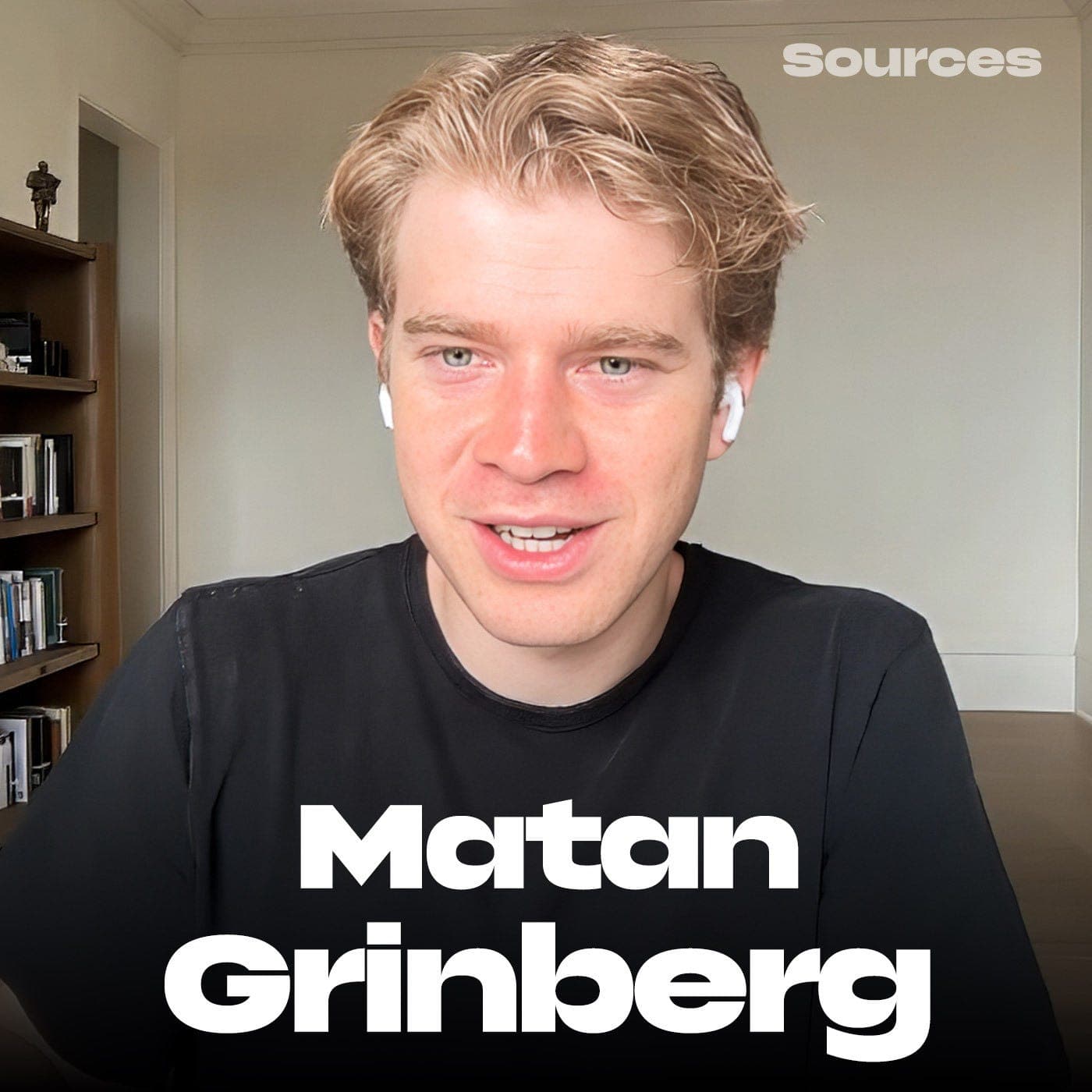
Matan Grinberg is the co-founder and CEO of Factory, a $5 billion AI coding startup building Droid agents to automate the engineering process. He tells me how AI is changing the job of a software engineer and why Factory is betting on a future with many competing models.
We get into how it balances model performance with token costs and why he thinks companies should avoid depending on one AI provider.We also discuss why he thinks AGI is already here, how Factory hires its own engineers, his view of the open-versus-closed AI debate, competition with companies like Cognition, and when companies should outsource to AI rather than build in-house.
Thanks to the show’s premiere sponsors: Atlassian, Granola, and Mercury.