Ask ChatGPT

 Sources with Alex Heath
3 Nov 2026 · 1h 8m · 21 chapters
Disruptive investor discusses a $10B growth/late-stage fund focused on U.S. open AI “stacks,” compute infrastructure amid shortages, and defense/safety as AI becomes political.
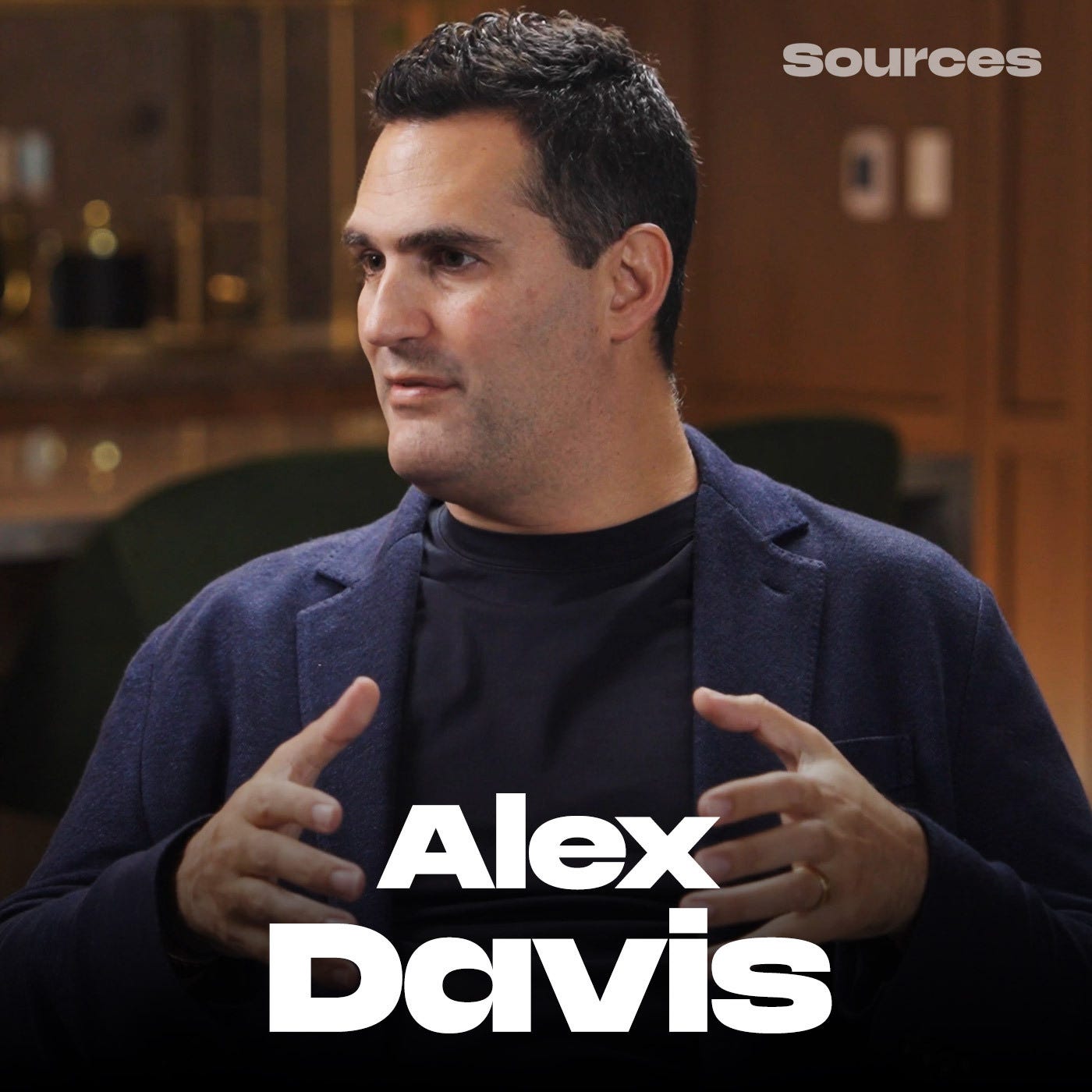
One guest, Alex Davis of Disruptive (Dallas-based, long-time private-market investor; grew up around entrepreneur Marvin Davis; Northwestern/CME background; started investing around 2011; runs a concentrated portfolio of ~40–35 companies).
Written by AI. May contain mistakes.
Discussion on the biggest opportunities and risks in tech investment.
“and to see competition to the closed models.”
Insights into the announcement of a large fund and its implications.
“they've gotten so big and they've stayed private longer, which is nothing new probably to folks who talk to your audience and use an investor.”
Exploration of compute constraints and their impact on investments.
“Does the compute constraints you're talking about incentivize you to look for investments that could change the order of all this so that this isn't a thing that every company now needs to deal with?”
Discussion on how Disruptive differentiates itself in venture capital.
“when companies seem, you know, like they're on that trajectory.”
Explore the rationale and strategy behind creating a large investment fund.
“How do we spend time with those companies where we could do more than just give them money?”
Discuss the transition from individual deal investments to structured funds.
“Or where we could say, we are what we are.”
Examine potential pitfalls and regulatory concerns in private investments.
“There is this information asymmetry and access asymmetry that helps investors like yourself, certainly, but also leads to these negative outcomes that we're talking about.”
Learn how to spot and support disruptive companies in the investment landscape.
“There are times where we become more convicted or we're writing bigger checks, the higher the value gets because it becomes more sensical to us and we can underwrite a return.”
Learn how external perspectives can assist companies in refining their market strategies.
“to help them without overselling it and open the door for one of our companies.”
Explore the investment journey and strategies surrounding Palantir’s IPO.
“So this was one of your earlier very successful investments.”
Discover the early investment decisions and strategic deals made with Grok.
“Let's talk about another quintessential investment I think you've made, Grok.”
Explore how existing assets can be repurposed and reinvested in the AI sector.
“But equally important is, could you look at the existing assets?”
Learn about the competitive landscape and the challenges faced by neoclouds in the AI market.
“but it's definitely something that is not usual of running in and stepping in.”
Discuss the impact of family legacy on personal ambition and business decisions.
“hurting, hurting, putting a lot of debt on these projects and finding out that, you know, forget about offtakers, they never end up with chips.”
Gain insights into the future of AI, defense technology, and emerging market opportunities.
“And I see the moment in time for us that they should be part of it.”
Explore the potential of new companies in the defense sector.
“special things that would otherwise be people that would just say, not interesting for me to go work at Lockheed.”
Learn effective strategies for fundraising in the current market.
“knowing that they're being good fiduciaries and that they'll spend it well, I think that that's really helpful.”
Understand the complexities of venture capital and its incentives.
“and there's no knock on any one firm it's just the overall sort of idea of like growing AUM and that's across all managers and whatnot Is your business IRRs and management fees?”
Discuss the integration of AI while maintaining a human-centric approach.
“So how do you think about the edge that you guys have relative to what AI can do?”
Examine the evolving landscape of investment valuation and strategy.
“But I think when it comes down to like, it sounds like when we talk about the dollars, maybe there's an extra zero on our stuff.”
Reflect on lessons learned and future directions in investing.
“the last 15-ish years of disruptive and say, man, if I would have known what I know now, things would be very different.”

Get the gist, explore an idea or ask about something said.
 Claude
On Sources with Alex Heath, what are the key points of this episode?
Searching your listeningAutomatic transcript. May contain errors.
0:00Alex Heath: I'd love to start with a two-parter here. What do you see as the biggest opportunity in tech investing right now, and where do you see the risk? Yeah, I think there's a bunch, and it's loaded, but I think no doubt there's a huge opportunity in U.S. open rates. You see this massive thriving ecosystem in China that doesn't yet exist in the U.S., and it's starting to percolate. that has to be one of the largest because there's no US company or westernized company that doesn't want to see the ability to own effectively your own stack when it relates to AI and to see competition to the closed models.
0:49So it's definitely a very big one. And I think the other one is probably on just this massive compute shortage that's very prevalent that everybody knows about. but that a lot of it needs to run through folks that know how to stand that compute up. And that's really what's going to help to keep the ecosystem thriving. So I think, you know, NeoCloud's, well, you know, getting hefty valuations and things like this, I think are ultimately incredibly prevalent. And then obviously the financing and whatnot that goes behind them. I would say those two things.
1:21Alex Heath: You're announcing a$10 billion fund, which is a lot of money to do growth investments. and that suggests you see a lot of opportunity in growth and late stage. But I'd be curious to maybe double click on, is there anything that gives you pause about, it feels very frothy right now. Valuations are crazy. I haven't been an investor for that long, but I'm told it's a very unusual time to be trying to make investments. And I'd be curious to hear you talk about the timing of this and not only like what it means for you and the firm and what you're doing at Disruptive, but how you think it maps to where we are in the cycle.
1:58It's a lot about sort of haves and have nots. And I think it's the perfect time to be a concentrated investor. And so if I were to look at, you know, when I first started investing in maybe 2011 or so, I think there were a total of like$10 billion venture-backed private companies or unicorns, and no one was saying unicorns then. Now I think there's, you know, I don't know, five, 6 ,000, and the number has gone parabolic. And so it's become harder, I think, to field the calls in the longer, look, we've been around for 15 years, and I think we've learned over 15 years is to not take all of the pitch decks that nobody can possibly cover.
2:466 ,000 companies, public investors don't do that. But if you really dumb it down, I think, to the top half a dozen, 20 companies or so, I think those opportunities exist. And what's happening with those is they've gotten so big and they've stayed private longer, which is nothing new probably to folks who talk to your audience and use an investor. But the need for capital for the very best companies in the world as they stay private is abundant. And I think they deserve the capital. And so therefore, people like us should be writing larger concentrated checks, which is always what we've done. And it's what's worked.
3:29And I think where we've not done well in the past or where we've seen others is that they have these sort of spray and spray mentality where ultimately, there's too many things to cover. It's too hard to find an unfair advantage. and you're really just playing defense. What we got to do is play offense and say, look, these are the companies. Like this is an N01 company that deserves to be raising 5, 10, maybe$100 billion of capital while it's still private. And it needs folks like us to help gel that part of the ecosystem. And so I'm not saying that we could write 20, 30, 50 checks a year that would allow us to write$500 billion checks and whatnot.
4:17I think there's very few. But I definitely think there's a market where it's an unfair advantage for us to gather a lot of capital and to place it into those top several companies that are N of 1 in their space. And that's ultimately what we've decided to do. And I think the froth occurs that you're seeing so many companies with massive valuations. And it's ultimately not the fault necessarily of those companies. It's really this idea that you can't, and we've talked about it before, you can't start a company that needs compute anymore out of your garage and cobble together some family money and have the story of$10 ,000,$20 ,000 of savings, not to go buy 150 ,000 GPUs.
5:11You can't do that, does it? It doesn't math out. And so I think there's this giant disparity between the companies that are the haves and will own effectively everything, and the have nots, which might get acquired and whatnot, but it's going to be a long way for them to be able to make it. And so that's where I question sort of venture versus like what I say we do, which is more of investing in growth and sort of picking those, you know, five, six, seven, what we think are our winners every year. And, you know, and it's not more than that.
5:45Alex Heath: This episode is brought to you by Granola, the AI notepad for people in back to back meetings. It works everywhere you do unless you focus on what matters. Try it at granola.ai slash sources and use the code sources for three months off. This episode is also brought to you by Mercury, AI-native banking that's loved by more than 300 ,000 entrepreneurs, including me. Visit Mercury.com to learn more. Mercury's a fintech, not a bank. Check the show notes for details. This episode is brought to you by Jira by Atlassian, where teams get the context, visibility, and control to move work forward. Try it free at Jira.com.
6:20Alex Heath: That's J-I-R-A dot com. Does the compute constraints you're talking about incentivize you to look for investments that could change the order of all this so that this isn't a thing that every company now needs to deal with? Like you're saying, like, do you see any way in the future where the cost of capital as it relates to compute can come meaningfully down? Yeah, well, I'm seeing terms like compute efficiency starting to weigh in, starting to be a thing that the model makers and whatnot are talking about more, and they should be. So like, how much utility do you create out of either what compute you have or what compute you have access to?
7:06But I don't see a way where it becomes inexpensive to be running models that are trying to compete at the frontier. Trying to compete at the frontier is a very real thing, whether it's in China, whether it's in the US, the numbers are off the charts, and they are public-like. So the access to these dollars absolutely need to be public-like, whether it's equity, whether it's debt. But for that short period of time where they're private companies, I just don't see a period where they can do it for nothing, or they can borrow, compute for equity, maybe in little pockets and whatnot, but it's hard to be creative when the out-of-pocket cash and the lenders and whatnot are so prevalent right now.
7:56Alex Heath: I just keep thinking about, is there anything in the architecture of these models and how they're trained that could lead to a much more efficient compute environment where you could maybe have a frontier model that only needs a tenth of the compute? We've heard about it. I think there's these great statements, and I'm not a big social media guy, but I constantly get sent things on X, and so I see there's folks using 10 ,000 times less the amount of compute to get to the frontier and whatnot. And if you really dig into what is happening on distillation or something else, Again, one of the things is like, can you put a model out that bench maxes that you created for$10 ,000?
8:44Perhaps, maybe. What happens then when I take that to a sovereign customer? And will it understand its fallacies? Can I use it? And my assumption is you can't use it. And so you probably have to build that yourself. And so I don't think there's a shortcut. Look, I'm not trying to. I'm an investor. I'm not trying to solve that problem. I think it would be really interesting to see it. But for now, I've seen great claims and none of them match up. I actually think you could go to the sovereign customer where you can go to the big box guys or go to big institutions, the largest banks in the US and say, they're going to trade this out for that, for cost, when really, I think everybody wants what's at the frontier and is great.
9:33Alex Heath: Let's talk about disruptive because you guys are very low key. We're here in Dallas where you're based and you yourself have never done a podcast. So thank you. Which is rare these days to find an investor who hasn't done a podcast before. What is the secret to disruptive? How did you start and how are you different? Appreciate that. I think what's different about it is, you know, we went into building disruptive with a different kind of mentality. You know, not one as like ex-bankers, you know, that went and worked in venture and then decided to, you know, build a fee-capturing business or something like that.
10:13Instead it was, you know, could you invest in private markets before they become public when companies seem, you know, like they're on that trajectory. And then, you know, if you could, for friends and for, you know, a few institutional, you call it friends and banks and things like this, could you actually put that into, could you create a business out of it? I didn't really know if you could. But I think what we found is on one-off opportunities, like I said, the N of one companies, whether it was in 2012 or if it's in the last year or so, that hasn't changed. and the desire for investors to want to invest in these really great companies that not only have that great upside.
11:05Think of like Amazon 25 years ago as a private company, I think was a$300 million company with a$60 million public float and an IPO. and it seemed really expensive then, and now it's a$3 trillion business. And so to think about what happens over decades and whatnot, I think it's very clear, if you could be an investor in some of these companies where your basis began well before they became public companies, I think that sells itself. It makes a lot of sense. And there's a de-risking mechanism to it as to like, we're not doing the harder thing. The harder thing might be picking companies, not might be, but is picking companies that, you know, haven't proven any product market fit, haven't made any technical breakthrough and whatnot.
11:59I'm talking about if you could pick companies that are winning that, you know, look at, you know, if it's NFL fans and whatnot, see the, you know, the team that's undefeated with a game left in the season and are likely going to the Super Bowl. Could you pick that team as the one that's probably going to win the Super Bowl? Would you bet on them? And could you get great odds in doing so? There's really no limited upside. To me, the view is you could do something like that. But when you looked at the venture space at the time I started doing this, no one was writing really big checks. And so you couldn't make that much a difference.
12:36Maybe there were a few, Fidelity and BlackRock, but they had just started doing it. And so I think I was early in thinking about sort of later stage investing into just historically that's done well. You know, have great access to the best engineers on the planet, right? Typically they win because leadership's able to recruit them. And then if you sort of put that into a box, and this is what we did, you know, really in the beginning is you put that in a single vehicle, share that with investors, say you'll invest in it too, and ultimately you get these great short-term outcomes because those companies would go public in any normal market.
13:15Now, we've had ebbs and flows where there's times where you've seen these companies stay private longer, or there's periods where they just don't go public at all, or there's shift changes where ESG becomes a big theme and then it becomes less of a theme, now it's AI. But what we've done for years is sort of just stick our heads down on that theme. And to your point, not doing PR or press, not focusing on what the other managers do, not fighting for competition, not even fighting for LPs. Really just knowing our own investors well, but more than anything, knowing that subset of companies, that list of 10, 15, 20 companies that are the best in the world that we need to get to know them well, and then also see what can we do for them that's different.
14:02And that's how we built this firm. How do we spend time with those companies where we could do more than just give them money? Everybody wants to give them money. And that was the ethos on how we built it. And then the point of how do you dream up building a$10 billion fund or something like this? It's, you know, you need to understand your LP base, certainly. You know, but in the case that we've, you know, been writing, I think some of the largest checks, you know, in Valley companies or, you know, growth stage companies consistently over, you know, the last decade or so. Now it's been 15 years, but truly, like, certainly over the last five, six years, I think we've been one of the largest check writers.
14:52I think it's well within our scope to say, look, we need to do this in a more regimented way. And I think if we stick it to, like, we're only going to write a certain amount of checks. We only write a certain amount of checks every year. Checks means companies. And if you dumb that down to, we're going to write 10 checks. We're going to invest in 10 of the best companies in the world that we think we could be helpful to and break it up into what's our average check size. Well, like theoretically, there's no reason we shouldn't be able to deploy$10 billion. So that's a good goal. But I sort of put a range of like five to 10 and found that, you know, the LP base would lean, you know, towards the top end of that.
15:34And, you know, under the auspice that I could, you know, find, you know, what continued to be the great outlier companies and continue to create the behind the scenes types of things that I think you could see we do with our companies. That's probably a little bit unusual. I don't see a reason and I didn't see a reason why we couldn't put a large fund together. There'd be no greater steward. There's other great stewards for large amounts of capital, but they might do different things. I think we're a really good steward of capital for being able to deploy a billion dollars into 10 companies over the next year and a half or two.
16:15Alex Heath: But why shift from the model you've had, which when we first met you were describing to me and felt very unusual and obviously is of doing individual deal-by-deal investments that your LPs have full exposure to. You were telling me about doing large checks very quickly and your LP is loving that. So why shift from that to this fund now? This is the first time you've had a fund, isn't it? Right. I mean, it's the first real fund. There's some small little things here and there. But I think the landscape's changed. So when we were first putting really large SPVs together in 2012, it's different now.
16:54There's been the creation over the last, I don't know, a decade or so where folks are largely calling themselves family offices, and then we don't know what that means when they have 500 investors. Or where we could say, we are what we are. We're a group of a bunch of great investors. Some are institutional, some are family, some are our friends, and we can be open kimono with the companies we invest in. But that's not the case for every other investor that they have. So ultimately, it becomes really hard for them, the great companies, to understand, like, look, I'm 10 times oversubscribed. I can take$10 billion into my company.
17:38It may just be easier if I bring it in from the discretionary funds, because we don't really know who these SPVs are. And now we're finding, and I think we'll see more and more of it. But I think it's a cause for concern, for sure, from a regulatory standpoint. It's some of these firms that are under a certain amount. Of course, I think if you manage over 150 million dollars, there's numbers where you could be an exempt reporting advisor. And unfortunately, those are people that if they deployed potentially, or said they did, or were raising money for a great company. Imagine Anthropic. Anthropic, we start calling a lot of people out in the last fundraiser.
18:22So what if it is that they didn't actually deploy the capital that they raised? And ultimately, that's a black eye on the company, even though the company had nothing to do with it. But there's a lot of gray area folks that have entered the market. And they've been called out for sure by companies that are very direct about it. you know, Andrel and some others have been, you know, Databricks have been big proponents of people doing this, I should say, of not being able to do it. For us, it makes a lot of sense now that you have that shift, that we be able to conform to what I think the companies need and want from a security standpoint.
19:02It's like, you know, here is committed capital. It's coming from this place. It's secure as to who your partners are on the capital side, and it's not a guessing game. And I think it'll work for some and whatnot, but I think you'll be prohibited over the long run if you're simply in the deployment of capital through SPVs only. And I would never want to create a situation where we just had adverse selection, where the great companies won't take capital from SPVs and only from discretionary. And so ultimately, we've gotten ahead of that now.
19:42Alex Heath: Do you think a lot of people are going to be burned on SPVs, especially in the big names like SpaceX, Anthropic, Databricks, etc., even OpenAI? Do you think there's going to be a lot of pain there? I do. Yeah, unfortunately, I do. I don't have any great example of it. I'm constantly looking for it because we, as a shareholder, we show up on the registry of a lot of companies' cap tables. There's a lot of people that are reaching out to buy companies. We famously don't, I don't know famously, but famously don't sell anything of ours to third parties. We're not using brokers. But I've heard many times that these brokerages or SPVs and whatnot are turning around and trying to sell us our own stock.
20:30And where they get the idea, I don't know. My assumption is, though, people are making things up. And by doing that, I definitely have a fear that there's a large amount of fraud. And the way I do think about it is that because there's so much time in between making an investment and then maybe a company stays private 10 years, That's a long time to say I deployed the capo, but maybe not. To figure out what that result was, maybe there's no result and they're safe, but if there's a good result, well, they either owe stock back to those investors or cash, and it takes a long time for us to see what the results are of those.
21:22The SEC does a good job on surprise custody audits and things like this to make sure people actually buy what they're saying. But I think those that slip under it, I'm fearful of those people.
21:33Alex Heath: And one has to think that if the private markets were more demystified and more transparent and accessible to the general public, maybe this grifting that we're talking about wouldn't be happening. There is this information asymmetry and access asymmetry that helps investors like yourself, certainly, but also leads to these negative outcomes that we're talking about. I'm wondering if there's anything, if you could wave a magic wand and change how the private markets work, is there anything that you would do? The information is, I think it's held very closely to those companies because they're not ready to report publicly.
22:10They're young companies. I think it's very much a function of that. And there's not a lot of companies that we know that aren't public yet. My choice are that they shouldn't otherwise and that they won't be in the next couple of years or so. I know everybody, you know, it's, look, as investors, you know, with, I think we have 40 or 35 some odd portfolio companies, you know, a concentrated portfolio. If you were to look at those companies, they so seriously take the moment in which they're going to go public, try to time it perfectly and whatnot. And I think there's this really interesting thing that happens whereby, ultimately, because there's so much pressure in that, making the right decision on timing, that it's just ultimately going to take longer because you're constantly perfecting what the timing is.
23:08We get to see them do it a lot of times. We get to see companies go public often, whereas the companies themselves, they go public one time. We got to see it a lot of times. And that happens often. We get to see these companies turn a billion dollars for the first time ever. Well, we get to see it in all of our portfolio companies, or we get to see them hit certain run rate hurdles and things like this. And so again, a lot of things, it's the first time the company gets to do something. We get to see it a lot of times and i think you know to answer your question like we get a a really great view of how that company's maturing they don't know how they're maturing sometimes and sometimes they do because sometimes you have multiple yeah multiple time founders but uh but i think uh you know i think the private markets it sits really well for us the amount of available information um you know in public markets gives such a level playing field to everybody, anybody with a Bloomberg terminal.
24:12With privates, there's so much more that goes into it, including what you can do for them, that I wouldn't change it for anything. How do you identify a disruptive investment? I think I touched on it a minute ago, which is we literally keep a list of, I say 20 companies, sometimes it's 15, and sometimes I own the list. And so there's companies that come in and out of that list. And ultimately, it's our job, if we're doing a good job forecasting of what the future of investments look like, of following those companies. And maybe they're too early, or maybe they're just about to come through on a breakthrough.
24:52And we're not the guys that feel like we have FOMO because we missed a round at a certain valuation, and we now can't invest in it at a later round. We're the opposite of that. There are times where we become more convicted or we're writing bigger checks, the higher the value gets because it becomes more sensical to us and we can underwrite a return. Or maybe there's more we can do to take them to market and be helpful to them. But that's exactly what we do. We're unfortunately not the people that get pitch decks and read through the pitch decks. We don't read through pitch decks. The times that we've done poorly in the past is when we've done that.
25:34We've learned, you know, if you go and just take the data and see the times that we've actually gone and found a company that we wanted to know versus the times they've come and found us, we've done incredibly well when we go to find them. And when they come and find us, it's adverse selection.
25:50Alex Heath: On that note, I mean, you've been kind of alluding to it, the ways that you all can help that seem unique. What is the Alex Davis disruptive version of helping? Let's just say half the job is identifying, underwriting, and figuring out the allocation of capital. The other half is, I just described to you a whole bunch of firsts for companies. The first time they go international, the first time they step foot in a CEO's office to sell a product. And these could be big companies, like big companies on a valuation basis before they do that. But those folks that we're taking them to, we've done it so many times where we're helping our portfolio companies.
26:39And I think everybody says they're value-add investors. So one of the values clearly is you give people capital and they use that capital. That's obvious. I think if you were to talk to our investors, they would tell you there's unusual things that we would do for them, creating unfair advantages for them, not in any nefarious way, but in a way where they may not have the ability at a top-down level to get to the most important person in an organization or in a country. And we make it our job to do that. In order to do that, though, you've got to really understand the company almost like you work there.
27:17And I think we have to be able to explain the story or the narrative around the company in a way that maybe we're even better storytellers than they are. Because a great company doesn't mean they're great storytellers, but we need to be to be able to help them. And so I think that's one of the, it's not like a superpower. It's certainly something that if we can go simplify the narrative, and I think it's one of the things that we've been able to do well personally, that's something I feel comfortable. Sitting with a CEO of a hundred-year-old company that that may or may not understand all the nuances that occur in a given time, but be able to very matter-of-fact sort of simplify the thing that that company can do to help them without overselling it and open the door for one of our companies.
28:06We've done that for a lot of companies and will continue to do that for a lot of companies. And that means traveling all over the world and spending probably half my time in my entire life with these companies on the road, with the C-suite, and trying to help them fit into market. And not to check a box, I don't have to do it for LPs. We're doing it because we actually think we could help the companies. If we don't think we could help them, for instance, take a very, we have a really nice relationship with folks at Databricks. They are so well integrated into the ecosystem that they're in, that it just becomes harder to help them because they've done so well.
28:50Alex Heath: Yeah, and we find this at Sound Ventures where I work too, is that the storytelling and how you position yourself, it's so important, obviously, but sometimes it takes a friend who is just on the outside but sees also what's happening around you more. Because when you're running a company, I mean, your blinders are on, your building, it's really hard to see the forest through the trees. and being a helpful person who's around the table but is not inside every day can really help with kind of that clarity of how do you position yourself that you're talking about. Yeah, like to what you said, I mean, if you say something nice about me, it's a lot better than me saying something nice about myself, right, which is kind of like to the point of what you're saying.
29:32But if I could point it out a little bit more carefully in a way that like, look, when we spend time with non-investors or maybe investors that are looking for plugins in their country. It's like, I know just the company for that. And then we can help sort of, you know, usher it. And then, again, when we're advocating for it with, you know, a friend of, you know, 20 years or something, it's very different than if they had gone through a local hire, in that country, junior, and try to go top down or bottoms up. Most of the companies at the level we're dealing with, they need to go top down. And so you got to help them get there.
30:18If you could do that, you're saving them probably years on a contract or a deal. Depends on the kind of company, whether it's consumer, we talk about like sovereign AI and things like this. How can you be helpful? well, repetition makes you really helpful to these guys.
31:00Alex Heath: Building with agents for free today at framer.com slash sources for 30 % off a Framer Pro annual plan. Framer.com slash sources. Rules and restrictions may apply. I spend a lot of time context switching between meetings, often with no time to process one before the next starts. Thankfully, Granola runs in the background the whole time. It's an easy-to-use AI notepad for meetings that works everywhere, even on phone calls. I use Granola to recall what was said in meetings and create helpful summaries. I use it every day to stay on top of what I need to get done with my team. It connects to my email and suggests follow-ups for me to quickly review and send, saving me valuable time.
31:37Alex Heath: Granola isn't just a core part of my workflow. It's basically my second brain. Try granola at granola.ai slash sources and use the promo code sources for three months off. Mercury is a modern take on banking built for startups like mine. When I decided to start my media business, Mercury was by far the most straightforward, full-featured banking solution for me to set up quickly. The interface is intuitive and simple, saving me valuable time every day. I use Mercury to track my spending, bills, and invoicing. I love that I can delegate permissions to my team so they can keep things running for me in exactly the way I want them to.
32:12Alex Heath: My favorite part is how forward-looking Mercury is with AI. Legacy banks are stuck in the past, but Mercury is built for how modern software works today. I use its built-in command assistant to analyze cashflow and help me move money. And Mercury also connects to other AI tools like ChatGPT and Cloud. I use this feature all the time and the folks at Mercury actually let me know that I'm one of the top users of it. So trust me. It's finally easy to get real-time financial data about your business wherever you need it. Visit mercury.com to learn more and apply online in minutes. Mercury is a fintech company, not a FDIC-insured bank.
32:47Alex Heath: banking services provided through Choice Financial Group and Column N.A., members FDIC. As you move faster and bring in more AI agents, keeping tabs on what's actually happening gets harder. Who's working on that? What did that agent just change? Are we still on track for our goals? That's why teams rely on JIRA for visibility across their work, whether it's done by people or agents. JIRA is powered by Atlassian's Teamwork Graph, which connects work across JIRA, your most used tools and apps, and your agents. That means your agents share the same context your team has, like the goal behind the work, the decision made yesterday, and the project plan, so they work faster and more accurately.
33:25Alex Heath: You get oversight, track agent progress right alongside human work, spot blockers sooner, and connect your work to goals. You don't have to choose between shipping fast and staying in control. Let's talk about two deals in particular you've done that I think exemplify how you work. And the first is Palantir. So this was one of your earlier very successful investments. I had heard that around the time of the IPO, you owned roughly 20 % of it. And the way you accumulated that position and then the moment that you doubled down right before it went public, I'm really curious about. Can you walk through how you built that position?
34:03Obviously, for the sake of their privacy and not overselling me, I had really great conviction in that team over everything. And they were out competing everybody in 2010, 11, 12, and then obviously just kept going for the best engineering talent. And it really didn't matter what they did, but there weren't really budgets for the things that they were doing. They were really creating budgets for the first time. That's a good sign, creating budgets. Yeah. Yeah. Although very hard for them when folks don't have a budget until there's an emergency. And then I remember even for them, a lot of the strife was actually trying to compete internally with organizations, not externally.
34:47Alex Heath: Why do we need this? Why do we need this? Yeah. And so it was actually fun to travel all over the world with those guys and be helpful to them. They're incredible operators, always incredible to work with. But basically, to the question and to the point of what happens is there is a point in these companies where they break through, where they're trying to become... Maybe it's growing gross margins and really proving that they have a sustainable growthy business that could be largely profitable. It's just maybe people didn't see it at a certain point in time. They were one of these groups that weren't largely backed by Sand Hill Road.
35:36And so it was clearly a fun business to be involved with because they had that chip on their shoulders. Look, at the time at which it was COVID, right around COVID, that they were, while everyone else was sheltering in place, they were thinking of going public, which was a total... which is a very Palantir thing to do and way to think. And so, look, it made a lot of sense to me. We had been in the company, I think, for 10 years at that point or so. And we had an opportunity that brought a couple large investors and included a big insurance company. And we absolutely doubled down. But it was because, look, you spend so much time getting to know a company.
36:26And our goal and our history has not been to be invested for 10 years in companies. Typically, you would think they're further along. In their case, it just so happened to be that, you know, at that moment in time, it made all the sense in the world to, if I could write a check to anything, and this is, you know, Palantir is, I don't want to be wrong, but is a sub maybe$10,$15 billion company which we know it's like half trillion dollar company now. Obviously, looking back, seemed like a really great bet, but it was understanding what had gotten them to that point, what got them comfortable to then go over the hump to do the, let's go public, let's not just go public, let's go public in a direct listing.
37:10Of course, we didn't know that we made an investment, but also I should say this, I don't think there was a month or two or three where we weren't investing in the company. Like we stayed with them for a long period of time.
37:22Alex Heath: And you doubled down right before they went out, which like, I assume your basis on that was really great. You've been doing it for a long time. Why double down right before they go out? I mean, you've got that incredible history of building up the position. Yeah, I think some of these companies and I think Palantir, it was one of these things that they were very closed off to the outside world. And in my view, it's really two things. One is, the world yet hadn't spent much time with Alex Karp. The way that he created his aura inside of Palantir was the most unique thing I've seen, still probably ever.
38:07and his ability to instill confidence in that team was sensational. And in the community of folks that he was creating budgets for and government, if the outside world, meaning they go public and whatnot, they got a view of it, well, then maybe they would see the same Alex Karp that I got to see. And there's so many other people that are incredibly special, Shum and the list goes on of the most impressive people that Palantir is and was. In fact, the fear is, would there be a drop off of these really great people if they went public? That was a fear. And they held on to that. And they've been an incredibly successful public company.
38:53But I think that was sort of the biggest thing is, can you double down before saying, these These guys are now going to show themselves to the rest of the world. Alex is actually going to be on these quarterly calls. And people are going to have to get used to somebody that's very straightforward, very honest, and very blunt and unique. And I think it'll be a breath of fresh air. And that was just a bet on a person, I think. And that team, largely, in thinking it's probably undervalued in the privates versus where it will be when it's public. And I think that was probably a fairly easy bet to make in the fact that he would just win the public over.
39:37And he has. I think he's become one of the more iconic CEOs, and he deserves it.
39:43Alex Heath: Let's talk about another quintessential investment I think you've made, Grok. So you were involved early in Grok, the inference chip company that was really prescient, I think, in setting up its own compute. and then did this very interesting deal with NVIDIA, this$20 billion licensing deal, where Jonathan and a lot of the core team went to NVIDIA, but the assets remained, and you're now running those. So you now have this inference forward cloud. Talk to me about how you got involved in Grok in the early days, why, and how that deal happened. Yeah, like most things, I'm not that early in anything.
40:25Maybe Palantir is an outlier just because the amount of time. The openness when I was willing to invest in the company. And the team is great, but that team was willing to shift their narrative where they'd actually be more of an accelerator. And so it wasn't hard to then get behind that. And obviously, like, look, Jonathan's incredibly brilliant. There's other people on that team, like Sonny and Gavin, who, you know, are easy people to get behind, you know, and a lot of them sort of filled each other's, you know, weaknesses. And then it wasn't long before, you know, when we made an investment that, you know, NVIDIA was interested in doing a non-exclusive licensing agreement, which ultimately happened in a really short period at the end of the year last year.
41:19Look, I think what most investors do at that point is try to figure out, you know, like Christmas present or something like this, I get to distribute a bunch of capital to LPs and whatnot. I think what happened was quite different there. Certainly an unusual deal where, you know, you had a bunch of folks end up going to NVIDIA to help with the chip making effort. Obviously, like you mentioned, investing in inference, obviously I think inference is going to be more important really than anything as it relates to running these models and reinforcement learning and all this stuff. But equally important is, could you look at the existing assets?
42:05What do they actually own? And could you do something with them. We could be really helpful in terms of understanding whether distributions to shareholders were done in the right way. I think that's important. Obviously, a deal done very quickly at the end of the year is typically not that tax efficient. And so how could you be helpful and just oversee some of the things there? But ultimately, I had the trust of people like Jonathan and others that I could take responsibility of that board, make sure distributions were done properly. But at the same time, instead of effectively finding an end or negotiating with data center releases to end them, which is a dream to those that own the data center, would be actually like repurpose it, reinvest in it.
43:10We have the capital to reinvest in these companies and ultimately upgrade all of the existing. They have about 53 existing megawatts and work with our friends at NVIDIA and be a partner of theirs by whether you have to retrofit some of those existing sites because the cooling efforts change. So maybe you have to liquid cool some of the sites. And then also with the iterations that they were making on the underlying technology, the LPU technology that Jonathan created is that they would sort of advance into three versions later the LPX. Could we be a customer of LPX and Verirubin and wouldn't it be great if we could go and amass a greater amount of sites to put those chips and sell those chips as offtake to others in our ecosystem.
44:08We have this great ecosystem of companies that we've backed that all are compute constrained. And could we be a partner to those companies? And at the same time...
44:19Alex Heath: This is also a resource to your other companies. A huge resource to the other companies, certainly. But then also like as a neoclid, because ultimately that's what it becomes. It becomes sort of like an inference in the Ocloud. Can you do that in a way where you're not just servicing venture-backed companies, but the hyperscalers, the Anthropics, which are kind of in the middle, soon to be public and whatnot? And could you become important enough that those folks would think of you when thinking about inference, when thinking about LPX next year when it delivers or Verorubin or things like this?
44:52And so to me, it seemed like a very obvious thing that it's something I should personally spend time on. And so I not just took the board, but took, you know, exec chair of the company. And like you said, I've been running the company. Don't know if that's the long-term plan to run that company. There will be, you know, great, you know, leadership that steps in and helps to formalize what the future of Grok looks like. But certainly, like, it has its place in the world. And we're really excited about Grok. but it's definitely something that is not usual of running in and stepping in. And we've had lots of help.
45:33We have lots of great people around the table. And it's been an interesting ride for the last six, eight months or so to be part of it, but I've seen it grow a lot.
45:44Alex Heath: Do you think the NeoClouds consolidate that there's too many right now? I think the way to look at it is like there's very little competition on offtake. So it's really a matter of who can stand compute up, who can be an honest player. And look, the average question that comes up is from a venture-backed company, even another NeoCloud or a model builder is, can you get me compute in three months, six months? You've seen it with Elon and what he's able to do because he's stood up the chips and he's got great working clusters. And Reflection, one of your companies has a deal with him. Yes, exactly.
46:35And those are shorter term deals where they need the compute, they need it now. And there's a premium for that. The problem I think ends up being that you might depend on one of these neoclouds that they'll stand something up for you in six months, which is almost impossible. But in order to do that, you'll pay a big upfront deposit, and you'll find that they either didn't do the diligence at whatever powered land they were doing it at, or they committed to doing something modular, which it might not be ready or large enough. This isn't about competition. There's more than enough demand for compute that if you have it, you'll find offtakers for it.
47:21How you price it really is dependent on like there is a market for it. There's certainly a market that's got wider margins if it's ready. And so there's things to think about there. But in terms of like how much competition there is, I don't think there's too many neoclads. I think there's not enough good neoclads.
47:43Alex Heath: Is this what you were talking about when you recently wrote, we prefer backing owner users, not speculative landlords, this will not end well? Correct. So what does not end well mean? Let's just say that you're not well-funded. Let's just say that you take five years to build something and not two years. Or you don't necessarily even know how to go about optakers or wrappers or financing and whatnot, and you have a piece of land in Texas as a big family or something, that's basically who I'm saying it's not going to end well for. We've seen the prices of memory in two years, like 5x, and double in the last year, and that wouldn't even come into the equation.
48:27We're then thinking about, well, now we've got to spend X billion dollars on chips that are now increasing 15 % a pop, but now there's new chips. And so do we put GBs or do we wait for Vera Rubens? Like if you're not, if you aren't fully adept and don't understand everything that's going on in that universe, which is highly dependent on a lot of different things changing literally daily. Yeah, I think if you're a visitor to the space, I think that I could see a lot of people getting hurting, hurting, putting a lot of debt on these projects and finding out that, you know, forget about offtakers, they never end up with chips.
49:13Alex Heath: I want to talk a little bit about your personal story and how it impacts you and how you think about running the company. I mean, your grandfather, Marvin Davis, he was a very, you know, larger than life figure, was successful in a lot of different domains. And I'm curious about what growing up in that kind of environment taught you as it relates to building for yourself and moving from Los Angeles out here to Dallas. Can you unpack that a little bit? Yeah. I mean, I grew up around one of the truly great entrepreneurs, risk takers, wild catters. I had a front row view in some things that most people never see.
50:01Obviously great to grow up around a lot of stuff, but to grow up around somebody as open and larger than life is that it's invaluable. And it's the kind of things that like, I have two little girls and I want them to see what I do. I want them to be opinionated in what I do. In fact, I share every deal I do with them. Before I do it, I want their blessing. I need to be able to explain it to them. My grandfather and I had that kind of relationship where he cared a lot that I understood things. And I did. So I got this great first-class lesson in things that most 10, 12-year-olds would never have come close to even experiencing, let alone understanding.
50:51And I think at that age, you don't even know half the stuff you're breathing in or the language of business. But I think I picked it up at some point, certainly when I was a teenager. And it gave me the kind of drive where by the time I was in college, I didn't want to be in college. I wanted to start a company. I didn't want to ride the coattails of family. I wanted to build my own business. And my biggest fear was not about being rejected on a sports team or something. My biggest fear is failure. And what happens if I'm not like him? Or what if I'm not successful at all? And so you have all these things that run through you when you grow up that way.
51:36I think I was fortunate that I went away for school. So I went to Northwestern, and I had an opportunity to really learn about the markets. And I worked at the Chicago Mercantile Exchange. And I got to do some things that were really interesting and learning about game theory and learned a bunch about auctions. And it later helped me in my first endeavor, but I'm a college dropout. And a lot of that is, you know, I did drop out of college after he passed. I didn't, you know, I was in college really because, you know, that was one of the things he wanted me to do. And, but I couldn't stand being in college.
52:19And I am an advocate, you know, for, you know, even people here at Disruptive when I feel like they're ready. some of the intern class, like, you know, I've used on the fact that, you know, I think they could skip school or at least parts of it, like when they're really, really ready. And like, this is a moment in time. And I see the moment in time for us that they should be part of it. And maybe I'll feel a kinship towards somebody here. And I see it as that like mentor-mentee relationship is the same kind of thing for me, you know, growing up, but it certainly propelled me to want to be different, keep my head down.
52:58And I never got involved in all the Hollywood stuff. And I don't live in Hollywood. We moved during COVID to Texas. But a lot of that is, again, little girls and a young family. But I felt like I could do what I'm doing from anywhere in the world.
53:14Alex Heath: I'd be curious to hear you make a prediction about how you see the macro picture of this environment playing out over the next couple of years? I mean, you've raised$10 billion, so you have the luxury of that capital. But do you see anything on the horizon that gives you cause for concern? I think the biggest concern, and I'll make a, you know, hopefully a positive prediction, but I mean, the biggest concern is, you know, is trying to follow some of these trends where, where are, you know, there's so many different things developing around AI in general is that you don't look at anything else.
53:56And for us, where there's been great opportunity, I'm going to have a chance to really talk about it, but it's like defense tech in general has this massive opportunity. And just as we were walking in here, Andrew will sign a massive contract with the Navy. These are things that 15, 20 years ago, we didn't see this stuff. You didn't see private companies signing these massive contracts of record with the US government or foreign governments and whatnot. I think that will continue to be the case. And in fact, greater. Where I think this current administration and I think others will allow for the greatest innovators who don't necessarily go and work at government, they'll have an opportunity to continue to build these very large and meaningful businesses that aren't sitting inside of the 100-year-old primes.
54:49And so I think we'll have, with one of these, several of these companies, I think we'll have new primes for the first time in 100 years. And I think that whole defense tech ecosystem changes, and then because of it, what we're seeing with the LLMs, it's all becoming very political. Right? Everybody's very scared for safety and things like this. They are becoming defense companies. All of them. And they're all doing work with the Pentagon. And they're all talking about regulation and self-regulation and things like this. And so, yeah, I think my prediction is, you know, one, there's going to be a huge, huge business.
55:30I don't know what it is. So I'm not necessarily advocating for a company, but I think there will be a huge opportunity in safety and in protecting our big corporations, our data and whatnot from the growth of AI and the populism of AI. I think that's a huge space. But I think to take our eye off the ball on defense technology right now or the fact that there won't be more companies that come up that do really special things that would otherwise be people that would just say, not interesting for me to go work at Lockheed. I don't want to do that. But also, too big of a mountain to climb to create my own Lockheed.
56:11I think that's now becoming possible, and I think you're going to see it. And look, we're seeing really the first two with Andrel and Shield, I think, becoming what are starting to look like primes. But I think we'll see more of those companies. And then I think we'll see like a tail of some of these, you know, and I really think the open models have an opportunity to become the next big defense companies and how they all work together. We'll see. But I think that opportunity is absolutely massive. And that would be my, I guess, my prediction.
56:45Alex Heath: Any advice you would give founders on fundraising right now, given all the market dynamics we've been talking about? Yeah, I'd be very specific, and I think this idea of being specific with the ask, and again, using words like compute efficiency are things that are like music to our ears, that you're not just raising ungodly amounts of money with being told this is how you're supposed to spend it. knowing that they're being good fiduciaries and that they'll spend it well, I think that that's really helpful. And a lot of that is in the storytelling. Like, do they do a good job of portraying they're going to be good fiduciaries to us?
57:29For the most part, we see it. Sometimes we don't see it.
57:32Alex Heath: I'm also curious to know what you think of the state of venture and private investing. The things you see that you go, uh, this is not right, or the incentives are misaligned, and how you've approached incentives at disruptive, which I think is fairly unusual for a fund your size. I just think venture's really hard. Yeah. Right? Like, without venture, we wouldn't exist. Like, we just wouldn't, right? We'd come in and sort of back the truck up when venture's been right. But venture's really hard because there's this, and it has to be, that spray-and-pray mentality and then the two or three in a hundred that I think statistically return a portfolio, an early stage portfolio, it's making sure those work.
58:22Those are the ones I'm usually dealing with, which is why I say without those, we wouldn't have much of a business or certainly not one where you could de-risk it. I think incentives can be misaligned because they can really be about how much capital can I raise. and there's no knock on any one firm it's just the overall sort of idea of like growing AUM and that's across all managers and whatnot Is your business IRRs and management fees? Like we make our money truly off of carry like it's very like you said it's different where I think I've said to you like I don't think anybody should get rich on management fees and people do where the outlier should exist is on great performance and on returns.
59:12So return a bunch of capital, celebrate it is great. The celebration of AUM, you ask me, my AUM today, I don't know what it is. It's not important because I'm not earning management fees on the AUM and I'm not trying to keep whether raise 10 or 5 or$7 billion or didn't raise anything at all. It wouldn't make a difference. What does make a difference is that we have these great iconic exits and they're not thrown in there with a bag of a bunch of poor results. And I think the way that we've built it's a little bit different than others is everybody is looking at, including the way that we point our investors in this direction is each of our companies really matters.
1:00:06There's no such thing as writing a company off. And when a company might not be performing like the others, I think the overall industry is such that we should probably spend less time on that company. I think in our case, it's like we should be harder and more focused on that company and figure some of the best things that we can do are save results, save an investment that could have otherwise been bad. If you can do that, like the good ones, like things that outperform and are these multiple Xs, they might have been that way anyway. But could you be really helpful to helping land the plane somewhere?
1:00:47And I think the venture community for the most part will abandon those companies that aren't outperforming. I think that's just sort of understood. I'm not saying anything that's new. Yeah.
1:00:58Alex Heath: Disruptive has, what, 30 employees? Yeah, about 30, 30. So how do you think about the edge that you guys have relative to what AI can do? And what is the part of your process that you know AI is never going to be able to touch this? And then how are you using AI? Because at the scale you're operating at, to have 30 employees is a pretty impressive feat. So how are you thinking about using AI in your day-to-day? And then there's talk in the valley of people setting up AI hedge funds and having AI trade the markets and be humans. And are you thinking about that as it relates to what you do? No. No.
1:01:33No. By the way, we're a very relationship-based business. There's a touch and a feel for the companies and for our people. And I care a lot about our culture. I don't want an AI culture. Certainly, our people are using Gen.AI to help them do things better, but we've not decreased and we won't decrease the amount of people that we have. We have a really good core group of people. We don't have a giant team. We could have many more people and maybe we'd have a few more people. But we have folks that are really dedicated to this business, unusual to other businesses. And I know people say that, but ours is like a family and no one's getting displaced by an agent or something like this.
1:02:25That said, it's definitely something that's paramount. They absolutely have to use whatever tools they've got to be able to perform better and to multiply the effects of what they do. But I think when it comes down to like, it sounds like when we talk about the dollars, maybe there's an extra zero on our stuff. But that doesn't mean you have to have an extra zero of people. We're just writing a bigger check. So it doesn't necessarily mean that you need 10 times as many people to deploy 10 times as many dollars. Maybe that's a bad fact pattern. And so there's a lot of ownership here and a lot of discipline around the things that we want to do.
1:03:11and ultimately we report to our investors.
1:03:14Alex Heath: How do you wrestle through thinking through an exponential as you're looking at an investment? I find personally as a newer investor, very new, that that's one of the hardest things that people wrestle with is the valuation now versus what it can be, seeing the bigger picture, seeing like the real ceiling, and most people can never see the real ceiling. But do you ever find yourself at night like when you're weighing a check you're about to write going like, I just don't know. Do you wrestle with that idea of the exponential much? Or is that something you've been able to just? No. I think the only thing I ever wrestle with is regulatory.
1:03:52Those are the things that should I have not done this because there was a regulatory issue? Besides that, no. And I published a letter recently in talking about value investing. And said it's dead. Yeah. Yes. And maybe that was taken out of context a little bit, but suffice it to say that we don't know where valuation is going to end up with the majority of companies that we're looking at. We don't know what the ceiling is, to your point. And so for the greatest companies in the world. Just take Anthropic two years ago. If we were modeling the company at$30 billion and saying, well, look, it's a 2x because they're going to do this, that, and the other thing, but no one would have predicted the fact that they could potentially get to$100 billion ARR and that they could do that in like two years.
1:04:59To have thought you could go and buy a company like that at a discount or if that was your nature that was the you know the idea of my node is like let me go get that at a six percent discount. Anthropic is good if I can get it at a six percent discount or I'm not doing it. Like that was the value investing mentality of like I'll buy a good company at a great price and my argument is like buy a great company period. period. And not to say that price is one of these things that you shouldn't pay attention to, of course, but the great outcomes are going to be great outcomes. And it's not going to be because you paid a 5 % discount or a 15 % premium.
1:05:43Those aren't going to be... If you go look back at my track record in history, it's not rounding the edges or sharpening our pencils around what we paid that made for a great outcome. The great outcomes were exponential outcomes.
1:05:57Alex Heath: You can end it here. You've been very successful, but I'm curious if there's anything you could look back on the last 15-ish years of disruptive and say, man, if I would have known what I know now, things would be very different. What would that be? Yeah, I don't know that I have any regrets in what we did, but certainly 15 years later, I know the answers to a lot of things. And I don't think that we've been in a time like the one that we're in, like right this where we're so much in the middle of the universe, where like, of course, I would have said we should have doubled down on the closed models, that we should have supported them for more compute and things like this.
1:06:34And there's all sorts of things like this. But you could say the same thing with defense. But overall, I think we've done a really good job. I'm happy with my team. I think ultimately our investors are really happy with what we've done. I got to go home and sleep well. You know, I'm excited about the fact that we have, you know, the next couple years to, you know, figure out, you know, what's next and, you know, what's the next decade going to look like. And I think it's like, look, we have the most fun job in the world that doesn't feel like we go to work. Like we put in a lot of hours, but it's a lot of fun because we get to deal with the most interesting companies in the world, the greatest founders.
1:07:14And I don't know another job in the world that they actually pay you to do this.
1:07:18Alex Heath: Here, here. Alex Davis, thank you. Yeah.
1:07:50Alex Heath: and control to build with clarity and ship with confidence. Try it free at Jira.com. That's J-I-R-A.com.
Alex Davis plans to put $10 billion into roughly 10 companies.
His firm, Disruptive, has maintained a low profile out of Texas while backing Reflection AI, ElevenLabs, Groq, Shield AI, Databricks, and Helsing. Its earlier investments include Palantir, Airbnb, and Spotify.
I sit down with Davis in Dallas for his first-ever podcast interview to understand how he picks the companies worth a billion-dollar check. He focuses on companies he thinks are already winning, even as their valuations climb.
We discuss why he doubled down on Palantir before it went public, what he’s building at Groq after its $20 billion licensing deal with Nvidia, and the opportunities he sees in open AI models, compute, and defense technology.
I also ask where the AI boom goes wrong, from speculative data centers to investment vehicles promising access to private companies.
Thanks to the show’s premiere sponsors: Atlassian, Granola, and Mercury.