Ask ChatGPT

 Sources with Alex Heath
21 Oct 2026 · 59m · 24 chapters
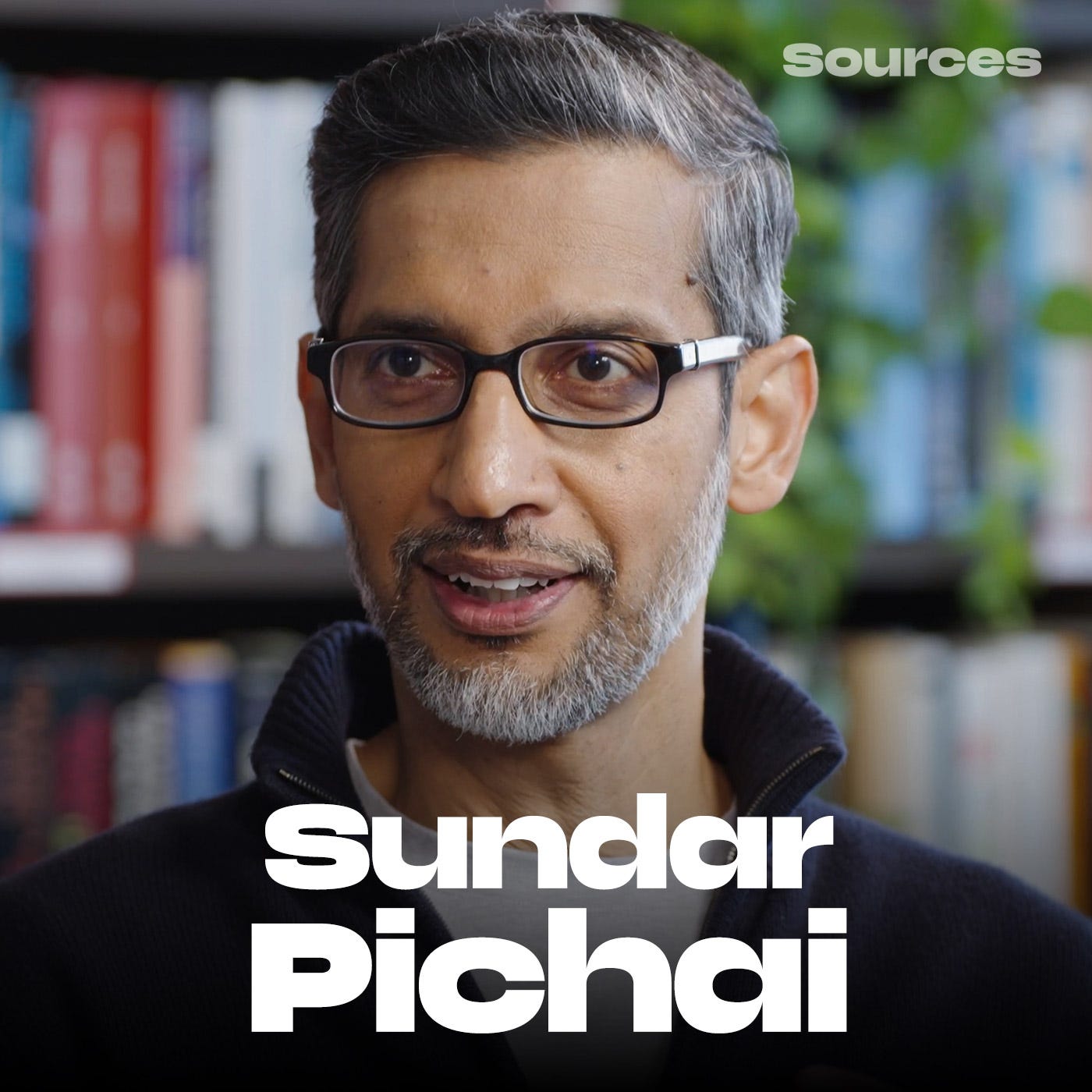
Sundar Pichai discusses Gemini 4 Argon’s early reception, compute constraints, safety testing, and how Google is accelerating frontier model releases. He also covers agentic coding impacts (e.g., Chromium and Minecraft), recursive self-improvement/RSI progress, DeepMind leadership changes, compute allocation decisions, personal/proactive agents, web/browser protocols for agents, and Google’s long-term bets (Project Suncatcher in space; Waymo and Wing scaling).
Sundar Pichai (Google/Alphabet; CEO). No other guest is identified in the transcript; the other speaker is the interviewer/host.
Written by AI. May contain mistakes.
Sundar Pichai discusses the early reception and performance of Gemini 4 Argon.
“So, you know, it's definitely NVR capacity constrained as we work through this launches.”
Discussion about the areas for improvement in the Gemini model and the constraints faced.
“So we've invested a lot more effort, both in terms of how we tested it externally through our Fairwind program with the U.S.”
Exploration of the importance of safety testing and real-time monitoring for AI models.
“You want to make sure, so for example, the work we've done, obviously the work you do to align these models well, but more importantly, both the compute and the systems you build to monitor them while they are working.”
Sundar talks about the competitive landscape in AI and how Google adapts.
“How closely do you follow the rat race of new models?”
Sundar discusses the potential productivity improvements driven by AI models like Argon.
“So some of what we had to adapt this year was to make deeper progress on agentic coding particularly, and then use that to improve our release cycles.”
A discussion on the concept of recursive self-improvement and its implications.
“So we are seeing examples like that everywhere.”
Sundar shares insights on the development evolution of AI models and the role of coding.
“And I'm curious, like, where is Google at on RSI internally?”
Exploring the dynamic challenges in coding for AI models.
“And so it was, you know, in a constrained environment, you know, if there and things like compute time, et cetera, you would do all of it.”
Discussing recent leadership transitions and their implications.
“in a way that, you know, a world-class team programming would accomplish it with good taste, great code, good reviewability, it's very safe, et cetera, et cetera.”
Understanding the evolving role of DeepMind within Google.
“and how do you apply it to solve other problems.”
How DeepMind allocates compute resources for future AI projects.
“How do you manage and are managing allocating compute towards long-term research bets?”
Analyzing Google's financial strategy and commitment to AI advancements.
“Yeah, depending on if you're planning for land, power, et cetera, you're probably in the outer years.”
Addressing the complexities of the global economy and market dynamics.
“So you have to understand long-term secular trends and invest to capture the transition.”
Learn about the complexities and challenges of economic cycles in AI development.
“And you can have the butterfly effect of like, you know, one incident which can have ripple effects everywhere.”
Delve into how AI is utilized for compute allocation and decision-making at Google.
“I've heard you say that you would love for AI to help you more with compute allocation inside Google.”
Discuss the future and development of AI agents within Google and their application.
“I'm trying to get you off the hook here.”
Examine the need for interoperability in web agents and their impact on the industry.
“running securely 24-7 with real-time monitoring, et cetera, and providing enterprises with the governance and control and auditability of those agents.”
Learn about the future of AI and how user context will drive product innovation.
“I think AI agents and AI will be even more disruptive, but there'll be microequilibriums which will emerge.”
Discover the ambitious goals of Project Suncatcher and its implications for AI compute.
“I think the agent declare naturally ends up doing that.”
Explore how ambitious projects drive technological advancements in various fields.
“And at that time, if you had tried to envision where Waymo would be today, it would seem like you're talking about something futuristic, sci-fi thing.”
Understand Waymo's growth strategy and its collaborations in the autonomous vehicle space.
“And so, and I think, so thinking about a technology curve early and pushing, I think definitely gives you those opportunities.”
Examine the current landscape of AI regulation and the need for industry standards.
“already driving with 95 % fewer C's crashes compared to regular driving.”
Delve into the potential of quantum computing and its uncertain future impacts.
“The government review, all these things.”
Explore the potential and opportunities of quantum computing as discussed by Sundar Pichai.
“and quantum feels like this thing that exists kind of in a layer above everything we've been talking about that could influence a lot of things.”

Get the gist, explore an idea or ask about something said.
 Claude
On Sources with Alex Heath, what are the key points of this episode?
Searching your listeningAutomatic transcript. May contain errors.
0:00Alex Heath: Sundar, we're here talking about a week or so after the wider release of Gemini 4 Argon. And I'd love to hear from you what the early reception has been to the new model. Pretty excited. You know, we had been using it internally for a while. It's definitely a world-class frontier model. Nowadays, when you look at the frontier, the breadth and depth of that frontier intelligence is pretty comprehensive. So if I were to mentally visualize a heat map across agentic tasks, knowledge, work, coding, etc., I think it is very, very strong on many dimensions. And I think it competes very well. The reception has been, you know, in the first 72 hours since Argonne launched, you know, we've had about almost 25 trillion tokens, which is about 3x what 3.0 had in the first 72 hours.
0:54So, you know, it's definitely NVR capacity constrained as we work through this launches. So really good feedback, particularly from our customers. But it's clearly areas to do better. You know, but it's, I think the frontier is constantly, you ship, you get feedback, and you're on to the next thing. And it's as dynamic a moment as I've ever seen.
1:18Alex Heath: What are the areas that you feel like you want to do better on still? You know, we want to continue on coding. It's a very good model. Our engineers have loved using it internally. But there are areas where we can see we can do better. At any given moment in time when we have shipped, we internally are continuing to make progress on. And so you have behavioral refinements based on the feedback you're getting from people using it. So there are areas we're going to do better there. You were mentioning the compute constraints. It's interesting that even a company like Google has those for a new model like this.
1:55Alex Heath: I mean, Argonne's a large model. It's obviously a very expensive model to serve. Can you walk me through the decision of how you have to now gate this? I believe right now it's accessible through the API, AI Pro and Ultra subscribers, obviously not to the widest possible user base yet. And I imagine that's challenging for a model of this size. So how do you think through that, gating that and releasing it? One of the things we've been very good at, if you go back to the 3.0 model, we can distill of these models and get versions which are nearly as capable but much more efficient. So we are working on those models as well, which will help us give wide access to as many people as possible.
2:36So those efforts are underway. We also, with this model, we are definitely at a moment as we are working through Frontier, you want to really think about safety of these models. So we've invested a lot more effort, both in terms of how we tested it externally through our Fairwind program with the U.S. government, giving early access to cyber researchers, internally, widely testing it. And we've obviously brought it out externally. You're right. It's a large model. We are serving it pretty fast, given the size of the model. So I'm excited what we are doing, but we'll continuously expand access from now on.
3:20And so you saw at the launch time, we had made it available to all ultra tiers, pro tier in the Gemini app. We followed it with pro tier in the anti-gravity app. And we are working on, you know, distilled versions, which we can serve to more people with the 4.0 series.
3:38Alex Heath: Is this the carbon model that there's rumors about? At any given moment in time, we have internal versions of our frontier models. And so some of these are code names of those versions. That's different from us getting a more efficient version of Argon available more broadly. So more efficient version coming. The process of testing it for safety, I'm curious to hear you talk about that. It's interesting to think about how the private frontier labs, OpenAnanthropic, talk about the security and privacy of their new models versus a Google or a Meta or a larger hyperscaler. It sounds like you guys are being very methodical with the safety testing for this one, and it's maybe taken longer than previous models.
4:24Alex Heath: Is that fair to say? Definitely. I think with the agentic capabilities and its ability to code so well, particularly when you're deploying it, we are serving many enterprise customers at scale. You want to make sure, so for example, the work we've done, obviously the work you do to align these models well, but more importantly, both the compute and the systems you build to monitor them while they are working. right? And that can be compute intensive too. But that real-time monitoring as these models are deployed, I think ends up being critical so that you get as early signals as possible if something is not working as intended and you can intervene.
5:10So we've taken time to build those systems, the sandboxing you would need to do, the real-time monitoring you would need to do. And with that, also for customers, giving them the protections they need so that you exactly know where it's running, what access it has, all the telemetry you need, all of that.
5:30Alex Heath: This interview is presented by HyperAgent. Hire AI co-workers that take on real roles, collaborate with your team, and help run your business. Learn more at hyperagent.com. Thanks also to Granola, the AI notepad for people in back-to-back meetings. It works everywhere you do and lets you focus on what matters. Try it at granola.ai slash sources and use the code sources for three months off. This episode is also brought to you by Jira Byadlassian, where teams and agents get the context, coordination, and control to move work forward. Try it free at jira.com. That's J-I-R-A dot com. This episode is also brought to you by Mercury, AI-native banking that's loved by more than 300 ,000 entrepreneurs, including me.
6:15Alex Heath: Visit Mercury.com to learn more. Mercury is a fintech, not a bank. Check the show notes for details. How closely do you follow the rat race of new models? I mean, I'm sure you do, but on X and everything of like, who's up, who's down? And, you know, I think you all really had a moment with Gemini 3 last year where I was like, wow, Google's back at the frontier. I think everyone obviously sees the benchmarks and Argonne is there for sure. But it feels like the energy is constantly moving to who is ahead in the pole position. And how much do you focus on that? How much do you encourage your team to focus on that versus not?
6:48Alex Heath: I'd be curious to hear right now how you're thinking about it. It's a great question. I think there's so much. It's such a dynamic moment. There's so much noise coming through. I'd obviously pay attention. I'm on X. I pay attention. It's important to get the pulse externally because you get a sense of where you're doing well, where you're not. So I observe all that internally, but more importantly, internally, we now have, you know, we have our own evals, which are pretty robust to evaluate SSR models. We can see the capability curve thereon. So we get very high quality signals internally as well.
7:22I think what I encourage the teams is we are very committed to being at the AI frontier for the very long term. We didn't get on this train recently. We've been, you know, focused on this for a long time. and we want to be at that intelligence frontier a decade from now and so on. So it is doing everything you need to, including safety, by the way. I think that's going to be critical to develop intelligence at the frontier. But I think one of the things for us through this year is we needed to pick up the cadence at which we are shipping things, right? I mean, the industry has been dynamic and, you know, the frontier models are evolving pretty fast, too.
8:01So some of what we had to adapt this year was to make deeper progress on agentic coding particularly, and then use that to improve our release cycles. We were able to start doing that with 3.5 to 3.6 to 3.7 to 3.8 flash. We kind of, in about three months, went through that sequence. sequence. And so, you know, obviously with 4.0, we expect to have improved release cadence as well.
8:35Alex Heath: There's aspects of Argon I'm interested in. One thing I saw was that it beat Minecraft on its own in a little over a day with, I think, only less than 2 ,000 in compute, which is pretty impressive. I'm curious what the implications of this level of agentic capability. I mean, a video game is one thing, but you could extrapolate that to potentially a lot of things. That's advanced decision-making, long-horizon task, right? Minecraft. When you see that, what do you think and how does that impact how you plan ahead? We've had internal versions where, for example, with Argon, we have seen this step change in internal productivity ever since Argon has been rolled out internally.
9:16a version of internally there, for example, there are large code bases on which we have pointed it to, and it's gone. Let's say we've had problems which we know we need to fix. It's millions of lines of code. Chromium, right? Yeah. You know, in Chromium, et cetera, you know, if you want to create an experience where you can drag out a tab, it's moved around, put it in an AI experience. How do you keep it live without reloading? That's the kind of like, you can get excited about this feature in your head, But historically for teams, it cuts through all layers of Chromium. But you can point argon at it and it can persistently go and work through it and get it done.
9:56So we are seeing examples like that everywhere. So what that excites me is I think if in some ways I view 2027 as a golden age of that productivity frontier for us because of the new class of models and how well we are integrating it with our internal environments. You can also apply these models to deeply improve model development itself, right? And, you know, what we in the industry talk about as recursive self-improvement. So those are all, you know, practically, I think, areas where you will see continued progress, which is exciting to me. Look, I think what you saw in Minecraft, you know, from now on, I think we are, the capability frontier is there where you can, in a dedicated way, apply, assuming you have the compute and resources, deeper progress on many areas than we have before.
10:52Alex Heath: Any verifiable domain, really, right? Yeah. And, you know, for sure. Yeah. Even in other areas, you can always have humans in the loop to give feedback and keep making progress, right? And so it feels like infinite possibilities. It's one of those moments where you think about, if you can think about a thing, you can apply it and make progress. And you've seen that with mathematics recently. And so things which you would think would take a long time, you can point and put effort into it and show dramatic progress like OpenAI did with mathematics with the recent models. So I think we're going to see a lot more of that in 2027.
11:33Alex Heath: Yeah, I've heard Sergey also talking about RSI recently and pushing the teams on that. And I'm curious, like, where is Google at on RSI internally? How much of current research and development is, I assume most of it's being assisted by the models, but where are we at on that continuum of the models really pushing? There's a lot of humans in the loop on these things and given the safety aspects of it. But we are definitely at a stage where AI researchers are co-working with the models in a deep way, right? And, you know, the models are involved in maybe suggesting recipes, automatically evaluating next checkpoints.
12:12So there's a healthy amount of models and researchers co-working. There are aspects of the pipeline which are like probably closer to being like, you know, what I would say in this continuum, more RSI-like. Some of them are lesser, but the whole continuum is shifting. So these are the reasons I think it's important to think about how we develop the frontier as we go through it. But I would expect the next 12 months to see continued acceleration because of RSI.
12:46Alex Heath: Quickly, while we're on just the model front here, I was at the last I.O. and you guys talked about Gemini 3.5 Pro. and there's still some questions out there of like whatever happened to that model is that did that just become argon or what happened there now when we were uh training 3.5 series we had flash and pro which we were working on an area where we internalized through the middle of this year is that there were gaps in both agentic capabilities particularly around coding and they're related and how fundamental it is to overall progress. So we wanted to definitely hill climb there. And the team felt the fastest way to hill climb was using Flash.
13:29It's a smaller model. It's more efficient. So you can really get a lot more iterative loops there. And so that's what led to 3.5 to 3.6 to 3.7 to 3.8 Flash. By the time we got that done, we had a chance to apply it to pro, but Oregon pre-training was done. Got it. So it was just realizing that 3.5 pro would have had a very short shelf life. And so we decided to take all the learnings and apply it in Oregon post-training. And so it was, you know, in a constrained environment, you know, if there and things like compute time, et cetera, you would do all of it. Yeah. But I think it gave us a chance to kind of skate to where the future needs to be.
14:19Yeah. And so obviously with 4.0, you will have, again, different model versions in 4.0. Argon is our largest model and what we have outside, but we will ship more models there. But we are also making Argon available to the pro tier in the meantime as well.
14:34Alex Heath: Where is the difficulty still in coding? Where is the area you're still trying to hill climb? It's not that difficulty. It's just the frontier is constantly evolving. And on every aspect of coding, Argonne will be the frontier if you were to look two months ago. I wouldn't say it's a difficulty as in you're constantly giving it more complex end-to-end agentic tasks. and you want the model to do incredibly well in a way that, you know, a world-class team programming would accomplish it with good taste, great code, good reviewability, it's very safe, et cetera, et cetera. So it's just a dynamic frontier.
15:21There are times, you know, all our models, you know, for example, take hallucination. it's a never-ending frontier to keep making progress on. It's an inherent part of the current state-of-the-art technology, but you're constantly working to reduce that. So it's both an opportunity and a difficulty to give one example of that.
15:41Alex Heath: We haven't talked since there were some leadership changes that I wanted to ask you about at Google DeepMind. Demis Asabas, the CEO, stepping back, becoming chief scientist, and also focusing more on isomorphic, which I'm very curious about, and then Corey, you know, being elevated, running DeepMind, Jeff Dean, Google legend, leaving to start Discovery Loop. And, you know, when that happened, there was a lot of press about that and intrigue about what was going on behind the scenes. I haven't heard you or anyone named there speak on it since then, so I'd be curious to hear from you. Maybe you can put some of the rumors to rest.
16:20Alex Heath: What was the thinking there? What motivated that? Why did that happen? You know, you're seeing some natural evolutions as people spend their time doing things for a while. Jeff was 27 years, I believe. 27 years. It's a long time. I feel proud I've worked together with Jeff for a long time, a long time. You know, obviously, he was seminal in his contributions here, and we are excited to see what he does with Discovery Loop. You know, I would start with saying he definitely wanted a, I think, moment in time where he saw an opportunity to go do something, which he was excited by with a set of people.
16:56The change internally, I would just say you're going through a moment in the industry where the frontier model development is an all-consuming thing, right? You know, we've had broad AI research, AGI research, and so on. But frontier model development is all-consuming. it's moving, it's picking up pace, right? And it's a very scaled operation, all the way from data to compute to the algorithmic work you do to managing the teams and your model agents to do that. So I think it's become an important job on its whole. Demis, he's obviously been thinking about this moment for a long time. He's particularly interested in both how do you go through this frontier moment safely and how do you apply it to solve other problems.
17:51It's part of the work that he did with AlphaFold and hence what we are doing now with isomorphic are examples of how you can apply, you know, AGI to solve other problems.
18:04Alex Heath: Medicine, drug discovery. Yeah. Yeah. Robotics and so on. Like, you know, it'll apply to everything. So I think he wants to spend more of his time. So he's very leaned in into those things. Which if you know Demas, you know he's always been passionate about that. Passionate about it. And he has been at it early on. And I think in some ways both seeing that the model development is kind of a well-established process. And Cori has been a deep mine for well over a decade too. And so we saw this opportunity for Cori to step up, do that, allows Demis. Demis is still involved as chair of DeepMind, but he's also spending a lot more time.
18:46You've seen him more involved with AI security conversations, but as well as thinking about how to apply AI in a more practical way, be it science, be it healthcare, and there'll be other areas as well.
19:00Alex Heath: Does this signal any kind of shift with how DeepMind relates to the rest of Google? Is it merging in closer? Yeah, what are the natural next order effects of this? There's been a natural process over many years, including when Demis was running it, where DeepMine, the Gemini app, gets built within DeepMine, right? So as an example, Cori had moved here to the Bay Area almost, you know, maybe 18 months ago. There's been close integration. makes sense for compute, for DeepMind to impact the rest of the Google. So there's been deep collaboration, which has already been underway a lot. So I don't think any of this in the continuum wasn't maybe externally people noticed that as a moment.
19:48But for us, it's been a deep coupling, which has been underway for a long time.
19:51Alex Heath: How do you manage and are managing allocating compute towards long-term research bets? I think what DeepMind was historically known for kind of pre-CHATPT and the current AI boomer in with the near term, the frontier models that you talked about, the Gemini app, the products, the commercialization. How do you allocate that? Has that shifted at all in the last year or two? The problem is always stakes are high. And I think we are fortunate to see extraordinary opportunities at being at the frontier of intelligence, having a very successful consumer business across many, many products and services, and being one of the top cloud hyperscaler companies in the world and the opportunities to provide the technology.
20:38So I think the opportunity space is large. And so obviously we have to plan ahead. But I think we have a pretty rigorous approach to plan ahead. These teams plan independently. Underlying all of that, we've been an AI-first company for a long time. And so with that comes in commitment to invest in the compute that you need to be at the frontier, both for research and developing the models. So that is ground zero with which we plan for the future. Beyond that, there are these businesses. For example, Thomas and the cloud team, they have their own long-range plans, you know, with their revenue projections, the opportunities, and we use that to plan, compute for them.
21:18You can always have moments when you look back in hindsight, I mean, there's no company in the world now sitting here. To give you a sense of how fast the technology frontier is moving, same time last year, this agent encoding liftoff hadn't happened. And remember, we build our own compute, right? And that has long lead times. So at any given moment in time, you're living with all the compute decisions you made two years ago. But people are assessing you based on the compute decision. They have the perfect information today. And so...
21:52Alex Heath: You had to make the call two years ago. Two years ago. And you make the call based on the signals. You're confident. You take a long-term optimistic view and you're aggressive in your investments. I don't think any company in the world today would sit and tell you, like, today, they got their decision right two years ago. And so you're working through those moments. And I think that comes with the territory. comes with the territory. We plan to be state-of-the-art in terms of our compute investments on an ongoing basis to both drive research and develop frontier models. And beyond that, we'll have opportunities to apply it in many other parts.
22:34And I think we plan to do it to the best of our ability.
22:38Alex Heath: So that means you're planning right now for 2028, 2029, right? Yeah, depending on if you're planning for land, power, et cetera, you're probably in the outer years. Right. And there was a big moment over the summer where you all went cash flow negative for the first time since the company IPO'd. And I think a lot of people in Wall Street... Free cash flow. Free cash flow. Not operating. Yes, of course. And people saw that and go, wow, Google's continuing to invest more aggressively. I think you guided up CapEx for 2027. and you're thinking about 2028, 2029, what are you seeing that's giving you the resolve, especially the moment in the summer where Google goes negative on free cash flow?
23:21Alex Heath: I assume that was a big decision. And how do you think about that and what is giving you that resolve? The strength and durability of the demand signals we are seeing. So it's probably, you know, to do something like this, you need to be confident at multiple levels. One is, I think we are fortunate to have early signals from such a diversified opportunity set, right? You know, all the way from consumer to enterprise. And so we are seeing that robust demand signals. You probably have more signal than any company on earth, actually. I haven't thought about it that way, but you could arguably make a case for it.
23:59And so you have that robust demand signals. We have the demand signal for Google itself, which is a cutting edge enterprise of how we are using AI and adopting it, and you're seeing the capability frontier, then you're able to independently, outside of the demand signal, in some objective way, actually assess the capability frontier and see how it's progressing, right? And seeing how that curve looks like, and be the scaling loss or like how our new models are doing compared to our old models, the complexity of tasks we are able to tackle, our internal evals and benchmarks, and so on. So you're getting a first-hand sense of it.
24:38You're also getting a sense of the breakthroughs from research, which give you a sense of, okay, will Gemini 5.0 be much better than where for Argonne is? And the answer is yes. So you're getting all those confidence signals across that layer of the stack. And we also have durable long-term contracts with committed revenue, which we are signing. So it's not just hope, right? You're planning to book of business as well. So you take all that into account and you lean in in a responsible, disciplined way, which is what we are doing.
25:20Alex Heath: It's interesting to hear you talk with confidence about those signals, which obviously I believe. And then I think people are also trying to grapple with, for example, like Core Reeve was the latest one, but there's fears about the neoclouds. There's fears about the financing of these things, the brittleness of it. When you look out there, even beyond Google, but Google's involved in a lot of these things, do you sense anything that gives you worry about a near-term, not even Google-specific, but just that the market's maybe over its skis? Look, I was obviously answering the earlier question from a Google standpoint, right, like looking at it, et cetera.
25:55You know, the broader market, to me, you have any time you work through these moments where the opportunity is massive and the rewards are high and you have a lot of players coming in, you are going to have dynamism and volatility associated with that. And I think that is an inherent part of a moment like that. This is why I try to focus very hard on that signals, which I have control over and I can see, right? And the demand signals, the business clear line of sight to the business opportunities we have in terms of contracts, backlogs, and so on. And you plan for that, right? And I think you design the company in a way in which you can work through moments where even if there's some variation, the long-term arc of it is good for the company, right?
26:43And so that's why your ability to take a long-term view helps. And even if you look through the last five years, the pandemic drove a big shift towards digital. Then some of it corrected. But it made sense to invest to drive that shift forward for most companies, which did so, have done better. So you have to understand long-term secular trends and invest to capture the transition. In fact, we invested a lot of our headcount growth as a company through those years was for Google Cloud. And we are benefiting on the other side of having scaled up. We were relatively later to the cloud market, but we took a very aggressive investment posture into that for a period of six to eight years.
27:39And, you know, that helps us through a moment like that. I think that's how I think about the AI moment as well.
27:46Alex Heath: Can you look out anywhere in the future and see where you're not compute constrained right now? Is there any moment in time you can look out and see? I hesitate to answer that way because... Yeah, you got to be careful because everyone will freak out if it's like... No, what I mean is it's more that, you know, we live in a moment in time in which the global economy is so intermingled in such complex ways. And you can have the butterfly effect of like, you know, one incident which can have ripple effects everywhere. Right. And so I'm trying to decouple two things. I'm not saying from now on everything will be a smooth.
28:25No, you know, life doesn't work that way. Right. You know, economies grow. there are hiccups we work through, there are business cycles, all that are inevitable parts of how the world works.
28:37Alex Heath: Right. And I think no one thinks this is like the past bubble. Like, this is not fiber. We're using all this. We're using all this. We are super constrained. And more importantly, we're using it for real today in practical value-deriving ways. And we see opportunities. We see clear line of sight in which all of this will work better in the future. But that doesn't mean as a collective industry or an economy, you overshoot or you have shocks to the system, which are out of your control and all that. So those are two separate things, right? And which is why part of it is I focus on the things that are in our control, our ability to take a long-term view, take our years of experience to better forecast, better model, better invest, and apply to this wide opportunity set we have in a pretty disciplined way.
29:33And so I put my energy, time, and attention into that and less thinking about, you know, is there too much exuberance or not?
30:03Alex Heath: switching between meetings, often with no time to process one before the next starts. Thankfully, Granola runs in the background the whole time. It's an easy-to-use AI notepad for meetings that works everywhere, even on phone calls. I use Granola to recall what was said in meetings and create helpful summaries. I use it every day to stay on top of what I need to get done with my team. It connects to my email and suggests follow-ups for me to quickly review and send, saving me valuable time. Granola isn't just a core part of my workflow, it's basically my second brain. Try Granola at granola.ai slash sources and use the promo code sources for three months off.
30:39Alex Heath: AI is only as useful as the context it has, but when that context is scattered across tools, threads, and DMs, your team and your AI agents are flying blind. That's the problem Jira by Atlassian solves. What's the goal tied to your project? What got decided last week in Slack DMs? Atlassian's teamwork graph pulls all of the valuable pieces together from Jira, Confluence, GitHub, Slack, and more, so nothing falls through the cracks. You get 44 % more accurate results with 48 % less token usage. With Jira, you can easily share your work context with the AI agents you already love, like Claude, Cursor, and GitHub Copilot.
31:15Alex Heath: Assign them work directly or connect your tools through MCP. All of this lets you spend less time digging through endless links and messages, chasing down what got decided and by who, and spend more time actually shipping. Learn more at jira.com. That's J-I-R-A dot com. One of the biggest pains I've had running sources has been managing my books. I'm not an accountant, and all of the software out there is unintuitive, clunky, and detached from where my transactions actually live. Until now. Mercury recently launched Mercury Books. It's AI-powered accounting that works with your Mercury banking and credit card transactions, plus external cards and payroll systems as well.
31:53Alex Heath: You can choose between cash and accrual accounting and quickly generate reports for your cash flow, P &L, and balance sheet. Like everything Mercury does, the design of Mercury Books is super approachable and clean. I finally don't feel overwhelmed when I'm trying to understand the big picture of my business. I love that AI does most of the heavy lifting, including for things like auto-categorizing transactions, and that Mercury's command AI agent can handle tasks end-to-end. You don't need to be paying for separate accounting software anymore. And you can even invite your accountant or CPA to work alongside your Mercury Books with you.
32:27Alex Heath: This doesn't cost extra, and Mercury will even help you find a human accountant if you need one. Visit mercury.com slash books to learn more and apply online in minutes. Mercury is a fintech company, not an FDIC-insured bank. Banking services provided through Choice Financial Group and Column NA, members FDIC. Framer is the AI website builder that powers the Sources Podcast website at podcast.sources.news. Framer brings AI agents into the same canvas where your website is designed, managed, and published, so you can move faster without giving up your taste or control. I use Framer to make the Sources podcast website be the destination for everywhere you can find the show, plus you can also see recent issues of my newsletter.
33:07Alex Heath: Start building with agents for free today at framer.com slash sources for 30 % off a Framer Pro annual plan. Framer.com slash sources. Rules and restrictions may apply. I've heard you say that you would love for AI to help you more with compute allocation inside Google. I'm curious, even in the last few months, is it involved at all? Are you finding that you're able to make better decisions or that you would even maybe hand off certain decisions to a model on that? Something as big and important as that? Two ways I would answer the question. One is given the stakes, it's quietly, you know, the decisions are being made by humans in the loop, including me, and, you know, directly involved.
33:51But I would say, even for me, one of the use cases, you know, I have agents running internally for me, you know, agents I've deployed, both to help me understand, you know, a simple thing. it's not super fancy, but at our scale, even to understand the model development arc, there are all these chat groups, there are pre-training chat groups, mid-training chat groups, post-training data, et cetera. It could easily take me an hour a day to kind of catch up what's happened in the last 24 hours, right? But now I have agents running which summarize and bring that information to me. I can still go deeper and I do so often.
34:36Similarly, there are agents with telemetry into our compute usage, byproduct area, efficiency, utilization, and is giving me inputs and insights. So those are the ways we are weaving AI into all this. We have extraordinary people working with all of this as well. I think it's made all of us be better at what we do. And so that's how I'm using it.
35:01Alex Heath: So no future near term where AI is making the compute decisions? I mean, even five years ago, you know, we used AI to make power consumption efficient in our data centers. So we do have, when we're making computer allocation decisions, AI is a core part of the input it's providing, right? I'm trying to get you off the hook here. Oh, the model said it, not me. You know, it's a continuum there. By the time it's doing that, you would be applying yourself to the next problem and so on. So that's how I think about it. Yeah. I'm curious what you make of this personal agent race that the industry is now in with Muse, which is a great product instinct.
35:42Alex Heath: I remember at the last IO, you guys showed Gemini Spark. Yeah. And I'm curious, you know, do you think Google needs to do more here on consumer? I know you just had the Gemini workspace where you're giving an agent an email, a workspace identity, all that. But in the consumer race, when you look at it, it's early, but I imagine you want Google to have even more of a stake in that. Well, it's a huge area of focus. In fact, the goal we set out for Gemini, how we call it, we want it to be a personal, proactive, and powerful assistant. It's a core part of what we are trying to do with Gemini. And you are right in IO.
36:20With Spark, I think that's the direction we are doing. We obviously spoke more about it in our enterprise event in the context of the Gemini agent. To be very clear, between enterprise and consumer, it's the same model, same harness, same runtime. It is just the context of what you have in a business or your personal context is different. And everything we announced in the event, because we're building it for enterprise, has world-class security governance. every task there, we are provisioning essentially a micro VM to go complete the task, running securely 24-7 with real-time monitoring, et cetera, and providing enterprises with the governance and control and auditability of those agents.
37:11We're bringing all that to consumers as well. So already you saw, you know, you have chat and tasks now in Gemini. Our vision, you know, in the near future is, it's one box and, you know, it's a content of what is a chat, what is a task, you know, which of those need to be persistent, which of those need to be scheduled, how does it come back to you? I think we view it as a natural opportunity. Empirically, when we look at what people are doing in Gemini, if you were to go back and classify it, we see the trend already, right? So the percentage of, if I were to call, queries, which are more agentic, has been steadily increasing over time, right?
37:58And we're going to make all of that more widely available as we go through the next few months. And we mainly launched all of this to Ultra and Pro users. Yeah. And so we're going to make it more widely available. The newer Argonne models deliver a huge step change. But you will be able to, again, as a consumer, talk to Gemini, not just in the app, but in the context of maybe from Gmail or Argonne Call. So we are focused on it from search, and we're focused on it in a pretty deep way.
38:36Alex Heath: Yeah. A thing I've been dying to ask you, especially with your experience running Chrome before, like the moment we're in, all these agents are using browsers like humans to complete tasks. I mean, with Muse, you can literally see, right? And it feels, when I look at it, I get why it's happening. You want to get the task done and that's the way to do it. But it feels like trying to fit a triangle into a square. It doesn't feel quite right. And to me, it's making me go, does the web need to fundamentally change for these agents? And I know there's protocols, you guys have worked on them, there's others.
39:08Alex Heath: But I feel like Google is uniquely positioned to do something here bigger. And I'm curious if you've been thinking about that. No, you know, deeply, you are right. Look, it's a complex moment because, you know, when we say agents working at scale, that means many, many different parts of the economy interoperating with each other in some way, in a way that has to make sense for all the players involved, right? And I think the technology frontier will be ahead of the ecosystem, how it comes to work together in this case. I definitely think a big part of this is why there's been a lot of momentum behind MCP or agent protocols or payment protocols like what we did with UCP along with a set of companies.
39:53And there's going to be a chaotic evolution there, hopefully working towards more interoperable standards. And I think that's a very elegant way to do it. Browser use and computer use is a very elegant way to work too because that's what you as a user would do. And it allows you to efficiently build controls for the users to be in the loop as well. So I think you have both ways and they're going to develop. and but there are moments where anytime I think if you solve it with better protocols you know I think it's a far more scalable approach and it'll work anywhere and instantly so I think but that
40:39Alex Heath: will take longer time yeah how do you think about protecting the interface in the way that you need to in this agent world right there's an argument you made there's a new kind of agentic Google search that could be invented now agents don't need you know amazon has blocked muse for example you have a very large ads business that requires engagement so what do agents do to those kinds of interfaces how do you protect or not from that the right answer longer term is you put users first and say what would users want and and you you want to try your best to be aligned in that direction work towards that direction, right?
41:17And I think that's what will drive these experiences. But ultimately, it has to work for all the businesses who are providing value to. So at any given point, you're going to reach equilibrium, and that equilibrium will shift. There'll be new players who view each of these moments as disruptive ways to do things differently. Like when the internet came, you would sit and think, shouldn't the way real estate works, how people buy and sell houses overnight transform, right? But it's kind of played out, not quite what people thought it would happen that way. And I would argue even today, most of it happens the way it used to happen 20 years ago.
41:59So there are real constraints in the real world. I think AI agents and AI will be even more disruptive, but there'll be microequilibriums which will emerge. For me, from our standpoint, I think you embrace the innovation. You kind of put yourself in the shoes of users and you try to innovate in that direction. That's how I would approach our product development. So I think that's what users would demand.
42:28Alex Heath: I've talked to Liz and some of your other colleagues over the last year or so about this idea of when do Google search AI overviews and Gemini fully merge, if ever? Because right now you've got these two large-scaled you know, AI products, Gemini, billion users, search, billions of users, but relative, you know, different, but overlapping in some cases, AI experiences. Do you ever see them fully combining? Okay. Here's an example, right? Like when we ship personal intelligence, they work. I mean, you can turn on personal intelligence, both in Gemini and in search, and it has your context. and so kind of works in a unified way.
43:07I expect our agents to provide that unifying experience across these products. In fact, that agent declare, rather than try to converge or think about different products and how they come together, I think the agent declare naturally ends up doing that. So because your agents, they're running in the cloud, they're running 24-7, they have your context, and so they can pick up things where you left off. So you can start a task in some place, you go to the other place, your agent has that context for you. So I think the agent declare offers us a chance to bring a unified product experience better than ever before.
43:49So that's how I think about it.
43:52Alex Heath: You guys are also starting to send data centers to space. You've got Project Suncatcher, your first pilot with Planet Labs and SpaceX. How's it been going? I mean, it went up. Is it still there? Is it burned up? What's been the early feedback? It's been doing great. It's still there. It's doing well. And we are, I think, we'll get a chance to say hello to the TPUs, which I'm really excited by. I had a chance to watch the launch here while it was happening. Look, I think when we take these projects, to me, it's no different from starting Waymo. I still recall flying to the desert to watch the Stanley car race as part of the DARPA challenge.
44:43And at that time, if you had tried to envision where Waymo would be today, it would seem like you're talking about something futuristic, sci-fi thing. right? But, you know, 10 to 20 years is a long time, particularly with the inflection points we are in. So I think we are taking the early steps, but we are deeply committed to the journey and the team is a world-class team. And, you know, in a 10 to 20 year timeframe, they're going to have amazing milestones. So that's what I'm excited about.
45:15Alex Heath: What about like the desert, the ocean, all these places on planet earth where we could put them now? I mean, why invest in space right now? If you think through from a first principle standpoint of energy availability, you know, being in sun synchronous orbits, getting access to 24-7 energy kind of, you know, it's a pretty good reason. There'll be more reasons, you know, I think. We left so many opportunities to use the physical space, the constrained physical space on planet Earth. The data centers today look big to us, but they are not. It's just arbitrarily big to how they were like 10 years ago.
45:59So it is tough for us to exponentially extrapolate our compute needs 20 years out. And so I don't think Earth would look nice if that's how you plan to do it.
46:11Alex Heath: It's a good point. Yeah. And we would have other constraints here and so on. but also by thinking about these technologies, it's like in the 60s going to the moon, going to space. You're pushing so many aspects of the technology curve. That's how you drive R &D. That's how you drive the future. So there will be, you know, it's the fundamental thing about a moonshot you realize is when you focus on something very ambitious, you invent so many things along the way, all of which end up being helpful. Which you found with Waymo and... Waymo, our TPUs. And, you know, because we were trying to build AI so early and the compute wasn't there, is what led us to build TPUs.
46:58Right. Right. And so, and I think, so thinking about a technology curve early and pushing, I think definitely gives you those opportunities.
47:05Alex Heath: And you said the word moonshot a couple of times. It's literally a moonshot. But is this, I saw that in the release too for it. Is this the next Waymo in that sense? Is this the next Alphabet spinoff kind of new company, Suncatcher? Yeah, we are definitely in a computer so integral to what we do as AI. You know, we haven't thought through this. I view it as the future way we will scale up compute in a pretty fundamental way. And so, but it's definitely a moonshot and, you know, and, but we are committed to doing that well. I would love to hear the strategy for Waymo because I can see it going a lot of directions.
47:43Alex Heath: and I'm curious, do you want to keep having these partnerships with the Ubers, et cetera, or will it be the fully, you know, vertically integrated Waymo fleet? That's one phase of it. And then I have a question about just, you know, selling Waymo vehicles directly to consumers. I'm curious if you've, what those two buckets, can Waymo and Uber coexist? And then could I just buy a Waymo car one day and maybe rent it out myself? It's an area where we are so, so far from a zero-sum construct. I think like, you know, it's just like, it's so early. The opportunity space seems so vast to me. So many applications for autonomous driver technology.
48:25I expect Waymo to work in a myriad of ways, including with other partners. I expect the other partners to do very well as companies on their own too. So all of that I'm very, very bullish on. The Waymo team, they're very, very focused on scaling up what they are doing. We just crossed half a million paid rights per week. And we are... So the team is razor focused on scaling that up. Toronto launch is coming. Yeah. 10 new cities this year. Right. And so it's operationally, logistically, scaling up the vehicles, scaling up in more environments, scaling up the customer service, the operations, all with safety being the number one priority.
49:15And I think that is what the next 12 months is going to be, more of it, international, other weather conditions, highways, and everywhere scaling up with this high safety bar we have, right? already driving with 95 % fewer C's crashes compared to regular driving. And so that to me is where, through it all, the underlying technology we are building is so general, it has all the option values you're talking about built on top of it.
49:49Alex Heath: I think everyone is like wondering where are you going to take that option value? Some people are scared because they have businesses to protect and others are just going, wow, what is the expansion? You know, I would just argue historically, if you've looked at us as a company, I think you've looked at us build Android, mobile, even in the AI ecosystem, we partner with a wide variety of companies. So I think we will always work with the ecosystem. And I think there'll be plenty of growth for everyone to do well. Will I ever be able to buy a WAMO car myself, though? It's not what we are working on at this moment.
50:22But never say... Never say never? Never say never.
50:26Alex Heath: What about Wing? This is one of your other bets that's really maturing. And I've heard you say maybe 40 million American households will have access to Wing in the not-too-distant future. This is drone delivery. Yeah. What do you imagine that's going to unlock? I just spent time with a wonderful Wing team on Friday evening. So it was my last meeting of the day. So, look, I'm very excited because they have a product which I think is very good. Early on, they made the bet to design a lightweight product which is easy to make and easy to deploy and you can scale it. So, they've gotten the primitives right.
51:12I think they have ambitious expansion plans too. So I would expect us to meaningfully increase the scale of deliveries in 27 and also bring it to newer categories than where we do today. Right. So those are the growth opportunities.
51:29Alex Heath: And this is similar to Waymo through a partnerships led approach? Yeah, that's how we will approach in 27. Yeah. Okay. You've been spending a lot of time in D.C. recently, I've noticed. and I haven't heard you recently talk about how you're feeling about the state of policymaking. Demis has obviously laid out his proposal for this kind of FINRA style body, which I think got a lot of interest. And I'm sure you're aligned with that in a lot of ways. But I'd be curious, especially the time you've been spending recently and you signed the thing that the White House did with all the other tech CEOs.
52:06Alex Heath: What would you like to see happen? You know, it feels like we're in this moment where everyone's trying to create the framework to support regulation. It is such a consequential technology with so many implications, including extraordinary opportunity to make, you know, society better, economies better, et cetera. I think we are in a phase right now where there is growing realization about how powerful this technology is. and that the companies which are at the forefront of this technology needing to operate with the right kind of safeguards and approaches so that we deploy this technology as safely as possible.
52:52So that's how I would capture the current moment. For us as a company, this is so core to how we want to think and operate. We've done that for a long time. That's what we're doing with the Argonne launch as well. So in some ways, that's what the current moment is. I think the next step is the more we can all standardize our testing approaches with better evals, better standards, I think that will help us assess the frontier much more effectively. If you look at the financial world or financial statements, there are clear standards, accounting standards you operate to, there are well-defined independent evaluators who do those things like the professional audit firms, I think.
53:34So those are all good directions for us to evolve to. There will be a time we will need to do more. But it's important to get it right, right? I think the technology is so dynamic. One of the challenges here is anything you do might be too inadequate or just wrong 12 months from now, right? And so I think building the competency, creating industry standards groups are all good ways to make progress. So that's where at least I'm spending a lot of my time and effort on, is as Google, are we meaningfully increasing the level of investments, the bar at which we are safely developing and deploying these models?
54:14I think companies which do that well will have a competitive advantage in the future, right? So that's the way I think about it. And so that's where a lot of my energy and effort.
54:24Alex Heath: Well, it's interesting, you know, we started this with you talking about how you guys have intentionally kind of, of your own accord, been more slow in the release of Argon and testing it internally. It was your widest internal test ever. The government review, all these things. And yet people are saying the government should mandate maybe a slowdown. And it sounds like market incentives are maybe working already based on what you're telling me of how you guys are working. I get nervous about these things. I get nervous about startups, giving startups room to still grow, regulatory capture, these kinds of things.
54:53Alex Heath: So I'm curious how you balance needing some regulation with that. Look, in all scenarios, the main thing I would advocate is a more uniform regulation than a patchwork of state-by-state regulations. I think that really can set the industry back and actually make it inherently unsafe because it's a more complicated frontier to work through. I feel very confident in our ability to adapt to ongoing developments in this space. already one way you can think of. All of us now, if we're developing a model at the frontier, even though it's voluntary, we are submitting our models to the US government for testing.
55:32So that's a change from a year ago. Whether it's codified as regulation or not, you have these developments which have happened. So I think it'll be an ongoing area where we are evolving based on what we are observing. And I think you want to anticipate, but I think it's important for a technology which has so much potential to make sure we are at the frontier as well for us, for me as a company, for us as a country, and so on.
55:58Alex Heath: I don't understand quantum, to be honest. I know you guys have a deep bet here, and quantum feels like this thing that exists kind of in a layer above everything we've been talking about that could influence a lot of things. It's a hard question, but I'd be curious to hear you share what you think the opportunity of quantum actually is. Because it sounds like I've been seeing you post, you know, you guys are making some progress here. And when you look at it, like when it hits, what do you think will happen? First of all, welcome to the club. When you say you don't understand quantum, you're joining each and every one of us.
56:35It's a technology. the more you spend with it, in some ways you understand it less. It's like AI. I think even more so, I think. Quantum is an area where we have clearly set internal milestones, and the team is tracking or exceeding to those milestones over almost now a 10-year time frame. And in terms of robustly scaling up quantum systems, with a view towards commercial applications, right?
57:10Alex Heath: The future possibilities of quantum are both vast, in some ways uncertain, et cetera, but I genuinely see practical commercial applications in a five-year timeframe, which we would get excited by. You know, we would be today like we provide TPU pods. You know, if I were sitting in a chair five years out, our Google Cloud team would be negotiating deals on quantum deployments at some scale, right? And so it is incredibly exciting to me. And it's another technology we've been committed to for a long time. And you'll continue to see us be committed and be at the frontier. Sandar, thank you. All right, Alex, real pleasure.
57:53Thank you.
57:57Alex Heath: This interview is presented by HyperAgent. Hire AI co-workers that take on real roles, collaborate with your team, and help run your business. Learn more at hyperagent.com. Framer is the AI-native website builder that lets you build faster without giving up control. Visit framer.com slash sources for 30 % off. Rules and restrictions may apply. Granola is the best AI notepad I've tried. It works everywhere, on a video or phone call, in person, or an Apple Watch. Try it now at granola.ai slash sources, and use the promo code sources at checkout for three months off. Jira by Atlassian is where your team and your agents work from the same context.
58:34Alex Heath: Try it free at jira.com. That's J-I-R-A dot com. Banking should feel like modern software. Get everything you need in one place. Visit mercury.com to learn more and apply online in minutes. Mercury is a fintech, not a bank. Check the show notes for details.
59:04Thank you.
Even Google can’t get enough compute. I sit down with Google and Alphabet CEO Sundar Pichai shortly after the wider release of Gemini 4 Argon to discuss its early reception, where he still wants the model to improve, and what it takes to keep Google at the frontier of AI.
Pichai explains the recent leadership shakeup at Google DeepMind and why building frontier models has become an “all-consuming” job. We also get into Google’s answer to the personal agent race, how he predicts Gemini will do more work on your behalf, and whether agents will finally bring Search, Gmail, and Gemini together.
I ask him about Google turning free cash flow negative, the risks in the AI infrastructure buildout, and how he plans for demand years before knowing what the models will be capable of. He explains the signals giving him confidence to keep spending and how he uses AI agents to follow model development and compute usage inside Google.
We also discuss Project Suncatcher, Google’s new effort to put AI data centers in space, and why he thinks it belongs alongside bets like Waymo. He shares what’s next for Waymo and Wing, and when he expects quantum computing to become a real business.
This episode's presenting sponsor is Hyperagent - https://www.hyperagent.com/ . Thanks to the show’s premiere sponsors: Atlassian, Granola, and Mercury.