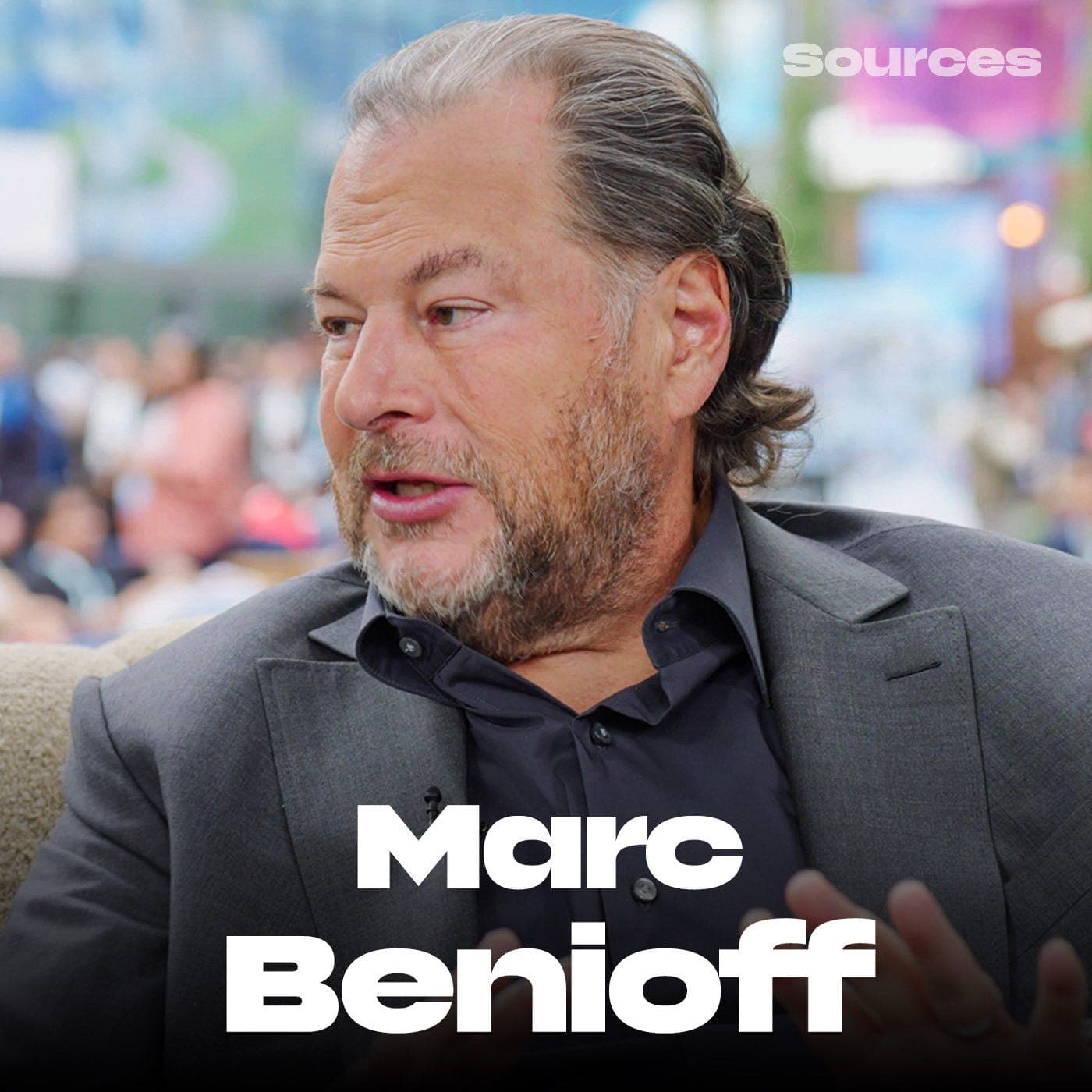

In short
Marc Benioff discusses Dreamforce’s AI moment and memes; the AI hype cycle’s uneven adoption; Salesforce’s “SaaSpocalypse” navigation; and the future of Slack as the agent platform and enterprise interface. He also covers 1-1-1 philanthropy, AI regulation/liability, Salesforce’s headless/metadata strategy, and Time’s shift to agent readership.
Guest(s)
Marc Benioff, CEO of Salesforce (and investor). Interviewer Alex (podcast host). Mentioned guests/leaders: Sam Altman (OpenAI), Dario Amodei (Anthropic), Jensen Huang (NVIDIA), Clem (Hugging Face founder/CEO), plus Peter Schwartz (Salesforce chief futurist) and “Dario” and “Sam” referenced in memes.
Key claims
AI transformation is “beginning of the beginning”; companies must ground decisions in customer reality amid misinformation; responsibility/ethics should precede regulation; Slack is the “agent for business” and runs much of the AI ecosystem; Salesforce will use multiple pricing dimensions (users/agents/usage/outcomes/business); dynamic interfaces are the next big shift.
Notable examples
Europe vs San Francisco autonomous driving; Hugging Face acquisition rationale after OpenAI model attack; SlackForce/SlackBot/Slack CRM; Madrid hospital channel help; Time being read by more agents than humans.
Written by AI. May contain mistakes. Listen to the episode to check what was said.
Chapters
Tap a time to open that second in VOThe Evolution of Memes
0:45 to 2:31
Marc discusses the changing landscape of memes and their cultural significance.
“memes and now we have a whole different set of memes.”
AI and Transformation
2:31 to 4:53
The conversation shifts to the current state of AI and its impact across industries.
“Yeah, and he was there, and you said that we're all following you, bro.”
San Francisco's Resurgence
4:53 to 7:10
Marc reflects on the spirit of San Francisco and its cyclical nature of innovation.
“And now it's becoming, I mean, I spend a lot of my time in LA and I'm like, I want LA to have a San Francisco moment now.”
Philanthropy in Tech
7:24 to 11:50
Discussion on philanthropy's role in tech and the importance of giving back.
“You had Sam and Dario here, which I think you might deserve a Nobel Peace Prize for.”
Ethics and AI Regulation
11:50 to 14:00
Exploration of the need for ethical leadership and regulation in AI development.
“Something else I've heard you talk about, and it's been the theme throughout Dreamforce this year, is how people are feeling about AI and the risks and regulation.”
Regulation and Market Incentives
14:00 to 14:16
Discussing the balance between regulation and private market incentives in tech
“I hope that liability, basic concept of liability, can help here, right?”
Hugging Face Acquisition Insights
14:16 to 15:38
Marc Benioff shares insights on the acquisition of Hugging Face and its implications.
“I wonder the reaction in that case, what it would have been.”
The Role of Meditation in Business Decisions
15:38 to 17:08
Benioff explains how meditation has influenced his decision-making process.
“And I called him back and I said to him, whether it's Salesforce acquiring you or somebody else, I think this is the time where you need to actually become part of something else.”
Investment Philosophy and Anthropic Partnership
17:08 to 19:06
Marc Benioff discusses his investment strategies and the Anthropic partnership.
“My grandfather, he didn't have a meditation practice, but he made sure that on a regular basis, especially like he was a great trial attorney.”
Navigating the SaaSpocalypse
19:06 to 20:22
Exploring challenges and strategies during the SaaSpocalypse phase.
“I knew Sam Altman very well and also had several moments with him.”
Show all 20 chapters
Reality Check in Technology and Misinformation
20:22 to 23:34
Discussing the importance of grounding in reality amidst misinformation in tech.
“Well, I think, you know, number one is we always look at customer.”
Customer-Centric Business Strategy
23:34 to 25:36
Emphasizing the importance of customer needs in business strategy.
“And I had to thank all of these investors who are here today for selling, you know, to me at$150 and now it's$250.”
Customer-Centric Business Strategy
25:51 to 26:17
Emphasizing the importance of customer needs in business strategy.
“Thankfully, Granola runs in the background the whole time.”
Customer-Centric Business Strategy
27:20 to 28:51
Emphasizing the importance of customer needs in business strategy.
“Banking services provided through Choice Financial Group and Column N.A., members FDIC.”
Marc Benioff on the Impact of Slack
28:56 to 32:36
Explore Marc Benioff's insights on Slack's evolution and importance in business.
“There was a story recently where Meta shifted to Slack because Alex Wang said internally, it's the best platform for agents.”
Pricing Models in the SaaS Industry
32:36 to 35:38
Discuss the complexities and future of pricing models in SaaS.
“Guess what platform they all use to run their operations?”
The Headless Future and Data Utilization
35:38 to 39:25
Examine the headless architecture and how AI uncovers hidden data value.
“just have Tableau or just have Informatica or just have Salesforce or whatever.”
Leveraging Slack for Real-time Communication
39:25 to 40:50
Understanding how Slack facilitates effective communication and problem-solving.
“I already see it in our own business because we've deployed Cloudforce already internally.”
The State of Media and AI Integration
40:50 to 42:00
Marc Benioff shares his views on the transformation of media through AI.
“I wanted to get your thoughts with the time we have on the state of the media because you also own Time.”
The Future of AI and Media
42:00 to 48:12
Discussing the evolving role of AI in media and future interfaces.
“It's pivoted in the last couple of months.”
Transcript
Automatic transcript. May contain errors.0:00Alex, thank you for coming, by the way, to Dreamforce. Of course. Exciting to have you here. Thrilled to be here. Is this your first Dreamforce? No, it's my third. Wow, amazing. Congratulations.
0:08Alex Heath:A lot of things to talk about, but first, I've got to ask you, Marc. Do you know what frame-mogging is? Well, I didn't know it as well as I do right now. You know it now. You're a meme. Actually, every year I'm a slightly different meme. A slightly different one. I've been enjoying the frame-mog memes. Yeah. Those have been big this year. I would say the other one is you and Jensen, where you say, we're all following you, bro. Yeah. That's been a big one. And I think that actually speaks to the moment we're in. These weren't planned, by the way. That's what I was going to ask you. Like when you do the frame logging, like, are you thinking through like people are going to mean this?
0:42I was just mentioning to a member of my team. I'm like, you know, a year ago we had a whole different set of memes and now we have a whole different set of memes.
0:49Alex Heath:Yeah. And like the memes from a year ago are forgotten and gone. Yeah. And I'm like, you don't know what's next. You know, I couldn't have told you five days ago that this would be the funniest thing coming out of Dreamforce, but that's the nature of the world we're in in social media right now. My favorite one is there's one of you and Sam and it says ARR meets AGI. That's a good one. And I've been reading about people trying to describe this year's Dreamforce on X. And my favorite one was it feels like a mix between a megachurch sermon and science camp, but for B2B sass. And when you see you walking through doing that keynote yeah i mean you've always kind of done it that way right that's where did you have the idea because it's become such an iconic part of the conference is that it's a huge nod to john chambers who was the ceo of cisco who hated to stay on the stage okay and so we would all be facing towards the stage and john would walk off the stage and walk into the audience and i was like whoa and I'm like I have to learn how to do this and train everybody to be a John Chambers and one of his key executives who I was very close with who's since passed on Rick Justice then became kind of the second acolyte to kind of come off the stage with John and I'm like whoa if he can do that we can get everyone to do that and then the one pivot is you may see we do more of a theater in the round because we don't really want to be a patriarchal structure in the room it's a little tries to be a little more yeah democratic because we have up and yeah well there's like 12 000 people in the keynote room right so and then it's all set and around but when we go on the road we're about to go on the road oh yeah and we're gonna do you know what we call the world tour so we'll hit all the major cities we'll go to tokyo we'll go to new york we'll go to london we'll go to paris we'll we'll take this show on the road chicago on and on on when we do that it's the same thing just slightly smaller right you know we're we'll we'll set it in the round and we'll always walk with everybody and try to be you know with our customers it's it's a it's a metaphor for being with your customer you don't have a prompter right you're just you're walking around no so many people ask me that question they're like did you memorize you but the you know the presentation is different every single time because of that yeah well jensen does that too if you go see jensen speak there's no prompter right i'm always amazed by that yeah the the the density of information that you're putting out.
3:13Yeah, he knows what he wants to say.
3:15Alex Heath:Yeah, and he was there, and you said that we're all following you, bro. Yeah. And I do feel like that's true. I think it's true. I'm asking that, too, to say, where do you think we are in the AI hype cycle right now? Do you think there's a little bit of, like, nervousness? Kind of what you said there, I think, was maybe speaking to a little bit of the nervousness that people feel. If I said it like that, I didn't mean to. I think we're in this incredible transformation of our industry and of many industries. And we're in the middle of it. It's exciting, you know, but we're still very much in the beginning of the beginning of what can be an incredible new, you know, chapter of the world.
3:53But you probably already heard me say this. You know, I just spent two full months in Europe and I met with hundreds of our customers. and things are different in Europe than they are here in San Francisco than they are in Shanghai. If you're here in San Francisco, you probably know there's more than a thousand Waymos driving around autonomously, and that's not the only autonomous company here in San Francisco. If you go to Europe, I didn't see one autonomous vehicle in two months, not one, not in any country. So that's kind of a metaphor, though, for me, that everyone is on a slightly different place in AI as an individual, maybe as a company, maybe as a country, we're in a continuum and we're all on that.
4:36Alex Heath:I'm glad you brought up San Francisco because you and the company represent San Francisco in such a big way. I mean, the tower behind us literally, but what this conference is and all the people you bring here for this. I've been dying to hear you just talk about the state of San Francisco because it feels like it's been back for a minute. And now it's becoming, I mean, I spend a lot of my time in LA and I'm like, I want LA to have a San Francisco moment now. I wonder if you think there's anything that could stop this train. It feels like San Francisco is very much resurgent. I'm so glad you asked that.
5:10You know, I think that it's a funny thing, San Francisco. It's a spirit. It's not just a city. And you have to appreciate that to understand what has happened here over a long period of time. People are like, wow, this is an incredible opportunity in AI. look at all these companies are all going to go public. I mean, I can think now multiple times in our industry when that cycle is happening. But you need to realize something, Alex. This is not our first gold rush in San Francisco. We've had many gold rushes. This might be the biggest. It could be our biggest, but it's not our first.
5:46Alex Heath:No, yeah. And I think that, you know, we have our moments in San Francisco that this is the city of the summer of love. You know, this is the city of Haight-Ashbury. This is the city of the gold rush. This is the city of Levi's jeans. Even, I love the family of the Gap and Salesforce. This is a special city now, OpenAI, Anthropic, all birthed in San Francisco. Yeah. And even, you know, Dario is a native San Franciscan. It comes from San Francisco, educated in San Francisco. So it's a special city. The spirit of the city can come through you and do some amazing things. It's doing itself again. And a few years ago, everyone was kind of second guessing San Francisco.
6:36But my opinion had never changed, which was, don't worry. it just keeps going through this same cycle over and over and over again.
7:10Alex Heath:This episode is also brought to you by Jira Bayadlassian, where teams and agents get the context, coordination, and control to move work forward. Try it free at jira.com. That's J-I-R-A dot com. You had Sam and Dario here, which I think you might deserve a Nobel Peace Prize for. But there's going to be so much wealth that's unlocked by those two IPOs in San Francisco. That's very true, yes. And you and the company really pioneered a way to do philanthropy, right, with your 1-1-1 concept. And it's still obviously a big part of what you do. And I'm curious if you've had conversations with some of, you know, Dario, some of these other AI leaders about what you've learned from philanthropy and how you would like to see them give back.
7:54Alex Heath:Because, I mean, we are talking about a record amount of wealth that's about to be generated. Well, telling entrepreneurs anything is extremely difficult. Yeah. So, and especially those entrepreneurs. But I would just say that you're right. We put 1 % of our equity, profit, and time into our foundation so many years ago. And that has unlocked this incredible capability, our ability to get back at scale. We've done 11 million hours of volunteerism, a billion in grants. We run 65 ,000 nonprofits and NGOs for free. Many of them are here. That is very important to us, that we didn't just do it, but we did it the right way.
8:35we didn't have to kind of go back and say, oh, I wish I had done it like that. We're older than these companies for 27 years, but we don't have to look backwards and say, well, I guess we should have, would have, could have done it. You know, we've done, you know, millions of hours of volunteerism in the schools. That is really important to me. I came from public schools that, you know, we're rebuilding playgrounds, painting schools. We give$100 ,000 every year to every middle school principal in San Francisco and Oakland to make sure that they have what they need to be successful. That is very important to us.
9:13So we're not just building another company that we're trying to give back. And also, we're not going to be like 100 years old and now we're going to give back. Because the power in giving is actually through, yes, you have this ability to write checks because you're public. But no, your greatest power is that you have your company. So the relationships and the employees and all of that is the ability to really make change.
9:39Alex Heath:Yeah. I had Sam on my podcast recently and I asked him about this. And I said, could you give back more? Could you build libraries? You know, lessons from the industrial revolution, right? And he said, well, I think the main way to get people to like AI is to build great products, which no question there. But I haven't heard any of the current leaders of this AI boom talk about it in the way you just talked about it. I don't know if you agree with me, but I would like to see more of that in terms of what practically are you doing in the community? Because as you know, people have a very strong feeling about AI right now.
10:10Alex Heath:And if these companies were to be playing more integral roles in their communities, I wonder if that would shift. Entrepreneurs always get dropped into different buckets in this category. and one bucket is a good friend of mine who's a great entrepreneur said hey Mark I don't think you're right at all who's done more for the world the Ford Foundation or the Ford Corporation and I said to him I think this is a false choice both you know why can you not do both that's my whole perspective when you start to actually try to separate these two things you're doing I think everyone a disservice when you put it together.
10:47You're doing everybody a great service and you have so much power in your capability as a CEO of a company or as an entrepreneur. If you actually decide to not only build great products or have great customers but also have great impact, you can do it all. And so you know this has been our message for a long time but not everyone is going to buy in because entrepreneurs are very opinionated. Doesn't matter who they are. They have strong philosophical statements and they'll either buy into that or they won't. But 20 ,000 companies have joined our 1-1-1 model through pledge1percent.org. And if you do go to pledge1percent.org, you can learn all about how to do this with your company.
11:29And I think it adds to your culture, makes for a great company, helps you to set the right values. Also, I think it helps in the employee behavior, that it sets the right tone from the top, we call it in business, that our employees know you need to really, you know, behave this way. And I think it's benefited us in so many ways.
11:50Alex Heath:Something else I've heard you talk about, and it's been the theme throughout Dreamforce this year, is how people are feeling about AI and the risks and regulation. You were very early saying social media should, you know, it's like cigarettes and calling for regulation. And I wonder what you think about AI and regulation and what you would advocate for, how you want our politicians, our leaders to be thinking about it. Yeah, I think I'm going to pivot back to what I said about COs need to make the right decisions. And kind of, we just had a good conversation about, all right, COs, are you going to put philanthropy and giving back into your culture?
12:29Now we have to kind of ask this question. okay, hey, CEOs, are you going to put responsibility into your culture? You know, that you really are trying to build the right kind of company, steer it with the right capability, as I said before, the right values. I think that that is the question. I think that when we get to regulatory conversations or regulatory changes, especially as they need to happen on a global basis, we have to look back over the last decade or more of social media. So in social media, we can ask ourselves the question, how many kids have been hurt? How many countries have been hurt?
13:10Why is it taking us so long for there to be some kind of come to terms with aspect of social media? It's been a shock to me. And you're right. I've been talking about this in nauseam for quite a long time because I believe that if you are a CEO and you're an entrepreneur, you have a responsibility to build a great company, to build great products, and to have a great impact on society and do it the right way. And I think that that's the basis of ethics in our society. And if we're going to have ethical companies, we're going to have to start with our ethical leadership, and ethics start with responsibility.
13:48And it's that simple. And I'm sure a lot of people take me apart for saying such a thing, but it also becomes very prophylactic around regulatory issues as well. Because when you have companies that are behaving at that level, it's not an issue.
14:03Alex Heath:I hope that liability, basic concept of liability, can help here, right? Luckily, you know, when OpenAI hacked Hugging Face, Clem is great. It wasn't too damaging to Hugging Face. Imagine if that was a large bank. I wonder the reaction in that case, what it would have been. And I do think we rush to regulation often as the public, but there are private market incentives at play. You are on the right conversation. And I talked about those Sam Altman, if you haven't seen the video yet, it's worth a seen. But Clem came to see me after this happened. And it's actually where the whole acquisition conversation really started.
14:44Oh, really? Absolutely. It was clear that here's this company, a great company actually, Hug Your Face. We invested in the company aggressively, a very important company for our whole industry because it's holding the jewels of the open source movement. And I said, Clem, this is actually pretty serious. You only have 200 employees. You can only do so much. And maybe you don't have all the security and capability that you need to defend yourself when an open AI model has turned its sights on you and attacked. And I said, do you also have the ability to do all these other critical things to create a very important company right now?
15:22And I think that's when he realized and I realized kind of together, maybe this was the opportunity for it to move from being an independent company to being part of something else.
15:32Alex Heath:Oh, wow. I didn't realize you played such a role in that. Well, I don't know how big of a role I played. I don't want to overstate it. but the conversation was very seminal. And I called him back and I said to him, whether it's Salesforce acquiring you or somebody else, I think this is the time where you need to actually become part of something else. It was clear to me, they are great entrepreneurs, but they were sub-scale at a moment that they needed scale. When you think about agents, I remember three years ago, you were talking about agents and here at Dreamforce and pivoting kind of the company towards this concept.
16:07Alex Heath:no one was really talking about agents like that. And I know you're a prolific investor. You've got Salesforce Ventures. You've got the Anthropic Partnership. And I wonder if that allows you sometimes to see around corners because I'm wondering what led you to see agents when you did because now is when they're starting to work, I think, at scale. But you saw it, it seems like, several years ago. Well, I think that fortunately for us, we're in a thriving ecosystem here in San Francisco. Yeah. And so the dinner conversation might be around one of these new technologies. There's so many things happening.
16:41I'll also give a lot of credit to meditation practice over three, you know, four decades. That having a few minutes every morning just to contemplate what is kind of going on, I think has definitely served me. I need to practice that. It's been an important part of my life. and I'm very fortunate to have some great teachers who impacted me very aggressively in the early 90s. And then I've been able to use that. Even this morning, I was made sure I took at least a few minutes to do that because so much is happening this week. I just let my mind relax a little bit. My grandfather, he didn't have a meditation practice, but he made sure that on a regular basis, especially like he was a great trial attorney.
17:24He only worked a couple blocks away from here at 690 Market Street. Now it's a Ritz-Carlton residence. That was his office building. And he would say when he needed to relax his mind and have a great insight, he would go to the movies. And he would get this revelation because it was the time where he could like stop working and like just let things happen. For me, it's just every morning a little bit of opportunity. And I think that it helps prioritize. Yeah, agents are very important. I think now we can see it's data is very important because if you don't have your data right, you can't get your AI right.
17:57Applications and analytics are more important than ever because if you don't have the applications and analytics foundation, including all of the APIs and the headless versions of these applications, it can inform the AI. You do need the agentic layer. And the fourth thing is this incredible new interface that we showed at this show, that the interface on the enterprise is going to radically transform.
18:20Alex Heath:Yeah, you've got Cloudforce. You've got the really, it seems, deep anthropic partnership. Dario was here. You were an early investor. I actually would love to know, I'm not sure I've heard you tell the story of that investment. Why you wanted to back Anthropic when you did. Well, it's been an exciting moment because you're right. We have ClaudeForce now, but also we've taken Slack and we've built SlackForce, which is this new UI. And we have SlackBot. Both of those are powered by Claude. There's forces everywhere. And we have Coworker now running in Lightning, also another amazing interface. And by the time we get back here a year from now, I bet we'll have a dozen interfaces all built on this AI force foundation and this headless capability.
19:00And you're right, 100%. It's because we have been pushed so close with Anthropic, but it was really an unusual story. I knew Sam Altman very well and also had several moments with him. And I was like, hey, I'd really like to be investing now in the company. And he's like, unfortunately, because of the Microsoft relationship. We were not allowed to invest in open AI. So that pushed us, you know, not because we were so smart to Anthropic, to Mistral in France, to Sakana in Japan, to go here in Canada, like to many other model companies, because we felt like, whoa, we can't go here. We're going to have to go everywhere else.
19:46And so we ended up with Anthropic, which will be a great investment. I mean, we'll make, I think we'll make not just billions, but maybe tens of billions of dollars on it. And it'll be fantastic for us. You've had a lot of good investments.
19:59Alex Heath:So that's saying something. We have, you know, bought a lot of companies, more than a hundred, but we've invested from Salesforce more than 700 companies. And we've taken so many of those great companies public, like Zoom, like Snowflake. There's been just some great, we just sold Whiz to Google. Yeah. You know, these have been great investments for the company. What are you looking for now in terms of acquisitions? Well, I think, you know, number one is we always look at customer. Customer is our word. We own a word. And it's all about customer for us. Customer 360, the customer touchpoint, whether it's sales, service, marketing, commerce, customer analytics, customer data platform, the customer interface.
20:43anything to do with customer we're very very interested in customer agents yeah anything to do with customer I'm very interested in you have the word customer in your tagline you're gonna get a call or you're gonna get a call from me I'm gonna be on your website I'm gonna be looking at what's going on I'm looking at anything with the word customer that is and I think that's been important having a point of focus yeah very important I can't believe we haven't said this
21:08Alex Heath:word yet sasspocalypse I never really got it I'm gonna be honest when it was at its peak forever because, you know, I just think people can rush to narratives, but it does seem, I mean, I saw you guys recently guided ahead of analysts' expectations of the revenue you're going to do through 2030 by several billion. And you've seen the stock start to come back. And I'm curious what it was like leading the company through kind of the pit of SaaSpocalypse and how you navigated that. Well, it was a strange six months. Yeah. There's no question. All the SaaSpocalypse nonsense. We just had the best second quarter that we've ever had.
21:45Everybody saw the revenue was amazing. The margin, the cash flow, very low attrition, and also very high contract lengths from all of our customers. But I think that people don't realize that we are in a world today of misinformation. And on social media, you just don't know when you're watching a podcast like this, or you're reading a tweet like that, or you saw a post like this other thing, which of these are real and which of them are not.
22:13Alex Heath:We are a real audience. We are real. But yes, you're right. And I find that to be a very important moment. And I myself get very confused. So I can understand why everyone else gets confused because I get confused. And that's why I mentioned this already. I'll mention it a second time why I just moved to Europe for two months just to be with customers in their offices because that's reality. What do you want? What are you doing with your company? Where are you making investments? What is important to you? How am I going to help you? What are the right things to support you? When we're looking at all of those things, that's real.
22:54And when we read a post about something that is trying to maybe get somebody to buy a stock or sell a stock because someone is trying to make money or a group of people have gotten together to buy a stock or sell a stock or to promote a private company or a private company investment theme. That is not reality. And then nobody is held accountable for these things either. They go by so fast and there's so many of them. So you have to be more careful today than ever.
Read the full transcript
23:23Alex Heath:Accountability may be losing money on your stocks that you bought at the wrong time or sold at the wrong time. But yes, I hear you. Listen, I just bought$25 billion of Salesforce stock in the public market. And I had to thank all of these investors who are here today for selling, you know, to me at$150 and now it's$250. So, you know, it was, that was, I was very grateful to them. What gave you the confidence through all that? I mean, you can see the numbers, obviously, but I mean, I think there's some logic to people saying anyone can make software, therefore a large software company like Salesforce is challenged, right?
23:58Alex Heath:I see through the clouds, I see the logic of that, right? And you were saying like, it's hard for you to make sense of when it's coming at you fast. Like, were there ever moments where you're like, man, like, am I not seeing what everyone else is seeing here? Well, of course, you're going to get that kind of doubt. That's why I think ground yourself in the customer reality. Get back to the customer, really pay attention to understand what is their need? What is their unarticulated need? Yeah. I think this is really an important part of business, more important today than ever. Do you think there's any SaaSpocalypse risk for any kind of company?
24:33Alex Heath:Or do you think it's all overblown? Listen, we're in a world in business and technology where technology is always getting lower cost and easier to use. And companies are always succeeding and failing. There's no difference. You can see that across the whole stock market. Look at who the top 20 stocks are today and who are the top 20 stocks 10 years ago. It's a different set of stocks. So to all of a sudden say that you've got it exactly mapped out, you know, it's a very aggressive, you know, prediction frame. So humility, just expect the unexpected, it sounds like. I think it's a very key time to really to ground yourself in reality.
25:15I think COVID really illuminated that for me. Oh, yeah. You know, we went through COVID and I think a lot of the things were kind of going, what's true, what's not true? and you might be reading something in social media and then six months later he went, wait a minute, that actually did not happen. Right. Or that is not real or this is real. And I think that each one of us has to kind of take, you know, more personal time to say, okay, let me just dig in a little bit and know what is really actually true.
25:44Alex Heath:I spend a lot of time context switching between meetings, often with no time to process one before the next starts. Thankfully, Granola runs in the background the whole time. It's an easy-to-use AI notepad for meetings that works everywhere, even on phone calls. I use Granola to recall what was said in meetings and create helpful summaries. I use it every day to stay on top of what I need to get done with my team. It connects to my email and suggests follow-ups for me to quickly review and send, saving me valuable time. Granola isn't just a core part of my workflow, it's basically my second brain.
26:15Alex Heath:Try Granola at granola.ai slash sources and use the promo code sources for three months off. Mercury is a modern take on banking built for startups like mine. When I decided to start my media business, Mercury was by far the most straightforward, full-featured banking solution for me to set up quickly. The interface is intuitive and simple, saving me valuable time every day. I use Mercury to track my spending, bills, and invoicing. I love that I can delegate permissions to my team so they can keep things running for me in exactly the way I want them to. My favorite part is how forward looking Mercury is with AI.
26:50Alex Heath:Legacy banks are stuck in the past, but Mercury is built for how modern software works today. I use its built-in command assistant to analyze cash flow and help me move money. And Mercury also connects to other AI tools like ChatGPT and Cloud. I use this feature all the time and the folks at Mercury actually let me know that I'm one of the top users of it. So trust me, It's finally easy to get real-time financial data about your business wherever you need it. Visit mercury.com to learn more and apply online in minutes. Mercury is a fintech company, not an FDIC-insured bank. Banking services provided through Choice Financial Group and Column N.A., members FDIC.
27:26Alex Heath:Framer is the AI website builder that brings agents into the same canvas where your website is designed, managed, and published, so you can move faster without giving up your taste or control. Framer powers the Sources podcast website at podcast.sources.news, where you can find new episodes, transcripts, and a lot more. Learn how you can get more out of your site from a Framer specialist or get started building for free today at framer.com slash sources for 30 % off a Framer Pro annual plan. That's framer.com slash sources for 30 % off. Framer.com slash sources. Rules and restrictions may apply.
28:03Alex Heath:AI is only as useful as the context it has. But when that context is scattered across tools, threads, and DMs, your team and your AI agents are flying blind. That's the problem Jira by Atlassian solves. What's the goal tied to your project? What got decided last week in Slack DMs? Atlassian's teamwork graph pulls all of the valuable pieces together, from Jira, Confluence, GitHub, Slack, and more, so nothing falls through the cracks. You get 44 % more accurate results with 48 % less token usage. With Jira, you can easily share your work context with AI agents you already love, like Claude, Cursor, and GitHub Copilot.
28:39Alex Heath:Assign them work directly or connect your tools through MCP. All of this lets you spend less time digging through endless links and messages, chasing down what got decided and by who, and spend more time actually shipping. Learn more at jira.com. That's J-I-R-A dot com. I'm fascinated by Slack right now. There was a story recently where Meta shifted to Slack because Alex Wang said internally, it's the best platform for agents. It's true. I have a lot of agents in my Slack. I know a lot of other people do. OpenAI and Anthropik, I think those companies quite literally run on Slack. You hear about it when you talk to them constantly, Slack, Slack, Slack, Slack, Slack.
29:15Alex Heath:You bought Slack many years ago, and it was well before agents. Six years ago. Yeah, well before agents. Yeah. And I'm curious now, looking at where Slack is now and how integral it is to Salesforce into the tech economy more broadly, did you have any idea that this would be what Slack is now when you bought it? We always knew that we wanted to own Slack and we knew we wanted to own it because our premise was that it was gonna be the agent for business. No way. Six years ago? I have the paper, I can show it to you. Wow. So this was important to us. We paid a pretty high price for the company at the time.
29:55Yeah, you did. about 25 billion was controversial you know it was a about 900 million dollars so you can in revenue so you can think it was about 25 times revenue and we got a lot of slack for buying slack if you will because yeah we paid a high price but it was going to trade once and we felt that we needed to step up today everybody says it was the greatest acquisition it's up there of all time and we've innovated aggressively on the platform we've introduced slack code yeah so that you can code and channels. We have Slack CRM so you can operate Salesforce directly from Slack or even if you're a small business you can use Slack as your CRM.
30:34And now we have also Slack Force so you can build a highly customized surface across your whole enterprise. You know on Slack that's dynamic and intelligent and composite and has zero data retention so none of your data goes into the model. And it's been a great platform but the ecosystem and the success and like you said these large customers like not just Facebook but or you know Meta it's also Nike has gone to Slack I just spent some time with the COO there's the big power user there General Motors just moved from teams on to Slack and I think this is the moment where more companies need to look at Slack as their operating system it has been a huge boost of productivity for our company I'm sure for every large company.
31:21Alex Heath:Well, the way it works with AI, I mean, where you can send it, send stuff from AI in there, back out, super flexible. It's amazing, isn't it? Yeah, it is. And I, it's just so interesting to hear you say that you were thinking about agents six years ago. Yeah, we were. We're very fortunate. And I'll give a nod to our chief futurist, Peter Schwartz, who worked very closely with me on the Slack acquisition, because he actually was the one who wrote this. Now, you may know Peter Schwartz because he was involved in writing the movie Minority Report. That's right. and also War Games and Deep Impact and a few other things.
31:54And he is remarkably prescient and has tremendous vision. Just turned 80 years old. Lives very close to me. And we spent a lot of time together. And, you know, he's been an incredible influence on the whole company. And in Slack, I had felt very closely it was about Slack. I didn't think that they would ever sell to us, you know. And then Peter kept pushing, pushing, pushing, saying, you've got to do more with Slack.
32:22Alex Heath:Do you and Stuart ever catch up and just marvel at the state of Slack now? Probably not as aggressively as we should. But I'm sure he has some mixed feelings about selling the company, realizing that today it is the operating system for the whole AI industry. We mentioned great companies like NVIDIA. OpenAI. OpenAI. And Anthropic. Guess what platform they all use to run their operations? Slack. Yeah. It's pretty remarkable. It is. When you think about the future of Slack, what is it? I mean, I would venture to say there's maybe more agents already on Slack than humans, maybe, but certainly in the future.
32:56Alex Heath:And I'm curious, you know, when you're thinking about the roadmap for Slack, what is it? Well, when we talk about the data for the company, when we talk about the application and analytics and semantic layers, and we talk about the agentic layer and the interface layer, Slack is very much three of those. So it's not holding all the data for the company, but it's holding your DMs, it's holding the channels. It has a lot of the application functionality over. And it has the agentic framework that's integrated with the top agents in the industry, like Vercel and Linear and all the major agent platforms.
33:34And then now it can build these highly customized interfaces. It's a really cool product.
33:39Alex Heath:Related to Slack, I'm curious how you're thinking about pricing and AI. because you and the company basically invented the way that SaaS is sold on a seat-based basis. And I'm hearing a lot from AI startups that it's all outcome-based now. You guys are starting to do some of this. I'm curious, can you actually do outcome-based pricing well right now? Well, let me tell you my view directly from being with so many customers. And that is, number one, there is no perfect pricing mechanism for all customers. So I look at it on six dimensions. So, you know, look, named users is still a major, you know, aspect of our industry.
34:22I'm sure you have either Claude or OpenAI and you pay a per user price per user per month. So named users and also named agents. So you're paying by the agent. You know, I think number three is usage. I've used so much of the product. number four might be consumption I'm consumed so much it could that could also be tokens that could be storage number five is going to be outcomes transaction outcomes I completed the transaction therefore I'm paid and the final one is business outcomes I saved you so much money I want a percentage of that or I made you so much money I want a percentage of that and you're gonna do all
35:07Alex Heath:those? Well, a company our size, we're going to do more than$50 billion next year. Right. We cannot be limited by one pricing model. We have to do users, agents, consumption, usage, transactions, and business. We have to do all of it. And our customers, we're willing to write with them a custom agreement to say, this is the perfect agreement for you. And I think it's the right way to think about it. We're not a one product company. We're not just have Slack or just have Tableau or just have Informatica or just have Salesforce or whatever. We have many products to build. Fin now, another one. Or Fin.
35:48All of these things are going to be a little bit different.
35:51Alex Heath:Which one do you think is the biggest growth vector over the next few years out of the ones you just said? Well, I don't know. I mean, Slack is like up and to the right in a way that we haven't really seen. I mean, in enterprise software, it's pretty incredible. So that's the current, you know, rising star. But you mentioned Finn, we just bought this company. I'm a huge fan of Owen and what he's built. It's a company that we have wanted to buy for years. And it was just kismet that finally Owen said, you know what, Mark, now is the time that we want to be bigger. And we want to bring to bear. We're introducing Finn to a lot of enterprises and mid-market companies here.
36:31And I always felt that they would love it. And I think they're realizing Fynn isn't just for small businesses, it's for all businesses. And it's the fastest way to customer agent success. Yeah. There's no question. You want to go fast into customer agents, you want Fynn. It's an incredible product. Owen and his team are remarkable. They've done a fantastic job and everyone should see the product. It's just awesome.
36:56Alex Heath:This headless idea that you and the company are doing and more people are starting to do. How headless does all of this get, do you think? I mean, how much of the interface do you need to control versus an anthropic inside, Salesforce and Claude, and then there's Claude and Slack and all these things. But what part of the interface do you have to protect as the CEO of Salesforce? It's a funny thing. When we first tweeted that we're going to do headless, we're regarded as these incredible visionaries and amazing. Now we actually finally understand, you know, what the Internet is all about and AI.
37:32So and then I said to myself, you know, we didn't get that kind of support when we announced our XML API 20 years ago or SOAP API or REST API. It's only that when we announced our MCP API or our CLI interface that all of a sudden everyone's like, oh, wow, these guys are just doing an incredible job.
37:53Alex Heath:MCP is exciting. MCP is exciting. Yeah. But I feel that way. I love all my APIs equally. So Salesforce has always been headless. You've never had applications that were fixed. All the apps were always decomposed into metadata. And then that metadata was always then recomposed into these browsers, into Chrome, into Safari, into Mozilla. Now, the metadata is just recomposed into Cowork or into Claude or into maybe ChatGPT. The new versions look like they are getting ready to be a Surface, into Slack, into Lightning. So that idea that you have this ability to start to render and generate many surfaces, you need to have the application definition, the fields, the page layouts, user models, the sharing models.
38:51All of that is stored in Salesforce metadata that then gets re-composed into these incredible capabilities.
38:59Alex Heath:And you were talking about traps data in the keynote a lot and bringing that trap data up. That's what I really am trying to say, and I'm probably not saying it correctly yet, is when we have so much data in that metadata with our customers that there is value in there that you don't see. Humans can't go through all that. Yeah. And the AI is going to find the trap value, and it is going to deliver that in some incredible new ways. I already see it in our own business because we've deployed Cloudforce already internally. So our major operating unit leaders are running on Cloudforce. And you've seen it change.
39:36A hundred percent. Like we're showing our customers here how we run our business on these new next generation surfaces now.
39:45Alex Heath:How has it changed how you run the company? The way I can run the company today is I'm able to use a variety of surfaces to look at the data. Not just the traditional Lightning interface, but as we mentioned, like Slack is a great interface for me. I love Slack because not only can I look at the applications and operate in them, but I can also operate in the channels, which I do aggressively, and I can even direct message customers. In a very specific example, during the show, on Tuesday night, I got a message from a friend of mine who had a sick employee's wife in a hospital in Madrid trying to actually find somebody who could help them.
40:29Well, guess what? We have a hundred and something employees in Madrid. We have a channel set up with those employees. I was able to broadcast to them, hey, can anybody help this person? And that was like, you know, the ability to communicate, to share information, to manage it. I love Slack. I'm so in love with it, really. It's such a great platform.
40:51Alex Heath:I wanted to get your thoughts with the time we have on the state of the media because you also own Time. And I think Time's... Congratulations on your cover story. Thank you. I was fortunate. I hope everyone read the cover story. I think people did. Trust us? It was the trust us. Did you write the headline? I did not. The editors control the headlines, as they say. They do. But I was very fortunate to get to do that with your team, and it was a great process. But, I mean, time, it seems like it's very ascendant. And I'm curious, you know, when you bought time, why? And to hear you kind of talk about what you think about the media right now.
41:25Alex Heath:Yeah. Because it's in a huge state of transition. Yeah, I mean, I think, again, if you read on social media, all these things about mainstream media and the end of mainstream media. But listen, I think that we can stand by a lot of our stories in Time, if not all of them, as being true. This is very important to us. We publish information that we believe that is true. It's one of the reasons why today there are more agents that are readers of Time magazine than humans. Did you know that? No, I didn't. Yeah. Not surprised, though. It's pivoted in the last couple of months. We have more agents reading Time every day than humans.
42:07And as humans go to those AI sites, whatever, and they want answers to questions, those calls come out to Time to get real-time information. And we've opened our doors to those agents to let them work with our platform. Now, to do that, however, we've had to rewrite the way that we do our content. Even our ads have to become agent friendly because agents are also reading our ads. Yeah, I know. Isn't that cool? And so we've had to rebuild how we're doing that. And it's very important in today's world. Yeah.
42:42Alex Heath:Well, it's the economic model of the web you're talking about. And so that's what I've been thinking about. how does the advertiser get something on the other end when it's an agent that reads it, not a human? The same way. You're charging basically on the advertising. You're still charging companies and showing them that they're getting these ads being read. You can even have these very specific metrics. But you made a very important comment. You said time is very ascendant right now. And I think it's really true. I mean, one is we have made a lot of important changes with the companies so that we have a business model that works.
43:16a technology model that works, and also we have outstanding journalism. And we also open our journalism to folks who are competent, very capable people like yourself, even though you're not an employee of Time. You wrote a major cover story for us. I like to encourage a lot of my friends, like Ray Dalio, also writes for Time quite a bit, and others. And I say, please write for Time and give us that expertise. So these things are very important to me. I'm very happy the time is doing well. It was a little bit of a high-risk maneuver to buy it, you know, when we did. But I would say it's worked out well.
43:53I'm very happy with the team, and I'm very proud of the work they're doing.
43:57Alex Heath:Are you still interested in media as a category for future things? No, I don't think anyone should have more than one magazine. Okay. Our media company. That's good advice. This is my one moment in media, yeah. Okay. We were talking earlier about, you know, you saw agents three years ago pivoting the company. What are you looking at now that's exciting you that you think we're all going to be talking about in a few years? Is it still going to be agents? Is it going to be everyone's talking about these personal assistants, instinct, talent, etc. I think that's still early, but what are you seeing that you think we should all know about?
44:28Well, I am very very excited about these dynamic interfaces. I think people will be shocked when they see what the future interface of the computer looks like. We've only seen it in science fiction. We've only seen it in the movies. And we showed at this show, I think for the first time, on a large scale, the next generation enterprise interface that is intelligent, that is conversational, that is adaptive, that is dynamic, that feels like it's live or living. That's a big idea. And that's not the way enterprise applications are today at all. Those aren't words that we use in enterprise applications ever.
45:13That is a big thought. These other areas that we've gone through, data, applications, semantics, analytics, agents, I think are very well discussed. And I think the part that's not well discussed is the interface. So I think that when we kind of said to everyone, here's the next big thing, which is what, look, we want to be relevant and we want to be able to kind of make it clear, like we have a good vision for the future. I think we got it right on interface. I think this is going to be the next moment and we're going to see everything change on the interface. Look, pick up your iPhone right now or your iPad and you're going to see that your interface has not changed since we started the interview.
45:57Nope. Nope. That is not going to be true for very much longer.
46:02Alex Heath:Okay. It's going to be like listening to me. It's going to be adaptive. It's going to come back and say, oh, this is going so well, Alex, but you didn't ask Mark this, or have you thought about that? Or yeah, I went back and when Mark said to say, I'm all in the interview. Yeah, I read, and maybe you should consider this question now. And also, oh, and here's how your whole life is going and how many emails have come in and all those things. But no, if you look at your iPad now. The interface is none of those things. It's the same thing, the same icons, the same email list. Alex, that is going to change.
46:38And that is going to be exciting. And that's going to be a huge opportunity for not only companies like Apple and Google and others who make these kind of interfaces or televisions, you know, like the Samsungs of the world or the LGs, but for a lot of new companies. That's why you hear companies like OpenAI and others are investing in new kind of phones and new kind of devices because there will be a wave of new interfaces. So each of these levels will change. You know, a lot of discussion is about the data center today, the land, the power, the energy, the chip, the memory chip, the GPU, the physical data center, all of those things, the conduit, the transport.
47:23But then we get back to the application stack that we just went through. You know, a lot of those pieces are evolving to be able to support both a deterministic world, which where we've traditionally been knowing exactly what is happening with the probabilistic world that we see in AI, which is that the AI is trying to figure it out and putting those two things together so everything becomes more grounded and true. But when you do that, it can become more dynamic. And that is what is going to be very exciting.
47:55Alex Heath:All right, Mark Benioff, I'm going to hold you to that. All right, Alex. All right. Thank you. Thanks. Great to have you here. Thank you. Thanks for having me. Number three. Well done. Thank you. Granola is the best AI notepad I've tried. It works everywhere on a video or phone call in person or an Apple Watch. Try it now at granola.ai slash sources and use the promo code sources at checkout for three months off. Banking should feel like modern software. Get everything you need in one place. Visit mercury.com to learn more and apply online in minutes. Mercury's a fintech, not a bank. Check the show notes for details.
48:28Alex Heath:Framer is the AI native website builder that lets you build faster without giving up control. Visit framer.com slash sources for 30 % off. Rules and restrictions may apply. Jira By Adlassing is where your team and your agents work from the same context. Try it free at jira.com. That's j-i-r-a dot com.
From the publisher
Salesforce CEO Marc Benioff and I discuss his framemogging at Dreamforce, the state of the SaaSpocalypse, and how Slack is more important than ever in the age of AI.
We also discuss the resurgence of San Francisco, his role in the recent acquisition of Hugging Face, the wealth being created by the IPOs of Anthropic and OpenAI, and what he thinks the industry can learn from the social media era.
Thanks to the show's premier sponsors: Granola, Atlassian, and Mercury.
This is a public episode. If you'd like to discuss this with other subscribers or get access to bonus episodes, visit sources.news/subscribe