Ask ChatGPT

 Sources with Alex Heath
5 Oct 2026 · 1h 2m · 21 chapters
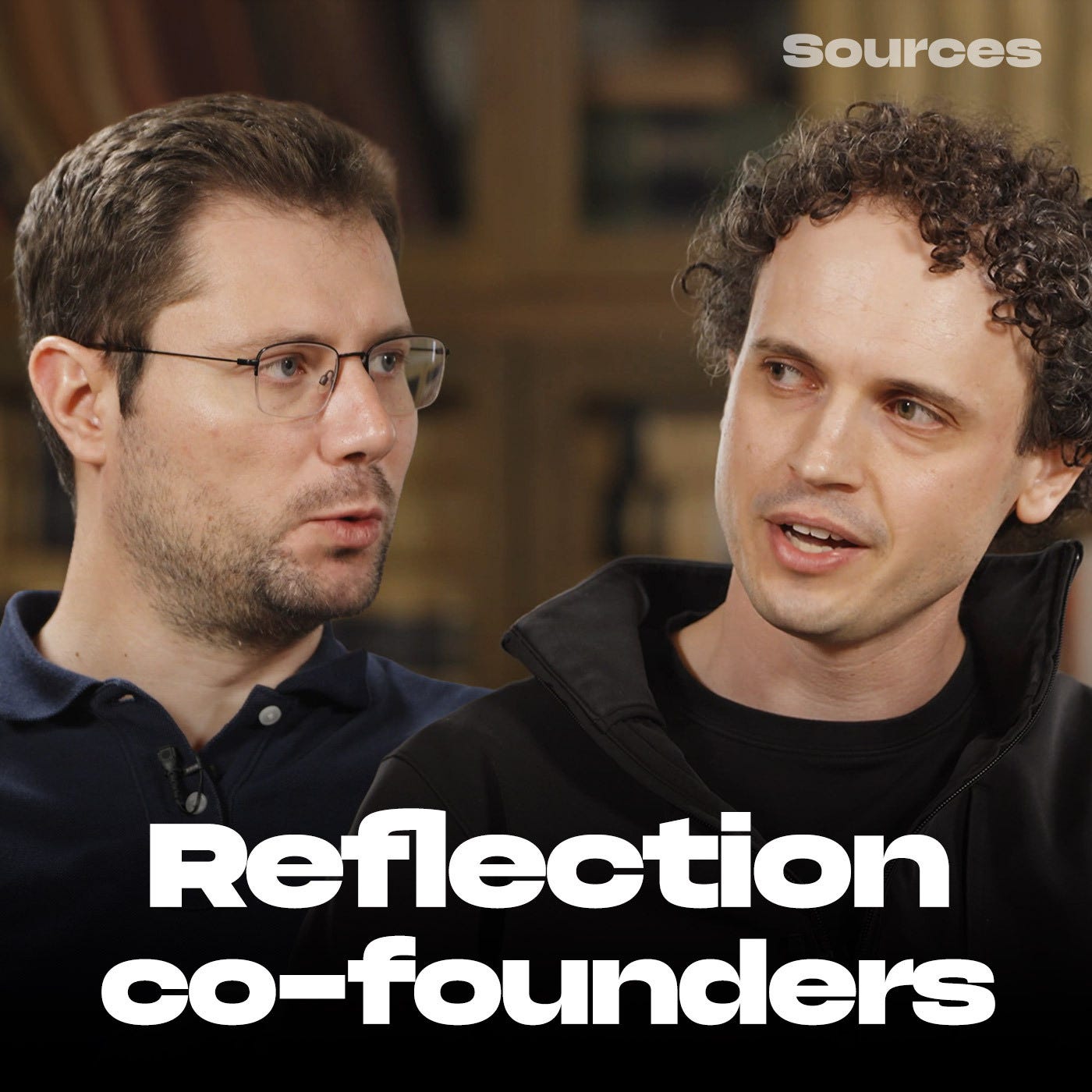
Reflection’s founders argue that open-weight models are becoming the “ownership” layer of AI as the market matures, driven by compressed timelines, enterprise adoption, and geopolitical incentives. They discuss why China led open models, Reflection’s first release Beam, their from-scratch training approach, and how they think about safety, alignment, and monetization.
Misha (Reflection co-founder; previously at DeepMind on Gemini; RLHF lead background mentioned) and Giannis (Reflection co-founder; previously at DeepMind; RL researcher; “boss”/manager relationship with Misha described; now equal partners/CEO).
Written by AI. May contain mistakes.
Discussion on the factors driving the current interest in open tokens and models.
“You know, we decided to really push for building great open models at this company about a year ago.”
Giannis shares insights on the current state of open models and their competitive edge.
“Giannis, though, I'm curious from your perspective, technically, the state of open models, has the progress surprised you?”
Discussion on why Chinese labs have led the development of open models.
“model development, then that's the thing that develops first.”
Exploration of Reflection's new model Beam and its anticipated impact.
“You guys are talking about Beam, your first model, which I think everyone in the AI community has been buzzing about.”
Discussion on the potential consumer applications of the new open model.
“never cares about, like a compact model that uses its tokens efficiently and intelligently to solve tasks.”
Discusses the rationale behind training AI models from scratch instead of distillation.
“what others build on top of these open models and how can we empower both enterprises and companies building consumer applications.”
Explores the importance of safety and alignment in AI, especially for open weight models.
“I'm curious how you all are thinking about safety and alignment.”
Highlights the significance of community involvement in identifying vulnerabilities in AI systems.
“who can investigate and inspect these systems.”
Discusses the risks of centralized control over powerful AI and the need for a decentralized approach.
“But is there a capability threshold you would hit where you'd go, we can't put these weights out?”
Explore the challenges of controlling AI systems and the importance of redundancy.
“and therefore it's not fair to compare to an operating system.”
Explore the challenges of controlling AI systems and the importance of redundancy.
“I'm not an accountant, and all of the software out there is unintuitive, clunky, and detached from where my transactions actually live until now.”
Learn about the founders' journey from DeepMind to starting Reflection.
“I actually heard that you reported to Giannis at one point.”
Discussing how Reflection plans to make money with open models.
“where teams from different offices would come together.”
Exploring the need for infrastructure and scalability in AI business.
“And that brings me to my question about the business.”
Explore the dynamics of serving AI inference and the implications for market competition.
“And the estimates are that there'll be tens of gigawatts of open model inference served within the next few years, which is a lot.”
Learn how trust influences enterprise decisions in adopting AI technologies.
“all of the hyperscalers, it's really like just the reflection compute that serves the reflection models?”
Discuss the need for building ecosystems around AI models and commercial partnerships.
“The internet was actually built by open software that was developed here in the US, and that actually affected the position of the US in the world and how the internet was built.”
Examine the significance of open models as foundational infrastructure for future economies.
“with the model that help the community We better understand and build safety guardrails, agents, and so forth.”
Delve into the future of AI markets and the potential for multiple intelligence providers.
“And in a closed lab, that's, again, abstracted, and so you kind of just get the experience out of it.”
Explore the future of AI and intelligence in a multipolar landscape.
“And I hope, right, we move into a world with a multipolar world with a lot of intelligence providers.”
Explore the future of AI and intelligence in a multipolar landscape.
“Granola is the best AI notepad I've tried.”

Get the gist, explore an idea or ask about something said.
 Claude
On Sources with Alex Heath, what are the key points of this episode?
Searching your listeningAutomatic transcript. May contain errors.
0:00Alex Heath: I've been thinking a lot about timing as we were preparing to have this conversation because what you guys are doing with Reflection feels very apt to the moment we're in. I was looking and mentions of open models on earnings calls 6x'd in Q3 and open model tokens are now the majority of what's flowing through Vercel and OpenRouter. So there's this real shift that's been underway and you guys have been in stealth and have big news that we're going to talk about on the open model front. But first, before we get there, I'd be curious to hear you both comment on what you think is driving this moment right now in terms of the surging interest in open tokens.
0:37Alex Heath: There's multiple things here I think we can peel back at. But if you were to kind of look at it big picture, what do you make of the moment we're in? Misha, we could start with you. You know, we decided to really push for building great open models at this company about a year ago. And at the time, I think that there are some things that we saw that would be kind of happening that have happened faster than we expected. And maybe one way to think about why open models are so top of mind and so important right now is using a real estate analogy, which is we have to remember that in the AI market, this market commercially has only existed for maybe three years.
1:21the market effectively started as a rental market. Closed models are the equivalent in real estate to renting an apartment. You're renting your intelligence. And that makes a lot of sense, especially when you're earlier in your life, you're a student or you just graduated college, you might go and rent an apartment. But as a consumer, you get older, you have a family, you have more finances. Ownership starts mattering a lot more in the real estate market. And so That's why there's rental and ownership in real estate. AI timelines are compressed, and so we've been in this commercial market for three years, where effectively in the West, there's only been a rental alternative.
2:02Now what we're seeing is that as the adoption has increased and the small startups that were tiny a few years ago are now giant enterprises and large enterprises have adopted AI, an ownership market is basically coming in. And the only way to own intelligence is, by definition, if it's open. Because if it's open, you can run it on your stuff. You can own it. You can control it. You can customize it. And what we're seeing is that the reason this has happened so quickly is because AI as a market has grown so quickly. And you're right. I think that 12 months ago, not that many enterprise at all were using open models, and not even startups, really, were using open models all that much.
2:43Six months ago, a lot of startups that had grown at the application level started switching to open models and have continued growing very quickly. I think that's where maybe six months ago, there was 30 % of token consumption on open router over cell was going to open models, 70 % to close. Now, six months later, it's flipped, where it's maybe more 70 % on open models and 30 % to close. And so we've just seen a very fast movement in the maturing of the AI market. And I think that is one thing. And obviously the geopolitical thing is the other thing.
3:20Alex Heath: Yes, which we'll get into. Giannis, though, I'm curious from your perspective, technically, the state of open models, has the progress surprised you? Is it about where you expected if we were to have looked out a year ago to now? As you've been thinking about the research roadmap, have you been seeing this moment coming or has this surprised you as well?
3:40Ioannis Antonoglou: No, actually, I think that if you look back, you can see that the open models have kept pace with the closed models. And I think maybe there's even a shorter distance between the open and the closed frontier currently with the biggest Chinese models. And I think that this is something that will just become more prevalent in the future. in the sense that I don't see why the closed frontier should just stay behind the closed frontier. It's a matter of just having the talent and the compute, and you can definitely just build open models that punch at the same level as closed models. And one thing to say here, I think there are two main reasons why we're also seeing this adoption of open models by enterprises and startups, in my mind at least.
4:31Ioannis Antonoglou: like one is the fact that the capabilities are there now like you know we have like some really powerful Chinese models or like open models in general which can really be used in in in the place of like closed models and the second thing is that the market has started to mature like to to Misha's point and what we've seen in the software market is is that like whenever something matures there's like always a movement towards the open alternative you know once the the market matures and the social market matures, then there are open alternatives and then enterprises and companies and individuals just like move to the open alternatives.
5:09Ioannis Antonoglou: And I think that like something similar will happen with the AI market as it matures further.
5:14Alex Heath: This episode is brought to you by Mercury, AI native banking that's loved by more than 300 ,000 entrepreneurs, including me. Visit mercury.com to learn more. Mercury is a fintech, not a bank. Check the show notes for details. This episode is also brought to you by Jira by Atlassian, where teams and agents get the context, coordination, and control to move work forward. Try it free at jira.com. That's J-I-R-A.com. Thanks also to Granola, the AI notepad for people in back-to-back meetings. It works everywhere you do and lets you focus on what matters. Try it at granola.ai slash sources and use the code sources for three months off.
5:53Alex Heath: You all are obviously an American company and you have your model coming out, which we're going to talk about. But I'd be curious to hear from you all, why is it that China and Chinese labs have just dominated on Open up until this point? I mean, Meta had its moment with Llama 3, but really the West has completely lost the frontier of Open until you guys. And I'm curious, what is it about the Chinese labs if you guys were to armchair it that you think has led them to catapult the way they have? The thing that drives technological development in the West is ultimately it's capitalistically and commercially driven.
6:30And if you're in an early market that is a rental market that primarily supports closed model development, then that's the thing that develops first. And it's only once the market is ready for ownership that I think there's a kind of commercial and capitalistic market support for open models. So I think that, for example, I mean, America used to have the best open models. Indeed, I think the highlight, the peak of that was Lama 3. But there was no real commercial incentive at the time for, you know, Meta to do that or for anyone else to be producing great open models in the West. I think that, again, armchairing this, that China has a different mindset that is more geopolitically motivated, and that I think that there was a bit of a sort of fluke moment, like a moment that was hard to predict, which is when DeepSeq v3 came out and was so good, and made Chinese intelligence abroad so relevant in a way that it hadn't been before.
7:32And I think that there was a concentrated push to support an open source ecosystem, primarily driven for geopolitical reasons. And so these labs in China were not actually making that much money at all until recently, until their intelligence got good enough and the market matured that there's a commercial market for open intelligence and now they're starting to make revenues. So I think that my view is that what happened there was primarily geopolitically motivated in China to kickstart that ecosystem.
8:03Alex Heath: Well, I think that brings us to what you guys are doing. You guys are talking about Beam, your first model, which I think everyone in the AI community has been buzzing about. What is Reflection doing? When are they shipping? And the moment's coming now. So you've got Beam, and it's around a 500 billion parameter model. On the open benchmarks, it seems state-of-the-art. But I'd be curious to hear from you all, and as we're talking, you're still kind of going through the final phases of validation and all this. But I'd be curious to hear from you all what you expect the reaction to this model to be.
8:36So Beam is our first model, is our first open weight model. We're very, very excited to release it. I think it's, you know, building a company is, I think there's a Reid Hoffman quote that it's building a plane while you're flying it. And the plane's been built. So I think we're very excited about that. It is indeed around 500B total parameter model, 23B active. and it advances the frontier of Western open models in a meaningful way, which we're excited about. The things that we think we're proud of with this model is its particularly strong encoding and agentic benchmarks. We believe that the form factor and the strength in these capabilities make it a really strong workhorse model for enterprises, public sector.
9:30It has this kind of utility, but also efficiency around it that I think will be appreciated. The other thing that we're really excited about is that it's a model that is leading in its reasoning efficiency relative to other open models. And when we say reasoning efficiency, we mean how fast does it solve a task relative to the compute it has at inference time or relative to the tokens that it has at inference time. and, you know, Giannis and team did some incredible work to get that statement. You wanted to share a bit of that.
10:06Ioannis Antonoglou: The form factor of the model is a 500 billion parameter model. It's 23 billion active. And if you actually, like, think of what you want from a model that's an open model and you want to ensure that it has, like, wide adoption, especially from, like, enterprises, you need something that is efficient, it is compact, and it actually, like, really produces the most intelligence that you can get out of your flops. And in order to do that, you need to have a reasoner. These are reasoning models. And the idea is to just use tokens to actually solve tasks. The way that you measure whether a model is more efficient or equally efficient to another model in terms of reasoning efficiency is by just seeing how many tokens, or how much time, how much compute it actually takes to solve a task of similar difficulty.
10:54Ioannis Antonoglou: And what we've actually seen is that we have a model of build a model that can be three or four times more talking efficient, reasoning efficient than some of the open frontier models like GLM 5.3 or like some of the best closed models like GPT-6 Luna. So the question then is like, how can you ensure that you can extract the most reasoning and the most intelligence out of like this small model? And the way to do it is by really scaling reinforcement learning. So reinforcement learning is something that I've been always really passionate about. I've started doing reinforcement learning back in the early days of reinforcement learning in 2012, 2013.
11:38Ioannis Antonoglou: And it's something that both Misha and I have always been really true believers in reinforcement learning. We've been RLPed. And you can actually see now that by scaling reinforcement learning, and what you've actually done at Reflection is that we scaled reinforcement learning to the highest level of compute in terms of like what we know publicly available in comparison to other like open labs. We've actually like you know released the research and we can just like compare apples to apples. So really kind of like double down on the compute we put into reinforcement learning with the goal of ensuring that we extract the most juice, the most intelligence out of the model.
12:17Ioannis Antonoglou: And this is ultimately what like enterprises and you know developers and never cares about, like a compact model that uses its tokens efficiently and intelligently to solve tasks.
12:29Alex Heath: And the enterprise use cases seem obvious when you describe it that way. Do you imagine broader consumer? I mean, these are all kind of nebulous terms, and enterprise adopting it can translate into consumer adoption based on how that company's relationship with customers functions. but do you see consumer applications of a lightweight, efficient reasoning model like this? Definitely, though the way we kind of think about it is that the purpose of an open model is to enable an ecosystem of builders to build on top of it. And so, right, it enables other companies that might be building consumer applications to control their own destiny and have an efficient workhorse that they can also customize against their data.
13:12And, you know, we're starting to see this new wave of new consumer experiences powered by agentic models. And so agentic capabilities are very important for doing certain... They seem like basic tasks for a consumer, but they're actually hard for AI.
13:27Alex Heath: Yes, they cost a lot of tokens. That's right. So if you have a workhorse model that is... It's sort of doubly efficient in that the size factor is efficient, but then because it's also very efficient in its reasoning, right? If it's, say, 4X more efficient in reasoning than other models and it has a smaller form factor, then those efficiency gains translate to faster response times to consumers, much lower cost of serving. And honestly, for consumer use cases specifically, the cost of serving matters a lot. And so I'm really excited to see what others build on top of these open models and how can we empower both enterprises and companies building consumer applications.
14:09Alex Heath: You all train this from scratch. you didn't do distillation or anything like that. Talk to me about that decision to do it from scratch because in open I think everyone just kind of assumes these days that everyone's distilling everything even the closed you know players there's like rumors of distillation happening and accusations so so why why approach it that way?
14:28Ioannis Antonoglou: Yeah so this is a good question I think that like there are two reasons first of all we wanted to ensure that like this is a you know a Western frontier open model that's actually like a fully uh built uh you know you know by our team in the united states we also have like a team in the uk but like a bit in in in our offices in the west and the second thing is that especially one when you want to really scale reinforcement learning it is extremely important that you also like control control your pre-training like uh pre-training you know now it's like more of a better understood science than reinforcement learning but like in order to do it in the right way so that you can scale reinforcement learning keep it extremely stable ensure that like this is a mixture of experts model but like ensure that like the the the router and the experts remain balanced and stable during this like high compute reinforcement learning regime it's really important that you fully own it there's a lot of work that went into the data that we put in our pre-training to ensure that like it seeds the right reasoning capabilities to the model that like then reinforcement learning picks up and just really accentuates and also on the architecture and the learning dynamics and the optimization so that like once you've actually trained it it's really stable it it has the right biases and priors so it can really like pick up with reinforcement learning and only by just really optimizing the system end-to-end by innovating both of the pre-training and of course on the reinforcement learning side, it is possible to just like build something that, again, is like really capable for its model size and it really packs a lot of intelligence in a smaller form factor.
16:04Alex Heath: I'm curious how you all are thinking about safety and alignment. It's the maybe number one topic, not just in AI, but like in geopolitics right now is aligning these models. There's all the headlines recently of, you know, OpenAI and others having rogue agents going out there and hacking things, and I think people are concerned about the increasing capabilities of these models. How do you approach alignment, especially for an open weight model? You know, there are kind of two things to kind of think about. One is, what are the benefits of doing safety research and protecting, you know, models in the open?
16:43And then the technical of how do you actually go and bake in safety into a model. As it pertains to open source, traditionally, and let's not even think about models for now because there's a very similar thing that happened in software development and with operating systems and internet, the internet protocols are open, operating systems like Linux and Android are open, and a lot of the strong encryption protocols that gave rise the whole field of cybersecurity are open. Like there's the way you test software, you do penetration testing. There's both black and white box penetration testing. And so the notion of openness has been fundamental to securing software over the last decades, to the point, right, there's Linus's law, which is that with enough eyeballs, all bugs become shallow.
17:37And that's why open source software is actually in many ways considered safer and more trustworthy than closed software, because you can just iron out, right, all the kinks. Now, we have to think about artificial intelligence as, right, it's an evolution of software. It's a machine. It's a piece of software. So it's not a god. Not, well, not that I'm aware of. Yeah. OK, good. I mean, you know, it's no more than, you know, than Linux or Android is a god. So maybe there's a church of...
18:08Alex Heath: It's a very pragmatic view. Yeah. Maybe there's a church of Linux somewhere and all the power to it. We'll find it. It'll be in the comments. But ultimately, it's a very sophisticated machine that has a long tail of vulnerabilities, like any piece of software. And it is impossible to discover and patch up that long tail with high confidence when you have a small number of people who have access to it. So right across the closed labs, there might be 300 safety researchers. And that's great, and I think the intentions are great. But it's kind of like saying, across my whole body, I have 300 white blood cells.
18:45Do I trust those 300 white blood cells to find all the pathogens and get rid of the stuff that's attacking your body every day? No, I'd rather have as many white blood cells as possible. And I think that this notion of with enough eyeballs, all bugs become shallow. I think it's true to, like if we think about mechanistically patching all the vulnerabilities in these systems, of which there are many. you need to bring a community in. You need to bring from 300 ,000 people who can investigate and inspect these systems. And so fundamentally, I think that in the same way that open source software has actually been the safest way to develop software broadly previously, I think the same thing transfers here.
19:32There are some things that are new because the software is so powerful, but the broad strokes are still the same. And so at a high level, I'm excited for moving into a world where a large open source community protects us in a way that I think is going to be much more effective than having a very small handful of people who are protecting the rest of the world.
19:56Alex Heath: As you're saying that, I'm thinking about hugging face when it was getting hacked by OpenAI. What did they do? They turned to open models, Chinese models, because they needed to defend and they didn't have access to the best frontier closed cyber thing. So that, it speaks to what you're saying. At the same time, I mean, I think there is a fear that, or a belief in a lot of the closed labs, at least, that like this is different than Linux, and maybe there should be a point at which this is held back. I mean, Giannis, maybe you can speak to this from the research perspective. Is there something on, I assume you guys are training your next model already, is there something on like larger trains where you would go, we would hold this back, even though it's open, we're an open company, this is too capable.
20:39Alex Heath: Do you all think that way at all? It sounds like no.
20:41Ioannis Antonoglou: You know, I feel like it is possible that you get to a level of capability that you want to just be more careful with how you deploy it. I think fundamentally sharing it with the research community at large has always been a net positive for the development of AI. And we actually saw that with safety in particular, like once like powerful open models were available to the researchers actually like so many insights and so many new safeguards were actually developed so I think that like fundamentally it isn't that positive I feel like maybe you want to just be more careful on like who has like access to to the model like you might want to just like restrict it more but fundamentally sharing it with the resource community and with you know the vast majority of developers out there who have good intentions and actually want to help us and the world to just make these systems more safe.
21:37Ioannis Antonoglou: It's a net positive and it's the right approach. Now, this is actually true that we see that models get more and more powerful. They hack their sandboxes, they form communities online. They collude with each other. Yes, they collude with each other, exactly. And this is something that we see more and more. At the same time, they also become better at policing themselves, or you can actually use AI to control AI and to just make it safer. There's research that goes into that. And fundamentally, I think that it is important that we share many of those findings. I think the fact that even the closed labs went ahead and just like release the findings of how these different agents operated can only provide us more insight and more information so that we can protect ourselves and we develop the necessary defense mechanisms.
22:37Ioannis Antonoglou: So this is to say that like in general, being open, being transparent makes things safer and makes our society better prepared for like the advances of AI.
22:50Alex Heath: But is there a capability threshold you would hit where you'd go, we can't put these weights out? Have you guys thought about that? We've definitely thought about that. And also, obviously, there's a lot of discussions now in D.C. around that notion. And that is very important and independent whether a model is open or closed. If you hit a certain capability, then we should, as a community of both industry and government, there are policies around what should be released and not under what gated measures you'd allow that to happen. So that's really around kind of a capability of intelligence. I wouldn't describe us as hardliners of clothes is not safe or open.
23:38And it's really around an ecosystem is safe. Having an ecosystem is safe. And having closed models out there with their points of view, open models with their points of view, this and that, that is the safer world. And of course, there's a threshold of capability under which these things need to be regulated, but that is independent of whether they are open or not. And I think that when it comes to openness specifically, there are arguments that, well, look, you can release an open model and maybe some bad actor could use it to do this and that, which, by the way, that's exactly what people do with software and why there's cybersecurity.
24:22But there's this other thing that I don't think people talk about as often, which is there's a bad actor issue and then there's the unintended consequences issue. And what happened with the open AI hugging face hack that you just described is that was an unintended consequences issue. That, again, because you have to, like, when we do these runs, right, these large RL runs, there can be like a billion agents over the life of a run, right, doing stuff. And it is impossible to imagine that, you know, your, like, 100 researchers, 300 researchers, or whatever, will be able to, you know, to really track each of those agents, right?
25:00So there will be, when there are a small number of white blood cells, there's a large surface area of things to protect against, and there are unintended consequences. And so what happened there was that these agents hacked out. I think Hugging Face tried to use closed models to protect them, but because the safety guardrails prevented them from being used for cyber, they were not able to protect themselves, so they had to turn to an open model. And that actually shows you an ecosystem working because, okay, there are some principles on one side that say, no, you can't use it for that. Then principals on the other side is like, no, you can use it for it.
25:34And ultimately, because the ecosystem existed, that enabled Hugging Face to protect itself. And so it's just this technology has a lot of unintended consequences, and the only way to really deal with it safely is to have a community and an ecosystem around it.
25:50Alex Heath: I totally get that ecosystem approach makes sense. I'm curious, though, technically, how do you approach this technically? Does that differ when you're building an open model, how you do safety alignment at all or is it the same?
26:02Ioannis Antonoglou: So actually like in terms of the technology that you are building, it's quite similar to the technology and the recipes that are used in the Glow's labs. The way that you actually do it is that there are two parts to it. Like you need to first ensure that you have like all the right evaluations across like all the different risk profiles so that you can measure the performance of the model, also the response of the model and ensure that like it's not either a model that just like refuses everything because like a model that refuses to do anything is like super safe. It's the safest model, but it's not useful.
26:34Ioannis Antonoglou: So there's like you have like these two things. This on one hand you have usefulness, on the other hand you have like safety and it's like a trade-off that you need to ensure that like you're measuring it right by having the right evaluations and you also like hill climbing it in the right way. Once you have your evaluations and you've actually collected the data and you've defined what is the behavior that you want your model to have And the way to do that is by collecting examples of like, you know, what good behavior and bad behavior looks like. And then you can actually apply the usual methods of, you know, imitation learning or SFT, as it's called, or reinforcing learning to ensure that the model always behaves, is aligned and behaves in the way that you want it to behave.
27:15Ioannis Antonoglou: This is a field of study that has been developed in the past five years. These are methods that have actually been developed in the closed labs and in the open research community. We're also really putting a lot of effort. We have a team of researchers who are only focusing on safety and ensuring that the models that we put out there are really evaluated correctly and they are safe. and they're really at the frontier of safety and usefulness.
27:50Alex Heath: Even if you buy the argument that model capability will create intelligence, we cannot fathom, we cannot comprehend what it will do in the world if it's fully diffused, and therefore it's not fair to compare to an operating system. It's actually something much more almost like a being in the sense of it's, we don't know how to control it. We don't know its parameters. I feel like that's starting to seep into the consciousness of the public with how some AI leaders talk about things. And I'm curious where you guys sit there.
28:20Ioannis Antonoglou: I think that the other thing that is important and goes back to the diffusion of power that Misha was talking about is that every time you have only one or two institutions controlling something that's so powerful, even if they have the best intentions, it's like a single node of failure. So you want to ensure that you have like a redundancy even in the system to ensure that like it's not you know if if this system just like fails then all systems have failed. And the Hagen-Face example is a prime example of that. That if you could actually use AI to protect against like a bad behaving AI then the world ends up being safer.
28:57Ioannis Antonoglou: And if other people are actually enabled and other institutions are enabled to use powerful models for cybersecurity and for protecting everyone, then that's net positive.
29:12Alex Heath: One of the biggest pains I've had running Sources has been managing my books. I'm not an accountant, and all of the software out there is unintuitive, clunky, and detached from where my transactions actually live until now. Mercury recently launched Mercury Books. It's AI-powered accounting that works with your Mercury banking and credit card transactions, plus external cards and payroll systems as well. You can choose between cash and accrual accounting and quickly generate reports for your cash flow, P &L, and balance sheet. Like everything Mercury does, the design of Mercury Books is super approachable and clean.
29:46Alex Heath: I finally don't feel overwhelmed when I'm trying to understand the big picture of my business. I love that AI does most of the heavy lifting, including for things like auto-categorizing transactions, and that Mercury's command AI agent can handle tasks end to end. You don't need to be paying for separate accounting software anymore. And you can even invite your accountant or CPA to work alongside your Mercury books with you. This doesn't cost extra. And Mercury will even help you find a human accountant if you need one. Visit mercury.com slash books to learn more and apply online in minutes. Mercury is a fintech company, not an FDIC-insured bank.
30:20Alex Heath: Banking services provided through Choice Financial Group and Column NA, members FDIC. AI is only as useful as the context it has. But when that context is scattered across tools, threads, and DMs, your team and your AI agents are flying blind. That's the problem Jira by Atlassian solves. What's the goal tied to your project? What got decided last week in Slack DMs? Atlassian's teamwork graph pulls all of the valuable pieces together, from Jira, Confluence, GitHub, Slack, and more, so nothing falls through the cracks. You get 44 % more accurate results with 48 % less token usage. With Jira, you can easily share your work context with AI agents you already love, like Claude, Cursor, and GitHub Copilot.
31:01Alex Heath: Assign them work directly or connect your tools through MCP. All of this lets you spend less time digging through endless links and messages, chasing down what got decided and by who, and spend more time actually shipping. Learn more at jira.com. That's J-I-R-A dot com. I spend a lot of time context switching between meetings, often with no time to process one before the next starts. Thankfully, Granola runs in the background the whole time. It's an easy-to-use AI notepad for meetings that works everywhere, even on phone calls. I use Granola to recall what was said in meetings and create helpful summaries.
31:35Alex Heath: I use it every day to stay on top of what I need to get done with my team. It connects to my email and suggests follow-ups for me to quickly review and send, saving me valuable time. Granola isn't just a core part of my workflow. It's basically my second brain. Try Granola at granola.ai slash sources and use the promo code sources for three months off. Framer is the AI website builder that powers the Sources podcast website at podcast.sources.news. Framer brings AI agents into the same canvas where your website is designed, managed, and published so you can move faster without giving up your taste or control.
32:09Alex Heath: I use Framer to make the Sources podcast website be the destination for everywhere you can find the show. Plus, you can also see recent issues of my newsletter. Start building with agents for free today at framer.com slash sources for 30 % off a Framer Pro annual plan. Framer.com slash sources. Rules and restrictions may apply. I have other questions about the business, but before we get into that, for people who don't know, what's the origin story of Reflection? You guys work together at DeepMind. I actually heard that you reported to Giannis at one point. Yeah, Giannis was basically my boss.
32:43Alex Heath: And now you're the CEO, so that's a fun twist. Well, we're actually equal partners. That was going to be my question. How do you run the company? You started it together, leaving DeepMind, maybe there first. You bet on Open in, what, this is 2024? Is that right? Well, I guess it was a year ago. Well, actually, when we started the company, we had two bets. And I would kind of bring it back to the origin story. At the time, Janus and I had worked on Gemini 1, 1.5. Janus was the RLHF lead. And one of the most storied reinforcement learning researchers at DeepMind. I actually switched from physics to AI when I saw AlphaGo come out, and then I later learned, you know, well, I knew that Giannis was an author, but that was kind of a, you know, sort of a, dare I say it, a celebrity crush moment when I joined DeepMind and had the pleasure to work under Giannis on his RL team.
33:40But at the time we shipped, Gemini 1, 1.5, and those models were really good at chat. You have to remember that when ChatGPT came out, these models were not good at coding. They were not good at agentic. They were really good at chat. And we started the company with kind of two bets in mind, a scientific bet and kind of a market bet. One was that there would be, that reinforcement learning was the way to get these models to have agentic and coding capabilities. And the other one was that there'd be powerful Western open models we can build on top of so that we can just do this research a lot more cost effectively.
34:20And the reinforcement learning within the first kind of year of the company became right across the industry. We were able to show some really strong reinforcement learning results at small scale, and obviously the reasoning models started coming out at that time from other labs. But at the same time, the Western kind of open frontier receded with the DeepSeek V3 moment. And we actually waited around for a few months for something to come out that was as good and then saw it that wasn't happening. And so that's kind of how the company changed course. But there's, I think, even a better story in terms of how we actually started it.
35:00And when we were building Gemini, there would be these sprints where teams from different offices would come together. And I was in the New York office, Janus was in the London office, and kind of an SF New York and London team descended on New York for one of these sprints. And at the time, it turned out that Janus and I were thinking these ideas kind of independently. I'd wanted to broach a subject with Janus, but he's an intense guy. And like, it's like telling your boss, like, like, hey, do you want to start something? It was a bit intimidating. So there was an evening when Giannis came to New York, and I was kind of showing people around.
35:38And so we took a group to the Comedy Cellar, and it was like an outlier raunchy set. It was the raunchiest set I've ever been to. So it was a little awkward. I've been there a lot. I've seen some raunchy sets. I was like, is this like, do people find this funny, or am I? You know, we went to that and then we took a long walk and went and grabbed this dinner on, there's this kind of boat in New York by the Google office that serves lobster rolls. And actually, Giannis broached the subject of, hey, you know, maybe we start something in this shape. And honestly, for me at that time, it was really, you know, whatever it is, if it's with Giannis, we're starting it.
36:22But we ended up, you know, we're both reinforcement learning pilled, both AGI pilled, I think had a very similar view of where we thought the world was going and then decided to start something together.
36:34Alex Heath: I heard a rumor, I don't know if it's true, was it Jensen? NVIDIA is one of your large investors. Was it Jensen who pushed you guys to go the open route when you were focusing on coding? Is that accurate? We came to that conclusion independently. Got it. But he's been a huge champion of open. And I mean, it's very clear that NVIDIA sees that as strategically just important, not just for them, but the entire ecosystem and they're a large partner of yours, right? Yeah. I mean, NVIDIA is a big investor across the whole ecosystem because indeed, right, the ecosystem is important. And obviously, open models are kind of a core part of that, that is an enabler for an ecosystem.
37:10So I think there's a lot of vision alignment there. and obviously we're very grateful for their support, but they're an extremely prolific investor across the whole industry.
37:23Alex Heath: Yeah, and you guys have raised over$2 billion, $2.5 billion. You have a lot of great investors. I think the last known valuation was around$25 billion. And that brings me to my question about the business. How do you make money on open models? I think we were talking about the Chinese labs Labs are starting to, but the margin is all at the frontier, closed right now, it seems. And you guys have also been striking some pretty big compute deals. There's the$1 billion with Nebius, the over$6 billion with SpaceX. So it implies you see the revenue ramp and you have an understanding of what you're going to do, and I'd love to hear how you all will approach this.
37:59Yeah, I'll share some thoughts, and obviously we'd love to hear Yannis' as well. Well, at a high level, when we think about open source, open models, or anything else that is open source, open source technology is a demand driver for something. An example is Kubernetes, demand driver for CPU clouds, effectively. Open models are really, when we think about where the market is going, is that the largest buyers of open intelligence. Well, they're definitely going to be, well, the scaled-up startups that became enterprises, large enterprises, public sector, sovereign entities, and allied countries.
38:45And the thing is, if you just give them an open model, they don't know what to do with it because it turns out that when you're buying a token from, let's say, a closed model lab, they've packaged up and abstracted a whole host of technology that went into that, which which is the cluster management software, the serving software, the inference software, kind of application layer, the whole system around it. So what we see OpenModels as is that it's a demand driver for that. So when you go to an enterprise and you're their trusted open intelligence provider, well, you need to serve inference into them.
39:18You need to help them set up agents, and you set up that infrastructure for them and serve that for them. Right. And so the business is really when when you sell a token for a closed lab sells a token, they're not just selling a model, they're selling everything else around it. And that's what you go and do. You go and help enterprise to set up right in a package turnkey way, all the other stuff around that they need to make the the open models useful. And we see open models as trust and demand drivers for, you know, that full stack.
39:50Alex Heath: Do you worry at all about the scalability of that model or in terms of how high touch that is to do that forward deployed work?
39:58Ioannis Antonoglou: I think it's not just the forward deployed work. I mean, this is part of it, but if you actually take a step back and you just kind of think of what the future will look like, I think that people, especially big enterprises, allied nations, everyone realizes that AEI is an extremely important technology that cannot be outsourced to a third party. It needs to just be controlled and owned, which means also the data, it means the infrastructure, it means like the deployment of it. And owning your own intelligence is actually like something that everyone realizes that's like extremely important and you just like see that there is a lot of movement in terms of capital, in terms of investment, in terms of capex in this direction.
40:40Ioannis Antonoglou: And this is something that like we also observe. So what we're becoming and what we're building is the company that's the intelligence providers for anyone who wants to own their own fate and own their own intelligence. And that includes the software, includes the inference, it includes the applications that are actually used internally. And I think this is going to be a significant part of the market because the way that I always think about it is that AEI, in a way, is like a form of labor. I feel like this is why it's priced the way it's priced. And if you think of who are the main consumers of labor in the market.
41:17Ioannis Antonoglou: It's actually like big enterprises. It's government. It's like big institutions. It's exactly the institutions that want to consume their own intelligence. And this is why, you know, serving these particular customers is, I think, not like in the medium term even, it's actually like the biggest chunk of like the AI economy. Yeah, I think there's maybe somewhat of a misconception that this kind of business is somehow, you know, like a forward deployed, you know, engineer services only kind of business. Really, it's like what you're doing is you're unlocking inference, right? And so just like closed labs are unlocking inference, they're, you know, the open labs, right, in China have APIs are unlocking inference.
42:02So you're serving inference, right? And the estimates are that there'll be tens of gigawatts of open model inference served within the next few years, which is a lot. And the way you think about everything else is how do you remove frictions to unlocking more inference? And what you do is you help enterprises and you help sovereigns and public sector agencies serve their own inference and unlock it at scale.
42:33Alex Heath: Does this imply that you all need to be a fully vertically integrated open hyperscaler yourselves? You've got these compute deals I talked about that your partners you're working with, Elon and Nebius, but do you need to have your own data centers? Well, I think that the data center stuff, in some kind of asymptotic end state, that probably makes sense, right? Because what ownership allows you to do is that it basically increases your margin. because you can kind of think about any part of the AI stack. You'll go to an investor or something or someone, and they'll say, oh, yeah, that thing's getting commoditized.
43:08Open models are commoditizing the closed models. And all this competition at the application layer, that's commoditized because the model is where it's at. Oh, and the bare metal, that's also commoditized because everything is sort of commoditized, is sort of the argument. And so I think that all of that is actually true. Everything over time gets somewhat commoditized to some kind of appropriate margin. And the companies that are vertically integrated that accumulate margin across the stack will be the most durable ones. But the question is, when do you do what? And I think that fundamentally, the market is early.
43:48You're in the game of getting great open models out there and unlocking as much inference for them as possible and then optimizing your margin.
43:57Alex Heath: Yeah, because I mean, Alibaba, they can give away QAN and make money on their cloud. And I assume there's a situation in the future where you all could do something similar. I mean, because right now, if someone runs a reflection model and you're not helping them with the things you're talking about, helping large companies, and you all aren't making anything from that. And I assume that... Would you imagine a future, I guess, where your all's models are not distributed by all of the hyperscalers, it's really like just the reflection compute that serves the reflection models? Is that what you're describing?
44:31I've kind of two views on this. One is that I think we keep underestimating how big these markets are and how, first, multi-polarity is a good thing that customers have choice. And these markets are so big that they'll support multiple large companies. And then the revenue potential of the company follows a pretty simple equation. It's intelligence density times the amount of compute that you have times the trust that you have with an enterprise to work with you.
45:01Alex Heath: That last one's a little fuzzy, the trust you have. How do you measure that? That one is actually, it's fuzzy, but it's really important, right? And enterprises make decisions both on base capability and then how much do they trust you, right? And something that we've found is that building the models builds a lot of trust. We've been able to make substantial progress on a number of commercial efforts before the model has been released because of the trust that building the model and showing some of the milestones along the way has built up. I think that it's a fuzzy thing, but ultimately when you go and like...
45:42That's been... I'm obviously a former researcher, and looking at enterprise buying decisions, it's like, yes, kind of capability, but it's also, do I trust this team to help me in my intelligence journey to deploy it? And it's a big differentiator because we have to remember that enterprises, public sector, sovereign entities, they're not as technically sophisticated as some of the companies in Silicon Valley, and they're looking for not just, oh, who's my inference provider? They're looking for who's my intelligence partner? When you're going talking to a CEO of one of these companies and they're looking for an intelligence partner, the trust is actually really important.
46:26I really think it's intelligence density times the amount of compute that you have, how much compute can you get under your umbrella, times how much trust you can build, and that there will be multiple winners.
46:36Alex Heath: Is there any part of this growing fear and pushback from the administration even on companies of like, you shouldn't be using these open Chinese models, we want you using domestic AI, USAI? Is there any part of that that's like overblown? How important is it that a company is using an open model made in the West versus an open model made in China?
46:59Ioannis Antonoglou: I think that if you think of what open software is, and we saw that with the internet era, it's actually the infrastructure upon everything was built. The internet was actually built by open software that was developed here in the US, and that actually affected the position of the US in the world and how the internet was built. And I think that people should not underestimate the importance of just becoming the default infrastructure provider. And AI and open models will actually be this infrastructure layer upon which the new economy will be built. So people should not underestimate the importance of actually owning this layer.
47:39Ioannis Antonoglou: And this is something that the US and the West in general, I think, have actually started to realize recently. And so it is important that we own our infrastructure because this is the infrastructure upon which the economy will just like sit. It's like really important that it's actually owned. At the same time, you know, as these models become more and more powerful, you know, there are like security risks, right? Like associated with that. The agents are getting to the point where, and, you know, maybe that was like more of a far-fetched sci-fi scenario a couple of years ago, but like now it isn't.
48:11Ioannis Antonoglou: you can have an agent that you can inject it with a prompt and then it just like goes off and it does something that it is harmful. Now, I'm not saying that like they're doing that. I'm saying that like it is possible that this happens. And if you don't use models that you can inspect and you can ensure that like there's a company that you trust to kind of like provide you with this intelligence, then you're just like introducing unnecessary risk. So it's both the fact that you want to ensure that the infrastructure of the future is actually owned, and secondly, to ensure that there are minimal security risks.
48:45Alex Heath: We've been talking about bigger picture, long-term stuff for you guys, but in the short term, you have had some commercial partnerships you've already announced. You've got the work you're doing in South Korea, which I'm interested in also as a model for how do you work with other countries, and then also the Dell partnership. I'd be curious to touch on both those, and then can you give us a sense of what's coming on the... How do you get these models out to the world beyond just putting on hugging face or something? There are two things here. One thing is ecosystem building, and the other is these commercial constructs.
49:17On getting the models out into the world, it's really important that the ecosystem doesn't build itself. You need to be an active participant in building that ecosystem and working with partners to ensure the models are natively integrated, natively supported across the whole stack from some of the NeoClouds that exist today to other inference providers, to hyperscalers, to the Dells of the world. And we have a whole open source team whose job is, one, build open source software around the model. So it's not just the model. The ecosystem is the software that you build around it, and we'll have beyond the model releases of open source tools that are meant to be coupled with the model that help the community We better understand and build safety guardrails, agents, and so forth.
50:12Then, obviously, there's an arm of the open source team around working closely with the ecosystem to integrate things. So, while ecosystems don't get magically built, you have to put effort into it. I think that on the commercial side, the way we think about these partnerships is this, again, going back to the notion that there are certain things that enterprises, sovereigns, public sector entities are good at, and there are certain things where they need partnership. And typically, a place where there's some expertise among these is finding land, power, shell. These are real bottlenecks. These are limiting factors to deployment of compute.
50:50If you have a rack sitting somewhere that is not powered, you can't monetize it, it's not useful. And so partnerships like this allow you to basically get plant, power, land, shell, and even stand up the infrastructure to bare metal. Dell is one of the best infrastructure providers in the world. Then there's a question of, well, what happens from there? Let's say you've figured out, and this is in Korea, it's this 250-megawatt data center, so you figured out how to set up the bare metal. What happens from there? Today, the market in compute is largely in offtake. So I take that bare metal and I sell it to hyperscaler.
51:36That market is moving very quickly into inference. Like, I'm no longer selling offtake, I'm selling inference into other enterprises, into my own enterprise. And at that point, well, I need an open model because I can't get my hands on a closed one to run around my own stuff. Maybe a hyperscaler can through some partnership or a closed model itself can. But by nature of you owning your own asset, you need an open model to serve on it or an ecosystem of open models. And you need a partner that will set up the stack for you because you don't have that expertise that will enable you to do that. And so that's where we come in, at the software layer above the bare metal, with the model and the whole stack around it.
52:19And I actually think Yanis had a great analogy to it, and so I'll let you speak to it. But you can kind of think about frontier model builders as kind of, you have to build all this software at scale for serving models in order to train models in the first place. So there's a really nice analogy that Dianus has to how AWS came from dogfooding web services at scale and how that translates to AI. Maybe you want to speak?
52:47Ioannis Antonoglou: Yeah, it's the idea that the clouds, you have like three main hyperscalers. You have like GCP, you have AWS, you have like Azure. And the way they actually like started is because they want to solve like their internal problems, right? So AWS had to support the Amazon business or they required like the servers. You know, GCP was like built because like Google had like this massive search engine and had just really serve like billions of customers. So they had just like solve an internal problem and that helped them just develop the really dog food. You know, the dog fooding is the idea of like eating your own kind of like products or like using your own products.
53:24Ioannis Antonoglou: So they had like this internal demand that kind of like led to the development of this technology and then realized that like this technology can be like sold more widely and it actually gave rise to the era of internet and like all the SaaS companies that were actually built over the cloud. So I feel like we will be entering like a similar era where where you need to have the insight of building a frontier model and just really be at the frontier of intelligence in order to ensure that you design the system in a way that it's scalable and it's the right solution for the right problem. To kind of Yannis' point, what that means is that by training these models, we serve trillions of tokens into our own runs.
54:06We serve billions of agents into our own runs. And we actually have built all the technology necessary for managing very large clusters across many different GPU fleets, serving the inference on top of them, sandboxing into agents at scale. And in a closed lab, that's, again, abstracted, and so you kind of just get the experience out of it. But if you're an enterprise or company and wants to own your stuff, we externalize all this software that we built and already battle-tested at scale for them, right, and effectively make them have the same capabilities as a frontier closed model lab, right, through a partnership.
54:43Alex Heath: As we're describing all this, and I do buy what you're saying that this is the shift that the world is going through. I see it as well. What are the implications for the frontier closed labs, do you guys think, in terms of how would they need to react or not? Do you think there's room for them to continue pushing the way they are and for this open ecosystem we've been talking about? I really think that it's, again, like a this and that world, and we keep underestimating the depth of, you know, of revenue potential in the AI markets because it is artificial labor on tap. And labor has actually been, to Giannis' point, like that's sort of, it's hard to get more labor for things, right?
55:22It's hard to, like there's a shortage of all sorts of labor in this country and other countries. And I think that it's hard to understand what a world looks like when you have kind of artificial and human labor kind of on tap, right, because it's kind of humans working with many agents to produce things. So the depth of these markets, we're still early on, right? The open model stuff has just started. The markets are starting to mature, but I think that we're underestimating the depths of these markets. And so when you go back to the equation of intelligence density times number of GPUs times trust, I think the closed model labs will do just fine because they have those three things.
56:02But I think a much more positive and the way this is kind of where the world is going, the momentum, is towards a world of multipolarity where there are instead of two, three companies that have this equation, that open models enable not just the model builder, but other companies building on top of that, right, to also thrive. And I hope, right, we move into a world with a multipolar world with a lot of intelligence providers. Obviously, there's only a certain amount of companies that can raise, let's say, billions of dollars or so forth. But it's much better to have 10, 20 than it is to have two or three.
56:42And I think that's kind of where this world will head.
56:46Alex Heath: Let's end on maybe teasing a little bit about what you guys have coming. I imagine you're training a large model. Give me a sense of what you want to be pushing on as you continue to build these models and the cadence we can expect from you. You've been in stealth now. You've got this model. It's very exciting. But what can we expect in terms of cadence and sizing and all of that?
57:09Ioannis Antonoglou: Yeah, that's a good question. I think that both the mission and the vision of the company is to close the gap between the open and the closed frontiers and ensure there is one frontier and reflection is at the frontier of intelligence. In order to do that, you need to both be scaling in terms of compute, in terms of the model size. So we'll have significantly bigger models coming out in 2027 and also in terms of your scale of reinforcement learning. And then the thing about reinforcement learning is that it can happen in like waves. That's why you see that many of the other models like GLM 5.1, 5.2, 5.3, or like, you know, Fable 5.1, 5.2, 5.5, and so on and so forth.
57:54Ioannis Antonoglou: So, you know, there's going to be a similar structure where we'll just have a bigger base model, and then we'll have like multiple releases like following after that. So there's a lot of more work that's happening already. We've started building our next generation of models and we'll be able to release and share more with the world in 2007. There's something about Yanis's work actually in AlphaGo and AlphaZero. One of the things that I thought was so inspiring for me and why I switched from physics to AI is that an algorithm was developed that never stopped learning. And so, by the time that AlphaGo beat Lee Sedol, it became superhuman or super intelligent.
58:39And at that point, it's just, well, you can put more compute in it and it can become even more super intelligent. It's just that it didn't make necessarily economic sense to maybe make it, you know, if you're already that good, what's the economic value of being even better at Go? Now, when we actually started the company, we thought that this moment would come for general models, general coding agentic models. And one of the things the team really cracked is reinforcement learning just keeps scaling. We believe the largest reinforcement learning run done in open source that's been openly documented.
59:19It's around 10 ,000 GB300s that have been running for weeks. and it's never stopped learning, right? It's a completely compute bottleneck that you just put more compute and the thing keeps on learning. And so what we feel has happened, and this is across the field, and I think the closed labs have kind of figured this out a bit earlier, but it's extremely important that this kind of technology and science is also written about in the open, is the field is figured out how to scale models, not just scale pre-training, but also scale reinforcement learning. And so now we're in this moment where you can really make the model super intelligent at anything, and it's just an economic task.
1:00:00How much money do I want to put in and how do I get the data and so forth? But I think some of the fundamental scientific breakthroughs have been made, and now it's about making them a lot more efficient. And that's really exciting because it's a full circle moment, I think, for both of us for why we got into this field. to be honest, AGI believer, and I think you joined DeFi in 2012. Yeah. And it's just incredible that, I mean, now it's 14 years after, and it's hard for me to dismiss these systems as anything other than AGI or something on the clear kind of smooth path to it. And now the question is, how do we operationalize it and make the benefits of this technology distributed throughout the world.
1:00:49We believe multipolarity is very important. How do we do this as safely as possible? Again, we believe transparency, visibility, and ecosystem of builders is important. But it's a really incredible time.
1:01:00Alex Heath: It is. I look forward to seeing what else you guys have in the coming months as well. Thank you for your time, both of you. Yeah, of course. Thank you. Thank you. Thank you.
1:01:16Alex Heath: online in minutes. Mercury's a fintech, not a bank. Check the show notes for details. Granola is the best AI notepad I've tried. It works everywhere, on a video or phone call, in person, or an Apple Watch. Try it now at granola.ai slash sources and use the promo code sources at checkout for three months off. Jira by Atlassian is where your team and your agents work from the same context. Try it free at jira.com. That's J-I-R-A dot com. Framer is the AI native website builder that lets you build faster without giving up control. Visit framer.com slash sources for 30 % off. Rules and restrictions may apply.
Reflection is soon releasing Beam, its first open-weight AI model, in a bid to become the DeepSeek of the West. Trained from scratch, Beam is designed for coding, reasoning, and AI agents. Reflection's benchmarks put it alongside the strongest open models, with substantially more efficient token economics.
To mark Beam’s debut, I'm joined by Reflection's co-founders: CEO Misha Laskin, who led reward modeling for Google’s Gemini, and CTO Ioannis Antonoglou, who helped create AlphaGo and AlphaZero before leading Gemini’s RLHF effort. Reflection has raised $4.6 billion from investors that include Nvidia, Sequoia, and Lightspeed.
We discuss why Chinese labs pulled ahead in open AI models, how Reflection built Beam, and why the founders think companies and countries will increasingly want to control their own models. I ask how they plan to make money from open-weight AI, whether openness can make these systems safer, and what comes next for Reflection.
Thanks to the show’s premier sponsors: Atlassian, Granola, and Mercury.