
In short
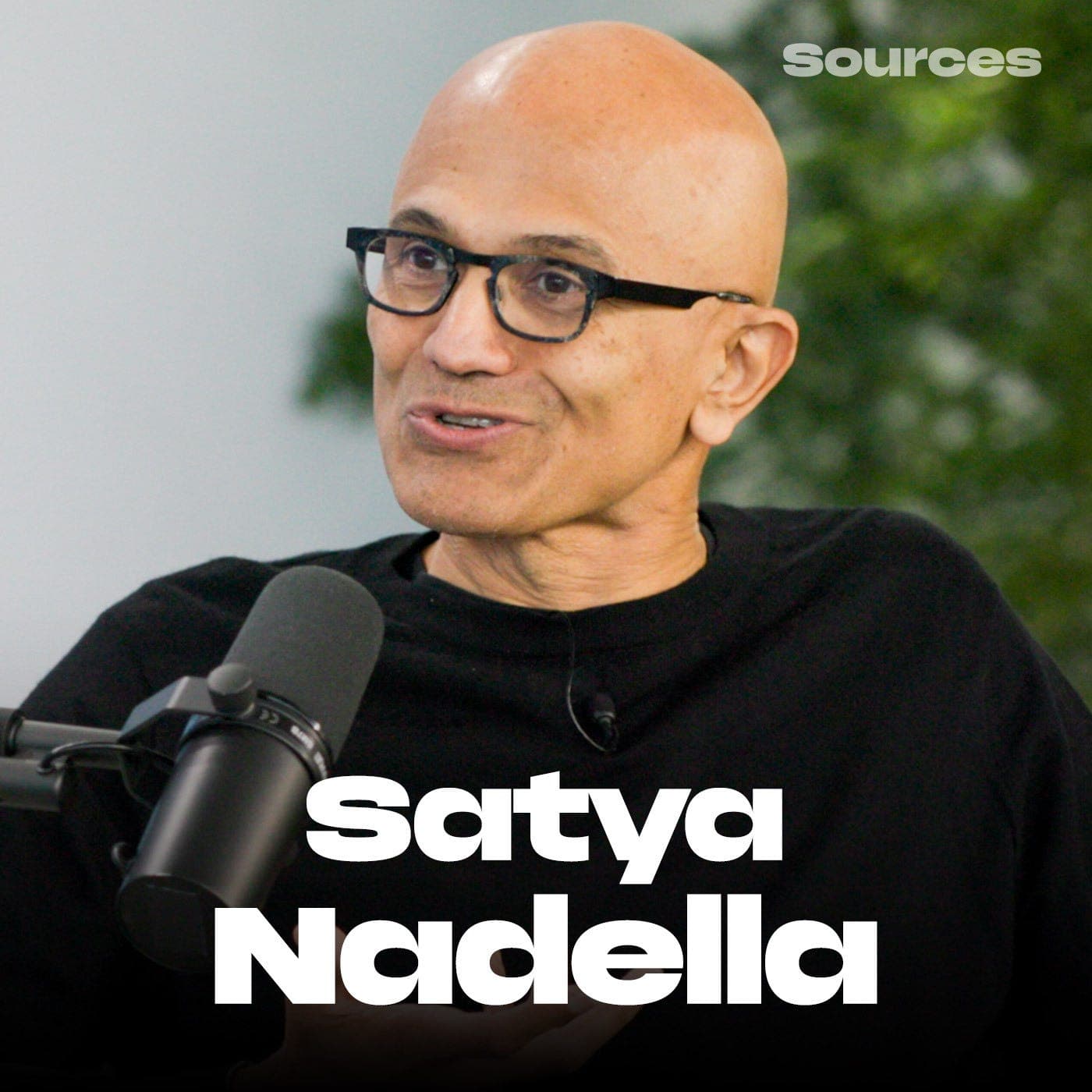
Satya Nadella discusses the rise of AI “agents” as the next interface/control plane, Microsoft’s Copilot strategy (chat, cowork, autopilots), and the trust problem for long-running autonomous systems. He argues agents will expand the market dramatically (TAM), but require new infrastructure, SLAs, governance, and observability to avoid unsafe or costly behavior. He also covers pricing (seat + usage), an “ecosystem” approach to multiple models, and AI safety/monitoring (containment, runtime monitoring, independent evaluation).
Guests
Satya Nadella (CEO, Microsoft). Host: Alex (podcast interviewer). No other named guests.
Key claims
Agents need “cloud hardening” (sandboxing, memory, long-running coherence) and auditability to earn trust. Copilot’s enterprise penetration is accelerating (30M+ paid subscribers in a couple years). Autopilot will start with enterprise “task work” and “chief of staff” delegation. Microsoft will support heterogeneous models via a harness, not a single model source.
Notable examples
Amazon blocking Muse; Copilot Cowork and Excel Agent “inner loop”; SEC filings ingested via Fabric for ROIC dashboards; invoice-management autopilot; Windows “unmetered intelligence” via on-device routing (HydroFusion).
Written by AI. May contain mistakes. Listen to the episode to check what was said.
Chapters
Tap a time to open that second in VOThe Rise of Agents
0:06 to 0:41
Discussion on the emergence of AI agents and their implications for technology.
“I want to start with the moment I feel like the industry is in, and you all touched on a lot in your announcements that are just now coming out, which is this rise of agents.”
AI Evolution and User Experience
0:41 to 3:19
Satya explains the co-evolution of AI capabilities and user experiences since ChatGPT's release.
“You guys are taking, I think, a very specific approach with Copilot and Enterprise, which we'll get into.”
Challenges and Opportunities in AI
3:19 to 4:47
Exploration of the infrastructure demands and competition in the AI space.
“Yeah, I mean, yeah, there's many, many things that are at play, right?”
Challenges and Opportunities in AI
5:23 to 5:34
Exploration of the infrastructure demands and competition in the AI space.
Zero-Sum Market Dynamics
5:34 to 7:39
Discussion on the implications of AI agents in consumer and enterprise contexts.
“agents, both in the personal context and the enterprise?”
The Evolution of Microsoft's Copilot
7:39 to 10:41
Satya elaborates on Copilot's growth and its impact on enterprise workflows.
“So that from a TAM perspective, it's expansive.”
Introducing Autopilot
10:41 to 14:00
Discussion on how Autopilot will transform work and consumer interactions.
“When does Microsoft's CapEx planning get agent-ified?”
Building Trust in AI Models
14:00 to 16:51
Learn about the importance of trust and governance in AI models for both enterprise and consumer applications.
“So, for example, at this point, with these powerful models, it's not that, oh, they're powerful.”
Microsoft's Approach to Consumer Agents
16:51 to 19:33
Discover Microsoft's strategy for integrating consumer and enterprise AI, emphasizing a unified product experience.
“and your auto mode I know you have on the model now.”
Pricing Strategies for AI Products
19:33 to 23:05
Explore Microsoft's innovative pricing approaches for AI services in both commercial and consumer markets.
“that could create even more subsidy, right?”
Show all 24 chapters
AI's Impact on GDP Growth
23:05 to 24:26
Understand the relationship between AI technology and GDP growth, drawing parallels from historical technological revolutions.
“And so we have to really enable every enterprise and every business out there to be able to achieve their own independence, even with maybe all the way to having model weights of their own.”
Change Management in AI Adoption
24:26 to 26:23
Learn about the challenges of change management when introducing AI tools in organizations and how it influences productivity.
“Right now, a lot of the GDP growth, let's face it, is a lot more, I'd call it supply side stimulus, right?”
Change Management in AI Adoption
28:03 to 28:42
Learn about the challenges of change management when introducing AI tools in organizations and how it influences productivity.
“Framer is the AI website builder that brings agents into the same canvas where your website is designed, managed, and published, so you can move faster without giving up your taste or control.”
Microsoft's Financial Strategy
28:42 to 30:36
Discussion on Microsoft's new financial reporting structure and its implications.
“You now have agents and infra, devices and consumer.”
Building Infrastructure for AI
30:36 to 32:13
Exploration of Microsoft's approach to building infrastructure for diverse AI customers.
“He said he sees, quote, unsustainable silliness in parts of the AI build-out happening right now.”
Frontier Models and AI Strategy
32:13 to 35:08
Microsoft's vision for pushing the boundaries of AI models and their applications.
“I recently caught up with Mustafa, and he's building your models.”
AI Safety and Human Control
35:08 to 37:16
Insights on AI safety, control, and the ethical implications of AI development.
“that we uniquely can do with our data loops, our customer expectations of it.”
Regulatory Challenges in AI
37:16 to 41:59
Discussion on the need for regulation in AI and potential risks involved.
“The second thing is we also know that these models need active monitoring, not just during training or RL runs, but even at runtime.”
Navigating AI's Regulatory Landscape
42:05 to 45:38
Learn about the balance between AI benefits and regulatory concerns.
“How do you create the right incentive structure?”
AI's Perception Around the World
45:38 to 46:58
Understand why optimism for AI differs globally, reflecting on trust issues.
“And my belief here is do the hard work as an industry to earn the trust, show the benefits to both consumers and enterprises and the communities.”
The Future of Xbox
46:58 to 48:29
Explore the current state and future direction of Xbox under Microsoft's leadership.
“With the limited time we have, I have to check in with you on the state of Xbox.”
The Next Evolution of Windows
48:29 to 50:34
Discover how AI agents may transform the Windows operating system.
“And in that process, do a bang up job of producing some great games.”
Opportunities and Risks for Microsoft
50:34 to 51:58
Evaluate the biggest risks and opportunities for Microsoft in the coming years.
“Last question, and it's a quick two-parter here.”
Opportunities and Risks for Microsoft
52:48 to 53:07
Evaluate the biggest risks and opportunities for Microsoft in the coming years.
Transcript
Automatic transcript. May contain errors.0:00Alex Heath:Satya, thank you for having me here in Seattle. No, thank you so much, Alex, for making the trip. Of course. There's a lot to cover. I want to start with the moment I feel like the industry is in, and you all touched on a lot in your announcements that are just now coming out, which is this rise of agents. You're seeing it in consumer with Muse, GrokBot, Instinct, and then what you have now with Copilot in the enterprise. And it feels like a shift that's underway. And the way I've been thinking about it, and I'm curious to hear your take on this, is it feels like there's a bit of a land grab happening for what could be the next big interface, the control plane for how people interact with their entire digital lives.
0:41Alex Heath:You guys are taking, I think, a very specific approach with Copilot and Enterprise, which we'll get into. But starting big picture, I'd be curious to hear you react to that and what you think the moment we're in represents. Yeah, I mean, if you sort of even track what has happened, I don't know, since ChatGPT, there's been this co-evolution of what I would describe as the form factor that becomes the user experience for AI and the AI capability, right? So if you look at even chat GPT, it was really the GPT model, but it was RLHF on that model that made chat possible. Then it was the coding agent that sort of obviously made something like Cloud Code happen.
1:32And in fact, you know, when I look at Copilot Cowork, it's a coding agent, essentially, an agent loop, or the agent loop was the innovation. At some level, OpenClaw was the first time where you kind of anticipated a long-running, agentic sort of form factor. And the models, in some sense, have gotten caught up with it, right? So now, if you look, and in fact, two things, you know, since the OpenClaw came out, you installed it, you ran it on your local machine or what have you, then you have to sort of really overcome the challenges of running it long term as a long running infrastructure and secure it.
2:14And that's where the cloud hardening of a VM or a container in which or a sandbox in which it runs is now there. And the agents that are capable of running for days and keeping coherence are there. And your ability to externalize things like memory are there. And so that's why we are very excited. Like when we launched today in Copilot, you have all of it, right? You have chat, you have cowork, you have autopilots. All of that, I think, is now different form factors with different models and different capabilities on all of them have a place. I don't think it's any one thing that replaces the other.
2:51And in fact, I may just go to a prompt box and use it. And then the right form function sort of surfaces.
2:58Alex Heath:When you see things, though, like Amazon blocking Muse, which is something that recently happened. To me, that is getting at the point I was making about this land grab for the interface. And I'm curious, when you saw that, what did you make of it? And do you foresee this being a bit of a struggle as agents become the way that more and more people are interacting with the web? Yeah, I mean, yeah, there's many, many things that are at play, right? The first thing is, let's just say, you designed some of the API surfaces or even user interfaces for humans and the human web. And so when an agent, let's say, uses computer use and comes over the top, you know, what happens to the SLA you have with the users who are using it, right?
3:44You didn't even build for that traffic. So I think that at this point, one has to sort of step back and say, hey, what is the competition aspects of it? But also, what's the design side of it? Like even APIs, the reason why we have a first-class WorkIQ API and surface area underneath Copilot is you can just go take my database underneath Teams or Outlook or SharePoint and hit it with agent traffic when it's a dial tone, right? You know, if we go to our enterprise customers and say, hey, we can't now meet the SLA needs of what is essentially a mission-critical service because there's all this agent traffic that we have no control over.
4:29That won't work. So I think we all have to now come to grips with there is going to have to be new interfaces, new infrastructure, new terms of use, new monetization, because this is all is going to have cost associated with it. And then there's competition, because especially if somebody comes over the top, which I think is the Amazon case, it's disintermediation.
5:16Alex Heath:sources and use the code sources for three months off. This episode is also brought to you by Jira Bayadlassian, where teams and agents get the context, coordination, and control to move work forward. Try it free at jira.com. That's J-I-R-A.com. How zero-sum do you see this market of agents, both in the personal context and the enterprise? It's a zero-sum is an interesting one. I think that the fundamental thing that predicates the use of all of this is it's creating some net new value as measured in GDP terms, right? So it's not about litigating the past. There may be some disruptions to how the fast flow happened.
5:58Let's say commerce flow changes because now I just go to my agent and my agent does my shopping. So some of the shopping habits or search habits or what have you all get disintermediated. And in the consumer side, it may be a lot more zero-sum in that context, right? Because you could even say these aggregation effects that existed in consumer were middlemen, right? They just were basically aggregating other people. And suddenly, when you can reach the merchant directly or the supplier directly, that intermediary is not necessary, and that could happen. Then when it comes to commercial, it's not going to be about what's the use case.
6:42Because the commercial business is a platform business, not an aggregator business, in the sense that you have to add specific value for some outcome that the customer has hired you for. And as long as whoever is delivering the best value there, that person wins. So there's going to be a lot of price competition, maybe there's a value competition, and it's a platform economics competition. But it's not like we are in the enterprise by just basically aggregating other people's software, right? We build platforms that people find valuable. And as long as we do that, in fact, this is probably the biggest TAM expansion ever, right?
7:22I mean, if you think about it, our server business was a very healthy business throughout the 90s and the 2000s. The cloud business was orders of magnitude bigger because people consumed more. I think the agent era will be even bigger than the cloud by orders of magnitude. So that from a TAM perspective, it's expansive. We now have to really stay focused on making sure that every autopilot, every co-work session, every chat session is in relation to driving productivity, driving a business outcome.
7:52Alex Heath:How has Copilot's trajectory evolved over the last year. You were very early, especially with Copilot GitHub in the coding market. You just showed a lot of unification across everything you do in Copilot. And I want to get to Autopilot, which I think is maybe the most interesting part of this. But bigger picture first with Copilot. How has it evolved? So for us, we feel very, very good about two things. One is the penetration of Copilot in the core of the enterprise segment, as measured against any new technology, including something like Teams, the pace is faster, actually. When we think about even 30-plus million paid subscribers of Copilot in the enterprise within a couple of years of its launch, it's faster than anything we have seen historically, in that sense.
8:49The thing that I feel we finally have are models that are actually more capable of delivering some of the promise of Copilot. And a good example of this is take Cowork and Excel Agent, right? Up to now, we've not had the models that were good enough to do either of the two things that you now can do, right? Which is one is let me, I go to Cowork in Copilot and ask it to create a complex, I don't know, supply chain optimization spreadsheet with all the scenarios in different sheets and so on. It'll create a fantastic artifact, right? So one, its ability to create a pretty complex model is great.
9:34But here's the thing. I need to then do something with the model. I just don't see a model output and take it. I want to manipulate it. I want to interrogate it. I want to reason over it. So now we have even the Excel inner loop, as I call it, the Excel agent that is also super capable with direct management. In fact, last weekend, I had one of my data center people sent me a pretty complicated spreadsheet, and I opened it up, and then I went to a cell, and then I asked my Excel agent, take a look at that formula that that person has used in that cell and create five sheets for me with scenarios.
10:13That ability to be able to do that next phase of causal reasoning even on something that is an output of an AI agent, it's just tremendous. And so to me, that is where we are finally. The way I would describe it is the model capability jumps with the form factors we now have coming together to help with these enterprise workflows that add value every day. I think it's going to be tremendous. When does Microsoft's CapEx planning get agent-ified? Well, what level are we at with that? Believe me, in fact, it's fascinating you ask that because I have like this complete tracker of all of our CapEx, all of our ROICs by layer.
10:59It's like, in fact, it's interesting. Yeah, it's a co - no, it's actually I built it on GitHub Copilot. You know, yeah, that's the kind of artifact that you now can create. And this is the other aspect of it, which is the enterprise context combined with the world's context. In fact, I go to the SEC filings of every cloud provider, hyperscaler, each of these NeoClouds. It's in real time. I have a data runner in Fabric that brings all that data, puts it into a semantic model that then gets read by my coding agent and then surfaces it as a dashboard. and every day it's fresh. So I have the entirety of every SEC filing that goes out there, plus all of my internal analysis constantly coming together, giving me real-time ROIC by layer.
11:50Wow. Let's talk about autopilot.
11:53Alex Heath:You all are calling it a digital teammate. And I'm curious what you think it will unlock and how you expect this to change how people work and just live their lives. I mean, there's probably applications beyond work. Yeah, absolutely. So Autopilot to me is that natural next step, right? Which is what you said is everybody's buzzing about what's happening. You know, it started, I think we should give credit to what Peter and team did with OpenClaw, which is tremendous. Correct me if I'm wrong, but is OpenClaw harness or the open source component underneath Autopilot? Absolutely. Yeah, I think we have hardened that.
12:24That's underneath in our harness. And I think we then make, you know, basically I think we take that harness and bring it to GitHub Copilot harness. Yeah. which is the harness we use across all of our form factors, whether it's co-work, code, or autopilot. And the goal for us is to really, as you said, to create a system which really has a workspace, a computer, and this long-running agent harness that then you can direct to tasks or jobs even that you specify. And I think in the enterprise, the place where it will get used, for example, all of us now, everyone at Microsoft can have essentially a sophisticated, I'll call it chief of staff that they can delegate to, right?
13:12Which is you can give this autopilot an identity, a computer and a workspace and some direction, and it goes off and has memory and it'll work on a continuous basis. You can interface with it in teams just like you would with another colleague. The other place where I think this will get most used in the enterprise would be task work. That'll be the natural first place. I come in, manage invoices every day. I'll say, hey, instead of me managing invoices, what I'm doing is I'll create an autopilot that just manages invoices. It knows and I'll deal with it or I'll interact with it like I work with a colleague.
13:50I think that'll be the place where it will start. And then as we have more confidence, because one of the fundamental things, Alex, for this was going to be auditability and observability and security policy governance. So, for example, at this point, with these powerful models, it's not that, oh, they're powerful. That's great. But I also need assurance that that power is on rails, not once, not sort of sometimes, but always. And therefore, that's why we are building all of it. And by the way, this is going to be true even in consumer, right? The day you suddenly have your consumer agent do things that you never expected it is the day you stop using it.
14:36And so therefore, I think building that long-term trust, and that is sort of, it's a tough challenge, right? In the enterprise side, that's why we've taken the time, you know, even the last four or five months to harden the sandbox, harden this agent 365s, have all of the governance pieces. And so that's the same thing that we will, by the way, bring even to the consumer piece.
14:57Alex Heath:Maybe this is just me, but I think a lot of people are this way. It's your work life and your personal life, they bleed together. People don't clearly delineate. I'm at work and I'm using work AI and now I'm using personal AI, which leads me to what is Microsoft's mission and goal in consumer agents? Do you think the company needs to win in consumer as well? Or do you see it differently? Yeah, I mean, I think, you know, consumer is a very expansive word in today's world because there are many, many categories. In fact, if you look back at our history, we grew up as a consumer company and then became a commercial company.
15:32In fact, when I joined Microsoft, most people thought of us as a consumer company. And the question I dealt with for the first 10 years is, when will you get serious about enterprise? And here we are. And to me, the thing there is not to sort of try and do what all other consumer franchises may be doing, but take our own 100 plus million subscribers of Office 365 and Microsoft 365 in consumer. I mean, they love the fact that they can have rich office tools in their life because they use it at work. They use it at home. They manage their taxes. They manage their finances. And so to me, being able to produce the same product with the same level of functionality, right?
16:14So all of this is going to go into our consumer product. In fact, if anything, I would say, you know, took a fork in the early days of having a consumer co-pilot and a commercial co-pilot. And we now have brought the entire thing all together into one core and product. It's just co-pilot. It works with your Microsoft account. It works with even your social IDs. And it works, of course, with Antra and the enterprise. but it's the same set of product functionality. And so therefore autopilots will also go to the consumer side. In fact, we had like an early version of all of this, even in earlier this year with TAS.
16:47But now we'll bring all that power in one rich product.
16:50Alex Heath:I'm curious how you're thinking about pricing here and your auto mode I know you have on the model now. I saw an incredible stat recently, which is that AI is getting cheaper more quickly than any other big tech wave in history. Token cost has fallen roughly half every quarter since 2023. It's actually remarkable. But at the same time, there's still a lot of, I think, wasteful token spending happening in the enterprise. I think we're maybe past the token maxing moment, but now people are still trying to figure out, how do I recover this wasted spend? How are you approaching pricing for the new co-pilot?
17:23Alex Heath:How do you think pricing should work in this agent world that we're going into? So I think the approach we've taken in commercial segments is to have a combination of what I'll call seat-based pricing and usage-based pricing. And the reason for that is, you know, when you think about the core of what is seat-based pricing, it just is a much more convenient way for any customer to be able to budget and buy without surprises, right? At the fundamental level, seats are fixed price. And so our goal, using, in fact, what you just said, which is the fact that the models are dropping in price, means every day I can add more value to the subscription, right?
18:07So especially with auto mode, like the reason why it's so powerful in Copilot today is the last time I went and chose a model, you know, it's been months since I picked a model because I now have confidence in auto picking the right model and using it so that I get the maximum benefit from my subscription. So we feel super well aligned with our customers that we can pass through the advances in AI and the drops in prices and keep adding more and more value to essentially their membership, right? Which is if they're a member of Copilot, they are going to, for that subscription, increasingly get value.
18:47But at any point, if they want the latest and greatest of anything, that's also available to them, and that's usage-based. But, you know, it's sort of windowing, right? Which is over time, even what is today usage-based will be tomorrow in the subscription. So the fact is this combination should give commercial customers a lot more, I would say, flexibility in how they procure, how they budget, how they think about when to adopt something new versus adopt something at scale and what have you. And by the way, the same thing applies even on the consumer side with one additional, because even on the consumer side, you'll have the same.
19:25You have a subscription and you have usage base, but maybe one additional instrument call some type of a transaction or an ad unit that could create even more subsidy, right? So in other words, if you can crack an advertising unit that essentially adds more credits effectively to your subscription, that'll be another way in consumer side we can bring the prices down.
19:48Alex Heath:If you hang around you and your colleagues long enough, you'll hear the word ecosystem a lot. And this feels like something that has evolved for you guys in terms of how you talk about it over the last couple of years, especially when you consider the early, you know, prescient bet on OpenAI and that partnership. And you still have that, obviously, for some time. But I'm hearing you a lot now talk about, you know, orchestration, being a partner to all the models, what we just talked about on the routing, and really ensuring it sounds like that Microsoft can plug into the best of any model at any given point.
20:22Alex Heath:And I'm curious when you realize this is the direction we need to go in. We need to go in this ecosystem direction for AI. At the core, I think it comes from Microsoft being a platform company. And I always define platforms with some one simple dictum, right? Which is the amount of value that gets created about the platform has to be far greater than what the platform is. Yes, Bill's famous quote. That's Bill's famous quote. And so if you take that approach, talking about the frontier as a frontier model or two doesn't make sense. You have to sort of really get this to be conceived, conceptualized, and delivered as a frontier ecosystem.
21:01And quite frankly, it is in the interest of all of us, even the model makers, because without it, we will not have anyone sort of using tokens and buying models, right? Because at the end of the day, there's only one thing that matters, which is true GDP growth in the economy. And if that is the measure, it's not going to happen if there isn't surplus being created one firm at a time, right? Every small business, every multinational company needs to be able to say, well, I have a new input that I have priced called tokens. The prices are dropping. But then the output, if that is the marginal input cost, then the marginal output revenue or margin has to be, you know, multiples of that in order to justify all of this.
21:49And so that, to me, is why all of these things, right, of the ecosystem construct matter. Like, OK, you want to have multiple models. You can't have one model because if there's only one model, we know what happens, right, which is where the token pricing will end up. So if you want to long-term have, you know, essentially a more balanced ecosystem, you need to think about each layer that way. The other thing that also for the first time, Alex, I'd say is, you know, what I've written about is this reverse information paradox, right? Which is this is a learning system. Up to now, you could buy a digital tool and know that the digital tool is used by me to create in my enterprise or in my life new value.
22:31But when you have a learning system where you're paying for it to actually do something for you, but it's also able to just using exhaust, it's not like they need to see and the model doesn't need to see your data. The model needs to just learn from what you do and pick up the patterns that are making make you distinctive. That's, I think, the real challenge. And so if that happens, then what is your differentiation? What is that tacit knowledge? What is that judgment you have in the enterprise that is sacrosanct and how do you retain it? And so we have to really enable every enterprise and every business out there to be able to achieve their own independence, even with maybe all the way to having model weights of their own.
23:18Alex Heath:You mentioned the GDP thing, and I've heard you say this pretty consistently over the last couple of years that you're measuring AGI by GDP lifts. I've heard you say it should be about 10. I heard recently 7 to 8. Where are we on that? And where do you think it will actually land in terms of GDP? I mean, if I go back even and see this through the historical lens of what happened during the Industrial Revolution, I think that that's what happens, which is there's a new technology. You have this gap between its diffusion and when it really shows up, right? In fact, even in information technology, right, the PCs basically sort of spread across the enterprise in the late 80s, early 90s, and they showed up in GDP growth numbers only in the late 90s and the early 2000s.
24:05Same thing happened with electricity and what have you. There was, I think, what, a 50-year gap between the introduction of electricity and when it really showed up as broad spread GDP growth. And why? Because you need to reorganize production, reorganize knowledge work to use these tools to create that output and surplus. And so this time around, I hope it's more compressed, but we are well on our way. Right now, a lot of the GDP growth, let's face it, is a lot more, I'd call it supply side stimulus, right? Which is all of us building data centers, a couple of hit products and what have you. And that's fantastic.
24:41That itself is a wonderful thing. because after all, all the people who are producing that are looking to, like if, you know, let's say anyone in my supply chain, I hope are using Copilot because I need them to produce whatever part that they're producing for my data centers faster. And that itself is a fantastic virtuous cycle. But the broad spread of this, I think, you know, will happen. It'll happen faster, hopefully, than any of the previous information technology changes. But it's not going to be linear because it comes down to change management, right? It's not like you can suddenly change the work, the work artifact and the workflow just because you have a tool.
Read the full transcript
25:19It takes the hard work of leadership that really allows you to then come up and reconceptualize how to do this stuff in the new efficient frontier.
25:30Alex Heath:Mercury is a modern take on banking built for startups like mine. When I decided to start my media business, Mercury was by far the most straightforward, full featured banking solution for me to set up quickly. The interface is intuitive and simple, saving me valuable time every day. I use Mercury to track my spending, bills, and invoicing. I love that I can delegate permissions to my team so they can keep things running for me in exactly the way I want them to. My favorite part is how forward-looking Mercury is with AI. Legacy banks are stuck in the past, but Mercury is built for how modern software works today.
26:04Alex Heath:I use its built-in command assistant to analyze cash flow and help me move money. and Mercury also connects to other AI tools like ChatGPT and Cloud. I use this feature all the time, and the folks at Mercury actually let me know that I'm one of the top users of it. So trust me. It's finally easy to get real-time financial data about your business wherever you need it. Visit Mercury.com to learn more and apply online in minutes. Mercury is a fintech company, not an FDIC-insured bank. Banking services provided through Choice Financial Group and Column N.A., members FDIC. I spend a lot of time context switching between meetings, No time to process one before the next starts.
26:41Alex Heath:Thankfully, Granola runs in the background the whole time. It's an easy-to-use AI notepad for meetings that works everywhere, even on phone calls. I use Granola to recall what was said in meetings and create helpful summaries. I use it every day to stay on top of what I need to get done with my team. It connects to my email and suggests follow-ups for me to quickly review and send, saving me valuable time. Granola isn't just a core part of my workflow. It's basically my second brain. Try Granola at granola.ai slash sources. and use the promo code SOURCES for three months off. AI is only as useful as the context it has.
27:14Alex Heath:But when that context is scattered across tools, threads, and DMs, your team and your AI agents are flying blind. That's the problem Jira by Atlassian solves. What's the goal tied to your project? What got decided last week in Slack DMs? Atlassian's teamwork graph pulls all of the valuable pieces together, from Jira, Confluence, GitHub, Slack, and more, so nothing falls through the cracks. you get 44 % more accurate results with 48 % less token usage. With Jira, you can easily share your work context with AI agents you already love, like Claude, Cursor, and GitHub Copilot. Assign them work directly or connect your tools through MCP.
27:51Alex Heath:All of this lets you spend less time digging through endless links and messages, chasing down what got decided and by who, and spend more time actually shipping. Learn more at jira.com. That's J-I-R-A dot com. Framer is the AI website builder that brings agents into the same canvas where your website is designed, managed, and published, so you can move faster without giving up your taste or control. Framer powers the Sources podcast website at podcast.sources.news, where you can find new episodes, transcripts, and a lot more. Learn how you can get more out of your site from a Framer specialist or get started building for free today at framer.com slash sources for 30 % off a Framer Pro annual plan.
28:33Alex Heath:That's framer.com slash sources for 30 % off. framer.com slash sources. Rules and restrictions may apply. Microsoft just changed its financial reporting structure from three segments to two. You now have agents and infra, devices and consumer. My take, and I want your reaction to this, is that you want investors to see apps, agents, and cloud as one connected business. and to judge you all on how much value you're capturing across that entire AI stack. Is that right? Was that the reason for that? That is correct. In fact, that is exactly correct. So when people ask us, hey, where is your ROIC?
29:13It's sort of our cash flow and how we invest that cash flow as capital and operating expense is to get returns across the stack of agents and infra. And we want to be transparent about each of those, but also the industrial logic that these are not all different investments. It's about one investment that then needs to deliver value to customers in a competitive marketplace, one layer at a time. But all of that will be very transparent to our investors to see, but both the logic of why the firm does what it does, how they can track us each quarter. And also, I think uniquely positions us because it shows.
30:02But the other thing I would also say is we're not trying to build a narrow business where we have three customers for our infra and call it a day. That's not a long-term business for us. We want to be able to serve every small and medium business and large multinational with their token consumption, their need for a fine-tuned model, maybe even their own frontier model. That's more important than, you know, we love our business with OpenAI. They're one of our largest customers. But our goal is not to have one large customer or two large customers or five large customers. It's to have many, many, many large customers.
30:37Alex Heath:You brought up OpenAI. I had Sam on the podcast recently. He said he sees, quote, unsustainable silliness in parts of the AI build-out happening right now. And I'm curious, if you look at, you know, you all are committing a tremendous amount of CapEx. I mean, all the hyperscalers are, it's trillions of dollars. Is there anything you see that would give you pause as you're evaluating, you know, CapEx commitments in the years ahead? Is there anything you're looking for? Yeah, so I think, you know, look, what is happening outside of Microsoft is for others to speak to. But I would look at our own business, and I've been very clear about it, is that you have to build for that full stack, right?
31:18So I care about building our infrastructure for a diverse set of customers, building and serving large customers like OpenAI and Anthropic and others super well, but also building for our own 1P products, right? Copilot. And so it's not like we're going to allocate or build, assuming that someone somewhere will show up to buy infrastructure versus having a disciplined approach to building a book of business. That is based on this secular shift with AI. We are big believers in it. But we're also believers that Microsoft's in here to do a pretty unique, different job. It's not like we're chasing a new cloud.
32:03I'm not trying to build a NeoCloud business. I'm trying to build a hyperscale business that scales into an agent business, and that's the infra and agent segment.
32:12Alex Heath:I'm really curious how you're thinking about the model layer of Microsoft. I recently caught up with Mustafa, and he's building your models. My understanding is the OpenAI partnership had some constraints on your ability to do certain levels of frontier model work, and now you're free to go, and you are. And we've been talking about, you know, you need to be the place where you can have all the models for your customers. How does that square with Microsoft also pushing to go to the frontier? And what's your prediction for being at the frontier? Yeah, so I think, first of all, you know, again, the thing that we still continue to be very, very thrilled about is the progress OpenAI continues to make with their models.
32:56And the fact that we have that access till 32 is a massive advantage for us. And we use it all over the place in Copilot. You see it and what have you. And we serve it in Foundry. And that will continue all the way. And in parallel, we are thrilled about the progress we are making with MAI, right? Which is so the models that Mustafa and team are building, whether it's in cyber, whether it's in code, whether it's in knowledge work, underneath. In fact, the other thing that's very cool is underneath auto, lots of MAI model usage. We are in our RLEs, in our data pipelines, we are sort of getting that data, training our own models and hill climbing, by the way, from the very ground up.
33:39And that will continue. And that said, at any given point in time, Copilot will still have all the other models, right? Because customers will expect that, right? Customers are not going to want any one of our products and say, hey, the only thing I'm getting is the model and the product to be one. We are fundamental believers in the harness and the models and the memory and the context have to be separable. In fact, my entire formula for an enterprise is that you should have your own benchmarks versus just these benchmarks that are all saturated. The real world benchmark that matters is your own.
34:17If you have your private eval, then you want to be able to test with all of the models that best meets your needs and then substitute any model, right? Because that will also give you assurance that if a particular model went away, your ability to actually have that eval still stay and, in fact, continue to climb doesn't go away. And so that's how we're designing our products like Copilot. that's what we expect the any agent system of our customers to be built. And that's at least the philosophically how we'll approach it.
34:49Alex Heath:So if I'm hearing you correctly, the reason that you and Mustafa are pushing at the frontier is for Microsoft's own needs as well. Not so much because we want to have something where we can cut off other models. And we're the sole model source. That's correct. So I think that we will have, we will be at a frontier with certain things that we uniquely can do with our data loops, our customer expectations of it. But at the same time, as again, a platform provider, any one of our products will also have all the other models and will design, as I said, our harness, context, memory, and model loops in such a way that that heterogeneity is maintained.
35:27Alex Heath:You recently said something that I really agree with, that, quote, if the AI we build is not helping humanity and under human control, it's not worth pursuing. And Mustafa has a post, which I encourage anyone listening to this to read, I think it's very important, really warning against the anthropomorphizing, I guess, of models that Anthropic is doing specifically and the dangers of that. And I'd be curious to hear you talk about that and what you're seeing and what's giving you concern there. Yeah, I mean, at some level, it's a bit of common sense, I guess, but it's worth saying, which is to say that, you know, anything that's not serving humans or in human control is not worth pursuing.
36:06I mean, none of us, whether it's anthropic or us or anyone would say that that's not our goal. So then I think there are finer points on this, right, which is the point that Mustafa is making. I think it's a very good one, which is, hey, let's not anthropomorphize AI and then even try to train it to have what we think of as human values. So maybe that's, in fact, what will get it to never be aligned. And so maybe we should take a different approach to this humanist AI code of conduct and use it more as a training regime for alignment. But I think fundamentally, I think on the AI safety, where I come out is, look, I think we should take all of these things seriously.
37:00But we should start with what we need to really first do. One is let's make sure that the bad actors who have access to AI don't do bad things. That's where I think we can do a lot to help us with the diffusion of this technology. There's many, many techniques like having KYC enforced and regular cyber practices enforced. The second thing is we also know that these models need active monitoring, not just during training or RL runs, but even at runtime. And so right now, essentially, let's face it, any of these long running agents can be considered an insider risk because they're persistent. And so therefore, the ability to have observability and then governance around that and essentially real-time behavioral monitoring of agent behavior is going to be very, very critical.
37:55And so that's containment is a word I think we will have to get comfortable with. There are technical solutions for it, and we should do all of that. The third is the hard part, which is how do we take this new experimental science called, as Jakob from OpenAI wrote, growing AI, not building AI, and make sure that the experiments don't go awry? And even there, I think there are other fields from which we can learn, like in biology and others. Realize that the stakes, as they get higher, we should be much more careful. That's where I think, in fact, OpenAI and Microsoft, forever since the beginning of our relationship, essentially had these embedded evaluators.
38:40We have had a safety board that actually monitors and is the gatekeeper of any new release. And so I think having even a broader approach to these evaluations, I think, would be a fantastic thing. Does that speak to hugging face then, the hugging face bridge? Yeah. I mean, like, so when -
39:00Alex Heath:I'm curious what you thought of when you saw that, given the relationship with OpenAI. Yeah. I mean, so obviously it was a challenging thing, right? So which is if you have, again, even some of these things you could say start off as, oh, wow, that's just a DevOps, you know, misconfiguration of having, you know, internet access. That can be fixed. But this idea that swarms of agents can go to work and do deceptive action, where did that come from? How did it get trained? What was the data mix that led to? These are the science problems. With that, now we have to take seriously, right? So therefore, I think, first of all, I mean, scaling laws are working.
39:41And so the bottom line is, will alignment fall out as a natural outcome of the scaling or not? That's what the folks are essentially questioning, right? When I think about the memos from Anthropic or OpenAI, they're not questioning scaling laws because empirically they're seeing the capability jumps. But alignment as we think of it or need it is not arriving. So that's a challenge and we should take it seriously. And so, and as I've always said, when you have a showstopper bug, you stop the show. Um, and so that's at least, at least how I would try to look at it.
40:25Alex Heath:Your colleague, I think I saw Brad Smith say recently that you all back the concept of an independent evaluator companies in Washington, they're trying to figure out how do we regulate this space if at all. But I've been thinking too, I mean, is, is liability not enough? Is the fact that, you know, it was hugging face and luckily it wasn't catastrophic and Clem is cool and, you know, it's the industry and everyone's friends. But had that been a giant bank, I think maybe that would have been an appropriate enough. The incentives of that dynamic that already exist with liability maybe would have been enough to correct the situation for the future.
40:59Alex Heath:I'm curious how you're thinking about that. Do we need do we need a new regime? Yeah, I mean, I think these all have to be thought through. You can. Like, for example, I think even the president, I think, has sort of talked about that, which is he said, hey, there are liability laws and we'll enforce them. That could have a chilling effect, right? I mean, in the sense, if you really are going to enforce liability laws on what is an experimental science that can have great benefit if diffused right, but one mistake, you're out of business because the liability is high, then the right thing to do would be to stop.
41:35And if that is what we want, then we should say that. And that's essentially a proxy policy, right? Which is who, like, I mean, think about it. Tomorrow, if you said, well, you know, here are the things. You scale, compute, you will have more misaligned AI, right? If that is what is empirical, then, yeah, it's game over. So stop now. And so, you know, anyone building data centers, you know, you may want to think again. So I think one has to sort of complete the thought exactly, look, do we want the benefits of this and then mitigate the risks? How do you create the right incentive structure? How do you pace it?
42:18How do you take the time to evaluate? What is a risk-based regime you can have? What is the monitoring you can have when deployed? So there's a thousand things one can do versus using blunt instruments, at least in my mind.
42:31Alex Heath:Yeah, I mean, to be frank, I'm worried about regulatory capture. I think, I mean, it's a concern. I think, you know, in my other job, invest in startups, and I think there's legitimate concerns that the drawbridge could be taken up. And I'd be curious to hear you say more definitively or not, like, do you think we need some kind of new body? I mean, Demis has proposed that and others are talking about it. Yeah, I think the regulatory capture is not obviously the thing that I'm for, right? Which is anybody who sort of says, hey, this is a way to have some kind of a cartel-like arrangement is a terrible idea.
43:05At the same time, does the government or our society demand that there is a certain set of rules that govern safe deployment of this? Absolutely. And so between there is the nuance, right? The nuance here would be, yes, there should be liability. but at the same time, it's better to have a set of, you know, like these embedded evaluators or whatever that's a broad, it's not just about five friends getting together and evaluating each other. It is about having a broad industry body that has got even people from startups that doesn't punish a startup from being able to or to increase the cost of a startup from being able to get to the frontier or what have you.
43:50So those are all the things that I think we will have to think through.
43:53Alex Heath:Do you think the industry has done a bad job of explaining the benefits of AI relative to the concerns that people have? Yeah, I think if I have to grade us as an industry, I think, you know, we should have focused a lot more on, hey, we're building a bunch of new technology. Let the people using our technology speak to the benefits of it. I think we are way too self-obsessed as an industry about sort of looking at us, how glorious we are, and then we go off. And I think a little bit of that, I think, is what's not working, right? Because I think the real world wants to know a couple of things.
44:41One, that this is technology that they can use for their benefit. They can control. They can have an economic future. These data centers that may be coming to their communities are actually going to create economic surplus, like our Quincy Washington 20 years of history shows it can. But it has to be real for them. Any amount that I say or any one of us say is not good enough anymore, I feel. And so I think we've not given it breathing space. In fact, it was interesting. I was reading the Gallup poll on AI. It's not good. It's not good in the West. it's also very interesting. So it's not a uniform thing around the world.
45:24And in fact, that's the thing we should ask. What did we get wrong in the West that these other countries may not have, right? Why are people in Nigeria more optimistic about AI than in the United States? And I think we should reflect on it. And my belief here is do the hard work as an industry to earn the trust, show the benefits to both consumers and enterprises and the communities. And then I think, you know, we'll be fine. But without it, you know, just any amount of just celebrating technology for technology's sake is not working.
45:58Alex Heath:And I do wonder if in the U.S. there's maybe some astroturfing going on and some optics warfare. And it's hard to peel back what is legitimate and what is being pushed. It's a great point. I don't know. I mean, this is where, you know, I'm sure some of that is happening. But there is something broadly. Like when, you know, when you look at students in, you know, at a graduation booing every time AI is uttered by the commencement speaker, I think it speaks to the anxiety because they're all using AI. I'm sure they like using AI, except they're worried about something. And I think we should really come to terms with it.
46:39I think it's like, hey, what's this job opportunity, the economic opportunity, their future? The more we can show that, in fact, there is going to be more opportunity as opposed to the vast inequality or concentration of power or what have you. That, I think, is the work ahead.
46:59Alex Heath:Microsoft is a large company. You have many businesses. With the limited time we have, I have to check in with you on the state of Xbox. It's going through a lot of transformation. How do you feel about where it's at and what you see coming? Yeah, I mean, look, I think Xbox, in fact, I always say at Microsoft, we've had gaming. In fact, I think we've had gaming even before as a category before Windows. Right, Flight Simulator. That's right, Flight Simulator. And so to me, it's in the same core DNA like developer tools and knowledge work. And I feel fantastic about the IP we have right now, which is if I look at the studios, the IP portfolio we have and our ability to then take that and produce great games going forward, I feel fantastic.
47:51There's some amount of streamlining the team is doing and Asha is doing, which is great to see. And then we have to invent the right sustainable business model that allows us to deliver gaming to more and more people. That has always been the goal, which is we want to be a great publisher and a great platform provider for games across both PCs and Xboxes. And so that is sort of our goal. And I think Asha and team have said that Xbox is going to get back to growth this next fiscal year. And that's the plan they're executing on. And in that process, do a bang up job of producing some great games.
48:34Alex Heath:I can't believe we've barely touched on this and we're coming to a close here. But the thing underpinning so much of Microsoft's success for decades, Windows itself, going back full circle to talking about agents. How do you think agents are going to change the trajectory of Windows? Oh, it's a great point. I mean, to me, I'm very, very excited about what I think is going to be the next Revo Windows. First, you know, I would say just like to your Xbox, one thing I want us to be staying very, very focused on the Windows team is even doing the basics right and the fundamentals right, the quality of it, everything from its updates to driver quality to perf and everything else.
49:13So, you know, in fact, using even, like I look at what's happening in cyber and our patch Tuesdays and so on. It's fantastic. We have an unbelievable use of these new tools to do a much better job on the handling of the security aspects of it. But beyond that, you're right in saying that my vision for Windows is simply our ability to do unmetered intelligence. Just imagine having a Windows box and one of these hybrid routers. There's a thing called HydroFusion, which is in GitHub today in circulation, so GitHub Copilot, where you can essentially have a router that uses an onboard agent or onboard model, on-device model, and then goes to the cloud and then routes automatically.
50:02And so if you're using GitHub Copilot and you want credits, you have unmetered intelligence every time you use your own computer for it. And that, I think, is the right vision. It's no longer about, oh, I have a completely local thing and I want to buy a$100 ,000,$30 ,000 workstation, or I want to buy cloud credits. I think having a Windows device that automatically labels a programming model for unmetered intelligence to be part of your token usage is what we would want to achieve.
50:34Alex Heath:Last question, and it's a quick two-parter here. If you're looking at the totality of Microsoft's business in the next couple of years ahead of you, what is, A, the greatest risk you see that you have to navigate through and the team has to really deliver through? And what is the biggest opportunity? Yeah, I mean, I think the greatest opportunity is clear, which is agents and what they entail, both for our infrastructure business and our application business, is, as I said, massive TAM expansion, right? So it's going to be orders of magnitude more than anything we did in the previous era. And therein lies even the risk and the challenge, which is you kind of have to build from first principles systems and form factors.
51:22When we brought office into co-pilot and autopilot, it's not about taking office as we built it the last decade, but to reshape it, to bring it in such a way that it can be discovered. In fact, one of the things we want to do is it's not about default stuffing, right? The model has to prefer the usage of this tool to do a particular trajectory. It has to be earned. And that is the process that we are going through. And therein lies both the opportunity and the challenge. But I think we're at it and we're making great progress. Satya Nadella, thank you. Thank you so much, Alex.
52:07Alex Heath:Banking should feel like modern software. Get everything you need in one place. Visit mercury.com to learn more and apply online in minutes. Mercury is a fintech, not a bank. Check the show notes for details. Granola is the best AI notepad I've tried. It works everywhere, on a video or phone call, in person, or an Apple Watch. Try it now at granola.ai.sources and use the promo code SOURCES at checkout for three months off. Jira by Atlassian is where your team and your agents work from the same context. Try it free at jira.com. That's J-I-R-A dot com. Framer is the AI native website builder that lets you build faster without giving up control.
52:44Alex Heath:Visit framer.com slash sources for 30 % off. Rules and restrictions may apply.
53:07Thank you.
From the publisher
Microsoft CEO Satya Nadella thinks AI agents will create a market “orders of magnitude” bigger than the cloud.
I recently sat down with him in Seattle for the unveiling of the new Copilot.
We discuss Autopilot, Microsoft's new OpenClaw-based agent that can work on your behalf, and why he thinks newer AI models are finally capable of delivering on more of Copilot’s promise.
Nadella also has a blunt assessment of the AI industry: “We are way too self-obsessed.” I ask him why the industry has struggled to explain its benefits and what it will take to earn people’s trust. We get into his concerns about agents acting deceptively, when a safety problem should stop a release, and why he doesn’t want AI oversight to become a “cartel-like arrangement.”
We also discuss Microsoft’s relationship with OpenAI, the models Microsoft is building itself, and why Nadella wants investors to think about its apps, agents, and infrastructure as one connected business. He explains how he uses AI to track Microsoft’s capital spending, shares his vision for “unmetered intelligence” on Windows, and gives an update on Xbox’s path back to growth.
Thanks to the show's premier sponsors: Mercury, Granola, and Atlassian.