In short
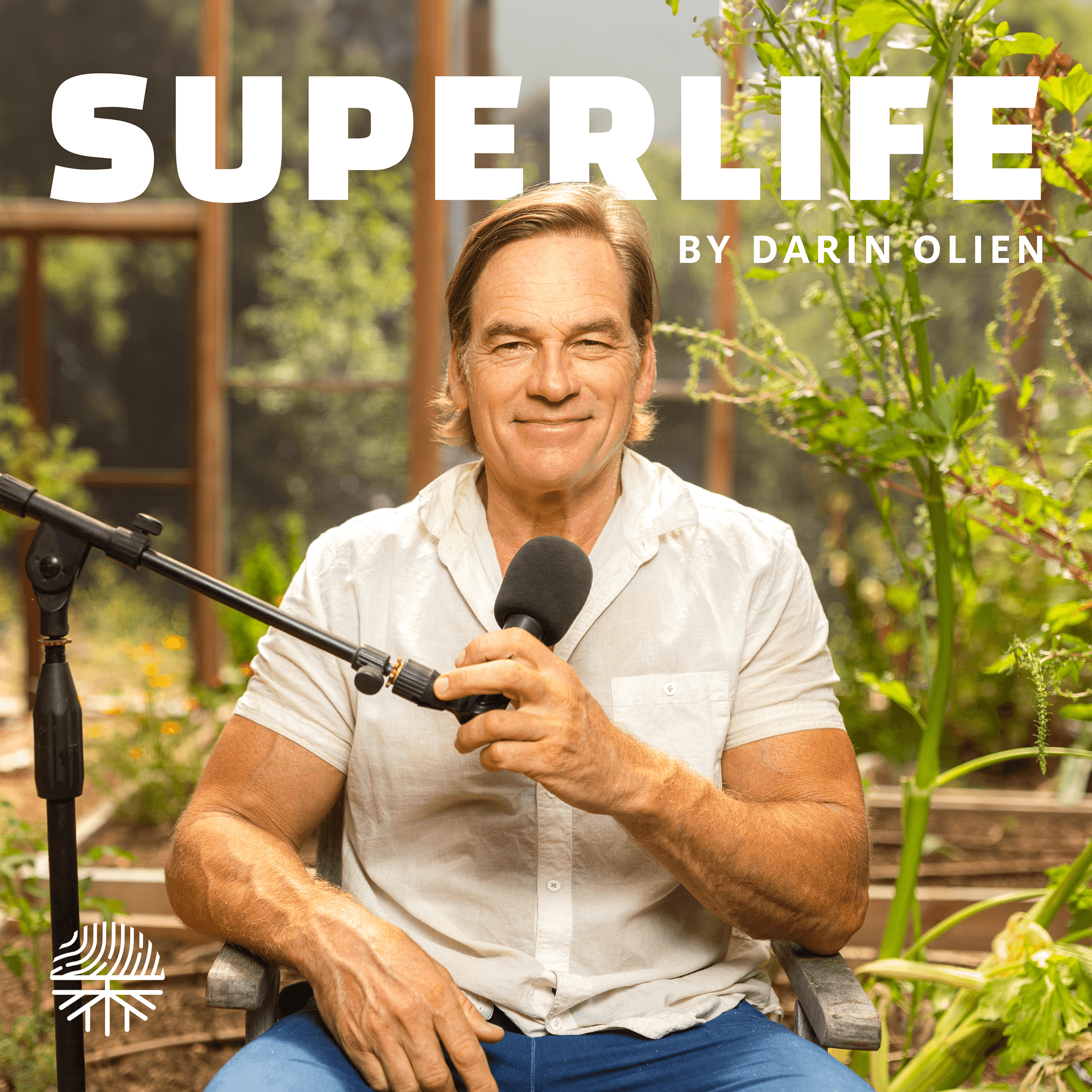
Darin Olien reflects on his mother Sandra Lee Olean’s death (June 13, age 82) and uses grief to argue for “super life” as living truthfully, loving actively, and clearing unresolved issues now—not later.
Guest backgrounds
No guests appear; the episode is solo.
Key claims
Western culture gives grief little space and pushes “move on” quickly, often isolating mourners. Other cultures maintain ongoing bonds with the dead through rituals (Mexico altars, Madagascar bone-turning, Ghana dancing/fantasy coffins, Andes/Quechua offerings, India cremation/holy rivers). Death reveals that love requires action: be vulnerable, speak honestly, and repair relationships.
Notable examples
Darin describes his mother’s steadfast, unconditional love despite family chaos; her peace before dying after a coma; and a palliative-care nurse’s “deathbed regrets” list (live true to yourself, work less, be open, stay in touch, allow happiness).
Written by AI. May contain mistakes. Listen to the episode to check what was said.
Chapters
Tap a time to open that second in VOReflecting on Loss
3:19 to 4:00
Darin shares his personal experience with his mother's passing and the impact of grief.
“I've done hundreds of episodes of this now super life.”
Navigating Grief
4:00 to 6:06
Exploration of the complex emotions surrounding death and the societal perception of grief.
“And I've never once done an episode on death, on grief.”
Cultural Perspectives on Grief
6:06 to 8:14
Discussion on how different cultures approach grief and the significance of communal mourning.
“And that's a strange one to deal with because on the one hand, the loss of a loved one, a loved pet, a loved friend, in this case, my mom, it feels as though life stops.”
Moving Inward with Grief
8:14 to 15:10
Darin emphasizes the importance of processing grief internally rather than trying to move on quickly.
“Maybe some cultures got it better than others.”
Cultural Perspectives on Grief
15:27 to 18:08
Explore how different cultures celebrate and honor death, contrasting Western views on grief.
“In Mexico, families build altars called efrenatas in their home or at gravesites It's covered in photographs, marigolds, candles, favorite foods of the person who died.”
Reflections on Maternal Love
18:10 to 24:40
Darin shares personal stories about his mother, illustrating the profound impact of her love.
“as a relationship that continues, just in a different form.”
Legacy of Love and Regrets
24:41 to 28:00
Discussing the importance of expressing love and the common regrets people have at the end of life.
“Maybe many of you know this and maybe many of you don't, but I have done a lot of things in my life and I've got connected to deep parts of myself.”
Lessons from Deathbed Regrets
28:00 to 31:26
Explore the common regrets people have at the end of their lives and how to live fully.
“to the fabric of even the unseen some so there's a researcher well not really a researcher exactly a former palliative care nurse named brawny ware who spent caring for people in the final weeks of their lives.”
Navigating Grief and Love
31:26 to 33:49
Understand how to handle grief while recognizing the enduring nature of love.
“Every fatal convenience we've ever talked about on this show, the toxins, the processed food, the disconnection, whatever it is, those are slow deaths, quiet erosions of a life you were supposed to be living.”
Call to Action: Live Your Life Now
33:49 to 34:43
A powerful reminder to take action in living your true life without delay.
“Some cultures don't even believe in moving on at all.”
Transcript
Automatic transcript. May contain errors.0:02Darin Olien:Welcome to Super Life with me, Darin Olien, a podcast where we explore, discover, and share solutions that promote a healthier life and a better world. Together, we'll ignite possibilities, inspire change, and build sovereignty, creating a roadmap towards a super life for you and for all. Get ready to start living your super life.
0:32Darin Olien:Before we get into today's episode, I want to acknowledge the company helping to support this conversation, Alchemist. You know, most of us spend so much energy thinking about what we put into our bodies. The food we eat, the water we drink, the air we breathe outside. But here's something that doesn't get nearly enough attention. The air inside your home. Here's a fact that floored me. conventional paints, which are petrochemical-based, are off-gassing, endocrine-disrupting chemicals for not just days, for years after they've been applied. This means the walls of your bedroom, your kids' rooms, your kitchen, they could literally be releasing toxic chemicals into the air you're breathing every single day.
1:21Darin Olien:That's why I want to talk about Alchemist. Alchemist is the world's first wellness paint. Their paints are mineral-based, VOC-free, and completely free of PFOS, those damn forever chemicals that have no business being anywhere in our environment, especially in our home. And because the formula is rooted in natural minerals, it's inherently anti-mold, anti-fungal, so there's no synthetic additives needed to perform, nature has already done the work. On top of all of that, alchemist paint is class A fire resistant, which I love here in Southern California, because guess what? Rocks, i.e. minerals, don't burn.
2:07Darin Olien:So you're not just protecting your family's health, you're protecting your home on every level. No downside. And here's the thing that really speaks to me. Alchemist is cradle-to-cradle certified. If you're not familiar with that, it's one of the most rigorous sustainability certifications in the world. It means the product has been evaluated across its entire life cycle from the ingredients sourced to make it all the way to what happens when it is no longer needed. Nothing is an afterthought with this company. That's a standard most companies never even attempt to meet, but they do. They've rethought the entire formula from the ground up so you don't have to choose between a beautiful home and a safe one.
2:52Darin Olien:We put so much thought into the products that touch our bodies or go into our bodies. It just makes sense to extend the same standard to the surfaces that literally surround us. If you're repainting a room or now inspired to do so, building something new, or just ready to make a healthier swap, check out Alchemist. Go to A-L-K-E-M-I-S dot com. Use the code Darren10, D-A-R-I-N-10. My mom died June 13th of this year. She was 82. Her name was Sandra Lee Olean. She was my mom. I've done hundreds of episodes of this now super life. Used to be the Darren O 'Lean show. I've talked about toxins in your water, microplastics in your blood, chemicals that hide everywhere, fatal conveniences, kids' clothing.
3:58Talked about a lot of things. All for you to live a super life. It's been going on all my life. And I've never once done an episode on death, on grief. The one thing that is waning for all of us at the end of every single conversation we've ever had, you've ever had with anyone, death is going to happen. So I thought it appropriate to not only talk about my mom a little bit, but talk about the grief that I'm currently experiencing. And it's also strange to think that this thing that's constant in our world, life and death, certainly death, death, like super life, I want you to live your life. But there's the other side of the coin.
4:49We can spend an hour talking about seed oils, whether they're good or bad. But our society won't talk 10 minutes, really, about the fact that everyone we love is going to die. And so here we are. I'm talking to you about a subject that we need to talk more about. And here's what's strange about losing my mom. There's sadness. There's a bit of anger. There's certainly deep pain. And a lot more emotions. And something that actually feels weird at the same time is this celebration of her life. and they're all happening virtually at the same time or close to the same and it is in waves not only once not only twice but many at times you don't expect and all of those emotions can also exist in the same hour where i'm crying and tearing up missing my mom and laughing and smiling because of the life she gave me.
5:59Life. Everyone else's life just keeps going. Life keeps going when there's death. And that's a strange one to deal with because on the one hand, the loss of a loved one, a loved pet, a loved friend, in this case, my mom, it feels as though life stops. but yet it doesn't it just keeps going and i want to say life give me a second
6:28Darin Olien:just let me sit here a second and stop with me as my mom stopped her life but that's not what happens so this is what we're talking about today this is not all sadness. Certainly not. This is talking about something that's even more important than how you sleep. It's really how you love. That's what death for me really illuminates. So today, I want to do something different. I want to talk to you about death so we can talk about life so we can talk about super life because i'm starting to think that's that there's this actual other side of the super life coin we talk so much about how it looks to live fully what happens when we don't when we let life beat us down because that's a slow death too when we don't say what we really mean to the people that we love, even when it's uncomfortable, when we leave things messy, unspoken, unresolved, and then the option to fix them is literally gone, at least physically.
7:53Okay, so this is that episode, and I encourage you all to listen
7:58Darin Olien:and to take this in as a baton of love in your life. to lean into clearing out shit you have with people that you love own responsibility for your part be vulnerable i want to start with a question why does grief get almost no real space in our culture no first thing that comes to my mind is it's scary it's a downer but not you know obviously we have funerals we have flowers we have casserole dishes we get together and you know a few days go by a week and then we're supposed to be back to normal there's this unspoken clock that we're on and we're expected to just like okay i'm back at it now sorry for your loss thank you back at work back in the emails back to doing doing doing doing doing doing that's not how grief is grief is a weather pattern sometimes there's sun and sometimes there's a rainstorm there's actually a term for this in psychology disenfranchised grief is grief that's denied and not publicly recognized because each culture creates its own grieving rules that your grief doesn't fit into.
9:27Darin Olien:Maybe some cultures got it better than others. Maybe some say it's lasting too long or it looks weird or it's not the right way. Once for the loss itself, once for the fact that nobody around you can hold it with you, there's a lot of things going on. And here's the deeper layer. Western psychological models of grief, the stages are like tasks of mourning. And I certainly, paying bills for my mom and tidying up her house and all of that stuff, developed these primarily these ways of individualizing this grief. Like I was downstairs in my mom's house, like calling social security, calling insurance companies, calling banks, paying bills.
10:22It was just very isolating and very lonely, but it needed to be done.
10:29Darin Olien:Researchers now recognize that certain models or ways that we've looked at western culture kind of maintain ongoing continual bonds with the deceased through ritual and practice instead of the westernized emphasis of moving on so the westernized idea is like okay grieve a little bit go to a funeral share some stories and now back to the ground the grind but that's not how many other cultures which we're going to talk about and that distinction really got my attention because I don't experience I'm done with grief. It just happened. June 13th was just a blink ago. So the moving on versus continual bonds, and this is something that was very interesting.
11:22We think grief has a finish line. Most other cultures don't believe that and there's also some other nuances there's also historic piece of peace to this as death became more private and hidden in the modern life grief grew more internalized you're individualized you're internalized it's you know even getting up and speaking at my mom's funeral yeah i fell apart i could barely you know i just sat up there and cried for the most part trying to get out words and it's on the one hand you're like trying to swallow this stuff and let it out at the same time because it's so powerful and then other people in the family don't want to say anything they don't want to talk at all which i find like okay cool
12:19Darin Olien:but like and then cry but not really cry it's a weird thing and we also used to die at home surrounded by family with the body present in the day in the house for days you really let that in you know if we have a viewing it's just a viewing and that's not even practice much now death mostly happens at a hospital behind curtains handled by professionals that you really never meet We've outsourced death. Pay for it. Where's the casket? Where's the yearn? Where do we hold this thing? At the funeral house? How is it handled? What are the documents? What needs to be filed? All of this stuff. But I'm also interested in, as I'm sitting in my grief today, I'm not interested in moving on.
13:11I'm interested in moving inward. understanding the levels even as i talk right now my heart hurts i can feel it talking about this
13:24Darin Olien:my heart hurts for the missing of my mom so i don't want to move on i don't want to get through it i don't want to shove it down before we continue the pod i want to share something i've tried so many supplements i've been in the space for 25 years and every so often then something really pops out. Mana Vitality is that difference. It's not just about adding minerals. It's about tuning your body to the higher frequency, physically, mentally, emotionally, and spiritually. Because this is the mana from the earth, the Shilajit, the Ormus minerals, and so on. There's so much going on with this brand.
14:05Darin Olien:I'm so excited. Beyond the Shilajit, they're expanding into other elementals. The brand is built on ancient alchemy with ingredients like gold nanoparticles, beta-glucans, shilajit, ormus, all geared to elevate you. Especially in today's world, you need bioavailable, a bio-delivery system that upgrades your body from the inside out. Every formula is frequency charged to promote balanced energy immune system and cellular renewal. And the wild part, the more consistently you take it, the more you feel everything in your body. It's the same with me. The more I use it, the better I feel. My sleep improved.
14:54Darin Olien:My skin glows. My stress goes down. My testosterone goes off. It's like my whole system is humming again. So if you're tired of low energy, brain fog, and or just not feeling the same and like something's missing, check out Mana. Go to manavitality.com. That's M-A-N-N-A vitality.com. Use the code DAREN20 and you get 20 % off your order. This isn't about health. It's about living in harmony with your greatest and highest potential. In Mexico, families build altars called efrenatas in their home or at gravesites It's covered in photographs, marigolds, candles, favorite foods of the person who died.
15:43It's very festive, celebratory. Ancestors. They visit. I've seen just down from my house, a Latin guy went off the edge of the road, and for three years, someone comes by and has a cross and flowers, and they're fresh every day. all the time, like in the middle of nowhere.
16:10Darin Olien:That's a different culture. And so grief isn't quarantined like here in the West. It's so very much quarantined. Deal with it yourself. In Madagascar, of all places, they have what's called, I'm not doing this one, turning of the bones the family literally exhumes the ancestors remains periodically as part of an ongoing relationship with the dead the dead aren't gone they're still part of the family family's rhythm of life now i'll talk a little bit about other things not that at all, but the relationship I have with my mom now. In Ghana, they celebrate a death with dancing, elaborately designing fantasy coffins and symbols of the person's life and work and passions and love.
17:09Darin Olien:I love that. The Andes, the Quechua, who live, I've met many of them in the Andes, their ancestors are seen as spiritual custodians of the land and the community and the ritual tied to the farming season, including offerings of coca leaves. Still think coca leaves are fantastic. And chicha, fermented beverage, celebratory. In India, Hindu death rites. Bodies are cremated and ashes released in the holy rivers like the Ganges. Not the most sanitary thing in the world, but, you know, all across many cultures, Mexico, Madagascar, Africa, Ghana, Andes, India, none of them treat death as an ending to manage and move past quickly.
18:07Darin Olien:And so listen to that. They treat it as a relationship that continues, just in a different form. And I'll talk again about mom, Mom now. And there's real research behind why this also matters, because that's the fabric of life. Just because the soul is not inhabiting the body, the energy is neither created nor destroyed, so it moves on. Rituals following death of the loved one are served as a very important function for us as individuals and families and communities and mourning. It's required. It's needed. It's craved. I wanted to have a funeral. I knew I was going to cry. I knew it's painful, but it's necessary.
19:03Darin Olien:This is important. The rituals of death that aren't automatically healing by itself, but it allows for the grieving waves to be okay. Hey, be acknowledged. It's okay to feel. How much of our Western world is not okay with just feeling? It's all just moving on. Stop feeling because if you felt, maybe you wouldn't even eat your burger. That burger was a tortured animal that was killed so that you can have a burger. I digress, but that's the point. We don't feel anything. Or we feel it and we blow it off and just go, I just want to live my life. I am sorry. That's not how I choose to live my life.
19:57I want to feel deeply and make choices and impact the world deeply.
20:02Darin Olien:That's why. And I don't know if you can hear that bird. There's a beautiful bird singing right now to me. And that's my mom. That's my mom. I hope you can hear that. So this section of the podcast is about my mom. Who was she? One image that captures her. I would say an image that captures her as a young person on a horse, independent, free, strong. She was fiercely stubborn. it allowed her to live through a lot of pain a lot of near-death experiences at least four or five of them significantly even three and a half months ago she was in a coma but she was doing so good before she passed that it surprised all of us because she was at peace that came from her her sister Pam talked to her the day before she said my sister never said that before never heard her say i'm at peace wow my mom what she did for me anchored in me so much more i started to get wind of it in the last few months we got deeper and deeper as she survived this other near death and i started to realize i started to ask her questions about what life was like when i came home from the hospital and dad's drinking and he was losing jobs and my brother was two.
21:35My mom held it all together. It's badass. She held the entire family together. She did. In utter chaos. Husband that was not there. Drunk. Vacant. Void. Not available. and she had two new kids she held it together and the thing also what my mom did was provide me the most consistent love in my life period period she loved me unconditionally just through and through
22:13Darin Olien:I never questioned if she loved me never ever and I was so used to it that I never realized that people didn't have it. And I think that love from her, I not even think, I know that love from her allowed me to stretch in my life, allowed me to take risks, allowed me to leave my hometown, to leave my state, and to leave my country 40 times, to travel around the world. All of those risks was because I was home in myself from the love that she gave. That's my mom. I told her everything that I wanted to tell her. I tried to help her in her health and her life since I was 18. I wrote my first exercise program specifically for my mom.
23:01I printed it out on the computer. I typed it out, what to do, how to move your body, what to eat. And I printed it out well before this was what i was 18 this was this was 1988 87 88 tied a red bow on it gave it to her for christmas i've always been an advocate for her and her health and she she had she didn't take care of herself that well so at a certain point i let go she's always there if she wanted to change or send her some shakes or shakeology or supplements uh create give food programs that deliver food to her house in a small town like i did everything and anything i could and she also made her own choices and she survived a lot got through a lot the beautiful thing about my mom was she was so kind she was so kind so loving didn't receive well didn't want help so stubborn she dragged branches across the lawn when she was in her 80s when my brother didn't do it fast enough and my brother is doing everything for her and like she's so stubborn if it's not done in two minutes she just does it herself and no one knows it and then she ends up hurting herself it's just that's just what she was.
24:28I celebrate her. I celebrate her today. I celebrate the love she gave me from the moment I was born and before and to the moment she left. And here's the thing I want to share with you. Maybe many of you know this and maybe many of you don't, but I have done a lot of things in my life and I've got connected to deep parts of myself. I've seen a lot of things that, you know, call it spirits, call it senses, feelings. I've seen a lot of things. And I felt my dad when he died, a certain energy. And without thinking about it, without trying to do it, I felt my mom. I still feel her. I feel her in my body right now.
25:18I feel her presence. and I feel it so accepting and loving and also this idea that she finally gets me she understands me because she didn't fully understand how the hell I did what I did in the world because she's a small town small town girl from South Dakota moved to Minnesota and she didn't travel much so on the one hand she didn't understand how i could go around the world and do all this stuff that i do and if there was one thing to tell her i said is because you loved me mom that's how i could do it because she loved me so i celebrate her for that and i just want to say right now that love is not passive it is active when you love somebody love in all forms love your children love your friends, love your parents, love, love, love.
26:18Just give it away. Be vulnerable. Be first. Just love. When people feel love, they can do more things. Because everyone is walking around with some sort of broken part of themselves. So love them anyway. You can have boundaries with people and still love them. but holding on to anything unresolved if there's one thing you take away from this today is clean that up clean that up i'm so grateful i had that closeness with my dad and we talked about everything when he died 20 some years ago and i had that with my mom too and that took a little more because she didn't see me as no she saw me she didn't understand me as much so i withheld until this last six months and not even really i always told her how honest honest i thought about life and and what i thought of her so i'm not holding on or sad that i didn't say something and the fact that I feel her presence, I can have a conversation with her.
27:38Let's just say it. I can have it in my mind. I can have it. I can write in a journal. I can have, I can tune in to her. We get to do that. That does exist. There is something greater. there is another side man i can feel it i know it so we get to connect to the fabric of even the unseen some so there's a researcher well not really a researcher exactly a former palliative care nurse named brawny ware who spent caring for people in the final weeks of their lives. She asked her dying patients again and again if they had any regrets or anything they'd do differently and the same themes kept surfacing of course.
28:31Here's what topped the list. I wish I had the courage to live a life true to myself not the life others expected of me.
28:44Darin Olien:This was the single most common regret of all. People realize, looking back clearly at the end, how many dreams went unfulfilled. Not by accident, but because of choices they made or didn't make. This is it. We get to risk living our lives. we get to risk going for what we want and we don't do not have to answer to anybody we get to risk that coming from our heart the second regret the second one the regret over working so much we blew off relationships that came from nearly every man this nurse nursed men who miss their children's youth, their partner's companionship, caught on what she called the treadmill of a work existence.
29:49Darin Olien:The third, people deeply regretted not having been more open, more honest about what they felt holding things for later or not really risking the vulnerability of being uncomfortable sharing honestly i love radical honesty just speak right to it it opens up possibilities creates connection fourth not staying in touch with friends old friends people to catch up on who know you. Golden relationships slip on by. And the fifth, the wish to have let themselves be happier, enjoy their lives rather than staying stuck in fear of change and pretending everything is okay when it's not. So listen to that list again.
30:43Darin Olien:Live true to yourself. Don't disappear in your work. Say what you feel. Keep your people close. Let yourself actually be happy instead of performing it. Do whatever it takes. That's not a deathbed list. That's a living list. That's the super life mission. The other side of the coin is acknowledging a life when you don't live your truth. Don't let that happen in your life. Do not. Make a commitment right now inside yourself. Right now. I mean it. Like right now. No matter what. You're going to live from your heart. You're going to take risks. You're going to live in love. Share that honestly with people.
31:37Darin Olien:Live forward. But live full and honest. Death isn't the opposite of super life. It's the test of it. Every fatal convenience we've ever talked about on this show, the toxins, the processed food, the disconnection, whatever it is, those are slow deaths, quiet erosions of a life you were supposed to be living. And the deepest fatal convenience of all might be this. It is convenient to not have the hard conversations in your life. It's convenient to assume there's more time. It's convenient to let resentment sit instead of doing the hard things. Repairing it. Now, we get to take responsibility for our lives.
32:35Darin Olien:We get to take responsibility for all of your life, not in guilt, in responsibility. Who could you be? How could you show up in life that would change everyone you come in contact with? Say the thing. Be the thing. Forgive and move forward. Love the people in front of you always. Be different. Be weird. Be so honest with yourself. it gives the permission for others to be honest with themselves. My mom is gone. She is physically no longer here. And there is grief in my core. And there is gratitude in my heart, sitting next to each other and possibly even in the same damn chair. I don't think that's a contradiction.
Read the full transcript
33:26I think that it's just what love costs and what love is when it's worth it.
33:35Darin Olien:If you're carrying a grief that nobody around you has, make space for it. Allow it. See it. Feel it. It doesn't have to look like anyone else's. There's no clock on it. Some cultures don't even believe in moving on at all. They believe in staying in relationship with those people. And if you're not grieving now, if someone you love is still here, then let this be a nudge. Don't wait for deathbed versions of clarity. You know what to do right now. Say the thing. Call the friend. Forgive the thing. live the life that is actually yours you need to take that on actively not for later but for now because that's super life all of it every part i love you mom thank you for creating the amazing man that i am i love you i love you i love you
From the publisher
What if grief isn't something we're meant to "get over"—but something we're meant to carry with love?
In one of his most personal episodes ever, Darin opens his heart following the passing of his mother, Sandra Lee Olien. Rather than offering easy answers or tidy stages of grief, he shares the raw, complicated reality of loss: the tears, the gratitude, the anger, the laughter, the memories, and the profound realization that death doesn't simply teach us about endings—it teaches us how to live.
Drawing from psychology, cultural traditions around the world, personal stories, and the wisdom of those facing the end of life, Darin explores why Western culture struggles with grief, why love is an active practice rather than a feeling, and how embracing mortality can become one of the greatest invitations to authenticity, forgiveness, vulnerability, and purpose.
This is not simply an episode about death. It's an episode about living so fully that, when the end eventually comes for all of us, there is as little left unsaid as possible.
What You'll Learn
-
Why Western culture often avoids meaningful conversations about grief
-
The difference between "moving on" and maintaining continuing bonds with loved ones
-
How cultures around the world approach death and remembrance
-
Why grief isn't linear—and why that's completely normal
-
The psychology of disenfranchised grief
-
Darin's deeply personal reflections after losing his mother
-
How unconditional love creates lifelong resilience
-
Why unresolved relationships become our greatest regrets
-
The five most common regrets people share at the end of life
-
Why vulnerability is one of the greatest expressions of love
-
How death can become one of life's greatest teachers
-
Practical ways to live with more honesty, forgiveness, and purpose
Chapters
00:00:00 – Welcome to SuperLife
00:00:33 – Sponsor: Alkemis Paint
00:03:24 – A deeply personal announcement: the loss of Darin's mother
00:04:01 – Why this is the first episode about grief
00:05:04 – Grief, celebration, and holding conflicting emotions at once
00:06:00 – Why life continues after loss
00:07:02 – Death teaches us how to love
00:08:11 – Why grief receives so little space in Western culture
00:09:14 – Understanding disenfranchised grief
00:10:24 – Moving on versus maintaining continuing bonds
00:11:25 – Why grief doesn't have a finish line
00:12:01 – Modern society has outsourced death
00:13:17 – Moving inward instead of moving on
00:13:33 – Sponsor: Manna Vitality
00:15:28 – How Mexico celebrates ongoing relationships with ancestors
00:16:16 – Madagascar, Ghana, India, and global grief traditions
00:18:15 – Why rituals help us process loss
00:19:30 – Allowing yourself to truly feel
00:20:27 – Remembering Sandra Lee Olien
00:21:36 – A mother's unconditional love
00:22:41 – How love creates courage and confidence
00:23:32 – Letting go while honoring another person's choices
00:24:26 – Celebrating kindness, resilience, and stubborn strength
00:25:25 – Feeling his mother's presence after her passing
00:26:17 – Love is an active practice
00:27:25 – Why nothing important should remain unsaid
00:28:20 – The five regrets of the dying
00:29:29 – Living your own life instead of someone else's expectations
00:30:10 – Work, vulnerability, friendship, and choosing happiness
00:31:24 – Death as the other side of SuperLife
00:31:54 – The greatest fatal convenience: assuming there's more time
00:32:57 – Responsibility, forgiveness, and radical honesty
00:33:29 – Grief and gratitude can exist together
00:34:22 – Say the thing. Forgive. Love now.
00:34:45 – A heartfelt farewell to Mom
00:34:53 – Closing thoughts
Thank You to Our Sponsors
-
Alkemis: Go to https://alkemispaint.com/ and use code DARIN10 for 10% off your order.
-
Manna Vitality: Go to mannavitality.com/ and use code DARIN12 for 12% off your order.
Join the SuperLife Patreon:
This is where Darin now shares the deeper work:
- weekly voice notes
- ingredient trackers
- wellness challenges
- extended conversations
- community accountability
- sovereignty practices
Join now for only $7.49/month at https://patreon.com/darinolien
Find More from Darin Olien:
-
Website: darinolien.com
-
Instagram: @darinolien
-
Book: Fatal Conveniences
-
Platform & Products: superlife.com
-
New Show: Roadmap to Happiness
Key Takeaway
"Death isn't the opposite of a SuperLife—it reveals whether we've truly lived one. The conversations we avoid, the forgiveness we postpone, the love we leave unspoken, and the dreams we delay all become painfully clear when we're reminded that none of us is promised more time. Grief isn't something to conquer or rush through. It's love continuing to exist after physical presence has ended. And perhaps the greatest tribute we can offer those we've lost is to live with more honesty, more courage, more vulnerability, and more love while we're still here."
Bibliography/Sources:
Peer-Reviewed Research & Journals
-
Phan, H. P., Ngu, B. H., Chen, S., & Hsu, L. (2025). How cultural beliefs and rituals may help alleviate grief and despair: A four-dimensional framework. Frontiers in Sociology, 10.
https://doi.org/10.3389/fsoc.2025.1620016
Books & Academic Encyclopedias
-
Doka, K. J., & Martin, T. (2002). Disenfranchised grief. Research Press.
https://books.google.com/books?id=disenfranchised-grief
-
SAGE Publications. (n.d.). Death rituals. In SAGE Encyclopedia of Anthropology.
https://sk.sagepub.com/reference/anthropology
-
Ware, B. (2011). The top five regrets of the dying: A life transformed by the dearly departing. Hay House.
https://bronnieware.com/blog/regrets-of-the-dying/
Psychology & Cultural Publications
-
Kuzo and Foulk Funeral Homes. (2024). Cultural traditions around death and mourning: A global perspective.
-
Simply Psychology. (2026). Grief across cultures: How different traditions approach loss and mourning.