
 Ask ChatGPT


 Talking HealthTech
29 Jul 2026 · 32m · 15 chapters
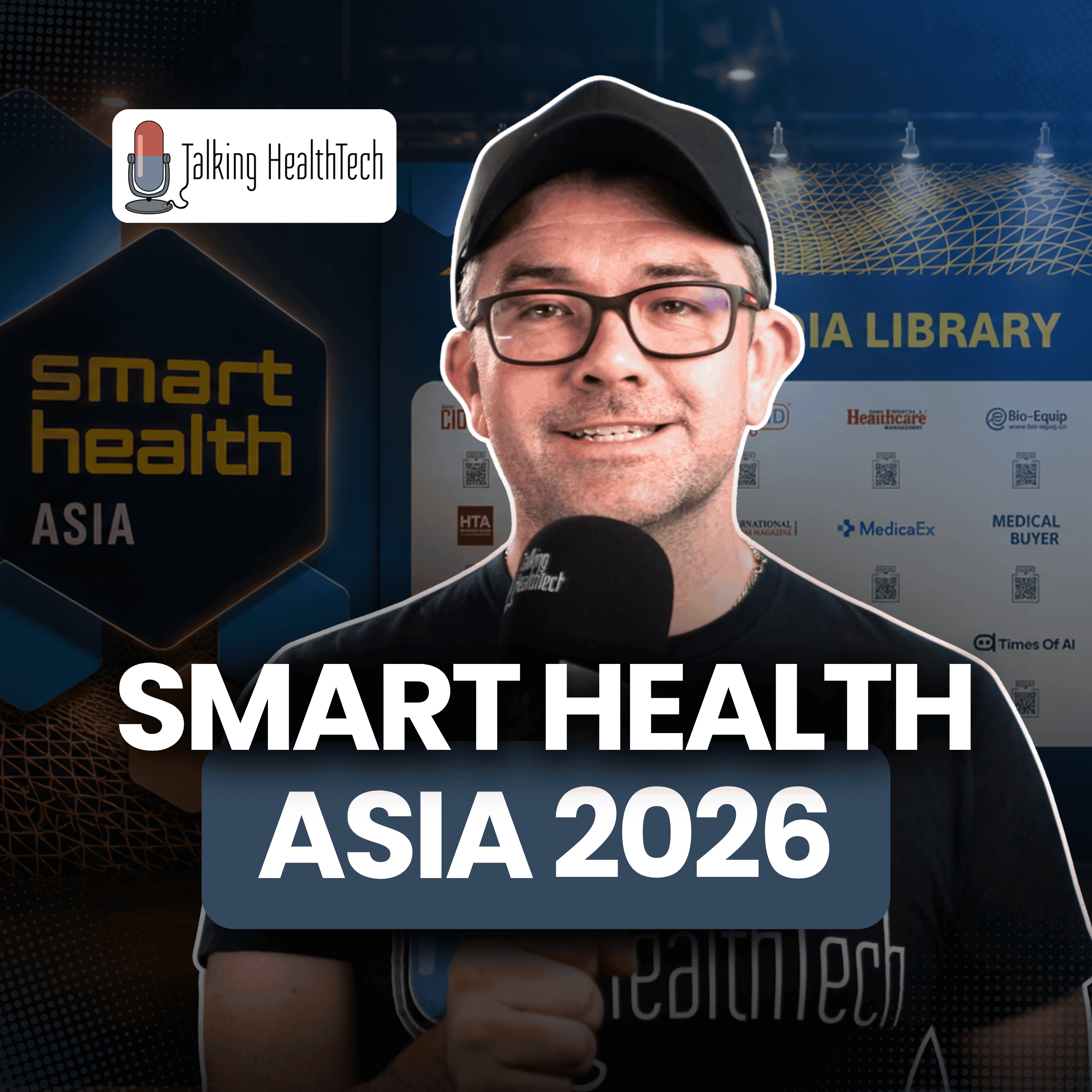
Highlights from Smart Health Asia 2026 in Singapore on improving healthcare access and quality in Asia through digital health, AI, and cross-stakeholder collaboration. Guests discuss scaling technology beyond pilots, workforce shortages, and using AI to reduce clinician workload while improving patient experience and cost efficiency.
Written by AI. May contain mistakes.
Madhu Sassadar discusses Apollo Hospitals and healthcare in India.
“I currently am the CEO and president for Apula Hospitals.”
Addressing access and specialty care challenges in India.
“And on our pharmacy side, which is about 7 ,000 pharmacies, it's incredible to see the rate of transaction per minute because it's also a very large online system that is available 24 by 7.”
Exploring how technology can address healthcare challenges.
“And especially, I think the urban-rural divide is very, very large.”
Discussion on key measures for success in healthcare technology implementation.
“And then when you combine this with telehealth, I think the potential is really, really large.”
Madhu discusses sharing experiences at Smart Health Asia.
“will truly make an impact in healthcare.”
Luciano Brustia shares insights about InterSystems and Asia-Pacific healthcare.
“It's both motivating, reinforcing, as well as I think we all will learn from each other's experiences.”
Discussing the specific healthcare challenges and opportunities in Indonesia.
“What's the big focus in Indonesia at the moment?”
Learn about Indonesia's initiative to unify healthcare records through technology.
“So trying to have a, to, blocking that is very important.”
Discover how AI is being integrated in hospitals to enhance patient care.
“What are you sharing with participants here?”
Explore Intersystems' commitment to reliability and sustainability in healthcare technology.
“So speaking about hyper noise and grandeur, in the AI space, there's a lot of investment in infrastructure and let's build like, you know, more and more data centers capability and all that kind of stuff.”
Understand how Intersystems prioritizes customer needs in their technology offerings.
“System is always up and we are running our light hardware.”
Get insights into the Smart Health Asia event and its significance in healthcare.
“And health care, sooner or later, everyone will be a patient.”
Learn how Smart Health Asia aims to foster collaboration among healthcare stakeholders.
“And of course, healthcare is one of the very important verticals that we focus in a lot.”
Discover key considerations for health tech companies entering the Asia Pacific market.
“So, you know, when we plan Smart Health Asia, right, we try to plan it across three key pillars, we call it.”
Learn about the importance of networking and collaboration in healthcare events like Smart Health Asia.
“So take, for instance, our transformation track brings together the clinicians themselves.”

Get the gist, explore an idea or ask about something said.
 Claude
On Talking HealthTech, what are the key points of this episode?
Searching your listeningAutomatic transcript. May contain errors.
0:05Peter Birch: Welcome to Talking Health Tech. My name is Peter Birch. I'm here at Smart Health Asia in Singapore with over 3 ,000 other attendees capturing over 80 different sessions from over 140 different speakers and representation from 18 different countries around the world. During the event, I was lucky enough to speak with some of those senior leaders who are up on stage, capturing all the key thoughts and hot topics that are shaping the discussions here at the event. You can catch some of those discussions here on the Talking Health Tech podcast in this episode, but you can head over to our YouTube channel because there is a special playlist featuring all the discussions that we had here at Smart Health Asia 2026.
0:44Peter Birch: Collaboration starts with a conversation team, Health Tech. Let's make it happen. My name is Madhu Sassadar. I currently am the CEO and president for Apula Hospitals. It's the largest healthcare system in India. We are about 73 hospitals, 7 ,000 pharmacies, over 400 clinics spread throughout the country. I manage the hospitals. I'm a physician by training. After my early education in India, I went to the U.S. My background is internal medicine, primary and critical care. I work with a large health system called the Cleveland Clinic. And after 30 years, I moved back to Apollo in an administrative role.
1:23And this is truly an exciting time. And I think I'm at the right half of the globe at the right time.
1:29Peter Birch: Yeah. How many people would receive health care through Apollo? Like, largest health system in the largest population in the world. That's a lot of health care. The transaction rate is very high, right? Because unlike Western health systems, the turnover is much more rapid in India. In a year, we would admit and discharge about 700 ,000 patients. And on our pharmacy side, which is about 7 ,000 pharmacies, it's incredible to see the rate of transaction per minute because it's also a very large online system that is available 24 by 7. I think that just gives us experience and the ability to try out novel technologies and see results very, very quickly.
2:14Yeah.
2:15Peter Birch: And what are the biggest health care needs or challenges that the population faces that Apollo needs to accommodate for? Yeah, I would say the biggest challenge is access, right, which in some way is common across the globe, right? Whether you are in Florida, Northeast Ohio, UK or in India, access is always an issue. It's the right provider or the right doctor at the right time at the right place or format. And of course, in India, while healthcare is growing rapidly, there's still large segments of the population that would like to see a doctor, can pay for it, but still cannot. And especially, I think the urban-rural divide is very, very large.
2:57Specialty care, access to capital-intensive technologies, CT scans, PET scans, radiation therapy. That's still, I think, the biggest challenge and will continue to be as the population both grows and ages in place. yeah and so we're doing everything that we can uh by the end of this year we would have opened another three hospitals so that's about six new hospitals in seven months so the growth rate is
3:21Peter Birch: pretty rapid yeah i mean that's one solution is build more hospitals but there's you know there's going to be a rate limit to that i guess at some point too like what kind what role does technology play in addressing some of those challenges for you yeah so again india shares a challenge with the rest of the globe, which is finding trained workforce. Even in India, which is home to one out of five people under the age of 25 as in India, yet we have a nursing shortage. They either exit the workforce or they leave. But I think this is where technology will play an incredible role. And it's being proven out today in the published literature.
4:00We can cut down the workload of radiologists who raise mammogram by 50%. We use AI in colonoscopy to aid in detection of polyps. We use that for stroke detection. So already that efficiency play, which is cutting down the doctor work time and the workload is a clear advantage for us, and especially in a country like India. And then when you combine this with telehealth, I think the potential is really, really large. For example, tuberculosis, which is still in this part of the world a challenge. the rate limiting step used to be reading an x-ray having a radiologist to read an x-ray but today we can acquire the image get ai to read it and only surface the complex ones or the ones that are marked abnormal for a radiologist so i think this truly improves the efficiency and and and multiplies the efficacy by by truly a factor of you know a few times yeah do you think i'm always
5:02Peter Birch: fascinated by what the measure of success is for say implementing technology or even just a new workflow or solution or something in healthcare as populations increase as or demand increases or complexity of healthcare increases sometimes it feels like we're just trying to keep up and so you know you can't really measure success by reduced number of presentations at a certain area or like ultimately better health outcomes at a population health level and all that kind of stuff from i guess maybe from an apollo point of view or even just in your own kind of experiences what's a good kind of key measure for success if there was say an implementation from a technology point of view at least then uh like how do you go hey we achieve what we're trying to do because you can get lost in the actual implementation and you forget why you actually start in the first place i mean truly if you walk this pavilion you'll get sold on 10 technologies before you leave right um so i i have this quasi value equation in my mind, value in healthcare, right?
6:02The numerator is quality access, patient experience, and the denominator is cost. And so you really need endpoints, hard endpoints on how you're going to improve quality access or patient experience and reduce cost. And it has to truly be scalable because you can easily get sold on small pilots, but most of these things, technologies need organizational change, have to be successful at scale, be sustainable. So I think that's really the test. And what's fascinating is a combination of digital technologies and maybe AI layer on top of it, maybe agentic technologies, today has the potential to hit all three, right?
6:44Improve quality, improve access, improve patient experience, and at a lower cost. And these are global healthcare challenges. You know, the OECD countries have major disparities in healthcare outcomes. Quality and patient outcomes is incredibly important in the US with a very advanced health system that spends a lot, about a fifth of its GDP. And they're very important in India too. So I think we are in a very interesting time where these technologies will truly make an impact in healthcare.
7:13Peter Birch: Yeah. Hey, lastly, we're here at Smart Health Asia in Singapore. I believe you're up on a stage at some point. Tell us about what you're sharing. Yeah, I do have. Well, we're going to share some of our experiences with driving digital technologies. And on the stage will be participants from Singapore, Thailand, Australia. And it's fascinating because the diversity truly illustrates the opportunity. And I think this bringing together these voices gives everybody here a chance to hear these diverse opinions and how change has been driven. I think what's also fascinating is how much we have driven.
7:51And AI is in some ways a leveler, right? I mean, it reduces that barrier to innovation. So I'm hearing examples of doctors using Claude to code up technologies and drive solutions, which five years back needed a large company, you know, based in Seattle to drive. So truly exciting time. And it's fantastic to hear these examples. It's both motivating, reinforcing, as well as I think we all will learn from each other's experiences.
8:22I'm Luciano Brustia, and I'm looking after the business of InterSystem and AsiaPAC. InterSystem, I don't know if you've never heard before. I'm surprised. But it's okay, but it's not a surprise. We've been around since almost 50 years. We are an American company based in Boston, and we are a technology company. People think that we are in health IT. But it's not entirely true. We are a technology company, been very, very successful in healthcare. That is our bigger market, around 80%. But we're also present in logistics, in finance, and all other markets. Our presence, I'm looking after AsiaPAC, and then you ask, why an Italian, which is clear from my accent, is ending up in AsiaPAC, but it's a long story.
9:18I'm 30 years in intersystem. So I travel all over the world, and then it's 15 years that I stay here in Asia. Perfect. And we've been present historically with our office in Sydney since 30 plus years, and then we expanded. So now we have an office moving from a geographical point of view and not upsetting anyone. From Auckland, in Sydney, Melbourne, and Darwin, we have Tokyo and Osaka in Japan, Beijing in China and from Beijing and Tokyo we're present more for 25 years and then we have office in Bangkok, Singapore and the last opening in Jakarta
10:04Peter Birch: Yeah, super interesting Now, well look, InterSystems by no means are strangers to Talking Health Tech plenty of content in the feed for people to check out We've not really done too much of a deep dive into the broader Asia-Pacific region or Southeast Asia or anything like that. Love to understand a little bit more about the types of healthcare challenges you're addressing or particular regions, which are like a super focus for you right now and the types of solutions that you'll be bringing into health systems, at least to set the context a little bit more. Yeah. So this region is very large.
10:37It's very big and has a completely different demand. Australia and New Zealand is more historically, a more mature market, and their requests are completely different. Japan is a very close market. You don't fund too many international companies. I would say Japan and China are close market. You don't fund international companies. When I say that we have more than 250 hospitals in China, and all the top 100 are mainly 80 % of them using our technology, people are running surprised. Like an American company doing technology in China. It means probably that it's good. And, you know, in Japan, which is the area in our part that is less focusing on healthcare, it's only 50%.
11:27But the biggest logistic organization, Paltak, is using our technology.
11:36Peter Birch: Right. And then we have Southeast Asia. Southeast Asia is very, very fast growing. Yes. We have historical customer in Thailand, but it's very fast growing in particular in Indonesia, Malaysia, and also Singapore, where it's very mature, but there is a lot of opportunities. We recently opened the office in Jakarta because really to address the demand of our customer. you know we are a global company and we have a 25 country with office around the world so when we open an office is to stay and to stay long term planning we are a private company private owned by one guy and like him but for us it's this means there's no pressure on quarter result we always need to do the right things for the customer doesn't mean to always say yes sometimes they know make you growing particularly they know that i was getting from my dad and would make me a lot of groaning and that was not only the no i'm gonna send this to lincoln that is making you grow yeah yeah no i hear you and i like that approach of hey look if we're going to be doing something for a long time uh and like any advice i give to a lot of uh technology providers that want to have a like a strong relationship in a new region, you really need to be in the region to be serious about it.
13:05Peter Birch: What's the big focus in Indonesia at the moment? Or what are the types of technologies or solutions or challenges specifically that bring you that? So Indonesia is very unique because it's around 300 million population, fourth most populated country in the world. And if you look at the pyramid of growing, there is a big percentage of the population sub-30. Yeah. And this is a huge opportunity for the government to have a solid data platform to address what is future. Because when you have in the sub-30, that is the so-called healthy part of your life, you still have not developed a chronic disease.
13:48So setting up all the infrastructure to prevent and to look after the chronic disease, that is the thing. Because when there is a chronic disease, is a big burden on the public health. So trying to have a, to, blocking that is very important. Indonesia started with a project that is called Satu Sehat. I don't know how much you are proficient in Bahasa, but Satu means one, Satu Sehat is health. So it's one health. Okay. One record for all Indonesia. You say, okay, we have done this in all countries. Yes. But Indonesia is large. which is not only 300 million people, it's a thousand of islands, and some parts are very, very remote.
14:32Yes. Technology is not a wide adopted, like in Jakarta. So Indonesia is not only Jakarta, Bali, and Surabaya. There are a lot of remote places, and that is where we would like really to help Indonesian government, like we are helping Malaysia, Natai, and all the other government, to grow and to accept a good infrastructure for the future.
14:55Peter Birch: It's exciting to be part of something that feels a little bit more proactive, I guess, in a sense of being able to focus on those, the opportunity to address health issues before they arise. And we talk about that a lot in healthcare. So that's pretty cool. We're here at Smart Health Asia in Singapore. What are you sharing with participants here? I believe you're up on a stage at some point. Well, we have a couple of good examples that I share before on the stage, and in particular the adoption of AI. So, of course, we need to talk about AI. We have a couple of hospitals, one in Indonesia, one in Thailand, that start using our new AI embedded software, IntelliCare.
15:44is the first AI native EMR that has been grown on the historical EMR trachea that has been very popular here in all the region and is which really give a different perspective to the clinician and to the care provider, I would say. Let's don't forget the nurse is the main part of the hospital. You know, 25, 30 years ago, everyone was striving to provide data to the care provider because they were missing data to make decisions. Yes. Now there are too many data. Yeah. So AI needed to be smart enough to provide the right data at the right moment. So either in EMC in Indonesia, either in Bangkok Nursing Hospital in Bangkok, we have seen doctors and nurses using our chatbot to ask why the patient is here.
16:48What's the problem today? The same information we'll have to get clicking around for 10, 15 minutes. okay and you know until the historical approach was okay we are working very very hard to resolve to to remove two clicks okay i still have 18 clicks instead of 20 thank you here instead is a human you talk or you type yeah we have a function of talking but most of the people type because of the noisy of the hospital so why the patient is here and then you can go deep in a more human language interaction. And that is where we are really providing value. We are working because, in particular, EMC was the first installation in the region in the world of IntelliCare.
17:34We are working with MIT. and one of the researchers of MIT, Dr. Angelica Marotta, is doing a research on the benefits before and after adopting the AI. And some results are coming very, very interesting. Reduction of 20%, 30 % of the time on searching information. I think that is very promising.
18:01Peter Birch: Yeah, 100 % it is. hey um i was just reflecting then too often when i think of intersystems had plenty of conversations quite a large technology company but you know unless you're engaging with it directly or even if i was going to say even like unless you're in the health system but some people don't even know that it exists yet it's powering the majority of the health system um i very much see it as the kind of technology company that just gets on and does stuff as opposed to makes a lot of hype and noise and grandeur about things. So speaking about hyper noise and grandeur, in the AI space, there's a lot of investment in infrastructure and let's build like, you know, more and more data centers capability and all that kind of stuff.
18:42Peter Birch: Whereas I look at the intersystems kind of messaging in the way of going about things, it's kind of leaning into this sustainability kind of side of things too. Tell me a little bit more about that, why that's a particular route that you're going down because everyone else seems to be going down this route of let's build more big things. So thank you for this. I wanted to answer one thing before. No one knows that there is a system unless when the system is down. Yeah, that's right. So that is important. So one of the things that InterSysman has always been famous in all our 50, 48 years of history is reliability.
19:19System is always up and we are running our light hardware. Right. So when for the same things, for the same number of process data, you need a very, very large software, very, very large hardware. With InterSystem, with our technology, always run very small ARIS. ARIS need much more ARIS requirement. And this is reflecting on the fact that ARIS is a multimodal database. so when you define a SQL table, a class is already the ability of vector searching on it. So you don't need to add another layer. You can scale horizontal, you can scale vertical and this is reflecting on less hardware. Less hardware means less, you know, the big, big data center everyone is talking is much less and that is where, there is an AWS research that I like that.
20:20on which set Iris is the one that is asking much, much less, even 80 % of resources less than all the other big data platform. And I think that is a very good future for our son.
20:35Peter Birch: Yeah, 100%. Hey, lastly, future thinking about the region and systems and your priorities as you walk away from Smart Health Asia this week, where are the next kind of priorities? or where do you think even your customers are going to be focusing on the most, which is going to then direct where you're going? Yeah, we go back to the fact that we are a private company and we are just looking after our customer. So the priority is always the same. Do the right things for the customer, listen to them, and provide what they need. Nowadays, there is a lot of demand on helping getting all this data the right information.
21:19No more data, but the right information. AI, good technology can help that. We are doing a big project in the region that is exactly focusing on that. And the technology is faster, is very fast evolving. The fact that we can put a lot of our income in R &D is allowing us to have always, trying to be always at the edge of the technology. It's very hard. But we are trying our best. And also with our customer, we are always trying our best to provide the best service. And because at the end of the day, as we're saying, we are in health IT, we are working for health care. And health care, sooner or later, everyone will be a patient.
22:06So we always need to be conscious and having an empathic approach of all the requests. You know, it's 30 years. I know I look very, very young, but it's 30 years that I'm working in InterSystem. And before working in InterSystem, I was an IT director in an hospital group in Italy. So this teach me that when a customer raise their hands and open their ticket, there is a need, there is a problem. They are raising their hands, there is a problem. So I always ask to our people, look at that empathic and try to understand what is the reason. Sometimes the customer is giving us the solution, which is say, tell me what is the problem.
22:53Don't tell me the solution. And this is when we want really to make the difference.
23:02Hi, my name is Kim. I'm the executive director of MESA Berlin Asia-Pacific, and I'm part of the organizing team for Smart Health Asia.
23:09Peter Birch: Gotcha. Sure. This is the first Smart Health Asia, is that right? That's right. But Messi Berlin is no stranger to running an event, as I understand. Yeah. So Messi Berlin, we have a history of more than 200 years. Wow. So we've been running trade shows, exhibitions across many different verticals. And of course, healthcare is one of the very important verticals that we focus in a lot. Yeah. And so Smart Health Asia, this is the first of its kind and it's here in Singapore. Who are the kinds of people who are attending this event? Yeah, so we created Smart Health Asia because we wanted to bring the entire ecosystem together.
23:46And when I say entire ecosystem, so it comes from hospitals, healthcare providers, government agencies, policymakers, regulators, you know, from investors to payers. And also, of course, all the technology providers across Asia and beyond.
24:01Peter Birch: Yeah, gotcha. Well, I mean, doing the rounds, I've seen a good amount of representation from some familiar and new faces from the vendor community, of course, but a lot from the health systems. I'm not seeing on badges, you know, someone from so-and-so hospital. And I can see that there's a good mix of, I guess, international contingent. Many people coming from around the region and probably around the world, too, but also a lot coming from the health system in Singapore. So I guess in my mind, that's kind of how a lot of the good ideas come about, right? You need to kind of understand what the local need is, but also look at more broadly.
24:33Yeah, and that's what we're trying to do. So we are trying to bring international expertise. Yeah, and what we're trying to do is this thing called process innovation, whereby, you know, hospitals from different countries can come and learn from some of the case studies and bring it back and adopt into the healthcare system. Yeah, and as you're aware, you know, right now, healthcare challenges are becoming more and more complex. and we talk about digital transformation. It's not something that can work in silos. And that is also the reason why we wanted to run Smart Health Asia because we know for the fact that if we want to accelerate innovation, ecosystem collaboration is so important.
25:09You need to buy-in from the different stakeholders from the entire healthcare value chain. And that's why we try to run Smart Health Asia by building a platform that allows the entire ecosystem to come together.
25:21Peter Birch: I noticed that looking around at some of the stages. so it almost felt like I was watching the Olympics of health tech or something because there's each flag of each but what I liked is that you know many of the panels I saw in in walking past was you know someone who's the CMIO or something from a hospital system in India next to someone from Australia from and Philippines and Thailand or whatever so um and kind of bouncing off those ideas hopefully then from an attendee point of view you can kind of get that broader kind of view what are you picturing kind of next evolutions from here because I see that you know Smart Health Asia 27 there's already you know saving the date for that and the pharma one as well yeah that's right so we are really excited for next year because alongside with Smart Health Asia we are introducing Smart Pharma Asia so you know Smart Health Asia is about digital health health tech, tech tech but we realize that you know healthcare and particularly in pharmaceutical pharmaceutical innovation is also a very important piece yeah so by bringing the pharmaceutical stakeholders in you know we are actually providing a platform to complete the entire innovation yeah innovation ecosystem makes a lot of sense to me and the and actually i thought too in speaking to some of the exhibitors who are here some of the exhibitors i mean have got a well-established presence here in singapore already let's say or in asia pacific but then there's others too that were kind of looking at using this as an opportunity to kind of test the waters a little bit understand the region a little bit more so I guess if there was you know if I was a health tech company thinking about entering Asia Pacific you know what are the types of things that you'd recommend off the bat that would be most important to prioritize if you're really looking to have an impact in this region?
27:09Yeah, that is a very good question. So, you know, when we plan Smart Health Asia, right, we try to plan it across three key pillars, we call it. One is the knowledge piece. So, you know, for a startup company who's very new to the Asia market, you know, they can come to the event and hear what are some of the projects, you know, that's happening in this region. You know, they can hear directly from the end users themselves, who are often so hard to catch, right, you know, in the hospital setting. They can hear from them directly. What are their considerations, you know, when they want to procure, integrate a technology within their, you know, healthcare system.
27:44So knowledge sharing is one piece. And of course, how we try to do it is that, you know, we try to integrate a lot of networking activities. So we curated networking activities for like-minded, you know, professionals. So that is why we have the three conference tracks. Each track is actually curated to really attract a very specific profiles. So take, for instance, our transformation track brings together the clinicians themselves. Yeah, because they are often such an important stakeholder in healthcare ecosystem. Yeah, so by building, you know, curator activities and curator programs, we try to bring the like-minded stakeholders together.
28:23And with that, you know, really giving opportunities for people to meet, to network, to brainstorm new ideas and to spark new ideas, I would say.
28:31Peter Birch: Yeah, and that's often the amount of people I've caught up with that I haven't spoken to in ages just from, you know, sitting here waiting for an interview or waiting in the line for a coffee or something. It's all those accidental kind of, you know, collisions. And it sounds cliche, but it's so impactful at an event like this. So lastly, I guess if I was considering attending Smart Health Asia, either from within the region or from outside too, who do you think is like most beneficial in attending the event next year? do you need to be well established in the region? Is it something that, you know, if you're even just considering entering the market, who's this for?
29:09So we actually created Smart Health Asia. It's really for the entire ecosystem. So you could be from a startup to a very well-established company, or even if you're working for the healthcare provider themselves, you know, I mean, this event is really curated for the ecosystem. So that's why, you know, from content to the people that we bring to the show through our hosted buyers program and to, you know, to the sessions and curated networking activities. We make sure that, you know, as a lot of thought actually goes into it, we try to make sure that, you know, what we are trying to build is really beneficial for the ecosystem.
29:44Yeah. So just to answer your question is that we do have, you know, pieces for every stakeholder to come and to take back home with them. Yeah. We hope you enjoyed this episode of Talking Health Tech. Make sure you like and subscribe and share this episode with someone who might find it valuable. For more information and resources about healthcare innovation, visit TalkingHealthTech.com.
In this episode of Talking HealthTech, Peter Birch speaks with Madhu Sasidhar, CEO and President of Apollo Hospitals, Luciano Bristia, Asia Pacific Business Lead at InterSystems, and Kym Chua, Executive Director of Messe Berlin Asia Pacific.
The discussion covers healthcare system challenges, digital transformation, AI adoption, workforce shortages, regional collaboration, and what it takes to drive innovation across Asia-Pacific health sectors.
The conversation explores how AI is easing pressure on clinicians, from assisting radiologists with scans to helping nurses pull up patient information faster.
It also touches on the urban and rural divide in access to care, Indonesia's push for a unified national health record, the importance of adapting solutions to local markets rather than adopting them outright, and how sustainability is shaping infrastructure decisions across the region.
This episode was recorded during Smart Health Asia in Singapore, an event that brought together over 3,000 participants from 18 countries.
It features interviews and observations captured during the event, highlighting perspectives from senior leaders, technology providers, and event organisers.
Key Takeaways
🩺 Access to healthcare and technology is a significant challenge in India and Southeast Asia, with urban-rural divides and workforce shortages affecting service delivery.
🤖 AI and digital technologies are being leveraged for efficiency gains, assisting with diagnostics (radiology, stroke, colonoscopy) and reducing clinician workload.
🌏 Regional health challenges and solutions differ greatly; mature markets like Australia and Japan contrast with fast-growing, young populations in Indonesia and Southeast Asia.
💡 Collaboration across healthcare providers, policymakers, and technology vendors is seen as essential for scalable, effective innovation.
🔥 Initiatives like Indonesia's "Satu Sehat" (One Health) aim to create nationwide health records, especially targeting preventive care as a strategy for future public health management.
Timestamps
00:00 - Event Introduction: Smart Health Asia
00:48 - Madhu Sasidhar, CEO Apollo Hospitals
08:23 - Luciano Bristia, InterSystems, Asia Pacific
23:02 - Kym Chua, Event Organiser and Executive Director, Messe Berlin Asia Pacific
Check out the episode and full show notes on the Talking HealthTech website.
If you’re enjoying the show and want access to exclusive healthtech discussions, meetups, and member-only content, you can learn more about becoming a THT+ Solo Member here: talkinghealth.tech/solo_shownotes
And if this episode was useful, leaving a review or sharing it with someone in the industry always helps.
Mentioned in this episode:
Use the free Talking HealthTech Glossary for plain-English explanations of digital health terms, acronyms and concepts across the industry: talkinghealthtech.com/glossary.


