
 Ask ChatGPT

 Talking HealthTech
12 Aug 2026 · 1h · 21 chapters
The episode explains why hospitals need “command centres” (real-time operational visibility) rather than relying on dashboards/BI that mainly show what happened after the fact. It covers how command centres support proactive flow management, early detection of operational blockers, and faster clinical actions across ED, theatres, wards, and (in some cases) primary care.
Written by AI. May contain mistakes.
Discussion on the role of command centers in real-time hospital operations.
“but they exist and tell us kind of things once they've happened.”
Introducing guests and their backgrounds related to command centers.
“I'm going to bring them up on the stage.”
Manuel shares his experience implementing command centers in Spain.
“Thank you, everyone, for joining us today in the audience.”
Femi discusses optimizing data usage in healthcare settings.
“And I'm sure there'll be plenty of direct questions for you, Manuel, because, yeah, it's great to hear from people who've done this and implemented and put it in practice.”
Vinod addresses common challenges in healthcare systems regarding capacity.
“And that's really what really triggered my interest.”
Manuel elaborates on challenges faced in traditional hospital operations.
“So let me say, probably all my colleagues with a similar role as mine in the audience know what happens after that.”
Learn how real-time data can impact patient care and operational efficiency.
“And no business intelligence can create that.”
Understand the importance of demonstrating ROI in health systems and operational efficiency.
“and you gave a really great example there of, you know, from a clinical point of view, the impact and real-time issues for patients.”
Discover the core principles that make command centers effective in hospitals.
“that, look, this is something that we need to lean into?”
Explore how challenges in hospital operations are mirrored across global health systems.
“And that is also really, really, really tough.”
Discussion on common challenges faced by health systems globally, particularly in Spain.
“No, actually everything Manuel talked about and Vinod actually kind of it's what we see, what we hear and the type of challenges our clients are trying to solve globally.”
The importance of engaging health system personnel in implementing solutions effectively.
“Yeah, that's important because obviously you can't afford everything.”
Exploration of strategies to enhance flow and safety in emergency departments.
“And like he's pointed out, we know the problems, but it's often quite reactive rather than proactive within the NHS, which I don't think is hot breaking news.”
Learn how innovative organizations leverage command centers for better operational efficiency.
“It just tells you where the issues are within the organization, but be bold enough to have the culture to make that change.”
Discover the importance of patient tracking and decision-making in emergency settings.
“that our first goal was to know exactly where the people and the patients were.”
Explore common challenges in hospital operations and how command centers can address them.
“I find interesting, too, that the points that you raised, but also Femi did, too.”
Understand how AI can enhance command center functionalities and patient care.
“I think that's been missing in some of the earlier sort of technology, you know, tools and technologies that we've had.”
Gain insights on effective strategies for hospital leaders looking to implement command centers.
“And I think the previous question around technology, culture, governance is actually really important because it's not about one taking precedence over the other.”
Learn how organizational maturity and collaboration impact hospital efficiency.
“But my main advice is know your organization.”
Discover how to identify and use existing capacity in healthcare settings.
“and the hospital C-suite in Australia and New Zealand.”
Hear insights from experts on implementing hospital solutions and their challenges.
“Vinod, I appreciate you sharing those reflections along with Femi and Manuel.”

Get the gist, explore an idea or ask about something said.
 Claude
On Talking HealthTech, what are the key points of this episode?
Searching your listeningAutomatic transcript. May contain errors.
0:00Peter Birch: Have you ever heard a term in digital health and just quietly had to Google it later? The Talking Health Tech Glossary has got you covered. We've got hundreds of terms in plain English explanations, written for our industry and all free to use. You don't even have to sign up for anything. Just go to talkinghealthtech.com slash glossary. Welcome to the Talking Health Tech podcast. My name is Peter Birch. We are live. And if you are here live too, drop a message in the chat. Let us know that you're here. It's a live episode of the Talking Health Tech podcast where I'll be bringing on guests in just a moment.
0:33Peter Birch: If you're lucky enough to be here on the day, you'll be able to contribute to the discussion. We need you to put those comments in the chat and the questions as we dive into this episode today. What are we talking about? Well, we know that hospitals are full of data these days and there's a lot of dashboards that exist, but they exist and tell us kind of things once they've happened. But there's a lot of difference between knowing what has happened and what's changing or what's going to happen. And this is the idea where hospital command centers come in. And so it's giving you real-time access rather than retrospective stuff.
1:06Peter Birch: It's super useful information to get on top of things, especially the small problems before they become much bigger issues. And what's cool is that often, you know, in the discussions that I have in the ecosystem around Australia, there's a lot of hospitals and health systems that are interested in this concept. I see the value, but I guess particularly in Australia and New Zealand, but it's more about issues like questions and how does this work and things like this. And what's great through the Talking Health Tech platform is that we get a bit of a global view. And I love learning by hearing from people that have actually done stuff.
1:40Peter Birch: So here in this episode today, I am delighted to welcome my guests. I'm going to bring them up on the stage. While I do that, make sure you drop a message in the chat. Let us know that you're here because these conversations go much better when we've got that collaborative discussion. It's live live, not like a record and then play it for you live. So joining me today, I've got Manuel Perez Valina, who spent nearly three decades as a CIO in the Spanish health system. He's led the implementation of a command center at one of Spain's largest public hospitals before going on to deliver the country's first regional command Centre, connecting hospital and primary care across the entire health system.
2:22Peter Birch: Also joining Manuel, I've got Femi Ladiga. She, a global, sorry, part of me, group chief digital officer at Daedalus and also joined by Dr. Vinod Sitha-Rahman, chief medical officer for Daedalus here in Australia and New Zealand. G'day, gents. How are we going? Good. Top of the world. We've got the global coverage too and we've got Mary in the chat. She's saying, G'day. It's good to see the clinicians are well represented. I'm sure we'll be covering content that'll be relevant to clinicians in New Zealand in this one. We've got plenty more that are diving into the live discussion to drop a message and let us know that you're here.
3:03Peter Birch: So, you know, I've only really given a bit of a high level of, mostly Manuel, but I'm grateful that we've got Femi and Vinod who can give both a global and a local perspective, but maybe it's better coming from each of you. Maybe, Manuel, if you can start, tell us a bit more about who you are, what you do, and a bit more about your interest or your involvement with command centers over time. Okay. Hi there, Peter. Thank you, everyone, for joining us today in the audience. And good morning from Spain. By way of a brief introduction, my background is in... I'm an economist i'm sorry for that but i i i spent my entire professional career in management roles basically focusing information management and and technology and uh i i spent 36 years in healthcare i.t primarily as a cio in in hospitals but also with a position in in regional healthcare organizations in all of them in Spain.
4:12You asked Peter about common centers and for the Gregorio Marañón hospital which is one of the largest and with a good reputation in Spain and also across Europe. I had several factors came together to create the perfect storm, the perfect opportunity. We were embarking on two major infrastructure projects, a new surgical building with 30 operation theatres and extensive recovery facilities unit with that and a new oncology hospital. We have enough funding to support some innovation with that large project. And I say a management team with a deep understanding of the hospital culture and also the IT hospital maturity.
5:05And that is what I think created the momentum and the confidence to move forward from the dashboards or from the BI concept to move to a common center concept in the hospital. And that, for the beginning, I think is enough.
5:25Peter Birch: No, that's a great context. And I'm sure there'll be plenty of direct questions for you, Manuel, because, yeah, it's great to hear from people who've done this and implemented and put it in practice. and its added value. Femi, great to have you on the pod. Tell us a bit more about you and what you're up to. Yeah, actually I'd like to introduce me. I'm the Global Chief Digital Officer for Duralus and I guess what kind of interests me a lot is working with clients like Emmanuel, not just in Spain but across the world. But if there's one common thread across all of my engagements. And it kind of goes along these lines that what if we can unlock the treasure chest of data we have in our electronic medical record solution, our hospital information management, or even departmental solutions, and we can create wide-angle views of different perspectives of what is going on within our enterprise?
6:25Is it because we've got a lot of footfalls in our emergency department or were struggling to drive accelerated discharge from our hospital, even though the likes of Dr. Vinod had said that this individual is medically fit to go. And so the interest pretty much was around trying to solve those specific problems. How do we ensure that we can address suboptimal operational processes that could lead to more outcomes within the hospital? And then we embarked on asking ourselves a lot of questions. What if we can prospectively, like rightly said, find a problem before the occult? and not only find a problem, what if we can evaluate the risk associated with what we've just found in the context of the organizational processes and then say, okay, actually, you need to embark on this set of actions and then push those actions back into the workflow of the specific individuals.
7:36And in some cases, actually, rather than bombard them with additional tasks, what if we could automate a lot of those actions as well? So it was that whole orchestration of those three themes is what actually triggered not just the interest, but our ability to execute and help and support a client like Manuel in achieving those objectives. And that's really what really triggered my interest.
8:03Peter Birch: I imagine that's of interest to many health systems around the world as well. And Vinod, I expect Australia and New Zealand, our region, is no different. Yeah, absolutely. I mean, I think, so, I mean, my background pretty much a clinician by training. I've spent time in public and private healthcare. Also did a bit of management consulting. But gave me the opportunity to work across several geographies with health system leadership across Asia, Middle East, Europe, and Australia as well. Now, I think I see the challenges, regardless of where I go, are pretty much the same, regardless of funding model, regardless of geography.
8:48Capacity management and equitable access are really two sides of the same coin. And when capacity slips, someone ends up waiting. And I think some cohorts end up waiting more than others. But systems have historically thrown money at it, more beds, more people. But I think that lever is already spent. So that's what sort of draws me to Command Center because today the workforce is tight, budgets are tight, infrastructure has already been built and paid for. So how do we, Command Center gives us an opportunity to really go after the only option that's left on the table. It's making that option more visible and more actionable while we still have time to use it.
9:35So that's pretty much sort of my interest in this sphere of things. Yeah.
9:40Peter Birch: There is a lot happening in digital health right now. New tools, funding rounds, policy changes, partnerships, and it's pretty hard to keep up with it all. Luckily, we have part of that solution and it's free and easy to access. It's the Talking Health Tech Weekly Newsletter, where each Wednesday you'll get the stuff worth knowing about, written by me, and I share all the latest news, events, and jobs, and other things from our company partners in there too. Sign up at talkinghealthtech.com slash newsletter, and there's a link in the show notes of this episode as well. All right, back to it. Well, if I think back to, you know, if I ask Manuel to think back to, you know, when things were implemented and, you know, the situation before a command center within, you know, the hospital setting in Spain like what the when trying what was the biggest kind of challenge to address or the if not for the the command center then you couldn't do xyz like what what really brought in that that main kind of problem statement that that made you think hey dashboards just won't cut it yeah yeah I am and that's a critical question Peter because from um let me Let me say from a traditional perspective, nothing was actually wrong.
11:02In fact, Gregorio Marañón Hospital, along with I would say the vast majority of public hospitals in Spain, had followed quite a solid digitalization path, successful implementations of hospital information systems, electronic health record, comprehensive developments in pharmacy or labs or pathology or imaging, quite good level and an increased level of interoperability. And probably the problem of what was wrong, but no one seems to see it as a wrong question, is that data quality was in some cases affected by, let me say, a lack of an appropriate data governance or an appropriate editorial policy.
12:02So dashboard, business intelligence, and every reporting relied heavily on the manual compilation of information through data extractions, downloads, people in preparation processes that could take two, three, four days at the beginning of every month. So let me say, probably all my colleagues with a similar role as mine in the audience know what happens after that. Meetings would take place with hospital executives and clinical departments, yes, analyzing what happened. Action plans would be developed and measures would be implemented. And some time later, you have some results, some impact that you start again to do this kind of will of seeing what had happened and then putting measures and then assessing what that measures created.
13:16But the problems continue after weeks and after months. And usually this is a good thing to do and has been useful for years and years and will be continuing being useful. but left so little room to create immediate responses to recurring or well-understood operational issues that we have in hospitals every day. So this usually led to some frustration among teams and among clinicals that the problems continue recurring and you have these small issues. Let me put a quick example. If you are in a dashboard scenario, in a classical reporting or BI scenario, when you have a patient with fever at 8 in the morning that has to be interviewed in a surgical, in an operational theater during that morning, you probably won't go with the performance, with the procedure, because the patient has fever.
14:45And this is something clinical. And no business intelligence can create that. And you cannot put it in a dashboard, because it's not as important two weeks later when you are analyzing a dashboard. And the same occurs when a cooling machine in an operational theater is broken. So you know eight o 'clock in the morning that you can go through the procedures you have all that morning in that operational theater. So there are two, three or four patients that are not going to go through the surgical process. From a dashboard perspective, this is not as important. You can analyze it later. But for a common-centered perspective, this is critical.
15:38And you can try to fix it immediately. And it's the same because it has a kind of industrial view. It's the same fiber that's a cooling machine. If you have the data and you are able to know immediately what's happening, you can act. So that patient could have an opportunity that day to go through their surgical process in other theater, things like that. So this changes a bit what you are doing in terms of dashboard or common centers. It's not trying to keep out the dashboard thing and the analysis and the plans and the evaluation and the assessment. It's to go through the operational issues that you try to fix in that moment.
16:37Peter Birch: Yeah, it's interesting, isn't it? Because, you know, I think you started off with stating, you know, in answering that question, in trying to address the problem statement. and you gave a really great example there of, you know, from a clinical point of view, the impact and real-time issues for patients. But you kind of started off as like, oh, nothing was really wrong. And I think about health systems that probably feel the same around, like we're very good at putting out fires or like acting on like extreme kind of situations that, you know, need to happen right now. But a lot of what you've described kind of in, And correct me if I'm wrong, but there's a lot of underutilized information and opportunity that exists there that isn't just, say, better for efficiency, but there's a lot of clinical kind of benefits that kind of flow on there that need to be demonstrated.
17:32Peter Birch: I want to come back to you on actually being able to demonstrate that return on investment for a second, or at least getting the... Because it's one thing for hospital executives to be like, yeah, cool, I agree. But then also you've got to fund the thing. So I want to come back to that in a sec. But given that we're talking about the clinical point of view, I actually want to go to Vinod for a sec because, you know, when I was coming into this discussion, often I think about a command center or a dashboard or like visualization. My mind immediately goes to, you know, the efficiency gains or the like the financials or operations and all of those.
18:02Peter Birch: But is there real scope for clinicians to get a lot of benefit from something like this? I guess the example Manuel gave was really great, but love to hear it from you as well. Yeah, I mean, there are a couple of angles to that. I think, you know, if you look, if you, so if we can take a macroscopic view of it, I think we're all in the same ecosystem, functioning, playing different roles. And these symptoms are pretty, they're quite prevalent from, you know, country to country. And in Australia, specifically, 9 out of 10 for admitted emergency patients spend close to 19 hours in the department before they reach a bed, right?
18:40That's six hours longer than what it used to take five years ago. And this sort of, you can see some of these flow dynamics carry into surgery where we know we are adding up to a million patients a year to the surgical waiting list. And the wait falls unevenly, right? So you've got public patients who wait on an average of 53 days or something like that for their procedures to perform. Privately insured patients wait about half of that. and I think if you look at so in the privates it's a little different it's a different symptom, different manifestation of the same problems you've got same constraint capacities but here you've got theater capacities which are being allocated to VMOs according to contracts and I think where the leakage happens is really how do you fill those sessions so underfilled sessions within the private practice is an issue because you've contracted time out four weeks and a couple of weeks in advance.
19:41And you're trying to make sure that all of the capacity that you're already staffing and paying for in advance is being utilized. I think that's the macro view of the mechanics of when flow's inefficient, you've got a lot of waste and that ends up either being paid by the patient in terms of wait times in publics or in terms of economic costs and revenues in the privates. Now, on the clinician side, I think you've got the entire team. I mean, just take perioperative care because of where we went. So you've got multiple roles who are trying to address flow challenges at the same time. So you've got, apart from the surgical team that's actually performing, there's a whole background cast that is trying to make this happen at planned durations, right?
20:32So many of the flow challenges today in the way we capture data, we are operating against lag indicators. So it gives us, it doesn't give us the right picture to be able to understand what are the common challenges in terms of flow. Is it, you know, is it start delays? Is it, you know, are they planning delays in terms of how we are planning these surgeries? Are there turnover times that need to be addressed? And these things could be different between different organizations. But what's important to get a common picture of where are these fires and what are these lead indicators that can be controlled today that prevent some of these snowballing into larger problems that result in either leakage or capacity wait times.
21:20I think what it ends up happening is when you've got the ability to use your existing data to prosecute your ability to fulfill demand that you've already signed up for in the future, then you start managing the outcomes and you're not reactionary. I think that's key in terms of being able to make smarter decisions.
21:45Peter Birch: yeah the manuel like to to the point we're kind of talking about earlier the it's one thing for us to all agree and and look retrospectively and say yes this is a um this makes a lot of sense and we can justify it by xyz but as we know you know any uh any investment into a solution carries a cost this is the financial cost but there's also the people cost the the all of the the um the bits and pieces needed because implementations um you know require that attention. You've got to justify that internally and win the hearts and minds. What did that look like for you? And how did you go about, you know, within the hospital system kind of demonstrating that, look, this is something that we need to lean into?
22:26Yeah, that's important to talk about the key enables that put us in the position to move to this concept. The first one was the the transformation program, the two new buildings, that's a genuine revolution for the organization, for the hospital, particularly given that some of our facilities were more than 50 years old. So these two new buildings and all the settings that we could put in place was really important. So we created a team, a team with everyone involved in the hospital so talking about command center was not simply an uh an i.t proposal that let's put a place with these big video walls with a lot of different colors and and images and everything red and and green and yellow things like that what was the wider planning planning team who was responsible for the new buildings and for the managing of the organizational impact that those buildings would create.
23:43Really, when you try to convince managers in a regional level to go with the clinicians and with the nursing staff and with the engineers and all the people that was working on the planning team of the new buildings is great. So that was an enable. A second, I would say that we deliberately limited the scope of the command center and we limited to operation theaters because it's located in that building and that makes a lot of sense, to inpatient wards and the emergency department of the hospital. So we deliberately put away their hospitals, our patient clinics and every communication with primary care.
24:43Those three were excluded from the original proposal in terms of cost, but also in terms of maturity. and probably we will talk a lot more or a bit more about maturity and IT maturity, organizational maturity, and what that means when you try to move to this concept. So the set of objectives was broad but was limited and put a realistic budget for the project or a realistic allocation by it for the project. Yeah. And then let me just a minute, but we created a clear narrative and a clear narrative is based on what a common center means. And we created four core principles for the Common Center.
25:40And these core principles are important and also created a broad understanding for everyone. And these four ones is truthfulness. It's a thing you can trust in what you see in the Common Center concept. and this is important but this is also tough because everyone needs to write down what needs to be written down in the moment in real time if not the concept disappears. The relevance of the information, the utility of that information and the action. If there is no action, if there is no protocol, if there is no real change in real time for an action as the one I mentioned before, you are in dashboard, you are not in common center.
26:34Peter Birch: I like that. So, yeah. And so that were really, really important. So that means establishing common center of the single source of truth. And that is also really, really, really tough. And you don't get there in a couple of months. Believe me. You get there in months and months and months and even years. Now that everyone understands that the single source of truth is what the common center says. And finally, have I mentioned luck? Yeah. That was also important. Well, you know, what do they say about luck? You've got to put yourself in the best opportunity to be lucky. you know it's not they don't just fall in laps you've got to do the groundwork and uh yeah sometimes things don't don't go the right way and sometimes they do but you've got to be prepared ready to capitalize on the opportunity so yeah i can see how there's a bit of that by the way i wanted to call attention to the fact that uh spanish um ambulances sound different to australian ones and we're in a live uh a live podcast episode otherwise we would have edited that out so a reminder for those in the chat if you're here um definitely uh drop a message in the chat if it's resonating or if you've got questions we can come to those particularly for manuel but anyone in in um in this discussion because femi you know thinking about your uh global view and thinking about europe because you know we're talking a lot about spain obviously emmanuel's um example which is amazing because i love being able to dive into a particular health systems use but thinking about other health systems around the world or in Europe, are you hearing similar challenges or is this resonating or is this kind of an isolated case in Spain?
28:32No, actually everything Manuel talked about and Vinod actually kind of it's what we see, what we hear and the type of challenges our clients are trying to solve globally. I think it's, when I look at some of the health systems that we work in today, there's a lot of common things that pop out all the time one is how can i effectively utilize my operating operating operating room room facility i mean i've got i've got them staffed i mean look at most on the average the cost of not utilizing an operating room that already staffed is significant and it could be as high as a thousand euros thousand dollars a day that is a significant amount of money that you are or cost that you are kind of losing in some way and i think so you i kind of see a lot of things around listen i need to reduce i need to bend the the curve of my waiting list, right?
29:45And that means I need to utilize my operating room properly. But as you begin to dive into those numbers, we see a lot of challenges around active, effective planning. Because what you tend to find, if you look around a lot, is a lot of other procedures are underestimated or underestimated because of that lack of that wide-angle view I talked about earlier at the beginning. And the other thing we also find really is because of some of the challenges that Manuel talked about that patients having fever or a lot of challenges around perioperative assessments or gaps in those protocols, we tend to find that a lot of individuals turn up on the day for procedure, but they are not.
30:34That procedure cannot be undertaken because there are certain gaps. Maybe the person has got a fever or has been in the emergency department the night before, or there are certain things that need to be deprogrammed. So you find a lot of these blockers that actually stop those procedures from proceeding. But on the other end of the equation, you have organizations saying, listen, I've got the footfall in my emergency department is just huge. How can I predict the volume of patients I'm likely to see today, tomorrow, or in the next few days, based on some environmental factors or social determinants of health?
31:15We also find a lot of organizations saying, hang on, when I look at the amount of bed days I lose every month due to delayed discharges, wouldn't it be great for me to try and work out what are those potential blocking events at the point of operation? Say, for example, someone has some clinical risk disposition that could result in extended length of stay. Why can't I manage that? Why can't I start the management of that early in the process on admission? or what if I can have real-time visibility of where my beds are? So when a request for admission is made in the emergency department, that burden process is actually collapsed.
32:04Right now, a lot of time is spent with folks with notepads in their hands looking for where the beds are in order to then allocate the bed to an individual. So all of these issues is what we see, and it's kind of a common theme. so so the question really is how can command center help i tend to use an analogy of a gps if i were driving say from um from sydney to cambra i would plot my starting position and my end my my my end location and it would tell me okay with it how quickly can i get out of Sydney. It would tell me where the traffic hotspots are. It would tell me for someone like me who is a boy racer, it would tell me where the police are, where the cameras are.
32:54It would tell me where the weather is along the way. And all of that are prospectively showing me what is likely to happen so I can plan properly. That logistic view is the same concept in healthcare. Every patient that pops into the hospital is actually impacted by the guy or the lady in front of that person. So what if you can bring those vectors together? And that's what we've been to help do with organizations like Manuel, where we look at all of the blocking events and all of the constraints around capacity and demand. And also try to understand where are the constraints in the system? because, for example, the key thing that kind of brought this to life for us was I remember one of our clients saying, I want to ensure that at 8 a.m., every individual and inpatient has a care plan in place to ensure that their treatment is optimal.
34:00And at the end, we were seeing network effects on actually activating that. The fact that they had their care plans in place at 8 o 'clock in the morning, suddenly we were seeing reduction in length of stay at the end of the episode. Some as high as a reduction of about a day to one day reduction in length of stay. And the net impact of that really was the beds were being made available faster. And we saw a reduction in burden from ED to inpatient. And then the other knock-on effect was actually the beds were available for folks that were returning back to inpatient from their procedures after recovery in the operating room.
34:43So what you tend to see really is even though the problems are similar, if you solve one problem, it actually creates a network effect across the entire organization. So those are the type of things that we're saying. The problems are the same. But once you start to tackle specific issues, you actually see a ripple effect across your entire organisation.
35:06Peter Birch: Yeah, it's a bit like the overused analogy of, you know, not trying to boil the ocean when you're trying to fix a health system. If you can kind of unlock a particular area, that cascading effect is certainly powerful. I think you know I'll I want to go back to Manuel for a second just to for you know his experience too the for that to occur though I'm interested you know particularly for command center what that looks like in the implementation phase particularly as you know you're looking across a region right not just within a particular facility which actually might be helpful for us to address Nathan's question he's put in the the chat which we'll come to in a second but just on this one for a moment the um uh because we've all been there too within a health system where a solution has been carefully kind of designed or like you know scoped out and and maybe even implemented but then where people don't actually use the thing then it's kind of defeats the purpose when like you know on a day today you've got to engage the the the people within the health system to actually see the value in it.
36:16Peter Birch: Otherwise, it kind of falls through. From a command center point of view, how important was it engaging the people that would be using the solution? And how did you go about that? Yeah, that's important because obviously you can't afford everything. And Femi said that probably the most clever strategy is to put people together and try to solve something that the example that I gave in Spain, I think every region has an amount of days that you are obliged to do a surgical intervention for a patient once you know that you have to do it and you put it in the system that you have to intervene this particular patient.
37:10So knowing day by day if you are going to achieve this goal at the end of the month, because usually it's 30 days or 60 days, is really, really important for the planning of the theatres. And it changed completely the perspective. Also, you need the leaders, you need the champions and you need the people inside the hospital, no matter it's nursing teams or clinical teams or everyone together to create a strategy for one particular problem and go for it and put it in the common center and demonstrate that there is a protocol. that is approved for everyone so you can move there and move the organization to create the second problem, the third problem, the fourth problem, and building this kind of small strategy but very quick.
38:22You cannot stand for three months trying to solve that or to fix some problem. You have to do it really in weeks and to put it in place and demonstrate that this has more value than telephone calls and things like that. And that's really the strategy.
38:44Peter Birch: Yeah, I think when they see that value and it starts to trickle through, you get that cascading effect that Femi was speaking about too. And if they see value, then clinicians and users are going to get amongst it. um before we kind of get to the final question i had you know we've got a couple of questions coming through in the chat so thank you for those attending live um for helping shape the conversation of course this will go out on the podcast episode later but um you know if you've made the effort to come and uh attend live chuck a message in the chat we'll um we'll get you on the pod so nathan flanagan has asked um about uh he's an a and e clinical lead in the uk and he's curious about the implementation of this within emergency departments and acute specialties, particularly for improving flow and safety.
39:31Peter Birch: And like he's pointed out, we know the problems, but it's often quite reactive rather than proactive within the NHS, which I don't think is hot breaking news. but it raises a common challenge that clinicians face. Did anyone kind of have some perspectives on Nathan's question? I mean, I think for me, one of the things that I think Manuel talked about at the beginning, it's about having a prospective view or a real-time view of what is happening. A lot of what we all have today in our health systems are very, very reactive. So the question really is, in an A &E department, wouldn't it be great for me to know that it's going to take that I have, let's make it up for a second, I have 700 patients that I deal with in A &E on a typical basis.
40:32And the wait time to see a doctor is actually a key milestone because in the DNA department, you've got the point of triage, assessment. You then have when the doctor has to make a clinical decision, either to admit or to discharge. And a lot of those milestones are influenced by other factors. So in order to determine whether femenine needs to be discharged, maybe there are some diagnostic results that are still being awaited. And even when he makes that decision, maybe there are constraints in the system in trying to get me admitted at the point when that decision is made. And I think what Command Center offers in such an ecosystem really understands the potential blocking factors ahead and gives you insights into how to manage the current state now.
41:24because at the end of the day, when it comes to command center, it's really about managing the culture of the organization and wrapping the governance around it because you could have the technology. Command center is a great piece of technology, but a lot of the influencing factors that drive it, like Manuel talked about, is our ability to change and react in real time to the information that's been shared. And I think that culture plays a lot of, there's a lot of impact on that culture. So if you're an organization that is quite innovative, they are willing to react to the information that is being presented to you, you're likely to see a faster return on your investment in command center.
42:12but if you're one that is very conservative, you can still get real value, but it's really about ensuring that when, don't be scared of the information you get, because command center is going to show you things you don't like. It just tells you where the issues are within the organization, but be bold enough to have the culture to make that change. And I think for And ANA is actually a big, it's a key point there where burden is a big issue. Delays in diagnostic are big issues. Ensuring that we have the right patient provider, patient doctor ratio ensures that we're able to have individuals triage as well as assessed on time.
42:58So those key measures are actually important. Yeah. It takes, it takes. Yeah. Now, may I add, Peter and Femi, that talking about the command center is always talking about real life and real life in an emergency department, at least in Spain, that you know that everyone is similar, that the NHS, that everyone can come and you have to deal with every people that come to the emergency in the hospitals, in public hospitals. that our first goal was to know exactly where the people and the patients were. They were on triage, they were waiting, they were waiting for love, they were waiting for an image test, things like that.
43:48But then we realized that it was also very important to set the patients that are going to be impatient, that they are going to stay in the hospital, and to put a list of information for the doctors, so saying there is an opportunity now in cardiology, so these two patients have now a bed that is ready for them, So they should be first. And this should be, it's just information in the doctor who always took the final decision. But usually this is, I have these two patients waiting for a bed. Please call. Are there free beds? Are beds available? What we have to do? So this is real life that puts phone calls away.
44:49You have the information so you can move around and take decisions, we thought, more quick and probably getting better opportunities for the patient that are really in a bad state and has to be impatient. So that is the kind of things that you put in place when you want to move a common center or to run a common center.
45:20Peter Birch: I find interesting, too, that the points that you raised, but also Femi did, too. I think you said technology and culture and governance are all kind of coming together, which Nelo kind of predicted in his comment even before you spoke. and Nello's asked the question, do you think adoption of innovative systems for hospital operations is primarily held back by one of these? So I guess, you know, pick your poison or, you know, we're spoilt for choice here. But Vinod, have you got a view on, is there one in particular, like the reason why some of these solutions don't go here? Is it because it's a technology question?
45:59Peter Birch: Is it a culture issue? Is there governance or is it something else? I think, you know, what Manuel and Femi pointed out, I think it alludes to the fact that oftentimes problems are looked at a departmental level. They manifest at a departmental level, but people seek to fix it as a departmental level. But if you look at it, I mean, from the examples that I've quoted, so a 19-hour wait time in an ED is a departmental manifestation of an upstream bed availability problem, right? That bed availability problem could be a consequence of care coordination issues that affects the post anesthesia care units?
46:37Can we affect the ICUs? And then have upstream impacts. So essentially when you're trying to solve, when you have infrastructure like the command center, it gives you a soup to nuts view of exactly what your hospital operation is looking like. So maybe the fix to the problem is not within the department. It could be upstream, but it's really helpful for hospitals to pick a starting point, which is very important. I think by far, I think one of the things that command center has enabled customers to do is to measure the cost of inaction. Oftentimes, we know the problem. We don't know what it's costing us in our health system in terms of either it could be real outcome, patient outcomes that we're striving for, or even financial benefits that private hospitals might be looking for.
47:27But once in their infrastructure, the data points, it gives you the unvarnished truth of exactly where the problems are and what it's costing you in real terms, in people terms. I think that oftentimes people see the magnitude of impact. And I think that's when that sort of again translates into, OK, now let's marshal around this common cause. It becomes a culture and then it gives the reason to change. I think that's been missing in some of the earlier sort of technology, you know, tools and technologies that we've had. I think this gives us a clear picture of the problem statement and what's at stake.
48:08Peter Birch: Some wise reflections there. I can see Jenny Newman's put a question or a few questions in the chat there. You know it's a big question when it covers half the speakers on the thing, but I love that. Thank you, Jenny. are and it's great also to hear from you know she's a virtual ward team lead for a trust in the UK I'll paraphrase here for like if you're watching the video you can read it there but on the audio side basically asking about because Manuel mentioned earlier on about you know what about primary care how do we integrate that with you know this this broader view a real interesting question around the role that AI plays in automating some of these systems because you know you're relying on people entering stuff that can often be a fail safe and AI is you know all that we've got this far without talking too much about AI Femi but have you got any comments or questions or points off Jenny's question?
49:00I think Jenny is correct. I mean for me command center is really about connecting the dots across the entire healthcare ecosystem right so and And her point, ensuring it's really key, because if my care is not being managed properly, let's just make believe for a second I'm diabetic or have some behavioral issues or something along those lines. Now, when I work up in an emergency department, it could be as a result of gaps in care that occurred outside of the hospital system. Now, that's actually an important insight that when I work up at the emergency department, the insight into my historical record or historical treatment pattern is available to the doctor that is treating me right now.
49:55And so that's what we talk about, the kind of opening that aperture of data, not just within a system boundary, but across systems boundaries, because that allows you to see the totality. of, you cannot say the longitudinal view of that patient. Now, when it comes to AI, a lot of things that we have seen really is we've seen AI deployed in command center, and we do it as well, at major points across the patient you know I just described. You can actually, we can use AI today to anticipate, based on my clinical disposition, would I be at risk of readmission in the next seven days or 30 days? That's number one.
50:44As I'm being treated outside of the hospital, you can also use AI to figure out will Femi be admitted or will he have a hospital episode as a result of the data you know about him today. That insight is actually useful for my care coordinator to say that, hang on, Femi could be at risk of admission or could be at risk of having to go to the hospital because there are gaps in his care. So I think what Command Center does and expect addressing Nelly's question really is how do we connect these dots together? And I think the previous question around technology, culture, governance is actually really important because it's not about one taking precedence over the other.
51:36It's actually you pulling these three forces together because you need the technology to connect the dots. But you then need the culture to ensure that you're able to push the information and the insight across to the various stakeholders. But ensuring that from a governance perspective, We want to derive value from openness, but we want to protect what matters. So bringing our clinicians along with us is really so fundamental. If there's one lesson I have learned in command center delivery is take your clinicians with you along the journey at the beginning. Because they are the caregivers. They have the final say, but provide them information to make decisions very quickly.
52:26So that's the, so AI has its role. And one of the things where we are even pushing right now is the whole context of agentic services where you're able to automate activities for the caregivers in a way that allows us to ensure that you're able to address those cost gaps that Vinod talks about. So you have an agent that can work like a human being in concert with the health system and allows you to deliver good value. Yeah, love that.
52:59Peter Birch: And I love the fact that Liz Keane in the chat was so keen about the fact that governance and culture was used in the same sentence. So it's good to see us bringing all those things together because it's super important. As we're pressing close to time, I wanted to give each of you a minute or two. I'm going to be mildly selfish and say for an Australia or a New Zealand-based hospital leader, let's say, if they're feeling like they know they've got a problem, but they haven't really made a move yet, what would be that one piece of advice? I think, Femi, you kind of already mentioned that in terms of that one key lesson, but would you say that's your kind of main bit of advice to a hospital leader?
53:41Peter Birch: or does that bring those clinicians along early? I think it is. I think the technology is proven. Change management is the number one thing. And then take your folks along with you because at the end of the day, command centre gives you an organisational x-ray and we need to be big enough to understand that what we see may not be what we like, but it allows us really to embark on the right intervention. I like that. What about you, Manuel? Coming from Genny's question that I think is key, when I accepted the role of regional CIO for Cantabria, I put three pillars or three main priorities. I go very, very quick around them.
54:32First, editorial data governance policy. So So no more local sets of data, no more creative classifications, data curated and clean as much as we can. Second one, process mining. Process mining technologies to know exactly what was happening and where are the pain points and the main pain points that you need to solve. Primary care, emergency departments, hospital inpatients, outpatient clinics, etc. And third one, obviously, common center strategy to put everything together and to create this source of truth and to create an organizational department in the common center that can orchestrate everyone and really go for the problems of the day by day and the day problems that you had in the hospitals or in primary care.
55:31and examples are really thousands of doctors not coming to the clinic in primary care and you have the opportunity to move that to some kind of video conferencing from other primary care doctors to that patient and you have to move that quick and there are opportunities about About the weather, Cantabria is a region that we have heavy, heavy mountain ranches. So in one minute you have heaviest snow that probably the patients that have to go to a day hospital, they couldn't afford it for one day and you have to move something and to don't lose not just the money, but also the opportunity for other patients to take the seat in the day hospital, things like that.
56:22But my main advice is know your organization. Be sure that you undertake a serious assessment of your organization level of maturity in terms of collaboration among departments, but also in sense of IT maturity. If you can start day by day to create this strategy, to know what are your real processes, where are the pain points you have to fix and you need to fix. And this is really, really important not to create a kind of bubble of information in a big video world. Know yourself and how is the culture of your organization. I think that that's the main issue and the toughest.
57:17Peter Birch: It's an important one and translates across the world too. So Vinod, lastly for you, you know, you're out there speaking to the health system leaders and the hospital C-suite in Australia and New Zealand. What's that piece of advice? I mean, I think it's very clear out there. I think we have to work on the assumption that there is capacity out there, that you already are sitting on capacity and you're actually sitting on problems and solutions at the same time. We just, we need to articulate, we need to do something about it. Now, work on the assumption that there is that capacity that you can unlock.
57:56It's inside the building right now. There's a lot at stake here. We're adding close to a million patients to the wait list. And at the same time, we're also paying millions of dollars to, we're outsourcing our wait lists to private hospitals, which is a great escape route to do so, but it's costing the exchequer quite a bit. and I think it's important to start small, find those gaps, size those gaps and that builds a business case for itself, right? So I think we've got to start somewhere. The good thing is we've got the tools, we've got the methodologies, we've got the technologies to enable that change to happen so let's get to it.
58:40Peter Birch: Let's make it happen indeed. I couldn't have said it better myself. Vinod, I appreciate you sharing those reflections along with Femi and Manuel. It's so wonderful to hear the real wealth and the reflections, the ups and downs of implementing such a solution within a health system. It's great to hear what's happening in Spain. And thank you for attending live in the chat, helping shape the conversation. You can catch this episode in a couple of weeks on the podcast. And if you've just only tuned in retrospectively and caught the recording, jump over to our website on the Talking Health Tech platform there's a Daedalus listing you'll be able to see their previous episodes that we've done with Daedalus and some more information and you can reach out via that way too so Femi, Manuel, Vinod I really appreciate you making the time and thank you in the chat for joining as well thank you so much thanks Peter thanks a lot thank you thank you we hope you enjoyed this episode of Talking Health Tech make sure you like and subscribe and share this episode with someone who might find it valuable For more information and resources about healthcare innovation, visit TalkingHealthTech.com.
59:51Peter Birch: That's it for this episode. I hope you enjoyed it. Make sure you subscribe to our newsletter on TalkingHealthTech.com slash newsletter so you can be across all the things we do at Talking Health Tech above and beyond this humble little podcast. Thanks so much.
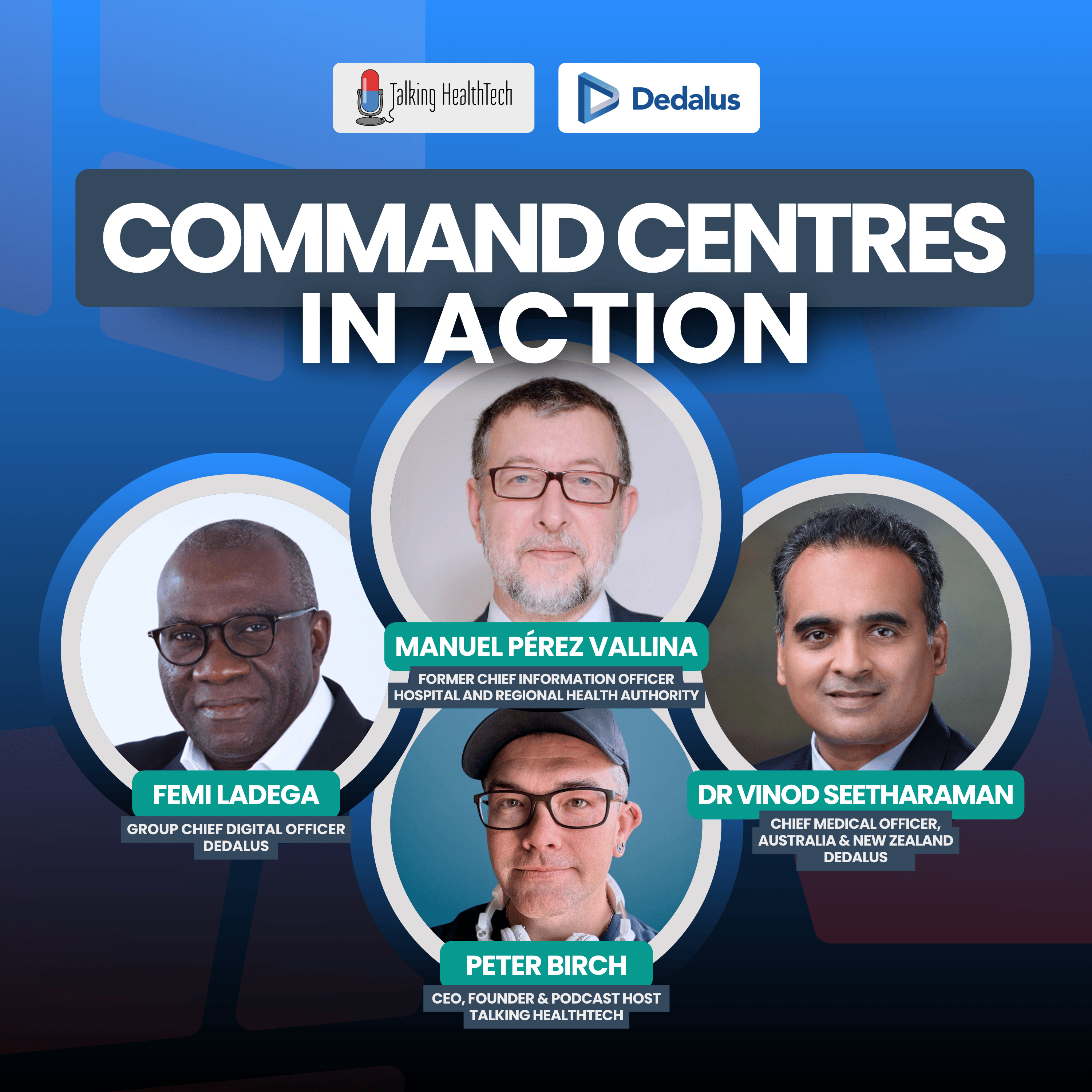
In this episode of Talking HealthTech, Peter Birch speaks with Manuel Pérez Vallina, former CIO in the Spanish health system, Femi Ladega, Group Chief Digital Officer at Dedalus, and Dr Vinod Seetharaman, Chief Medical Officer for Dedalus in Australia and New Zealand.
The discussion covers the evolution of hospital command centres, the shift from using dashboards for retrospective data towards enabling proactive, real-time operational decisions, and how these changes impact clinical workflows and patient outcomes across different health systems.
Recorded live, the conversation draws on experience building one of Spain's first hospital command centres alongside lessons from health systems in the UK, Australia and New Zealand.
The panel unpacks why familiar pressures such as underused operating theatres, growing waiting lists and bed shortages appear so consistently across borders, and what separates a command centre from a wall of screens.
Along the way, they examine the four principles that determine whether the model delivers real change, the cultural and governance work that sits behind the technology, the role artificial intelligence can play in filtering meaningful signals, and the practical first steps for organisations weighing up where to begin.
Key Takeaways
🚑 Hospital command centres enable real-time, actionable insights beyond traditional dashboards, improving operational efficiency and patient care.
🛠️ Implementing command centre solutions requires aligning technology, organisational culture, and governance to drive sustained change.
📊 Demonstrating value and securing investment means clearly defining the use case, limiting initial project scope, and engaging stakeholders early.
⚡ Effective change management and clinician engagement are crucial for successful adoption and maximising impact.
🌐 Challenges and solutions discussed are common globally, but must be tailored to local healthcare system maturity and needs.
Timestamps
00:00 - Episode introduction & topic overview
03:42 - Manuel Pérez Vallina on Spain’s command centre journey
05:55 - Femi Ladega: Global perspectives and data orchestration
08:29 - Dr Vinod Seetharaman on capacity management challenges
10:26 - Command centres vs. dashboards
19:02 - Clinical benefits and flow management
22:13 - Stakeholder engagement and return on investment
32:07 - Real-world impacts and cascading benefits
39:48 - Implementation challenges and change management
48:59 - Integrating AI, primary care, and data governance
53:45 - Final advice for hospital leaders
Check out the episode and full show notes on the Talking HealthTech website.
If you’re enjoying the show and want access to exclusive healthtech discussions, meetups, and member-only content, you can learn more about becoming a THT+ Solo Member here: talkinghealth.tech/solo_shownotes
And if this episode was useful, leaving a review or sharing it with someone in the industry always helps.
Mentioned in this episode:
Use the free Talking HealthTech Glossary for plain-English explanations of digital health terms, acronyms and concepts across the industry: talkinghealthtech.com/glossary.


