
 Ask ChatGPT

 Talking HealthTech
31 Aug 2026 · 28m · 10 chapters
Australia’s push to break digital health silos via interoperability, so healthcare data flows in real time across systems and improves safety, access, and patient control (beyond “postcode” barriers).
Written by AI. May contain mistakes.
Discussion on the importance of interoperability for better patient access and care.
“This challenge of if only we could all be more interoperable then patients would get better access to healthcare.”
Sharing impactful stories highlighting the need for better data access in healthcare.
“And you'll appreciate this one because someone just shared that she found out that she had a lump and breast cancer through a result that was in my health record.”
Exploring advancements in healthcare technology and its implications for clinicians.
“Your key is almost like two-factor authentication in a way.”
Discussing the current challenges in digital health and the importance of interoperability.
“So taking those use cases, then getting those standards implemented to actually then bring in value back.”
Discusses the disparities in access to healthcare based on technology and geography.
“in Metro Rural, whether it's our, you know, old antiquated sort of desktop-based systems versus our cloud-based platforms.”
Explores rising consumer demands for healthcare access and the role of AI.
“because someone didn't have access to the data that I've already showed 56 times before.”
Emphasizes the need for standardized clinical terminology and data for consumer safety.
“Like there are so many intelligent people out there who are doing really clever things with AI as consumers and it's working for them.”
Analyzes how My Health Record can centralize and enhance healthcare delivery in Australia.
“then you can have a better dialogue about your health care.”
Describes how enhanced access to health data can improve patient-clinician dialogues.
“and it's not that a clinician has to even think, oh, no, I'm using My Health Record.”
Discusses how integration of various systems can improve healthcare delivery in Australia.
“And so we had that conversation while I was in the consult room before I even had the blood test done.”

Get the gist, explore an idea or ask about something said.
 Claude
On Talking HealthTech, what are the key points of this episode?
Searching your listeningAutomatic transcript. May contain errors.
0:00Peter Birch: Have you ever heard a term in digital health and just quietly had to Google it later? The Talking Health Tech Glossary has got you covered. We've got hundreds of terms in plain English explanations written for our industry and all free to use. You don't even have to sign up for anything. Just go to talkinghealthtech.com slash glossary. Welcome to the Talking Health Tech podcast. My name is Peter Birch. Today on the show, I'm joined by Peter O 'Halloran from the Australian Digital Health Agency, Farhoud Salimi from Telstra Health and Dr Monica Chahizha also from Telstra Health. G'day team, how are we going?
0:33Peter Birch: Great. Morning. Excited. Same. Thanks for joining me here in this conversation and I guess the framing for this discussion too is a problem that I guess in healthcare it's not one that we've, you know, is brand spanking new. This challenge of if only we could all be more interoperable then patients would get better access to healthcare. Clinicians could be able to provide better services, systems would all be connected. I don't think any of that is kind of new knowledge for people. Let's assume that is kind of known. The difference is now there's probably some more practical things that we can do about it and some examples that we can also share about what that actually looks like.
1:07Peter Birch: Peter, it's great to be able to have you in this discussion as well, as well as my good friends from Telstra Health. But from your perspective, you know, and thinking about the overall piece, you know, where would you say we're at in that whole interop journey and the real kind of urgency or burning platform for us to actually do something about this connected piece and having data flow. Yeah, and look, Peter, like everyone else, I've been on this journey for probably more years than I want to count. We've been talking about this for decades. We've had so many false starts where everyone's gone, we need to talk about interoperability, we need to do something.
1:41I look at it today and I say, it's fundamentally different. We recognise why we need to have interoperability. We recognise that harm is occurring to patients every single day because clinicians do not have the information they need, their fingertips to treat someone safely and appropriately, people accept that. We're no longer talking about we need interoperability. We're talking about how can we get there? What are the next steps? When will we get to Nirvana? And having been involved for a couple of years, we're probably not going to count anymore. It's too depressing. What I would say... Senior is it too.
2:13Yeah, I didn't have any grey hair before I started this. What I would say is I've never seen so much traction as we've seen in the last two or three years towards this journey. And I'm completely confident by 2030, we'll get to the point where sharing of healthcare information in real time is just routine in Australian healthcare. We don't think about it. We won't be talking about, oh, we should do it. We'll be talking about what are we doing next with that data? How are we synthesising it so it's the best use for the clinician? How are we applying that to whether it's precision medicine or whether it's to population health?
2:43That's where we need to get to. And I think we can get to that position in four years because we've got these building blocks in place. We've made the progress. As Peter Sprivolos has said, we're beyond the tipping point. It's now becoming routine. It's how do we go those extra steps and just embed that interoperability throughout the sector.
3:01Peter Birch: I look forward to in 2030 around episode 850 is my rough calculation. We'll be pulling out a clip from this and be like, yeah, cool. Now we've got more stuff to talk about. But particularly Monica, I'm keen to hear your take on it too because from a clinician's point of view and the patient side too, too. Are we talking about a challenge that is more just to allow us to run a more efficient and profitable healthcare system? Or like, what's the real impact from a patient's point of view? I'll share a story that was just shared with me before, which was a really interesting story. And you'll appreciate this one because someone just shared that she found out that she had a lump and breast cancer through a result that was in my health record.
3:45No one had told her that before. And it's only because she went in and had a look because of, I forget what she shared with me, and she was happy for me to share this as well. She went in and it is her health, right? When you think about it from a consumer perspective, and we're all consumers of health, we're the ones more invested in staying healthy, right? So we want the information to stay in this journey as well. Now, we've been talking about it for a while, and it's a little bit, and I think I've spoken about this before, it's a little bit like seatbelts. Everyone knew that putting a seatbelt on was the right thing and remember the days where people used to pretend to put a seatbelt on as well?
4:24I don't remember that. I do remember those days. But anyway, it's until, you know, policy came through and made it legislated that it was the obvious thing was like these days no one would even think about it right and so sometimes the obvious thing that is coming through is aided by policy by a community that's ready to go which is sparked and then we and then the technology is almost then a platform to get to the right care i've thought about the seatbelt
4:54Peter Birch: thing a bit too because i've heard that but because if you had to two-factor authenticate and then fill out a form and then you know get approval to put on a seatbelt and they have two three seatbelts here going which seatbelt am I yeah so you know we're kind of at that it's technically available which is really hard to kind of do is that right or am I oversimplifying it and in the end and I said this before it's about the care connected because at the end of the day it's that moment of care that is really important for you to make a decision whether you're a consumer or the clinician that you have five minutes ten minutes to help this person in their journey the technology and this is why I ended up in this job, is one of those things that can really transform those five to 10 minutes to make it really meaningful.
5:36And so as we think about that, we've been in this journey building that technology to make those 10, 15 minutes way more valuable so that you feel you're in control of your health journey. But it's also, if I go back to that analogy, like in order to get in the car and drive a car, you've got to have the paperwork, you've got to have a licence. Your key is almost like two-factor authentication in a way. It needs to become routine in how we think and how we operate. Of course, when I'm working as a clinician, the first thing you'll do, you'll go in the morning, you'll log on, you'll have access to these things, you'll check, you'll do it, and then you'll go on and provide exceptional care to patients throughout the day.
6:13Some of these things and some of the technology that's been developed historically is pretty average at best, and we all know that. What I see being developed today by a whole range of vendors is light years ahead of that, where actually it is intuitive. It is actually focused around what a clinician needs to do to do their job. And that's the thing I think is people are still judging interoperability on a 20-year-old system that they're using now. A five-year-old system. Well, I was trying to be nice. But also, Peter, I think in 2030, we shouldn't be talking about interoperability, right? It should be that seamless in the workflow.
6:44The data should just come through where you're not actually clicking different portals or going and getting the data to assemble it. As you said, there are people out there that are actually bringing that information within the workflow, within the system seamlessly. And it's also investing in that national infrastructure to underpin that as well, I think, which is where we'll get to hopefully in 2030, where your two-factor auth or your Apple keys are no longer something you think about. It's just always in your pocket. Exactly. And if we know we've succeeded, if we get to 2030 and we don't talk about digital health, it's just health.
7:17It's just how care is provided. It's how people access it. and then it goes to the next stage of we should then be talking about so what are we doing in Australia with a learning health system that's actually using that data whether it's for the the consumer who's seeing a clinician in right that moment or whether they're planning something and you might have a newborn baby and you're going so what what will their care journey be over their life or even be simply population health like that's the conversation we need to be having in 2030 we need to know we've made it because interoperability is done it's dusted it's in place and you're looking at information and insights and the technology is there i think that's the biggest myth as well to us yes we've got legacy systems hello we all do we have to deal with legacy systems right i mean and they were there fit for a purpose right like if you think about 20 25 years i mean they were pretty out there great for a purpose at that point in time and for a microservice or a particular point in time.
8:13But these days, it's around connecting the care, it's around exchanging it, it's bringing insights to that moment of care. Therefore, this is a big transition between maintaining these legacy classic, classic we call them, classic products, classic products, and then building a future, right, at the same time.
8:35Peter Birch: Yeah. the thinking about some of those because often we say too if it was just a technology problem far hood it's kind of like all the technology exists we can kind of yeah sort that out but maybe we can start firstly on the not so much the challenges but like what are those actual if we were to come down a little bit further and talk about like the practical bits that people might be familiar with in the health system those use cases like the the real examples of the here's a particular vertical or a particular service that with the right application of technology it has like a meaningful impact?
9:07Yeah, look, I think technology is part of the problem. Like the tech has improved over the years quite significantly. But what Monica said, you know, 10, 15, 20 years ago, all those little systems that we had were actually a significant improvement. What we actually created was digital silos instead of paper silos and paper filing cabinets. If you take that to where we're at now is where we're coming up with the standards to actually get those systems to talk to one another. So that was obviously the first part, which, you know, Monica mentioned, Spark's Accelerator sort of created. But then how do we then take that standard, take that goodness that's been developed and actually implement it?
9:45So if you think about, you know, e-referrals, e-requesting results, so, you know, working with SA Pathology to actually get the results out there, take that into from public health system into our application and actually turn that into something that a GP can use in a private, sort of setting and then actually then put a request in for another order or another test. That's all now becoming electronic. So taking those use cases, then getting those standards implemented to actually then bring in value back. But even if you think about it, I personally went to my GP, got referred to the hospital, then went back to the GP, three tests.
10:22That was probably not required because they all did the same thing, right? And the GP specialist and the hospital. If you actually share that information, how much time and effort could it save for the patient and the clinician and even the sector.
10:34Peter Birch: I like those examples too because often in that single use case, if that was like an exception, that, oh, that's a little bit, that's mildly annoying, but, yeah, you could totally go get a test and come back, but you do that at scale. That was like six months ago. Yeah, yeah, yeah. GP did the same test as the specialist as the hospital on me personally. And that's every day that that's happening. And to millions. And to millions, exactly. And you just look at it like you think as a clinician that must be infuriating, Monica, where you know you could have so much more and you could have a much more insightful consultation with the patient.
11:06You might actually be able to progress a lot further if you already had access to those results, if you knew what they were and if it was just available routinely. But even the patient expectations are changing as well. I want to be able to have my record, to be able to circumvent that test being done, to have that conversation with my clinician about the results of that test. Yeah, and be the captain of your care. Yeah, exactly, be in charge. And that's what we're trying to solve.
11:29Peter Birch: So yeah, digital health has got a pretty serious acronym problem. And we've all got our favorites, but it's a lot, right? And you don't really want to be the person in a meeting that has to ask what something stands for after you've been talking about it for the past couple of weeks. That's why we've built the THT Glossary. It's a free, ever-growing library of digital health terms that we explain in simple language written for people who actually work in the industry. So it's useful if you're brand new in the space, or you're one of the veterans that just want a refresher before a meeting, or maybe you want to check to make sure we've got everything in there.
12:05Peter Birch: It's all there for you. Have a look at talkinghealthtech.com slash glossary. Bookmark it. Send it to your team. It's the kind of thing that should exist. So we created it. Hope you enjoy. I'm just thinking back to the example of the, you know, by 2030, it'll be sorted. Then we've got all... That's what Peter said. Step one, because then we're working with the data. Then I'm going to change the name of the podcast, apparently, because it won't be health tech anymore. but it'll be a pain. But it'll be the evolution. Like you were saying earlier for Hood, like that digit, originally 20, 25 years ago, we digitised processes and systems that were truly appalling that in some cases have been that way for 100 years.
12:39And it was a step change then. We're now at that next moment where we have the next step change where we're actually going to have all those just joined together and the data will flow. And then we'll move to the next step change again is how do we then operate in a world where we actually have access to all of this data on a routine basis? Because that once again will change how medicine is practised. And that's what we need to be preparing for.
13:00Peter Birch: I reflect on all of the great ideas and all of the examples of like real step change in healthcare and frankly any industry too in any country. If we're all as passionate and kind of switch and also knowledgeable and had the resources, all those things that you need, I'm sure we could all kind of get there without, you know, and achieve that goal. However, we also know that sometimes there's not enough of a burning platform or even though that's where we want to go sometimes we're kind of like well there's not enough incentive to get there or there's not like uh if not for if we don't do this then what happens like what does that look like for you i'm opening the floor um i don't know why i even brought this ipad for talking points because now we're just having a chat but there because there's so much to talk about but the um if uh if we don't get this all right is it just that it's a bit of a pain and that yeah we need to improve it or is there like a real kind of burning platform that we need to address now?
13:55Look, I think that there is a significant amount of digital maturity in the system, right? There are differences across the board, whether, you know, in Metro Rural, whether it's our, you know, old antiquated sort of desktop-based systems versus our cloud-based platforms. I think if we don't get it right, then there is definitely a safety issue for the patient. Clinicians making decisions with half the information accelerated by the use of AI, which will always tell you it's right with only half the picture. You can just imagine what that means from a clinical care and a safety perspective. So I think it is an imperative that we need to actually change it because things are moving at a much more rapid rate and we need to actually rise up to meet that.
14:36And we've got burning things like workforce issues. We've got resources that are limited. As in, the burning platform is like really burning. Like there's not like we're getting thousands of nurses coming out. It's not like we, you know, we've got so many things that we have to think about. You know, we do have, we're lucky to have a universal health care system in this country. Therefore, we look after everyone. Access, you know, biggest determinant is a postcode. All those things come together into rural, regional, the workforce shortage, the expectations these days of people that want the same thing.
15:13But we've got less, you know, resources are limited as well. So all that comes together as one burning platform with technology enabling that. But then also the out of the possible, because if you think about the burning platform and where we can go, it started with the legacy systems and it's what I call manumation. It's the automation of manual processes. So it's the desire to say, well, I do it this way. Let's automate that process that way. And then now we're going, so that was the first phase. And then now we're going to, we are recording care that happened. right so in the moment our systems will capture something that's already happened and we record it speeder says as we move forward we'll be able to use that before that so we plan the care and it becomes a different way to deliver health care and if you talk to consumers at the moment they're they're screaming out saying we don't want to continue the way it is and one of the biggest changes we've seen the last five years is consumer expectations for how health care is delivered and particularly how digital enable it have gone through the roof like consumers just expect that they tell one clinician something that every clinician they're treating team knows and that's not an unreasonable expectation consumers also likewise expect that they have access to their information in a timely manner that their clinicians have access to it these are this is a burning platform in a way that consumers will not tolerate continuing the way we have been historically like they are rightfully demanding and saying i want access to my data i want to ensure my doctor, my nurse, my physio, whoever is treating me has access to my information.
16:45And I don't want to go into yet another clinical consult and tell the same story 57 times because someone didn't have access to the data that I've already showed 56 times before.
16:55Peter Birch: Am I right in assuming that because that challenge of like, oh, healthcare is frustrating because I don't have access to this, or it's really tricky to do X, Y, Z, but you kind of need to do it as a patient, otherwise you're not going to get care for yourself or a patient. Is the difference now that like what would a patient have done about it 20, 30 years ago? Well, I have to go through that arduous process. Now with the AI piece and all the tools available and direct consumer applications, there are alternatives that patients, consumers will find that potentially are not the safest solution or it's untested or it's not part of the, it kind of extrapolates.
17:36Peter Birch: Am I sort of going in the right direction? Because the difference now, because what you just described kind of sounds like healthcare as it's been. And yeah, people are going to be annoyed about it. And we've just put up with really annoyed people. But then... And that AI fills the gap is what you're saying. Yeah, yeah, yeah. I don't know. Am I right here? Yeah. And AI fills the gap in a really scary way if people aren't careful. Like there are so many intelligent people out there who are doing really clever things with AI as consumers and it's working for them. There are so many more and who just go, oh, well, it's AI, it'll be fine.
18:04The computer knows best, it'll be okay. And we haven't set those people up for success. They don't know what some of those guardrails should be. We don't yet have standardised clinical terminology across all healthcare data in Australia. Not all the AI models even understand what that is. And so these are some of the guardrails and the things we need to put in place so that consumers can say, that's fine, I can do it with a clinician in the normal way, or I can chuck in my AI engine and do it safely. And I think that's the other part we need to do as a society is say, how can we enable people to have that choice?
18:35and if they choose to do it, how can they do it in an educated manner that is actually safe for them to do? And how do we as a sector and as government put in place those guardrails so that the data is standardised or that there are safe ways of doing it? That builds trust. But Peter, we all used to use Dr Google. It was a lot harder to find the right article or the right advice. AI, for it to be successful, it needs fuel, right? The fuel for AI, apart from the water and electricity, leave that to one side, which is all bad, is actually data. And it's clean data. If you give it unclean data, as Peter said, without the right terminology, without the right mapping, it's not going to work.
19:13And if you actually get the data right, get it mapped out, get the terminologies right, get it complete, then you have that ability to let consumers and patients actually engage a lot more with their health record. And if you then close that loop back into your clinical care, back into when you go see your clinician, then you can have a better dialogue about your health care. I've seen it go wrong as well in my latest incident that I was telling you about. The clinician actually ticked the wrong box on my referral. I put the result back into AI and it told me that I had a problem in my left ventricle and it wasn't correct.
19:51He'd actually ticked the wrong box. So this is why you have to get it right. Otherwise, you can actually mislead people down the wrong pathway.
19:57Peter Birch: So it has to be right. I feel like one of the things that are going to enable and hopefully help a lot of consumers, I believe anyway, Peter, would be My Health Record. Yes. Absolutely. How do you see the role of that in this kind of new world too? And what's happening there? Australia, despite we all think everyone in Australia goes, oh, healthcare, digital healthcare, it's terrible here, everywhere else is so great. It's actually not. and when I talk to so many people overseas it's kind of like Australia's in that sort of top 10 or 20 of nations globally in terms of how well we're doing in digital health care.
20:30Health care identifies, standardized clinical terminology, my health record are core foundation pieces to that and always will be and so recently we announced a whole range of uplifts of our conformance profiles my health record very boring very dry etc except the outcome as software is upgraded to the newer versions of conformance profiles is much more fundamental. It is embedding standardized clinical terminology into those systems. It is uplifting the privacy controls, the cyber controls, basic clinical user design to ensure that software is actually fit for purpose and safe to use. That's exactly the benefits that we're getting and that's where My Health Record is centered to this.
21:09So through the legislation we have for My Health Record and the defined interoperability requirements under the legislation and software conformance, that actually helps us lift the whole sector in Australia up to a new level in terms of that clinical safety and the cyber and the privacy protections. But also it gives us a national platform where the information can be shared seamlessly between clinicians and consumers, where consumers can choose who has access to information in what circumstances. And that information can be consumed into a whole range of clinical systems, whether it's a clinical system in a hospital or in primary care or wherever.
21:44and it's not that a clinician has to even think, oh, no, I'm using My Health Record. It's just the health data's there. And the same for the consumers. Like, my idea is two or three years from now, a consumer may not even think about My Health Record, and they shouldn't have to, but it'll be there in the background providing that central sort of piece of infrastructure that moves data from point A to point B, but also has really strong legislative protections to put the consumer in the driving seat.
22:09Peter Birch: So, yeah, what I'm hearing then, And the answer for a greater adoption of My Health Record is not a new button or the latest UI experience from a person. You talked about it being like that central infrastructure piece. So that's the critical thing that's different now. There's more information and it's more utility. There is. And look, we've already seen through the share by default legislation, even before it took effect for pathology and radiology, uploads of documents to My Health Record went through the roof. we had in one year, 25 % of the clinical documents shared through My Health Record came from one year.
22:43Like in totality. The views went through the roof, whether that was clinician views from different sectors, whether that was consumer views. Five years ago, 10 years ago, if I went into my My Health Record, there'd be nothing. Sparse. It's pretty empty. Sparse. I mean, there was a couple of bits from Medicare maybe and that's about it. Yeah. Now I can go in there and see my test results. and being realistic, I'm reading my blood results before I see my GP. Because you want to have a meaningful conversation or you want a guided conversation rather than surprise. But not only that, it's like when I was talking to my GP, the answer is, oh, yes, we need to do this blood work.
23:19If the results are in these ranges, you're fine, come back and we'll review in three months. If it's outside that, we need to talk. If it's here or here, this is what you do. And so we had that conversation while I was in the consult room before I even had the blood test done. and so I actually had control of what happened next. The GP is not having to see me unnecessarily to do a fairly pointless review of what were very boring and standard results and she knew that I had a treatment plan in place for the next three months. That is what should just become routine every day so that we don't think about it, it just happens.
23:53Peter Birch: How's that vibe shaping directionally the things happening on the Telstra Health side? Look, I think as we look at our landscape and our product sets and where we look into the future with, you know, our Corus product, it's definitely something we're thinking about in terms of how we design that with interoperability at the centre and in mind. Obviously being very much patient centric in how we develop our workflows, but at the back end, it is all aligned with what Peter and team are doing as part of My Health Record. So FHIR standards and really, really reliant on the work that they're doing to bring that single patient record together, whether you're working in our system and the clinical records or the details are in our system or whether it's someone else using another platform, another system connected back up to My Health Record and back to our system to show you that end-to-end view.
24:41And it's that longitudinal view that we're after. So we're really, really looking forward to some of the, obviously, developments there to be able to make sure our platform comes to life as well as we develop and deploy that. Yeah. And, you know, going back and reflecting on the years, I would say we're lucky and we also, So it's not a result of luck, it's hard work around the national infrastructure, the My Health record, the need to connect to all the national bits and pieces, let's call them. And so for us, because obviously we're Australian first, then it's part of everything that we do. But we also then include the clinician, the consumer point of view as we build.
25:21And so having those voices in of the users that are there across all the disciplines, it's also really important for us. So we have a program where we have clinical advisors in there giving us their feedback, very honest feedback. Times, no, that's not good at all. Yes, but we can do that. So I think, and we can do that now building it because we also stand on the shoulders of the giant excellent infrastructure and be connected from the start. as opposed to try and do integrations, integrations, integrations, and then something breaks as well, right? So, yeah. But, I mean, that's also the thing is we're not – this isn't being done to anyone.
26:01It's being done with everybody, and that's the difference, I would say, this time compared to the last few times we've all been involved in it. Like, this is involving industry. This is involving consumers. This is involving clinicians from the ground up. I mean, if you've never been to a Sparked event, and you've seen them, Peter, you know exactly what Spark's like. Like, it's this mad, chaotic, everyone in a room having views, passionately debating different issues. But what comes out at the end? A really good standard that we all can embrace because it meets all the need. And implement. And implement tomorrow.
26:34And that's the difference, I think, is we have that, this is the whole sector coming together to do it. And it's not just Australia doing it in isolation. Like, we're adopting global standards. We're working with other nations. We're working with Australian development organisations globally to get them to go down the same path. And so what I really, I think that will deliver for us in the next three to five years is we'll see great Australian homegrown software products that are increasingly being used overseas where they're adopting the same global standards, where we will see. That's a dream, Peter.
27:06That's a dream. But that's what we need. We need that ability because people and data are not stuck in one location or even one nation. they travel across the globe and we need to support that we need software that can go across international borders and we now software vendors who are working in multiple countries and we need to bring vendors in from other countries to to share their wares with us yeah
27:29Peter Birch: hey look i think that the the discussion we've had here reflects the the vibe within the broader industry and um looking forward to seeing things continue all the details for telstra health and the australian digital health agency actually are all on the in the show notes of this episode and on our website too for people to check out. And I might free up the dream team here to get on and get some stuff done. So Farwood and Monica and Peter, I really appreciate you making the time. Thanks so much. Thank you. Thanks, Peter. Thanks, Peter. We hope you enjoyed this episode of Talking Health Tech. Make sure you like and subscribe and share this episode with someone who might find it valuable.
28:04For more information and resources about healthcare innovation, visit TalkingHealthTech.com.
28:14Peter Birch: That's it for this episode. I hope you enjoyed it. Make sure you subscribe to our newsletter on talkinghealthtech.com slash newsletter so you can be across all the things we do at Talking Health Tech above and beyond this humble little podcast. Thanks so much.
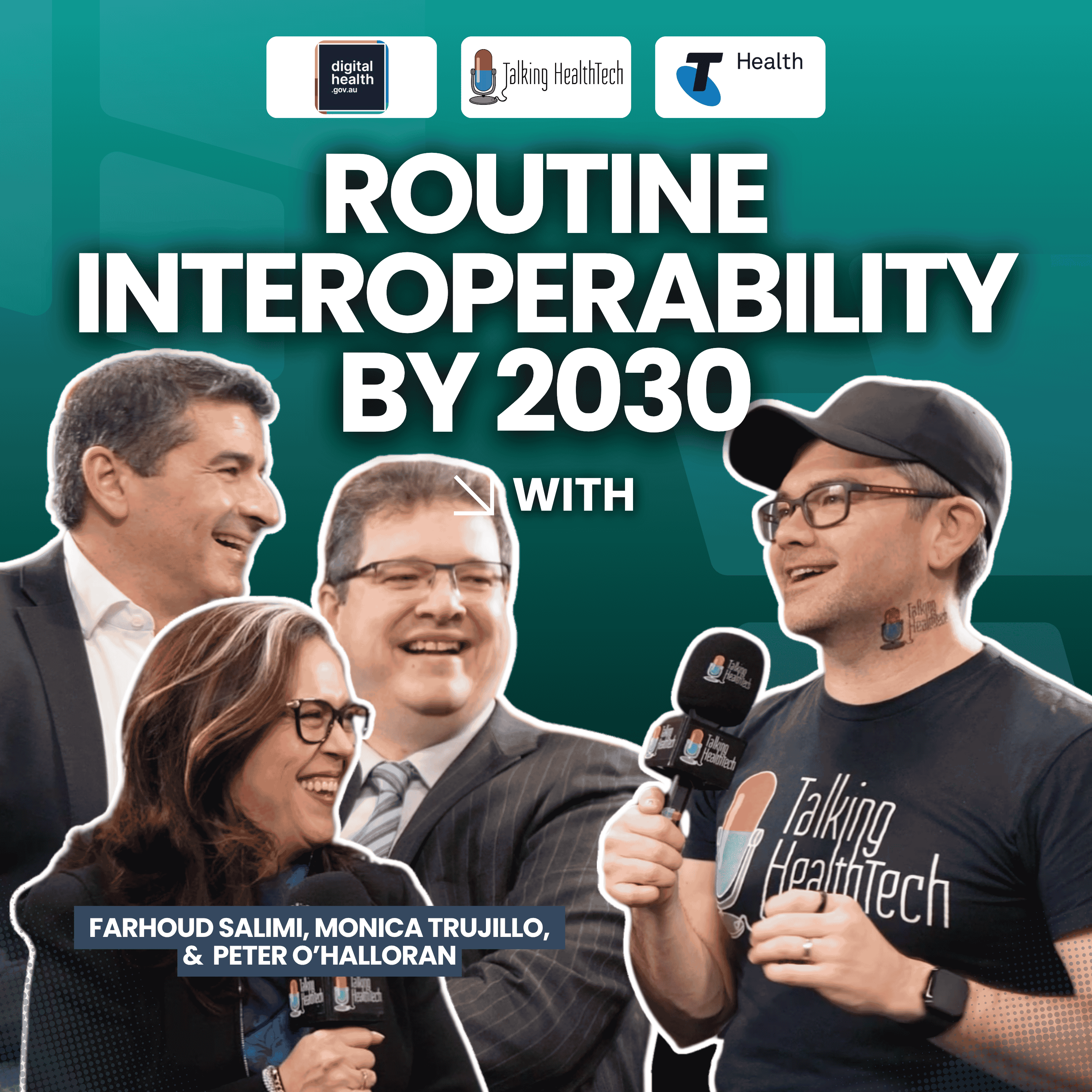
In this episode of Talking HealthTech, Peter Birch speaks with Peter O'Halloran from the Australian Digital Health Agency, and Farhoud Salimi and Dr Monica Trujillo from Telstra Health, about the current state and future of interoperability in Australian healthcare.
The discussion covers why seamless data sharing is crucial, how policy, technology, and consumer expectations are driving change, and the evolving roles of national infrastructure like My Health Record.
The group unpacks how the shift from paper to digital created a new problem, with information locked inside systems built for a single hospital, practice or specialty.
They talk through the real cost of that fragmentation, from repeated tests and retold medical histories to the harm that occurs when clinicians do not have what they need at the point of care.
The episode closes on what success looks like by 2030, including a future where interoperability is no longer a talking point, data simply arrives inside the workflow, and connected care reaches rural and regional Australia as reliably as it does the capital cities.
Key Takeaways
💡 The priority now is not convincing stakeholders of the need for interoperability but implementing practical solutions for data sharing in healthcare
💡 Modernising "classic" or legacy systems is a major challenge, but new platforms are being built with interoperability and patient-centricity at their core
💡 Consumer expectations are rapidly evolving, with an increasing demand for immediate access to health information and digital-enabled care
💡 My Health Record has shifted from being a basic repository to becoming central infrastructure, supporting real-time, secure, and routine data sharing
💡 Incorrect or incomplete health data, particularly when combined with AI, can lead to safety risks, reinforcing the need for better standards and data quality
Timestamps
00:00: Introduction & framing the interoperability challenge
01:09: Evolution and urgency for healthcare data sharing
03:07: Patient impact and consumer stories
08:47: Practical use cases and technology improvements
12:48: Urgency, burning platforms, and risks of inaction
19:02: The role and future of My Health Record
22:52: Interoperability at Telstra Health and industry collaboration
Check out the episode and full show notes on the Talking HealthTech website.
If you’re enjoying the show and want access to exclusive healthtech discussions, meetups, and member-only content, you can learn more about becoming a THT+ Solo Member here: talkinghealth.tech/solo_shownotes
And if this episode was useful, leaving a review or sharing it with someone in the industry always helps.
Mentioned in this episode:
Use the free Talking HealthTech Glossary for plain-English explanations of digital health terms, acronyms and concepts across the industry: talkinghealthtech.com/glossary.


