
 Ask ChatGPT

 Talking HealthTech
9 Sep 2026 · 35m · 17 chapters
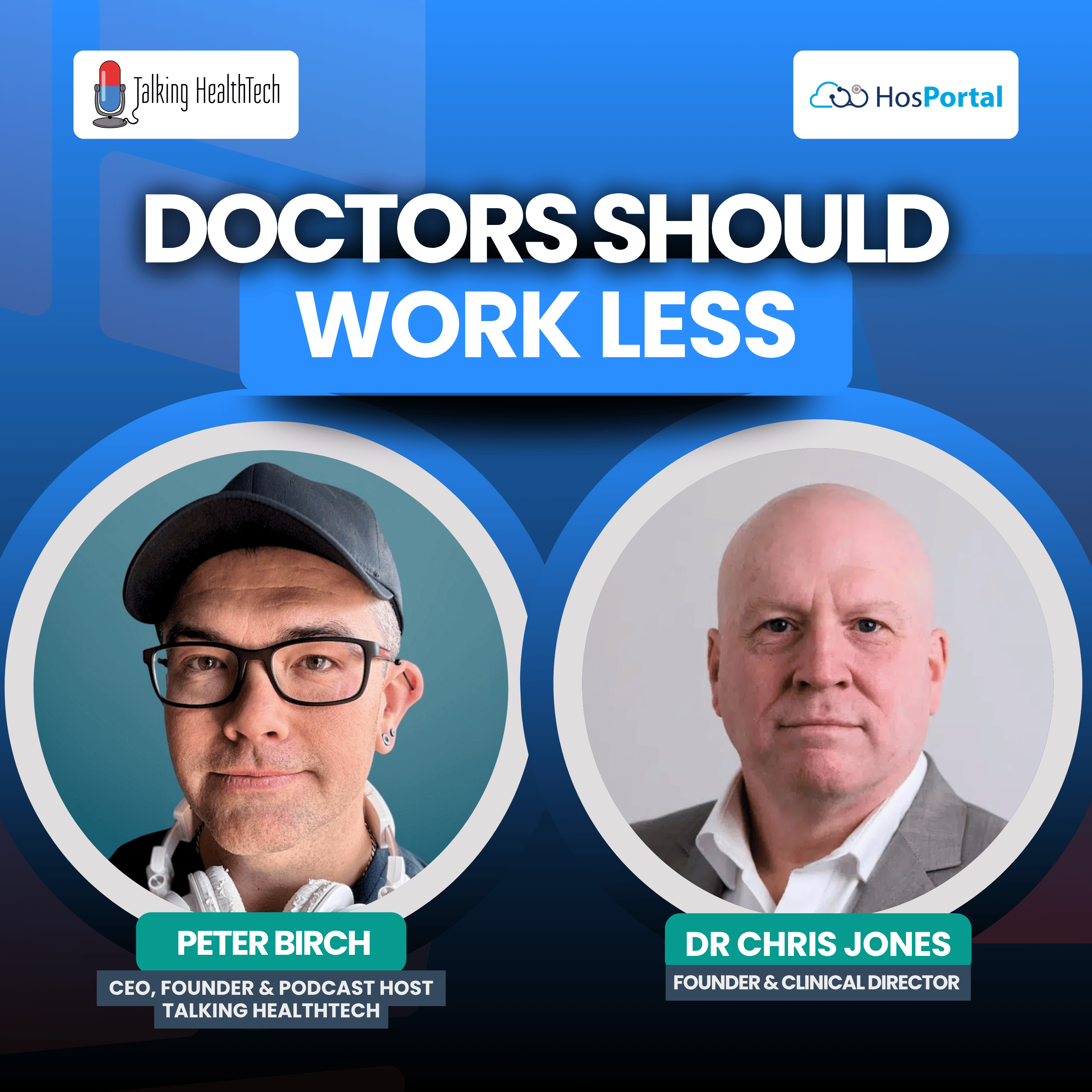
HosPortal’s approach to clinical rostering for hospitals—especially anesthesia and junior doctors—using customizable rules and AI agents to translate clinician needs into roster logic, reduce friction, and improve work-life balance and patient safety.
Dr. Chris Jones is an anesthetist, software engineer, and founder/clinical director of HosPortal. He rebuilt HosPortal’s software from a “clean slate,” released a major version four years ago, and expanded use across all Australian states; public hospitals use it for multiple craft groups.
Rostering complexity should be handled with flexible, deeply customizable rules; AI agents can help users create rules in natural language and generate reports/rosters using the user’s permissions. Better supervision and more reasonable working hours reduce fatigue, burnout, and mistakes.
Junior doctor term-preference collection (surveys then Excel) generalized for all hospitals; AI agents that answer queries like intern hours/leave totals; AI in healthcare envisioned for radiology and 24/7 ED intake avatars.
Written by AI. May contain mistakes.
Dr. Chris Jones discusses the advancements and complexities of clinical rostering.
“Well, when you put it that way, I'm feeling that we're both wiser and arguably both more attractive.”
Exploring how doctor work-life balance has changed and its impact on rostering.
“And the problems of rostering are complicated and interesting and fun to solve.”
Examining the specific challenges faced by different craft groups in rostering.
“our software is focused on dealing with those complex rules and making sure that works well.”
The importance of understanding and communicating rostering needs effectively.
“Make it something that everybody can use.”
Discussing how AI is being integrated into rostering solutions for efficiency.
“As you were describing earlier too, that framing up that whole scenario, the fact that there's a lot of information to consume from potentially various locations.”
Learn how AI agents are revolutionizing the process of clinical scheduling.
“And we've got agents within our software that can do that now.”
Discover the challenges of simplifying complex hospital systems through technology.
“Because again, I was talking to you about how I was doing these videos for marketing and stuff.”
Explore reflections on how healthcare practices have evolved since COVID.
“there's like some milestone kind of topics that always come up and there's the COVID big pillar and the AI big pillar now.”
Understand the improvements in work-life balance for today's healthcare professionals.
“eventuate or has it opened up kind of new surprises that we didn't even think about?”
Discuss the disparities in healthcare access and its implications.
“They recently celebrated, the most recent diploma had the number 10 ,000 on it.”
Learn about the potential of AI to enhance patient engagement and support.
“area or in a capital city or something, it's like, what can other parts of the country or the world kind of take from that?”
Explore how AI is seen as a revolutionary tool in various industries.
“But I think that's a positive thing that adds value if people can use it in the right way.”
Anticipate the future roles of AI in healthcare and its impact on clinicians.
“And as I said to you earlier, I've told everybody on my team, I don't care how much you spend because it is so much, so helpful in so many ways.”
Explore how AI can enhance patient interaction in emergency departments.
“You know, I'm sure you've heard in the media, this hospital's got 50 ,000 x-rays that haven't been reported.”
Discuss the appeal of nostalgia amidst rapid technological advancement.
“But you're going to see the same thing everywhere else.”
Learn about the roadmap and priorities for healthcare software development.
“Yeah, with the pen in the thing and the winded.”
Understand the evolving role of AI in healthcare and its potential impact.
“And, and like, I think like anything, um, you know, organizations can, as long as they do things safely and appropriately and things like that, you know, you need more shots at goal to have it.”

Get the gist, explore an idea or ask about something said.
 Claude
On Talking HealthTech, what are the key points of this episode?
Searching your listeningAutomatic transcript. May contain errors.
0:00Peter Birch: Have you ever heard a term in digital health and just quietly had to Google it later? The Talking Health Tech glossary has got you covered. We've got hundreds of terms in plain English explanations, written for our industry and all free to use. You don't even have to sign up for anything. Just go to talkinghealthtech.com slash glossary. Welcome to the Talking Health Tech podcast. My name is Peter Birch. Today on the show, I'm joined by Dr. Chris Jones, founder and clinical director at Hoss Bortle. G'day Chris, how are you going? I'm going great Mate, it's been a little bit It felt like we only spoke not too long ago A little bit ago But then we were just chatting before finding the episode Then you were last on the feed And it was number 57 back in July 2020 So six years since then, man It doesn't feel like six years A lot's happened in six years It doesn't feel like six years since we spoke, but I feel six years older, that's for sure.
1:01Peter Birch: Oh, okay. Yeah. Well, when you put it that way, I'm feeling that we're both wiser and arguably both more attractive. So let's see the direction that we're going. I'm keen to, so we'll link up the episode for people to check out back then, the audio one we recorded in 2020. But for those unfamiliar with Hossportal, particularly now and the work you do, maybe if you can introduce yourself and the work you do and we'll go from there. Sure. So I'm an anaesthetist, but I'm also a software engineer and the entrepreneur that created the company Hossportal to solve the problem of clinical rostering for predominantly medical practitioners, which is very complex.
1:49and I've been in the game for a while and things have gradually changed over the time. I mean, a long time ago when I very started on this journey as a junior consultant, I saw the writing on the wall. Back then, people did rostering on bits of paper and I knew that eventually all rostering would migrate to not only software but web-based software and so to a degree, that's where we are today. And so our software is now across all states in Australia. Most of the public hospitals use our software in different places. A lot of it is anesthesia because anesthesia has particular complex rostering problems, but also every other craft group ranging from emergency departments, radiology, junior medical doctors, radiographers, all that kind of thing.
2:38And it's a very fun space to work in for me as someone who likes solving problems. And the problems of rostering are complicated and interesting and fun to solve.
2:50Peter Birch: There's a lot of opportunity for technology to be that tool to solve some of those problems. Back when we spoke many years ago, I can see here that you're about to release a next version of Hoss Portal. tool. So I imagine a lot's happened since then too. What's been the last six years like? It was a lot of work to rebuild the software because we took a clean slate. We decided that the existing software had sort of moved past its use date, but we'd learned a huge amount about what the next generation should look like. We spent a lot of time crafting that and released it four years ago now. But even then, we knew that there was a lot more to do.
3:37So I would say since we released it, we've probably doubled again the kind of capacities and capabilities of the software. And with each new department we expand to, we learn new ways people think about rostering. But at the same time, there's been a real generational shift in how doctors work because when I was a junior doctor, I got handed a roster and told, that's what you have to do. No concerns about my work-life balance, no concerns about my mental health. And a lot of that has changed. And therefore, there's a lot of complex rules around how rosters need to be designed to keep in mind that our doctors are human beings, they've got lives to live, and that they need to be able to have those lives side by side with the work they do, not only for their own safety, but for the safety of their patients.
4:25And so a lot of our software is focused on dealing with those complex rules and making sure that works well.
4:33Peter Birch: With those rules, and so when you're building stuff in hospital, often, you know, you need to take the perspective of the customer. If someone's building something, taking the perspective of the customer, how can I solve this problem for a customer? And, you know, the example that you talk about is that, you know, from a clinician's point of view, as you were, you know, it's kind of that end product is just given to you and that can impact your work-life balance and stuff like this but but ultimately i'm guessing that the customer for you someone who's um uh implementing hospital is at a you know health system level so that responsibility that they've got of um you know ensuring that they've got a good balance and all these kind of things is that um a real key driver there or what are the kind of key things that are really like the real problems that are driving kind of priorities for you in terms of features and the way that hospital works?
5:32I think what we've been doing is progressively moving into different craft groups and each craft group has different problems they're trying to solve with rostering. So for example, lately our focus has been on junior doctors because they represent a large cohort of people across Australia. And we start by talking to the people who are at the coalface of that, sometimes the doctors themselves, but typically the kind of next tier up. So a senior doctor who's involved in how the junior doctors' rosters are managed. And we sit down and talk to them and say, well, what are the problems you're trying to solve?
6:14What are the systems you're using now? How do they not meet your requirements or where do they fall down? And what would the ideal environment look like? And then because we're building products we want everyone to use, so we were talking to a hospital in Sydney about how they deal with placing their junior doctors across terms. And what they'll do is they'll create like a survey monkey, send it out to their doctors. The doctors tell them what terms they'd like to do. Then they collate that and put into an Excel spreadsheet and then go through it and try and build up a working set of term preferences.
6:56But we have that conversation and try and flesh out all those details. But that hospital actually has to deal with the same rules, the same kinds of doctors across Australia. So All the hospitals in Australia have to do this. So what we try and do is take their particular perspective and go, okay, that's what they need to do. But how could that really work for everyone else? Make it generalisable. Make it something that everybody can use. And so that, for example, at the moment is the problem we're working hard on because we know that it's something everybody requires and they don't have a good solution for now.
7:33but short answer to your questions we talk to the people right there right at the cold face they're not actually the ones buying that software they're the ones using it yeah i could see that be
7:43Peter Birch: a real pain for a health system you know the needing to um well it sounds like on the rostering side that it's that there's a problem to solve so um you know someone might find a way usually build a spreadsheet that then plugs into another thing and then kind of wrangle something together So I imagine a lot of your work with health systems, whilst there's a kind of standard product that it's built on, that it's going to differ depending on the different health systems that you speak to in terms of what they need. Am I kind of going in the right direction here? Yeah, absolutely. And what we try to do when we're building the software is make everything customizable.
8:23so one of the things I think we stand ahead of a lot of our competitors is we build each thing by thinking as deeply as we can how complicated could this be what have they told us are the requirements it's like well what's the maximal way this could go and then build customizable rules into the software that try and sort of cater to those different options people might have and even then leave in hooks for things that we think, well, we're not going to implement this today, but we can see down the road, someone will want that because it never matters. Never, no matter how complicated somebody says they want something, there's always another complicated version of it we haven't thought of or haven't heard of.
9:08So we try and make it so we can come back later and go, oh yeah, that's fine. We'll fold that in.
9:15Peter Birch: I find I'm reflecting on a conversation I had a couple of days ago, actually, um, at one of our events, but it was with, with someone from a health system. And we were talking about this situation where it's really good in some health systems where if you've got like a real problem solver or doer, but, but one kind of negative of that is often that they'll be really kind of, um, hyper-focused on, on like, they'll see, okay, this system can't do this. So I'm going to work out a different way to do it. but when you were just talking about you know that scenario there where you've kind of you're building with the future in mind or like with flexibility there I can picture a world where there are a lot of end users of a solution that they don't even know that the thing can actually do that and they've built some workaround where there's a like maybe because that's just always been the way that we do this with rostering is that there's post-it notes or there's excels or there's a whatsapp group or there's a there could be a bajillion different kind of workarounds I imagine a really important part of that then is just that constant communication once you know something's been deployed it's definitely not a set and forget thing it's a constantly speaking and trying to understand what they are doing and seeing how you can you can optimize around you know their day-to-day look absolutely and I mean there's a lot of sides to that so so one is providing really good responsive support so we we get queries like that every day you know so we we use like a chat tool to people.
10:44So I need to know this stuff. And we go, yeah, you've got a report that can do that. Just go there and there's the report. Or can I build rules to do the roster in this way? And we go, yeah, yeah, there's lots of rules. I just need to go and do them. What we're finding interesting is this interface between the complexity of those rules that people need and their ability to create them because they're complex. So oftentimes in a clinical world, people know well I've got this rule that rule the other rule that that dominates how my roster needs to be built but describing it and turning it into a piece of software is hard so increasingly we're using AI to help with that so actual real language where you say talk to an agent within the software describing the rule you want which then builds the rule and makes it available for
11:33Peter Birch: them to use so yeah digital health has got a pretty serious acronym problem and we've all got our favourites, but it's a lot, right? And you don't really want to be the person in a meeting that has to ask what something stands for after you've been talking about it for the past couple of weeks. That's why we've built the THT Glossary. It's a free, ever-growing library of digital health terms that we explain in simple language, written for people who actually work in the industry. So that's useful if you're brand new in the space, or you're one of the veterans that just want a refresher before a meeting, or maybe you want to check to make sure we've got everything in there.
12:11Peter Birch: It's all there for you. Have a look at talkinghealthtech.com slash glossary. Bookmark it, send it to your team. It's the kind of thing that should exist. So we created it. Hope you enjoy. Yeah. As you were describing earlier too, that framing up that whole scenario, the fact that there's a lot of information to consume from potentially various locations. There's a lot of rules to factor in um it sounds like a very um good use case for for ai and not one where it's kind of like you looking for reasons to bolt on ai to a solution this seems like humans know what need to happen but also need to ensure that you know everything is compliant with xyz um so i kind of even just assumed there was like a so it's like a um natural like you just type in what you generally want to do and it starts to kind of direct you in the right way what does that actually look like so what we've moved away from is so again our chat tools will you can ask questions and their agents might point you in a help file but what we really want is agents that do stuff for you because you don't really want to know how do i build a report you want build the report for me and give me the numbers and answers that I want now.
13:32And so that's what our agents are designed to do. So they sit within our software, accessing the user's data with the same permissions that they have, so that you can literally say, tell me how many hours all of the interns did last month, and it will just tell you that. Or, you know, who's done more leave than this many weeks leave per year or something like that. And that's what we're aiming for. And we've got agents within our software that can do that now. And next level is including that in other tools. So our auto roster building tools, which take these rules we've been talking about, plus user preferences build your entire roster.
14:21But the next level is AI agents helping you actually construct that. Because again, I was talking to you about how I was doing these videos for marketing and stuff. And one of the terms I used is I told somebody when describing Hospital, I said, Hospital's a fighter jet, not a bicycle. and what I meant by that is it's hard to fly a fighter jet. We're not all maverick, but it's easy to ride a bicycle. At the end of the day, it's hard to take something really complex and make it easy for someone to use, and I think AI agents are starting to close that gap so that, you know, to use the same metaphor, that I'm sure a day soon will come where you can get into an autonomous plane that will fly itself from one place to another, and that's what we're hoping to do, to get these agents to close the gap between intrinsically this software is doing a complicated thing and the settings around it are complicated but you just want to say build me a roster that works and that's what we want to do i'm just looking here at some of the notes from the
15:27Peter Birch: conversation i love this luxury of being able to you know look back in time on like this is what we thought at this time and this is where we're at now i feel like i need to do more of those types of episodes actually because back then the the hot topic was covid it's like we've got after eight or nine years of doing, I think it's eight years of the podcast, you know, there's like some milestone kind of topics that always come up and there's the COVID big pillar and the AI big pillar now. And you were kind of, you're in the middle of both of them now. And the big kind of, um, piece around the COVID side was the, the, you know, doing a lot more things remote and being able to do various telehealth or like even just engaging with clinicians virtually.
16:04Peter Birch: And, uh, I think then back the conversation we had was that, you know, there's going to be a world where things go back to normal and there's going to be clinicians that go back to the way things were and there's going to be well not even clinicians like anyone in the health system you know just back to status quo and then um others you know taking the best elements of it ultimately you know i reflect on some of these things too um and why it could be interesting looking back on like hey we said this six years ago and let's look at it today because you kind of hope that you know a conversation around well if we do this then you know it has the potential for clinicians to have less burnout or more time with family or all these kind of things.
16:42Peter Birch: And if we look at what actually happened, then I'm interested in your side, I guess with hospitals growth and the continued kind of expansion, then people are benefiting. Are you actually seeing some of these benefits that we talked about way back then actually eventuate or has it opened up kind of new surprises that we didn't even think about? Look, I think it has. I mean, the conversations I find myself happening with the kind of doctors in positions I was 20 years ago. So, for example, I had a conversation with one of the sort of younger consultants at a hospital in Queensland. And it was really clear that the doctors there worked less hours than I did.
17:26And they seem very comfortable with that. And I think to myself, it's sensible what they're doing. And I did some stupid hours. But, of course, back then, my senior doctor said, oh, you've got it easy when I did it. Every generation is complaining that the generation of today is a snowflake. But I do think it's better. I mean, I saw doctors end up abusing drugs. and I saw some die by their own hand, either accidentally or on purpose. That's a thing that happens in anesthesia, unfortunately. But yeah, I think I am seeing when I talk to doctors today that their working hours are much better. Their supervision level is much better.
18:21Again, that's something we do in hospital. We provide ways of codifying supervision and making sure that it happens. I think all that stuff is a lot better. And to me, that's a good thing. If it's a bad thing, the only downside would be if you've got slightly less people on the ground. But I don't actually think that's true. I think there's more doctors now. Like my diploma from the College of Anesthetists has the number 2 ,000 on it. They recently celebrated, the most recent diploma had the number 10 ,000 on it. So there's a lot of people giving anesthesia more than there were 20 years ago when I started.
18:56um so so again the short answer is i think it's good i really think doctors should work less hard um and that is better for them and it's better for their patients because funnily enough you know they talk about fatigue uh you know when you haven't had enough sleep being kind of equivalent to having alcohol on board you know you may have heard that you know if someone's not had enough sleep it's like they're 0.05 on the alcohol yeah i think that's true in the extent of making mistakes But what I actually think really happens is burnout and people stop caring, you know. Ultimately, you want doctors to care.
19:36And if they are subject to too much stress and not enough sleep and not enough real lifetime, then they don't care as much. And I think that's the thing that makes the difference is caring about your patients, caring about your colleagues. It really matters. And I think we've made progress. I think it's better than it was.
19:53Peter Birch: I would agree. And I also would imagine there could be clinicians or anyone that would be consuming this episode and saying, well, that's not the reality where I am. And, you know, we often say that too about healthcare, particularly in Australia, but anywhere in the world that, you know, the, that I forget the exact saying, but it's not evenly distributed. So there are plenty of areas around the country where they don't have access to, you know, the, be it the tools or the, just the sheer, you know, resourcing or whatever it might be to enable that. But I guess what can be hopefully reassuring or at least directionally as an ecosystem, if we can, what I'm big on is if there's been versions of success that, you know, even happen in a small area or in a capital city or something, it's like, what can other parts of the country or the world kind of take from that?
20:49Peter Birch: Because there's always going to be other parts that are further behind. You know, speaking at a system level is pretty broad brush. but yeah, I would agree. There's definitely problems of access, okay? But interestingly, and we really haven't started to go down the rabbit hole of AI, which I can talk about all day, but I read this very interesting article in New York Times by a medical practitioner, a senior one, I think she was an emergency doctor, talking about how she realised her own deficiencies as a doctor because of the incredible value she was getting about talking about her own medical care to AI agents.
21:32And she said, well, when I talk to the AI agent, it's got all the time in the world for me. It doesn't say, look, I've got another appointment. You've got to go. It's constantly positive even when she fails in the tasks it gives her. So, you know, you go to see your doctor. You didn't do the thing they said. You need to eat more greens. you need to exercise more the doctor goes well look i can't help you i told you what to do whereas the agent's always okay that didn't work let's try something a little less ambitious but let's keep being positive and i was fascinated by this and i thought in your context of what you're saying everyone can actually get that kind of value and i know people out there are negatory about ai a lot of people i'm actually very positive about it and i think and i've known people who get value from using an agent for a source of positive affirmation, guided direction based truly on themselves, not generic advice, but advice based on them and their needs and their requirements.
22:33And this is accessible to everybody, really. Almost anybody anywhere in the world can jump on and talk to an agent. And it's not the answer for everything. It's not perfect. It has its own problems. But I think that's a positive thing that adds value if people can use it in the right way.
22:50Peter Birch: No, definitely. I smiled when you said that, you know, the agent's always got time for you. I think my Claude's tired because it keeps telling me, cool, let's pick this up tomorrow. And then I'm just like, no, let's just, I'm like, what are you doing? It's a knee sometimes. I'm like, what? I'm quite okay. I'm fine. I'm not tired. You're good. I'm good. Yeah, yeah, yeah. And then it keeps going. It's fine. But yeah, maybe. Well, hey, no, we went there because that was going to be my next kind of thing too. Because if I think about those big pillars of content that we've got on Talking HealthSec and you're kind of in the midst of those and we sort of put the stake in the ground at the cove piece and you did definitely now that one that, you know, where we go there.
23:24Peter Birch: Like what's happening directionally now in this AI world, there's a bit of water under the bridge in terms of people playing with tools and seeing how it fits into the businesses, either on the building software side or on the healthcare delivery side. Where do you see the role of, I'll ask this question again so then it can just be a feature of me. Yeah, no, that's all right. But where do you see the role of artificial intelligence now, I guess, in 2026? But then let's call it six years time. I want to speak to you before six years. But if we put another stake in the ground, what's that going to look like?
23:58Peter Birch: What are we going to be talking about then? That's a couple of questions there. But maybe firstly, let's look at AI now. So, I mean, I said I'm excited about it. I'm positive about it. I've got a low P doom. and I for us as a a software engineering business but but we're not really that's not even what we are we're a software delivery business we're a product delivery business every part of what we do can be made more productive and better using AI in my opinion and again there's always caveats it's not perfect but it's a tool and it's a tool that's changing everything we do and allowing us to do everything we do better, faster, more efficient.
24:40And as I said to you earlier, I've told everybody on my team, I don't care how much you spend because it is so much, so helpful in so many ways. And that's partly because of the fact it allows us to go quicker and go faster and be better. But it is everybody's being given the same opportunities and we all have to grasp those opportunities. is. So my throwaway line to you, I said already was, this is the biggest revolution since the industrial revolution. Okay. This is bigger than the internet. This is bigger than smartphones. This is bigger than telephones, electricity, everything that's come since then.
25:21This is every industry, every person is going to be changed in some way, some big, some small. And so you have to grasp it. So back in the industrial revolution, if you had a hand loom and you were making a carpet, you need to change what you're doing or you're going to be left behind. But, you know, more in software engineering than anything else, we're seeing it. But then again, as we've sort of talked about in our personal lives, and I think there's much to be gained and I'm excited about it and grasping it and using it and learning from it every day.
25:56Peter Birch: And then where does it go though? because, you know, we are, on one hand, tools are, you know, there's always a new model or there's a new capability and it's people say, you know, this is the dumbest it'll ever be and there's a whole other argument to that one too. So everyone's got kind of opinions or perspectives and their own experiences of using the tools. And over a longer period of time, do you, you know, see a world for, you know you mentioned you're the what is it the the zero p doom the uh you know like the zero slow oh sorry so like low low probability of an armageddon but the um it's going to be impactful and like what does that mean for for healthcare because either on the clinician side or on the patient side i've said to various people that i think if you if you don't use your hands to do things, then you need to be concerned that you'll be replaced by something else.
26:56And if we take healthcare, for example, I think a lot of healthcare is going to be improved by AI in the sense that humans are very infallible. We talked earlier about fatigue, but people forget stuff. They don't know stuff. They don't ask the right questions. And I think more and more, we will see AI getting involved in healthcare and it will be good. It will improve healthcare. That means doctors will still be there, but they'll be working with AIs together. I mean, the most obvious example is like diagnostic radiology, for example. I fully expect that diagnostic radiology to be fully replaced by AI within the next five years.
27:40I mean, it's a bit like driving cars and we haven't got self-driving cars yet, But at the end of the day, you're never going to get a self-driving car that doesn't accidentally have an accident sometime. And you're never going to get an AI that reads x-rays to never make a mistake. But all it needs to do is be 10 times better than a person. And that will happen. And probably is now. I don't know. So, you know, areas like that we're going to set, which is good for everyone, right? Less mistakes. You know, I'm sure you've heard in the media, this hospital's got 50 ,000 x-rays that haven't been reported.
28:09Well, plug in an AI, get them all reported. People's diagnoses get made earlier. their conditions are treated better and everyone's happy. But that will extend to other areas. So, you know, for example, I can see people turning up in the emergency department and sitting down and talking to a screen with an avatar on it that is indistinguishable from a person, but is infinitely patient, can talk to them 24 hours a day, will ask the right questions, will never be tired. It knows everything about human medical conditions and is completely up to date. It's read all the articles that were written yesterday.
28:46And it will take the first bite of the cherry and then pass you on to a doctor who's now got really, really good information to put in a drip, give you the antibiotics, do whatever needs to be done. And they'll work hand in glove to provide much better, much more accessible, safer care. And I'm positive about this. I think it will be better. And that means our doctors can be used. They'll still be there, but they're doing different things. They're doing the things with their hands because, I mean, those Chinese robots are pretty damn good, but, you know, they can do martial arts and acrobatics, but I'm not sure they're up to putting in IV lines.
29:24But, again, that will happen too. But what we hope is at the end of the day, everybody benefits. And I think that's, for example, what we're going to see. But you're going to see the same thing everywhere else. If you're there's coffee, you're safe for now. Yeah.
29:40Peter Birch: Well, that's it. Well, you know, it's a, although in Vegas, I saw the robot bars and the robot, and in, it was in Singapore too, the robot baristas. So, you know, who knows? But I think there's always, and there might be the growing market of nostalgia, and that's why people will consume the Talking Health Tech podcast because it's, oh, wow, here's two humans that are talking to each other. Oh, yeah. There will always be that. It's like the slow food thing or people going back to using Polaroids and film or playing cassette tapes. Can you believe people want to play cassette tapes? When you said you were young, did you ever use a cassette tape?
30:18Peter Birch: Yeah, with the pen in the thing and the winded. Yeah, yeah, exactly. Like, why would you go back to that? So there will always be nostalgia, no worries. And then so from a hospital's perspective, you know, the directionally what's on the roadmap or like what can people expect? Where are your priorities over the coming 6, 12, 24 months? Well, I did talk about the term preferences thing because we believe junior doctors are a large craft group. They're people we feel there's a niche that needs filling. And so that's one of our big focuses right now. We're also reaching back to the software we've built over the last four years and taking the existing functionality and polishing it.
31:03because over time as you're adding more and more features, it's easy for the interface to start to not be at the level you want it to be. So we're doing a lot of that, refreshing, sort of scoping things. But that also allows us to critically examine what does our software currently do and how would it be better? Again, coming back to that notion of we'll think out of the box what are the things people might need and go back to the customers and saying, how are you finding our tools? How could they be better? So our auto roster building tools have made huge leaps since our initial release because we've now got very sophisticated algorithms for building optimal rosters with these rules.
31:47And again, trying to tweak those and improve those and make them better to get the best roster to match what people want. Because you're matching both the requirements that a government gives you, for example, and they're quite onerous now and the requirements people have, back to what we're talking about, work-life balance and safety and all that. So we're working on those. And I think integrating AI into our tools is the other thing. And you kind of alluded to it, the notion that everybody is doing this because you have to, but I actually still think it adds value. It's not just not useful. It's actually really useful and people are going to use it more and I place it a pretty high priority for us to get those tools in there and get people able to do the things they want to do more efficiently with less friction.
32:37So that's another strong focus. But longer term, it's a little unknown. We want to expand outside of Australia. We're just talking to some people in Singapore and Hong Kong. every new avenue will provide new exciting ways that people build rosters and the problems that they have I'm kind of I'm a bit of an entrepreneurial type I think about business opportunities and ideas all the time always involving software but I know there's enough in rostering in healthcare for a lifetime you know like there's so much to do so I have no worries that someone will always find something that I find very engaging and interesting to try and solve so that that's what we'll be doing it's just seeing what the road ahead throws in front of
33:31Peter Birch: us and jumping on it and making it happen 100 well look I mean it's the right uh problem to be uh sorted all the the logistics side on the rostering piece so that makes a lot of sense and yeah and as you said the the whole point around that yeah it is an unknown and there is a lot of capability and potential in the AI tool piece as well. And, and like, I think like anything, um, you know, organizations can, as long as they do things safely and appropriately and things like that, you know, you need more shots at goal to have it. Well, again, I'm mucking up the saying, but the, you know, the more shots at goal you take, arguably the more, more goals you get.
34:05Peter Birch: So there's going to be some features around the AI side that get launched and then kind of get depreciated. And then there'll be some really winner ones too. But, um, if you're not kind of continually evolving, then you're not going to see those opportunities. So love the vibe, Chris, and always, you know, good to have a conversation with you. Let's make sure it's not another six years until we do a podcast recording. But in the meantime, people can find both episodes on our website, on the hospital listing there, some more information about what you guys do as well. So go check it out. Chris, appreciate your time.
34:33Peter Birch: Thank you so much. Great talking to you, Pete. Take it easy. Thanks, mate. All right. Bye. We hope you enjoyed this episode of Talking Health Tech. Make sure you like and subscribe and share this episode with someone who might find it valuable. For more information and resources about healthcare innovation, visit TalkingHealthTech.com.
34:57Peter Birch: That's it for this episode. I hope you enjoyed it. Make sure you subscribe to our newsletter on TalkingHealthTech.com slash newsletter so you can be across all the things we do at Talking Health Tech above and beyond this humble little podcast. Thanks so much.
In this episode of Talking HealthTech, Peter Birch speaks with Dr Chris Jones, Founder and Clinical Director at HosPortal, about the evolution of clinical rostering in Australian healthcare, the integration of AI in medical workforce management, and shifts in work-life balance for healthcare practitioners.
The discussion covers how HosPortal is addressing the complex challenges of scheduling across diverse medical craft groups, the impact of digital transformation on hospital operations, and the growing importance of customisable solutions and ongoing user support.
HosPortal has been rebuilt from a clean slate and has roughly doubled in capability, and the software now runs across every state in Australia, covering anaesthesia, emergency departments, radiology, junior medical doctors and radiographers.
Chris explains why the current build focus is junior doctor term placement, a problem most hospitals are still solving with survey forms and spreadsheets, and how the team designs for complexity they have not been told about yet.
The conversation also gets into where AI genuinely earns its place inside clinical software. Chris describes agents that turn a plain-language description of a rostering rule into a working rule, and agents that do the task rather than point users at a help file.
He shares his view that diagnostic radiology will be fully replaced by AI within five years, along with the ten-times-better test he applies to it, and paints a picture of an emergency department avatar that is endlessly patient and never tired.
Underneath all of it sits a point about people. Chris argues that doctors working fewer hours with better supervision is a net good for clinicians and patients alike, and that the real cost of fatigue is doctors who quietly stop caring.
Key Takeaways
🩺 The complexity of clinical rostering is growing, driven by specialist requirements, junior doctor preferences, and a broader focus on work-life balance.
💻 A major rebuild of Hosportal's platform has enabled greater customisation, scalability, and more sophisticated automation across Australian hospitals.
🤖 AI is playing an increasing role in both automating roster construction and making the system easier for end-users to interact with, including the use of natural language agents.
🧠 There has been a cultural shift in healthcare, with greater attention on clinician mental health and safer working hours, positively impacting staff and patient safety.
🌏 The future roadmap for Hosportal includes continued AI integration, product refinement, and expansion beyond Australia into new international markets.
Timestamps
00:00 - Hosportal introduction & background
02:27 - Rostering problems & user experience
04:13 - Shifting work-life balance for doctors
07:17 - Customisation and customer-driven solutions
11:30 - AI features & natural language tools
13:44 - AI's role in the future of healthcare
31:04 - Roadmap and international expansion
Check out the episode and full show notes on the Talking HealthTech website.
If you’re enjoying the show and want access to exclusive healthtech discussions, meetups, and member-only content, you can learn more about becoming a THT+ Solo Member here: talkinghealth.tech/solo_shownotes
And if this episode was useful, leaving a review or sharing it with someone in the industry always helps.
Mentioned in this episode:
Use the free Talking HealthTech Glossary for plain-English explanations of digital health terms, acronyms and concepts across the industry: talkinghealthtech.com/glossary.


