
 Ask ChatGPT

 Talking HealthTech
14 Sep 2026 · 35m · 17 chapters
The episode explains how Hillwell/HEALWELL AI (built on Pentavir’s Darwin AI) turns unstructured clinical documentation into trusted “smart summaries” and patient identification for real-world evidence, aiming to reduce clinician admin burden and improve prevention, early detection, and guideline-based care. It also covers governance/ethics and how interoperability infrastructure (via Orion Health) enables scaling.
Aaron Leibtagg, co-founder of Pentavir (inventors of Darwin AI). Background: 15+ years in finance (data/process/risk focus) before moving into health AI; Pentavir embedded in a Canadian hospital incubator and produced peer-reviewed NLP results on real ambulatory notes; later partnered with Roche and completed ~80 ethics-approved real-world evidence studies across Canada, US, Europe, and the Middle East.
Most documented EHR data is unused; AI must be trusted/compliant with source verification; clinician-in-the-loop summaries save time and reduce burnout; AI accelerates scaling once privacy/governance and real-world validation are solved.
A Canada Infoway pilot using Darwin Power Smart Summary integrated into an EMR to reduce chart review time; Tasmania breast cancer screening; diabetes/heart failure risk surfacing; Australia breast screening equity proposal.
Written by AI. May contain mistakes.
Discover Aaron's journey from finance to health tech and the founding of Pentavir.
“the first time we spoke, I was wearing my high-vis vest during Digital Health Festival between the things and we spoke to each other in the corridors for all of about a minute or two.”
Learn about the personal story that motivated Aaron and Steven to improve healthcare.
“In around 2017, myself and my co-founder, a gentleman by the name of Steven Aviv, we started a company called Pentavir.”
Explore how Pentavir uses AI for real-world evidence studies and patient care.
“So here you have two guys in finance looking at healthcare and saying, how did that happen?”
Learn about Pentavir's partnerships with HealWell and Orion Health to enhance healthcare.
“We published that paper and somebody at Roche was looking for advanced lung cancer patients on immunotherapy and how they're doing.”
Discuss the measurable impact of AI on improving patient outcomes and healthcare sustainability.
“evidence studies using our AI technology in countries like Canada, the US, Europe, the Middle East, et cetera.”
Examine regions adopting AI solutions and the challenges they face.
“So, so one of the most amazing, gratifying, impactful things about the work we do is we are having real measurable impact for patients who are everyday people today.”
Understand the ethical considerations of implementing AI in healthcare systems.
“And that is another example of some of the impact that we're having today with proven and validated AI, leveraging the pieces that HealWell has brought together.”
Discuss the importance of collaboration in addressing healthcare challenges.
Explore the complexities of implementing AI in healthcare systems and its impact on clinicians.
“But if we can collectively share those through that, I mean, that's, yeah, 100 % that's the purpose of having this as a platform.”
Learn about a successful pilot program using the Darwin AI engine to enhance clinician efficiency.
“and how is this actually going to change how I engage with a patient because I'm still writing stuff on the back of my hand and I'm doing all of these things and I still got to jump into five different places.”
Discuss the challenges of information overload in healthcare and how AI can help streamline data.
“Number two, dramatic and clear measurements in time savings, which has a direct link to reduction of administrative burnout for clinicians, which is a real problem.”
Explore the potential for AI in improving healthcare systems in Australia and current initiatives.
“If the software infrastructure, which is already trusted and deployed within, let's say, New South Wales, managing that connected care record.”
Understand the challenges of implementing new healthcare technologies and the importance of patient care.
“How do I demonstrate I've got proven AI?”
Explore how leadership and willingness shape responses to healthcare challenges.
“What comes to mind and is reflective in my experience is what makes it hard in how you frame the problem is my wife is a big fan of Mel Robbins.”
Understanding the significant impacts of unaddressed diabetes in healthcare.
“And I can tell you, you know, the folks at Orion Health, we talked about Brad and our team on the ground there and how privileged I was to sort of be an Australian.”
Discover HEALWELL AI's smart solutions and their implications for clinicians.
“I could pull further on a thread, but we'll probably break the matrix.”
Reflecting on the discussion and looking forward to future engagements.
“Because what was once one disease, depending on your biomarker, there's 50 different types of treatments and interventions for breast cancer right now that can save people's lives.”

Get the gist, explore an idea or ask about something said.
 Claude
On Talking HealthTech, what are the key points of this episode?
Searching your listeningAutomatic transcript. May contain errors.
0:00Peter Birch: Have you ever heard a term in digital health and just quietly had to Google it later? The Talking Health Tech glossary has got you covered. We've got hundreds of terms in plain English explanations, written for our industry, and all free to use. You don't even have to sign up for anything. Just go to talkinghealthtech.com slash glossary. Welcome to the Talking Health Tech podcast. My name is Peter Birch. Today on the show, I'm joined by Aaron Leibtag from Hillwell. He's the co-founder of Pentavir, the inventors of Darwin AI. I've got so much to talk about with you, Aaron. Thank you so much for joining me today.
0:36Thanks so much for having me, Pete.
0:38Peter Birch: Look, I feel like this was a more appropriate place to have a conversation because for context, the first time we spoke, I was wearing my high-vis vest during Digital Health Festival between the things and we spoke to each other in the corridors for all of about a minute or two. I'm like, no, there's more to this conversation that needs to be had in a podcast forum. So now that you're back home in Toronto, or at least we're in different time zones, it's good to be able to sit down for a longer conversation. I am in Toronto and thrilled to remember that conversation and really looking forward to this conversation.
1:14Peter Birch: Yeah, cool. So tell me a bit more, your background experience and things, because there's the the Pentavir play piece that ties in with Healwell with our good friends from Orion. Let's not get too far ahead of ourselves here, but maybe introduce yourself, tell us a bit more about you, the work you do, your background, and then how that kind of, and then we'll probably go from there. Sure thing. So as you said, my name's Aaron Leap Tagg. In around 2017, myself and my co-founder, a gentleman by the name of Steven Aviv, we started a company called Pentavir. Uh, both of us before that spent over 15 years in finance, zero health degree health, uh, experience, but in finance, you know, data, good people, good processes, you know, returning capital are really important things.
2:08And, um, both of us always had that appreciation around good data, good people, good processes, magic happens. And when that falls apart, like disaster happens. You know, Steve, from a technical architecture perspective, you know, spent a career building global systems, essentially managing risks. If you think about John Hancock's annuity hedging system, he designed that system. And unfortunately, his mother went into a hospital. She broke her ankle. It should have been routine. She had several comorbidities that, you know, a health care professional would say, you know what? we should manage risk by setting the cast like this, maybe a regiment of blood thinners.
2:51It was documented in the chart at no fault of the care team. It just didn't happen and she passed away. So here you have two guys in finance looking at healthcare and saying, how did that happen? And the string that we pulled was it's because the majority of information that is documented. So this isn't prediction. This isn't forecasting. This is there is documentation by a health care professional somewhere in your electronic health record. But the vast majority of that isn't used. And back in 2017, we said, how is it that in industry health care, that 17 percent of most countries GDPs is actually life and death?
3:38the majority of data isn't used to improve healthcare at all. So we went about solving that, but we did it really, really differently than sort of your typical startup. We embedded ourselves in one of Canada's largest hospitals, an incubator that was really around validating medical devices. And we published with that hospital, the first ever peer reviewed publication, using our early natural language processing algorithms against real unstructured clinical ambulatory notes. So not an academic data set, like the real stuff in the electronic health record that clinicians are documenting every day.
4:23It was validated and compared to actual clinicians manually going through charts and comparing it to our output. And we did incredibly well. We published that paper and somebody at Roche was looking for advanced lung cancer patients on immunotherapy and how they're doing. And they said, if I read your paper correctly, have you created a technology that can replace manual chart review or manual chart abstraction? And for your audience, the vast majority of clinical research, how do we create those data sets? We have medical students, nurses, PhDs, literally manually going through digital charts or paper charts and putting data into an Excel spreadsheet.
5:11We scaled that. We did that successfully six months later. We were presenting meaningful clinical endpoints around the patient journey of advanced lung cancer patients on different therapies, as well as validation of our AI. This was 2019, together with Roche. Pharmaceuticals started to call, pharmaceutical companies started to call, and, you know, we came to the decision that we feel that we can build our company by partnering with life sciences, doing real world evidence studies that are ethics approved, yet we got the rights to build our models. Nobody gives out those rights anymore. And it allowed us to fund our IP.
5:59And we've done now sort of probably close to 80 real world evidence studies using our AI technology in countries like Canada, the US, Europe, the Middle East, et cetera. So then as we look to scale, what do you need? You need a company like HealWell that was starting to acquire digital health assets, but also grounded in a company called Well Health, which is Canada's largest private healthcare company. So a company that owns EMRs, owns clinics. And, you know, we started to partner with that company. And then when we acquired Orion Health, which to me is one of the most exciting events, Because if you think about what Orion Health has, is they spent 30 years creating interoperability, health information exchanges, connected care records.
6:56So now we've got access to the data, access to the health systems, proven and validated AI that can surface these patients. and now we're you know got a number of solutions but it's really around identifying patients to change their lives and to optimize health care systems around the world wow that's super cool and
7:20Peter Birch: the um i mean i think about the amount of potential that exists there when you've got those kind of building blocks all kind of in the stable so to speak i mean there's on one hand there's BAU for a lot of those organizations too like because there's a lot of healthcare to do right now as we say um but then there's always an eye on the future too where are you seeing those kind of is this like the in bringing all those pieces together is this kind of one of those longer term kind of perspectives or is there kind of immediate impact when you've got when you start putting these pieces together that are um finding their way through to solutions like Orion or others too.
8:00Yeah. So, so one of the most amazing, gratifying, impactful things about the work we do is we are having real measurable impact for patients who are everyday people today. And what do I mean by that? So if we take a step back, what are the three largest drivers of death in the world when it comes to you know healthcare cardiovascular disease cancer and then medical error and if you unpacked heart disease and you unpack cancer and you look at what has really made the difference prevention identifying early getting patients on guideline medical therapies getting patients screened for example we're doing tremendous work in tasmania for example in terms of breast care screening.
8:50So if those patients are lost and the evidence to identify and surface those patients is somewhere in the electronic health record, the very fact of the work we're doing, whether it's on the research side, whether it's in the health information exchange interoperability connected care side, every patient we surface is so much more than a data point. It is a person's life that is getting an intervention that they otherwise wouldn't have bought in. So we're having that impact today. The other piece is when a patient is identified that, you know, they're not managing their diabetes well, A1C or heart failure, LDL1C, we have therapeutics today on market that cost a fraction of what the costs are when and if they go to a hospital.
9:44And that is another example of some of the impact that we're having today with proven and validated AI, leveraging the pieces that HealWell has brought together.
9:54Peter Birch: When I think about Heal Well generally and the geographic scale of some of the solutions that exist to into different parts of the healthcare ecosystem, are there particular parts of the world that you're seeing are, say, adopting or leaning into these types of solutions to impact patients at scale? And yeah, maybe if you could share some of those examples. What I find is really unique point in time because everybody realizes that there is a problem. Healthcare and how we deliver healthcare today is not sustainable. You know, we do a lot of work in Canada and fortunate enough to have sort of conversations at the most senior level within the Canadian government.
10:40And I'm recalling a slide where I say we spend about 40 cents of every tax dollar on health care in one way, shape or form. If we were to spend 100 cents, it wouldn't necessarily change the needle. Our emergency rooms would still be crowded. Our health care workers would still be overburdened. As newer and more personalized treatments are coming on market that are very expensive. How do we create sustainability? How do we create new models to deliver care? So everybody realizes that there is an issue. Everybody also realizes that AI is real and it will make a difference, especially in healthcare.
11:25The question is how do we do it ethically? How do we do it, you know, securely? How do we do it compliantly? And that's where you have sort of various degrees of how fast do we move or how cautious are we? And sure, I can pick, you know, different regions, but each region has a little bit of a different appetite. Like even in Australia, when we were together at DHX, I had the privilege a few nights before to have dinner with Deputy Minister Rebecca White, as well as, you know, several other, you know, clinicians. And what seemed to be sort of one of the sort of pauses there was, okay, how do we deal with privacy and governance in the backdrop of AI?
12:17And we could point to Europe that does that really well with the EU AI Act, right? Right. So it's it's it's everybody has an appetite. But how do we sort of and I think your podcast is such an important voice to help bring these pieces together, because educating the various stakeholders on how do you mitigate risk? How do you protect patients? How do you properly deploy, whether it's public funds or private funds to change these paradigms? And it's just finding that right formula and those right success stories in terms of patient outcomes. outcomes.
12:52Peter Birch: So yeah, digital health has got a pretty serious acronym problem and we've all got our favorites, but it's a lot, right? And you don't really want to be the person in a meeting that has to ask what something stands for after you've been talking about it for the past couple of weeks. That's why we've built the THT glossary. It's a free ever-growing library of digital health terms that we explain in simple language written for people who actually work in the industry. So that's useful if you're brand new in the space or you're one of the veterans that just want a refresher before a meeting or maybe you want to check to make sure we've got everything in there.
13:28Peter Birch: It's all there for you. Have a look at talkinghealthtech.com slash glossary. Bookmark it. Send it to your team. It's the kind of thing that should exist. So we created it. Hope you enjoy. 100%. I've been big on that since day one. Which is why the whole collaboration starts with the conversation kind of goofy tagline comes from but it's the some of these topics that we're talking about feel a bit um like they're very big and strategic and you know directionally we're kind of going that way but it's hard to then say well what do we actually do about it at this point I think if we can start and rather than pointing at areas and say well this isn't working and that's not working there are parts of the world that do things really well and parts that they're kind of for whatever reason still working towards.
14:16Peter Birch: But if we can collectively share those through that, I mean, that's, yeah, 100 % that's the purpose of having this as a platform. It made me think, though, you know, if it was to think about the, putting these AI solutions into healthcare systems, another big thing I kind of rant on is the implementation side, the actual making it happen part. and be it at a hospital level or a full statewide kind of deployment, the realities between what the vision is and what the impact may be if this is done right versus the, hey, you know, I'm a nurse listening to this episode and how is this actually going to change how I engage with a patient because I'm still writing stuff on the back of my hand and I'm doing all of these things and I still got to jump into five different places.
15:10Peter Birch: you know, the, how much of this AI discussion is, you know, really interesting and in the theory side versus what's actually in the, like going to impact clinicians on a day to day? Because you gave some great examples already, but some of it almost feels like a bit like a big public health level. Is there real kind of clinician level pieces that are going to surface? So I can share some real examples. So we just finished a really exciting demonstration partnership with the Government of Canada, an organization called Canada Infoway, whose mandate is around interoperability. What our pilot was, was we took the Darwin AI engine, which essentially accelerates speed of discovery of all of that information I described earlier in our conversation that's buried in clinical notes pdfs etc that informs our um you know our health who we are and and and what our health is so if you're a doctor and you're really busy which you are before i see pete i got to go through a bunch of charts ahead of that ahead of that encounter like that's that's a very real time constraint.
16:25And the time I have, how my charts are organized, where your information is in that pile of, you know, virtual paper will determine the quality of that encounter and possibly, you know, the decisions and interventions that are made in that encounter. We piloted our Darwin Power Smart Summary, which takes all of that information and puts it into a summary fully integrated into their EMR because we're EMR agnostic with full source document verification so that they can trust. So now we can see all of the information about PETE in a summary that meets IPS standards to dramatically reduce the time for a clinician to understand what they need to understand about you in terms of your full medical history, your comorbidities, the medications you're on, when you started, when you stopped, referral letters, hospitalizations, etc.
17:28We implemented that. Incredible success. So number one, live, in practice, using AI across Canada. Number two, dramatic and clear measurements in time savings, which has a direct link to reduction of administrative burnout for clinicians, which is a real problem. Number three, really positive clinician feedback in terms of this made them better clinicians to their patients without the risk of AI taking over. So this isn't Chachi PT being your doctor instead of them. This was surfacing in a trusted, transparent way using AI information that already exists, putting that in a format, understanding that so you can be that physician in the loop to treat better.
18:26There's one real example that I can share.
18:30Peter Birch: um you know in some of the recent ai discussions that i have you know i think about the commonality or the or the separating all of the cliches from the cliches the um such a big part of the cognitive load and the stress and the burnout and the and the extra cost in retests and all the all the things that we talk about are like the the things holding health care back um often boil down to like just information's everywhere and it's not the all the information doesn't exist and we actually don't know but like let's get it again just in case because we don't trust it so you're going to send this person for another blood test and all these you know death by a thousand cuts maybe that's the wrong term but the the at an individual patient level it's kind of mildly annoying but at a whole system level you know that's then that's what brings the burden in the end if um you know am i oversimplifying that we just need to get better at like finding the stuff that we have and AI is going to play a really big role?
19:30You're not. And that the challenge is, is that simplification takes away sort of the buzz that so many people get excited about. You know, there's that, there's that, you know, famous sort of anecdote story, and I'll apologize to your listeners if I butcher it, of, you know, the person searching for the keys to his car and the, you know, somebody comes and says, well, what are you doing? And says, I'm searching for the keys. And they say, well, where's your car? And it's like, you know, it's parked around the corner. And you say, well, what on earth are you doing searching for the keys here? And the person looks up and says, this is where the light is.
20:12And I share that because we get so excited, especially as all of us are playing with our own chat GPT about the marvel of what we can discover in our genomics and the marvel around how we can optimize our longevity and the predictions we can make. And let me be very, very clear. I am for those things. But if 80 % of the data that already exists to your point is not used at scale, efficiency, and speed, then we better solve that first and if the solve for that is going through the mounds of clinical text in a way that meets the highest threshold of trust compliance which is not an easy thing to do and most companies didn't spend the eight years developing the ip that we have right then garbage in garbage out and I think a lot of the false starts we're seeing in AI today is a function of that either garbage in garbage out that we just use superficial administrative data sets to train models or academic data sets outside of the real world and thinking your outputs would be good to false starts of saying you know what we're not going to take things like privacy, governance, really, really important.
21:40And if you check both those boxes, I think that more than anything else is the accelerator to scale AI.
21:49Peter Birch: And I think about the, you know, good friends, the partners at Orion Health and this work that we're talking about here, particularly in Australia too the um are you seeing that a lot of the stuff that's happening across the Hillwell side is is then kind of working its way through you know you mentioned before about the excitement around HIEs and the capability and I guess the history that Orion has too do you think that that changes the direction that that they're going it just kind of or it supercharges them what's your kind of take on what that means for Orion in Australia just from from what you've seen in the industry too yeah so we're working hard at it so i think orion health in the australian market specifically and i've had this conversation uh with deputy minister white and i forget the other you know a few other folks is um we have that tremendous opportunity Why do we have that tremendous opportunity?
22:52If the software infrastructure, which is already trusted and deployed within, let's say, New South Wales, managing that connected care record. So we've already created connectivity and interoperability where when you ask what is sort of the normal current state and other jurisdictions around the world, fragmentation and silo data sets. Now we've got connectivity. So then it becomes, okay, can you imagine taking that summarization that has been proven and validated in Canada, identification that we're doing in the US, where an intervention has a profit motive associated with it, with a patient benefit, so you get that sort of acceleration.
23:43with research we're doing in the UK, and you combine that in the jurisdictions that we've got great coverage with it here, you know, in Australia, you know, all the pieces are there and there can be rapid scale. So then it just becomes, to your point, getting everybody aligned to that vision and aligning the incentives accordingly. And that's really the hard work we're doing. It's not the real hard lifts that most other companies face. How do I get access to the data? How do I build trust with government? How do I demonstrate I've got proven AI? How do I have publications and validations? We've checked all those boxes.
24:28So now our pursuit in Australia is how can we make Australia truly a world global leader in responsible use of AI. And one of the proposals we have out right now is really around increasing equity around breast cancer screening. We're already providing this screening software in terms of some major states within the country. How can we take the work again we've done in a country like Canada where we're powering a learning health system, well published, clear inequities uh in care bring that you know that ai into the australian market to to deliver better care for citizens at a cheaper cost with better outcomes i feel like i can have this
25:09Peter Birch: conversation with you aaron i'm not sure where this question is going to go or wherever it's even going to come out as a question but hear me out on that point i don't like you know the usual thing no one's going to argue that we need better patient outcomes and the cheaper and um you know they're all things that as a society in any country in the world that we should be aspiring to and then we've got this challenge that often those solutions come from organizations who they need to be commercial entities to exist and because they hire staff and have costs and then it becomes a race for who's the most competitive to be able to then convince the people that are to do the thing but then they might and that process is long the money's got to come from somewhere and all that kind of stuff but then you know someone might lock into a particular solution where it goes down the wrong particular path is there something like if it was all this easier and we would have done it by now you know what i mean like the but we're in this situation and we've got to is it that we've got to win the hearts and minds of people to be able to understand these solutions like what happens if there's a lock-in kind of contract somewhere that for the next decade or next couple of decades we can't do this thing in a particular country because they've already signed up with xyz so it's like oh well that's unfortunate for that freaking community like i don't know it's it sounds so appealing and uh like maybe it's the way you've put it that is like hey we've got the solution here and this opportunity exists and of course there's things we need to work out but i don't know what's that gap yeah so you know the problem me describe in terms of call it the competitive nature you know or or you know the old adage nobody gets fired from going with ibm well 100 look look look look where ibm is today um no offense to to my friends and colleagues at ibm they're not a company partners that's all right um you know it's we're the early days of ai so so number one we're we're at the bottom or top of the second inning, if that.
27:16We may even be in the first inning. So, you know, has folks locked in, has hospital systems locked into solutions that gives them sort of no flexibilities to sort of deliver on some of these, you know, real world benefits that I described, even with, for example, the concentration of companies like Epic or Oracle that have really sort of taken hold in the acute setting. It's still, I still don't believe that's the case. In my experience, and it's definitely not easy, you know, it's a hard journey. But to your point, when the patient comes first, and that's your North Star, and folks are aligned to that, you can navigate through.
28:00What comes to mind and is reflective in my experience is what makes it hard in how you frame the problem is my wife is a big fan of Mel Robbins. And she shared with me, you know, something that I guess it's a Mel Robbins saying, you know, is this something we can't do? Or something that we do not want to do? And there's a difference. And what I would say is, there's very little things that we can't do. So then the question becomes, is this something we want to do or do not want to do? And that's the string to pull, right? Does a hospital administrator really want to lead the change management associated with this paradigm change in technology?
28:59Well, they'll say they, you know, yes. And nobody wants to be Decca Records that passed on the Beatles. But somebody actually shared with me internal memos at Decca Records after the Beatles became a huge hit on all the reasons it was the right decision at the time that they made the pass on the Beatles. So, you know, this is sort of the courage and the leadership that I think, you know, will make the difference. And I can tell you, you know, the folks at Orion Health, we talked about Brad and our team on the ground there and how privileged I was to sort of be an Australian. And I'm looking to coming back soon and just seeing the relationships that Orion has in the market.
29:50We need to create that coalition of the willing and that coalition of trusted partners to say, what is that outcome we want? And is the prize big enough? And that's usually also where things fall apart. If we were to just pick, Pete, diabetes, management of A1C scores, really, really simple. the lack of management of undiagnosed diabetes where we've got access to testing access to therapeutics that and that alone makes up likely 30 percent of all stroke emergency room visits in your emergency rooms and 70 percent or around 70 percent of non-traumatic amputations for to just pull on that one string.
30:43Think about the human impact, the healthcare impact, the political populist impact we can have, you know, using some of the tooling to solve that problem. So getting people excited about sort of those goalposts is what's going to make the difference.
30:58Peter Birch: I could pull further on a thread, but we'll probably break the matrix. And I don't think we've got time for that on this particular conversation, but it's a conversation for when you're next in Australia, I'm sure. But to round things out, then if there was the, back to, you know, the immediate horizon, I guess, for be it Hillwell globally, or also what you know of what's happening in Australia too, what can people look forward to seeing, or where are the priorities in that immediate horizon that is taking some bandwidth? Yeah, so what you can really look forward to seeing that we're excited about is the rollout of our smart suite of solutions on top of the healthcare infrastructure that we already have.
31:40So if you think about, you know, the software that Orion Health does exceptionally well around health information exchanges, connecting hospital data, you know, you know, around a state or around the country, if you think about surfacing that information and visualizing that information for various stakeholders, just at sort of the superficial level, we do that well. Now imagine rolling out smart summarization, giving clinicians the ability to summarize the entirety of that patient's history longitudinally with full source document verifications that will allow them to understand you in less time, more accurately.
32:22That's a time machine. Imagine the ability to be able to surface patients for consideration who likely should be considered, maybe they got a rare disease. Maybe they're not on guideline therapies and making that easier for clinicians to identify. And then doing that identification to increase access for clinical trials. So many patients just don't have access for trials that may or may not change the trajectory of their health. So again, rolling out that smart set of solutions within Australia, building on the infrastructure that we have. Leaning in on breast cancer screening, where it's not just about the screening, but now it's really around, you know, how can we do more, go deeper from the analytics perspective?
33:11You know, equity, comorbidities, geography, to really, you know, help these patients. Because what was once one disease, depending on your biomarker, there's 50 different types of treatments and interventions for breast cancer right now that can save people's lives. So those are some of the exciting things that we're driving with our partners in Australia that we're hoping will sort of become part of the, you know, awareness within the country soon.
33:46Peter Birch: Yeah. Aaron, look, it's been a pleasure to sit down, have a chat in this format. And I'm sure there'll be others in the future too. You know, all the details for Orion and Healwell will be in the show notes of the episode. People can check out on our website too. Plenty of other content to consume, but I really appreciate the time. Thank you so much. It's been a pleasure. Thank you.
34:10Peter Birch: We hope you enjoyed this episode of Talking Health Tech. Make sure you like and subscribe and share this episode with someone who might find it valuable. For more information and resources about healthcare innovation, visit TalkingHealthTech.com.
34:28Peter Birch: That's it for this episode. I hope you enjoyed it. Make sure you subscribe to our newsletter on TalkingHealthTech.com slash newsletter so you can be across all the things we do at Talking Health Tech above and beyond this humble little podcast. Thanks so much.
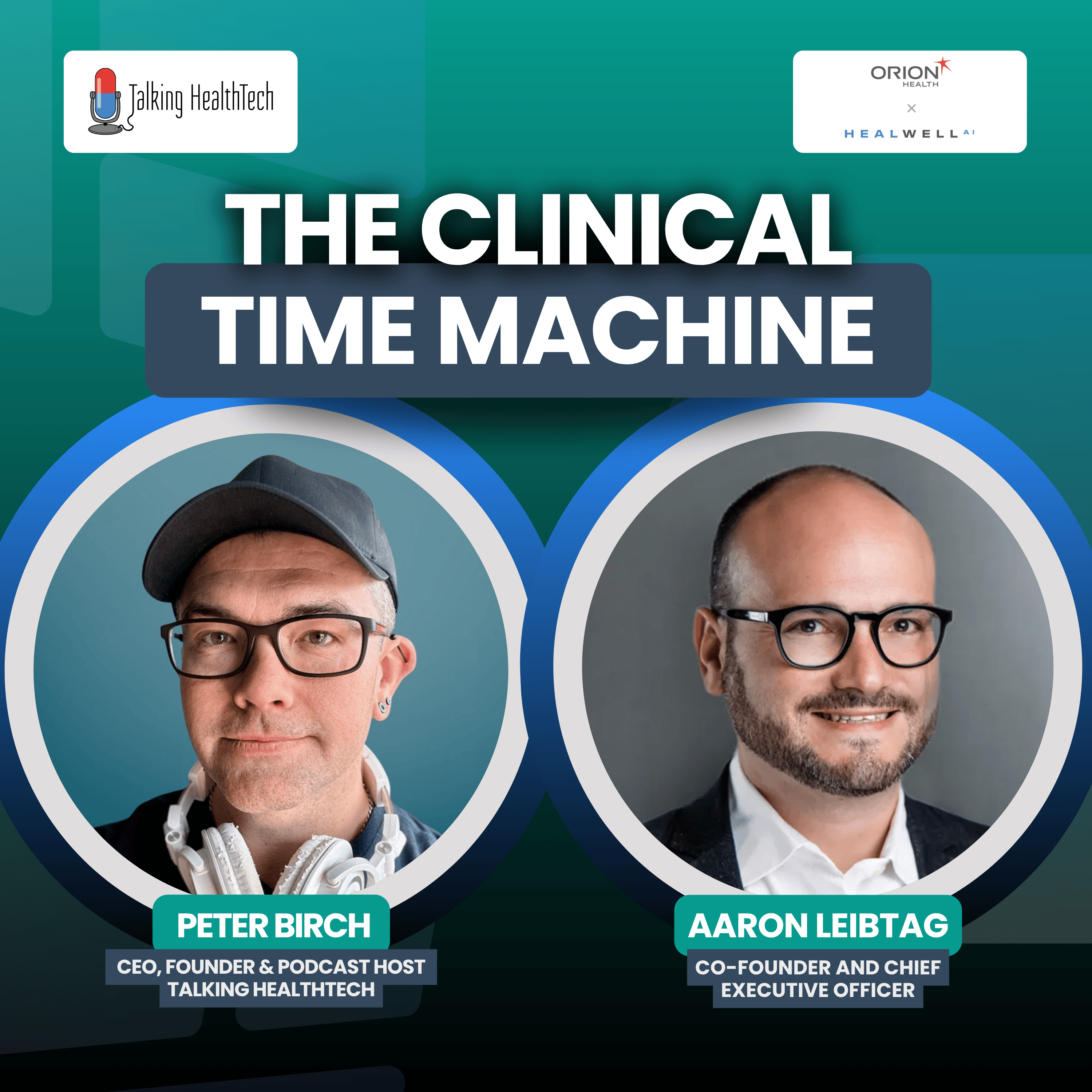
In this episode of Talking HealthTech, Peter Birch speaks with Aaron Leibtag, Co Founder of Pentavere, now part of HEALWELL AI (TSX: AIDX), where he is Global Health Systems Leader.
The conversation covers Aaron Leibtag's transition from finance to healthtech, the founding story of Pentavere, a HEALWELL AI company, how AI technology is being leveraged to improve healthcare data utilisation, the practical impact of these solutions in real health settings, and what partnerships with organisations like Orion Health mean for the future of health systems in Australia and beyond.
Aaron explains why roughly 80% of existing health data sits unused, buried in free-text notes, referral letters and PDFs that analytics and decision-support tools rarely reach.
He walks through how Pentavere's DARWEN™ AI engine works, using natural language processing to read and interpret that material and build summaries that reflect the judgement of clinical experts, with full source document verification so clinicians can trust what they are seeing.
The discussion also looks at the SMARTSummary powered by DARWEN™ AI pilot delivered with Canada Health Infoway and integrated directly into the EMR, alongside close to eighty real-world evidence studies run across Canada, the United States, Europe and the Middle East.
From there, the conversation turns to the ethics, privacy and governance questions that come with deploying AI in clinical settings.
Peter and Aaron close on what Australia's existing health information exchanges make possible, why medical error and missed screenings remain such costly problems, and why solving the basics matters more than chasing the next breakthrough.
Key Takeaways
🩺 The majority of documented healthcare data remains unused, with AI technology now helping to extract and utilise this information for patient benefit
🌏 Implementation of AI-driven real-world evidence studies is already underway in countries including Canada, the US, Europe, the Middle East, and Australia
⏱️ AI tools that summarise patient data significantly reduce clinician administrative load and improve accuracy in patient care decisions
🔒 Ethical, secure, and compliant deployment of AI in healthcare is a global priority, with regions like Europe leading on policy frameworks
🤝 Partnerships with organisations like Orion Health are helping accelerate access, interoperability, and clinical utility of healthcare data in Australia and globally
Timestamps
00:01 — Introduction & guest background
03:01 — Why healthcare data is underutilised
05:10 — Real-world AI implementations
07:57 — Immediate and long-term impact of solutions
15:06 — Clinician-level AI tools
21:10 — Orion Health’s role in the Australian context
Check out the episode and full show notes on the Talking HealthTech website.
If you’re enjoying the show and want access to exclusive healthtech discussions, meetups, and member-only content, you can learn more about becoming a THT+ Solo Member here: talkinghealth.tech/solo_shownotes
And if this episode was useful, leaving a review or sharing it with someone in the industry always helps.
Mentioned in this episode:
Use the free Talking HealthTech Glossary for plain-English explanations of digital health terms, acronyms and concepts across the industry: talkinghealthtech.com/glossary.


