
 Ask ChatGPT

 Talking HealthTech
21 Sep 2026 · 32m · 14 chapters
Remote patient monitoring (RPM) in Australian healthcare—how clinical-grade devices and connected platforms enable “hospital in the home”/virtual care, shift resources toward patients who truly need inpatient care, and move beyond pilots.
Craig Simmonds, device-focused digital health professional at Propel. He started bringing eye-health devices into Australia ~11 years ago, then expanded to enterprise/clinical device use cases. He emphasizes device accuracy, simplicity, and TGA approval.
Consumer wearables often lack clinician-usable accuracy (e.g., wide blood pressure/SpO2 ranges). RPM works when devices are simple for patients, data flows into clinical platforms, and funding covers both devices and software. NSW Health’s iHealth rollout to all local health districts supports large-scale adoption.
NSW Health rolling out iHealth devices for hospital-in-the-home; aged-care blood pressure readings replacing paper logs; Vital Patch (TGA approved) for continuous ECG/respiration rate up to 7 days; Remy otoscope (TGA approved) shared via phone/computer.
Written by AI. May contain mistakes.
Craig Simmonds discusses his background in eye health and devices.
“Welcome to the Talking Health Tech podcast.”
Discussion on the need for clinical accuracy in health devices.
“I, you know, set up the business just to do eye health.”
Exploration of trends in remote patient monitoring in Australia post-COVID.
“People may have a preconceived idea on what these things are, especially in the more consumerized.”
Craig explains the rollout of iHealth devices in New South Wales and their significance.
“And they've done not just one local health district, every local health district that's wanting to do a hospital in the home have now got hundreds and hundreds of iHealth devices so they can start their journey.”
Discussion on how devices improve patient monitoring and healthcare efficiency.
Analysis of funding challenges and solutions in the implementation of remote monitoring.
“So yeah, digital health has got a pretty serious acronym problem and we've all got our favorites, but it's a lot, right?”
Learn about how New South Wales Health is funding devices and platforms for patient monitoring.
“suddenly they get a whole lot of funds and then they buy a whole lot of iHealth devices and they go, oh, fantastic, we've got devices.”
Understand the challenges and strategies of providing tech support in healthcare settings.
“whatever they're talking about, they know that they have to allocate funds to the devices and the software to allow to, they can monitor more people with the resources they've got.”
Discover the significance of simplicity in medical device design for patient use.
Explore how hospitals equip patients with devices and manage care remotely.
“And what a number of hospitals are doing in terms of, because it's not just the device, because it connects to them, they all connect to an app.”
Learn about innovative devices for continuous monitoring in healthcare, like ECG and respiration rate tracking.
“on any new devices or funky things that you've seen.”
Understand the steps involved in bringing medical devices to the Australian market, including approvals.
“And so I wanted to find a specific device because there was another product out there that said it did all these things.”
Discuss the future of remote patient monitoring and its growing acceptance in healthcare systems.
“the, but I guess, yeah, you're having a lot of those conversations.”
Explore the growing adoption and impact of remote patient monitoring in Australia.
“So where there's a lot of opportunity, but the fact that now New South Wales Health has gone in volume, they're gone, this, you know, virtual care is a major, major strategy.”

Get the gist, explore an idea or ask about something said.
 Claude
On Talking HealthTech, what are the key points of this episode?
Searching your listeningAutomatic transcript. May contain errors.
0:00Peter Birch: Have you ever heard a term in digital health and just quietly had to Google it later? The Talking Health Tech glossary has got you covered. We've got hundreds of terms in plain English explanations, written for our industry, and all free to use. You don't even have to sign up for anything. Just go to talkinghealthtech.com slash glossary. Welcome to the Talking Health Tech podcast. My name is Peter Birch. Today on the show, I'm joined by Craig Simmonds from Propel. Propel. G'day, mate. How are you going, man? I think. it's great to chat it's been a little bit I mean we chat you know at random airports and uh other there was a string there where all I all I did was meet you at the airport for some reason I like passing ships but uh keeping keeping busy and uh lots to talk about since the last episode of the podcast we can link all that up in the show notes for people to get some more context um but as it has been a little bit um maybe it might be helpful for you to give a bit of an introduction tell us who you are what you do and um some of the work you're doing now we'll get from there sure Pete um so I love devices Pete um you're the device guy yeah I think you you work out in life what you're good at and uh that's what I'm good at that's what you are that's what I love I started by bringing eye health into the country 11 years ago and uh I mean I thought at that stage 10 years ago I thought oh well this would be a a great new phase of my life.
1:28I didn't know where it was going to go. I, you know, set up the business just to do eye health. And yeah, well, I'm still here 11 years later, which is great and bigger than I'd like to think better than ever before. And I've got a really clear picture of where devices are being used and how we can be used. Actually, if anything, I've got a lot clearer a picture on what the use cases are it's not just device for device sake it's like what is the problem that we're going to be that we're we need to be solved so or like as in what vital sign needs to be measured and what device do we need for that as opposed to find a device and go oh let's hopefully that will solve something yes so solve the problem first then get the device
2:13Peter Birch: 100 and i love not that this is a marketing or a branding uh type podcast or anything but out of She kind of just, like, 100 % when I think of, like, devices and remote monitoring and all of those things in Australia, it's just, I would just speak to Craig. Like, if you're not speaking to Craig, then what's, like, what are you doing? And it's not because of any fancy campaign or any kind of tricks. It's just sheer brute, like, getting in and doing stuff for a long time. It's perseverance, isn't it? Yeah. And building relations. Like, there's a lot in there, too. And knowing your stuff and being passionate about it.
2:47Peter Birch: So right kind of person for this episode. And when we do talk about it, actually, we were just chatting even before we hit record, the concept of wearables and devices and things. People may have a preconceived idea on what these things are, especially in the more consumerized. Well, I've got two things on my hand right now that are measuring things. So what bucket do you put your devices into? Well, there's two sides. I tend to go more clinical, yet the eye health devices, they're consumer devices. So I've always started on the consumer side, but I've very much focused on the enterprise side in terms of I'm very conscious of if I bring a device into Australia, it's got to have the clinical accuracy about it.
3:36And look, there is so much talk about, you know, I'm sure you've probably got an aura ring on your finger and I've bought a Hume band and there's Whoop and all those things and the Apple watches and they're wonderful devices. But my space is the clinical space. And, you know, I bought one of those bands just recently just to test it out because it says it does blood pressure and oxygen saturation and makes me look more beautiful. well um i'm not sure about the last part but even checking the blood pressure and oxygen saturation on a band okay it gives me my readings but it'll give me such a wide range that i go well that's not relevant for a clinician and if i'm monitoring someone at home i need to have a specific data point and those do not give me accurate at this point they may in in time um but i i play in that my my goal is i want to help people stay at home rather than going to hospital and so any device that i do has to have that clinical stamp of of accuracy and um the the data can go into wherever it needs to go whether it's a third party platform an Epic.
4:57It needs to go somewhere. And that's the challenge for all those other type of consumer wearables. At this point of time, they don't do that.
5:06Peter Birch: Yeah. Well, this is it, isn't it? I think the gap is getting closer. But if we had this conversation eight years ago, the idea of particularly a public hospital or a public system even being interested in acquiring devices for patients to use at home that kind of feel like a consumer thing it just it there was no that was wasn't even fathomable um and there's there's elements of it now that are coming through that you know and there was the covid piece where we had to do it and that plays a part but then there's all these other bits and pieces too and if you're deep in the weeds of it you kind of know from a public health perspective in Australia that hey there's a bit of this going on but if you're from outside of it like how interested would you say in terms of and again each state's different and all that kind of stuff but how interested would you say is say on the public health side in hospitals in exploring different tools to allow patients to be measured outside the walls of the hospital yeah it's look it's definitely increasing and I think we've become we we had a big period of COVID where everyone everyone did it every public hospital had to do it they had no choice and then we went through we went from high to a real low after that like we had a couple of years of nothingness and now I think we've really come out of that with a real vengeance and I mean New South Wales Health has recently just rolled out iHealth to every local health district that's wanting to do a hospital in the home program yeah they have they've taken a different approach they've been they've been doing this for a number of years they've been doing remote patient monitoring for a number of years they've had a couple of different starts um and then they say right it's almost like they went back to the basics they said right let's get the devices right let's get the foundations right let's not try and do the whole thing all at once because there are devices and there is software and while sometimes we like to think it's all part of the one thing they are very different things i mean as we said i do devices that's that's what i'm really good at um i do software and i'm very much aware of software but my strength is on the device side um there are companies that do software and they do it exceptionally well and then they'll use me for the devices because they say oh we don't do devices you do the devices for us and i go well i don't want to do the software you do the software for me yeah so what new south wales Health have done it in volume, in real volume.
7:42And they've done not just one local health district, every local health district that's wanting to do a hospital in the home have now got hundreds and hundreds of iHealth devices so they can start their journey.
7:53Peter Birch: Interesting. So the iHealth devices, what will that enable then? So it's, I always think the beauty about devices and what I do is my stuff is, I like to keep it simple. people so when when we're talking about it but we always like to get complicated so i like to put right back down and we always like to use i guess big words and things like that but all we do is blood pressure right someone needs their blood pressure monitored they need their oxygen saturation monitored they need their temperature monitored i've got scales i'm not going to stand on the scales i need their glucose one that's it pete that they are the foundations and the fundamentals of health if we don't know someone's blood pressure well then um that's going to have a big impact on they could have cognitive um deterioration um actually that's two big words i shouldn't use those but but they're they're the basics that every whether it be hospital or age care they need to know the vitals of a patient i mean covid was the best example it's oxygen saturation you know if if you're not breathing if you don't have enough oxygen in your body you're in trouble and forgive my ignorance but for like a lot of devices that measure like blood pressure and oxygen saturation you can get down at the pharmacy or like patients can kind of you know do that themselves like why why does that need to then be driven through on the hospital site the challenge with the devices that are bought from a pharmacy is there's no program involved in pharmacy so someone just walks into a pharmacy they buy a device a pharmacy could have a really cheap thing to a really expensive thing which is lovely which is great but there's no engagement so you know someone gets a blood pressure monitor and they go oh they take it home and they might do their readings but they're only seeing the readings they still might be writing them down i mean the the beauty about eye health and i don't do devices for the sake of doing devices the readings why do this is because this is full of data it goes somewhere you know the basic i do i'm doing a lot in aged care now and one of the challenges is in an aged care facility a nurse or a carer will go to a resident to take their blood pressure as i write it down on a piece of paper.
10:26Peter Birch: So yeah, digital health has got a pretty serious acronym problem and we've all got our favorites, but it's a lot, right? And you don't really want to be the person in a meeting that has to ask what something stands for after you've been talking about it for the past couple of weeks. That's why we've built the THT Glossary. It's a free, ever-growing library of digital health terms that we explain in simple language written for people who actually work in the industry. So that's useful if you're brand new in the space, or you're one of the veterans that just want a refresher before a meeting, or maybe you want to check to make sure we've got everything in there.
11:02Peter Birch: It's all there for you. Have a look at talkinghealthtech.com slash glossary. Bookmark it, send it to your team. It's the kind of thing that should exist. So we created it. Hope you enjoy. like i was going to share a story of uh like my granddad going through his stuff you know when you need to clear houses and there's a book that was about this thick and every day he'd written it down in like it was like a school book and he'd written it down and no one was actually sure like what that was used for i think he just got into a routine and that was something to do and that and everyone's got interesting and maybe that's like the you know the the old school aura ring I don't know, but the outside of, I couldn't picture him going in to see a clinician and then them doing something meaningful with, they probably acknowledged it and could have looked at it, but it's written it down.
11:50But you're right. And that's what people still do. So, you know, we all use our phones now. I mean, even five years, we weren't using our phones, but now we use it for everything. and the beauty to have that information just stored on your phone. And then so we take it to the next step for hospitals of, you know, you're at home, you're doing your blood pressure, you take your reading, it goes onto an app and then straight away in real time, a hospital can see that reading. Now that's what a wonderful thing that is. So, you know, if you've got to take your blood pressure a couple of times a day or even once a day, for a hospital to see that trend over time or for them to get an alert when your blood pressure is outside of that reading, for them to say, all right, well, you need to come into hospital now or you don't have to come into hospital now.
12:46It's changing the way that it's a resource allocation change, actually. It's like, you know, let's focus on the people in hospital that need to be in hospital. and for chronic disease or even a lot of post-acute, if you don't need to be in hospital, but we can measure your vital signs at home, great. And that's the power of these devices, getting the data. Our devices give you data and we send it into whatever platform is being monitored.
13:18Peter Birch: And how are you finding that the use of devices is being funded through, say, larger hospital systems? Because that's always the challenge too, is that this sounds really good, but then, you know, everything's got to be paid for somehow. Does it fit into the existing model? Are we seeing progress there? I think it's changing. So, and New South Wales Health is a clear example, is they've gone, right, well, we're going to go hard on this. Previously, every hospital has gone their own thing, done their own way, and they've got it from their own, their existing bucket of funds, wherever that's come from.
13:58And often over the years I've had, you know, suddenly they get a whole lot of funds and then they buy a whole lot of iHealth devices and they go, oh, fantastic, we've got devices. But then they may not actually have the funding for the platform for where the data is going to go into. But I think New South Wales Health has done it completely different. They've funded both the devices and the platform. And so many other hospitals, I was up at Gold Coast Hospital last week and MADA Hospital and both of them have, you know, they're saying this is a really important part of what we're doing. And it's not just a niche thing or a pilot thing is this is a major part of where we have to take our hospital.
14:43and whether it's hospital to home, home hospital, virtual care, whatever they're talking about, they know that they have to allocate funds to the devices and the software to allow to, they can monitor more people with the resources they've got.
15:03Peter Birch: My mind goes to, when you say, hey, look, you know, there's going to be a big rollout of a lot of devices to a lot of health systems. Me as someone who always used to be operations and support, my first thing I think is all of a sudden, a lot of people are going to have things in their hands that they may not always be familiar with using. And every time you add more technology to something, you then also need to bring with it the need for support too. And I actually don't know where I'm going with this one, but I've just come off a flight. So bear with me. It could be a really good analogy or it could be horrible, but I was looking at sitting there and this is all I've got to work with these days.
15:37Peter Birch: So I just sit on planes. it feels like but the you know the in-flight entertainment the the thing that's there and I was looking around and like flight attendants every second or third call was them coming over to either you know help with something on the screen or go back and then reset it because from what I worked out all they've got in their arsenal is well is it a user error have you got to click something or can I reset like turn it off and on again and come back um but that's become like a big part of their their data at least it did on this particular flight um and we've kind of accepted that, well, this is necessary because, you know, we're not going to roll back or maybe we get people to bring their own device.
16:10Peter Birch: Then there's new challenges of Wi-Fi and the Wi-Fi won't connect. So that's just become what the experience is. I'm not sure if healthcare is, well, I loved your take on it. Is healthcare ready to be like tech support or how does that play into, because you also go through the process of deciding what kind of devices come through to meet that need, as you talked about as well. Do you look at like how easy it is to use as part of that factor? Is that a really important one? Yeah, it is. So I think there's, I'm going to answer in two parts. One, I'm going to talk about the devices, but then I'm going to talk about how the hospitals are providing the devices to the patients.
16:47So from the first part, when I look at devices, I've got to make sure they're really easy to use. And there's only a couple of steps. The iHealth devices, they're beautifully designed devices. They look good. They're easy to use. there's only a couple buttons to press they're not they're not technical anyone use them i mean i have my own online store and um you know people just buy them online and i never talk to them again yeah i mean because they don't ring me say craig can you help me sync this they're just designed to flow just like when you open your iphone and it just shows you what to do it's the same thing um i'm really conscious about like i've seen lots of different devices and i've brought devices in that I thought, oh, these are really cool, but sometimes they get really complicated.
17:37And if they're too complicated or there's too many steps, I go, no, if I can't get it, God help anyone else.
17:48And I've learnt that over time. You've got to keep the devices really simple to use. And I think this is a trap that we've been, while remote patient monitoring hasn't been able to really expand we're doing it now because i think sometimes we like to get too complicated we like to think oh we can have one device that does everything yes it can't do everything because um it might say it can do everything but there's in health there are we're dealing with the body and the body the body is a dynamic beast which doesn't have it's not black and white and zeros and ones it's all over the place um so you need sometimes you need specific tools for specific um situations so yeah i'm really conscious of the device has got to be simple to use by the patient so open the box and basically do it
18:48Peter Birch: i think the um you know this device is used to measure this thing approach really suits the situation of serving healthcare for the broader population, because yes, there are situations where patients have, you know, multiple things that need to be monitored and all that kind of stuff, but even just cognitively, you know, the, okay, I'm going to do this, whereas if it was an all-encompassing device, yeah, maybe there's, it's going to be interesting to see how that approach goes, but yeah, the simpler the better, 100%. Just a follow-up, Pete, on that, And what a number of hospitals are doing in terms of, because it's not just the device, because it connects to them, they all connect to an app.
19:29So what we're finding a lot of our hospitals are doing is rather than rely on the patient to have their own phone or tablet, they will actually provide the tablet to the patient as well.
19:41Peter Birch: Like as a whole kit, basically. As a whole kit. So there's some are happy, some patients, I mean, it comes down to equity and access, which makes sense. You know, there's going to be a cohort of patients who are fine to use their phone, but a lot won't be. And so the hospital will give a tablet with the devices. Here you go, where you go. And you're ready to go. It's all set up for you. Something I thought about too is that, you know, a couple of years ago when we were talking about remote patient monitoring in Australia, a really obvious use case is in rural remote locations when people can't easily get to a place of care, they can do it from home.
20:21Peter Birch: And we've had some quite interesting discussions in the past, you and I, on those topics. It sounds like, though, in that example with, you know, New South Wales Health rolling out to every LHD, you know, this is, there's plenty of use cases for anyone in any part of Australia. I guess that speaks to your example before, but if someone doesn't need to come into a hospital, then why do we need to bring them in? So are you finding that that's like an increasing trend, that it doesn't really matter if it's rural or remote or if it's into the, you know, major city areas? It can be metro. I mean, that's the irony of it all.
21:01We always thought this is rural and remote. But actually, I think about all the conferences I've done over the years, I've never done a rural and remote conference. I've always done metro conferences, if you like. Because at the end of the day, that's where the volume of people are. And, I mean, you can be, you know, I'm in Melbourne, I'm in a city, but you could be in a suburb 20 k's away and what's the difference? So if you can't get, if it's too hard to come into the hospital, you don't need to go into the hospital, then, you know, if I've got Alfred hospitals just down the road from me, if I don't have to go into Alfred and find a park and spend the money on parking and then have to see a clinician, but the clinician can see me because I'm 10K away or whatever it is, so much easier.
21:57Yeah, it's a no-brain.
21:59Peter Birch: It wouldn't be a conversation that we have where we don't geek out on any new devices or funky things that you've seen. Is there, because I talked a lot about the eye health stuff, but obviously as you know you've got other kind of devices and things that you're bringing what's catching your eye at the moment yep so um i've always been so eye health has always been episodical devices episodic monitoring monitoring and i've always been looking for continuous monitoring and one of the the big problems that needs to be solved is how do we monitor respiration rate So breathing rate. Lots of use cases for that.
22:36And that's continuous. Respiration rate is, breathing is continuous. It's not just a point of time. And also ECG. So for cardiac patients, you need to see what their rhythms are on a continuous basis and in real time. So just recently, Pete, I've now got this device called Vital Patch. and this is a patch that goes on the body as such, and this enables the patient to go home. They'll wear it for up to seven days, and that'll give a continuous stream of the patient's heart rate, their ECG, all their rhythms. It'll pick up any arrhythmias. It'll do respiration rate. It does body posture. It even does a force detection if you fall over.
23:30It does body temperature. So it does some key vitals that these devices don't do continuous and you don't need continuous blood pressure. It's nice to have ambulatory, but for ECG and respiration rate, you need continuous readings. And this device does that. We've just recently got that TGA approved. And I've been doing this for a long time, this space. And once again, it's a change of mindset to know that we can do it now. This device doesn't say it can do all these other things. We're very specific at what it can do. And so that's what I'm adding to our stable of only a couple of key devices that we do.
24:25Peter Birch: what's the what's the process for you in um you know because there's a lot of stuff out there and you know i've i've we've caught as i said before we've caught up in all kinds of parts of the world and you're always keeping an eye on what's happening in um health care you must go through a lot of uh websites and test things and uh you've seen everything um what's your process you mentioned tga i mean that's obviously a very important part if you're bringing devices into australia have you got like a set process or something yeah so um first of all i um i'm very conscious of what it uh sometimes i'll go and go i'm looking for a specific problem to solve yeah that's kind of an easy thing um and then i go to say i just look to see what's out there actually i saw you at a conference in las vegas a couple of years ago and i was looking for a device that could, an otoscope, that could see into your ear, which is, this is the device.
25:29This is called Remy. And so I wanted to find a specific device because there was another product out there that said it did all these things. And I thought it was way too expensive and you could never scale it. And then I saw this device, it linked to your phone or your computer, and you could see the ear canal and take photos and videos and and share it i thought great found them liked it really love a company to deal with i had to get a tga approved so i got a tga approved that took that one took almost quite some time over six months to get a tga approved and then it really i always sometimes it takes two years to get anything to get anything um so i was allowed two years for whenever I bring a product in for it to start to get traction.
26:19And I started to, so it's got to be usable. It's got to be affordable. I've got to get a TGI approved. It's got to solve a specific problem. Yes. Did all that. And then actually New South Wales Health also bought 89 of them for all the local health districts as well. So, yeah, there's a couple of steps. I've brought products into Australia, which I thought would solve a problem. And then I'm always talking to hospitals, my clients, to see what type of reaction. And you know if you get a reaction that's positive or you get a, oh, yeah, that's nice, Craig. And after a time, when you get too many that's nice, Craig, that's like, yeah, that's not going to go anywhere.
27:06Peter Birch: Not going to be nice, not just be nice. the, but I guess, yeah, you're having a lot of those conversations. You're seeing where the, the needs are. Um, so, so having that, that process seems important. Rounding out then, thinking about, um, this landscape, your world of being the device guy and the, uh, you know, you mentioned there was, it feels like there was a bit of an up and down and, and that's where we're at now. Are you, are you seeing from a, particularly from a, uh, for the broader public in terms of getting devices onto their hands or stuck to them or whatever they happen is that going are we continuing to see that trend upwards is there interest from those health systems in doing that or what needs to change in order for um there to be because in the end what we're trying to achieve is that if it means like all those points that we said before greater access for patients and all that kind of stuff are we going in the right direction yeah i i think we are now i think we've i'd like to think we've got over the hump of like we don't do i don't people don't do pilots anymore um i think they're either in um they either get it or they it's just not for them yeah um but there's a more there's a lot more going for it i think we've got enormous this we've only touched the service um in like new south wales have gone they've gone all state um queensland there's only a couple of hospitals doing it victoria it's in bits and pieces so there's a lot of opportunity in Victoria, WA is going for it, South Australia doing bits and pieces.
28:41So where there's a lot of opportunity, but the fact that now New South Wales Health has gone in volume, they're gone, this, you know, virtual care is a major, major strategy. That's really exciting for our whole digital health community. And I talk about the, me as a device supplier and the virtual care platforms that are out there, um i think we're on a really um uh enthusiastic i'm excited by the next five years actually
29:10Peter Birch: um yeah i agree i mean the vibes there for sure and there's interest and the conversations happen and yeah that's a big tell is not just about the vibe but the the um the curse of the pilots is um i guess you know they're always going to exist but it's i guess that's an indication for for anyone in it you kind of need to be do your research and get in and do it you know because um otherwise you're sort of wasting everyone's time i had a lovely call from a general public um just last week um one of our victorian hospitals are doing just a small program um and they they provide our eye health track blood pressure monitor to the patients and And he had to give it back at the end of it.
29:56And he rang me. He said, look, this hospital has given me this device and I really like it. Can I buy one from you? And I was like, of course you can. And I thought that's a really lovely progression of, you know, hospitals are actively providing these devices. They're helping their patients. Some of the patients don't want to give them back. And they'll, can I continue to monitor my health? Now, that's the older, I actually thought that was the ultimate credit to that hospital and credit to the program that's like, we are, this is, this is preventative health.
30:32Peter Birch: Yeah. I mean, that's what we're, that's what we're trying to do, right? That's so good. Like, that's a great use case. And hopefully that provides some inspiration to other health systems that it's a, it's a cascading effect. I think, you know, there's the immediate return. There's the financial piece you've got to get right. Sure. but then if we can invest in over a longer period of time um surely that kind of stuff compounds and there's some already some great examples of it craig it's always a pleasure having a chat with you man looking forward to doing more of it um out and about at things or in the tsh plus community all the places all the details are in the show notes for this episode for people to check out if you've been listening on audio and unsure what craig's talking about go back and watch the video it's on the youtube uh and uh looking forward to doing again soon good luck with everything craig thanks so much thanks Pete appreciate it We hope you enjoyed this episode of Talking Health Tech.
31:21Make sure you like and subscribe and share this episode with someone who might find it valuable. For more information and resources about healthcare innovation, visit TalkingHealthTech.com.
31:35Peter Birch: That's it for this episode. I hope you enjoyed it. Make sure you subscribe to our newsletter on TalkingHealthTech.com slash newsletter so you can be across all the things we do at Talking Health Tech above and beyond this humble little podcast. Thanks so much.
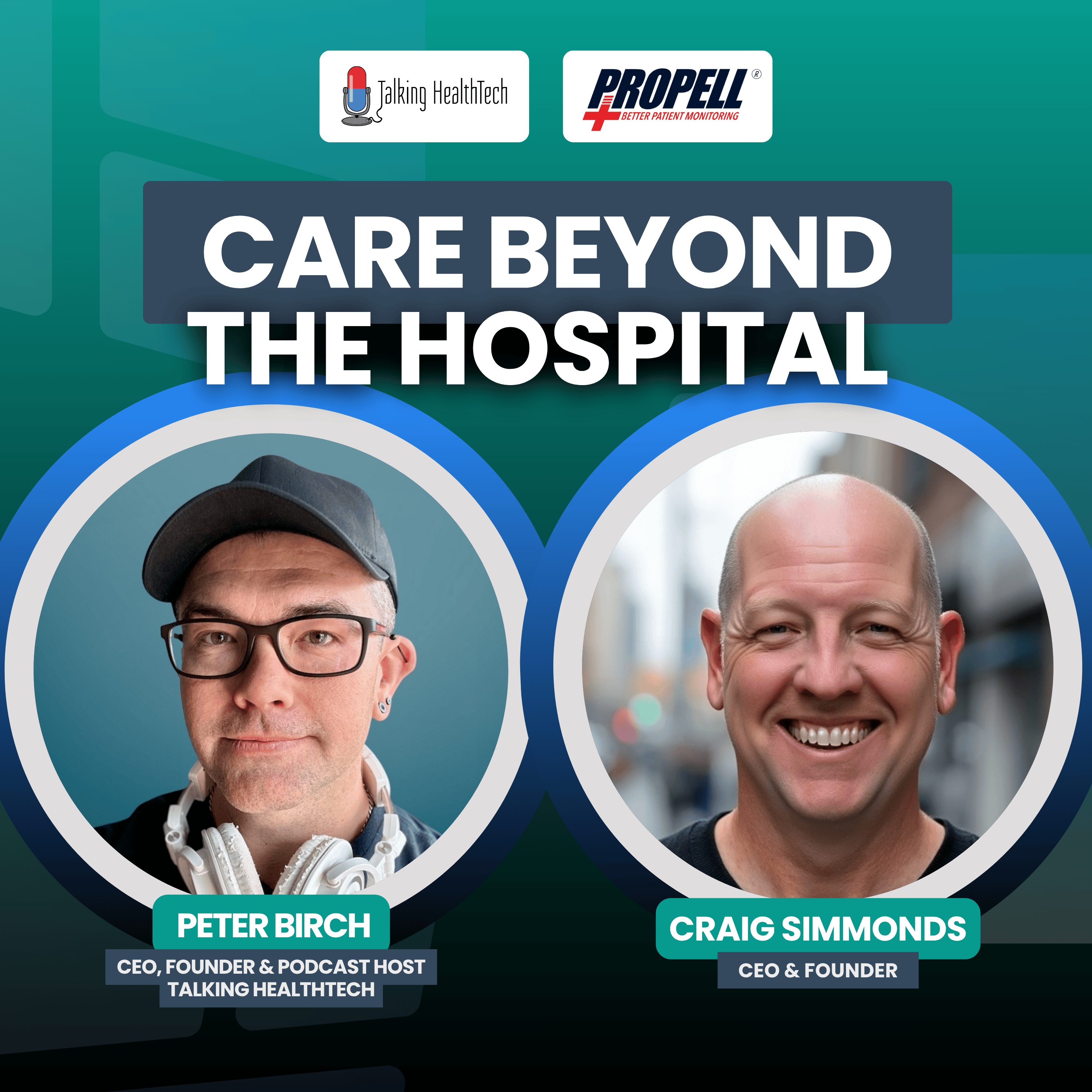
In this episode of Talking HealthTech, Peter Birch speaks with Craig Simmonds, CEO & Founder of Propell, about the growth and acceptance of remote patient monitoring devices in Australian healthcare.
Together, they cover the mainstreaming of virtual care, future directions for device technology, and the practical challenges and opportunities in rolling out devices like iHealth across hospital and home care.
They discuss what's driving hospitals to move beyond pilot programmes and treat remote monitoring as a core part of everyday care, including how NSW Health's rollout of iHealth devices is shaping the way patients with chronic disease or post-acute needs are supported at home.
The conversation also covers the shift from episodic, patient-initiated checks toward continuous physiological monitoring, along with the importance of integrating patient data with hospital systems for real-time clinical intervention.
It also looks at how services are working to close the digital divide by providing patients with fully set-up devices and tablets.
Craig shares insights from his experience navigating TGA approval, funding models across different states, and what it takes to keep programmes focused on genuine clinical outcomes rather than technology for its own sake.
Key Takeaways
🩺 NSW Health's large-scale adoption of iHealth devices is a major shift towards mainstream remote patient monitoring in hospital-in-the-home programs
💡 Clinical accuracy and integration with hospital systems are critical for monitoring devices, distinguishing them from general consumer wearables
📱 Simplicity, usability, and clinical reliability are fundamental criteria when selecting and deploying health monitoring devices
🔋 New devices such as Vital Patch are enabling continuous, real-time monitoring of key vitals like ECG and respiration rate
🌏 The adoption of virtual care and remote monitoring is accelerating nationwide, not just in rural/remote locations but also in metropolitan settings
Timestamps
00:00 - Introduction to Craig Simmonds and Propell
05:45 - NSW Health iHealth device rollout
07:37 - Core measurements: vital signs at home
10:43 - Data integration and real-time hospital alerts
13:30 - Funding and logistics for device programs
16:27 - Usability and support for patients
21:08 - Future: continuous devices and the Vital Patch
Check out the episode and full show notes on the Talking HealthTech website.
If you’re enjoying the show and want access to exclusive healthtech discussions, meetups, and member-only content, you can learn more about becoming a THT+ Solo Member here: talkinghealth.tech/solo_shownotes
And if this episode was useful, leaving a review or sharing it with someone in the industry always helps.
Mentioned in this episode:
Use the free Talking HealthTech Glossary for plain-English explanations of digital health terms, acronyms and concepts across the industry: talkinghealthtech.com/glossary.


