
 Ask ChatGPT

 Talking HealthTech
23 Sep 2026 · 36m · 14 chapters
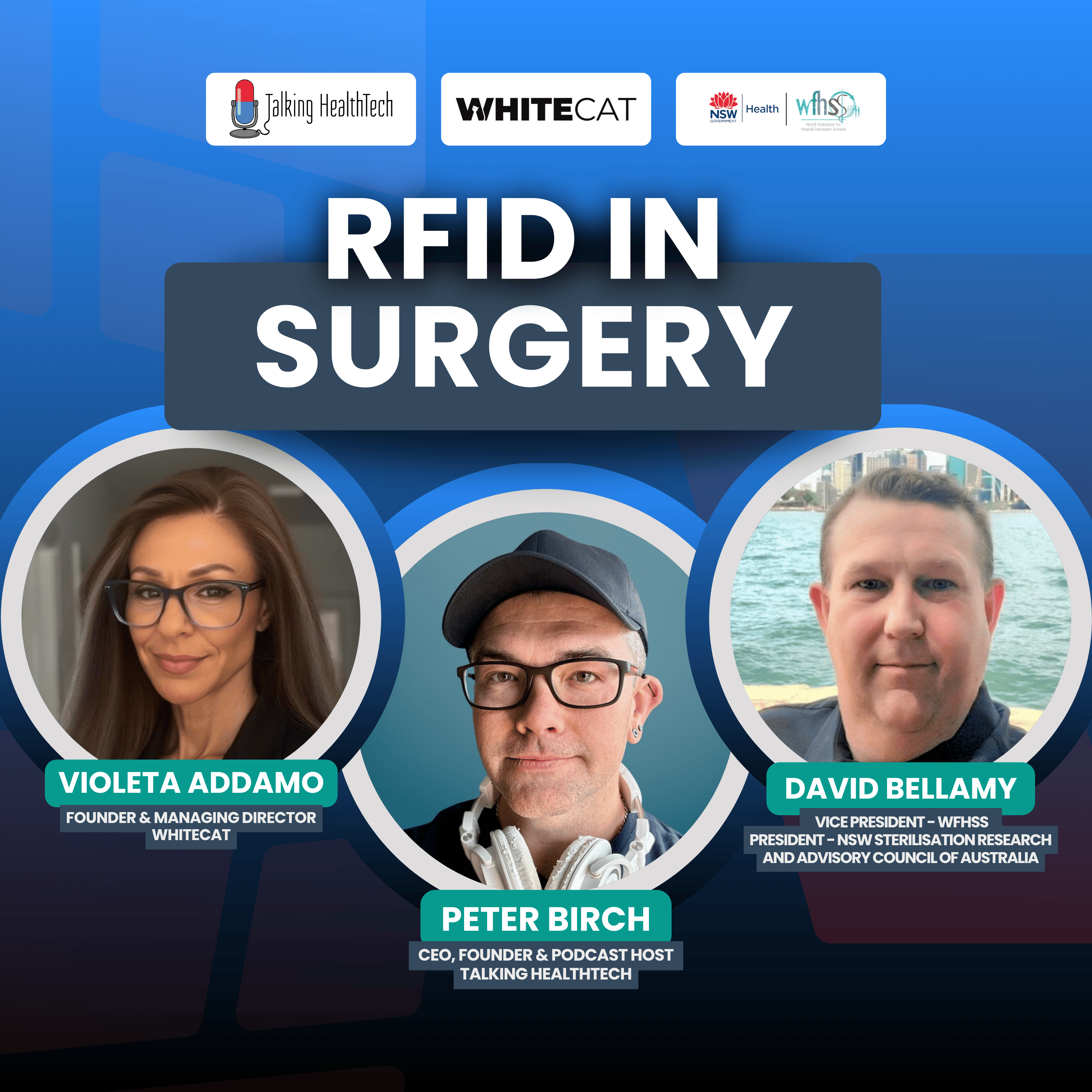
Episode topic: Traceability in CSSD/sterilization—how RFID (plus hybrid approaches) can improve compliance, instrument visibility, recall handling, and efficiency. The episode discusses Australia’s accreditation expectations (tracking instruments/devices to patient and procedure), data matrix limitations, and upcoming UDI requirements (TGA; class 1S+; implementation by 31 July; full compliance by 2029).
manual tracking is time-consuming and error-prone; RFID can extend tag longevity (about 2,500 autoclave cycles vs data matrix ~60–90); RFID enables near real-time locationing, richer data storage (UDI), faster recalls (minutes vs days/hours), and alerts to prevent use of unsterile instruments.
Europe uses RFID to validate digital counts and timestamp/sign to patient files, correlating to sterilization cycles; recalls currently rely on letters with uncertain reach, while UDI registers aim to target facilities/departments.
Violeta Addamo (White Cat; RFID surgical instrument management distributor/implementer; background in environmental science, dental/surgical/interventional cardiology sales, then RTLS/healthcare tracking). David Bellamy (CSSD/sterilization leader; committee work; KOL representing WF/HSS; focuses on compliance, recalls, and patient/procedure traceability standards).
Written by AI. May contain mistakes.
Introduction of guest Violeta Addamo and her background.
“Welcome to the Talking Health Tech podcast.”
Violeta discusses her background in environmental science and transition to RFID technology.
“That was pretty much the focus for me about six years ago.”
Discussion on the importance of sterilization tracking and compliance challenges.
“And that could be from anywhere from, you know, a surgery, like a dental surgery, all the way to a hospital.”
Exploration of RFID technology and its application in hospitals.
“I appreciate you making the time, Violetta, for this kind of preamble here and the discussion coming up.”
Discussion on the challenges and advancements in traceability within healthcare.
“Violetta, I want to come back to you for a sec, because you mentioned, you know, your area for a bit was the RFID space.”
Learn about RFID technology's role in tracking medical instruments in hospitals.
“that didn't impact the actual CE mark from the manufacturer.”
Explore the concept of Unique Device Identification (UDI) and its implications for compliance in healthcare.
“The only problems with those is a lot of people aren't aware of it yet, which is quite interesting, but there hasn't been much resources or information put out there.”
Discuss how recalls affect patient safety and the importance of tracking instruments.
“So if you had a recall, for example, we would be able to trace it back within minutes rather than days or hours.”
Delve into the inefficiencies of manual tracking systems in healthcare and their impact.
“you know, these conversations about, uh, the inefficiencies in the healthcare system or the, you know, we need to do more with less and, uh, you know, challenges in workforce and, and burnout and everything.”
Learn about international practices in healthcare technology and their effectiveness.
“Violetta, you were saying before that like, and David, you probably got points on this too, but the globally, this is kind of, is it the normal or that they're further ahead in say the US and Europe?”
Exploring the necessity and challenges of investing in healthcare technology.
“So their thinking is, and how they think about it is that if we educate people greatly, then they're going to do the job properly.”
Discussing the uptake of RFID technology and its benefits in tracking surgical instruments.
“Well, Violetta, I was keen to get your take on RFID specifically and the global best practices as well, if you've got any insights Yeah, so we have seen probably in the last six years a significant uptake of RFID.”
Examining how data and technology can streamline operations in healthcare.
“And, um, you know, we're all about continuous improvement in healthcare as well.”
Advice on how to effectively implement RFID in healthcare settings.
“If you can avoid it, then that is brilliant.”

Get the gist, explore an idea or ask about something said.
 Claude
On Talking HealthTech, what are the key points of this episode?
Searching your listeningAutomatic transcript. May contain errors.
0:00Peter Birch: Have you ever heard a term in digital health and just quietly had to Google it later? The Talking Health Tech Glossary has got you covered. We've got hundreds of terms in plain English explanations, written for our industry and all free to use. You don't even have to sign up for anything. Just go to talkinghealthtech.com slash glossary. Welcome to the Talking Health Tech podcast. My name is Peter Birch. Today on the show, I'm joined by Violeta Addamo from White Cat. Hey, Violeta, how are you going? Awesome, Pete. How are you? Nice to see you again. Good to see you. Always a pleasure catching up out and about at Industry Things and in the THD Plus community.
0:37Peter Birch: But we're carving out some time on the podcast to talk about the stuff that keeps you busy. But for those unfamiliar with yourself and White Cat, maybe you can give some context in terms of you and the work you do, and we'll go from there. So White Cat started out as a distributorship. That was pretty much the focus for me about six years ago. and we built that distributorship based on a certain technology which comes from Denmark and the product or the company name is called CareTag and they specialize in RFID surgical instrument management and I had a real passion for that there was a problem I noticed 10 years ago and so that's how White Cat came about I mean literally I was in Rio Tinto in Mongolia underground, finishing a project for UAT, saw this RFID journal and went, hey, that actually might fix the problem of being a little bit more.
1:31And long while I've laughed at the point.
1:33Peter Birch: I totally think that every time I'm underground in Rio Tinto as well, that's where all my good ideas come from. Maybe a little bit more, I thought I knew you, and that one kind of threw me a little bit. Maybe you could give a bit more context on where that came from. Well, it's interesting because I started, well, I started, let's go back like almost origin sort of phase. So I actually started and graduated as an environmental scientist and was doing my master's. And lo and behold, of course, when I graduated, we were the first to graduate with that type of degree. So environmental science was just so important in London and in those days.
2:14And there was just something there, not, I just didn't feel fulfilled. You know, there was a piece missing. and someone had asked me, hey, how you considered dental sales? And lo and behold, that's how I actually ended the medical market, through dental, and then worked my career through up into surgical sales and interventional cardiology and then moved to tracking because I had an interest in digital health. And to be honest, that was just a bit of a fluke. I really didn't understand what I was getting myself into when I moved from surgical sales into tracking. and I fell in love with it. That was over 10 years ago.
2:53And how I landed in Rio Tinto was because we did the tracking in healthcare, the foundation of what we do is pretty much the same except that, you know, it's designed for a hazardous environment. So I was brought over to another company or less sister company to sell and deliver those projects for the company called ATP in WA. And so, yes, I was finishing the project in Chattah Ridge and so Mongolia on staff safety. And I read the article on RFID and I literally harassed Kear Tag for a whole year to get that distributed issue because I was that passionate and thought, and I've actually nailed it.
3:33What, this is exactly what I'm looking for to solve this problem that I'd seen in our tech.
3:39Peter Birch: and the when we say the tracking piece the um because there's physical physical bits and pieces right you're talking about devices like consumables like what what are we tracking yeah so uh in a hospital environment we class anything whether it's mobile or non-mobile an asset so we will tag anything um that you basically want to have some traceability or visibility on you want some insights on that whether it creates you know relating to compliance or reporting or It could be a lot of different things. But for the most part, we sort of call it asset tracking. We can track people. We can track anything, really, environmental conditions.
4:19So that's where that had come from. And I specialized more in healthcare at the time. And then really the foundation of that type of tracking, it really builds into anything else, whether it's industrial, whether it's hazardous, underground, mining. The concept's the same. Maybe we're driving different outcomes, but the concept's the same.
4:36Peter Birch: And so White Cat now, so this is your jam. And so the types of healthcare facilities you're dealing with and people, tell us a bit more about that. Anyone who has, who does any type of sterilization would require some form of tracking, whether they're trade tracking or individually tracking. And that could be from anywhere from, you know, a surgery, like a dental surgery, all the way to a hospital. But for the most part, what I dabble in is really anything day hospital and above. So we're talking enterprise, great delivery, not just your, you know, ad hoc on-prem delivery. Most of those are a manual type of tracking that we don't deliver.
5:18Peter Birch: So we recorded an interview for this episode and it involves, you know, not just yourself, but it's, this is a topic that is kind of a big one in the industry and across healthcare. So it was good to get some different perspectives in. Did you want to frame that up before we cut over to that interview so we can actually hear about what some of this looks like in practice? Yeah, so there's a lot of major changes in compliance at the moment. And the reason why we did the follow-up podcast with David Bellamy, who's at KOL for our industry and on the global stage. So he represents the WF, HSS. So we interviewed him and we were discussing those issues.
6:03And I think having this discussion with you sort of sits the premises behind what are we actually really talking about and why that's important in relation to sterilization tracking. Amazing.
6:12Peter Birch: Well, let's cut into it so people can hear more. I appreciate you making the time, Violetta, for this kind of preamble here and the discussion coming up. So let's get stuck into it. Yes, I'm currently an SSD major and also sit on a few different committees and that. But I'm also kind of pioneering and looking for ways to improve and not only services for patient safety, but also when it comes to traceability and things like within SSD as well. Got it. Now, within Talking Health Tech, for those that have consumed many a podcast episode, they've probably from time to time heard an acronym or two.
6:56Peter Birch: and they've likely gone to our glossary of terms on our website where there's a plethora of information. I think that's 650 different terms we've defined on there. You can check that out on our website. But I feel like if we don't have SSD on there already, we will be putting it on there. Violetta, for those unfamiliar with this kind of space and the sterilisation and equipment side, frame it up a little bit more so people know what space we're in. I've been focusing on a particular RFID technology that is applied to surgical instruments. and that has never been done here before in Australia but it's been a long passion of mine to solve in RTLS tracking so we never really had a solid solution for it and I noticed that there was quite a bit of a problem in tracking in CSSD almost 10 years ago so I was on this mission to solve this problem and I came across a company called CareTag and they developed special RFID tag that goes onto these surgical instruments.
7:54Peter Birch: And the fact that there's a World Federation for Hospital Sterilisation Services says to me it's a pretty big deal. And if that's your world, then you know that full well. But if you're not familiar, because there's plenty of people in healthcare that probably touch a lot of parts but aren't totally into that side of things. So give us a bit more context. Yeah. So, well, sterilising as a whole is kind of a black magic. It just happens in the background and normally not at the forefront. Everyone knows about operating theatres and the parts that the public see, but we're actually in the background kind of doing the work so that they can do the operations.
8:31And just going on about the instrument tracking and that globally, it's an issue. So I'm very lucky with my role that I get to go and see a lot of hospitals, especially in the APAC region. And it's quite interesting that pretty much every SSD globally has the same issues when it comes to things like traceability and instruments and all the rest of it so I do find it very interesting that's and then being able to provide a solution and kind of working together and make a difference not only in my own department but also across Australia and if not further and it'd be great David actually if you could help me understand
9:11Peter Birch: a little bit more about those issues and you know mentioned traceability quite a bit and the fact it's a global thing and um we'll get to the technology in a little bit but um maybe if you could just help me understand a bit more like because there's got to be regulations there's got to be rules and there's there's you know the the minimum requirements and things that need to be done but where um where does it create the most amount of um burn of people's time and and focus in traceability of um social equipment yeah well so within Australia it's quite we've got the um Australian Council, Quality and for Hospitals, where there's a standard that we get accredited to.
9:54And in there, it stipulates in one of the standards that we have to be able to track a device or an instrument to a patient and a procedure, which is not the easiest thing to do, considering when you have operations that could use hundreds of instruments, how do you track every single one of those instruments. So compliance with that and again it's different levels, different interpretations but and things when with technology and moving forward it's going to become easier but it's something that is very hard to do and trying to find a solution is also very difficult. There are systems in place and especially just in Australia where you wouldn't be able to do that or or it's questionable at best so just trying to improve um how we do it and making it easier is kind of where we should be heading and this is kind of one solution that could be definitely looked at and implemented but uh there's there's often we have instruments that get misplaced they might be left behind in the theater um things like that so that that's the biggest probably problem is that we're wasting a lot of time looking for instruments that haven't been placed back in a tray and so on.
11:16And the worst fear anyone can have is the whole fact that you could leave an instrument in a patient.
11:23Peter Birch: So yeah, digital health has got a pretty serious acronym problem and we've all got our favourites, but it's a lot, right? And you don't really want to be the person in a meeting that has to ask what something stands for after you've been talking about it for the past couple of weeks. That's why we've built the THT Glossary. It's a free, ever-growing library of digital health terms that we explain in simple language, written for people who actually work in the industry. So it's useful if you're brand new in the space, or you're one of the veterans that just want a refresher before a meeting, or maybe you want to check to make sure we've got everything in there.
11:59Peter Birch: It's all there for you. have a look at talkinghealthtech.com slash glossary. Bookmark it, send it to your team. It's the kind of thing that should exist. So we created it. Hope you enjoy. Yeah. Well, I mean, this is the thing. It's like you want, you want to have that, I imagine you want to have that reassurance about, cause, cause when you just think about the complexity of the issue, like you've kind of outlined David, there's so many moving parts, like physical small bits of things that have the potential, if not managed appropriately could create inefficiencies, sure, but then, you know, at a more severe level, like some pretty significant clinical issues.
12:40Peter Birch: Violetta, I want to come back to you for a sec, because you mentioned, you know, your area for a bit was the RFID space. So that's the being out of track. Actually, we're going to stack the glossary. I know we've got RFID in there, but help me understand a bit more how you, you know made that kind of move from looking at RFID generally and then like the opportunity in the surgical instrument space? Yeah I think just to David's point when we talk about traceability it's not just one technology and I do even though I have RFID as a solution and I'll get to the point of how we got there but it really requires a hybridization of traceability so it's not always one solution that would fit for this case.
13:24I think that's important to note. Now, how did I get to RFID? Well, in fact, we currently do trace and some hospitals can trace down to the instrument level using the data matrix that's etched onto that actual instrument. The only issue we're finding with the data matrix is its longevity. And it is a difficult barcode to place onto an instrument. Some can be as small as a 1.5 centimetre to 1.5 centimetre edge. It's extraordinarily small and hard to put enough data on it. So the reason why RFID came into light was because we needed to put something on an instrument that didn't impact the actual CE mark from the manufacturer.
14:08We also wanted to try and give real-time visibility. So near real-time visibility was the other factor around efficiency, but tracking all those things like where did it actually go? Did it get thrown in the bin? Is it left in the patient? And that's why RFID was introduced. And it's not just the chip itself but rather the whole technology. So there is an adhesive that is applied in the tech that enables it to have the longevity that the data matrix doesn't have. So, for example, some data matrix, and maybe David could talk to this a bit more than I can, I'm hearing only last between, you know, 60 and 90 autoclave cycles.
14:46Whereas when you think about what, where the technology is at the moment with RFID is that it's sitting at two and a half thousand autoclave cycles in real life. And that's quite impressive. And it also may not last to the life of the instrument, but close enough.
15:03Peter Birch: And so RFID, that's the ability to be able to track wherever it is like geolocated. Is that what I'm, what I'm, what I'm picturing? Yeah, so real-time locationing is really about tracking it all through its journey and how you determine that journey is based on what the hospital needs. So they may want to have certain areas segmented within the hospital that they'd like to know that that asset has moved through that area or been processed in that area. And that enables us to capture that moment for the hospital, timestamps it, gives us a real idea about where it's going, who's using it, how it's being used, whether it's being thrown out and all the rest of the data that comes with it.
15:46The other probably most promising thing about RFID is that we get to store a little more data than you can possibly do with a data matrix. So the UDI can be stored in there, which is, I think David can talk a lot more to the UDI than I can about the compliance issues or what we will see in future we will need to meet.
16:07Peter Birch: Tell me more about the UDI. I'm making notes with a lot of letters, David. Yes. So the UDI is a, well, I say wonderful, but a bit of tangy speak, but the TGA is thinking about rolling out and it's having a, so UDI stands for unique device identification. So they want to, anything that's a class one S and above, which is almost everything that's used in a hospital setting will need a UDI when it comes to the instrument and then you've then got to track that UDI again part of the standards and accreditation to the procedure then to the patient which then kind of just adds this extra layer on top of whatever we're trying to achieve now already and just making it more deeper so when it comes to reusable medical devices the UDI should be already on the instrument and then we have to then work out how we're going to get that UDI into our tracking system and and being able to capture that UDI essentially so it's they already want it to be implemented by the 31st of July kind of thing and then this year and then we have until 2029 to be fully compliant.
17:33The only problems with those is a lot of people aren't aware of it yet, which is quite interesting, but there hasn't been much resources or information put out there. It's kind of just here it is and work out how to do it kind of thing, which is quite normal for the TGA.
17:52Peter Birch: Well, I mean, this is it to ensure everyone's got issues at different scale and, you know, different existing workflows and things like this. And you can kind of get the intent, but the challenging part for healthcare systems, I imagine, is that there's a lot of healthcare to do right now. And if you're not really sure in the, you know, would this kind of meet the requirement that we need to meet that doesn't fully exist yet anyway, it's a tricky job. You know, I'm just picturing back at the conversation around, you know, the, I don't know if it's gold standard or like, you know, what would be ideal is being able to trace, you know, the use of an instrument at a patient level.
18:42Peter Birch: Because there's one thing to say, hey, we've got this many, like an inventory check within a hospital, but there's obviously much more hyper-focused, you know, detail required. Violetta, is that like a patient level traceability, like using different surgical instruments on a particular patient, is it a world where it's possible to know, hey, this particular, I don't know, scalpel or whatever it was used on a particular patient? Is that a world that's possible today? Yes, they actually do that in Europe at the moment. They use a lot of the RFID technology to do that. Let me elaborate a little more on that because I think it's easy to just say, but just for your audience, let's picture it for a second.
19:25So I know I'm talking about this little fine little tag that goes on an instrument, but it's more than that when it goes through theatre. So when we do pre-procedure and post-procedure counts, they're actual manual counts. But what we're doing in Europe is we're validating those counts with a digital count, like a bulk scan. So we're accounting for everything. When that bulk scan occurs, it's digitally timestamped and written and signatured to the patient file, and that tells us what's actually been used for that procedure and then correlates that back to the sterilization cycle. So if you had a recall, for example, we would be able to trace it back within minutes rather than days or hours.
20:08Peter Birch: Yeah, well, that was one thing I was thinking of too. I mean, recalls generally within any industry, it's always a pain. Like what does a recall look like now, David? Like if there was a recall to take place, I guess on instruments, is that a thing? um and i am from healthcare i promise it's just not i've never hyper focused on this area so i'm loving this conversation learning more hopefully along with many other people too because it sounds like there has to be a lot of investment in in just maintaining the current status in people time and and kind of equipment and things and sounds like so much opportunity for um uh you know improvement so if we've got to get that like level of detail but just back to the recalls like thinking about what this has to happen on a day-to-day now right what does that look like in any healthcare system there's two kind of levels of recall one can be triggered by the tga or the manufacturer so at the moment if the manufacturer has an issue with an instrument they identify they've got to then go to the tga and pretty much the tga just put out a letter and kind of hope that uh it hits the right people um there's really no way of being able to track uh where these devices have gone so that's kind of where the UDI and that's where the TGA are kind of heading where they have a register all the UDIs get registered and then they want to be able to track exactly which facility which department and everything these are going to so at the moment the potential of having something used on you if a TGA puts out a recall notice is quite significant because if it doesn't get to the right people or people change jobs and that's who's registered with the TGA, but they don't actually know that they've gone and there's someone new in there, then that's missed entirely.
21:54And then they can still go on to use those products. Then there's the hospital level recall. So if there is a sterility breach or something along those lines, then depending on when it's picked up and so on, there could be quite a number of patients that are actually impacted. And if you're not at either instrument or tray level, at worst, you should be at tray level. But if you're not at tray level, then if it's not picked up for a month, then you're potentially having to notify a month's worth of patients that may not be directly involved, but only because they've had an operation that time, then they have to be notified that they could be part of this sterility breach where if you have tray level tracking instrument level tracking then you can pinpoint and far less people would be actually impacted than if you weren't doing any kind of tracking um and again with the with the technology and everything else it just would make it so much easier manual tracking if you just got manual labels they go into patient's notes you've then got to collect all those notes you've got to have someone manually going through um where if you're at this level and you're putting it into a tracking system, uh, you can find it out a lot quicker.
23:13Peter Birch: Yeah. Like, you know, thinking about that example, you kind of outlined then we talk often in, you know, these conversations about, uh, the inefficiencies in the healthcare system or the, you know, we need to do more with less and, uh, you know, challenges in workforce and, and burnout and everything. And that's all very real. And, but often that's, you know, a lot of the focus might be on the patient-facing side, like in a consultation, like just having clinicians available or even near the admin and billing side. We speak about that a lot on the podcast. But that process that you just outlined sounds pretty human intensive.
23:52Peter Birch: And when technology, especially, you know, now, the ability to track things and, you know, data and it feels more like a technology job than a human job. And yes, you need the human to oversee and to be ultimately responsible and things. But surely, Violetta, getting humans to manually track things and enter them into systems, that's a huge cognitive load and error prone. I'm making a lot of assumptions here, but am I kind of on the right track here? To some degree. And I think David can agree. There are some processes we cannot eliminate, but we can improve maybe the speed at which they're done.
24:34there is a human element that has to happen in sterilisation, especially at the inspection phase where instruments have to be reviewed. Certainly even in the theatre section though, that can be sped up. So that means those room turnovers are happening faster. And certainly in respect to the paper, like for those who are still manually tracking, unfortunately, yeah, they'd have to involve a lot of resources to look through all those books to be able to gather the data to then go and physically pull the stock off the shelf. So, but, you know, the electronic or RTLS system allows for that to happen at a greater speed.
25:10And we're looking at recalls of up to about five minutes, being able to produce reports and then get resources out to go and remove that stock off the shelf. So I think recalls, correct me, David, I think they're allowing for some of those adverse events up to 10 days to report, whereas we could probably do it in a day. having this other technology you you can from a system uh make them non-usable so if it was something that's gone through a sterilizer you can then in the system say okay everything that's gone into that sterilizer is now unsterile when they go to scan it in the operating room it comes up with an alert saying it's unsterile you can't use it and that's where the tga want to kind of go this whole uvi thing so that you know they can make it uh unusable from their level and whoever's got them um will then not be able to use it if they implement and and go down the whole level of tracking um and scanning the udis um so and then going back to your assumptions and all they're they're pretty much not assumptions you're pretty much spot on it's very manually intensive and it's uh and extremely error prone like if you're if you're relying on so many multiple levels of people doing their job correctly uh and and in theater it's or uh you know time is of the essence you've got surgeons that are finish one case and before they've put the stuture down from closing the wound on one patient they're kind of already wanting the second patient or the next patient uh so that's where things can start where you don't have to do all that manual process then the efficiencies that Violetta alluded to, then creates more time, which then potentially we can then end up operating on more patients because we've got those times.
27:00Peter Birch: Makes sense to me. Violetta, you were saying before that like, and David, you probably got points on this too, but the globally, this is kind of, is it the normal or that they're further ahead in say the US and Europe? what I'd love to hear about like what the best practices are in in other parts of the world that we could kind of look to is there any kind of data that shows hey this is is not just a good idea but it's demonstrating the the benefits that we're talking about I'll let David go in first yeah so so globally um uh the world is at different stages so and depending on where you are so the Europeans, they kind of put a lot of money into healthcare.
27:42They kind of decide where their taxes go. And most hospitals or most countries have decided that a big chunk goes to healthcare. So they are a lot more technology advanced than kind of what we are. Where the US, they've focused a lot on education. So their thinking is, and how they think about it is that if we educate people greatly, then they're going to do the job properly. Because when it comes to technology and that, it all costs money. So some people are focused more about profit than processes, I guess. And in Australia, we're kind of got very good and rigid processes. A lot of our policies, procedures, guidelines and everything else are kind of adapted or adopted overseas as well that follow ours because ours are kind of more stringent.
28:36We're lucky that we do look at technology in that. We're just not kind of taking that extra step. We've got to kind of prove that why do we need it first because it's initial outlay of costing and then kind of the savings that you can gather from that. And the problem kind of is it's not a bad problem, but it's not a good problem is that if you don't really have it or have a recall triggered you don't really know how hard it is or um until something actually happens and you have to go through that and then how many people are impacted because if you have a recall where you only have to notify 10 patients that you've been exposed to over 400 that's a huge difference and how do you how can you really put a cost on that like if you can if you can prevent that that's a huge thing And we're also, with the cost factor and all the rest of it, just having those efficiencies and making able to track these instruments because they do go missing and so on.
29:44It's just that we need to look at that over just the initial cost of the implementation.
29:52Peter Birch: No, that makes sense. Well, Violetta, I was keen to get your take on RFID specifically and the global best practices as well, if you've got any insights Yeah, so we have seen probably in the last six years a significant uptake of RFID. And just like David said, we needed to prove it works. We needed to understand what the return on investment was. And probably in the last two years, it's been a rapid uptake. And mostly in Europe, I have to admit, but we do have some Asian countries trialling the tags right now because they're curious about the results that we achieved in Europe. And so for them, it was really important to track the UDI.
30:35And then efficiency was the second reason why they wanted to improve their tracking. So that's pretty much what I can tell you what I've seen in the last six years in relation to surgical instrument tracking in particular.
30:47Peter Birch: Now, demonstrating that return on investment or better utilisation of, you know, existing assets and things that's, um, always going to be kind of front of mind, I imagine, to anyone that's kind of making that investment in time and people and resources and things and money to, um, implement any kind of new technology, particularly in, um, in this space too. And, um, you know, we're all about continuous improvement in healthcare as well. I imagine there's some good tie in with, um, having this kind of visibility, um, you know, utilizing, like the data that you collect surely would be beneficial from a from a continuous improvement side of things as well David yeah definitely and uh not only um for continuous improvement but you could have a look at utilization so having a look and seeing what instruments because we have a lot of overlap with instruments within trays as well so if we're using two different trays but they have the same instrument in there and we can actually you could probably use this technology to then see how many of those instruments being used and then kind of slimlining.
31:56And every time that you're reducing the contents or streamlining what is in a tray, then of course you're saving money and time as well. And then another factor from that would be is that having that much data captured, you could then start looking at using formulas and possibly AI to have a look at when your busiest peaks are and you can start rostering staff that way as well. So on your less busy days, so you can start then having less staff work this day and maybe more hours on this day to then cover those workloads instead of having kind of that generic eight hour day and all the same amount of stuff that are happening on there that could be utilized as well.
32:40Peter Birch: Lastly, then thinking about like wrapping up the conversation, if there was any kind of key takeaways, like think about this area of instrument management David I'm just like keen to know what you're most either not excited about or like interested what keeping an eye on or where you think kind of most attention needs to be in this space um and and any kind of final thoughts and keen to then go to Violetta after you to then um you know give some advice for for those looking to implement RFID in practice as well but David just generally on this yeah so having gone through some recalls and things like that uh my best bit of advice is if you can implement something to prevent or make it uh easier to deal with then definitely something you should be looking at um kind of being proactive instead of reactive is the biggest thing because then they i don't think everyone really understands the impact that you would have to patients when it comes to how many you've got to kind of involve in that.
33:47If you can avoid it, then that is brilliant. And I'm lucky that I have a robust tracking system, but always striving to better practice, I think, in the healthcare is that's where we have to be aiming.
34:02Peter Birch: I like that. And then for RFID specifically via letter for those healthcare systems, just trying to understand more how it fits in or looking at implementing? Is there any kind of guiding steps or next things to do or like your approach to it? Yeah, look, I think where it fits in really well is, with the exception of David, because he already tracks down to the instrument level and it's, I mean, RFID just gives you that extra visibility, right? But we're looking for sites that are at that tray level or manual and paper that want to implement technology like RFID to give them that ultimate visibility.
34:38you know how can they reduce their inventory or how can they improve their compliance it needs to be phased it needs to start small we need to prove why this investment's important and that's why I think the pilot is always a great way to start for RFID and and any technology whether we're integrating to theatre and which we do you know to give you that full overview that we were talking about so we integrate to other applications to create a holistic view but I would always start very small with the process of thinking big.
35:08Peter Birch: I like that. Well, people will be able to find the details for White Cat, Violetta and everything in the show notes of this episode and a bit of a summary of the conversation, but also on our website, there's a listing there and more information you can dive into. So all of that will be linked up there. I've really enjoyed learning a lot with you both, Violetta and David. I appreciate you making the time for this conversation. Looking forward to doing it again soon. Thank you so much. Thank you. Thank you. Thanks, Pete. we hope you enjoyed this episode of talking health tech make sure you like and subscribe and share this episode with someone who might find it valuable for more information and resources about healthcare innovation visit talkinghealthtech.com
35:50Peter Birch: that's it for this episode i hope you enjoyed it make sure you subscribe to our newsletter on talkinghealthtech.com slash newsletter so you can be across all the things we do at talking health tech above and beyond this humble little podcast. Thanks so much.
In this episode of Talking HealthTech, Peter Birch speaks with Violeta Addamo, founder and managing director at WHITECAT, and David Bellamy, vice president for the World Federation of Hospital Sterilisation Services and president of the New South Wales Sterilisation Research and Advisory Council of Australia.
Violeta shares how her path into healthtech began in environmental science before moving through dental and surgical sales, eventually leading to the founding of WHITECAT six years ago, built on CareTag, a Danish RFID system for surgical instrument management. David brings his standing as a recognised industry leader in sterilisation through his role representing the WFHSS on the global stage.
The conversation explores the challenges and advancements in surgical instrument traceability, the implementation of RFID technology in sterilisation departments, compliance with unique device identification (UDI) requirements, and global practices in healthtech for instrument management
The episode also covers how Central Sterile Services Departments (CSSD) manage the cleaning, sterilisation, and tracking of surgical instruments, and the risks that arise when these processes rely on manual systems such as paper logs and barcode scanning.
It also looks at how RFID and real-time location systems are being trialled to improve visibility across the instrument lifecycle, reduce search times, and support faster responses to sterility breaches or recalls.
Further topics include the regulatory landscape shaping instrument management in Australia and abroad, including requirements set by the Therapeutic Goods Administration and the Australian Council on Healthcare Standards, as well as comparisons with practices in Europe and emerging trials across Asia.
The discussion closes with a look at what these advancements mean for the future of surgical safety and hospital efficiency.
Key Takeaways
🛠 The importance of surgical instrument traceability for both patient safety and operational efficiency in healthcare settings
📡 The evolution and adoption of RFID technology for real-time tracking of surgical instruments, including the limitations of traditional data matrix approaches
📝 The introduction of UDI requirements in Australia and the implications for compliance and traceability in sterilisation processes
🔄 How digitisation and technology reduce manual effort, errors, and the time required to handle equipment recalls
🌏 A comparison of global approaches to sterilisation and traceability, highlighting differences in technology adoption between Australia, Europe, and the USA
Timestamps
00:00 - Introductions and guest backgrounds
02:06 - Real-time location tracking and RFID in surgical instruments
05:03 - Traceability challenges and compliance requirements
09:01 - RFID vs data matrix for instrument-level tracking
10:47 - UDI compliance and future standards
15:40 - Manual vs digital recall management
22:51 - Global perspectives and best practices
Check out the episode and full show notes on the Talking HealthTech website.
If you’re enjoying the show and want access to exclusive healthtech discussions, meetups, and member-only content, you can learn more about becoming a THT+ Solo Member here: talkinghealth.tech/solo_shownotes
And if this episode was useful, leaving a review or sharing it with someone in the industry always helps.
Mentioned in this episode:
Use the free Talking HealthTech Glossary for plain-English explanations of digital health terms, acronyms and concepts across the industry: talkinghealthtech.com/glossary.


