
 Ask ChatGPT


 Talking HealthTech
7 Oct 2026 · 32m · 16 chapters
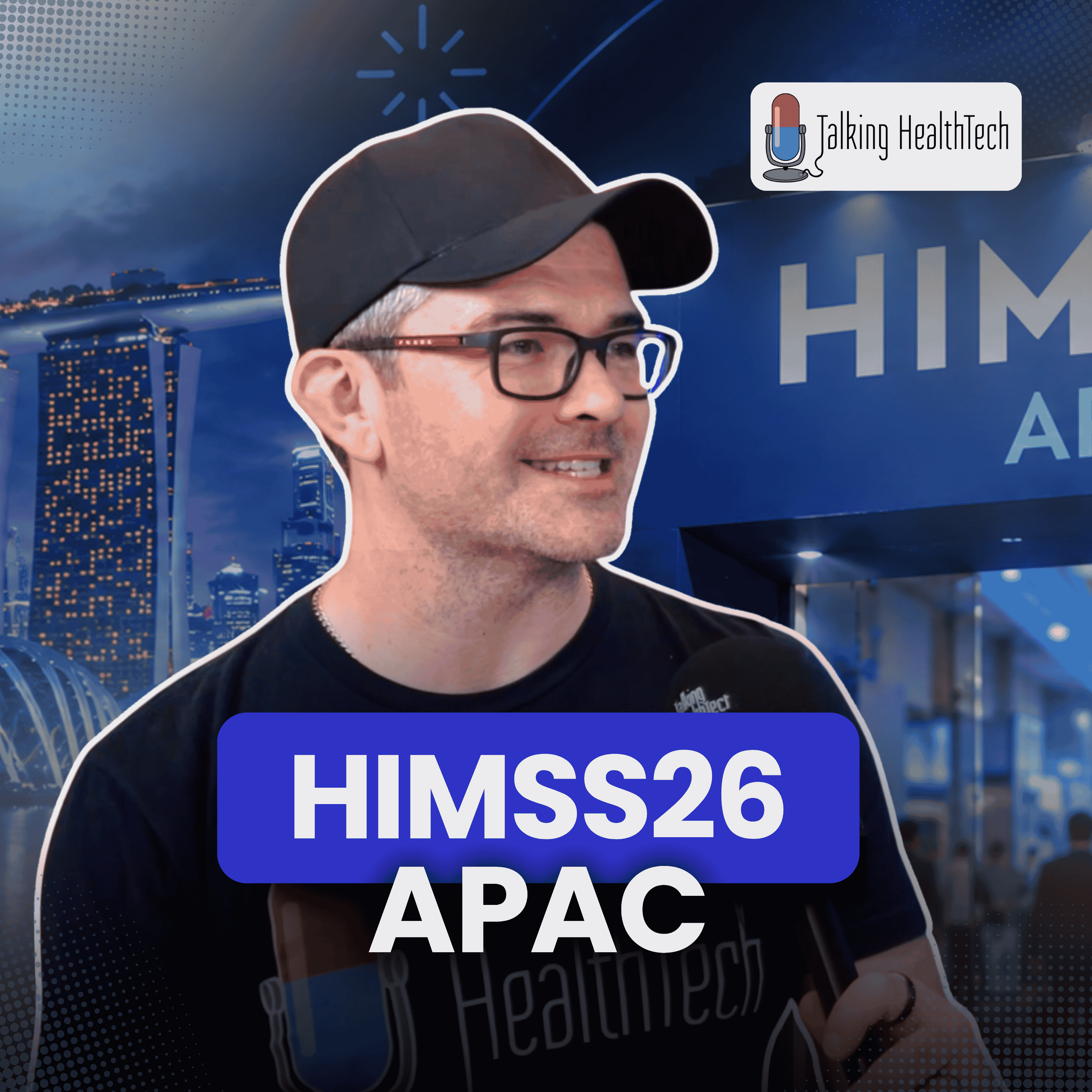
HIMSS APAC 2026 conversations on Asia-Pacific healthcare collaboration and digital excellence, with a focus on HIMSS EMR maturity benchmarking, connected care, AI governance (including “shadow AI”), and practical AI infrastructure and hospital operations.
Written by AI. May contain mistakes.
Discussion on HIMSS's role in supporting health systems across Asia-Pacific.
“Collaboration starts with a conversation, Team Health Tech.”
Exploration of the focus on connected care systems in various APAC countries.
“which is funny given it's the closest region to Australia, but it's been the last on the list.”
Discussion about the concept of shadow AI and its implications for governance in healthcare.
“I look after digital transformation and I've been doing that for the last 18 years in healthcare.”
Exploration of using AI for optimizing healthcare resource allocation and patient data management.
“and everything happening back home in Australia.”
Learn about using multi-dimensional data to improve patient care in hospitals.
“I'm from Chinese University of Hong Kong.”
Understand the importance of AI infrastructure in healthcare organizations.
“So it's really important that we have the best infrastructure that's ready for the AI era.”
Explore the challenges of integrating new AI solutions with existing hospital systems.
“Does this, like, the work that you're doing apply on top of everything that any hospital does?”
Discuss healthcare technology accessibility across different regions, including Asia and Africa.
“I will say it's pretty similar when we talk about like a big region.”
Examine the potential acceptance of AI tools by patients and their implications.
“but it's pretty much similar to every region right now.”
Learn how government policies in China support AI innovation in healthcare.
“That's going to cost maybe too much oil to sustain.”
Discover the innovative AI solutions being developed for the healthcare sector.
“Yesterday we had the advisory board meeting dinner with the CEO and all the region heads, and they are actually talking about how can we train our model that's more fitable for the whole group of expertise.”
Learn about Samsung Medical Center's approach to healthcare technology and patient care.
“And back then, one single neuron would take me the whole cluster of server to burn out.”
Explore the digital transformation journey of Samsung Medical Center since its inception.
“with Samsung Medical Center, tell us a bit about the scale and the services and the healthcare needs in the region.”
Learn about the early adoption of digital health practices in healthcare.
“Natively, we are born to the digital health.”
Discover how logistics robots are improving hospital efficiency and patient care.
“Imagine for over 100 years, hospital logistics still depends on manual transportation.”
Explore the positive effects of technology on nurses' workloads and patient interactions.
“After deploying the logistics, now they are more focused on patient care.”

Get the gist, explore an idea or ask about something said.
 Claude
On Talking HealthTech, what are the key points of this episode?
Searching your listeningAutomatic transcript. May contain errors.
0:00Peter Birch: Have you ever heard a term in digital health and just quietly had to Google it later? The Talking Health Tech Glossary has got you covered. We've got hundreds of terms in plain English explanations written for our industry and all free to use. You don't even have to sign up for anything. Just go to talkinghealthtech.com slash glossary.
0:32Peter Birch: welcome to talking health tech my name is peter birch i am back in singapore and this time for hymns asia pacific and i'm having conversations with healthcare leaders from all parts of the region to bring you this special feature episode today you can catch all of the discussions that i had during hymns apac in a special feature playlist on our youtube channel and the link to that's in the show notes of this episode but coming up you hear a couple of the conversations now and I hope it gets some value. Collaboration starts with a conversation, Team Health Tech. Let's make it happen. Hi, it's Andrew Pierce.
1:03I'm a Vice President at HIMSS. I'm based in Australia, but I look after our, I guess our advisory services for digital health transformation here in Asia Pacific.
1:14Peter Birch: Amazing. And look, I've seen some of the work up on the boards here at the HIMSS Connect booth here at HIMSS APAC, but tell me a bit more about the work you're doing within the Asia Pacific region. Yeah, well, it's been quite broad and diverse. I reflect back to when I first joined HIMSS back just around the pandemic times. And I guess think that it's been a real amazing transformation in how we're helping health systems in Asia Pacific by HIMSS. What we've helped hospitals and also government, I guess, prioritise where their investment should be to get the best outcomes for the populations they've served.
1:52And we've been doing that across more than a dozen countries in Asia-Pacific since the pandemic. And it's been a real, real privilege to be part of that journey.
2:02Peter Birch: And so is this what we refer to the HIMSS levels? Is that right? Like people might have heard a lot of the terminology being thrown around, but maybe just at a high level, can you give it some more context? To guide people on their transformation, HIMSS has developed, I guess, evidence-driven standards, if you like. and they're global standards. So the standards that we have for different parts of digital infrastructure, whether it be infrastructure itself at the base, whether it be the EMRs that they put in, whether it be the analytics and AI solutions that they adopt, et cetera, et cetera, they're all based on our global research and they're applied consistently whether you're a hospital in Melbourne, Australia, or whether you're a hospital in Taichung, Taiwan, or another hospital within Riyadh in Saudi Arabia, it's the same standard.
2:52And they can compare and contrast themselves with each other and their peers. Those standards, like I said, with a few hundred criteria in each, so they're not small standards. And in them, they show, I guess, the priorities that you need to have down at what we call stage zero are the first things to do. Then there's a list of things that they need to do in stage one all the way through to stage seven, which are the most advanced. So what these standards do, I guess, is really guide where you should start or where you are, where you should do next.
3:25Peter Birch: I think everyone likes a benchmark or a guide or like a yardstick on where to go next, particularly if being able to look in other colleagues in other parts of the world too. So I can see the value there. Yeah, exactly. I guess it's been really quite interesting. Like I said, even four or five years ago, a lot of the countries thought they were all different. But that's actually not the truth, right? Yes, there are some local region specifics. There are some local regulations that are quite similar. But what we really, really have seen over the last few years is that hospitals in Asia-Pacific love to compare and collaborate with each other.
4:07And I guess one of the things that we at HIMSS are really proud to do is, one, we provide the guidance to our standards. But the second thing that we do, because we're a membership organisation, we actually bring peers together. And so the combination of standards and priorities and a helping hand from, like I said, I just got back from a project in Tainan in Taiwan. So down in the southern part of Taiwan with a wonderful regional hospital that's just been recognized at our MRAM stage 7, so EMR adoption at the highest level. And it's a wonderful achievement for regional hospital. on our team we had myself from australia we had a representative from singapore with their experience a representative from thailand and the chief information officer from a leading hospital in south korea all providing our thoughts on what we saw it in thailand and them asking us what we think and how we can help them transform as well so i guess that was a really great example which is quite typical of how HIMSS supports health systems.
5:15Global standards measured consistently with collaboration from their peers and others together to help each other. Because it's all about growing together. The ecosystem's only good if we're all growing together. Individual excellence isn't that important, to be honest.
5:33Peter Birch: 100%. Last thing, such a great articulation of the value there, by the way. If I was thinking specifically about the Asia-Pacific region, You know, I'm certainly getting a crash course in what's happening, which is funny given it's the closest region to Australia, but it's been the last on the list. But it's a lot of diversity, a lot of kind of levels of capability, but a lot of passion there too I'm noticing. Is there one or two kind of key things that really stands out to you about this region that you hope people take away? One of the things that's, oh, there's a few thoughts on that, I guess, but I think one of the things that's being focused on in the last, probably the last 12 months in this region, which has been really really which is still moving ahead we're still formulating if you like is around the concept of connected care and the governments in many countries within this region are focused on how they connect up the health systems it's a challenge in Australia connecting up the states and territories the hospitals with the primary care with the private clinics Australia's system is all around connected care the strategies around successes around that and you then go to somewhere like Taiwan where they're highly digitized you see they've got a national health care system uh national insurance they've got a very very very integrated national platform and you go well do they care about connected care well they do they're actually not as well connected as they would like but they they are still prioritizing how well they connect the a regional hospital with a tertiary hospital with a clinic with an aged care home with their ambulance services.
7:08Same in South Korea. There's some very, very mature tertiary hospitals, but they still got work to do on connecting up specialist clinics with their small regional hospitals. So I guess the key message is, is that yes, there are some digital excellence in Asia Pacific, which has been recognized here at this conference, but governments in many of the countries are now actively working on, well, digital excellence in one or two areas is great, but actually what we need to do to transform the outcomes for our population is to connect up the healthcare system. And that is consistent across each of the countries in Asia-Pac, which is awesome.
7:45And we're helping on that. Yeah.
7:50Peter Birch: So, yeah, digital health has got a pretty serious acronym problem and we've all got our favourites, but it's a lot, right? And you don't really want to be the person in a meeting that has to ask what something stands for after you've been talking about it for the past couple of weeks. That's why we've built the THT Glossary. It's a free, ever-growing library of digital health terms that we explain in simple language written for people who actually work in the industry. So that's useful if you're brand new in the space or you're one of the veterans that just want a refresher before a meeting or maybe you want to check to make sure we've got everything in there.
8:27Peter Birch: It's all there for you. have a look at talkinghealthtech.com slash glossary. Bookmark it, send it to your team. It's the kind of thing that should exist. So we created it. Hope you enjoy. My name is Lily. I look after digital transformation and I've been doing that for the last 18 years in healthcare. You have. It's taken us to meet in Singapore to have a conversation, Lily. It's been a little bit since we last spoke. Yeah. A few years, isn't it? A few years. Time flies. What brings you to Singapore, themes APAC. Well, I'm here to talk about shadow AI, but also to look at what everybody else is doing in the AI space.
9:00There's lots of amazing things in Singapore at the moment.
9:03Peter Birch: There is a lot of amazing things, a lot of great diverse conversations with different parts of the region already across Asia Pacific. You said shadow AI. Tell me a little bit more about what you mean. Shadow AI basically means that people are using AI and your IT department or governance is not aware of it. Oh, I feel like there might, there might, well, I imagine there's IT managers like, like, nah, this doesn't happen. Actually, to be honest, they probably think, yeah, a lot of this is happening. But how do you get across all of that as a healthcare system? Well, there's a few ways you can get across that.
9:34I think, first of all, you need to be across what your current governance position is. But there's also tools nowadays that can help you monitor what people do. It's a little bit scary, but it's like a big brother thing. And then a lot of them is relying on people understanding what they should do and what they shouldn't do. Education is a very important aspect. Now, I use the word very carefully, education, not training, because education means that you're understanding it rather than training just doing what you're asked to do.
9:59Peter Birch: Are you, like, is the ideal standard that people just don't use any systems that aren't approved by, like, you know, what's on the list, if you know what I mean? Like, is that the best case scenario, that everyone just uses what's on the list? I think the best scenario is that we work together to get that list populated and educate the broader community and also our organization because you're never going to get to a point where people are not using something that you don't know about or you don't sanction, right? It's about them coming to you and asking you, hey, I have an idea, I want to try this, and you're responding in time to get to the point where you support them through that journey because you don't want to stop them from being innovative.
10:40You don't want to stop them from moving forward. You want to support them.
10:42Peter Birch: I was hoping you would go down that route. I'm trusting you here. No, because I feel like, you know, we're in an age where there's a lot of new tools and also approaches that come from the bottom up in terms of technology and all those other elements about the consumerization of a lot of different applications too. And yes, there's potentially a lot of risk that could be inserted into a health system through that approach, but also a lot of opportunity to address some real challenges. Because the people who know the workflow the most are the ones that are going to try and find solutions for it, right?
11:10Absolutely. Absolutely. It's always like, I don't know, while the speakers talked about a nail and a hammer. If you are the hammer, everything's a nail, right? That's another metaphor that I really like is AI evolution. It's like there was not electricity. You know, when electricity first came out, we don't know what to do with it because the light bulb hasn't been created.
11:27Peter Birch: Yes. Right? The EV hasn't been created. Mobile phone hasn't been created yet. AI is going through that evolution. We have the technology. We need some of the tools to be able to do that. And eventually, we don't really care about how expensive it is anymore because we can't live without it anymore. And hey, we've talked a bit about Western health and everything happening back home in Australia. But, you know, you keep yourself busy across healthcare overall. What else are you up to? Well, I've joined a board recently, the Australian Society of AI for Mental Health. And we provide advice to our clinical psychologists, anybody in the mental health space, on how to use AI safely and effectively.
12:04You know, most of our board members are using AI and they have been amazing adopters at it, but they're very careful about it and they know where the guardrails are. I've also started doing my own research on AI, particularly around AI-powered EMRs, around governance implementation frameworks and how that would drive a better outcome, both for the patient, for the health service and for the population. A lot of things that I'm doing in the AI space.
12:26Peter Birch: Do you find anything particularly interesting happening within the APAC region that could benefit some of that work that you're doing back home? I think learning from what everybody else is doing, It's a good starting point. Also, part of this, a lot of things that you hear me talk about today is with AI, a lot of times you're the first doing it in your country, in your state, in your organization. You need to go above and beyond your current network to understand what everybody else is doing. And sometimes you might be the first person doing it in the world here. So part of that is exciting, but it's also something that you don't have anyone to reach out to.
13:02So building upon that network here, taking to all these smart people about what they're doing, helps you build that. And so that you don't have to make the mistakes that they make, maybe.
13:11Peter Birch: Yeah, I like it. Lastly, what are you hoping people take away from your session on shadow AI and just generally the discussions that are happening here during the event this week? I had this interesting conversation with a colleague in this event. And all the conferences we go to is on AI governance, governance, governance. and governance, the moment you hear governance, you think no or never or later. I hope that people will take from my session that governance can be utilized, can be there to support you as well. It doesn't have to be the showstopper and we always think of it that way, but no, you need to use governance to make innovation better and that's what I want him to take away from today.
13:57Hi, everyone. I'm Oro. I'm from Chinese University of Hong Kong. I'm a researcher there, and we do study on how do we use the multi-dimension data to collect patients' data, hospitals' data to try to make the model, the world model for healthcare system. So it's like making the pairing for the doctors and the patients, so we know what to deliver to the patient at the right time. And we also make the model, simulate the whole hospital so that we know what kind of resource should we allocate at different timing for the whole process of supply chain time of oil. So we really like to share our technology from Asia to global clients as well, because I also have my own startup called SenseCare, where we do AI infrastructure for all the organizations, including hospitals, home care and MOH, Ministry of Health, because now everybody understands the value of data sets.
14:54Yes. So it's really important that we have the best infrastructure that's ready for the AI era.
15:00Peter Birch: Yeah, 100%. And help me understand a little bit more where this fits in. I mean, hospitals have EMRs and HISs and every other kind of acronym too. And then there's, I guess, data analytics and bits and pieces that happens underneath or throughout. Does this, like, the work that you're doing apply on top of everything that any hospital does? Or does it need to connect in with existing infrastructure? Walk me through how that kind of fits in in practice. and hope that you get. That's a really great question because I get asked this question all the time. So there are two types of projects we do.
15:35One is the greenfield that we provide the whole infrastructure plus all the applications looks like a plug-in into that framework. And that's easier to use and easy to implement. But there are so many historical legacy in the existing city-level hospital right now. So we do have that co-pilot-looking thing that can plug into their existing EMR system, depends on what they are using. That one will take some time for the training of the staff and the training of our QC staff as well. So it depends on what do you have. And I'm pretty sure slowly everybody is going to transit to that new infrastructure style.
16:17But it takes time.
16:18Peter Birch: Yeah. And are you finding that this is something that is, like the insights that come out of it or like the output of it, is it particularly relevant to the Asia-Pacific region or is this something that learnings could be gathered from other parts of the world looking at this approach too? I will say it's pretty similar when we talk about like a big region. The accessibility of good technology in healthcare is always really scattered. So we are trying to bring up the accessibility in the rural area in Asia But we also see a lot of countries that's not having good support yet, like Africa, Mideast even.
17:02Even when we are talking about project size could be really, really big in Mideast, but it's still really relatedly delayed. So I wouldn't say that in Asia is more advanced because we still have those scattered places, but it's pretty much similar to every region right now. So we talk about a lot of accessibility literacy in the conference just now because we want to bring up the literacy of AI for our clients, not only the doctors, but also the patients. How do you actually use this technology better to advance your knowledge of health care instead of being challenging and get scared of it? Yeah.
17:48Peter Birch: Well, this is it, isn't it, too? I think communities globally are going to face this as patient-facing AI solutions become more prevalent and more obvious than, you know, we're really going to see then whether patients embrace it or continue to challenge it and want more from it or whether they, you know, vehemently kind of oppose it. Have you got a sense of what might be the general acceptance of patient-facing AI tools within this region? Or is it really a time will tell? Or it also depends, I guess, on how it's implemented as well, how we bring patients along in that journey? I think Asia plays a really important role here because China is one of the pioneers in this phase.
18:37because Chinese government is really trying to push this forward because they have so many patients and they have this AI industry that they try to bring up. So these two industries together is getting a lot of policy supports that people are free to use them in certain kind of support financially, policy-wise, and also a lot of funding. So we are seeing a lot of hospitals are creating those infrastructure policy and the compliance structure for being the example for the whole nation. And now we are seeing a lot of countries are picking up those ideas at the same time. But what we want to actually trying to see in the future is people really treat AI as electricity, like a commodity, so that nobody is asking the question of ROI in the future.
19:34So that's what we want to change, like the mindset. We want people to actually embrace it. And when we talk about electricity, we also face the challenge of sustainability. Like, do we really have that much power to enable the whole region to use agentic AI? That's going to cost maybe too much oil to sustain. So we want to make sure everybody is using this technology wisely. For example, if the whole region is setting up central IDC, AIDC in general, then the resource will be consumed more wisely because everything is on the same platform and the API SDK will be having the same standard. That will be quite similar to the telecom era where everybody is using the same standard and using the same format of utilities.
20:28so that's what we want to lead it to to lower the cost so when it's becoming the commodity we are actually having a earth that we can live on for longer yeah love that um you know you
20:42Peter Birch: mentioned you're up on stage here at hymns apac um speaking about uh involving patients in that that ai journey tell me a bit more about what what you've been you know with someone with an experience such as yourself you know there's lots you can talk about an event like this what are the What types of conversations you're having here at HIMSS APAC, either on the stage or with delegates in attendance? So, yeah, it's funny. Yesterday we had the advisory board meeting dinner with the CEO and all the region heads, and they are actually talking about how can we train our model that's more fitable for the whole group of expertise.
21:21For example, if we want to use those tools for quality control, how can we converge all those guidelines together? Because in different hospitals, the management schema is always different. So from our point of view, the first buyer decision is always coming from the president, the CEO's mindset. So how can we have something that's ready to use right away for each different hospitals? So that's something that's quite different from what we have seen in the consumer-based design. So that's critical. There's something unique about the healthcare industry as well. It's always coming from the top down when you are using something very expensive.
22:07Yes.
22:08Peter Birch: Lastly, tell me a bit more about the startup that you're involved with as well. So we do have two unique angles. One is to build in the AI infrastructure because we are actually a spinoff from a big corporation doing AI for like 20 years. And now we want to have the unique infrastructure advantage for the healthcare part. That's why we have all those multi-model data sets that's running on this platform. It's pretty much like the traditional MCP infrastructure, but people call it different way nowadays. Now it was open claw and now it's harness. I don't know when it will become a different name.
22:50So that's something we are building because in China, we have so many base models, so many different datasets, standards, and different applications running all over in the hospital. When I was the CIO in Shanghai Zhongshan University Hospital, we have around 300 projects running all the time. So imagine how complicated the API system is. So we want to be that middle platform, the agent platform, so that everything can talk to each other, but facing the AI infrastructure as well. So that's one part I'm really passionate about because I know every CIO would want that as a management tool. Another thing is coming from my research angle, because I used to be a computational neuroscientist.
23:33I built model for the brain. And back then, one single neuron would take me the whole cluster of server to burn out. So I was looking for computing from quantum computing technology. But now we see the transform of the whole biotech. That's so much data says coming in as well. So the modeling simulation can be a little bit more efficient. and if we can model the human being better maybe we can find a way for longevity easier because now we have all those testing those different products that's matching for the single challenging problem everybody wants to know the answer so that's another thing that we call it a world model we build the world model for the patient and a world model for the doctors so just like the pairing I was talking about, but it's more advanced, more precise.
24:28So we have this timely push notification for this patient or for this healthy wellness purpose that whether you should take intake something today or tomorrow, what type of exercise you should choose, or something traditional Chinese medicine that we can recommend you to. So that's something world model give us the idea about we believe we have such a big data pool and product line that we can take advantage of. So two lines of products we are building right now.
25:04My name is Jong-Soo Choi. Actually, I serve as a CTO at Samsung Medical Center in Seoul, South Korea. It's really happy to see you here.
25:15Peter Birch: Good to see you too. For those unfamiliar with Samsung Medical Center, tell us a bit about the scale and the services and the healthcare needs in the region. Yes, Samsung Medical Center is a tertiary care teaching hospital located in Seoul and opened in 1994, very short history compared to other traditional healthcare in United States or Europe and we nowadays care over 9 ,000 outpatient every day and we also perform more than 200 surgeries each day. We have 1 ,700 sick beds with a better occupancy rate is around 90 % and length of stay is 5.7 days. This requires a highly efficient operation throughout the hospital.
26:16Peter Birch: And sometimes the Samsung Medical Center is seen as like the aspiration or the target for some medical practices. And healthcare facilities too. Why do you think that is? Actually, we have a very relatively short history in medicine, but we are pursuing advanced technology in care to patients. And another slogan is care to get happy together. As you know, patients always waiting at the hospital is not unhappy. So we'd like to reduce the waiting time and give them more opportunity to treat cancer patients. So that's why we are ranked number three in the oncology globally. As you know, in front of us, there is only two.
27:12They are more focused on the cancer treatment, not general hospital. In case of general hospital, we are ranked number one in the oncology.
27:23Peter Birch: I'm sure it was, because I did an interview probably 12, 18 months ago with, I think, the CMO of Samson Medical Center, and it was in Dubai, of all places. But from memory, what struck me from that conversation, and I might be reinterpreting it, but when Samsung Medical Center is seen as so innovative with technology, it's not so much about here's the flashiest or the fanciest kind of tools that haven't been proven. It's the most efficient use of technology just because it's out of necessity and the throughput that's required given the resources that you've got. Am I kind of on the right track here?
27:59Yes, maybe. Natively, we are born to the digital health. So 30 years ago, 1994, we already deployed every prescription order electronically. So every prescription is entered into the computer since 1994. Imagine that. So it's not possible everywhere globally. globally but we are very focused on how to transform the healthcare practice into the digital health since 1994 and in two years of the our opening we also moved to another digital imaging and so in 1998 we deployed the film is hospital and early 2000 we also eliminated any paper for medical record and we also as you know samsung medical samsung is very good at manufacturing smartphone we also the very the inherent of the such technology yes we are using mobile for reducing waiting time in every
29:14Peter Birch: the practice that makes sense yeah and uh you're presenting up on stage tomorrow tell us about what you're sharing with participants here? Imagine for over 100 years, hospital logistics still depends on manual transportation. But we already deployed logistics robots. Every 9 p.m., robots starting to moving to deliver medical supplies from warehouse to general care club. There is no human needs. So if we started this project, deploy robot in the practice, maybe we will experience a fail. But we need to change the culture. That's why we'd like to give time back to the nurses. As you know, the nurses spent too much time organizing medical supplies at the care floor.
30:15but we'd like to eliminate, essentially eliminate the manual operation of the medical supplies. After deploying the logistics, now they are more focused on patient care.
30:30Peter Birch: Yeah, absolutely. If there's ways for technology to pick up the tasks that technology is better placed to sort out anyway instead of the humans. Yeah, 100%. Lastly, what are the types of technologies you're looking to invest into the way that Samsung Medical Center does healthcare into the future? The result of the robot deployment, and we reduced the time for the manual workload. And what is the real outcome of this project? We're giving more time to the nurses and patients. We'd like to give more happiness to our healthcare professionals. That is our pursuing point. Yeah, yeah, yeah. We hope you enjoyed this episode of Talking Health Tech.
31:17Make sure you like and subscribe and share this episode with someone who might find it valuable. For more information and resources about healthcare innovation, visit TalkingHealthTech.com.
31:31Peter Birch: That's it for this episode. I hope you enjoyed it. Make sure you subscribe to our newsletter on TalkingHealthTech.com slash newsletter so you can be across all the things we do at Talking Health Tech above and beyond. humble little podcast. Thanks so much.
In this episode of Talking HealthTech, Peter Birch speaks with Andrew Pearce from HIMSS, Lily Liu, Director of Digital Health at Western Health, Aurel Qian from SenseTime Medical, and Dr Jong-Soo Choi from Samsung Medical Center about digital transformation, AI, and healthcare system innovation across the Asia-Pacific region.
The conversation covers approaches to digital benchmarking, connected care, shadow AI, AI adoption infrastructure, and robotics in hospital logistics.
Recorded during HIMSS26 Asia Pacific in Singapore, this episode brings together a range of perspectives from across the region, each guest offering a different lens on what it takes to modernise healthcare at scale.
From navigating legacy hospital systems to building the networks and standards that support safe, sustainable AI adoption, the discussions explore what's really driving digital transformation on the ground.
They also look at what still needs to be solved before technology can deliver on its promise for patients and staff alike.
This episode is part of our HIMSS26 APAC coverage, recorded live in Singapore. Catch the rest of the conversations in the Talking HealthTech @ HIMSS26 APAC on YouTube, or on your favourite podcast platforms.
Key Takeaways
💡 The HIMSS global standards offer consistent benchmarking for digital health maturity across diverse Asia-Pacific health systems, enabling collaboration and knowledge sharing.
🤝 Connected care remains a central priority for APAC governments, focusing on interoperability across hospitals, clinics, and aged care to drive improved patient outcomes.
🦾 AI is increasingly woven into healthcare, from "shadow AI" practices within organisations to structured infrastructure aiding clinical decisions and operations.
🔋 Acceptance of AI in healthcare is shaped by government policy, infrastructure, and public engagement, with APAC nations like China advancing large-scale deployment strategies.
🤖 Automation, such as robotics in hospitals, is reducing manual workloads and enabling clinicians, especially nurses, to focus on direct patient care.
Timestamps
00:11 - Peter Birch, Host Introduction
00:41 - Andrew Pearce, Vice President, Analytics and Global Advisory Lead, HIMSS
07:30 - Lily Liu - Director, Digital Health, Western Health, Divisional Director, Digital Health, Western Health
12:50 - Aurel Qian, Co-founder and Chief Medical Officer, SenseTime Medical
23:57 - Dr Jong-Soo Choi, CTO, Samsung Medical Center
Check out the episode and full show notes on the Talking HealthTech website.
If you’re enjoying the show and want access to exclusive healthtech discussions, meetups, and member-only content, you can learn more about becoming a THT+ Solo Member here: talkinghealth.tech/solo_shownotes.
And if this episode was useful, leaving a review or sharing it with someone in the industry always helps.
Mentioned in this episode:
Use the free Talking HealthTech Glossary for plain-English explanations of digital health terms, acronyms and concepts across the industry: talkinghealthtech.com/glossary.


