
In short
Tech Life asks whether AI can reduce aviation’s climate impact, focusing on contrails. Topic: Operation Blue Skies, a state-backed North Atlantic trial to avoid contrails by rerouting aircraft slightly around humid “climate hotspot” airspace.
Guest backgrounds
Dr Paul Hodgson, Google technical lead for Operation Blue Skies; Edward Tien, co-founder and CEO of GPT-Zero (AI text detection).
Key claims
contrails form when hot exhaust freezes into ice crystals; in humid patches they can grow into cloud blankets that trap heat, with control warming estimated at about a third of aviation climate warming. Google uses satellite imagery and machine learning to detect contrails and forecast where they’ll form; predictions are ~70% correct, enabling ~70% warming avoidance.
Notable examples
30-month trial, ~10,000 flights, deviations of a couple thousand feet, randomized “trial vs no-change” design; GPT-Zero says it has >99% recall and <1% false positives, used by 20+ million users for essays and job applications.
Written by AI. May contain mistakes. Listen to the episode to check what was said.
Chapters
Tap a time to open that second in VOContrails and Climate Impact
0:30 to 1:40
Explores the environmental harm caused by aircraft contrails.
“Is the West Bank reaching a tipping point?”
Operation Blue Skies Introduction
1:40 to 3:21
Introduction to Operation Blue Skies and its goals in reducing contrails.
“taken by manufacturers to help children and even adults have a healthy relationship with mobile phones.”
Technology Behind Contrail Avoidance
3:21 to 6:04
Discussion on how AI is used to predict contrail formation and mitigate warming.
“Operation Blue Skies has just been announced.”
Challenges of Implementation
6:04 to 7:58
Covers the technical challenges faced in applying contrail avoidance solutions.
“And can you explain to me, Paul, where the AI comes in and what the Google system can do to predict that weather forecasting and how it works?”
Trial Details and Success Metrics
7:58 to 10:05
Details on the trial processes and what success looks like for the program.
“So if avoiding the contrails is quite simple, why is the aviation industry not doing this routinely already?”
Conclusion of Interview with Dr. Hodgson
10:05 to 10:17
Wrap-up of the discussion with Dr. Paul Hodgson on contrail reduction efforts.
“benefit would be and how effective the technology is.”
Engaging with Listener Feedback
10:49 to 14:00
Engagement with listeners on various topics discussed in previous episodes.
“Is the West Bank reaching a tipping point?”
Explora Technologies: Simplifying Children's Tech
14:00 to 16:13
Learn about Explora's smartwatch designed for children and its benefits for families.
“It's a Norwegian tech company founded in 2016.”
Coily: Promoting Healthy Phone Habits
16:13 to 18:10
Discover how Coily aims to help families develop healthy phone usage habits.
“Of course, not every solution has to be a phone.”
Balance Phone: A Distraction-Free Device
18:10 to 19:49
Learn about Balance Phone and its approach to creating a distraction-free smartphone for families.
“that we could find on the market to limit ourselves.”
Show all 16 chapters
Choosing the Right Device for Families
19:49 to 20:06
Explore the importance of selecting the right device for children and family needs.
“That's Carlos Fanclara from The Balance Phone.”
The Rise of AI-Generated Content
20:06 to 22:19
Understand the impact of AI-generated text in various fields such as education and recruitment.
“If you're like me, there may be times when you're reading something online and you stop and think, hang on a wee minute.”
Detecting AI in Content: GPT-Zero
22:19 to 25:16
Learn about GPT-Zero and its role in identifying AI-written content across the internet.
“Are we talking about detecting AI written text in job application or essays?”
Implications of AI Detection in Education
25:16 to 27:30
Discuss the implications of AI detection tools in educational settings and their effectiveness.
“across different types of writing, such as applications, essays, social media content, and we're able to get this false positive rate under 1%.”
Introduction to a New Topic
28:11 to 28:34
Explore the introduction of a discussion about the West Bank situation.
Rising Tensions in the West Bank
28:34 to 28:57
Understand the rise of settler violence in the West Bank and its implications.
“Is the West Bank reaching a tipping point?”
Transcript
Automatic transcript. May contain errors.0:00This BBC podcast is supported by ads outside the UK.
0:30school ready at Whole Foods Market. Is the West Bank reaching a tipping point? I'm Asma Khaled, and I host the Global Story podcast from the BBC. For more than a week, homes in the village of Qusra have been under siege, including one of a Palestinian-American man from Ohio. It's just the latest to draw attention to the rise of settler violence in the West Bank, which the UN says is higher than at any point in the last 20 years. For more, listen to the Global Story on bbc.com or wherever you get your podcasts.
1:03Hello, I'm Shona McCallum and welcome to Tech Life, the programme about you and the technology that's making a difference to your life. This week, my head is in the clouds, but for professional reasons, believe me. If you've ever wondered about those trails coming out of aircraft engines as they fly high above you, well, they're harmful to the environment. And what you're actually seeing are ice crystals that are formed when the hot exhaust from an aircraft freezes around particles from the exhaust when it hits cold air. But don't worry, there's a possible tech solution. I'll be hearing about it in a moment.
1:39Later, we look at three very different approaches taken by manufacturers to help children and even adults have a healthy relationship with mobile phones. And the internet is awash with AI slop. Or maybe that's how it can feel sometimes. If only there was a way to detect what's been written by a person or a machine. Stay with me to find out more.
2:19Keen listeners to Tech Life will remember that in my last show, I looked at new developments in electric-powered aircraft. battery-powered flights could eventually be one way of cutting aviation's reliance on fossil fuels. But until electric planes become more viable, there are still thousands of conventional jets in our skies every day. And it's not just the fuel they burn that's contributing to global warming. One problem is caused by contrails.
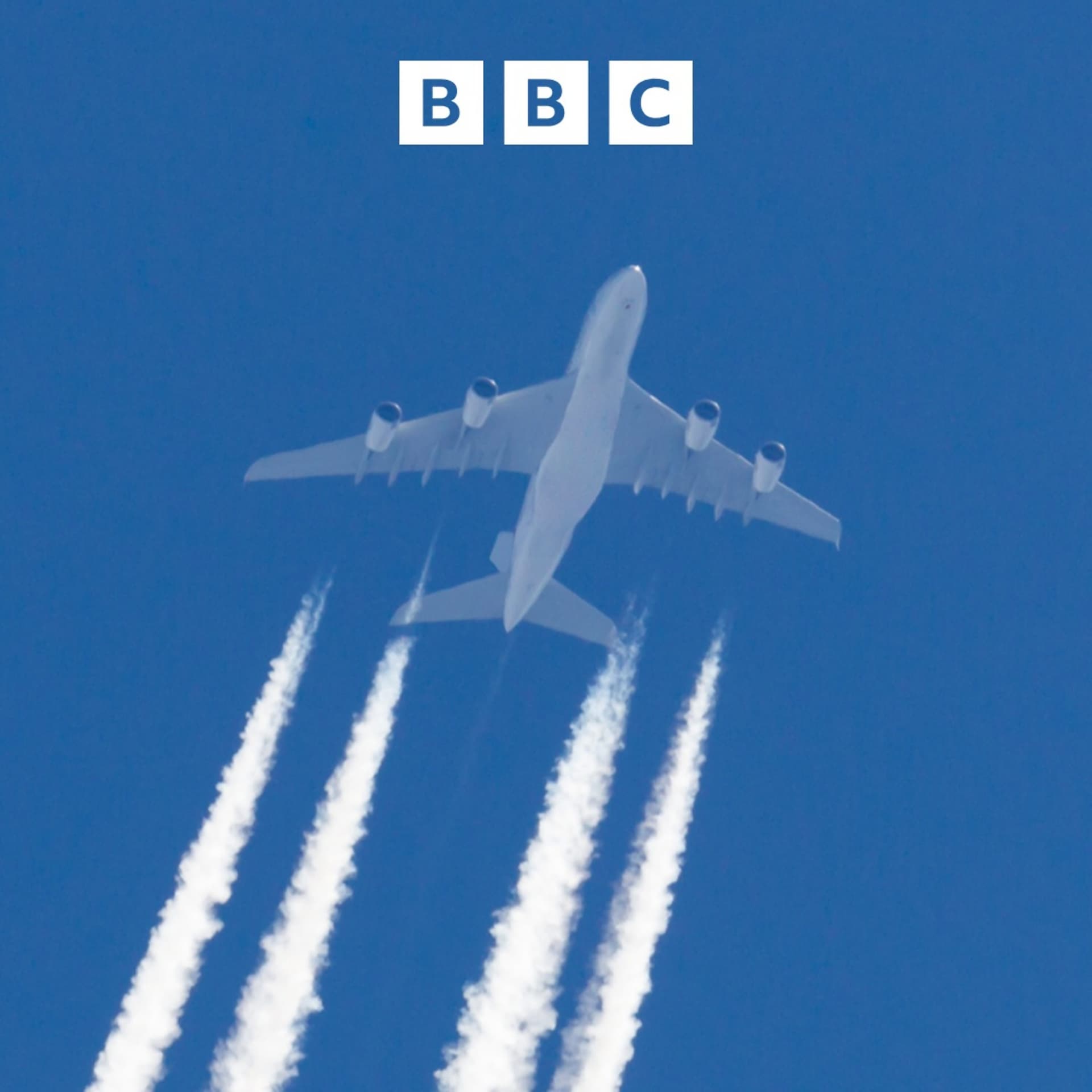
2:54While passengers reaching cruising altitude will be hearing this you might be on the ground looking up and noticing long straight lines of white cloud trailing behind a plane's engines. Those lines are contrails, short for condensation trails and they contribute to global warming. So can anything be done to reduce them? The answer could be yes, and it involves artificial intelligence and a lot of data. Operation Blue Skies has just been announced. Those behind it say it's the world's first state-backed trial to avoid contrails across a large area of the North Atlantic to the west of the UK. Google is part of the consortium providing the AI technology.
3:37Dr Paul Hodgson is Google's technical lead for Operation Blue Skies. I asked him to explain why those white trails behind aircrafts can be such a problem. Those white scribbles you sometimes see forming behind aircraft, or what my five-year-old likes to call sky graffiti, are called condensation trails. And what you're actually seeing are ice crystals that are formed when the hot exhaust from an aircraft freezes around particles from the exhaust when it hits cold air. Now, much of the time that they evaporate away very quickly, but in very humid patches of airspace, those contrails can grow into large cloud blankets that cover entire regions.
4:23And that cloud blanket overall tracks heat that's trying to radiate from the Earth into space, creating a very significant warming effect. In fact, we think that control warming is responsible for something like a third of all aviation climate warming. So could you tell me about Operation Blue Skies then and when you come in? Operation Blue Skies is a programme that we're starting today that aims to run a series of what we call control avoidance trials over the North Atlantic corridor, or in particular the eastern part of that, which is controlled by the UK through the airspace management of NATS, which is the UK's navigation service provider.
5:08And so what we're aiming to do is try to avoid that controls forming in the first place by deviating aircraft slightly around those particularly humid regions that are responsible for those warming clouds. This is done in collaboration with Google, with NASA, with the Met Office in the UK and Cambridge University, Imperial College London and Contrails.org, in which we will forecast where those climate hotspots are likely to be. At Google, we use AI-based forecasting based on us detecting where contrails are formed in satellites. And are we talking about changing altitude by a few thousand feet or are we talking about actually changing the routes?
5:54So in this trial, we call this an airspace scale trial. Avoidance will be conducted by the air navigation service provider Nats. And that will mostly be done by deviating aircraft, as you say, by a couple of thousand feet. And can you explain to me, Paul, where the AI comes in and what the Google system can do to predict that weather forecasting and how it works? So at Google, we take satellite imagery over this region, actually all over the Earth, and combine that with data about where flight paths have passed to try and work out where we see these white squiggly lines in those images. So we use a machine learning algorithm to detect where aircraft have formed contrails.
6:40And that's an important part of trial programs because it helps us to understand how effective the trials have been. And at Google, what we then do is we take those observations, knowing where contrails are formed, and combine that with weather data to use an AI model to try and predict where we think the next set of contrail regions might form in the future. And you speak about those predictions. I mean, how accurate do they need to be? That is an interesting question. So the contrail regions are relatively rare. Other studies have found that those predictions are on average about 70 % correct, which means we can avoid about 70 % of that warming.
7:23And in fact, that's been backed up by previous trials we've done. I'm just thinking if you're telling air traffic control to move an aircraft and then the contrail wouldn't have formed, you've kind of potentially burned extra fuel for nothing. Yes, this is something we have to monitor quite carefully in trials to make sure we have a net climate benefit. But it's worth noting that the climate cost of contrails is roughly of the same magnitude as all of the CO2 that aviation burns. And the deviations by a couple of thousand feet is a very, very small fuel penalty relatively. So if avoiding the contrails is quite simple, why is the aviation industry not doing this routinely already?
8:06So I think the concept is very simple, but in practice there are lots of technical challenges to implement this. The rise of AI has been one big enabling factor in contrail mitigation. It's enabled us to be able to en masse detect contrails through satellites. and that's a relatively recent development. Despite the fact that CONTRAIL research has been going on for decades, that's a relatively recent breakthrough that's enabled us to be able to start scaling CONTRAIL avoidance. So this is a 30-month trial. It involves 10 ,000 flights. What result would constitute success for you? The trial programme last 30 months were aiming to operate the trials themselves during the next two winter periods.
8:54during select hours of the evening and nighttime when we think traffic is lower and actually contra warming is actually worse during those hours. What we'd like to see a success is we run trials very much like clinical medical trials where we run a randomized experiment. So we have some days in which we deviate aircraft around contrails and some days where we do nothing on purpose. And we look at our satellites at the difference between those days. And by doing that, we can tell whether the change in control formation is random, i.e. we just got lucky on some days, or whether we think that that change can't be down to chance and must be down to what we've done.
9:39And what level of climate benefits would make this worth ruling out wider than once you finish the trial? So in terms of longer term scale up, our job here is to demonstrate these technologies in these particular air spaces to show they work. I think the ultimate scale up of that is a question for probably regulators and policymakers. All we can do is show what the benefit would be and how effective the technology is. And that's Dr Paul Hodgson, Google's technical lead for Operation Blue Skies, talking to me about their attempts to reduce the number of environmentally damaging contrails in our skies.
10:22Pop quiz. What's in your kid's lunchbox? At Whole Foods Market, they've already done the studying. Over 300 food ingredients are banned from their shelves. No hydrogenated fats in the peanut butter and no high fructose corn syrup in the cookies. And for sandwiches, there are no synthetic nitrates or nitrites in any of their deli meat. So you can pack lunchboxes with peace of mind. Get back to school ready at Whole Foods Market. Is the West Bank reaching a tipping point? I'm Asma Khaled, and I host the Global Story podcast from the BBC. For more than a week, homes in the village of Qusra have been under siege, including one of a Palestinian-American man from Ohio.
11:03It's just the latest to draw attention to the rise of settler violence in the West Bank, which the UN says is higher than at any point in the last 20 years. For more, listen to The Global Story on BBC.com or wherever you get your podcasts.
11:30This is Tech Life on the BBC World Service with me, Shona McCallum. If you heard last week's show, you'll remember my colleague Chris Vallance looking at AI deep fakes, including how they're being used to create illegal child sexual abuse images and what can be done about it. You'll still find that programme as a podcast. John Kitchen in England was listening and emailed us I feel that we've entered a post-social media world I deleted all social media in June 2018 John said he'd been receiving unsolicited offers of inappropriate material and as a former chair of governors at a private school he added if I was still in this position I would insist all images of children be removed from the school website Chris also looked at a new microchip designed to detect smells Steve Bostock WhatsAppped us to say, following an accident in 2012, my wife entirely lost her senses of smell and taste.
12:27And I wondered if this new type of tech might help such people in the future, please. Well, Steve, at the moment, the chip is a proof of concept with hopes it could one day be used in a handheld electronic smell detector. But it's an interesting question and we'll be watching to see where this technology goes next. thanks to everyone who got in touch about the program we'd love to hear from you too if you've got an idea for a future show or you want to comment on anything you've heard this week email us at techlife at bbc.co.uk or whatsapp us with a text message or a voice note on plus 44 330 1230 320 please include your name and the country where you live
13:15For the past month or so on Tech Life, I've been looking at the question being debated in countries around the world. How do we keep children safer online, particularly when so much of their digital lives happen on smartphones? We've heard about possible regulation, restrictions on social media and the role of parents and schools. But what about the technology itself? Today I want to look at some of the hardware being designed to give children access to technology without necessarily giving them everything that comes with a conventional smartphone. There are lots of products out there and we can't test or review them all but I've picked a few different approaches to give you a sense of what's available and some of the things you might want to think about if you're considering a first phone for your child.
14:01Let's start with Explora. It's a Norwegian tech company founded in 2016. which makes smartwatches and phones aimed at children. One of its products is deliberately much simpler than the smartphone most of us carry around. Hello, my name is Lisa F. Ekenstam. I am the Chief Marketing Officer of Explora Technologies. What's the appeal of the tech that you've got for families? There's definitely a heated debate going on about children's digital lives and parents and teachers are asking for help. Over half of parents in surveys that we've done, over half of parents regret giving their children a smartphone too early.
14:44Nearly half of them think that a phone use has changed their child's personality. But what we really see is that 65 % or so say that there is no good alternative on the market, but parents are actively looking for something. And that's really what we've built for. We also know that children themselves worry that they use their phone too much. And what makes your company and products different from the competitors that are out there? So our product is different from the competitors, basically because it's not a smartphone. It has very basic functionality that addresses the key concerns or the key functionality that parents are after.
15:31They want safety for their children. They want to be able to contact them through messaging or voice, and they want to know where they are. So this phone has that. So GPS tracking. You can call. You can send text messages. But that's about it. There are no apps. There is no Internet access. It has functionality like a torch and a calculator. But apart from that, it has a very basic camera. But apart from that, it's pretty boring. And it's actually, we say it's made to stay in children's pocket or in their bags and used when they need to connect with parents or others. But that's basically the functionality of it.
16:12That's Lisa F. Ekenstam from Explora Technologies. Of course, not every solution has to be a phone. it can be a phone accessory. Coily is a wall-mounted phone perch, or you might call it a cradle. It comes with a coiled cord with a USB-C connector, so when you rest the phone on it to charge it up, it looks like a landline phone setup. Kate Trey co-founded Coily with her friend Lauren. Both are mums to young children. She told me what they hope to achieve with their product. We hope that Coily is the tool that people need to be able to develop the healthier habits around phone usage that they want and for parents specifically as we're both parents we believe that one of the number one and studies back this up that the number one thing that kids learn from parents is what they do right it's not what parents say but it's what they do and so if kids are seeing parents checking their phones all of the time checking it reflexively always in their pocket then by the time kids get phones that's what they're going to be doing as well but if we can show kids that if we can show our kids as parents that the place on the wall is where the phone goes and that when it's there we are fully focused on the people in front of us we hope that for for parents as well that was katry from coily and then there's a third approach give children something that looks and works much more like a conventional smartphone but strip away some of the things designed to keep us scrolling balance phone is a barcelona-based company making what it calls a distraction-free smartphone.
17:47It says more than half its customers are families buying a first smartphone for a child or teenager. I'm Carlos von Clara and I'm the co-founder of Balance Phone. Balance Phone is a phone without distractions, without any addictive content. Basically, we realised two years ago that we were spending way too much time on our phones and we didn't like it. And both me and my co-founder started trying some solutions that we could find on the market to limit ourselves. We found them too difficult to use or not radical enough so that they would work for us. And at some point, we even took a bit more of a further step and we tried using a Nokia.
18:28And that's when we identified there's a too much difference or too big of a gap between a dumb phone and a smartphone. And we wanted to cover this space in the middle. Basically, what the balance phone is, it's a phone that doesn't make you renunciate on anything in your daily life you can use any functional apps on on play store basically that's banking digital health music you can even navigate the web but always safely because what we do is we block all addictive content on smartphones there's no social media there's no streaming services there's no pornography there's no gambling and none of this is accessible on a balanced phone the end result is a phone that is very accessible, very functional for a daily use, but with very limited screen time because there's not much to get distracted on.
19:18And if someone wanted to install something like Instagram or TikTok, what is stopping them installing it on the balance phone? We apply restrictions on a system level. Basically, what we do as a company is we develop software and we put it or we install it irreversibly on Samsung devices. and all these restrictions that our system enforces are embedded on a system level. So when they try to install Instagram on our phone, they simply cannot do it. That's Carlos Fanclara from The Balance Phone. Of course, what device to choose for your young person is a personal choice and what works for one family won't necessarily work for another.
20:00I'd love to hear what solutions you've come up with. Is this a conversation around your kitchen table? Get in touch. Our contact details are coming up soon.
20:17If you're like me, there may be times when you're reading something online and you stop and think, hang on a wee minute. Did a human actually write this? Because AI generated text is now everywhere. essays, job applications, social media posts, perhaps even the odd work email message when someone's feeling particularly uninspired. And there's nothing necessarily wrong with getting a little help from AI. But there are times when it really matters whether the words in front of you came from a person or a machine. This has become a particularly live issue in education and recruitment where students and job seekers have faced accusations of using AI to write essays and applications.
20:58So how can you actually tell? Well, perhaps inevitably, there's tech for that too. AI detection software attempts to work out whether something was written by a human or generated by artificial intelligence. One of the best known tools is GPT-Zero. Edward Tien is its 26-year-old co-founder and CEO. I asked him what gave him the idea of using technology to catch out other technology. Around three years ago, when ChatGPT first launched, we started with the idea where we want to detect AI content on the internet and that humans deserve the truth of how something was created. Three years later, we're still working on it and improving that.
21:44And when you look at the internet now, how much of what we read do you think is actually written by a human? According to our research on isinternetai.com, we're monitoring over millions of documents across the internet. We're recently reaching a tipping point where over 20 % of all content on the internet is AI. That's even more on certain platforms like LinkedIn, where over 40 % is AI. And even more on content where people are writing about AI or marketing tools that are far higher. And more and more, that's just growing. Are we talking about detecting AI written text in job application or essays?
22:27I mean, tell me who's using your AI detector. We have over 20 million users that are using it across job applications, essays. But now more and more, I would say people are interested in seeing the content they're reading. And we have a vision tool that automatically filters out emails, social media posts, even YouTube videos. And it's just changing from this submission to just, wow, I'm being inundated with AI information. I want to know, is this AI or not? And tell me why this distinction matters then. Because if something is useful, well-written, and informative, then does it matter if AI wrote it?
23:15That's a great question. I would say for certain tasks that require critical thinking and how something is formulated, it is important to know that was their thought process behind that information. For the average writing and this idea of AI slop, I'd say it's a little bit less important. And what people are really trying to detect is not AI writing, but just average or mediocre writing and kind of formulas are repeated. And how do you train your AI detector to find this type of AI written material? So I would say there's two processes. For our AI detector, it's a combination of some writing heuristics in terms of differences of AI writing.
24:00But now the majority of it is getting as much information and data of AI writing as possible and training an AI model ourselves to identify And how accurate is your AI detector? Because obviously you want to get this stuff right, as reputations could be damaged if you get it wrong. I would say it's important to know that AI detection is a probability rather than a percentage. Being said, in our training, we have a recall of over 99 % accuracy for our AI detector. I'll also fact that something that is shifting is we're going away from this binary of this is all AI or this is all human into a world where now there's like a combination of people writing with a combined amount of AI and human writing more and more.
24:56Our application has also evolved to reflect that. And now there's a new mixed class as of a few months ago for this middle ground. So it's kind of evolving as a space there. Obviously, no detector is perfect, but what's your false positive rate? So we benchmark across different types of writing, such as applications, essays, social media content, and we're able to get this false positive rate under 1%. Some of the big name universities in the United States have stopped using AI detectors because of concerns about their accuracy. Were they wrong? I would say this turning on and off really becomes a binary of we either adopt AI or we don't use AI when AI detection itself is part of a toolkit of tools that a lot of teachers are using in addition to hallucination detection with citations, in addition to changing their assessment, and in addition to talking to their students.
26:00I would say the most popular AI detector in the world is a teacher's intuition, and we certainly don't want to turn that off. So would you be comfortable with, you know, a teacher punishing a student because your software said their work was AI generated? So for all three years, our software at the end of a detection result has a disclaimer to please not use this for a punitive tool similar to plagiarism detection. Do you think schools should be teaching children how to use AI well? Yes. We used to ask, did a human write this? Increasingly, the better and the more critical question is to ask what part is a human going to play in what we built and write?
26:49And that presumably comes down to that critical thinking element. Yes, I would say in education, the danger isn't that everyone starts using AI or everyone, you know, becomes a worse writer. The danger is that people don't have the building blocks and the skills to edit, to think, to learn the process. I was, you know, being a journalism student many years ago, realizing that so much of writing from the classes I took is not about the final output that ChatGPT produces. It's about that iterative process. And in editing, there is thinking. And that's something really worth preserving. That was Edward Tien from GPT Zero talking to me from San Francisco.
27:38Well, this script that I'm reading right now has been written by producer Tom and definitely not by AI. I think the clue's in the spelling mistakes. But if you want to write us a message about today's show, whether in your own words or with the help of AI, then do get in touch. Our email address is techlife at bbc.co.uk or WhatsApp us on plus 44 330 1230 320. You can even send us a voice memo, but please remember to include your name and where you live. Today's edition was produced by Tom Quinn and presented by me, Shona McCallum.
28:34Is the West Bank reaching a tipping point? I'm Asma Khaled, and I host the Global Story podcast from the BBC. For more than a week, homes in the village of Qusrat have been under siege, including one of a Palestinian-American man from Ohio. It's just the latest to draw attention to the rise of settler violence in the West Bank, which the U.N. says is higher than at any point in the last 20 years. For more, listen to The Global Story on BBC.com or wherever you get your podcasts.
From the publisher
Cloudy lines in the sky, caused by aircraft engines, are called contrails. They're harmful to the environment. Now a project is underway, using AI, to reduce the amount generated. It's called Operation Blue Skies, and we speak to Google about their involvement.
Also this week: we look at three very different approaches taken by manufacturers to help children and adults have a healthy relationship with mobile phones. And AI detectors - how do they work?
Presenter: Shiona McCallum Producer: Tom Quinn
(Photo: A large four engine passenger jet flies at high altitude. The sky is blue, and the jet engines are emitting white cloudy trails, known as contrails. Credit: Getty Images)