
In short
```markdown Tech Life Podcast Episode Summary
Episode Title
China's AI Progress
Episode Description
The episode explores the impact of China's DeepSeek AI tool launched a year ago on the U.S. markets and the increasing adoption of Chinese AI technology by American companies. It also covers the use of mobile apps in Denmark for product boycotts and tests an exoskeleton designed to assist walking.
Presenter
Shiona McCallum
Producer
Tom Quinn
---
Key Topics Discussed
- DeepSeek AI and Its Impact
- Background: DeepSeek, a Chinese AI chatbot, launched a year prior, causing significant disruptions in U.S. tech markets.
- Immediate Effects:
- DeepSeek topped download charts, even surpassing established apps like ChatGPT.
- U.S. tech stocks, particularly NVIDIA, suffered major losses (nearly $600 billion in market value).
- Long-Term Changes: The launch prompted U.S. companies to reconsider their AI development strategies.
- Current Trends in Chinese AI Development
- Open Source Models:
- Chinese companies like ByteDance and Alibaba are increasingly using open-source AI models.
- American companies, contrastingly, tend to focus on proprietary models that are monetized.
- Cost Efficiency:
- Chinese AI models are significantly cheaper (sometimes one-tenth the cost) compared to American counterparts, leading U.S. companies like Pinterest to adopt them.
- Examples & Interviews:
- Pinterest's CEO highlighted the advantages of customizable open-source models and their operational efficiency.
- Airbnb is utilizing a mix of Chinese and U.S. models for their specific needs.
- Geopolitical Dynamics
- Irony of Open Source Leadership: China, despite its political structure, is democratizing technology through open-source models, raising questions about the notion of a tech race with the U.S.
- Collaborative Development: The episode suggests that development in AI is more collaborative than competitive, with shared technologies across borders.
- Consumer Boycotts in Denmark
- Boycott Apps:
- Two popular apps, Non-USA and MedoMeter, empower Danish consumers to identify and boycott products from the U.S.
- Ian Rosenfeld, developer of MedoMeter, explains how the app uses AI to trace product origins via image recognition and credible online sources.
- Motivation behind the Apps:
- The apps emerged in response to political tensions and aim to provide consumers with information to make informed purchasing decisions.
- Exoskeleton Technology
- Overview: Alistair Keane tests the Hypershell X Ultra exoskeleton designed to assist in walking.
- Functionality:
- Provides mechanical assistance, reducing physical effort during walks.
- Different modes adjust the level of assistance.
- Use Cases: Beyond hiking, exoskeletons are being explored in warehouses and military applications to enhance physical capabilities and safety.
---
Key Takeaways
- AI Competition: The narrative of a U.S.-China tech race oversimplifies the actual dynamics, which include mutual influences and shared technological advancements.
- Consumer Empowerment: Mobile applications in Denmark illustrate how technology can mobilize public sentiment and consumer behavior in response to geopolitical issues.
- Wearable Tech: Exoskeletons exemplify how technology can enhance physical capabilities, although their acceptance in everyday use may take time.
---
Audience Engagement
- The episode encourages listeners to share their experiences and thoughts on using Chinese AI products and technology's role in their decisions.
---
Final Notes Listeners are invited to engage with the show through various means, contributing to ongoing discussions about technology's influence in our daily lives.
Contact Information
- Email: techlife@bbc.co.uk
- WhatsApp: +44 330 1230 320
```
Written by AI. May contain mistakes. Listen to the episode to check what was said.
Chapters
Tap a time to open that second in VOThe Impact of DeepSeek on AI Competition
0:45 to 2:47
Discussion on how DeepSeek's launch affected the AI landscape and US tech stocks.
“I'll be speaking to a developer of one of them.”
China's Progress in Open Source AI
2:47 to 6:04
Lily Jamali discusses the advancements in China's AI models and their implications.
“North America technology correspondent Lily Jamali has been looking into this for us.”
American Companies Using Chinese AI
6:04 to 8:07
Exploration of why American companies are turning to Chinese open source AI models.
“Yeah, so they have a recommendation algorithm that they call PinRec, and it's all about serving users content that is likely to resonate with them.”
Consumer Boycotts Powered by Technology
8:07 to 14:00
Discussion on mobile apps that help consumers boycott products from certain countries.
“I'm using his terms here and referencing America there.”
Frustration and Innovation: The Birth of MedoMeter
14:00 to 16:43
Learn how frustration with political actions fueled the creation of an app for informed consumer choices.
“Yeah, so all of this started because of the US administration.”
MedoMeter's Functionality and Global Reach
16:43 to 18:06
Discover how the MedoMeter app provides transparency and its availability in multiple languages.
“And yeah, I think that are the ones at the moment.”
The Political Nature of Consumer Choices
18:06 to 18:29
Explore the implications of technology in empowering consumers and whether it should be political.
“We did ask the US State Department in Washington for a comment, but we haven't received a reply at the time of this recording.”
Exploring Exoskeleton Technology with Alistair Keane
18:29 to 20:55
Join Alistair as he shares his experience using an exoskeleton device for mobility enhancement.
“But what if a human could have a bit of a mechanical help to walk around, maybe with a wearable robotic device perhaps?”
Real-World Applications of Exoskeletons
20:55 to 23:47
Learn about the diverse uses of exoskeletons in various fields, from health to military.
“If you go to max power it's maybe good for 90 minutes or five or six kilometers but most people will get up to 30 kilometers out of it five or six hours.”
The Future of Exoskeletons: Challenges and Potentials
23:47 to 26:00
Discuss the future of exoskeleton technology, its societal acceptance, and potential growth.
“But there are other manufacturers out there making other similar exoskeletons for other uses.”
Transcript
Automatic transcript. May contain errors.0:00Hello and welcome to Tech Life, the programme about technology and how it touches all our lives. I'm Shona McCallum and this week we're looking at developments in artificial intelligence, one year on from what many called a Sputnik moment for American AI companies. The original Sputnik moment came in 1957 when the Soviet Union overtook the US in the space race. Last year's moment was triggered by the launch of a new Chinese AI chatbot called DeepSeek. It topped the download charts and caused US tech stocks to sink. One year on, what's changed? That's in a moment. In Denmark, if you want to boycott products from a particular country, what do you do?
0:45Well, you can download apps for that. I'll be speaking to a developer of one of them. And taking the Huff and Puff out of a hike up a hill, we try out an exoskeleton for walkers who don't want to break into a sweat.
1:17Here's some proof that time flies in the world of technology. It's been a whole year since the Chinese artificial intelligence model called DeepSeq R1 shook up the tech world. And when I say shook up, American news anchors reported it like this. It was an earthquake today in the world of artificial intelligence. Good evening. I'm John Dickerson. I'm Maurice Dubois. And the aftershocks were felt from Washington to Wall Street and Silicon Valley. Signs that China may be catching up to the United States in the AI race sent tech stocks plunging. A Chinese startup called DeepSeek has created an AI model at a much lower cost than the U.S.
1:56competition. Its AI assistant was today Apple's most downloaded app, surpassing the AI app ChatGPT and Threads, a social media app. California-based NVIDIA, which makes the chips that power AI, lost nearly$600 billion in market value, the biggest one-day loss by a company ever. That was CBS Evening News from a year ago. They mentioned NVIDIA there. It wasn't the only company affected. American tech stocks went into free fall and it made a lot of people rethink the prevailing approach to developing AI tools, for a couple of days at least. Then attentions turned elsewhere, but not in Silicon Valley, where Chinese open source AI models have been gaining traction since DeepSeek was released.
2:42So what progress is China making with developing AI? The BBC's North America technology correspondent Lily Jamali has been looking into this for us. And I started by asking Lily to tell me more about the models being developed by China. So open source models are, as the term says, open. You know, developers can actually get into the code, play with it and customize it to what they need. The makers of these models actually show their work. So researchers and other AI developers can study it and build on it. when DeepSeek R1 came around last year at this time, it showed what China was capable of as far as developing AI models.
3:26And there were questions about how much they borrowed from other models like Llama, which is made by Meta. That's, of course, the same company that runs Instagram and Facebook. But nevertheless, DeepSeek sparked a real interest in Chinese AI models. And now we're seeing ByteDance and Alibaba and other Chinese companies really gaining traction in this open source AI model space. They are actually quite good. And the American AI companies, by contrast, are really focused on monetizing their AI models, not giving them away, you know, on the cheap. These are, you know, I think the American companies are still developing open source models, but the big dollars are really being put behind closed proprietary models that you have to pay for.
4:17And you've been learning that a lot of American companies are increasingly starting to favor those Chinese open source model. And Pinterest is among them, which may surprise some people. Why is that? Yeah, I mean, American companies that are in the Fortune 500, as well as startups that are often operating on a very tight budget. I have been surprised at how forthcoming a lot of American companies have been about how they're using these Chinese open source models instead of American models developed by, for example, OpenAI or Anthropic. I did speak with Pinterest CEO Bill Reddy and their chief technology officer, Matt Madrigal, about why they're using Chinese open source models.
5:08I had actually met Matt a couple months ago and he had mentioned they were building their own models in-house. And I was really intrigued by that. Pinterest, of course, is all about inspiration, right? For fashion and food and so much else. The big reason they're using these Chinese AI models is because they are just so much cheaper, like a 10th of the cost in some cases. and they can customize them to do exactly what they want them to do. CEO Bill Reddy told me that open source also is really the preference in the tech industry, and it has been for a long time. If you look at most of the companies that come out of Silicon Valley, they really depend on open source software.
5:46Open source software, by definition, isn't owned by any one person, isn't owned by any nation state, isn't owned by any company. And that actually propels a lot of innovation. Really interesting to hear from Bill Reddy there, really being quite open about the AI that they are using. Tell me, though, how Pinterest are actually operating these tools. Yeah, so they have a recommendation algorithm that they call PinRec, and it's all about serving users content that is likely to resonate with them. Here's what Pinterest's chief technology officer, Matt Madrigal, told me. Open source techniques that we use to train our own in-house models for what's called pin rec, they're 30 percent more accurate than the leading off the shelf models.
6:33And that, Shauna, is what I'm hearing from other Fortune 500 companies too. Airbnb, the booking site, is another. They're using a mix of Alibaba's Qen and some U.S.-based models too. So there's this constant fine-tuning that seems to be happening so that these companies can make their own models such that it does what they want it to do. In Airbnb's case, it's about supporting customer needs and the like. So these companies all have specific tasks that they want these AI models to help them carry out. And they can just really get into the code in a way that they can't with the proprietary models being favored by the American companies.
7:14And some observers have noted that there's a bit of irony to China leading on this open source tech. Can you tell us about that? Yeah, I actually was really intrigued by a recent interview on our own BBC that was given by former deputy PM Nick Clegg. He spoke to us and said that these Chinese AI models are the leader. They are leading in open source technology. And he said he found it pretty odd that it's China that is actually democratizing this technology almost for free, sometimes completely for free around the world. And the irony there in his telling of it is that you've got the world's great autocracy, China, that is sort of sharing this knowledge as, you know, it's competing with the world's greatest democracy.
8:07I'm using his terms here and referencing America there. But not everyone buys that idea that there's this race between the US and China. That's right. We talk about this technology in terms of it being Chinese or American. These technologies are being built up together. And, you know, one company is going to be using the work of another in another geography. So remember, you know, these Chinese AI models that are open source used Meta's Lama technology, which is open source. So you have Chinese companies using what American companies are developing. And now you have American AI developers and companies developing these in-house AI tools.
8:52They are now using tech that China has developed. So even though all of this and the AI race is often framed as a geopolitical rivalry, there's actually quite a bit more competition than you might think. And so this idea of a race between the U.S. and China just doesn't resonate with everyone who has been observing this all play out. And it's always great to get your take from the heart of Silicon Valley. Thank you so much. And that was Lily Jamali, our North American tech correspondent. Thanks for being on Tech Life. Thanks for having me.
9:36This is Tech Life on the BBC World Service with me, Shona McCallum. We love to include you in our programme, so it was nice to hear from Angus, who sent us a WhatsApp message from Stroud in the UK. Angus heard last week's show where we covered a lot about health tech, including the latest LED face masks and a body scanner. Angus says, having listened to other programmes about masks and scanners, There are a lot of physiological and technological reasons as to why they are no more than marketing. Well, I can't really say that, Angus, but you've used a word that means rubbish. We get the idea. If you want to contact us about anything on this week's show or want to flag something that we should be looking at, please get in touch.
10:19Maybe you're using Chinese AI products. What do you think of them? Are they any better or different from the ones offered by American companies? You can email us techlife at bbc.co.uk. Or like Angus, you can WhatsApp us, a text message or a voice note. The number is plus 44 330 1230 320. Please remember to include your name and where you live.
10:52Next, we're looking at how tech can be used to power consumer boycotts. Every so often, relations between countries can get tense. In Denmark, that's been the case recently, following tough words from politicians and public protests against US President Donald Trump's position on Greenland. This was the sound of a hands-off Greenland protest in Denmark's capital Copenhagen held on the 17th of January.
11:29Well, something else has been going on in Denmark. Two mobile phone apps have surged in popularity and are vying for the top spot in the country's download charts. Both apps show users if a product comes from the United States, allowing them to decide if they want to boycott the goods and find a local alternative. One of the apps is called Non-USA. Its creator Jonas Piper wasn't available for interview, but he did email us to say it's not an attack on the US, it's a tool for Danish people and people of Europe to make more informed decisions. The other app I mentioned is called MedoMeter, made by Ian Rosenfelt from the digital agency Inbound Copenhagen.
12:10I asked Ian what his app does. So what it does is you have an ability to take an image of any product when you're out shopping, for example, and then it will identify which product it is and it will use AI to make a deep dive to figure out what are the origins of this product, which country is it from, which company actually has invented it and which brands own it. And what it does in the deep dive, it actually goes in and looks for the ultimate owner of the product or the brand. And this way, users get informed, what do you call it, some information about which country or which brand country they're actually supporting by buying this ultimately.
13:01And how does it use AI then to identify the origin of the product? It does it by searching online. So the AI acts like a type of agent. So first it identifies the product based on the image. Then it goes out and it uses Google search to find information about it and try to find the most accurate information. So we have tuned the AI to look for sources that are correct. So if there's some blog article or something that says something about this product or brand, it will disregard that. So it looks at Wikipedia, it looks for trusted sources and therefore gets pretty accurate results back. And people have been using it, haven't they, to look at if their purchases are coming from America specifically.
13:58Can you tell us about that? Yeah, so all of this started because of the US administration. I'm not going to mention any names, but I think you know who I'm referring to. The first time they introduced the terrorists against Canada and I think it was Mexico, I think most of Europe reacted to this. And this was way back in March last year. And people were frustrated. They felt powerless. For me, it was very much a psychological thing that I felt frustrated and I needed to do something. And so through that frustration then you created this app? Yeah, through my own frustration, but also I started actually joining this Facebook group called Boycott Products from USA, which is a Danish boycott initiative on Facebook.
15:02and I joined that and I could see that people were just as frustrated as I was but they didn't really know how to do something how to act and some of the the guys there they asked hey what if we had this app or solution to help us I mean there are no apps out there we have this these barcode scanners but they don't tell us the origins of the brand they just tell us who's the distributor or something like that. So since I've been working a lot with AI and I could see that, you know, I actually had an idea for another type of solution to scan a product and find out if it was healthy or not. And I was working with, you know, actually ChatGPT to see if it could do that.
15:48But then I thought, OK, if it can do this, then why not try to create an app that can actually create this transparency. You're high up in the download chart. Tell me about then what you're thinking for the next few months. For the next few months, I'm thinking that I'm going to keep improving this. Now I have a huge audience that is giving me feedback, especially I'd say the Danes, of course, but the German people are, you know, they're really helping a lot. And I love them for that. And so it can be used in other countries then, not just available to Danes? The Medometer is translated in eight languages, German, Spanish, Italian, Swedish, Dutch, English, of course, French, Portuguese, I think also.
16:43And yeah, I think that are the ones at the moment. Do you think a product which allows people to boycott products from a particular country is a good use of technology? I think if we can give someone an ability to make informed choices, I think that's a good thing. I actually didn't really want this to be a political product, more something that could empower people and give them a sense of control. The reason it's called made-o-meter was actually because it had a meter where you could say, how many percent is this American or not? But I removed that because I wanted to be unbiased. I want people to make their own decisions on what they see and not push them in a direction.
17:32We've spoken about boycotting American products, but could this app be used for people to avoid products from other countries? Yes, of course. And that's why, I mean, it is an unbiased, non-political app. You know, there are a lot of different things that could, you know, where people feel frustrated or, or, you know, they want to make a change. And this app can be used for anything. That's Ian Rosenfeld talking to me about MedoMeter. He was speaking to me from Copenhagen in Denmark. We did ask the US State Department in Washington for a comment, but we haven't received a reply at the time of this recording.
18:23A couple of weeks ago we devoted a whole episode of Tech Life to discussing human-like robots. But what if a human could have a bit of a mechanical help to walk around, maybe with a wearable robotic device perhaps? This is the sound of Tech Life's Alistair Keane, experiencing just that in Nevada's Red Rock Canyon in the United States. Have a listen.
18:52Well, Alistair Keane's with me in the studio to explain more. Hi, Alistair. Hi, Shona. So what were you doing there in that short clip? Well, it sounded like I was walking, and I was, but you also might have heard a little bit of a mechanical sound to it, a little bit like a robot and well I was the robot I was wearing an exoskeleton. And what is an exoskeleton and what's special about the one that you tried? They are effectively a device that clips onto you around the waist and then attaches to your legs and they give you a boost so if you've ever tried an electric e-bike that as you start to pedal you kind of get a bit of fire and it gives you an extra boost as you go it's a little bit like that but for walking so it was kind of lifting my knees as I walked along.
19:36The one I tried was called the Hypershell X Ultra, but there are lots of different ones now being invented for lots of different uses. And so what do you use them for? You can use them for going out for a walk like I was doing out on an adventure. You could use it in a warehouse or even some of the armed forces are using them. And what does it look like then? You've described it as a robot that you can kind of wear, but I guess our listeners would be wondering what does it really look like? Yeah, it's a slightly strange contraption. So you belt a kind of power pack around your waist and then there's some motors attached to that and then some bits of metal or carbon fiber are then extended down to your legs and they get kind of strapped on around your legs as well a little bit i guess kind of like a puppet might have to actually make a puppet move and i'm not sure i've explained that fantastically so here's toby kinsley he's the director of global communications at hypershell and he talks me through their device.
20:30It rests on the top of your hips and you got the waistband here and then we have the two motors one on each side together is a thousand watts of peak power. That's what lifts the legs. Yeah and that's where the torque comes from and then here on the thigh is the leg lever which is made of carbon fiber which is a very premium lightweight material and attaches to the thighs and then on the back here we have the battery and it's swappable so you can pop it out and put in the spare. And how much battery life does it have? If you go to max power it's maybe good for 90 minutes or five or six kilometers but most people will get up to 30 kilometers out of it five or six hours.
21:04So a decent day's walk. Yeah per battery and then once you're low on battery you can just swap to the next one. Okay so you put on the exoskeleton Alistair and you went for a walk up and down the canyon. How did it feel? What did it do for you? Did you get that boost? It's very strange at first to get used to this. So Red Rock Canyon is in the desert and it is incredible scenery, big red rocks, and there was a blue sky, and there was cactus around. It was a fantastic place to go for a walk, very rugged over the rocks. And so as I moved, I was kind of gently being eased along. Now, there is an app that comes with this particular exoskeleton, and you can adjust just how much of a help you're getting.
21:44In hyper mode, it was like I was bouncing on the moon as I moved around on these different rocks. On the much more leisurely eco mode, it was just helping me to the point where I was wondering if it really was working or not but I also recorded some thoughts as I was actually using it so here's one of them. I've been wearing the exoskeleton for about one hour now and at times I kind of wondered if it was really helping me and then I've switched it off and felt how heavy it now feels to walk normally which is a fairly good indication that it is giving me a boost. But isn't the idea of going for a big long walk or a hike in the great outdoors, get your lungs full, get a bit of a sweat going, you know, enjoy that exercise.
22:29And then you've got this device, which kind of takes the effort out of walking. Does you think it defeats the purpose of going out for one of these expeditions? That was exactly the scepticism that I had when I was invited to go for this walk. And I've seen these exoskeletons being advertised for quite a long time now and I've always thought the same thing. Would it take away from the effort of going out? They market it more as it could help you go further or perhaps you're someone that needs a boost for various different reasons, perhaps your health or your age. Being able to go on that kind of trek isn't possible and this could help you do that.
23:06Or perhaps you just want to go further. Perhaps you can still have a good bit of exercise but maybe get to the top of the peak and see a bit further. That's certainly the response that I got when I put that very question to Toby Kinsley from Hypershell. It really depends on your goals for what you're trying to accomplish by going outdoors. Some people, they want to go out for working out and to train their bodies and become stronger. And so maybe a Hypershell isn't the right thing for them. But if your goal is to get to the peak and be able to see the view, get up there with a lower heart rate, be able to enjoy the view when you're up there, then Hypershell could be for you.
23:41Now the exoskeleton that you used was designed for one thing and that's helping you walk, right? But there are other manufacturers out there making other similar exoskeletons for other uses. Yeah, we were on quite a big group tour out to Red Rock Canyon wearing these exoskeletons and we got quite a lot of looks from just the other members of the public about what were these devices we were wearing because you just don't see people in public wearing these devices yet. And will we ever? I'm not entirely sure. However, there are lots of other use cases where exoskeletons are starting to be used. So in warehouses, for example, where workers have to lift heavy boxes and move around, they can really help people to kind of stand up straight in the correct way and make lifting that box a little bit lighter.
24:26So they can help with health and safety. And some armed forces have started using them as well. Some of them don't necessarily have batteries attached to them. They might just be strings and different systems that can help pull people up. But they're being used to help soldiers perhaps who've got to climb high mountains or go further and reserve some of their energy to do that. I think it's those sorts of use cases like a lot of tech where we will start to see it being employed first and you never know it might just make it out onto the streets or onto Red Rock Canyon or wherever you go for a walk near where you live.
24:59I think it will just take a little while to get there but there are lots of companies trying to crack the market a lot of them based in China I have to say and they're really going to try and push this tech to us over the next couple of years. And I think just the idea of putting something on and being kind of confident to use this technology as you say it's quite cumbersome and it's quite obvious if you're wearing it. It's really obvious you've got this big pack around your waist you've got these kind of bits of metal or whatever attached to your leg so yeah it does take a little bit of confidence that people aren't going to laugh at you or ask you to any questions while you're just trying to have a peaceful walk.
25:37That's Alistair Keane going above and beyond the call of duty here on Tech Life to test that technology for us. Thank you so much, Alistair. Good to chat to you. Thanks, Joana.
25:49Well, it's time for me to wrap up this week's show and walk off into the sunset, but sadly without Alistair's exoskeleton. Remember, you can get in touch with us. Our email address is techlife at bbc.co.uk or you can whatsapp us on plus 44 330 1230 320. Remember to include your name and where you live. Today's Tech Life was produced by Tom Quinn and presented by me, Shona McCallum.
From the publisher
The launch of China's DeepSeek AI tool a year ago sent shockwaves through US markets and Silicon Valley. But now Chinese AI tech is being used by more and more US companies. Our North America Technology Correspondent, Lily Jamali, tells us about it.
Also this week: shoppers in Denmark are using mobile phone apps to boycott some goods from overseas. And we road-test an exoskeleton taking the physical effort out of long outdoor walks.
Presenter: Shiona McCallum Producer: Tom Quinn
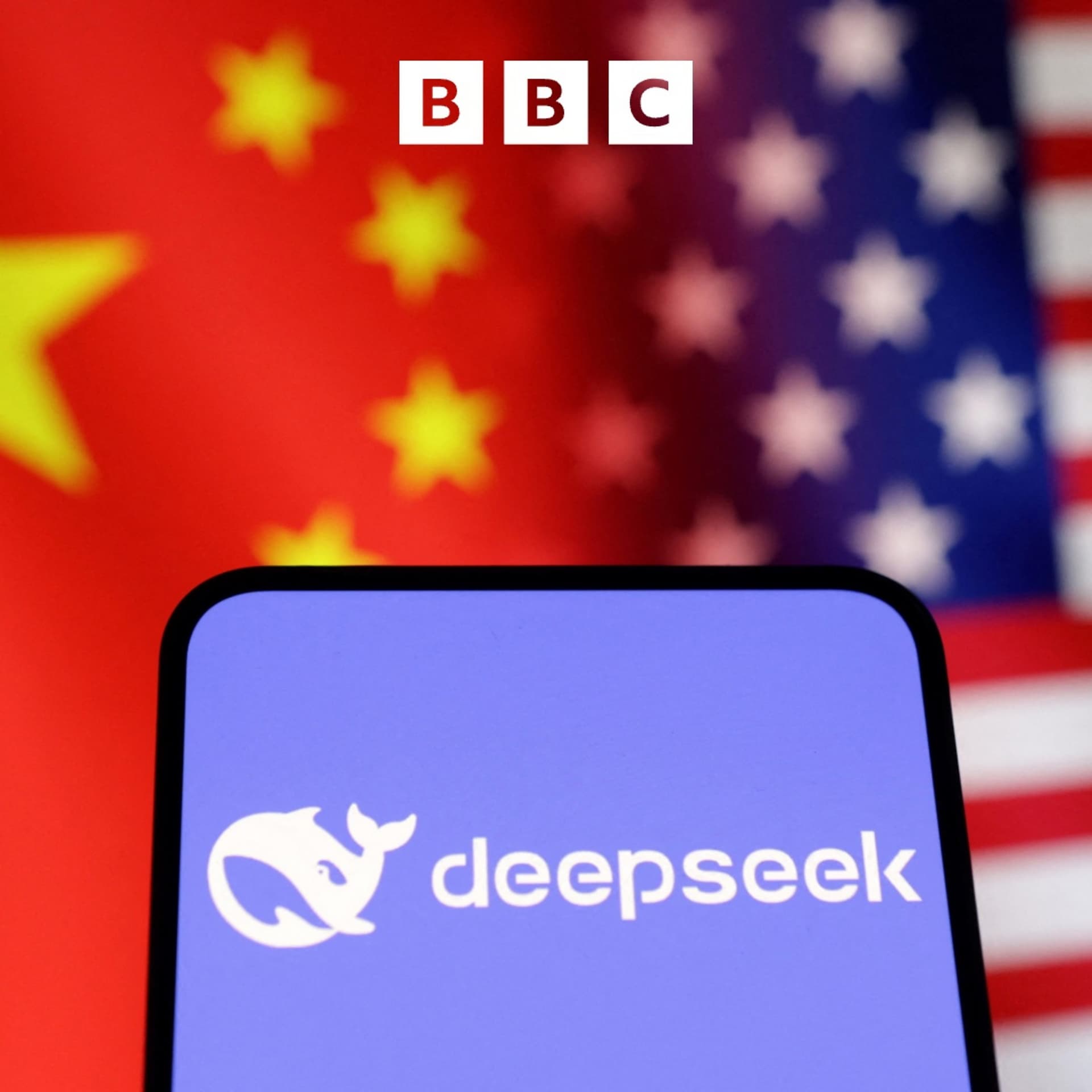
(Image: An image of a mobile phone displaying the DeepSeek name and logo on the screen. In the background are flags of China and the United States of America. Credit: Reuters.)