In short
How tech could improve health—sleep apnea treatment without masks, “hospital at home” monitoring to free beds, and an AI breast-cancer app for earlier detection in Pakistan.
Guests and backgrounds
David Petrie (67, Glasgow; sleep apnea diagnosed ~15 years ago). Nigel Clark (CEO, Zoo Sleep; developed a chin-worn TENS-based device). Prof. Jörg Steyer (King’s College London respiratory/sleep medicine; leads the UK trial). Martin Ratz (Stockholm entrepreneur; heart-attack survivor; founded DOCLA for remote hospital-level monitoring). Suha Lalani (26; Pakistan-born; Harvard MPH student; created Pink Detect after a late-stage breast-cancer death in her family).
Key claims
Zoo Sleep trial will test a non-invasive device to reduce apnea-hypopnea events and improve partner sleep. DOCLA uses wearable vital-sign monitoring with “human in the loop” AI to cut admissions/readmissions and costs. Pink Detect’s AI risk assessment and self-exam tools improve referral and early-detection rates.
Notable examples
Zoo Sleep uses TENS under the chin to gently pull the tongue forward; trial targets ~200 patients after CPAP failure. DOCLA cites 99% patient satisfaction and estimates 25–30% of hospital patients could be discharged. Pink Detect reports 6,000+ tumors identified and 36% higher referral and 17% better early detection.
Written by AI. May contain mistakes. Listen to the episode to check what was said.
Chapters
Tap a time to open that second in VOUnderstanding Sleep Apnea
0:45 to 2:55
An overview of sleep apnea, its effects, and personal stories.
“First we'll be talking about a condition which affects millions of us called sleep apnea.”
David's Experience with Sleep Apnea
2:55 to 6:07
David shares his personal journey with sleep apnea and its challenges.
“One condition which affects millions of people is called sleep apnea.”
Different Treatment Options
6:07 to 7:58
Exploring various treatments for sleep apnea including CPAP and alternatives.
“Particularly, we know young and female patients may struggle to do so.”
Innovative Sleep Apnea Device
7:58 to 13:12
Presentation of a new non-invasive device aimed at treating sleep apnea.
“And then there's a little kind of module at the front, which has got all the electronics and the battery.”
Clinical Trial Insights
13:12 to 14:00
Discussion on the ongoing clinical trial and its expected outcomes.
“So from the NHS level, the evidence would come together at the end of this trial.”
Listener Feedback from Sierra Leone
14:00 to 14:28
A listener expresses appreciation for the program.
“on plus 44 330 1230 320 valentina whatsapped us to say i really love this program listening from Sierra Leone.”
Upcoming Topics in Healthcare
14:28 to 14:54
Discussion about a breast cancer app and healthcare bed shortages.
“getting clinical exams as soon as you start feeling there's something wrong.”
Martin Ratz on Health Monitoring
14:54 to 20:21
Martin Ratz discusses his heart attack experience and health tech solutions.
“A life-changing event was the cause of his health tech story.”
Impact of DOCLA in Patient Care
20:21 to 20:56
Martin explains how his platform improves hospital care efficiency.
“They send flowers, chocolates, cards to us.”
Suha Lalani's Journey in Breast Cancer Awareness
20:56 to 22:41
Suha shares her personal story and the need for breast cancer education.
“We're going across to South Asia now and another entrepreneur, Suha Lalani, whose personal experience prompted her to use the power of tech and AI for better health outcomes.”
Show all 11 chapters
The Pink Detect App Explained
22:41 to 25:57
Suha discusses the features and impact of the Pink Detect app for breast cancer.
“Suha is 26 now and studying for a master's in public health at Harvard University.”
Transcript
Automatic transcript. May contain errors.0:00This BBC podcast is supported by ads outside the UK.
0:30all the great deals happening now.
0:37Hello, today on Tech Life we're looking at three technologies in different parts of the world but each starting with a personal experience and asking the same question, how can tech help us live healthier lives? First we'll be talking about a condition which affects millions of us called sleep apnea. We'll hear from David whose sleep has been disrupted for years by the condition and the new tech being tested to help people like him rest more easily. My wife was one of the main drivers in persuading me to go and see the GP 15 years or so ago when I was first struggling with this because she could tell that there was a problem and could tell that I wasn't quite myself.
1:21How wearable devices are allowing patients to recover at home, an idea born from entrepreneur Martin's own heart attack. It was surreal, a completely surreal experience. I haven't had any health issues. My vital signs were good. My blood tests were normal. So it was a complete shock. And Suha, a young woman using AI and an app to help women spot breast cancer earlier, inspired by what she saw growing up in Pakistan. Someone very close to me was diagnosed with breast cancer. and it was a late stage diagnosis. So I realized that if someone so privileged can actually have late stage diagnosis, what about the women that are not as privileged?
2:28We're starting today by dimming the lights in the Tech Life studio.
2:39A warm cup of cocoa, dressing gowns on, and I'll make sure my phone is somewhere far away where it can't distract me, as it's time to wind down.
2:52Because we're talking about sleep, something that many of us struggle with in the modern world. One condition which affects millions of people is called sleep apnea. Put simply, your breathing stops and starts throughout the night. It can lead to a loss of energy and tiredness during the day. It can affect mood and for some people it can be dangerous leading to far more serious health problems. David Petrie is 67 years old and lives in Glasgow in Scotland not far from our Tech Life studios. he was diagnosed with sleep apnea 15 years ago. What happens is you go to bed at night, you have eight hours or so sleep, you get up in the morning, you think you've had a nice night's sleep, but then throughout the day you feel tired, you feel sluggish, you suffer from daytime sleepiness, that sort of thing.
3:41What basically happens is that while you think you're asleep, you're actually waking up for maybe just a fraction of a second every so often, but that can be happening several times a minute. So although you think you've had maybe eight, eight and a half hours sleep, in reality you've probably only had about half of that because you've kept waking up. And that is a problem because it causes daytime sleepiness, it causes tiredness, it can lead on to all sorts of other medical problems. And what's causing you to wake up? It's basically to do with the amount of air that's coming into the body. That's why snoring is seen as one of the symptoms of sleep apnea.
4:20people snow because they're not breathing properly and if you're not breathing properly through the night while you're supposedly sleeping then your body's defence mechanism is to wake up even if it's just for a fraction of a second so that it can get some air in. And David told me it's not just those with sleep apnea who can be affected by it. I'm married and my wife was one of the main drivers in persuading me to go and see the GP 15 years or so ago when I was first struggling with this because she could tell that there was a problem and could tell that I wasn't quite myself. And could she hear you snoring at night?
4:59Yeah I mean I was she was aware of the fact that I wasn't sleeping well during the night I was cautiously waking up even though I wasn't aware of the fact I was doing it she could tell and it was something that she was extremely concerned about understandably so. Making lifestyle changes like losing weight, giving up smoking and reducing the amount of alcohol you drink can all help manage the condition. Or some people find changing the position they sleep in helps too. There are also medical devices you can use. David uses something called a CPAP machine. Here's Jörg Steyer, Professor of Respiratory and Sleep Medicine at King's College London.
5:36The standard treatments to keep the airway open at nighttime that are evidence-based are, you mentioned CPAP therapy, which stands for Continuous Positive Airway Pressure Therapy. And people may have heard of patients who sleep with a mask on their face at nighttime. And this mask is connected with a tube to a machine and lets you breathe pressurized room air so that when the airway wants to collapse at nighttime, the pressurized air provides an air splint, keeping the airway open. The downside is, if you ask yourself, would you sleep for the rest of your life with a mask on your face? Particularly, we know young and female patients may struggle to do so.
6:19So another evidence-based alternative is the use of a mandible advancement device. This looks like a gum shield. You bite on it. It advances the lower jaw and stretches the airway forward to keep it open at nighttime. and it is particularly effective in mild and moderate sleep apnea. And we'll be hearing more from Professor Steyer in a moment. Here in the UK, a clinical trial is underway to test a potential new alternative. A sleep health tech company called Zoo Sleep has been awarded£1.5 million, or around US$2 million, in public funding to support one of the largest sleep apnea trials ever run in the country.
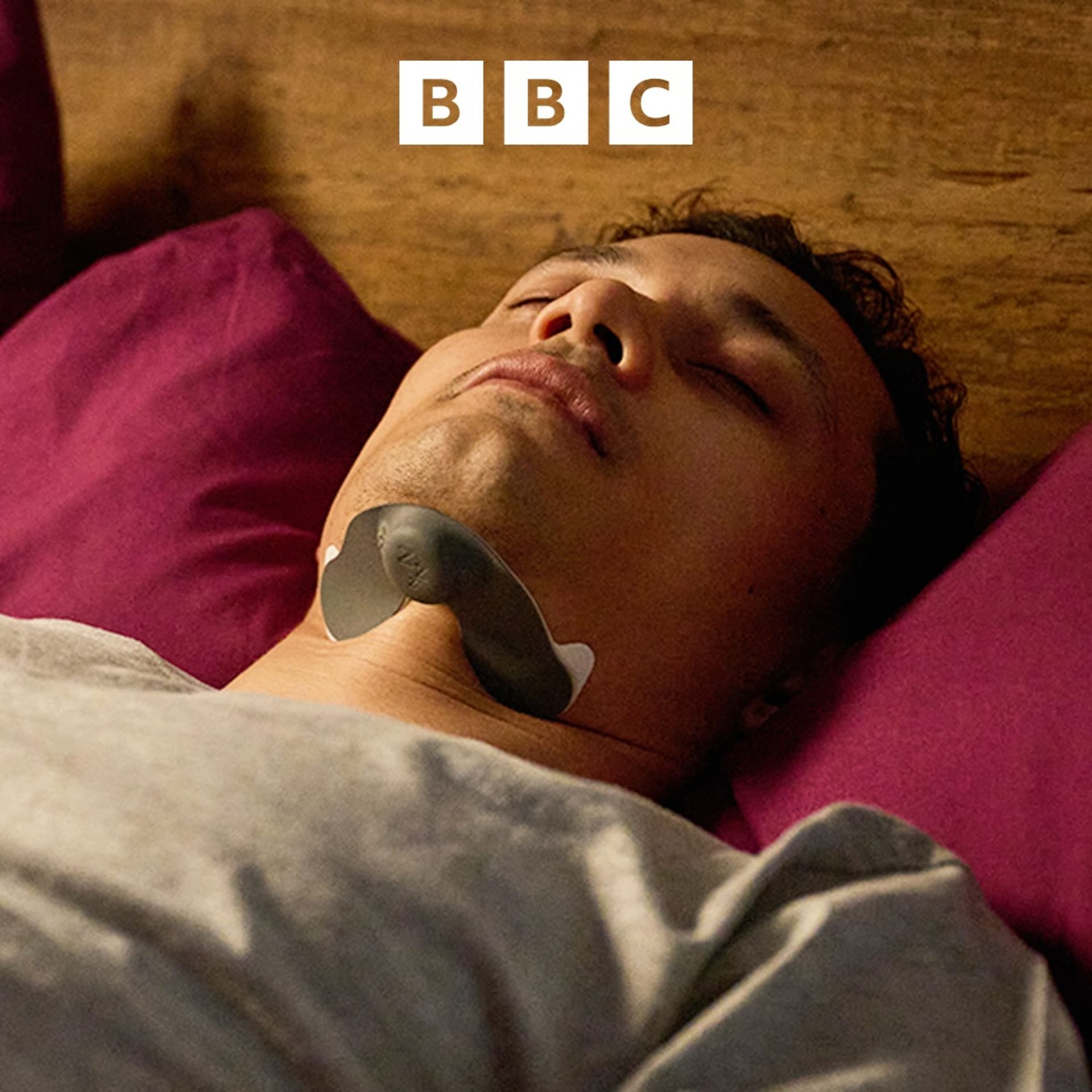
7:02The study is led by Guy's and St Thomas' NHS Foundation Trust working with King's College London and will assess a new non-invasive device designed to keep the airway open during sleep without masks, tubes or surgery. Nigel Clark is the chief executive of ZOOS Sleep Limited the company that's developed the device. Here's how it works. We've designed an amazing small device called ZOOS that is reasonably simple but also very very clever and it uses something called tens technology which has been around about 50 years and you place the device under your chin during the night while you sleep and what happens is is it stimulates the muscles under your chin which are connected to your tongue and we very very gently without you noticing it pull your tongue forward while you sleep which open up your airways and so that will alleviate and stop snoring but also if you open up your airways it'll help you breathe better which is which will treat sleep apnea and you've got the device there in front of you it's a rubber device it's quite lightweight could you just describe that for me yeah sure it's a tiny little device it weighs a couple of grams I think and And essentially, it's shaped a bit like a boomerang.
8:23And then there's a little kind of module at the front, which has got all the electronics and the battery. And then the boomerang are two very flexible circuit boards that lead to some electrodes that provide the stimulation. And as I say, you use a consumable, use a very technical five-layer medical-grade hydrogel pad, which will help conduct the stimulation levels from the device through to your skin. and so just places very gently under the skin you wear it unnoticed you don't wear it realize you're using it after the first few nights of getting used to it. What outcomes will matter most in determining the uptake of your device then when it comes to having a wider rollout obviously you're in trial phase at the moment but what is it you're looking for?
9:13The main outcome we're obviously looking for is to lower the number of times you have a sleep apnea episode so when you measure that it's called a apnea hypopnea index a hi index when you get diagnosed with sleep apnea you're either mild moderate or severe sufferer depending on how many events you have per hour do you want to see that coming down but we need to see that lowered so our previous trials have shown really good response rate so in people that do respond and do because this isn't for everyone so it's the people that do respond to our treatment we've seen some really good people that drop from severe sleep apnea all the way down to mild sleep apnea or moderate sleep apnea down to mild or mild to nothing so that's the the big guiding thing we're looking for in the trial but all the other things are that are also really important is you sleep better you feel better in the morning but also you know there's other outcomes we're looking at in terms of potentially how well your partner sleeps because it's often not the person that's snoring or has the sleep apnea that doesn't sleep well.
10:24It's the person next to them in the bed that really affects them and that's a big kind of secondary outcome of the trial. That's Nigel Clark of Zoo Sleep. Well, we talked there a bit about the clinical trial. Back to Professor Jörg Steyer, who's leading it. So initially, over the next two years, presumably, we will offer this kind of treatment to patients who fail first-line therapy, so CPAP therapy. We will recruit about a bit short of 200 patients and follow them up whilst they're using this new device in the community for three months. We will study them at the beginning and at the end and compare how they're doing on this new treatment.
11:08But it has to be said, there's no such treatment as one size fits all. We are also aware that certain patients do respond to this treatment very well and others less well. For example, the neck circumference. So in the trial that we previously published in Thorax in 2016, we saw, for example, that all female participants were responders. And we think this is likely because they're having a slimmer neck circumference than their male counterparts. For any given weight, you have typically women with a slimmer neckline than men. This is quite interesting in itself because we do know that in trials, women are in sleep apnea trials typically underrepresented.
11:55And we'll try to recruit 50-50 men, women into the trial to actually get a good evidence base to advise accordingly. I just wonder, with the context then, you've worked with sleep apnea patients for many years. Where does this device fit in the future of treatment and what are you hoping for? This could be an additional non-CPAP therapy that is potentially in future evidence-based. And on the agenda, it could affect the treatment of many patients because it's easily available. It's non-invasive. It's relatively cheap and with relatively little side effects. Tense machines are used for decades for conditions with pain related to the spine or so, but even in labor-related pain in pregnant women, because there is thought to be little risk for the baby in situ.
12:55So from that perspective, it's a fairly simple, a fairly safe and fairly affordable treatment. At what point do you consider this to be a legitimate alternative? You know, when will you be satisfied that this is a legitimate treatment? So from the NHS level, the evidence would come together at the end of this trial. And with this trial, we might actually be able to convince then the NHS healthcare system to provide this for other patients in general healthcare in the UK. My thanks to Professor Jörg Steyer. Sleep quality is something that affects so many of us. So tell us what tech you've tried to get a better night's rest.
13:37Or maybe you've found tech was the problem or found an improvement when you stopped having your phone by the bed. Let us know. Our contact details are coming up in a second.
13:52you're listening to tech life on the bbc world service with me shona mccallum on those contact details i just promised as always you can email us on techlife at bbc.co.uk or send us a whatsapp on plus 44 330 1230 320 valentina whatsapped us to say i really love this program listening from Sierra Leone. Well, thanks, Valentino. It's much appreciated. Still to come on Tech Life, the breast cancer app, which is hoping to help educate and inform women in Pakistan. We know about, you know, the importance of getting regular mammograms once you hit a certain age or getting clinical exams as soon as you start feeling there's something wrong.
14:37But my family member completely ignored it because they were scared. But next up, we're talking about another issue affecting healthcare systems around the world, the lack of available beds.
14:53I've been speaking to Swedish entrepreneur Martin Ratz. A life-changing event was the cause of his health tech story. I was 44 years old, healthy, slim. Some may even say that I was athletic and I very unexpectedly suffered a heart attack. And take me back to that time. How shocking was it for you to discover you had had a heart attack at 44? It was surreal, a completely surreal experience. I haven't had any health issues. My vital signs were good. My blood tests were normal. So it was a complete shock. The experience prompted him to find a solution to something that he experienced during recovery.
15:39And one of the insights from that experience is that when you're in a hospital, you're constantly monitored. There are devices everywhere and you're being looked after. However, the minute you leave the hospital, there is no monitoring whatsoever. even though we have all this technology available to look after patients. So, for example, when I took the elevator down from the hospital ward that I was at, there were all these sensors in that elevator, but there are no sensors to monitor patients or people such as I and millions of others around the world that feel very fragile when they've left the hospital.
16:21Martin spoke to us from his home in Stockholm. Here he is explaining how he thinks his platform Dockla can help health services free up valuable hospital beds. Dockla is a company that makes it possible for patients to receive hospital level care in the comfort of their own home. We do that because we can use new technology and monitor patients with various devices and track their vital signs in the comfort of their own home rather than them being in a hospital. And you're using a combination of wearables that people would probably be familiar with. So if someone is unwell, there are certain vital signs that get monitored in the hospital.
17:05Could you just describe to me what you're trying to emulate at home that means that a patient could be continually monitored within that comfort? Exactly. So there are essentially two categories of patients that we look after. either those who are in a hospital and can be discharged earlier, or patients that are out in the community, chronically ill patients, and we can reduce the risk of them being admitted or readmitted to hospital. And we use hospital-level devices, so these are certified devices, to track, for example, blood pressure, oxygen saturation, heart rate, respiratory rate, temperature, weight, et cetera.
17:54These are very basic vital signs that one would normally track in a hospital setting. And we use these devices and track those patients' vital signs remotely. So they are transferred and then they can be viewed on a dashboard by clinicians. And we know that it's artificial intelligence that is underpinning a lot of how this works at scale. Could you explain that to me? Yes. Well, so artificial intelligence, of course, will have a fundamental effect on how healthcare is delivered. I think we should be careful with this. It's very important to always, in our case, have a human in the loop, as we say.
18:36So there's always a human being who will check any clinical decisions before they are executed. But again, the level, the amount of data that we can analyze quickly and personalize so that it is individual proactive care rather than reactive chaos. AI will help us make that happen. For some patients that are in a hospital setting, that does give them a sense of comfort and the ability to ring the bell and see a doctor or a nurse immediately is something that they want. What do you say to those? Well, clearly, remote monitoring or hospital at home is not for every category of patients. Absolutely not, right?
19:25But a very conservative estimate suggests that between 25 % and 30 % of patients who are currently in hospital do not belong there. They can easily be discharged and looked after at home. Whereas in fact, the level, the intensity of monitoring can often be higher than in hospital because you don't have all these waiting times. You have alert mechanisms that can be far more sophisticated than in a hospital setting. And what evidence do you have that DOCLA is working in the places that you have ruled it out? Well, so we have at least three sources of evidence. Number one, and most importantly, patients love it.
20:1599 % of our patients rate our service as good or excellent. So they really love it. They send flowers, chocolates, cards to us. And secondly, clinicians love the service because it enables them to focus on patients that they really need to look after in hospital rather than others. And thirdly, taxpayers love it because we reduce the cost of care because it's far cheaper to look after patients at home than it is in hospital. Thanks to Martin Ratz, the founder of DOCLA.
20:56We're going across to South Asia now and another entrepreneur, Suha Lalani, whose personal experience prompted her to use the power of tech and AI for better health outcomes. I come from a fairly privileged background in Pakistan. And when I was doing my undergrad in Canada, studying biomedical sciences and majoring in cancer biology, this reality hit home because someone very close to me was diagnosed with breast cancer. And it was a late stage diagnosis. So I realised that if someone so privileged can actually have late stage diagnosis, what about the women that are not as privileged? How intense this problem is?
21:40And surprisingly enough, there is no solution in Pakistan. And how's your family member doing now? Unfortunately, they passed away within 16 months of their diagnosis. I'm sorry to hear that. I guess that just brings it really into sharp focus then. Of course, yes. And when that happened, I was mortified. And so was my family that, you know, we're so privileged. We know about the nuances of breast cancer. We know about, you know, the importance of getting regular mammograms once you hit a certain age or getting cynical exams as soon as you start feeling there's something wrong. But my family member completely ignored it because they were scared.
22:25So I can only imagine the nuances that prevail in communities that are not even aware of breast cancer or the symptoms or self-exam techniques, or even if they are, the taboos and stigmas that prevent them from seeking care. Suha is 26 now and studying for a master's in public health at Harvard University. She has also created an app called Pink Detect, and I asked her to explain how the app works. Pink Detect app essentially provides a range of tools, number one being an AI-powered risk assessment engine. So as soon as the women download the app, they're prompted to take a questionnaire, which analyzes their health data.
23:09It asks some very basic questions like the first time you got your period, your height, your weight, any family history, and so on and so forth. And then our algorithm essentially analyzes the user's risk of developing breast cancer in their lifetime and categorizes them into one of the three categories, low risk, moderate risk, or high risk of developing breast cancer in their lifetime. And then within the app, there is a range of tools that you can kind of navigate. So there is one self-exam simulation that helps women take self-exams in real time. And then there's also a journaling feature that ensures that women are able to log their findings within the app.
23:52And this journaling feature remains as, you know, a record when women go to doctors to show them that this is what we saw during our, you know, self-exam. Going back to the initial questionnaire, if you like, I mean, is it enough information to determine low, moderate, high risk? Presumably you're going into things like family history of breast cancer. Yes, yes. So we actually developed this risk assessment engine with the help of a Gale model. Gale model is a very reputable model that is used to predict breast cancer risk in a woman's lifetime. But we realized that Gale model was not very nuanced when it came to women of color, so much so that it was quite inaccurate for women in Pakistan, for immigrant communities in the U.S.
24:47So we basically modified the Gale model so as to, you know, align it with the demographic of Pakistani women. However, we're now on the next stage of modifying our risk assessment engine even more by adding large language models and even adding more data to ensure that is even more accurate in predicting risk levels. And what results have you had so far with women that have used the app? Yeah, so it makes me really proud to share that Pakistan Journal of Health actually published a study that was conducted independently by seven clinics in collaboration with Institute of Public Health Lahore, where they used Ping Detect app to see how beneficial it is to detect breast cancer as early.
25:39And so far, PingDetect app has diagnosed over 6 ,000 tumors, malignant and benign both. And we've seen an improvement of 36 % in referral rates, as well as 17 % improvement in early detection rates. So a lot of the cases that were initially being diagnosed at stage four and stage three were now being diagnosed at stage one and stage two because of the use of PingDetect app. Thanks to Suha Lalani, the founder of Pink Detect.
26:38Has it helped or maybe sometimes made things worse? Email us techlife at bbc.co.uk or you can find us on WhatsApp. We're on plus 44 330 1230 320. Today's Tech Life was produced by Tom Quinn and Imran Raman-Jones and presented by me, Shona McCallum.
27:08Thank you.
From the publisher
An anti-snoring device is being trialled as a potential solution to sleep apnoea, a condition which affects millions and can have wide-ranging consequences on daily life. We speak to the team behind the trial. Also on the programme, two health tech entrepreneurs whose personal experiences informed their products: A man who had a heart attack at 44 and now works to help reduce hospital recovery times, and a woman who lost a close family member to breast cancer and is working to help inform women in Pakistan to spot the signs and get help.
Presenter: Shiona McCallum Producers: Tom Quinn and Imran Rahman-Jones
(Image: A man asleep in bed with a black boomerang-shaped device attached to his neck. Credit: Zeus Sleeps)