In short
Tech Life Podcast Episode Notes
Episode Title
Data and Me
Host
Chris Vallance
Producer
Tom Quinn
Editor
Monica Soriano
Air Date
TBD
---
Episode Summary This episode addresses the implications of trusting companies with personal data, particularly in the context of 23andMe, a genetic information company that faced significant challenges. Additionally, it explores the increasing energy demands of artificial intelligence (AI) and innovative solutions to combat climate change in vulnerable regions like the Maldives.
---
Key Segments
- Data Privacy Concerns with 23andMe
- Overview of 23andMe:
- A US-based DNA testing company where users provide saliva samples to obtain genetic information.
- Originally popular for ancestry and health risk insights.
- Case Study - Danielle Landracina:
- Shared her experience using 23andMe to connect with her biological family.
- Challenges Faced:
- Financial troubles and a significant data breach affecting around 7 million users.
- Filed for bankruptcy protection in March 2023, planning to auction off its database.
- User Concerns:
- Users like Danielle worried about data safety and the ability to delete personal information.
- Concerns about data permanence once shared with companies.
- Expert Opinions on Data Security:
- Amit Sinha (CEO of DigiCert):
- Discussed the complexities of data storage and the chances of personal data being replicated or backed up beyond user control.
- Géraldine Javier (Cybersecurity Lawyer):
- Reassured that the new owner of 23andMe, Regeneron Pharmaceuticals, is obligated to adhere to original privacy policies.
- Regulatory Oversight:
- California Attorney General Rob Bonta:
- Expressed intentions to monitor Regeneron's compliance with privacy commitments.
- User Sentiment:
- Users are becoming more cautious with sharing personal information.
---
- Powering the AI Boom
- International Energy Agency (IEA) Report:
- Data centers are significant electricity consumers, with AI driving demand.
- Current Data Center Statistics:
- Approximately 11,000 data centers globally, consuming about 1.5% of global electricity.
- In some regions, such as Virginia and Ireland, data centers represent 30-40% of electricity demand.
- Future Demand Predictions:
- Data centers' electricity needs could match Japan's electricity consumption within the next five years.
- Energy Solutions:
- Discussion on diversifying energy sources, including renewables and nuclear energy, to meet burgeoning demand.
---
- Innovative Solutions in the Maldives
- Growing Islands Project:
- Collaboration between the Self-Assembly Lab at MIT and Invena to develop sustainable solutions to combat coastal erosion.
- Methodology:
- Utilizing underwater structures to promote natural sand accumulation.
- Monitoring environmental conditions through tilt sensors and satellite data for predictive modeling.
- Listener Engagement
- Call to action for listeners to share their indispensable technology items and thoughts on the topics discussed.
---
Key Takeaways
- Data Security in Crisis: Trusting companies with personal data can lead to significant concerns during financial difficulties, emphasizing the need for stringent data privacy measures.
- Energy Demand for AI: As AI technology continues to expand, so does the responsibility to manage its energy consumption sustainably.
- Innovative Environmental Solutions: Technological advancements can offer practical solutions to combat the effects of climate change on vulnerable regions like the Maldives.
---
Listener Interactions
- Listeners are encouraged to share their technology necessities and thoughts on the episode's themes via email or WhatsApp.
---
Contact Information
- Email: techlife@bbc.co.uk
- WhatsApp: +44 330 1230 320
---
This episode of Tech Life provides a poignant exploration of our relationship with technology, data privacy, energy demands, and innovative solutions to global challenges.
Written by AI. May contain mistakes. Listen to the episode to check what was said.
Transcript
Automatic transcript. May contain errors.0:00Welcome to Tech Life on the BBC World Service, the programme about technology that's making an impact on all our lives. I'm Chris Vallance. This week, what happens when a firm we trust with our data gets into financial trouble? We hear from a woman who trusted a US company with that most personal data, her genetic information. And AI is going to face a power crunch. The International Energy Agency tells us about the challenges of powering the artificial intelligence boom. All that, and we find out how you grow a tropical island. Researchers in the Maldives tell us their tech could protect the low-lying nation from erosion and rising sea levels.
1:02We start today with a question. What happens when you provide a company with data about yourself and that company gets into difficulties? Is your data really safe and can you ask for it to be deleted? Customers of US-based 23andMe might have been asking those questions recently. At its height it was one of the most popular DNA health and ancestry sites in the world but then it ran into trouble. The BBC's North America technology correspondent, Lily Jamali, has been following this story for us. I spoke to Lily in San Francisco, and I asked her to tell me all about 23andMe. Well, 23andMe is this DNA testing company, and the proposition was pretty simple.
1:48It was that you'd spit into a tube, send it in, and for a fee, you would get back a trove of information about your genetic makeup. So that could include information about health risks you might face. A lot of people flock to 23andMe to learn more about their ancestry. And I got to speak with one former 23andMe account holder named Danielle Landracina. She is from Maryland here in the U.S. She told me why she signed up. My father was adopted and he passed away in 2007. and so I wanted to learn more about my dad's biological family. I actually did find some relatives, and we did make contact via email and exchange some information, some family history.
2:35It was just nice to know and learn about other parts of my family and just learn that history of what did they know about my dad's mother, or my dad's father, you know, where they were related and where did they grow up. Well, that all sounds quite exciting for her. So what went wrong? Well, 23andMe had a ton of success early on, but they had trouble getting users to stick around. A subscription service that they launched never quite got off the ground. They also looked into developing drugs using all this data that they had gathered over almost two decades. But that is a very expensive business.
3:13It can take years to develop a new drug. The breaking point came in 2023 when the company revealed that hackers had been able to access the personal information of many users, around 7 million of them. And things kind of spiraled from there. So in March of this year, the company filed for bankruptcy protection and made clear what they were going to do was to auction off their parts, including that very valuable database of genetic information that they had collected. So the company's problems, as you may remember, Chris, were making a lot of news headlines back in March. And that's when customers like Danielle Landracina took notice.
3:51So when I heard that on the news, it was very concerning to me. It said that they were looking to sell the company, which is selling the data. And the recommendation by a lot of these news reports was to go online and delete your data. So what you just heard from Danielle is what a lot of other users were thinking, too. They just weren't sure if this data that they had deleted was really gone. So I asked a couple of experts about this, including Amit Sinha. He is the CEO of the digital security company DigiCert. He says that generally speaking, once you hand over your data to a company, it can end up in a lot of different places.
4:34Data gets replicated. There are backups in the cloud. Maybe there are some partners who access the company's data for legitimate purposes. Then the question is, how are they storing that data? Because now there's a copy of that data. Where else is it present? When I think about this problem, I often wonder, wouldn't it be nice if, you know, remember the Mission Impossible movie? This data will self-destruct in five minutes, right? So what's going to happen to 23andMe? Well, the drug maker Regeneron Pharmaceuticals has agreed to buy the company. They're going to buy it for a little bit more than$250 million.
5:12They, as part of this auction that took place in May, are going to get all of 23andMe's data. So what does that mean for 23andMe users? I've been speaking to Géraldine Javier, a cybersecurity lawyer at Kroll and Mooring, about that. If that information and that data is being transferred over to another organization or company, the receiver of that information is still obligated to comply with the requirements and representations of the original reason why that data was collected in the first place. So consumers should also feel, you know, a little bit more at ease. And just because that information is going from one company to another, it doesn't mean that their information is at risk.
5:56So we reached out to 23andMe on a couple of occasions to ask whether user data privacy choices will be honored when the company's assets are sold. They chose not to respond to us directly, but the buyer, Regeneron, has said that it is going to comply with 23andMe's privacy policies and all applicable laws. So what happens next? This is a great question. It's about enforcement. So will Regeneron stay true to its word and actually uphold this privacy policy that so many customers believed would be the policy for years when they first signed up? And I spoke with Attorney General Rob Bonta. He is the top law enforcer here in the state of California.
6:40He told me that they're going to keep a very close eye on what Regeneron does going forward. If they say that data being deleted means it's actually deleted, he's going to be looking out for any complaints from customers to indicate otherwise. And if he finds that there's any issue, he says he will take action. What does Danielle make of all of that? Well, Danielle is one of a number of people who I spoke to who said that they're going to be a lot more cautious from now on. Take a listen. I am definitely a lot more hesitant to share personal information. I will not share my genetic information, my DNA anymore with a site or a company.
7:26I do more so than I ever did before read terms and conditions. But I know our data is what is valuable. So I'm also not naive in the fact that anything that I do on my iPhone or, you know, my website traffic, I know that that all is being tracked and sold. But it's more about my personal information. I'm just more careful. So Danielle there saying she'll be a bit more cautious in the future. Well, thanks a lot, Lily. Thanks for joining us again. Always great to be with you, Chris. That's our North America technology correspondent, Lily Jamali there. And since I spoke to Lily, it's been reported that the founder of 23andMe has asked a US court to reopen the auction for the company, so a fresh bid led by her can be considered.
8:17So the sale of the company might have another twist still to come.
8:32You're listening to Tech Life on the BBC World Service with me, Chris Vallance. As you know, we're always pleased to hear from you, our listeners. Brian from Uganda got in touch with us on WhatsApp to say, thanks for the show. Well, thanks for listening, Brian. And Odeon, I hope I'm saying that right, in Brisbane, WhatsAppped us to say, good morning from Australia. I listened to your programme for the very first time today and was very impressed. That's great to hear, Odeon. I hope you stay impressed. Now, for the benefit of new listeners like Odeon, we should mention that we continue to be interested in hearing about the one item of tech you simply can't do without.
9:11Patrick Wiggins from Utah in the United States' favourite gadget is certainly something you wouldn't want to leave on the bus. As someone who has enjoyed jumping out of aeroplanes for 60 years, Patrick tells us, there is one piece of kit that I could choose not to use, but I always do. The devices are made by several companies but are generically called AADs, which stands for Automatic Activation Device. As the name implies, if a jumper forgets or is unable to open their parachute, the AAD opens it for them. And Patrick says AADs have saved over 5 ,200 lives to date. What a fascinating story about a piece of tech I knew nothing about, but one I won't be volunteering to try out for tech life.
9:57And if you've got a piece of tech you simply can't do without, whether at home or at work or indeed jumping out of a plane, please do tell us about it. Our email address is techlife at bbc.co.uk or send us a WhatsApp or even better, a voice note. The number is plus 44 330 1230 320. I'll repeat those details at the end of the programme. and still to come, the tech solution which could protect low-lying island nations.
10:31Now on Tech Life, we do like to peer behind the shiny exterior of the tech we use. Whenever we connect to the internet, save something to the cloud, interact with an AI, it's likely a data centre will have been involved, processing the data we send to it and sending information back. These vast buildings house banks and banks of computers, and they are power-hungry beasts. We don't think of tech as a heavy industry, but a big data centre can use roughly the same amount of electricity as an aluminium smelter, where metal is refined from ore. And AI is driving that energy demand up, so much so that experts say power grids are struggling to keep up.
11:13The Paris-based International Energy Agency, or IEA, has been looking into this in a major report published earlier this year. Laura Cozzi is the IEA's Director of Sustainability, Technology and Outlooks. I asked her why data centres consume so much power. We started looking and digging how much electricity is actually a data centre consuming around the world. And what we found, there are around 11 ,000 data centers around the globe. The larger they are, the more they consume. If you want to compare with households, a small data center would consume around 100 ,000 households. But the largest that is in construction today, we are talking about millions of households.
11:57So they're growing very, very fast in size. And therefore, the electricity use that we need is also growing fast. So an emerging big electricity demand center. But I think it's important to put in perspective when you look at the global electricity used today data centers are just 1.5 percent of global electricity. What is it that the data centers do that requires all this electricity? Yeah so in fact in data centers what you have is a large amount of chips. Those chips need cooling so you have the cooling that requires electricity to make sure that those chips are always at the right temperature.
12:39And then those chips perform a number of things, including, for example, all type of operations that we may ask to our computer, from asking questions to resolving problems to making a data search. So all these things require electricity. And a big driver of what's going on in data centres is at the moment is artificial intelligence. Yeah, absolutely. So data center can perform different functions and increasingly data centers are actually used for artificial intelligence. And what we find is that demand for data centers very much driven by the use of artificial intelligence is going to grow from now to 2030.
13:19So in the next five years or so, the equivalent of electricity demand of Japan. So this is quite large. It's among the fastest growing electricity use in the world. And in some countries and regions in the world, for example, in the United States, in Virginia or Ireland or Netherlands, data centres are already constituting a very large portion of electricity demand. We're talking between 30 to 40 percent of electricity demand just powering data centres. And that's going to increase as well, isn't it, that proportion in those countries? Absolutely. So we are actually seeing, especially in the US, data centers have this interesting feature.
13:58They tend to cluster together. Once you have a data center, you actually tend to build another data center exactly in the same location. So in the United States, for example, you have five places where basically 50 % of all data centers are just located in five places. So this share is going to grow over time. When you talk of these data centers being concentrated, Like in many countries, there are sort of the hubs where these data centers tend to be. What are the consequences of that? Data centers tend to be much, much closer to cities than other bigger industrial facilities. This means that you're going to connect to an electricity grid that has already many other loads and important loads.
14:40The second is this clustering and aggregation that we spoke earlier. So you start with maybe a data center that is 100 ,000 equivalent households, but then you add another one and then another one and then another one. And the important thing is that you build this very, very quickly. You build this maybe in 12 to 18, 24 months. So the grids need to adapt very, very quickly. So we have an electricity demand that is quite large, very close to city centers and growing very fast. So it is posing in certain places in the world, new challenges for the electricity sector. So could we run out of electricity for chatbots and other applications of AI?
15:21What we found, actually, if you look at all the pipeline of data centres in the world today, around one-fifth may be at risk of not having enough electricity. So I think that there has to be and there is already a conversation starting about possible options, including on maybe locating data centres in different places and stop clustering as much as we've been doing up to now, but also, for example, speeding up, building out the electricity grid. How are we going to power this increase in demand? A lot of interest is going to still, going to renewables, but increasingly low carbon sources that can produce very high quality electricity.
16:03What are those? For example, nuclear. You have very little emissions, power all the time, and you're sure that the source is there. So we're seeing increasing investment from those companies also in this type of generation, nuclear and increasingly geothermal. But in our analysis, it's also very, very clear that you will need to see a lot of sources contributing to this growth, including, for example, in the United States, natural gas. In places like China, we're also seeing coal contributing to the production of electricity for data centres. Is there a chance that AI can come up with discoveries or help us operate things like power networks more efficiently?
16:41This is absolutely true and absolutely fascinating. We are just at the beginning of AI being used by the energy sector and we have been reviewing the already existing application and we do see exactly what you mentioned, Chris. For example, in the electricity grid, you would be able, with the same physical infrastructure, to actually have optimizing things, more electricity flowing through. So integrating more renewables, for example. So when we go through all the sectors, from production to use in transport industry, households, buildings, etc., we see that the potential to reduce emission is actually much, much larger by a factor of five than the actual increase in emissions from the electricity production.
17:24That's Lara Kotze from the International Energy Agency speaking to me from Paris and we'd like to hear from you about what Lara said. Do you think AI will be used to improve electricity grids or is that wishful thinking? Perhaps you live somewhere where data centres are already having an impact on electricity or water demand. Drop us a line.
17:54Well, put on your summer clothes and let me take you now to the Maldives, the smallest nation in Asia. Located in the Indian Ocean to the southwest of Sri Lanka, the Maldives are a chain of about 1 ,200 small coral islands, grouped in clusters or atolls. They're home to just under 400 ,000 people. None of the islands stand more than 6 feet or 1.8 metres above the shoreline. The threat of rising sea levels caused by climate change is a real fear for their inhabitants. And sea erosion is another problem, washing away land into the crystal clear waters. Traditional defences have included building breakwaters and dredging.
18:39But a partnership between the Self-Assembly Lab at Massachusetts Institute of Technology and Invena a Maldives-based climate technology company, is coming up with a new solution which involves growing islands. Hi, my name is Sarah Dole and I'm the co-founder of Invena. You know, island nations where I'm from, like Sri Lanka and the Maldives, are kind of the canary in the coal mine when it comes to impacts of climate change. And when you say the Maldives, you picture paradise like beaches, but what you don't see are the real-time impacts from coastal erosion and storm surges, which could get worse due to the impacts of climate change.
19:17Invena has been collaborating on the Growing Islands project with the Self-Assembly Lab for the past seven years now to reimagine a new model for the built environment, you know, one that builds with nature rather than fights it. That's Sarah Doll from Invena. Skylar Tibbetts is the founder and director of the Self-Assembly Lab at MIT. I asked him why he was involved in Growing Islands. Yeah, so the Growing Islands project is in the Maldives, and we're working with a local organization in Vena. And they approached us because for many years we were studying self-assembly and self-organizing systems.
19:55And we realized that islands, especially coral-based islands, self-organize. And the real question is, how does that happen? And could we promote it to happen? We obviously want to do that because of erosion and sea level rise and storm inundation. we want to find ways that islands and coastlines can be more resilient. And so if we can tap into this natural process, then we could promote islands to grow over time naturally. And erosion is a particular problem in the Maldives? Yeah, many islands are eroding, but also there's a problem with dredging for new development. So, you know, if you have an existing natural island, the beaches are eroding, and then often they'll use dredging or land reclamation and they'll pump sand back onto the beach.
20:41But if they want to build a new resort or a new island, they'll pump sand from the deep ocean and they'll make these islands. But then the sand will erode away quickly. So how do you grow an island? Talk me through that. There are several approaches that we've been studying. One of the approaches, and really based on our main hypothesis, is that the sand accumulates or erodes based on the relationship between the force of the ocean, so currents, waves, and tides, and the bathymetry or the underwater topography or terrain. And so if you place structures with very specific shapes and specific orientations, then sand can naturally accumulate when the water flows next to it.
21:22And so what we do is we place different objects underwater. And these are usually tens of meters in length, usually roughly two meters in height. And they have different shapes. So one of the structures that we place is a ramp-like structure. And some of them are more like vegetation or field structures or a series of objects, almost like a necklace underwater, you know, different geometries. And each one of those has different effects on how the sand accumulates. Can you describe how the island grows? Yeah, and I will say that there's two approaches. So one approach is that you want to have a new island from scratch, and that's really like a new development or land reclamation approach, and we want to do that without dredging.
22:06And so we place objects. Most recently, we made this 90-meter structure. We placed six 20-meter objects in a kind of circle shape, and as the water flows across those objects, because of the direction of the currents or the waves. And there's two monsoon seasons, so they come in 180 degrees from one another. As the water flows over these objects, the sand then starts to accumulate in the middle of this kind of circular ring. And then as the season changes, the water flows from a different direction, but it goes over the other objects on the other side of the ring and it still accumulates in the middle.
22:44So you basically get this large amount of accumulation. We now have two meters of new sand height. The change in elevation has been two meters of sand over the area of this 90 meter circle. And the sand continues to grow up and eventually engulfs the objects that we place. So that's an island. But another configuration is a beach condition. And in that case, you have waves and current and tides kind of flowing onto the beach. And so what we do is we place objects off the beach, you know, 40 to 50 meters off the beach. and there are a series of objects and as the waves and the water flow over it, it then reduces the wave energy and the sand starts to move onto the shore.
23:27I suppose a lot of this must rely upon being able to predict sea currents in terms of so that you know where to place these islands and so that you can be confident that the sand will accumulate. Yes, and we have to study that from a different angle. So one angle is that we look at all the weather patterns and historic weather data and, you know, live weather data and ocean buoys, et cetera. Another angle is that we have to do bathymetry surveys. So people go out with a boat and they survey the underwater landscape, and then we get geometries out of that and then tells us the landscape of the ocean.
24:03And that tells us where we can place structures and what the depth is. And then we also place tilt sensors and these tilt sensors then give us the current direction, flow, velocity. And so with those three things, we can then make estimates about where we should place the objects, where the sand is moving in different seasons. And then most recently, we started using satellite data. So we take images, you know, many images, as many images we can take, high resolution satellite images, and then we can monitor how the sand is moving. And then we've started building machine learning and prediction on that.
24:38So we can try to predict to where the sand is going. And we're now forming a new organization called Littoral, and that's all about monitoring coastline change for islands and coastal communities. So you've actually got artificial intelligence there to help you predict where will be best to place these islands. Exactly. On the computational side, we can use the satellite images and use that to train a model because it's real data. It's not using physics simulation. It's just taking images of what actually happened. And from that, you can build predictions about what will happen. And so we can use that to understand how coastlines are changing, but we can also use that to predict where we should place structures or how the sand will accumulate in the future.
25:20And that was Skylar Tibbetts, the founder and director of the Self-Assembly Lab at MIT, speaking to us from France, where he will be attending a UN Oceans Conference based in Nice.
25:36Well that's about it from Tech Life Island on the sun-kissed shores of the River Clyde in Scotland but we're already thinking about next week's show. If there's anything you think we should be covering from the world of tech or if you'd like to tell us your thoughts on today's show please do get in touch. Our email address is techlife at bbc.co.uk or you can WhatsApp us on plus 44 330 1230 320. Please include your name and tell us where you live. And we still want to hear about the tech you simply can't live without. Today's Tech Life was produced by Tom Quinn, edited by Monica Soriano, and presented by me, Chris Valance.
From the publisher
What happens when a company we trust with our most personal data gets into financial trouble ? We hear from a woman who trusted a US company with her genetic information.
Also on Tech Life this week, will there be enough electricity for the demands of artificial intelligence ? The International Energy Agency tells us about the challenges of powering the AI boom. And we find out how to grow an island in The Maldives. The tech involved could protect low-lying territories from erosion and rising sea levels.
We enjoy reading your messages about the one item of tech you simply can't do without. If you want to tell us about your must-have piece of tech, please get in touch by emailing techlife@bbc.co.uk or send us a Whatsapp message or voice memo on +44 330 1230 320.
Presenter: Chris Vallance Producer: Tom Quinn Editor: Monica Soriano
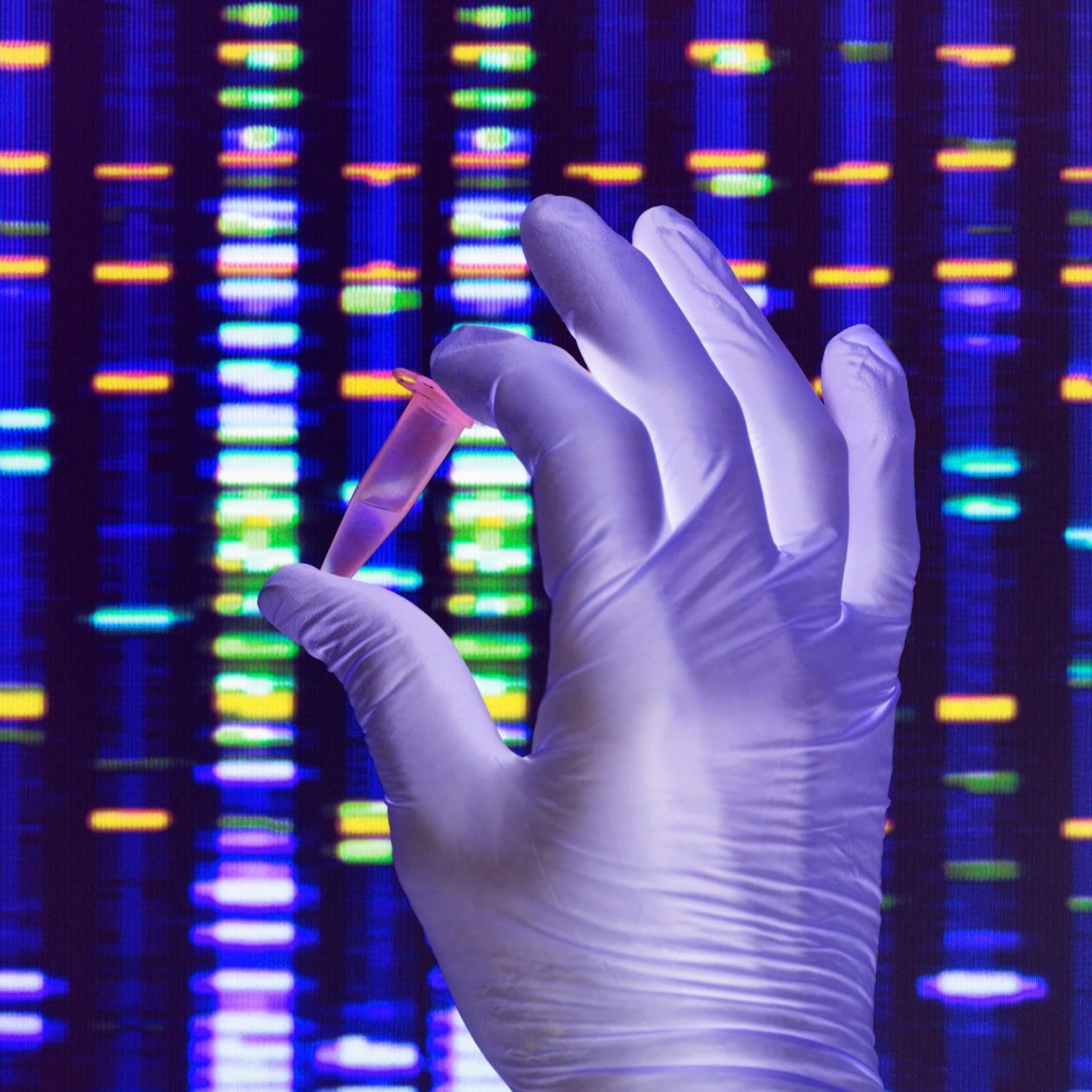
Image: A scientist holds a DNA sample with the results on a computer screen in a laboratory. Credit: Westend61/Getty Images