In short
Tech Life Podcast Episode Summary: Drones with Tasers
Episode Overview In this episode of *Tech Life*, host Chris Vallance explores the intersection of technology and public safety through conversations with Rick Smith, CEO of Axon Enterprise, and discussions on autonomous underwater gliders and quantum computing.
Key Topics Discussed
- Axon Enterprise and the Future of Tasers
- Rick Smith explains the function and design of Tasers.
- Discusses new features of the latest Taser model, including increased range and shot capacity.
- Addresses concerns about the safety and associated risks of Taser use, including recorded deaths.
- Explores the potential future use of drones equipped with Tasers for non-lethal policing.
- Autonomous Underwater Gliders
- Introduction to a robotic glider developed by Teledyne Marine that will circumnavigate the globe.
- Discusses the technology behind the glider, its data-gathering mission, and its significance for oceanography.
- Highlights the potential impact on weather forecasting and climate change studies.
- Quantum Computing Developments
- Insights from Rajeeb Hazra, CEO of Quantinuum, on the advancements in quantum computing.
- Discussion about the hybrid model of classical and quantum computing and its applications in drug discovery, personalized medicine, and materials science.
- Predictions about the timeline for practical commercial applications of quantum computers and their impact on consumer technology.
Detailed Notes
Axon Enterprise and Tasers
- Taser Mechanism:
- Induces a seizure-like effect without causing severe injury.
- Rick Smith describes the sensation as a combination of intense tingling and muscle cramping.
- Product Developments:
- New model extends range from 3-5 meters to 15 meters.
- Upgraded from 1-2 shots to 10 shots per device.
- Safety Concerns:
- Acknowledges a report linking Tasers to around 30 deaths, emphasizing the importance of considering toxic drug levels in those cases.
- Smith reassures that the purpose of Tasers is to provide non-lethal alternatives in policing.
- Future Innovations:
- Research into a specialized Taser dart for penetrating heavy clothing effectively.
- Discussion of drones as first responders, able to assess situations faster than human officers.
- Ethical Considerations:
- Controversy surrounding drones armed with Tasers, including past resignations from Axon's ethics board.
- Emphasizes the need for real-time oversight to prevent misuse.
Autonomous Underwater Gliders
- Overview of the Glider:
- Described as a small, airplane-like robotic device that uses buoyancy to navigate underwater.
- Aims to gather scientific data while circumnavigating the globe.
- Purpose of the Mission:
- To demonstrate the effectiveness of gliders in remote ocean areas and their utility for long-term data collection.
- Data Applications:
- Collects real-time data useful for understanding weather patterns and ocean currents.
Quantum Computing Insights
- Hybrid Computing Model:
- Combines the strengths of classical and quantum computing to solve complex problems.
- Hazra discusses the potential for breakthroughs in drug discovery and material science.
- Commercial Viability:
- Predictions that practical applications of quantum computing will emerge in the next 16-18 months.
- Highlights potential for significant economic impact, suggesting the quantum computing industry could create trillions of dollars in value over the next decade.
Conclusion This episode of *Tech Life* delves into the implications of emerging technologies in public safety and scientific research. From the ethical questions posed by the use of Tasers and drones in policing to the transformative potential of quantum computing, the discussions highlight the need for careful consideration of both the benefits and risks associated with technological advancements.
Listener Engagement
- Listeners are encouraged to share their thoughts on the use of Tasers and quantum computing, as well as submit their own tech-related stories and experiences.
---
For further exploration, listeners can engage with the podcast through email or WhatsApp to share feedback or personal tech adventures.
Written by AI. May contain mistakes. Listen to the episode to check what was said.
Transcript
Automatic transcript. May contain errors.0:00This BBC podcast is supported by ads outside the UK.
0:30Find out more at polandyourplacetogrow.com. Every day, millions of customers engage with AI agents like me. We work round the clock and have the facts at our fingertips. We're fast and effective, but incredibly patient. And we're built on Sierra, the leading AI-powered customer experience platform. No hold music, just answers and action. Visit sierra.ai to learn more. That's sierra.ai.
1:27of the technology. That's in a minute. Also today, our planet's oceans are vast and deep and exert huge influence over our weather and climate. We meet the robot that will glide underwater around the world, gathering data. And if your tech life has been turned upside down by artificial intelligence, you'd better get ready, because another computing revolution is fast approaching. The area of quantum computing is, in my mind, when you look at the applications, as big, if not bigger than AI.
2:19Well, we begin tech life today with a firm whose policing technology is both electrifying and shocking, literally. Put your hands down! Stop where you are! Taser, taser, taser!
2:39Suspect down. Taser deployed. That's a bit of a promotional video from a company called Axon Enterprise, whose best-known product is the Taser. Rick Smith is the boss of the multi-billion dollar company. The tech his firm develops is in a very real sense, shaping the future of policing around the world. Now, we know in this interview, some of you will disagree strongly with his opinions. And we'd love to hear your thoughts on what he says, because his company's products may well be coming to where you live. I began by asking Rick how a taser worked. So the taser weapon is effectively, we're trying to bring Captain Kirk's phaser from science fiction to reality.
3:26And so it's a way to stop people in dangerous situations without requiring that you injure them severely or kill them. In terms of the sensation of being tasered, what would you compare it to? So we induce something that looks like a seizure and it's certainly unpleasant, but when we turn it off, the effect is gone. It is somewhat like that feeling if you hit your elbow and you feel the sense of numbness and intense tingling, if you take that, pulsate it 20 times a second, very intensely, and then layer on top a severe charley horse. If you've ever had a muscle cramp where the muscle is just uncontrollably cramping, you swirl all that together and that's what a taser weapon feels like.
4:06You say it's unpleasant. Is that from personal experience? I've done it eight times. I think I'm done, but I've done it eight. Tasers have been around quite some time. you've just rolled out a new model what's new about that weapon the big thing is that we've been able to extend the range from let's say three to five meters effective range to now we're out to 15 meters of effective range and we've gone from a one or two shot device to 10 shots tasers are not lethal by design, but there have been deaths associated with taser use. I think in 2017, Reuters compiled a database of a thousand deaths associated with tasers.
4:54Does that concern you when you read about people who've died after they've been tasered? Oh, absolutely. I mean, that is exactly the situation we're trying to avoid. So we don't deny tasers have caused about 30 deaths. Now they've been used more than 6 million times. So it's actually an extremely low risk rate. And the real risks of injury are primarily around falls. We've had around 20 people that fell either from an elevated height. And then we've had about eight cases where the spark from the taser ignited a flammable environment, whether it's gasoline or in a methamphetamine lab. But most of those cases tend to involve toxic drug use.
5:34And so when you say a thousand cases, at first, it says, wow, I wonder if the taser is killing these people. But when you realize in the vast majority, in almost every one of those cases, these people have very toxic levels of drug on board in the throes of the toxic overdose. What do you see as the future of the taser weapon? I mean, you've got this new model out. Where do you want to take it to? We have one remaining technical hurdle, and that is heavy clothing. Sometimes the taser system cannot get through heavy clothing. So we are testing a new system, a new dart that has a very specialized tip that is made of a heavy tungsten.
6:12It's very sharp and it can penetrate up to about about 20 centimeters of clothing. The hard part is how do you penetrate leather and all these different clothing and at the same time make it stop when it goes through the skin so we don't end up with a deep penetration, you know, into the internal organs. And that's where all the technologies come in, where we have a very sophisticated device. It can we can use the fluid pressure that builds up as soon as you punch through the skin, you're now in a wet environment. And we use that physics change to then cause deformations in the dart itself, like a break, like a crumple zone on a car to stop it from going any further.
6:51In terms of technology in policing, you've got a whole range of interests, your company, not just the taser. One of the areas that you've been investigating are drones. What we're focused on is how could we make drones that use taser nonlethal weapons to stop people without killing them? That is a capability. That's a couple of years down the road. So that's not what we're doing today. What we're doing today is really focusing on things like what's called drone is first responder. And what that means, there are cities like Cincinnati, where we've now deployed many drones all over the city in robotic.
7:28We call them hives where the drone needs no human operator. It can launch and it can get to a location far faster than any police officer could because of traffic and the physics limits of getting around the city. And that's a great way for police to very quickly be able to assess what's happening. You mentioned drones with tasers. That's been controversial in the past within your company, hasn't it? I think in 2022, you had the majority of your ethics board resign over a plan you had for a drone, a remotely operated drone carrying a taser that could be used to intervene in school shooting incidents.
8:07do you feel that you have you can address the fears of people that people had at that time about the use of drones and one hundred percent in fact look this was difficult for them and remember it was post 2020 and george floyd and all the controversy and i have yet to have anybody tell me what is a better approach because the way we stop a man with a gun today is the same we did with the sheriff in the Wild West, send in the sheriff with a gun and they have a gunfight and we see who wins. That's crazy. We should be able to send in a drone or a robot and that drone or robot needs to be able to stop the threat.
8:46With these drone and robotic systems, we can have supervisory oversight in real time where the weapon won't function until somebody in authority has given it the green light. You are working with 17 ,000 police forces. Sorry for the pause. I had to look and check. That was the right number. It's such a big number. you're working with 17 ,000 police forces in over 100 countries. Are there any countries in that list of 100 where you are uneasy about the human rights record or where people have had questions about the human rights record of those countries and the human rights record of the police in those countries?
9:26For sure. I mean, this is something we put a lot of thought into. But now, let me reverse this to you. We sell to the Swedish police or sorry, let's say the Norwegian police, the home of the Nobel Prize. Certainly, I think everybody would say, OK, we're fine with them having these weapons. But now we get an inquiry from a country that has had a troubled history of police violence. And they say, we want to deploy taser weapons and body cameras. In fact, this happened. I don't want to name the country. But they had been on a visit to the London metropolitan police. And as part of their police reform, they wanted to add nonlethal weapons and body cameras.
10:02And in that case, we were actually blocked by the U.S. Department of Commerce because we are regular. We're a heavily regulated business. And so we have to get government approvals everywhere we ship our products. That's one where I absolutely think we should have been able to ship there. And I think the government got it wrong, because how does how do you make things better in a country where you have a police force that when we talk about excessive force, They're talking about shooting and killing people and really excessive use of lethal force. You know, we don't make the world better by only selling to police that are already perfect.
10:36Are there countries you wouldn't sell to? Well, we certainly would not sell to any countries that were legally disallowed. And I would appreciate that. But, you know, purely on the basis of their human rights record rather than any kind of legal compulsion not to sell. Well, certainly like we wouldn't sell to North Korea and they're on the list. But I would say if I think of the world in terms of zones, I think the the list of countries we cannot sell to is larger than the list of countries that we would sell to, because I think there are some that are that are on the list that have had historical troubles that if if we came to believe that with with the best of intentions, they're trying to improve, we would engage there and and try to play a meaningful role.
11:17To come back to some of the futuristic things you've mentioned, do you think we will see drones with tasers being deployed in Western countries? Yes, absolutely. Do you think we'll see that in the UK? Yes. Some people say, you know, that might lead to, if you like, a kind of click button sort of mentality that the deployment of a taser becomes like a video game. It's the classic critique of drone warfare. Yes, it's a reasonable critique. However, I would also argue it takes years before any of the new systems we developed are approved for use there because there's a very thoughtful process. And I think the whole idea in the UK, like if we make a drone with a taser on it, you will not be able to have just any person pick it up and use it.
12:03You'll have to be logged in, authenticated that you are an accredited user, and you'll sign a form as part of the user agreement that you take legal responsibility for the use of that device and the agency can choose to set up real-time oversight. So you have two key systems where it's not just one person making a video game-type decision, it's real-time authorization. And by its very nature, we will have video of every use. And so there will be none of these situations where there is use of force and there's no video. And so whoever's using it will need to be held accountable. And we think you know, democracies are pretty good at holding their police accountable.
12:42The views there of Rick Smith, the founder and chief executive of Axon Enterprise. And as we said at the outset, we want to hear what you think about his ideas. Are taser-armed drones really the way to deal with mass shootings? Or is tough gun control the better solution, as indeed many taser-using police forces believe? Let us know what you think. This advertisement feature is paid and presented by Poland's Ministry of Foreign Affairs. Looking for the perfect place to grow your business? For over 30 years, Poland has been a launchpad for innovation at the heart of Europe, powered by world-class research and ambitious young talent.
13:22From bold startups to established powerhouses, Poland offers the momentum, resources and reliability you need to take your business further. Poland, where businesses don't just grow, they're built to last. Find out more at Poland, your place to grow.
13:48This is Tech Life on the BBC World Service with me, Chris Vallance. One of our listeners, Farhan Sheikh, has got in touch. Farhan lives in the south of England and he wants to share a mini tech adventure involving his 15-year-old car. He says, I bought a relatively low-cost Android-based screen that uses Bluetooth and Wi-Fi to connect to my phone for navigation and uses FM to send audio to my old in-car radio. This has modernised my car to have the capability of Android Auto or Apple CarPlay. As a bonus, the screen came with a built-in 4K resolution dashcam and a reverse camera with a long cable too.
14:32Well, thanks, Farhan, for sharing that mini-adventure. And you raised an interesting point. In times past, doing up your car meant buying some alloy wheels or fitting a turbo. Now I suppose it can mean a tech upgrade or even paying a subscription to unlock features. Very controversial, that. If you have a mini-tech adventure like Farhan that you want to share or a reaction to an interview, do get in touch with us. You can email us at techlife at bbc.co.uk or you can WhatsApp us. The number is plus 44 330 1230 320. And still to come, how much longer will we have to wait to see the benefits of quantum computers?
15:22And now on Tech Life, batten down the hatches, Close the watertight doors because we are going deep, deep, deep underwater.
15:38Right now, somewhere in the North Atlantic, off the coast of the United States, a small torpedo-like robotic device is moving far below the waves. And it does it by gliding. Its five-year mission is to glide around the globe, gathering data on the planet's oceans, which will help weather forecasters. The project is being led by an American company, Teledyne Marine. Shay Quinn leads the mission, and he's been explaining gliders to me. Gliders are a form of autonomous underwater vehicles. So it's a robot for the ocean that does not have any crew on board. And as opposed to many other subsea vehicles, gliders are a little bit different in that they use changes in buoyancy, whether it sinks or floats, to move through the water.
16:30So it basically uses these changes in buoyancies to sink down to the depths of the ocean and then float back up to the surface of the ocean. And as it does that, it moves over great distances. And while it's doing this moving up and down through the ocean, it's taking sensor measurements, scientific sensor measurements and taking track of where it is through the ocean. And it's used by oceanographers to gather scientific data for long periods of time out to sea. And what does one look like if we were in the same room as one? What would I see? It actually kind of looks like a small airplane. It's yellow, it's tube in shape, it's got a fin on the back and two wings on the side.
17:12It looks very much like a small airplane, but it's intended instead to go into the ocean. It has a small propeller at the back to help it push through the strong currents that it might encounter. But other than that, it uses these changes in buoyancy to move through the ocean. So you've got a mission for this glider. What's its mission going to be? Yes. So this particular glider is the first of a new series of gliders that we've made that is larger, has more batteries on board, and is able to stay out to sea for longer periods of time. And as such, we've decided to take on a circumnavigation of the world, starting here in Cape Cod, Massachusetts, and then moving around the entire world's oceans, making stops at various stations along the way before returning home.
18:01Now, why are you doing this? I assume it's not sightseeing. There's a lot that I think we are excited about for this. First of all, it's a, you know, on the Teledyne side, we have a product that we'd like to show that we can use this product for these long endurance missions. We create an oceanographic tool and oceanographers need to put these vehicles out to sea for long periods of time to gather data that they need for all different kinds of science that they're doing. What we're trying to show is we now have a tool that we can get even farther out to sea in even more remote locations to take data where you aren't really taking many data, you know, many data points are not being gathered.
18:41So there's that aspect of it, which is really great. So what are we going to learn from this glider? What's it going to do? What is it going to help you find out? As this glider travels through the ocean, it'll be gathering scientific data as it goes. and in near real time, every time it surfaces, transmit that data shoreside so it can be used in worldwide ocean models. It's open source data so that scientists from around the world can use the data that this glider is gathering to help understand their studies. For example, here on the East Coast, right where we've put this glider in the water, right now we're experiencing a large storm.
19:22So data from this glider, what's going on in the water, is helping scientists here understand what might happen with this weather system. So understanding mechanisms of ocean currents, how they interact with the weather, that sort of thing is what this is for. Exactly. That's one use of it. That's one sensor that we have on it. The sensor that is called a CTD, which measures conductivity, temperature and depth, is a very common sensor in oceanography. and it really provides data that can be used across several different fields of study. I mean, do you imagine there being fleets of these gliders?
19:58Because, I mean, you know, you can set them off and they're sending back data. You've got one. Do you imagine this being, you know, the seas being filled with these kind of autonomous craft? Well, they already kind of are. We do have fleets of these gliders already being used to track all sorts of oceanographic data. We've been making these gliders for over 25 years. and they are used in hurricane prediction. They are used in physical oceanography, chemical oceanography, biological oceanography, all around the world. What's different about this one is that it's able to move to areas of the ocean that are much more remote than gliders have been able to reach in the past.
20:37And that was Shea Quinn from Teledyne Marine.
20:49Well, keen Tech Life listeners will perhaps remember that I visited a lab a few months ago seeking answers to some of your questions about quantum computers. We covered a lot of the science and tech of quantum in that edition, which you can still find online. In simple terms, quantum computers solve problems in an entirely different way to the computers we currently use every day. And potentially they can crack some problems regular computers just can't, opening the door to a wealth of new discoveries. But at present, quantum machines only have very limited practical applications. But now a number of experts believe that the pace of development is accelerating.
21:33Rajeeb Hazra is president and CEO of Quantinuum, an international company that develops quantum computers and was recently valued at 10 billion US dollars. I began by asking him if quantum computers could replace classical computing of the sort most of us use today in laptops and phones. We don't believe in the time horizon that we can look at for the advancement of the technology, that would be the case. What we actually think is the combination of classical computers working with quantum computers will actually together be able to solve problems that we couldn't solve with either one of them or would be prohibitively expensive to solve and try and solve with either one of them.
22:21So in a way, having both at our disposal gives us this, what we call the hybrid computing infrastructure that lets you attack what is done best by classical computing and also lets you open up the frontier that couldn't be done with classical computing alone using quantum computing. What are the kinds of problems that quantum computers will solve that the computers of the present, or at least that are widely used today can't solve? Very simply put, I think the whole area of discovery of new materials, we call it a chemistry problem, but chemistry underlies pharmaceutical, life sciences, biology, all of that is chemical interaction of naturally created things.
23:06You will see how the process of drug discovery, which is discovering what molecules work best, personalized medicine, even wellness, self-healing systems within the body, all are going to be very, very positively enabled by quantum computing. And you could say, why won't they be done otherwise? Because two things. One is either it'll take levels of compute that would make the entire Earth be covered by data centers, or there isn't a way to actually for human beings to model those kind of phenomena accurately, even on infinite amounts of compute. For many years, I suppose, quantum computing companies, and I think I could put Quintinium in this bracket, have operated without generating money.
23:47They've operated on the premise of a product they might deliver that would be of commercial value and interest. How close are you to actually getting a product that is going to start solving real-world business problems of commercial value? What you said would have been absolutely right about three years ago. We knew how to build a smaller quantum computer that could be increasingly more reliable, and that's measured in number of what's called qubits. But we hadn't quite figured out how to scale that to million plus qubits, which is where you start solving really large problems versus the promise.
24:30We have that today. So we've taken the science challenges and turned them more into engineering problems to go ahead. And that's why we've accelerated what would be value creation on useful commercial use cases from five, seven years away to in the next 16 to 18 months. So where as a consumer might you first start to see the impact of quantum computers? So this isn't going to be like a chat GPT moment in my mind, right? I mean, that's been in the industry, technical industry, that's been the largest thing in the last few years. But what you will see very soon are things like the ability to personalize your medication, to be able to profile your pathology and physiology.
25:21And you won't go get a prescription for X. You'll get a prescription for X. So you will start to see that personalization happen. So quantum computing is going to be part of the substrate of many, many things that the consumer uses, whether it's new kinds of objects and devices, you know, the screens for next generation phones requires a particular kind of chemistry beyond OLED. And that is being done, accelerated with quantum computing as part of the discovery infrastructure. So we consumers will touch the impacts of quantum computing in almost every walk of our life. We just won't be using or carrying one, at least for a while.
26:05You recently attracted a round of investment that I think put the total value of your company at around$10 billion. What do you see the value of the quantum computing industry being if you can overcome all those hurdles? If you look simply at the scale of economic value that quantum computing will create over, let's say, the next 10 years, you could see it creating, you know, trillions of dollars of value. I can give you one quick example. I mean, if quantum computing can create a new drug for a widespread disease and shorten the discovery of that drug by a factor of two, that's tens of billions of dollars of value created.
Read the full transcript
26:56The area of quantum computing is, in my mind, when you look at the applications, as big, if not bigger than AI. And that was Rajeeb Hazra from Continuum, explaining what's going on in the world of quantum computers. He was speaking to me from London.
27:18Well, our quantum of time is almost expended on this edition of Tech Life. A reminder that we are keen to hear any thoughts you may have on the interview about tasers, particularly if it's based on your own experience. And do keep telling us about your mini tech adventures, whether you are working on a startup or starting up an old car. You can email techlife at bbc.co.uk or WhatsApp us on plus 44 330 1230 320. This week's programme was produced by Tom Quinn and presented by me, Chris Vance.
28:11This advertisement feature is paid and presented by Poland's Ministry of Foreign Affairs. Looking for the perfect place to grow your business? For over 30 years, Poland has been a launchpad for innovation at the heart of Europe, powered by world-class research and ambitious young talent. From bold startups to established powerhouses, Poland offers the momentum, resources and reliability you need to take your business further. Poland, where businesses don't just grow, they're built to last. Find out more at polandyourplacetogrow.com
From the publisher
We speak to the founder and CEO of Axon Enterprise, maker of the Taser, about the tech's future. And the future includes drones armed with Tasers.
Also in this edition of Tech Life: why an underwater glider is circumnavigating the globe, gathering data on the oceans. And find out why the quantum computing revolution could arrive sooner than expected.
Presenter: Chris Vallance Producer: Tom Quinn
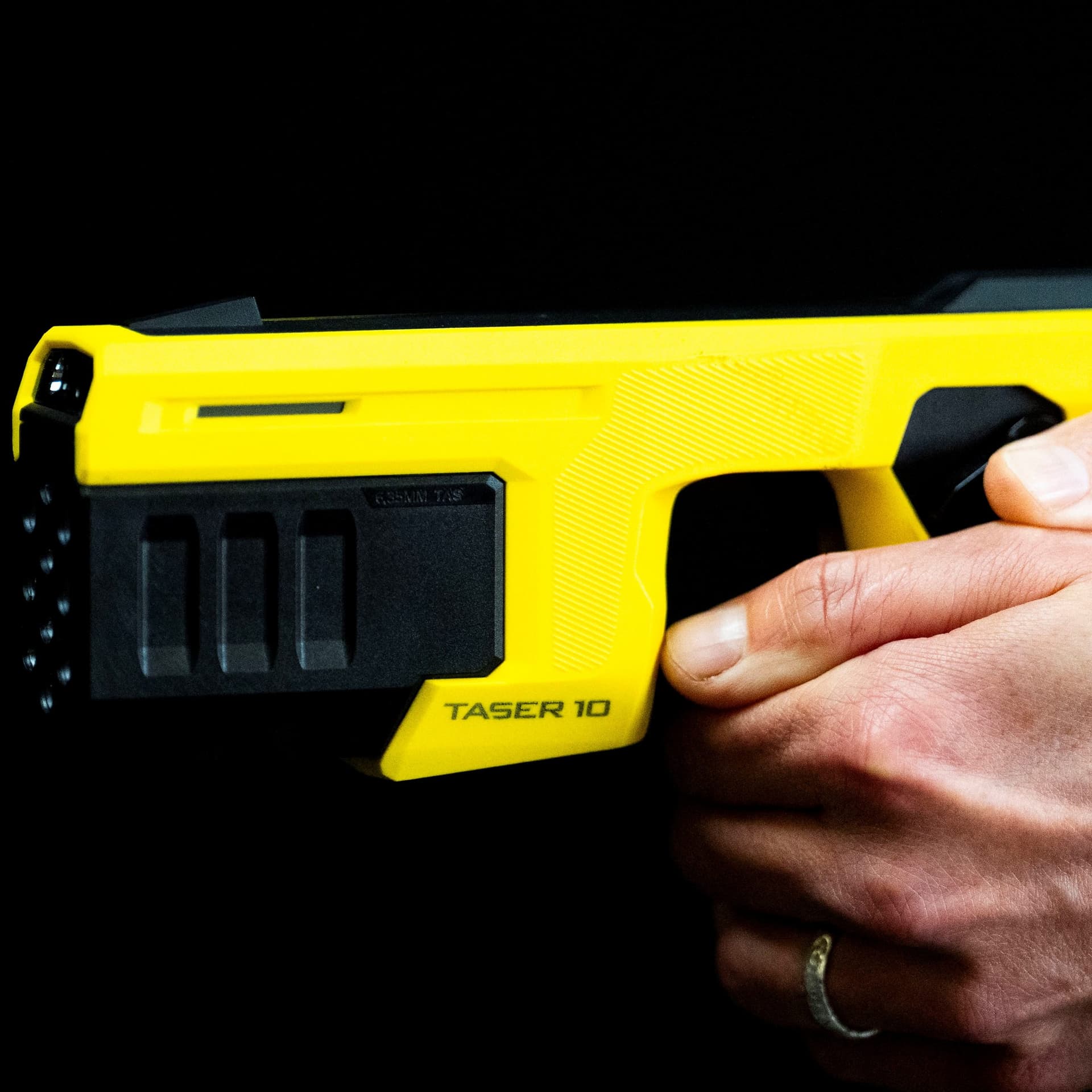
(Image: A close-up photo of a Taser being aimed. Credit: Jordan Pettitt/PA Wire)