In short
Growing up in the age of AI, focusing on how parents and schools should respond to AI risks and opportunities; plus two tech-for-health and tech-for-conservation segments.
Guests
Daniel Susskind, writer and economist; Gresham Professor of Business; author of What Should My Children Do? How to Flourish in the Age of Artificial Intelligence. Dr Sarah Nassari, co-founder of Quinn (menstrual-blood health tech). Carol Alexander-Reed, Airbus Global Community Impact Manager.
Key claims
AI worries are longstanding, but generative AI makes them more immediate; education should teach basics (literacy, numeracy, critical thinking) and critical use of AI rather than banning it; AI could enable personalized tuition at scale. Quinn argues menstrual blood contains systemic blood plus vaginal fluid and endometrial tissue, enabling multi-condition testing (e.g., fertility/thyroid hormones, HbA1c; in FDA trial for cervical cancer via HPV). Satellite imagery can improve forest monitoring for Tapanuli orangutans by guiding targeted ranger interventions.
Notable examples
UK “learn to code” mandate (2013) and its mismatch with today’s AI skills; Q-pad made from cotton/paper for home use; Tapanuli orangutan habitat in Batang Toru, Indonesia, with cyclone-related forest loss and satellite resolution down to ~30cm pixels.
Written by AI. May contain mistakes. Listen to the episode to check what was said.
Chapters
Tap a time to open that second in VOAI Concerns and Opportunities
0:45 to 2:36
Discussion on the rapid advancement of AI and the concerns surrounding it.
“Artificial intelligence is advancing rapidly, but the speed of that progress and fears about the harm it could cause if things go wrong are worrying many people, including senior figures within the AI industry.”
Interview with Daniel Susskind
2:36 to 5:04
Daniel Susskind discusses his insights on AI's impact on education and workforce.
“I've been speaking to Daniel Susskind, a writer and economist who spent years examining the impact of technology on work.”
Preparing Future Generations
5:04 to 7:30
Exploring how to prepare children for an uncertain future with AI.
“Do you think it's possible to future proof them to new technologies like AI?”
The Role of AI in Education
7:30 to 11:16
The potential of AI to enhance learning and the importance of teaching critical skills.
“And one of the worries that I have is that since 2009, around the world, literacy and numeracy in particular have been on the decline.”
Understanding Menstrual Blood and QPAD Technology
14:00 to 19:30
Learn about menstrual blood's unique properties and the capabilities of the QPAD for health testing.
“And in simple terms, what is menstrual blood made up of?”
Conservation Efforts for Tapanuli Orangutans
19:30 to 20:45
Discover the challenges faced by Tapanuli orangutans and how technology aids in their conservation.
“Now, would you like to hear the sound of an orangutan swinging from a tree in an Indonesian forest?”
The Role of Satellite Imagery in Wildlife Protection
20:45 to 26:10
Understand how satellite technology helps monitor and manage ecosystems for endangered species.
“Airbus will provide them with imagery from satellites they operate in orbit around Earth and other tech expertise.”
Transcript
Automatic transcript. May contain errors.0:00This BBC podcast is supported by ads outside the UK.
0:30and more options to their lineup, can shop at machinefinder.com. Boo-yah! Hello, I'm Shona McCallum. Welcome to Tech Life, the program about technology and how it can change lives. Artificial intelligence is advancing rapidly, but the speed of that progress and fears about the harm it could cause if things go wrong are worrying many people, including senior figures within the AI industry. So what should parents and children make of it all? And how can young people navigate school and future careers when AI is becoming increasingly important? That's in a moment. Later, I find out how one piece of health technology is helping scientists uncover disease-fighting data in menstrual blood.
1:17And rare orangutans in Indonesia are losing their forest habitat. We hear how satellite images are helping wildlife experts protect their home.
1:45How are you feeling about artificial intelligence at the moment? You've probably heard the latest warnings about its potential to go rogue and even threaten the future of humanity. In the past week, we've heard concerns from a former researcher at an AI company, then bosses from some of the biggest firms, called for a slowdown in the development of the technology. Politicians have been weighing in too. It's all created, well, a lot of this. Artificial intelligence could kill everyone by the end of the decade. A series of alarming warnings from AI researchers. A potentially dangerous progress of artificial intelligence.
2:20Blow down the pace of developing artificial intelligence or risk losing control of it. For Tech Life, I recently looked at how we can protect children from threats online. So is AI the next thing parents need to worry about, or should we be embracing the opportunities it offers? I've been speaking to Daniel Susskind, a writer and economist who spent years examining the impact of technology on work. He is the Gresham Professor of Business and the author of a new book, What Should My Children Do? How to Flourish in the Age of Artificial Intelligence. Given all the latest warnings about AI, I began by asking Daniel, should we be allowing it anywhere near school classrooms?
3:02What's interesting about these new statements is that actually the underlying worry is not that new. People have been writing and talking about the harms, the risks of these technologies for some time. I think what has really happened, though, is that in the last few years with the arrival of first generative AI and then in the last few months with some of the particular applications, I think some of those worries that seemed a bit hypothetical and a bit science fictional now seem to be, you know, far more practical and immediate. I mean, what I'd say is this, is that as with almost every important technology of the 20th century, the technology has two faces.
3:51On the one hand, it has harms and risks. But on the other hand, it also has a promise and potential too. And I think the same is true of artificial intelligence as well. This technology can be used for bad and we've got to try and control and mitigate the bad. but also it can be used for good as well. And I think one of the most important ways that we can use it for good is in education. So tell us about your book then and what did it set out to do? So I've been thinking and writing about the impact of technology and particularly AI on work and society now for 10 or 15 years. And I mean, this work has taken me all around the world to talk to very different groups of people and very different organisations.
4:33And time and time again, though, I've stood up and I've spoken about artificial intelligence and people have come up to me afterwards and said look Daniel that's all very interesting but what on earth should my children do yeah how should we prepare the next generation for this world that you're describing and so that's what I'm trying to do in the book I'm trying to explain not simply how we prepare children but how all of us can prepare for this for the age of artificial intelligence. And let's just focus on children then for a moment Do you think it's possible to future proof them to new technologies like AI?
5:11And how are they going to get prepared for that next challenge? We live in such an uncertain world where it just isn't possible to predict with any confidence the sorts of jobs, exactly the sorts of jobs that are really going to be in demand. And one of the stories that I tell, which I think is a good way of capturing this, is back in 2013 here in the UK when David Cameron, who was the then prime minister, announced that all primary and secondary school children up and down England were going to learn to code. It was mandated. And it wasn't just in the UK. Many, many other countries around the world followed suit.
5:55Fast forward a decade, though, and what does it turn out that these systems, Claude, ChatGPT, Gemini, whatever it might be, what does it turn out, not simply that they're good at doing, but what they're best at doing, writing code. So it turns out that precisely the thing that we thought would prepare the next generation to flourish for the rest of the century barely lasted until they'd finished school. What we've got to do is not try and think really deeply and carefully about the future and resolve all this uncertainty, but take the uncertainty as given and ask, how can we prepare the next generation for a future that actually we don't know that much about?
6:32And so what are the possibilities then if we embrace AI to help our children learn then? We can use these technologies to help the next generation understand ideas, solve problems, perhaps make discoveries that would have just been out of our reach until recently. And that, for me, is the sort of exciting possibility of this technology, that we can use it to empower the next generation and really help their lives go much better. And AI can also help with some of the fundamentals with teaching, literacy and numeracy. I mean, do you think it could have an active role in the school, in the classroom, on a laptop?
7:12I think so, yes. However the future turns out, And whatever the advanced skills of the future turn out to be, we know that those critical skills, literacy, numeracy, critical thinking, those basic skills are going to be in demand. And so I think, you know, an important starting point is getting back to basics. And one of the worries that I have is that since 2009, around the world, literacy and numeracy in particular have been on the decline. So I think the idea that we need to teach the basics, I think, is really important. But you also asked the question, does this technology have a role in the classroom?
7:49And I think it does. One of the arguments of the book is that it's important to remember that social media is not the same thing as artificial intelligence. You know, I have a lot of worries about social media and I'm very supportive of many of the restrictions that some of the campaigners against social media for young people have at the moment. But artificial intelligence is not the same thing. And what I worry about is that legitimate concerns about social media and well-informed restrictions on the use of social media seep into a sort of conservatism with respect to technology in general. And we've seen this in the last few years with various kind of knee-jerk bans on the use of, you know, chat GPT, for instance, in the classroom.
8:33And I think that's a mistake. I think there is a role for these technologies in the classroom. There's a lot to go at here. You mentioned schools banning social media. I mean, some are actually banning AI. Others, we've heard in the programme, are embracing it. Do you think a prohibition now is simply just unrealistic when it comes to AI? There is a sense in which it's unrealistic because so much learning happens outside the classroom and the teacher can't be sitting at a child's side as they do their homework, for instance. But the deeper point, though, is that it's also just letting down the next generation if we don't teach them how to use these technologies and how to use them to flourish.
9:15I mean, one of the things I'm very excited about, for instance, is the promise of personalised tuition. We know that an average student who receives one-to-one tuition will tend to outperform most of their fellow students in a traditional classroom setting. But the issue, of course, is that one-to-one tuition with a human tutor is just unaffordable. We can't offer it at scale to everyone. And that's why these generative systems in particular are so exciting, because they offer us the promise of tailoring what we teach, how we teach, to the particular strengths and weaknesses of the student in question.
9:49With these systems, they're just focused on you. They pay attention to you. They take your questions. They answer your questions at three o 'clock in the morning. The blunt point that I make is that, you know, in truth, I think these systems at personalising education are better than 95 % of the teachers that I've seen. And I include myself in that. Obviously, you're an AI optimist. I can hear that with everything that you're telling me and the examples you're giving me. But we know that these systems can also confidently give children false or biased information. I mean, when do you think it's safe to trust it?
10:24It's not enough to just blindly teach people how to use this technology. We ought to be spending about a third of our time now in education teaching people how to use these technologies critically. And that means not taking everything that they say for granted. It means interrogating it. It means understanding their biases and their limitations. And it's really important that we, you know, we teach the next generation to, you know, take a critical active stance with respect to these technologies, to always be, you know, pushing back and trying to, you know, being able to tell when these technologies are behaving idiotically.
11:01If the next generation don't have these basics, literacy, numeracy, critical thinking, they're not going to be able to tell when these systems are behaving wonderfully or when they're behaving mistakenly. And that was Daniel Susskind, a writer and economist with a new book out, What Should My Children Do? How to Flourish in the Age of Artificial Intelligence.
11:31This is Tech Life on the BBC World Service with me, Shona McCallum. Scott has emailed us from Australia. He was listening to last week's episode, which included highlights from Gamescom in Germany. Scott writes, I noticed there wasn't a mention of Grand Theft Auto 6 during the segment. Well, hi, Scott. We have mentioned it in some previous gaming items, but I have a feeling you'll be hearing a lot more around November time when GTA 6 finally launches. Thanks for getting in touch. If you want to contact us, you can reach us by text or voice note on WhatsApp. The number is plus 44 330 1230 320. Remember to include your name and the country where you live.
12:13You can also email us at techlife at bbc.co.uk is our address. I'll repeat these details again at the end of the show.
12:28For around half our listeners, periods will be a familiar part of life and one that can be challenging in all sorts of ways. Most women will have used a sanitary pad at some point but what if, instead of simply absorbing menstrual blood that pad could help reveal valuable information about your health and gather data that could lead to disease breakthroughs. The Q-pad contains a small removable strip that collects a sample while it's being worn. The strip can then be pulled out and sent to a lab for testing. Dr Sarah Nassari is the co-founder of Quinn, the company behind it. We want to talk about Quinn and menstrual blood, which has historically been treated as waste.
13:10What first made you think it could be medically valuable? The idea behind Quinn to utilize menstrual blood is actually an idea I had while I was still in medical school. One of the issues that I saw is that it's actually really hard to know what's going on in our bodies when we are outside the doctor's office. And so blood being the most commonly used bodily fluid for any diagnostic, the next thought really was, well, how do we get access to that? And again, that's invasive. You have to go into a medical environment. You need professionals to help you with the blood draw. And that's sort of when it hit me that, hold on a second, half the world bleeds every month.
13:47Why haven't we looked at that? And then I was surprised and perhaps shocked to see how little information was published on even the composition of menstrual blood, let alone what the clinical utility could be for women. And in simple terms, what is menstrual blood made up of? And what can it reveal that a conventional blood sample cannot? It's a very unique bodily fluid in that it consists not only of systemic blood, so what we use when we do a venipuncture, but also has vaginal fluid and endometrial tissue. So you really have these three components present in one sample. And we know that there's a little bit less than 400 unique biomarkers in menstrual blood that are uniquely sort of representative of the reproductive organs.
14:43even though in the last 10 years we've come far in understanding what it is, we are still just scratching the surface of understanding how this can be useful for women globally speaking. And what can somebody genuinely test for with the QPAD today? We know that the QPAD can test for things like fertility hormones, thyroid hormones, of course hemoglobin A1c. we are currently in an FDA trial with our collaborators on cervical cancer screening. So it's something we've published on. We know we can detect the virus that causes the cancer and we are far enough in that conviction that we are now taking it through the appropriate regulatory bodies.
15:28With one cue pad, can you test for more than one condition? Yes, so we can test for multiple conditions. And I think one of the beauties of this product really, and the way that we've designed it is that we are actually collecting quite a larger volume of blood, even enough that we can actually biobank those samples and do sort of research on the samples even after the fact. I'd love to ask you about attitudes, because I wonder if you have had any resistance, simply because many people are uncomfortable handling menstrual blood. And obviously, say I'm not talking about women? We've had a fair deal of resistance, certainly, I would say, in particular in the early days of Quinn.
16:16There was a lot of scepticism. And there was even, you know, from the medical community, this sense of that's gross. And why would you do that? We've certainly come very far since then. The conversation is no longer about opinion, it's about the data. And so whether you think it's gross or not is actually irrelevant when it comes to the discussion that we are having at this point. The question is, what does the data show? Is there clinical utility or isn't there? And do we believe this has value for women's health? Do you think women's health has been held back by perhaps historically researchers not considering menstrual blood worth studying?
16:54There's no doubt about it in my mind. In fact, I think it's it's almost crazy to me that at this point in time there is so and certainly when we started Quinn there was no data on what menstrual blood was and now don't forget that this is not just women in our part of the world there's a massive part of the of women that are living in areas where there is nobody to take a cervical specimen to screen you for that high-risk HPV or to do a veenipuncture, frankly, right? And they had this superpower. Why not use it? You mentioned women in other parts of the world. Obviously, we're a global podcast and radio program.
17:35And, you know, I'm interested to know whether or not your tech could improve access in lower income communities. You know, that's the very purpose of why we started Quinn was the question of access impact. We can innovate as much as we want in healthcare, but if it isn't accessible, if it isn't economically viable in the areas where we need it the most, then I think we haven't really done much. We haven't moved the needle to where we are actually solving a problem, right? And so we very intentionally built the QPAD on cotton and paper. We wanted to make sure that it was accessible. We've done studies in rural Zimbabwe.
18:14We've done studies in Southeast Asia. we've seen the response from women not just in terms of sort of is it accessible but also is it simple enough is it comfortable enough that women can actually handle that that responsibility that I will say it is the moment we take health care and the responsibility of performing a test or a collection of blood and we say now you're doing it in a home without supervision it has to be very very very simple and I think the QPAD solves for that because it's it's I remember having this discussion with our FDA review team in terms of the instructions needed for women and we had this instruction I'll show you this is the instruction booklet right now which you know for any medical product you really need quite detailed instructions and the feedback from women were you don't need to tell me how to use a menstrual I know how to do that and my male review reviewer I was like, it is just very, very simple.
19:15Women do it from their 10 years old. So in that way, I think it's a very powerful body fluid, I think, that has the potential to have a global impact and make healthcare accessible. Absolutely. And that was Dr. Sarah Nassari, the co-founder of Quinn.
19:43Now, would you like to hear the sound of an orangutan swinging from a tree in an Indonesian forest? I thought you might.
19:59It does sound rather relaxing, doesn't it? Well, the Tapanuli orangutan is the world's rarest great ape and one of the most endangered primates on Earth. Fewer than 800 are thought to remain in the wild and their only habitat in northern Sumatra is under growing pressure from deforestation and the fragmentation of its forests. But that could be about to change. Now technology in space is being used to help protect them. Airbus Foundation, the non-profit branch of the Planemaker and the charity Connected Conservation Foundation have selected six projects around the world as part of their Satellites for Biodiversity awards.
20:40One of the six projects is run by local environmentalists in Sumatra helping the orangutan. Airbus will provide them with imagery from satellites they operate in orbit around Earth and other tech expertise. Carol Alexander-Reed is Airbus Global Community Impact Manager in Toulouse, France. She told me more about the local project. Yeah, so this is a small organisation called the Yayasan Ecosystem Lestari, so we call them YEL for short. They're working to support a specific ecosystem in North Sumatra in Indonesia, in Batang Toru, which is an expansive area of almost 2 ,500 kilometres. and within that ecosystem there's various species that survive and thrive there, one of which is the critically endangered Tapanuli orangutan.
21:30So the project that we have with them is really to look at the ecosystem preservation to enable that species of orangutan to be able to survive. And tell me about these orangutans then and is there only known habitat in Indonesia itself? Yeah, so the Batang Toru is the only place on Earth that this type of orangutan call home. So they're the rarest great ape on the Earth. And there's around 800 of these great apes remaining in the wild. The ecosystem that they really depend on to feed, to breed, to live is under threat through various factors. And so we work with that organisation to provide them with the data that they need to be able to make management decisions around how to improve that habitat.
22:21And you mentioned they're under threat. I mean, what pressures are the orangutans facing? There was a significant episode in November 2025 where a cyclone hit the region. 6 ,000 hectares of intact forest was destroyed by flooding and landslides. and that actually killed around 11 % of the local orangutan population. But then there's also human-induced pressures. So as agricultural land expands, there's mining activities in the region, there's infrastructure development, and that's putting pressure on the overall ecosystem, but on the ability of the Tapanuli orangutans to be able to thrive within that ecosystem because they're struggling now to move between connected spaces.
23:10Why do we need satellites here? What satellite imagery brings is the expanse of area that you can view from space. So you can see at landscape scale what's happening. And then that allows for when it's boots on the ground that we can target those interventions. We use resources effectively. We use data to inform which areas need to be checked because the imagery is showing that there are certain changes that might have happened. So if there's a clearing, for example, that becomes visible on satellite imagery. The local rangers, the local conservationists know exactly where they need to go to be able to verify what's happening, whether it's something natural or whether it's something that needs more urgent attention.
23:57And how often does that happen then, that the satellite photographs are then used to spring into action, boots on the ground or a field survey or a deployment? The beauty of satellite imagery is that you can make it as frequent as you want. So you can pass and take imagery on a regular basis, but you can also do that over time. And so that you can monitor the different changes over time. So for this type of project, we're looking at developing a kind of more responsive and effective forest monitoring system over time that looks at things like recent deforestation and fragmentation. What are the drivers of different types of habitat change?
24:45Areas where these connected, these corridors that the animals need to use, where that might be declining. And then be able to use that data to then prioritize the action. And the images are at 30 centimetre resolution. What does that mean or look like for non-experts like myself? If you imagine a pixel, so we all know what pixels look like. And if you have kids from Minecraft, what a block looks like. So a 30 centimetre resolution means that one pixel is measuring 30 centimetres of area. And so if you imagine the size of an A4 sheet of paper, the length of that, That's the type of granularity that you're able to see.
25:28So if you are looking, for example, at 10 metres of satellite imagery, that would be one pixel measuring 10 metres of area. And so in that context, you might see blocks. You might see coloured blocks. When it's 30 centimetres, you can actually see tree canopy. You can even identify species. you can identify tracks in the road. So if there's tracks in an area where you wouldn't really expect to see them, that might trigger an approach where you look into whether there's some illegal activity going on in that area. So it really gives you the granularity that you need. And that's Carol Alexander-Reeds, Airbus's Global Community Impact Manager, speaking to me from Toulouse in France.
26:18Well, it's time to wrap up today's Tech Life, AI, periods and orangutans. I think it's fair to say we covered quite a lot on the programme. If you'd like to contact us about anything you've heard, you can email us. The address is techlife at bbc.co.uk. Or you can WhatsApp us on plus 44 330 1230 320. You can also send us a voice message. Please include your name and where you live. Today's Tech Life was produced by Tom Quinn and presented by me, Shona McCallum
From the publisher
AI is developing rapidly. What should parents and children make of it all? And how can young people navigate school and future careers when AI is becoming increasingly important? We speak to an expert who has written a new book about these issues.
Also this week: we find out how one piece of health tech is helping scientists uncover disease-fighting data in menstrual blood. And satellite imaging is helping conservationists in Indonesia protect the habitat of a rare species of orangutan.
Presenter: Shiona McCallum Producer: Tom Quinn
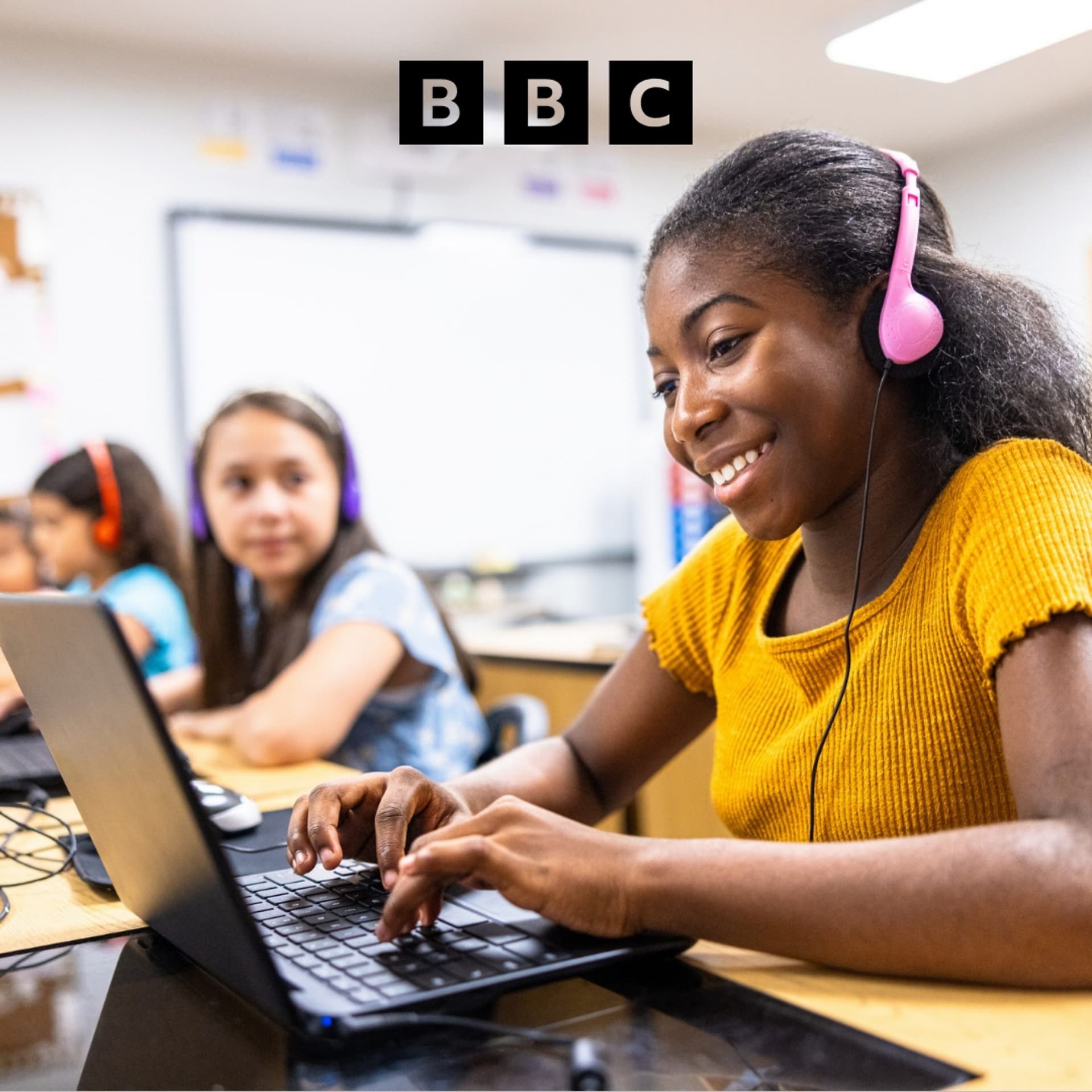
(Photo: A female school pupil sits at a laptop in a computer lab. She is wearing headphones. Credit: Getty Images)