In short
How AI could help healthcare, including better diagnosis, freeing clinicians from paperwork, shifting toward prevention using wearables, and extending support in low- and middle-income countries; plus two other health-tech stories: menstrual health access and a child-safety “good news” case from the internet.
Guests and backgrounds
Dr William Waugh, public health expert and visiting professor at Imperial College London and affiliate researcher at Cambridge University. Amber Vaudigel, founder of 28X (menstrual health tech) and previously Pregnancy Plus. Omar Abu Bakr, 15-year-old student and general manager of Guidexa, a student-led startup building a smart safety vest for visually impaired people. “Mabel” (Internet Watch Foundation analyst; name withheld) and BBC cyber correspondent Joe Tidy.
Key claims
AI can outperform humans in some image-heavy diagnostic tasks, but needs human oversight. AI could enable earlier prevention via blood/wearable signals and reduce inequities if regulated. Period tracking apps often exclude most women via paywalls or data-for-advertising tradeoffs; 28X avoids cloud storage to protect sensitive period data. The IWF case shows identification can happen via recognizing a school uniform badge.
Notable examples
AI transcribing GP consultations and auto-filling records; wearables predicting heart/dementia risk; a proposed AI chatbot pilot for community health workers. 28X: free, private, clinically informed tracker with no cloud servers. IWF: tracing a long-searched victim after spotting a school uniform/logo in “Category A” material.
Written by AI. May contain mistakes. Listen to the episode to check what was said.
Chapters
Tap a time to open that second in VOAI in Healthcare: Challenges and Opportunities
2:15 to 4:04
Explore how AI can influence healthcare and the challenges it faces.
“to something that we've been seeing for years and years and years and one that we don't always get a result.”
The Role of AI in Patient Care
4:04 to 6:27
Discuss how AI can improve doctor-patient relationships and diagnosis.
“I guess people would think that, you know, the last place we would trust machines is medicine, because it's so human, isn't it?”
Moving Toward Preventative Healthcare
6:27 to 8:04
Learn how AI can shift healthcare from reactive to preventative measures.
“and perhaps using AI in that way when we look at people that are using and wearing wearables, for example?”
Health Equity and Accessibility of Technology
8:04 to 9:21
Discuss the risks of health inequity with new technologies.
“devices to track their sleep, monitor their heart rates, look at their oxygen levels.”
Empowering Healthcare Workers with AI
9:21 to 11:20
Explore how AI can enhance healthcare delivery in low-income settings.
“and supported by governments, that it will just be the rich, worried well that benefit from these technologies.”
Innovative Solutions for the Visually Impaired
12:24 to 14:04
Learn about a student-led startup creating safety vests for the visually impaired.
“This is Tech Life from the BBC World Service with me, Shona McCallum.”
Independence and Innovation
14:04 to 14:21
Discussion on the mission of the team behind the products.
“At the end of the day, we don't look at ourselves like we are a bunch of students building products.”
Child Abuse Case and Recovery
14:40 to 21:00
A discussion about a girl's recovery from child sexual abuse material.
“unfortunately, dark places on the internet.”
Inequality in Health Tech for Women
21:17 to 24:45
Exploration of the disparities in menstrual health tech and its impacts.
“period tracking apps ai powered health tools and wearable devices promise personalized care yet many sit behind paywalls or rely on expensive hardware.”
28X: A New Approach to Menstrual Health
24:46 to 27:09
Introduction to 28X, a free, privacy-focused menstrual health app.
“So this is the first app where nothing is shared with a cloud server.”
Transcript
Automatic transcript. May contain errors.0:00This BBC podcast is supported by ads outside the UK.
0:30customers get 15 % off their first order. That's K-A-C-H-A-V-A dot com code NEWS. Craving the coffee flavor you love, but without the caffeine? Cachava's got you covered with their newest coffee flavor. This all-in-one nutrition shake delivers bold, authentic flavor crafted from premium decaffeinated Brazilian beans. Quality nutrition shouldn't be complicated. Just two scoops of Cachava's all-in-one nutrition shake, and you've got 25 grams of protein, 6 grams of fiber, greens, and so much more. Whether you're craving that coffee taste to kickstart your morning ritual, or as a nutrient-packed reward to round out your afternoon, cachava keeps you fueled and satisfied wherever your day takes you.
1:10Plus, it actually tastes delicious. No fillers, no nonsense, just the good stuff your body craves. And for the times you feel like switching it up, you've got seven flavors to choose from, all with the highest quality ingredients. Treat yourself to the flavor and nutrition your body craves. Go to Kachava.com and use code NEWS. New customers get 15 % off their first order. That's K-A-C-H-A-V-A.com, code NEWS. Hello, I'm Shona McCallum, and welcome to Tech Life, the program about technology that's making a difference to lives all over the world. In today's edition, we're looking at two different areas of health tech, something we know you, our listeners, are very interested in.
1:54In a moment, I'll be discussing how far the use of AI has evolved in healthcare so far and what it might be able to do for us in the future. A little later, I'll be speaking to a businesswoman who's trying to make female health tech more accessible and affordable. And I'll bring you a good news story that originated out of the darker side of the internet. It was a really lovely outcome to something that we've been seeing for years and years and years and one that we don't always get a result.
2:43artificial intelligence is moving into every corner of our lives but health care is a whole different challenge. From Paris to Cairo, doctors face life or death decisions every day. So how could AI help health professionals work smarter, catch disease earlier and even change the way people around the world look after themselves? Well to help us explore the opportunities, the risks and the ethics of AI in medicine is Dr William Waugh, a public health expert and visiting professor at Imperial College in London and an affiliate researcher at Cambridge University. I started by asking him what makes medicine uniquely difficult for AI compared to other professions.
3:28I think the whole world is super excited about AI changing this or that profession and healthcare may be the hardest test because you have layers of regulation, you have real life and death scenarios. And you've also got a very human core. When you think about healthcare, it's nurses, doctors caring for individual people with real compassion. And I think a lot of people would assume that may be one of the hardest areas to automate with a computer. I guess people would think that, you know, the last place we would trust machines is medicine, because it's so human, isn't it? And that's so important, that relationship with the doctor or the nurse.
4:17Yeah, exactly. But at the same time, there is really promising research that in some scenarios, AI could really help doctors and nurses get more accurate diagnoses. And in some scenarios, AI acting alone has shown ability to even outperform doctors. So for example, when you have huge amounts of complex information, lots of scan images, sometimes computers are very good at synthesizing this type of information sort of much more efficiently than a human can. You know, computers don't get tired, they're very consistent. But then at the same time, it's still good to have a human doctor overseeing these interpretations to come to an accurate diagnosis and recommendation for treatment.
5:12If AI lets doctors do more work, who do you think benefits first? Is it the patients, the clinicians or the health systems that are trying to cut costs? Well, hopefully everyone could win if it's done in a careful manner. Now when you go to a GP, your doctor, rather than looking at you, is looking at a screen and filling out a checklist. And I think AI could actually change that dynamic and rebuild a stronger relationship with patients, because you could have it recording in the background with the patient's consent, the consultation, and automatically transcribing the notes, filling out the records, so the doctor doesn't have to look at a computer screen and it could actually facilitate a better relationship with the patient.
6:04So in that sense, I think everyone could win. You can imagine a future where the technology advances more and it could really free up time and also free up time from perhaps more mundane tasks that doctors are doing, which is not really about caring for patients. It's just about filling in forms. It could take that off their desk. What do you think about shifting medicine from this reactive to almost preventative and perhaps using AI in that way when we look at people that are using and wearing wearables, for example? Yeah, that's one of the areas I'm most excited about. If you think about modern health systems, most of the budget, most of our taxes, they all go on late stage sickness.
6:53It's really a sickness service. 90 % of the budget is spent on hospitals, on treating sick people, when probably the most important thing we can do is shift from this reactive sickness service to a early stage prevention service, which allows people to stay well for longer. and we know that like the biggest diseases that everyone catches are like heart disease, dementia, other neurodegenerative conditions. They take about 15 to 20 years incubation time in your body which means you have the disease developing before you have noticed symptoms and what's super exciting is there's a lot of new technologies that are allowing us to find early warning signs, early clues in your blood, in wearable days from the way your heart rate is changing, on the way you sleep, to allow us to predict who is most likely to get disease and then would maybe allow us to develop preventative interventions to either stop someone getting a disease at all or delay when they get it.
8:00And do you think that we are genuinely empowering patients as well if they are wearing these devices to track their sleep, monitor their heart rates, look at their oxygen levels. I mean, we know people monitor their steps, but there's a lot of detailed data you can be collecting about your everyday moves. Definitely. And I think people are already naturally starting to do this. I don't know if you're wearing a smart watch, but about half a billion people in the world are. And I think they are probably making subtle changes to their life to try and get that extra thousand steps in per day or get to bed a bit earlier to ensure they have a good amount of sleep and that's that's super important.
8:47What do you think for the kind of future then of healthcare as more and more people use and wear these types of devices but also the gulf perhaps gets bigger between people in the West who have access to these types of technologies because they come at a cost, don't they? Definitely. Yeah, with all new technologies, we need to think really carefully about enabling the people that need them most to have access to them. I'm sure there is a major risk, if not properly regulated and supported by governments, that it will just be the rich, worried well that benefit from these technologies. and not the people who may be at much higher risk of disease.
9:33And we need to work really carefully to ensure we don't widen these health inequities. I think that's very, very important. And so how do you see AI changing healthcare in low and middle income countries? Well, I think it could have a really dramatic and positive effect. I mean, one exciting area is, if you think about environments, countries which have very low numbers of doctors and nurses per head of population, you could empower community health workers to operate at a level similar to, you know, the most well-trained doctors in the world through working with an AI agent, which is trained on all the best studies and all the latest research in their pockets.
10:22And so you could create this sort of super empowered workforce in low and middle income settings that simply don't have the resource and the time to train tens of thousands of doctors. I think it could really help improve the level of care that people are given access to. And I think that's very exciting. If you were advising a health minister in a developing country then, what's the first AI investment that you might tell them to make? I think I would see if they could do a pilot with maybe community health workers and, you know, a smart AI chatbot, which has been trained on thousands of medical cases.
11:06And I would see if it could improve the diagnostic accuracy of their diseases and the treatment recommendations and allow community health workers to do more. I think, you know, probably start there. My thanks to Dr. William War there and we'll be talking more about health tech later on in the programme Turn your tax refund into a new kitchen with Menards Make this the year you checked that project off the list Renovate your space with new cabinets from Cardell They're ready to install and come in a variety of styles and finishes with free shipping to your home Visit our kitchen showrooms in store or go to menards.com for free estimates today Plus, check out our weekly flyer for all of our hot deals going on now.
11:55Save big money at Benards. When you've got Omaha Steaks' convenient everyday protein waiting at home, that what's-for-dinner panic turns into your weeknight win. And now's the time to buy during the Omaha Steaks Spring Savings Event. Save big on their exclusive lineup of mouth-watering steaks, gourmet burgers, air-chilled chicken, pork, seafood, and more. Go to OmahaSteaks.com for an extra$35 off when you use promo code AUDIO at checkout. That's OmahaSteaks.com, promo code A-U-D-I-O. Terms apply, see site for details.
12:41This is Tech Life from the BBC World Service with me, Shona McCallum. Well, what did you think of my interview with Dr. William Waugh and how far would you trust AI with your healthcare? You can email us your thoughts. Our address is techlife at bbc.co.uk. Or you can WhatsApp us a text message or a voice note. The number is plus 44 330 1230 320. Please include your name and where you live. Last week we were contacted by Omar, a 15-year-old school pupil who lives in the West Bank town of Tulkarm in the Middle East. He and some fellow students have formed Guidexa, making a safety vest to help people with sight loss.
13:24So we got in touch with Omar and asked him to tell us more about it. Well, hello BBC Tech Life. I'm Omar Abu Bakr and I'm the general manager of Guidexa. We are a student-led startup that helps blind and visually impaired people navigate safely and independently. We've designed a simple, affordable smart safety vest for the visually impaired. Our system is built within a wearable vest. It includes multiple distance sensors that detect obstacles up to several meters ahead so that they can alert the user in real time so that they can navigate safely. We also integrated motion and GPS tracking, which makes the guidance feel more reliable.
14:04At the end of the day, we don't look at ourselves like we are a bunch of students building products. We look at ourselves like we are trying to give people some independence that they lack in their daily lives. Well, thanks Omar for getting in touch and good luck with your project. And if you've got a new invention that you're working on, let us know and we might call you back.
14:30Just a quick word. If you have children listening with you right now, we're going to be talking about a difficult subject for the next few minutes. As you probably know, there are, unfortunately, dark places on the internet. Children can be groomed by predators to do things that are clearly wrong and illegal. Their images can be posted online, and a lot of the time no one knows who the youngsters are, making it hard to find them and help them. But there is some good news a girl who appeared in hundreds of child sexual abuse images and videos has been tracked down after years of searching by internet safety experts.
15:08The victim who is now a young adult was found after researchers saw a picture of her school uniform. Investigators from the UK's Internet Watch Foundation or IWF first saw the girl in abuse material in 2020 but back then they had no way to find her. The BBC's cyber correspondent Joe Tidy has spoken to the analyst who spotted her uniform. Hi Joe, what do we know about the child involved here? What we do know is that she is now a young woman, so we can guess 18, 19 years old. And what we know is that the content that the IWF were seeing from around 2020, so for the last five and a half years, they've seen this poor girl's pictures and videos pop up on their screens whenever they've been carrying out these investigations into child sexual abuse material they think that she was around 13 or 14 in most of the the content that they have come across what happens is these predators they will groom a young girl or a young boy on a social platform normally and then move to some sort of encrypted channel and then they'll have video calls with them and they'll they'll you know encourage them to do various things and some of this stuff was the most severe the most extreme of the categories that the IWF comes across, which is Category A, which is extremely serious and horrific content.
16:27And tell me about the Internet Watch Foundation and the analyst who identified this young victim. Yes, so the analyst wants to be called Mabel. That's not her real name. What they do in the IWF is very sensitive work. Finding and removing child sexual abuse material off the internet is really, really important and really nasty work. and Mabel said that she joined the IWF about five years ago and this girl just kept popping up in the stuff that she was categorising and getting taken off the internet and she always wondered who the girl was and the face really stuck in her mind. So Mabel was then able to trace this girl because she spotted a school uniform.
17:11Tell me about that. Obviously their main priority at the IWF, the Internet Watch Foundation, is to find, either proactively go out hunting for this stuff or to go through public reports of child sexual abuse material and get it taken offline. And they do that by looking at it, categorising it and then giving it a hash number, so identifying it and then that goes into a giant database that's run by the police and social networks and internet service providers are able to access those hashes to make sure that kind of content doesn't spread. And Mabel was given a case in January. she was given some files to look through of what they call a cyber locker, which is kind of like a cloud storage type service.
17:51And the public report was that this is child sexual abuse material. But Mabel looked inside it and actually that the images were innocuous. They were not illegal. They were pictures of a young girl. And one of the folders had a name on it. And Mabel looked at it and she recognised instantly the girl that she had been seen in the other illegal material over the last few years. and she used a glimpse in one of the pictures of the girl of her school badge, so the emblem on her school blazer, and she started looking into who this girl might be. Immediately I opened the folder. I recognised the face of a child in the folder from one of these sites that I've been actioning over and over and over again over the last few years.
18:35I just opened all the material in this folder and they were all benign images. However, the images were in a school setting. So I just did a very quick Google search of the images, of the logo, and I managed to pin down where this school was. And we did a search, along with my colleagues, of the police database of child abuse imagery to see if this young girl had an ID in there, a victim ID, to see if she'd been safeguarded. and she was indeed in there but not as a recognised victim so no name so we reported what we knew to the relevant police force what usually happens is we don't often get to hear what the outcome is but in this instance within a few days we heard back from the police force concerned that they'd been able to trace the young girl.
19:39She was a young teenager in the images and she was now a young adult. So after the girl was traced, what then happened to her? Well, Mabel said that normally, you know, it's very rare to get enough details to put in a report to the police, say we think we might have an identity on this person. But when that does happen, often they kind of hand the reports in and then get on with their work and they never hear anything back. But what was really nice and rewarding for the team in this case was that within three days of saying we think this is the girl here the police got in touch and said we have found her we are offering her all the support that she needs you know safeguarding that kind of thing and there's kind of been a bit of a mediated conversation between Mabel and the victim which has been a real lovely moment for the team at the RWF who don't normally have that kind of interaction with the victims they they help.
20:29She had never been offered any support because she'd never reported the abuse. So she was offered support and she was really relieved that we, the IWF, were continuing to remove images that were found of her. So it was a really lovely outcome to something that we've been seeing for years and years and years and one that we don't always get a result. Thanks to Mabel there and thanks Joe, our cyber correspondent. Nice to chat to you, Joe Tidy. Thanks, Shona.
21:16so we know that health tech is booming but critics say much of it is leaving women and girls behind period tracking apps ai powered health tools and wearable devices promise personalized care yet many sit behind paywalls or rely on expensive hardware. Amber Vaudigel is the founder of 28X, a new menstrual health tech platform designed to be completely free, private and accessible to women, no matter where they are in the world. She previously founded Pregnancy Plus, now the world's largest pregnancy app. The technology today is mainly built around making women the product, The incentives are wrong.
22:02So they are built for women and they all start with good intentions, but there is very little choice. Everything nowadays is subscription-based, it's optimised for the top 5 % of society and I think we can do better. So it's built for the affluent women. Period tracking apps are some of the most widely used health apps in the world, Yet, as you allude to there, many of them charge those subscriptions. Why do you believe that paywalls in menstrual health create inequality? Well, the majority, the 80%, does not have$5 or$10 a month spare just to get insight into their health data. And the other side is that then apps are free.
22:49but then they have to share their most intimate data with advertisers. So it's a trade-off between paying for content and access or sharing your most intimate data. And period data is one of the most sensitive data out there that is of huge value to advertisers. And I think based on the models that we have, there is a much more improvement that we can make there. And so ultimately, femtech products then are built for Western high income women. What's missing for girls and women in minority language groups and those that are using health tech perhaps for the first time? What's missing is it's not optimized for minority languages because they don't convert to subscriptions.
23:38It's not optimized for the visually impaired. It's not optimized for the 12-year-old girl that wants to learn about her period for the first time. It's not optimized for the lower-middle-income countries. We're forgetting the 80 % in society. And the 14-year-old girl who has questions about her period, but English is not her first language, there's a cultural taboo to speak about this at home she doesn't want to bring it up at school where's she going to go so she they go to the app stores to download an app and then the first thing they face is a choice between sharing your data with advertisers or paying for a subscription and that's the five dollars she doesn't have so tell us about 28x then because that's your newer venture.
24:26What problem are you trying to solve that existing apps aren't addressing? We are building with 28x the first free, completely privacy safe, but clinically informed period tracker that keeps all your personal health data exactly where it belongs and it's on your phone, so not on service. So we basically give users the power back over their own data, but it also looks beautiful it's easy to use you can learn about your health but without having to pay for a subscription without your data being shared with advertisers the large language models are getting quite powerful ai is quite powerful and we need to protect users from a future where all your data can be used in ways that we can't foresee yet and how are you doing that then We don't have the data at all.
25:18So we eliminated all cloud servers. So this is the first app where nothing is shared with a cloud server. It's almost like a vault app. So you can read any article about any topic, whether it's sexual transmitted disease or whether it's about domestic violence. So there's lots of content in the app. But nobody knows what you click on, where you look at, because there's no link to a cloud server. It's completely closed off. we thought let's fix the architecture because we don't have your data. So we can't be hacked, we can't be summoned because we simply don't have it. If a government wants to in Pakistan or wherever says we'd like that data, we don't have it.
25:58So we can't share it no matter what pressure is put on us. So why were those design choices so important to you? It's a woman's data and it belongs to her. So signing up for some T's and C's that you don't understand and that by default everything lives on a cloud server is a bad idea in the first place. But with large language models and how powerful AI is going to be in the future, we need to protect users as well. Because if you give your most intimate data to advertisers or large language models, my question is, who's going to get the job in the future? The woman looking to get pregnant or the one who isn't, who will get the better health insurance, the woman who declared her endometriosis or PCOS to a large language model or the one who didn't.
26:48The micro profiling is something that's going to come our way and it's very hard for users to understand this. So it's our duty to protect users and make sure that that data stays with them. You've spoken about Pregnancy Plus, obviously that platform growing and being used by millions of women. I just wonder if you could lift the lid a little and tell us a bit about that journey and now that sense of responsibility you have perhaps to women as a founder of these types of technologies. It's an interesting question. I thought long and hard about this as well, how it formed me and how the journey went.
27:28And so it gave me a big insight in the freedom that if you can make ethical choices yourself, that's a wonderful position to be in. And then indeed, as an app developer, you're quite a techie. And then one day you wake up and you see that you have got two million pregnant women a day on the platform. You feel that responsibility. And I never expected to have that. For me personally, I felt that that came with a big obligation to do the right thing. That was Amber Vodigil, the founder of a new app called 28X, which will be internationally available from the summer, rolling out to 100 countries and in 35 languages over the next year or so.
28:17Well, my studio clock is telling me we've reached the end of another edition of Tech Life. Remember, you can contact us about anything you've heard in today's show. I think health tech is one of the most interesting topics that we cover. So if you've got thoughts, I'd love to hear them. Techlife at bbc.co.uk is our email address or WhatsApp us a text message or a voice memo. Our number is plus 44 330 1230 320. Please remember to tell us your name and the country where you live. Today's Tech Life was produced by Tom Quinn and presented by me, Shona McCallum.
29:13Hi, this is Alex Kantrowicz. I'm the host of Big Technology Podcast, a longtime reporter and an on-air contributor to CNBC. And if you're like me, you're trying to figure out how artificial intelligence is changing the business world and our lives. So each week on Big Technology, I bring on key actors from companies building AI tech and outsiders trying to influence it. Asking where this is all going. They come from places like NVIDIA, Microsoft, Amazon, and plenty more. So if you want to be smart with your wallet, your career choices, in meetings with your colleagues, and at dinner parties, listen to Big Technology Podcast wherever you get your podcasts.
29:48It's 2009 and we're in the German mountains. a man straps himself into a car on the world's most dangerous racetrack. He whispers to himself, It's time to put my balls on the dashboard. as he starts the engine. In 15 minutes, he's in an ambulance, unconscious. In 15 years, he's a billionaire. This is Toto Wolff, Formula One's most powerful team boss and the breakout star of Drive to Survive. This week on Good Bad Billionaire, how Toto Wolff made his billions. Listen wherever you get your BBC podcasts.
From the publisher
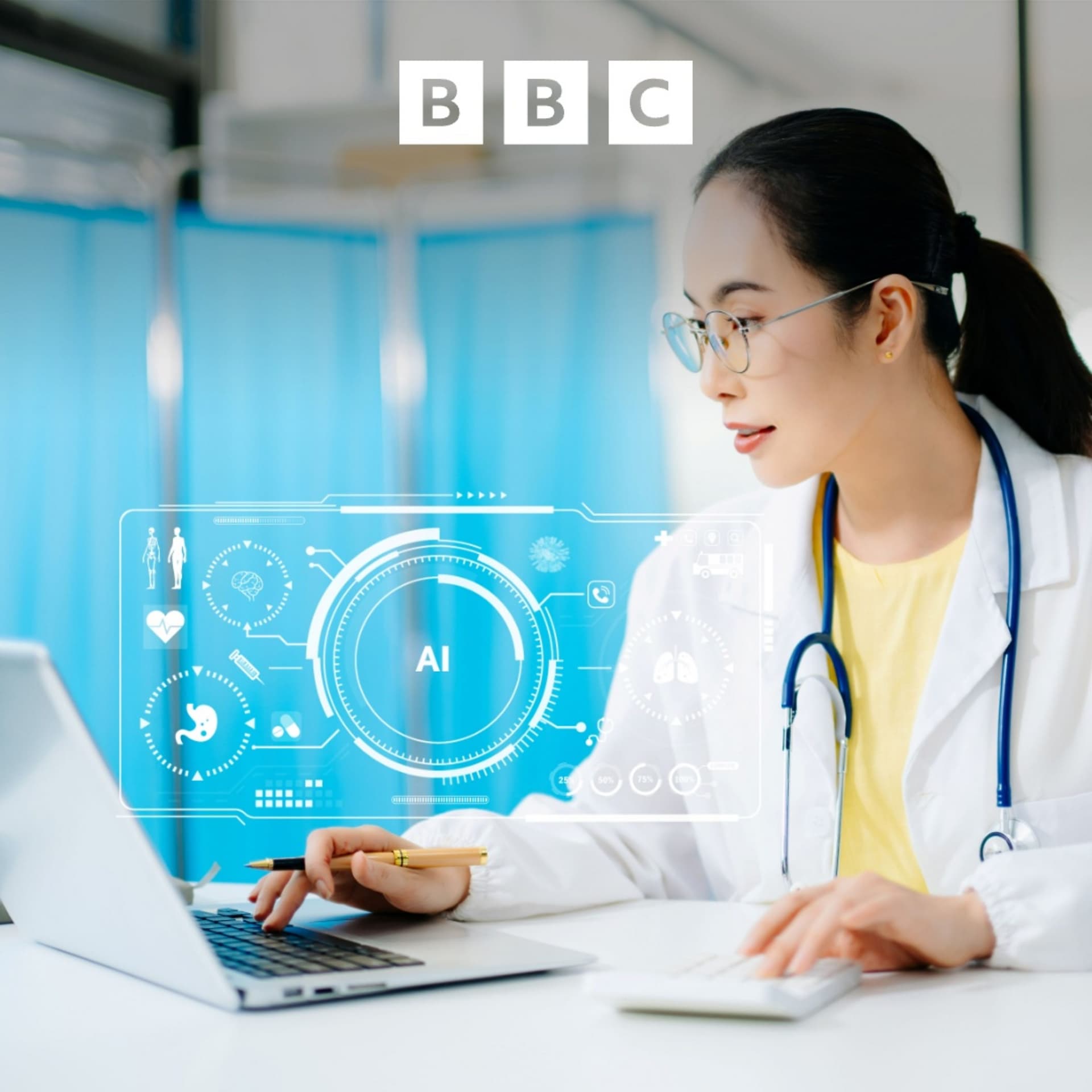
We discuss how AI could help health professionals work better, detect diseases earlier and even change the way people around the world look after themselves.
Also this week: Shiona McCallum interviews a businesswoman who is trying to make female health tech more accessible and affordable. And we have a good news story that originated on the darker side of the internet.
Presenter: Shiona McCallum Producer: Tom Quinn
(Image: A photo of a female doctor sitting at a desk in a hospital lab. She is using AI technology on a laptop computer. Credit: Getty Images)