In short
Tech Life Podcast Episode Notes: Keeping Connected
Episode Overview Presenter: Shiona McCallum Producer: Tom Quinn Episode Description: Discusses connectivity, focusing on how to maintain internet service when undersea cables are damaged by natural disasters or conflicts. Also explores the use of satellites and AI for wildlife tracking.
---
Key Topics Covered
- The Importance of Connectivity
- Underlying Infrastructure: The internet functions through a network of undersea and overland cables.
- Risk Factors: Internet cables can be disrupted by accidents, natural disasters, or sabotage, impacting global connectivity.
Notable Incident
- Damage to two undersea cables in the Baltic Sea, suspected sabotage, highlighting vulnerabilities in the network.
- Insights from Tony O'Sullivan, CEO of Retin
- Understanding of Fiber Optic Networks:
- Combines undersea cables and overland routes for connectivity.
- Utilizes fiber optics where data is transmitted via light wavelengths through glass fibers.
- Network Management:
- Provides around 44,000 kilometers of fiber optic cable across Europe and Asia.
- Maintains resilient networks to reroute data in the event of cuts.
- Challenges in Repairing Infrastructure:
- Frequent fiber cuts occur, especially in subsea cables, with repairs taking weeks to months based on geopolitical issues.
- Geopolitical Considerations:
- Current geopolitical tensions (e.g., war in Ukraine) have significantly impacted network operations.
- Shift in internet traffic routing due to border disruptions.
- Satellite and AI Use in Wildlife Tracking
- Project Overview:
- Led by Dr. Ila Deporge at Princeton University, utilizing AI to count migrating wildebeest in the Serengeti.
- Methodology:
- Traditional counting methods involved manned aircraft; AI now processes satellite imagery to provide a more reliable count.
- Initial estimates of 1.3 million wildebeest were contested by new findings showing fewer than 600,000.
- Future Implications:
- This technique can be applied to monitor other wildlife populations and could change conservation strategies.
- Innovative Connectivity Solutions: Light Beams
- Introduction to Tara:
- A company using narrow light beams for internet connectivity, providing an alternative to traditional fiber optics.
- Technology Advantages:
- Offers high speeds, low latency, and low energy consumption.
- Can connect areas where laying traditional cables is impractical (e.g., rivers, hilly terrains).
- Real-World Applications:
- Successful deployment across the Congo River, connecting two cities that were previously unconnected.
- Played a role in disaster recovery efforts, restoring connectivity post-natural disasters.
- Challenges Overcome:
- Addressed obstacles such as wildlife interference (e.g., birds and monkeys) with advanced tracking and pointing systems.
---
Key Takeaways
- Connectivity is Essential: Understanding how internet infrastructure operates is critical, especially in light of geopolitical issues.
- AI in Ecology: The use of AI for wildlife tracking can provide new insights that challenge traditional ecological estimates.
- Innovative Solutions: Light beam technology represents a promising frontier in overcoming geographical barriers to connectivity.
---
Listener Engagement
- Encouragement for listeners to share their technology experiences, especially women in tech.
- Contact methods include email and WhatsApp for listener feedback and stories.
---
Conclusion The episode highlights the complexities of maintaining global connectivity amidst challenges and the innovative technologies being developed to address these issues, both in human communication and wildlife conservation.
Written by AI. May contain mistakes. Listen to the episode to check what was said.
Transcript
Automatic transcript. May contain errors.0:00Hello and welcome to Tech Life, the programme about technology and how it shapes the world we live in. I'm Shona McCallum. This week, keeping the internet up and running. Have you ever thought about what happens to internet cables in the event of a natural disaster or wars? We look at the issues of connectivity. We also ask, are light beams a solution for carrying data? Plus, satellites and AI are being used to count migrating wildebeest in the Serengeti. The bigger finding here is that we can use this technique to monitor wildlife populations at scale. So I think it's quite exciting that we can now do this for other wildlife populations as well.
0:41We hear how tech is challenging long-standing estimates of animal numbers.
1:05Have you ever wondered how if you send an email from your phone in Nairobi, it can arrive in Auckland in a matter of seconds? Or how you can video chat with someone on the other side of the world almost instantly? Well, behind these communications that we take for granted a lot of the time lies a sprawling web of overland and undersea cables, quietly powering the internet that we all use. So what if it stops working? Well, that does happen in some parts of the world. usually when the data cables between countries become disrupted. This might be because of natural disasters, accidents or even sabotage.
1:42Here's how the BBC reported one incident which took place at the end of last year. Investigations are underway to determine the cause of damage to two undersea telecommunications cables in the Baltic Sea. One between Finland and Germany was cut on Monday, the other between Lithuania and Sweden on Sunday. Germany has said it suspects sabotage and attention is now focused on shipping passing near the cables at the time the damage occurred. So how do the companies running the networks that carry all our data keep us connected when conflicts break out at short notice or when earthquakes happen without warning?
2:19Tony O'Sullivan is the CEO of Retin, a company which provides network services to customers in Europe and Asia, including Internet service providers and content makers. I asked Tony if his company's cables were laid over land or under sea. It's a mixture of both, very honestly. You cannot just do one or the other the moment you get to connecting the UK. You don't really have a lot of choice. You've got to go under the sea. And of course, if you're connecting Germany to Belgium, again, you have to go by land. So it tends to be a mixture of infrastructure. And how does it work then? And where do you carry the data to?
2:54To explain a little bit more about how it works, obviously, we run a fibre optic network. So these are glass fibers, which wavelengths of light go down these glass fibers, and those wavelengths of light carry data. And we use these point-to-point circuits to create what is ultimately a part of the global Internet. And these point-to-point circuits mesh together, and the data gets exchanged at interconnect points, which are typically data centers, where we meet with other carriers, with customers, and with large content companies such as Facebook, such as Amazon, such as Microsoft or Google. It sounds like a complex network.
3:28The best thing to do is to try and understand what you're trying to achieve and what people are actually doing when they access the internet and how it works. So obviously, when you're on your mobile device or on your computer at home, and you go onto the internet to try and visit your bank website or check your Facebook page or whatever it is you like to do, essentially, you are sending a message out to the internet and saying, hey, please send me some data. And all we're doing is taking that message, addressing it in the right direction and pulling that data back down towards your access provider who then passes it onto your device.
3:59The question is, where do you get that data from and how do you source it? And that's where it becomes a little bit more complex because there are multiple different paths that it can take. And if you had to quantify how much fibre optic cable you have and how long would it be, are you able to do that? How many kilometres? It's relatively simple. We're about 44 ,000 kilometres of dark fibre, which extends all the way from the UK across to the border with China. And then we We extend our network as well via circuits called Least Capacity, which extends all the way into Southeast Asia and beyond.
4:31And how do you monitor what's happening in the cables? So if we're looking at the fiber layer and understanding the wavelengths that are operating on that fiber, we have equipment called DWDM equipment, which essentially is the equipment which creates the wavelength and sends it down the fiber. And we, of course, we have monitoring ability over that. So we can see if the fiber gets cut. we can estimate roughly where the fiber cut is by looking at the latency between the cut position and where your equipment is. And then that allows us to direct repair teams in the roughly right locations. They can try and identify by sight where the specific fault is.
5:07And can you provide some examples of fiber cuts then? Honestly, fiber cuts happen across the network every single day. It is a constant stream. The simple fact is if you're running a fiber network, which is 34 ,000 kilometers long, there are going to be cuts on a relatively regular basis. But for the most part, customers don't see the impact of this. And that's because we tend to have backup routes. We have a resilient network, which we've built in. Where you tend to see the most impactful fiber cuts is where there is a cut in a place where it's difficult to repair and often where multiple cable systems are impacted at one time.
5:39And that tends to typically be on subsea. So the problem with subsea fiber cuts is, first of all, the time to repair, which can be anything from six weeks to, in some cases, 12 months, depending upon where the cut is, because obviously there are geopolitical considerations sometimes to getting a repair ship in place and things like that. So you've got a very long time to repair. And quite often, there are situations where there are multiple subsea fibres in one location, which get cut by the same incident. Are there any particular hot spots around the world for data cables being disrupted? There are.
6:11And again, it's partly driven by geography and partly driven by history. The Red Sea traditionally has been a big hotspot for subsea fibre cuts because it's a big hotspot for subsea fibres. It's the traditional route to connect Europe to Asia via subsea. And the reason for this is, of course, the only landmass between the Red Sea and the Mediterranean is Egypt. The terrestrial path there is relatively short. So it's quite a simple route to do from that perspective. Ultimately, it's a problem created by the ease of design of subsea across those routes. Now, what we've seen in the last five years is that many of the subsea consortiums have looked at ways to try and avoid this.
6:47So we're starting to see more terrestrial cables, for example, that cross the Middle East and then come out into the Mediterranean, cross Saudi Arabia, and then come out of Dubai and then on towards India and on towards Southeast Asia. But where we are today is still the majority of traffic which connects Europe to Asia does go via the Red Sea. And in the example where we lost two of the cable systems early last year, that was where there was a Yemen rocket attack on a ship and the ship dragged its anchor across the seabed and cut two of the cables. And so how do you ensure that you're connecting countries by the least risky route?
7:21Well, this is a very complex question and there are many different factors that you have to take into account because obviously cable diversity, the physical distance between the cables is a key question. Then you've got, do you have geopolitical issues which are interconnected on those cable systems. And obviously, you know, the Middle East today, yeah, we don't know what's going to happen geopolitically there, because obviously, we have the situation with Israel, we have the situation in Qatar, etc. So you've got to take that into account. There are other routes available, you can look at terrestrial cables between Europe and Asia.
7:53And so then you have to start to understand what the risks are on those cables. And you mentioned geopolitical issues there. It's difficult, obviously to predict when wars or regional hostility might arise, even earthquakes. But is that something that you try to do? Of course, you have to take this into account. If I went back 10 years, things were much less risky in the sense that geopolitics was much more stable. Globalisation was very much a thing. Countries were slightly less antagonistic towards each other. And the world felt like a much more stable place. But obviously, since the end of COVID and we started to see these changes, we've had to take these factors into account more.
8:34We always took them into account, but now there's an additional aspect of thinking to this and understanding which countries are working well together with each other, which ones are a little bit more antagonistic, which ones have other issues such as war on their doorstep, which might cause, as with the case of these fibre cuts, cause a missile rocket attack on a ship. It's all of these things that you have to take into account. Has the war in Ukraine caused you problems? Absolutely, is the simple answer to that. Obviously, clearly nowhere near as much as it's caused for the people of Ukraine.
9:06But before the war, we were one of the largest IP transit providers. IP transit is internet access for other telecoms companies or big content companies. So we were one of the largest internet providers on a wholesale scale, bandwidth-wise, into Ukraine. And it did cause a lot of problems. If we look at the way that internet traffic used to route from Ukraine prior to the war, there were several fiber systems which went by Russia and quite a lot which went into Europe. And of course, following the invasion of Ukraine by Russia, the fibres on the border with Russia were cut. So all of that traffic had to shift towards Europe.
9:37And of course, it's not just had to shift on a physical level, but of course, Ukrainians do not wish their internet traffic to go by Russia. And that's 100 % understood. So very quickly, we had to build out additional fibre routes into Europe and also think about how you're going to maintain those during the state of war as well. because in some cases we were having our equipment destroyed by attack as quickly as we were able to replace it. That's Tony O'Sullivan, CEO of Retin, explaining to me how they help keep the internet up and running. And later in the programme, we'll be finding out how light beams can keep people connected when cables can't.
10:26You're listening to Tech Life on the BBC World Service with me, Shona McCallum. I just want to say thank you for getting in touch with us every week. We love reading your messages. If you do tune in every week, then you'll know I've been encouraging more of our female listeners to get in touch. And Paula emailed in to say, Hello, I'm a 48-year-old woman in the UK. I've recently been having heart issues, so I've turned to tech while waiting to see a consultant. I'm using a belt heart monitor and also an app. And I run the results through AI Microsoft Copilot to explain it. I've then been able to send those results to my doctor and use it to change my lifestyle.
11:05Well, thanks to Paula for getting in touch. We wish you well and a speedy recovery. And really interesting to hear how you're using a wearable. The advances in health tech really are amazing. Another listener, Levi, has emailed us to let us know how technology has changed his life. He says, I live in Kenya and I've always had a love for tech and cars. I just started my own website for news in those topics. Well, good luck with your new project, Levi. If you'd like to get in touch with us about anything on the show, remember you can email us. Our address is techlife at bbc.co.uk or send us a WhatsApp text or a voice note.
11:42The number is plus 44 330 1230 320. Please include your name and where you are in the world.
11:58To the plains of the Serengeti next.
12:07The sound of the great wildebeest migration, a colossal annual journey these animals make to the Maasai Mara in Kenya in search of lush grass. As you can imagine, counting them is a tough job, almost impossible, but one that technology can supercharge. For the first time, artificial intelligence is being used to count the wildebeest from satellite images and the results have thrown up some surprises. I've been talking to the lead researcher. My name is Dr. Ila Deporge and I'm a postdoctoral research associate at Princeton University in the Department of Ecology and Evolutionary Biology and I'm going to be talking about a project that we started at the University of Oxford in the Department of Biology.
12:52So tell us about great wildebeest migration across the Serengeti then. I mean, I've seen the videos, I'm sure many people have. It is quite the wildlife spectacle, isn't it? Sure, yeah. So as far as we know, it's the largest migration of terrestrial mammals. There's another migration of the white-eared cob in South Sudan that looks to be a similar size, but it's one of the largest kind of wildlife spectacles on Earth. and essentially these migratory wildebeest, they're following the food, so therefore they eat grass, so they're following the quality and strength of the grass, so therefore they're following the rain.
13:29So they move in this kind of circular migration on an annual basis, moving through both Kenya and Tanzania. And why is it important that we count them? So I guess a fundamental question in animal ecology is to have an understanding of wildlife population size. And so it's good for our understanding in terms of the impact that they'll be having on the other species in the ecosystem. So their movement pattern supports, you know, the carnivore population, which is also the largest one on the planet in the Serengeti Morrow ecosystem and lots of other herbivores. So if their numbers are fluctuating drastically, then that means it will have repercussions for all of the other animals in the ecosystem.
14:14so it's good that we can keep a rough count of how many are there and how that number is shifting each year. And until now, how has the counting or estimating of wildebeest numbers been done? Manually? So yeah, so normally it's done from manned aircraft survey over about three days so you fly transects and you count the number of wildebeest that you see and this is done with cameras and then you can also use some machine learning to count the number of wildebeest in the photographs that you get back. But they're flying about two and a half kilometres apart from each other, each transect. And then they take the count that they get from that area and they extrapolate it to a much larger area to get a ballpark of the figure.
15:01And how much information can you get from the satellite images that you're taking of the wildebeest? Yes. So the beauty of the satellites is that they're able to capture kind of one shot of the Earth's surface at one time. So in this study, we've covered just over 4000 square kilometres. So that's, you know, one very, very large image. And that reduces the risk of any double counting and also allows to see, you know, where the animals are in relation to vegetation and paths and lots of other things. So you can see them in context. And you got some unexpected results, didn't you? Because you thought there was 1.3 million wildebeest, but in fact, that's not the case.
15:43Well, yes. So our count shows less than 600 ,000 and we conducted it over two years. What we would ideally like to do now to verify why we're getting a very different count than what's coming back from Manned Aircraft Survey is image the same area at exactly the same time with an aeroplane and with a satellite. But it's quite difficult to do that because we don't have precise timing control over when the image is going to capture from the satellite. And so to temporarily synchronise both of these methods is quite challenging. But really, we want to do that now to compare where is the discrepancy in the numbers.
16:22How accurate is the AI when it comes to looking at wildebeest? Because obviously, there's a lot of animals, there's zebras, there's other similar animals down there. Can it really determine which is a wildebeest and which isn't? The resolution that we have now is 30 centimetres. So we're able to see the wildebeest, but there are other species, as you're saying, you know, travelling in tandem with them. So that's why in the paper that we published, we also explained that potentially our count is also a slight overestimate because other species are included. The models have got very good now. And the thing that we've done is that we've compared two models.
16:59So we've used UNET, which is a pixel-based segmentation model, and YOLO, which is an object-based model. And so by using two deep learning models, it means because the count we're getting back from both of them is quite similar to one another, it means that we're validating one model by using another. So it was very promising that we got similar results from two models that use quite different approaches. And I wonder, what does this mean for our understanding about these animals if the numbers are so drastically different to what you had previously thought? Yeah, so I think the bigger finding here is that we can use this technique to monitor wildlife populations at scale.
17:40So I think it's quite exciting that we can now do this for other wildlife populations as well. We still would like to have this parallel comparison between a man aircraft count and a satellite count to find out where the relative error biases are. But I think it does open the question of you know how accurate are our our counts for very you know widely dispersed terrestrial mammals that you know we've used aerial surveys to count in the past so now we have a new technique that's giving us you know a different number it means that we we maybe need to revisit some some other wildlife populations and we can use the same method but i think having this parallel count would be the next obvious step to to see what's going on.
18:27That was Dr Ayla Deporge who leads the research talking to us from Princeton University in New Jersey.
18:39Now earlier in the programme we were talking about what it takes to keep the internet working using vast lengths of fibre optic cables running over land and undersea so we can all get online. Well, what if it's not practical or if it's just way too expensive to lay down data cables in a particular place? Think rugged mountains, over rivers or in jungles. Did you know there's another way? Using light. A company called Tara is using narrow invisible light beams to deliver high speed internet via terminals that look like traffic lights. It offers a faster and cheaper alternative to physical cables.
19:18Their technology is already in use, helping to connect people in 12 countries around the world. Mahesh Krishnaswamy is the founder and CEO of Tara. He's been speaking to TechLife's Zoe Kleinman. Zoe started by asking Mahesh to explain what Tara does. So Tara is a technology that uses beams of light to provide very high speed connectivity from one point to the other point. We use this completely ICF lasers in order to provide vast amount of throughput with very low latency as well as low energy consumption. It's really interesting to hear about the use of light beams as a kind of alternative to the more traditional infrastructure like fibre optic cable and satellite connectivity.
20:02What's going on here? When you use radio frequencies you are essentially using the part of the electromagnetic spectrum that goes on lower frequencies. So when you go from 2G to 3G to 4G and 5G, roughly every decade, we've been going higher and higher up on the electromagnetic spectrum in search for more bandwidth to pack more number of users and in order to be able to satisfy the growing demands for data. But very soon, we're going to be hitting a wall, which is the terahertz gap that does not allow us to transmit or receive any data. Essentially, it blocks any kind of transmission. And it's also the part of the spectrum that's too fast for radio frequencies, but also too slow for optics.
20:46People have solved this problem by moving over to the light domain, which is essentially what fiber optics does. Fiber optics essentially uses beams of light, but inside a conduit. and what Tara is working on is a way by which we can combine the best of both worlds where you can get the speeds of fiber but with all the flexibility of wireless. I think what's interesting to me particularly is how you're doing this over vast distances aren't you? I've spoken to people who've been working on what they call Li-Fi which is kind of using light beams for Wi-Fi inside a room or inside a house but this is sort of supposed to travel long distance isn't it?
21:26That is correct. Traditionally, when you use radio frequency, you are spraying, you're going over a wide cone and to be able to cover more number of people. As a result, you're not really getting to all the people. And so your amount of energy is dispersed. Tara uses beam supply, which is completely eye safe lasers, to be able to pinpoint and be able to bring that focus energy. And that allows us to go longer distances. What's the biggest obstacle that you've had to overcome in developing this? Is it birds? Birds were part of the problem initially, but we have now worked on improving our algorithms and we have implemented mechanisms by which we can detect a bird that goes through and we are able to retransmit so that we are not able to limit the user experience.
22:14But in terms of some of the challenges, I'll tell you one of the biggest advancements that we have done is in our pointing and tracking system. And we had to learn this by experience. one of our initial deployments was in India on a cell tower, which was completely occupied by dozens of monkeys. And these monkeys are very territorial, and they wouldn't allow us to go and install our link or adjust or fine tune the links. And we were seeing a lot of movements and shaking because these beams are very narrow. We're talking about a beam the size of a chopstick pointing at a grain of rice across several kilometers.
22:51And when you have such precise pointing, even the smallest amount of shakes caused by the monkeys could impede the performance of the links. So rather than waiting for a window where the monkeys are not occupied in the tower, we have improved algorithms, implemented sensors in our product now to compensate for these tower space. So whether it's a monkey, whether it's a wind, whether it's in a very hurricane prone zone, we are able to withstand and tolerate some of these movements and keep the beam aligned at any given point. So it's not just the birds, but sometimes it's also the monkeys. Just coming back to the light beams, you have managed to do this across a river, haven't you, from one city to another?
23:36Is that right? Yeah, there have been many instances. Because it's a wireless technology and it's a point-to-point, we are able to go to places where fiber optic cable cannot. So I'll give you an example. the Congo River, which is one of the deepest and the fastest flowing rivers, separates the Democratic Republic of Congo and Congo-Brazzaville. And so Brazzaville and Kinshasa are two cities that are separated by this mighty Congo River. It is so fast moving and so deep that it's very difficult for anybody to run a fiber optic cable around it. And so for decades, nobody was able to connect these two cities.
Read the full transcript
24:14and the only alternative was to go either 400, 500 miles around a place where we can do it or transfer the data all the way to Europe and then come back. And so that was very inefficient. And so we were challenged by one of the local cable operators over there to see if we can close this gap. And within a matter of a few weeks, we've been able to ship a link and connect these two countries together using one of our tara beams. This is about four and half kilometers. And we've been able to bring bandwidth parity to this place, but also do this in a very fast and efficient way. Crossing rivers is a very simple and a very useful application, but we've also helped out during disaster recovery situations.
24:56During Hurricane Maria after Puerto Rico, we did this after submarine cables that disrupted connectivity to an island in the Caribbean. So we've been able to resolve and bring connectivity very quickly. Can you see the light pain? No, you cannot. These are completely eye safe and they're also invisible. All you need is a clear line of sight. And as long as you can see the other side, you're able to communicate to the other side. That's Mahesh Krishnaswamy, the CEO and founder of Tara, talking to Zoe Kleinman from the United States.
25:41Well, whether you've been listening to Tech Live streamed over a fibre optic cable or a beam of light, or maybe you're old school and do it by listening to the radio, we hope you've enjoyed today's edition. You can tell us about the tech that's on your mind. And if you're a woman, I'd especially love to hear from you. You can WhatsApp us on plus 44 330 1230 320 or email us. Our address is techlife at bbc.co.uk. remember to include your name and where you live. Today's edition was produced by Tom Quinn and presented by me, Shona McCallum.
From the publisher
This week we're talking about connectivity. How to keep the internet running when international data cables are damaged by earthquakes or war. And are light beams a solution ?
Also this week: Satellites and AI are being used to count migrating wildebeest in Africa. We hear how tech is challenging long-standing estimates of animal numbers.
Presenter: Shiona McCallum Producer: Tom Quinn
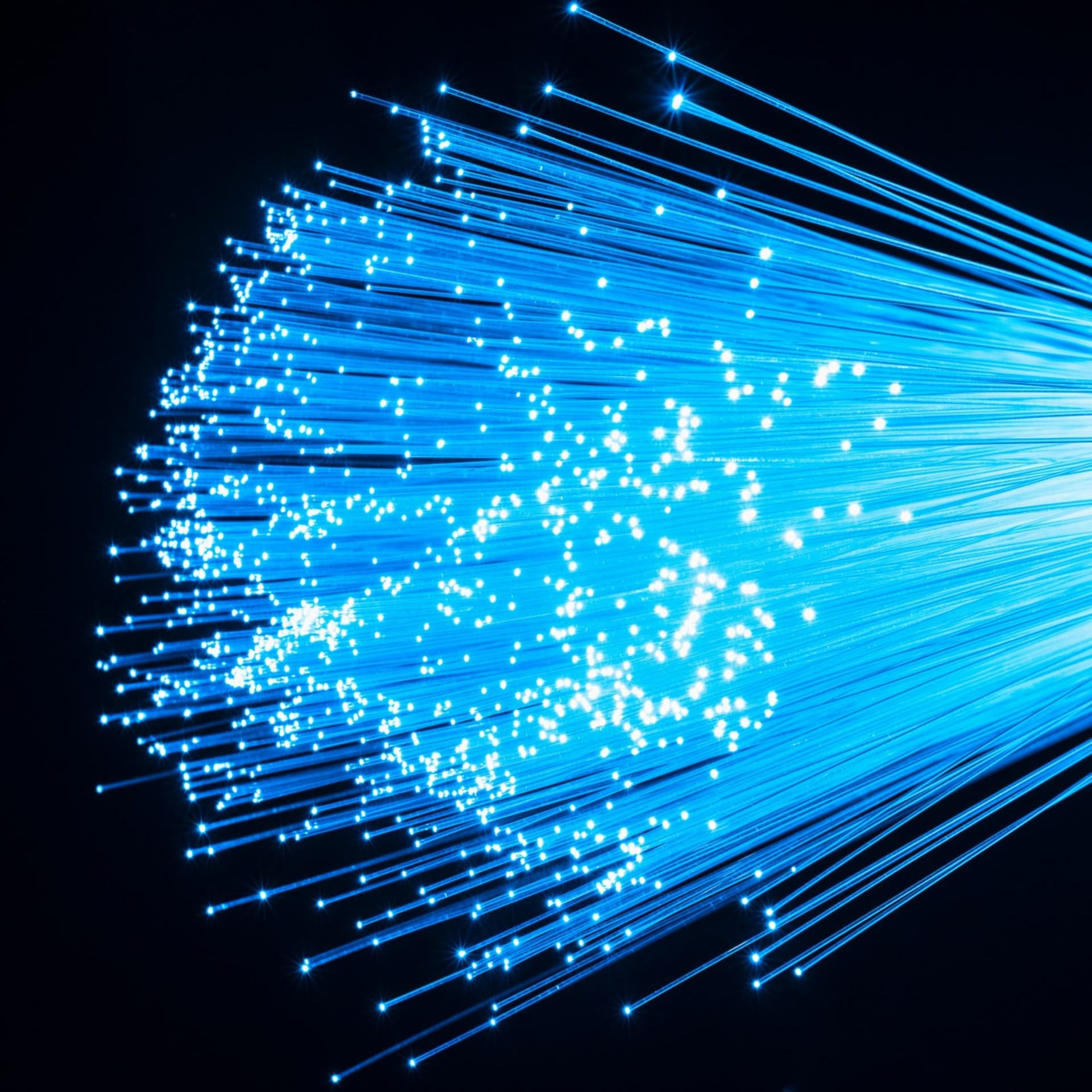
(Image: A photo of many fibre optic cables emitting bright light against a dark background. Credit: Getty Images)