
In short
Tech Life Podcast Episode Summary: Launching a Commercial Space Station
Episode Overview
- Title: Launching a Commercial Space Station
- Presenter: Shiona McCallum
- Producer: Tom Quinn
- Air Date: [Insert Air Date]
This episode explores the advancements in space technology, focusing on the upcoming launch of Haven-1, the world's first commercial space station, by the company Vast. It also highlights innovative technologies aimed at aiding elderly care in Japan and supporting agricultural practices in Africa.
---
Key Topics Covered
- Haven-1: The First Commercial Space Station
- Company Behind the Project: Vast
- Launch Date: Expected in 2026
- Significance:
- If successful, Haven-1 will mark a new era in commercial space endeavors.
- Aims to demonstrate private sector capabilities in low Earth orbit.
Interview with Max Haot, CEO of Vast
- Vision: Building a sustainable and economically viable space station to extend human presence in space.
- Design Philosophy:
- Focus on safety and sustainability compared to traditional governmental space stations.
- Plans for a crew of four to stay for extended missions, with potential for up to eight astronauts during handovers.
Purpose of Haven-1
- Primarily for scientific and technological research.
- Not yet focused on space tourism; current missions will prioritize research, training, and technology development for future moon and Mars missions.
- Potential for manufacturing pharmaceuticals and advanced materials in microgravity.
- The Rise of Robotics in Elderly Care (Japan)
- Context: Significant demographic challenges with a growing elderly population and rising dementia cases.
- Innovative Solutions:
- Robots designed for caregiving tasks, enhancing rather than replacing human interaction.
- Examples include the Café of Mistaken Orders, where dementia patients work as servers to promote engagement.
Key Developments
- Humanoid Robots:
- Developed to assist caregivers and improve quality of life for dementia patients.
- Focus on precision and adaptive understanding to interact safely with humans.
- AI Technologies:
- Fujitsu's motion analysis technology for early dementia detection through observation of gait and posture.
- Emotional support robots, like Sharp's Pokitomo, designed to remind users of medication and provide companionship.
- Agricultural Innovations in East Africa
- Organization Featured: Just Dig It, a grassroots initiative focused on re-greening landscapes.
- Technology Used:
- A mobile app called Kijani, featuring AI avatars to educate farmers on sustainable agricultural practices.
- The avatars provide personalized guidance in English and Swahili, enhancing engagement and understanding.
Impact on Farmers
- Farmers report a strong connection to the avatars, which serve as relatable advisors.
- The app aims to improve crop yields and support sustainable practices amidst climate challenges.
---
Key Takeaways
- Commercial Space Exploration:
- The shift towards privatization in space endeavors could lead to more sustainable and innovative approaches to space research.
- Elderly Care Transformation:
- Technology can significantly enhance the quality of care for elderly populations, especially those suffering from dementia, by providing support and engagement.
- Agricultural Advancements:
- Leveraging technology, particularly mobile applications and AI, can help address food security issues and support farmers in adapting to climate change.
---
Concluding Thoughts The episode illustrates the rapid evolution of technology in various sectors, emphasizing the importance of innovation in space, healthcare, and agriculture. As we look to the future, the integration of commercial ventures and advanced technologies holds promise for enhancing human life both on Earth and in space.
For further comments or inquiries, listeners are encouraged to contact the show via email or social media.
Written by AI. May contain mistakes. Listen to the episode to check what was said.
Transcript
Automatic transcript. May contain errors.0:00Hello and welcome to Tech Life, the programme about technology and how it affects your life. I'm Shona McCallum and this week we're looking skyward to the stars and the next human habitat in space. I'll be speaking to the head of the company hoping to launch the world's first commercial space station next year. That's in a moment. Japan has a large elderly population and an increasing number of people with symptoms of dementia. We'll have a special report on robots and other tech designed to help. Robots should supplement, not substitute human caregivers. So while they may take over some tasks, their main role will be to assist both caregivers and patients.
0:43And I'll be finding out about the Swahili-speaking avatar helping farmers make the best of their crops in Africa.
1:08Today we're looking at the next steps for humans in space with something that's not been done before. First though, a little history lesson. Let's go back in time to May 1973 and NASA's launch pad at Cape Canaveral in Florida. Ignition sequence has started. Six, five, four, three, two, one, zero, and we have a lift off. Skylab lifting off the pad now, moving up. That was the launch of Skylab, America's first space station. It wasn't the very first one to be put into orbit though. The Soviet Union did that in 1971. China currently has its own manned space station called Chang 'e-gong or Heavenly Palace.
1:52But perhaps the one you're most familiar with today is the International Space Station or the ISS. here's a flavour of what it's like from an astronaut. Hello, I'm Sunny Williams. I'm up here on the International Space Station. So this is Node 2. This is a really cool module. This is where four out of six of us sleep. And so people always ask about sleeping in space. Do you lie down? Are you in a bed? Not really, because it doesn't matter. You don't really have the sensation of lying down. You just sit in your sleeping bag. I'm not sure that I could sleep like that. Well, it takes an enormous amount of money and effort to keep a space station in operation, which is why governments and their space agencies do most of the funding.
2:39The benefit is a whole lot of scientific and tech research can be carried out in microgravity and for long durations. Well, a new kid on the block, a California-based company called Vast, is hoping to put their own space station into orbit as early as next May. It's called Haven One, and it'll launch on a SpaceX Falcon 9 rocket. If successful, it'll be the world's first commercial space station. Here's their promo. In 2026, a crew of four will visit Haven One for two weeks, launching and docking aboard the proven SpaceX Dragon spacecraft. It's important for humanity to get out into the stars. I think this is good not only economically, but just good for the human spirit.
3:23Humans need a frontier and something to explore. Well, I've been speaking to the boss of VAST to find out more. So I'm Max Hout, I'm the CEO at VAST. And here I'm lucky to lead a team of slightly more than a thousand people building next generation space stations. Private space stations, I think, still sound like science fiction to a lot of people. So in very simple terms, what are you trying to build? Space stations have obviously been there for quite a while, starting with the Russian Sailor Station and then Mir and then obviously the International Space Station that is up there. And these space stations have been incredible in capabilities.
4:01It has been safe. There's so much science and experiments that are occurring there. But one thing that these space stations, the historical non-commercial one, the governmental one, have been is too expensive and it's unsustainable. And so this new era, it's really all about how do we rebuild all of these amazing achievement and capability, but how do we do it in a safe and sustainable economic way? And that, we believe, is the job of the private sector. It's our job to get external funding, additional funding, the vast majority of it, and then to build a station, own it and operate it and unlock what we hope will be an incredible lower 4-bit economy of opportunity.
4:49And how many astronauts will it be able to safely keep alive in space? And for how long do you expect them to be up there? So right now we're in the era of the SpaceX Dragon crew vehicle. And there is also NASA is trying to develop the Boeing Starliner vehicle, but it's not ready. And the SpaceX Dragon vehicle can bring four crew at a time. And so in this era where all of the space stations that are being built kind of are built on that building block, that allows us to have four people per Dragon. And then you can have a for long duration mission. that is our end goal and intention to achieve by 2030, where there's a permanent crew on the space station.
5:31Then you have handovers where you have another crew of four coming and you have for an amount of time of eight people on the station, maybe for a couple of weeks or even less, and then you go back to four people. So the nominal number is four all the time and then eight at various peaks there. And what's the purpose of the station? What will it be used for? Is it for science and tech research or space tourism or something in the middle? So firstly, we're not yet in the era of space tourism. And frankly, we think that's quite a ways away. And the reason is that today people go to space to do important research and science.
6:10The human race, you know, only about 700 people have gone to space for a duration of time. You know, we've not had a lot of time, aggregate time for people in space. And so every time somebody goes to space, and I'm not talking about suborbital flight for just a minute. I'm talking about missions that are two weeks or six months. Every time somebody goes to space, we should treat that very seriously and use these results very carefully. As you know, there has been people self-funding their flight to space. And we don't call this tourism, right? They are self-funded individual that when they go to space, they get the same training as the professional.
6:46And more importantly, they are doing science, research, outreach, all of the same thing that professionals do. In terms of why we go to space, there's really two main categories. Why do we send people to space? The number one is to further the technologies we need to go to the moon and Mars. Lower orbit, where our space station will be, is the closest form of orbital space. You know, a rocket can get there in 10 minutes. Going to the moon takes longer, right? Can take a week or so or days. and then going to Mars can take the best part of a year. And so if you are developing a moon base, if you are developing a Mars base, you better make sure that your astronaut and your technology, the first time you test them is not when you go on this long duration and risky mission.
7:33So lower orbit, one of the key reasons why we go there is to train the astronaut, test all the technologies ahead of this longer mission. The second part of a space station, a lower 4-bit space station, is to make life better on Earth. There's a lot of promise and hope that given the microgravity environment, the fact that you don't have the same gravity as on Earth, you have microgravity there because you're in orbit, we can manufacture pharmaceuticals as well as semiconductors, optical fibers. and we can manufacture things in higher quality or with properties that cannot be done on Earth. So you could imagine a world where we can make a drug in space that we just cannot make on the ground and it resolve a disease.
8:22And you mentioned the ISS, which is due to be retired by around 2030, I believe. Do you think we're ready to hand over our presence in low Earth orbit to private companies like yours? You know, the first step has already occurred in the last decade. And the first step was the transportation, right? The destination is the space station, the ISS, and the transport is the rocket that brings the crew there. And in the late 2000s, NASA decided, OK, it's now time to retire the space shuttle. And it's time to hand over the transportation, the crew capsule capability to industry. They picked Boeing and SpaceX and funded them exactly in the same way.
9:02They didn't pay for necessarily 100%. and asked them to build this capability. It turned out that Boeing was delayed and SpaceX succeeded in bringing back to the United States and the Western world the capability to send astronauts to space. And so, yes, we are ready. You know, that's exactly what the government is now doing, or NASA and its partner, which include Europe and Japan and Canada, are doing for now the destination. It's a natural progression. And now there is a race between us and our competitors for whoever will launch the first module. We are expected to launch our first module called Haven One next year and to have a crew visit it.
9:40And if we do so, we will have created the world's first commercial space station. Now it's a single module space station and that has allowed us to create all the team facilities, design and technologies so that we can build a multi-module space station that we need to be able to support continuous crew. You mentioned the race there between yourself and your competitors. How important is it for you to win that? We're entrepreneurs and we believe in first movers. And more importantly, you know, VAST right now, this year, we had our first spacecraft in orbit, a satellite that proved all of the technologies that we need for a space station, excluding the human part.
10:19So we still need, you know, a power system, avionic system, radio system, ground control, control room. And so we had our first mission in November. we launched our satellite called Haven Demo, and it's been an outstanding success. It's right now orbiting the Earth and going around the Earth every 90 minutes. And the next step is really to incrementally prove all of these systems, but plus the pressurized cabin, the window, the hatch, the life support system, and the docking with the SpaceX Dragon. And so only the day where we will have done that, launched Haven 1 and have the first crew go to it for two weeks and come back home safely, only that day when they are back home safely can we really call ourselves a real commercial space station company.
11:03I think a lot of people will be remembering watching rocket launches and seeing things fail. Quite often in space, certainly, we hear about missing deadlines or failing completely. If things don't go to plan, is that a worry for you? Yes, we, of course, worry every day. And we have methodologies and process, you know, testing rigor and mission assurance that, you know, make sure that the odds of a failure is as small as it can be. But obviously, we have to move in a commercial way and move fast as well. So we take, you know, measured risk. The good news is that that space station, you know, if we had an issue, it would be an economic loss for VAST, right?
11:45We would have to build another one and launch it, and that would take years and hundreds of millions at the end. but there will be no crew at the start. And then only when that's fully functional for about a few weeks in orbit with other crew will we commit the crew to go on top of the SpaceX rocket in the Dragon spacecraft, launch to orbit using the NASA-approved SpaceX product and then dock to Haven 1. So these are all the steps, you know, where we cannot make an error is when humans are involved. And so, yeah, we do worry about it every day, but we don't just worry. We have expertise and process to make sure every risk is measured.
12:22We have all the full tolerance that's needed to make sure we have a safe mission. And once Haven 1 is up and running, do you anticipate countries getting in touch with you, governments getting in touch with you saying, look, can we do a project? What do you see the dialogue in the future? All space agencies of the world are in direct dialogue today with us. and you should expect that we will be announcing the crew of Avon One which we would expect will have at least 50 % being sovereign astronaut well before we launched the module. So watch this space. That's Max Hout, originally from Belgium and now the CEO of Vast speaking to me from Los Angeles in the United States.
13:18This is Tech Life on the BBC World Service with me, Shona McCallum. Nigel Morris from South Yorkshire in the UK emailed us after listening to a recent show discussing AI in music. Nigel says, I think that allowing AI to get involved in making music is something that should be very carefully regulated. Human musicians have some attributes that AI just does not possess, such as instrument skills, passion and human experience. Yes, nothing quite beats witnessing a live musical performance, does it? Thanks for getting in touch, Nigel. It's time also to say hello to Paul Conklin, who emailed us to say he has a piece of vintage tech that he can't do without.
14:00It's an inexpensive, portable AM-FM radio, and he uses it to listen to the BBC during his early morning jogs. Well, maybe you are listening to this message right now while immersed in your exercises. I hope you run well, Paul. If you want to tell us about any tech that's on your mind or if you want to comment on this week's programme, email us techlife at bbc.co.uk is our email address. Or you can WhatsApp us a text message or a voice note. The number is plus 44 330 1230 320. Remember to please include your name and the country where you live.
14:44Next and Japan has a population of about 124 million. It's estimated that one in five people over the age of 65 are living with dementia or at least have early symptoms of the condition. The challenge may seem overwhelming but local tech companies are trying to help those in need. The BBC's Asia business correspondent, Surinjana Tiwari, travelled to Tokyo to find out more about the scale of the problem and to see the technologies being developed to address it. It might sound like a typical cafe, but the customers here don't always get what they order. That said, nobody minds. This is the Café of Mistaken Orders in Tokyo, part of a growing movement in Japan to rethink how society engages people living with dementia by hiring them as servers.
15:40Toshio Morita, one of the café's waiters, uses flowers to remember which table ordered what. Despite his mental and physical decline, Mr Morita enjoys the interaction. I like meeting all sorts of people. Everyone's different. That's what makes it fun. For his wife Masako, the cafe provides respite and helps keep him engaged. He struggles to answer questions now, but he still looks forward to this day so much. I'm deeply grateful that he has opportunities like this. I am at the Konkanji Temple in the Sugamo area of Tokyo and lots of people are coming to pray. It is a Sunday and it's also a holiday weekend but it's really remarkable the number of older people who are here.
16:37Here in Japan, the older population is really significant, a big chunk of the population and dementia is a big issue with it being estimated that one in five people of the elderly population are living with dementia or the early symptoms of the condition. And that number is only expected to rise as the elderly population grows. In a lab at Tokyo's Waseda University, half a dozen humanoid robots are being tested to perform various tasks. The idea is that they'll become future caregivers for those seeing a decline in capabilities and to solve a chronic shortage of care workers. IREC is a 150 kilogram humanoid robot that can already handle several tasks, from nursing care like changing positions and putting on socks, to daily housework like scrambling eggs and folding laundry.
17:39Assistant Professor Tamon Miyake says developing such robots takes incredible precision. It's extremely challenging because robots must precisely control the force they apply when interacting with people. That requires full body sensing and adaptive understanding. But robots like IREC are still prototypes. Researchers here say it may take another five years before they can provide physical care. Here's Tamon Miyake again. Robots should supplement, not substitute human caregivers. So while they may take over some tasks, their main role will be to assist both caregivers and patients. Tech companies are also developing new ways to screen for dementia, including one tool from Fujitsu.
18:30A camera films a person moving and then AI analyzes their posture and gait. Changes in how a person moves like shuffling while walking, slowing down or difficulty in turning can be some of the earliest signs of dementia. AI gait analyzes posture and movement using skeleton recognition. It's non-invasive and easy to deploy in clinical settings. Hidenori Fujiwara from Fujitsu explains why the technology is so useful. If doctors can use motion capture data, such as walking patterns or posture, they can intervene earlier, prescribe treatment and delay the onset of dementia. Developers are also turning to robotics for emotional support, including one that looks like a teddy bear.
19:20Sharp's tiny robot is called Pokitomo. At just 12 centimetres tall, it can fit in your hand or hang on your bag. And yet, it's smart enough to listen and remember. Here's Miho Kage, development manager at Sharp. I believe elderly users can benefit. For example, it can remind them to take their medication. Or simply serve as a conversational companion for those living alone. Back at the Konganji Temple, mostly older people are washing their hands before going into pray. In the years ahead, Japan faces major pressures, a shrinking workforce and rising social care costs. Innovations may not replace humans just yet, but they could help ease stretched resources, from screening to caregiving support, and ensure older people stay active and engaged for longer.
20:16That's the BBC's Asia business correspondent Surinjana Tiwari reporting from Tokyo.
20:30To East Africa next, where farmers still struggle with low crop yields due to the impact of climate change, poor infrastructure and disease. It means they lose massive amounts of their produce and often face high costs. We're going to be hearing from a not-for-profit group from the Netherlands trying to help. Just Dig It is a grassroots organisation that has joined the fight against global warming by re-greening landscapes, and they do it with help from a mobile app and avatars. Carl Lenz is the head of digital re-greening at Just Dig It, speaking to us from Amsterdam. Just Dig It is cooling down the planet by re-greening degraded landscapes in Africa, And my role is to digitize that process.
21:15So using digital tools and channels to spread the word about re-greening techniques and inspire millions. So you've mentioned re-greening there. Tell me about the mission of Just Dig It. Landscape degradation is a huge problem all around the world, but especially in Africa. So that's the problem we're trying to tackle. And we do that by applying techniques that have been proven to capture rainwater, restore the soil and bring back vegetation again. And tell me about the use of technology to spread your message. Well, it was your BBC colleague, Sir David Attenborough, who said saving the world is now a communications challenge.
22:03And that's exactly what inspires us to use technology to spread the word about techniques, re-greening techniques that actually work. So we have quite good data on the techniques that people can apply to re-green their land and in that way cool down the planet on the very local level, but also on the macro level. So what we have been doing in the last years is build an application called Kijani, which means green, in Swahili. And in that, gave people, let's say, online or digital learning tools to learn the techniques that we have been teaching farmers for over a decade. Crucially, the avatar videos are currently in English and Swahili, the most common languages in Kenya and Tanzania, but other languages are available.
22:56Hello, my name is Maria. Najina Langu Nibaraka. Nous sommes les instructeurs du cours de la plateforme de reverdissement numérique. Lelikonga li nigeza Isandra et miza menie Just Digit, yogulu shaza amakulu e zikikigiza maheta omshaba. Angelina Terimo works for JustDigit in Tanzania, helping farmers there. It's a very simple application. Anyone, anywhere can use it. That's based on Android phones. If you just click it, it's going to download. And it's a very simple process. You have a really nice introduction from an AI avatar called Baraka, who basically just introduce what is Kijani and what it can do for you.
23:38and straight on, if you want to learn a method, you go straight to the methods and we have nine beautiful courses right there that basically help anyone anywhere to learn according to what challenges they have. But there's also an introduction to help somebody kick off understanding how to use the application itself. From there, it's very smooth. There's a lot of videos. There's a lot of pictures, very well clear descriptions to help anyone at any moment in time to learn. Visually, but also by listening, but also by reading. OK, so we understand it is an educational app that has videos and shows methods to farmers.
24:19Tell me about the use of AI avatars then, because is that something that sets you apart? Definitely. And it has really simplified, I think, the whole learning journey for any user anywhere. The avatars are very clear in the way they speak in all languages. I've listened to them in Swahili and I'm a natural Swahili speaker and I can clearly understand it. And also it flows with also connecting a learner to an actual person who's training them, but through an avatar. So it's a voice of another farmer helping to basically influence or inspire another one to re-green and also improve their farmland.
25:01And what do farmers say about it? Do they like it? Definitely. They actually really connect well to the avatars and they feel it's actually a person. They can feel that they're actually talking to a person, another person telling them about what they have done. Because what we have done with the avatars, they're not just speaking from somewhere else. They're actually speaking in that personalized manner. So it feels like you're actually having an advisor right there with you, talking to you. That's Angelina Tarimo in Tanzania from Just Dig It.
26:02And wherever you are in the world, if you're celebrating festivities around now, I hope you have a happy and a peaceful time. Today's Tech Life was produced by Tom Quinn and presented by me, Shona McCallum.
From the publisher
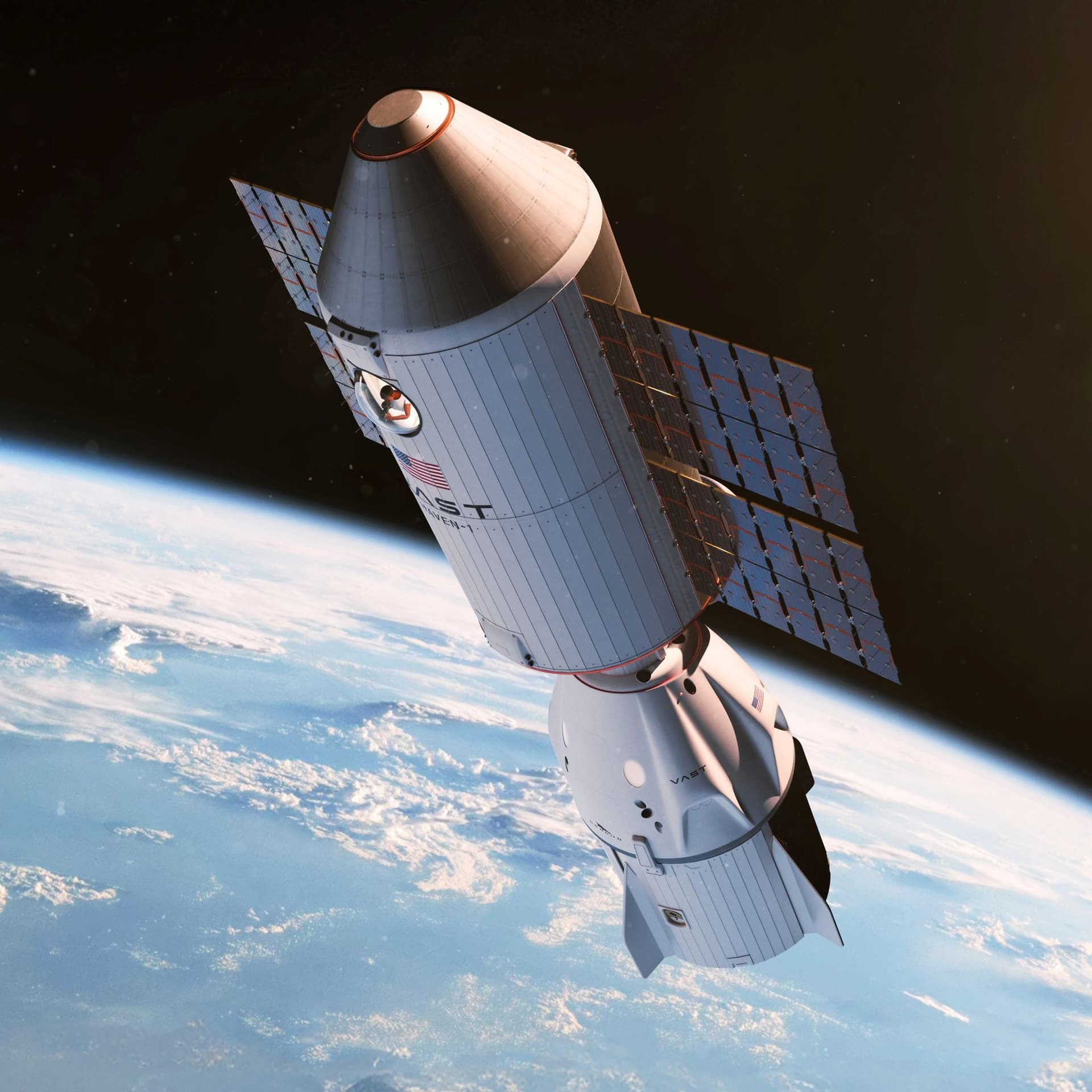
A company called Vast hopes to put Haven-1 into orbit in 2026. If successful, it'll be the world's first commercial space station. We speak to the company's CEO, Max Haot.
Also on Tech Life this week: find out about robots in Japan that will help people cope with dementia. And the local language avatar providing growing tips to farmers in Africa.
Presenter: Shiona McCallum Producer: Tom Quinn
(Image: A future illustration of the commercial space station Haven-1 in orbit above Planet Earth. It is docked with a Dragon spacecraft. Credit: Vast.)