In short
Tech Life episode covers three tech topics: (1) humanoid robots performing surgery, (2) smartphone/social media restrictions for children and the “infinite scroll” debate, and (3) carbon capture retrofits for fossil-fuel cargo ships.
Guests
Michael Yip, senior author and professor in Electrical and Computer Engineering at UC San Diego; he says humanoid robots can use existing surgical tools and be teleoperated to perform gallbladder resections (two operations on a pig) and could later assist surgeons or work side-by-side remotely/autonomously. Aza Raskin, inventor of infinite scroll and co-founder of the US Centre for Humane Technology; he argues UK’s under-16 social media bans are a “huge win” but not enough, and proposes adding “friction” to reduce engagement incentives. Alicia Fredrickson, co-founder/CEO of Seabound; she claims lime-based onboard CO2 capture turns CO2 into limestone, with ~80% capture in a Middle East pilot and ~95% at Long Beach, and that lifecycle assessments show net benefit if lime is produced “green.”
Written by AI. May contain mistakes. Listen to the episode to check what was said.
Chapters
Tap a time to open that second in VOExploring Humanoid Robots in Surgery
0:30 to 1:24
Discover the advancements in surgical technology involving humanoid robots.
“Is on-again, off-again conflict the new normal between Iran and the United States?”
The First Successful Operations
1:24 to 2:26
Learn about the first successful operations using humanoid robots and their capabilities.
“And later, as I continue my look at the debate over smartphones, social media and the growing number of restrictions aimed at children, I speak to the man who invented the infinite scroll.”
Challenges and Innovations in Surgical Robotics
2:26 to 5:24
Understand the challenges faced in integrating humanoid robots in surgeries and how they are being addressed.
“where researchers say they've achieved a world first.”
The Future of Humanoid Robots in Healthcare
5:24 to 8:05
Discuss how humanoid robots could transform surgical care and address staffing issues in remote areas.
“robot is robust enough to stand on its own without engineers on standby.”
Reactions from the Medical Community
8:05 to 10:36
Examine how the medical community is responding to humanoid robotics and the potential for autonomous surgery.
“So having a robot that is there on standby that somebody can jump into and provide immediate surgical care when it's needed is a really big motivation for what we're doing.”
Listener Engagement and Thoughts on Robots
10:36 to 11:30
Hear about audience thoughts on being operated on by humanoid robots and related listener messages.
“That's Professor Michael Yip from the University of California, San Diego, talking to me about humanoid robots in the operating theatre.”
Tackling Greenhouse Gases at Sea
11:32 to 13:44
Explore innovations in reducing greenhouse gases from ships burning fossil fuels.
“Is on-again, off-again conflict the new normal between Iran and the United States?”
The Origins and Critique of Infinite Scroll
13:44 to 14:00
Learn about the infinite scroll feature's origins and its impact on users, featuring Aza Raskin.
“Right, so you might identify with this next scenario.”
Interview with Aza Raskin on Social Media Regulation
14:00 to 20:31
Learn about Aza Raskin's views on the UK government ban on social media for under-16s and the implications for technology and society.
“If that sounds familiar, you've experienced what's known as the infinite scroll, that endless stream of posts that just keep you swiping.”
Seabound's Innovative Carbon Capture Technology
20:58 to 27:34
Explore Seabound's process for capturing carbon dioxide emissions from ships and its environmental impact.
“Well, so much of what we buy has travelled by sea at some point.”
Show all 11 chapters
Global Story Conflict Overview
28:32 to 28:59
An overview of the ongoing conflict between Iran and the United States.
“Listen to The Global Story on BBC.com or wherever you get your podcasts.”
Transcript
Automatic transcript. May contain errors.0:00This BBC podcast is supported by ads outside the UK.
0:30at Whole Foods Market. Is on-again, off-again conflict the new normal between Iran and the United States? I'm Tristan Redmond, host of the Global Story podcast from the BBC. Iran has buried its former supreme leader after a six-day funeral procession while still exchanging strikes with the US. The ceasefire is fragile at best. At worst, it's over. Could anything bring peace? Listen to the Global Story on bbc.com or wherever you get your podcasts.
1:02Hello and welcome to Tech Life, the programme interested in technology making a difference to all our lives. I'm Shona McCallum. Today we're stepping inside an operating theatre where the latest member of the surgical team isn't human. It raises a question that could one day face all of us, would you let a humanoid robot perform your operation? I'll explain in a moment. And later, as I continue my look at the debate over smartphones, social media and the growing number of restrictions aimed at children, I speak to the man who invented the infinite scroll. Now it's something like 100 ,000 human lifetimes are wasted by infinite scroll every week.
1:45And there might be a solution to a dirty problem at sea, retrofitting carbon capture technology to fossil fuel burning cargo ships.
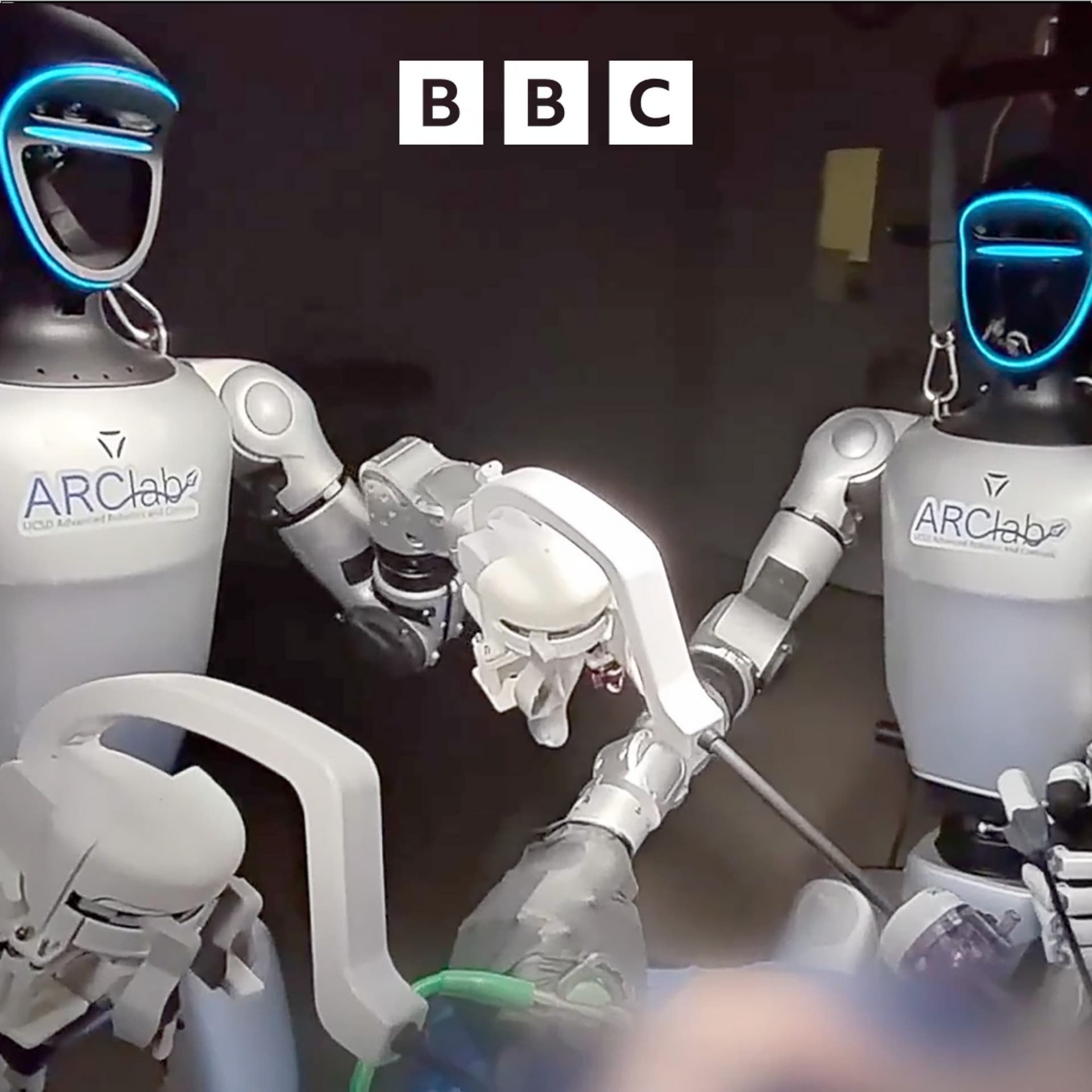
2:13Imagine lying on an operating table and looking up to see a humanoid robot preparing for surgery. Science fiction? Well, it might be closer than you think. We start today in the United States, where researchers say they've achieved a world first. They claim humanoid robots, the kind that look a bit like you and me, have successfully carried out two operations in a preclinical trial. Until now, surgical robots have tended to be big, expensive machines designed for one specific job. But humanoid robots with two arms, two legs and hands could make that technology much more flexible. In this case, the robots were remotely controlled by surgeons as they operated on a pig.
2:56The work is the result of a collaboration between medical and engineering teams at the University of California, San Diego. Professor Michael Yip from the university's Department of Electrical and Computer Engineering is one of the senior authors of a research paper which has just been published in Nature. I spoke to him from California and started by asking him exactly what they had achieved. The humanoid robot in this case was brought in to basically act as a surrogate for a remote surgeon to do an operation that was a gallbladder resection, a very common general surgery application that happens millions of procedures all over the world every year.
3:37And how did that happen? So when we brought the humanoid robot into the operating room, we knew immediately that we had to solve a couple of challenges. First of all, unlike traditional surgical robots that are used today that are designed with specialized instruments specific to that robot, we wanted to understand whether the humanoid robot could interact with existing surgical tools. That's really going to be the future, in my opinion, where we don't have to change the entire workflow of a hospital or an operating room. But we should have these robots be able to pick up tools and use ones that are the same ones that doctors would use in their own hands.
4:16So that was the first challenge. And that took several months to solve. And then the second challenge is how do you make it all teleoperated, right? So how does a surgeon remotely kind of jump into the body of a humanoid robot, control its tools and then perform a surgery live? So solving that pipeline also required some engineering effort. And what does it take to get to the level of confidence in robotics then that you're clearly apt and able to do operation? operation, okay, a gallbladder operation might be seen as something that's done quite routinely, but by the same token, it's quite a leap of faith to do what you've done.
4:55We demonstrated two gallbladder resections in a controlled setting, right? And in this setting, you know, we had a lot of both engineering staff and surgical staff on hand to make sure that, you know, everything progressed appropriately. When we look at kind of where does it go and how could it potentially actually eventually roll out into the real world? I think that there's a couple of challenges still ahead. Of course, there's the challenge of making sure that the robot is robust enough to stand on its own without engineers on standby. But the other challenge is that these robots are not designed initially to do surgery, right?
5:36And so we can look a little bit deeper at their design and kind of figure out, well, can we improve the precision that they're being used to do these surgical tasks with? And can we improve the latency and reduce the latency of remote operations? And furthermore, I think what's really exciting is could we actually improve the AI on these systems that one day they could not only be used in teleoperation mode, but they could be part of a surgical team. So robots and humans working side by side, the robot as an assistant, handing back and forth tools, providing help, retracting tissues, sectioning blood, these kind of really small tasks but really meaningful tasks that right now are a burden on a large surgical team.
6:24And do you see that as the future of surgery? I honestly do feel that this is a very big future for surgery. And the reason why is because today's healthcare foundation of medical devices and robotics is built on one robot for one type of procedure. And this is just ultimately not scalable because there are so many new procedures coming out and there's so many existing procedures. And you just cannot support million dollar robots to do one type of procedure. But if you have a humanoid robot that gets good enough at performing different procedures, then it will effectively be able to cross the different types of operations and be used throughout the hospital.
7:12So one of the things that is particularly interesting about this is the remote aspect of it. So you could have a humanoid robot performing an operation in a place like a country in Africa that doesn't have the expertise from thousands of miles away in another continent. Do you see that as something that will help health care across the world? Right now, there are a lot of communities that are remote or have less resources that do not have adequate surgical care, right? And one of the challenges is really from a staffing issue, these communities cannot support the staff to stay there and perform operations because either there's not enough operations to be performed on, but also that there's not just enough financial resources to support staff like that.
8:05So having a robot that is there on standby that somebody can jump into and provide immediate surgical care when it's needed is a really big motivation for what we're doing. And in fact, we've already been working for several years on remote surgery and looking at the use of AI to alleviate the challenges of long distance surgery, the latency that can rise from that and making sure that we can perform procedures safely. And how do you see the medical community being receptive to this type of thing? Obviously, you're from the computer engineering background and your enthusiasm is palpable. But, you know, has that dialogue been a challenge at all?
8:50Yeah. So having worked in this field for almost 20 years now, it's been very interesting to see the shift of how the healthcare professional community has responded from skepticism to excitement. and just like asking for like, what's next? Can we kind of leverage this in these scenarios? But the second thing is that as a lot of developments and a lot of nations in general have a massive shortage of doctors, nurses, surgeons, and so on and so forth. This is a labor shortage issue, right? And humanoid robots as a technology not only can bridge this through remote operations, but then eventually could bridge this through autonomous behaviors.
9:34Yeah, because at the moment, obviously, there's still a human in the loop. How far are we really from having autonomous AI-controlled humanoid robots performing operations? Yeah, I think that there's going to be a stage progression. I'm actually pretty bullish on the idea that humanoid robots or human-like Android robots will be integrated into the operating room in the near future in tasks that are assisted. So what I mean by that is that they may not be the ones doing the cuts and the suturing and so on and so forth, but they might be working side by side with a human surgeon to pass back and forth tools to hold, you know, endoscope camera so that the surgeon has better visualization of the body.
10:20These assisted tasks are low in terms of the challenges from automation and low in terms of risk, but they are a huge benefit in terms of alleviating the necessity for large surgical teams and alleviating the pressures of scheduling and providing timely access to surgery. That's Professor Michael Yip from the University of California, San Diego, talking to me about humanoid robots in the operating theatre. They are obviously benefits that the professor highlighted, but how would you feel about being operated on by a humanoid robot, even if it was controlled remotely by a human surgeon? I'd love to know your thoughts.
11:01Our contact details are coming up in a moment. This is summer at its peak. Whole Foods Market Summer Fruit Fest is your invitation to eat the season. Fresh, organic and bursting with flavour. Start your day with peaches and organic blueberries and yoghurt. Build a grazing board with fresh fruit, prosciutto, and artisanal cheese. Then fire up the grill with no antibiotics ever, proteins, and fresh produce. Savor the season. Shop Summer Fruit Fest at Whole Foods Market. Is on-again, off-again conflict the new normal between Iran and the United States? I'm Tristan Redman, host of the Global Story podcast from the BBC.
11:41Iran has buried its former supreme leader after a six-day funeral procession while still exchanging strikes with the U.S. The ceasefire is fragile at best. At worst, it's over. Could anything bring peace? Listen to The Global Story on bbc.com or wherever you get your podcasts.
12:13This is Tech Life on the BBC World Service with me, Shona McCallum. On last week's show, we featured a voluntary agreement among parents in Greystones in Ireland not to give smartphones to children until they'd reached secondary school, usually at 12 or 13 years of age. Well, Zakaria Farah sent us this WhatsApp message from Mogadishu in Somalia. I found your episode about the community-led initiative in Ireland very interesting. I learned a lot and found it inspiring to see a community working together to support children's well-being. Thank you, Zakaria. It's great to know that you're listening to us in Somalia.
12:49Alan Wilson emailed us from Stirlingshire in Scotland, which is only about 30 miles or so from our studio here in Glasgow. Alan writes, Rather than give your kids a smartphone, why not provide them with a SIM-enabled smartwatch? And among a list of advantages, Alan thinks a child would not be staring at their smartwatch compared with a phone, and he says it would be easy for parents to block out social media platforms. Well, stay tuned, Alan, because we're going to be talking about more on that theme shortly. If you want to get in touch with us, maybe about humanoid robots performing operations, our email address is techlife at bbc.co.uk.
13:26Or you can WhatsApp us, a text or a voice memo. Our number is plus 44 330 1230 320. Please include your name and where in the world you live. Coming up later, how do you remove greenhouse gases from big ships at sea burning fossil fuels? I speak to a woman who says she has the answer.
13:55Right, so you might identify with this next scenario. You've sat down to check your phone for five minutes and looked up and it's at least half an hour later. If that sounds familiar, you've experienced what's known as the infinite scroll, that endless stream of posts that just keep you swiping. The person who invented it around 20 years ago is Aza Raskin, but these days he's become one of social media's biggest critics. He's the co-founder of the US-based Centre for Humane Technology, a non-profit which wants society to benefit from technology while reducing its harms. I spoke to Aza shortly after the UK government announced plans to ban under-16s from accessing social media, joining a growing number of countries considering similar measures.
14:42I started by asking him what he made of the government's decision. Well, first, this is a huge win. The UK is joining Australia, Denmark, Spain, India, Indonesia. there is a growing human movement, which is really pushing back on technology's overreach into our humanity. And that's what this represents is now 25 % of the world's population, which now includes the UK, lives in a country that says they either has or will ban social media for kids, which means protecting kids from mal-insentized technology. This is a big deal, but of course, it doesn't go far enough because just because this is a ban for kids doesn't mean it becomes magically safe at 18.
15:26It doesn't magically become safe for adults. But it's a very, very good first step. And how do you see this shaking out then as we progress with implementation, which is clearly the question that everyone's asking, how on earth does something like this work? We've seen in Australia, anecdotally, that perhaps it's not working as well as it should have, and that children are still able to access these platforms. Yeah, well, obviously, So you go from like the good idea. And I think that claiming the moral high ground is very important because if you go back even two years and you'd have asked, do you think it's possible for countries to start to protect kids?
16:07You said, no, the technology is just too strong. These companies like control the means of social participation. And so implementation is always messy. But I think this gives the opportunity to start trying. I think a better solution moving forward would actually be to start hitting the companies in their engagement, which is what really hurts for them because they make all their money from the amount of time you spend on their site, how much you engage with them, how much you engage. And, of course, when you make and optimize a population for their reactions, you make them more reactive. A better solution would be something a little bit more gradual, where depending on how much time people spend on the site, sites begin to slow down a little bit.
16:52So what you really need to do as a society is to start adding a little bit of friction, just in the same way that you go to buy cigarettes. There's friction at the point of buying cigarettes, which is to say there's a higher tax or when you're going down the street and there are speed bumps, which slows you down. We need to societally start adding these little bits of friction to start realigning the way the companies actually design their products, not just hard bands. Now, of course, you know more than a lot of people about designing the products. And I guess claim to fame or otherwise would be the invention of the infinite scroll.
17:29I know you've previously said that you kind of regret some of that. But I just wonder when you first realized it was causing harm. Yeah, well, I hope, I mean, I've now spent my life like making things like the social dilemma, fighting back against all this work on translating animal language, understanding the language of like crows and whales. And I hope at the end of my life, I don't just end up with a tombstone that says like he scrolled. But that said, I invented infinite scroll in 2006. And this is before social media really got going. And what I learned was that my good intentions got eaten by the incentives of these companies.
18:09And the incentives are to gather as much your time, it becomes a race to the bottom of the brainstem for your attention. And that creates a raft of issues because the things that are more polarizing, more hateful, the things that are worse for your mental health are the things that the algorithm selects for because it's selecting for getting reactions out of you. and really it was by the time of 2012 2013 when you could like walk down the street and see people's heads bowed to their phones paying attention to something distant and a supercomputer essentially pointed at their mind rather than the people around them but it's like this needs to stop that the asymmetric knowledge that we as designers and technologists know about how your mind works and your children's mind work is no longer being used to help but instead to hurt and now it's something like 100 ,000 human lifetimes are wasted by infinite scroll every week.
19:06And does that trouble you? It does. It does. And, you know, if I try to find solace, it's that inventing infinite scroll, it's not such an amazing invention. It's the kind of thing that gets invented many times by many different people. But I don't think that absolves us technologists from the responsibility of understanding that when you're playing with technology that touches people's lives for eight hours a day, you have a deep responsibility for caring for those people and the time that you're displacing and then coordinating because where the companies always hide is saying, well, look, if I don't make a version that's more addictive, that shows shorter form videos that preys on psychology than somebody else will.
19:51And so, you know, I have a fiduciary duty to like doing this thing to my for my shareholders. And what the companies should have done, and I think their moral responsibility is, is to coordinate, to create safe ground rules so that, you know, social media could have been the thing that connected humanity, and that had us experience the most love and the most community. But obviously, they've done the opposite. And that's because of those incentives. And it's our job to create the new kinds of incentives that let humane technology flourish. That's Aza Raskin, credited with inventing the infinite scroll, and also the co-founder of the Centre for Humane Technology in the United States.
20:30And I'm going to be looking at more aspects of the debate that's underway about smartphones and social media the next time I'm back in the Tech Life's presenter chair.
20:46You might not realise it, but shipping can be a surprisingly dirty business.
20:57I bet that got your attention. Well, so much of what we buy has travelled by sea at some point. Those giant cargo ships keep global trade moving, but they also produce a huge amount of greenhouse gas emissions. In fact, estimates suggest shipping is responsible for around 2-3 % of the world's emissions each year. The Global Maritime Forum says that if the shipping industry were a country, it would be the world's sixth largest emitter. Now, a UK startup believes it's found a way to tackle that problem. The company is called Seabound. Its co-founder and CEO, Alicia Fredrickson, told me how their carbon capture technology works.
21:38So picture a shipping container. We fill it with little pebbles or little rocks called lime, and then we put the container onto a ship and we connect pipes from the ship's engine. And essentially, the exhaust gas from the engine passes through this container of little pebbles, and the CO2 is soaked up by the lime and it turns into limestone. and that's everything that happens on board. So it's a very simple chemical reaction to trap the CO2 from the engine and then when we get back to port we lift effectively the box of rocks off of the ship and then we can sell the limestone to be used as a building material in construction or we can recycle it on land to reuse the lime to capture more CO2.
22:22Your system relies on lime to capture carbon dioxide but producing it itself is energy intensive and releases carbon dioxide as well. So when you look at the full life cycle, is there a genuine net climate benefit? Yes, so we work with lime companies, both existing players as well as startups, to produce lime in a green way so that there aren't emissions from its production. And those are the key partners that we work with to source our material for carbon capture on ships. And you've got the numbers that show that there's more carbon dioxide captured than generated overall? Yes, absolutely. So this is something that we do as a climate startup, but many other peers of ours as well.
23:06It's called a life cycle assessment. And so you basically document all of the different steps of your process from end to end and all of the emissions associated with that. And then any emissions you have to subtract from the total amount that you capture. So this is definitely something that we scrutinize regularly. And what happens to the limestone produced on board once the ship reaches the port? You mentioned some of it could be sold, but I wonder, could it also be stored or reused? Yeah, so there's a couple of options. So one is to sell the material for use as a building material. So it could be put into roads or buildings.
23:44It could be used for different construction projects. The other thing we could do is recycle it. And that essentially means separating the lime from the CO2. That way we can reuse the lime to capture more CO2 on another ship. And then the CO2 that's resulting there can either be sequestered or it could actually be sold for new products like fuels or chemicals. So the end product or the end use case of the limestone affects the overall carbon balance? Yeah, so it depends on what you want to do with the carbon. So the most sort of simple or straightforward recommendation is to store the CO2 underground if you are recycling the limestone.
24:24And that way you are continually reducing the CO2 emissions. If you turn it into a new product, like a fuel, then it would be released when that fuel is burned. But crucially, you could then capture carbon on the ship that is burning that clean fuel and essentially keep the CO2 in circulation and have this circular fuel system. And you've tested this technology on real vessels at sea and in port. What capture rates are you actually seeing in real world conditions? And I just wonder what prevents you from capturing 100 % of the exhaust emissions? Sure. So we've done a couple of paid pilots so far.
25:04For the first one, we were on a medium-sized container ship. My team and I actually took turns sailing around the Middle East to run the trials on board. And we reached about 80 % CO2 capture efficiency and about 90 % for sulfur emissions. So we capture other types of emissions on ships as well. For our second pilot, which was on the port of Long Beach in California, we reached about 95 % CO2 capture efficiency. So we've proven at high efficiency so far. I think to go even further than that, there is a theoretical limit for what lime can do. So for us, it's really just about being up or as close to that limit as possible.
25:41Some climate campaigners argue that carbon capture risks delaying the transition to cleaner fuels because it allows ships to keep burning fossil fuels. How do you respond to that criticism? Yeah, it's a good point. I think there are many different types of assets, including ships, but also including some facilities on land that are considered very hard to abate. And that means that there's no other solutions for reducing their emissions. So I think in the absence of alternative solutions, carbon capture is the best thing that we can do. And it's much, much better than letting those emissions be released.
Read the full transcript
26:20and to kind of paint that more clearly as well for a ship it typically operates for 25 to 30 sometimes 35 years there are ships being built today that will only be able to burn fossil fuels they will not be able to electrify they won't run on clean green fuels and so the best thing we could do is reduce their emissions again by capturing carbon and retrofitting them. You've received some recognition for the work that you're doing, which must be great. What does that award mean for you and for Seabound? Yeah, I was very fortunate recently to win the Bold Future Award from the Clicquot, which is the longest running business award for women in business.
27:02And I think it's very encouraging that people outside of shipping, essentially, have recognised our work. Shipping, I think is often out of sight, out of mind. But actually, I think for solutions like ours to be successful, we need broader awareness from people outside of shipping in order to help catalyze these solutions, especially because shipping touches all of us. It moves about 90 % of the world's goods. And so the more people that we can reach, essentially, the more likely we are to achieve the impact that we're aiming for. That's Alicia Fredrickson, the co-founder and CEO of Seabound.
27:42Well, I hope you enjoyed today's edition of Tech Life. One of my favourite things is hearing from you, our lovely listeners, so feel free to contact us about any tech that you're interested in or a story that you want to share. Techlife at bbc.co.uk is our email address or WhatsApp us, a text message or a voice memo. Our number is plus 44 330 1230 320. Please let us know your name and the country where you live. Today's Tech Life was produced by Tom Quinn and presented by me, Shona McCallum.
28:32is on again off again conflict the new normal between iran and the united states i'm tristan redmond host of the global story podcast from the bbc iran has buried its former supreme leader after a six-day funeral procession, while still exchanging strikes with the US. The ceasefire is fragile at best. At worst, it's over. Could anything bring peace? Listen to The Global Story on BBC.com or wherever you get your podcasts.
From the publisher
Humanoid robots have successfully performed surgery in an operating theatre for the first time. They were remotely controlled by surgeons. An expert involved talks to Tech Life.
Also this week: the man who invented the infinite scroll tells us his latest thoughts on social media. And how do you stop big cargo ships pumping greenhouse gases into the air, as they move our goods around the world? We hear about a carbon capture solution.
Presenter: Shiona McCallum Producer: Tom Quinn
(Photo: Two human-shaped robots stand holding equipment, and perform surgery in an operating theatre. Credit: University of California San Diego)