In short
Tech Life Podcast Episode Summary
Episode Title
Quantum computers are coming - do we need ethical guidelines?
Episode Description
Quantum computing has the potential to revolutionize various fields, but it also raises ethical concerns. This episode discusses when to start considering the ethical implications of quantum technology. Additionally, it explores innovative data storage solutions using glass and reflects on the visions of humanity's future in space as inspired by science fiction.
Presenter
Chris Vallance
Producer
Tom Quinn
---
Key Topics Covered
- Introduction to Quantum Computing
- Quantum computing is poised to make transformative impacts across numerous sectors, including:
- Pharmaceuticals
- Healthcare
- Finance
- Energy
- Ethics of Quantum Computing
- Dr. Natasha Orton from the National Quantum Computing Centre discusses the Responsible and Ethical Quantum Computing Action Plan.
- Ethical considerations should be integrated early in quantum technology development to influence positive societal outcomes.
- Current examples of emerging technologies (like AI) illustrate the risks of delaying ethical considerations.
Potential Harms of Quantum Computing
- Unintended Consequences: Risks associated with algorithmic biases and accessibility.
- Cryptography Threats: Quantum computers could compromise modern cryptography, affecting sensitive data security.
Global Divide
- Access Disparities: There is concern that only wealthier nations will exploit quantum technology, widening the gap between developed and developing countries.
- Data Storage Innovations
- Discussion on storing data in glass as a long-term archival solution.
- Companies like S-Photonics and Microsoft are exploring glass data storage technology, which can last thousands of years.
- The approach involves creating tiny bubbles in fused silica glass to store data densely.
Storage Potential
- S-Photonics: Claims up to 360 terabytes can be stored in a glass medium the size of a beer coaster.
- Microsoft's Project Silica: Focused on archival data storage for personal, scientific, and historical records.
- Science Fiction and Space Exploration
- Alastair Reynolds, a science fiction writer and former scientist, reflects on the influence of sci-fi on real-world space missions and our aspirations for interplanetary travel.
- Questions the feasibility of interstellar travel with current physics and celebrates the role of science fiction in inspiring future explorers.
- Emphasizes a shift in contemporary science fiction focus towards themes like climate change and inequality, rather than just space exploration.
- Future Outlook
- The episode concludes with a contemplation on the ongoing evolution of technology and society’s role in shaping it responsibly.
- Encourages listeners to think critically about the intersection of technology, ethics, and societal needs.
---
Key Takeaways
- Proactive Ethical Frameworks: It's crucial to develop ethical guidelines for emerging technologies like quantum computing at the early stages.
- Innovative Storage Solutions: Glass-based data storage may offer a durable alternative for long-term data preservation, addressing current limitations of magnetic media.
- Cultural Narratives in Sci-Fi: Science fiction plays a significant role in shaping our perceptions of space exploration and future technology, reflecting broader societal concerns and aspirations.
---
Contact Information Listeners are encouraged to share their tech stories and ideas for future episodes via:
- Email: techlife@bbc.co.uk
- WhatsApp: +44 330 1230 320
---
Next Episode Preview: More insights into technological advancements and their implications for society.
Written by AI. May contain mistakes. Listen to the episode to check what was said.
Chapters
Tap a time to open that second in VOExploring Quantum Computing Ethics
1:18 to 4:08
Discussion on the need for ethical considerations in quantum computing.
“On today's show, quantum computing promises revolutionary new discoveries, But tech revolutions can be messy things.”
Potential Harms of Quantum Computers
4:08 to 6:06
Identifying potential harms and unintended consequences of quantum tech.
“You're doing this at quite an early stage in the development of quantum, and we've seen lots of exciting progress, But I think everybody says it's, you know, really useful.”
Access and Ownership Issues
6:06 to 7:28
Discussion on the ethical debate surrounding access to quantum computing.
“So industries are taking steps now, governments are taking steps now to address this potential threat.”
Establishing Ethical Principles
7:28 to 9:32
Efforts to create and implement ethical principles for quantum computing.
“Yeah, that's, again, a very real possibility.”
Long-Term Data Storage Innovations
10:08 to 14:00
Exploring storage technologies that preserve data for thousands of years.
“And you know that when the first problem of the day is a clanking blower motor, there's no need to break a sweat.”
Innovative Glass Data Storage Technology
14:00 to 17:54
Learn about the cutting-edge technology of storing data in glass using lasers and nano explosions.
“So as many people may have seen in the latest Tom Cruise film Mission Impossible, you have the 5D memory device, which is able to store up to 360 terabytes of data, which is the theoretical maximum of our technology.”
Archival Data Storage Solutions
17:54 to 20:00
Discover the potential applications of glass storage technology for long-term archival data.
“And they're not the only company working on storing data within glass.”
Science Fiction's Role in Space Exploration
20:00 to 25:18
Explore how science fiction narratives influence real-life space missions and cultural visions of the future.
“SpaceX's Starship vehicle is an impressive technological achievement.”
The Influence of Sci-Fi on Technology
25:18 to 27:34
Examine the relationship between science fiction and technological advancements, particularly in rockets.
“And now you'd be flying in the face of any reality if you didn't include China, India and a host of new nations.”
Transcript
Automatic transcript. May contain errors.0:00This BBC podcast is supported by ads outside the UK.
0:30That's OmahaSteaks.com. Promo code A-U-D-I-O. Minimum purchase may apply. See site for details. It's time your hard-earned money works harder for you. With the Wealthfront Cash account, your uninvested cash can earn up to 3.95 % APY. That's a 0.65 % boost over an already high rate for three months, just for being a new client. Plus, free instant withdrawals to eligible accounts. Start today at Wealthfront.com. 3.3 % base APY via program banks as of January 30th, 2026. It is representative variable, requires no minimum and is earned on funds swept to program banks. Boosted up to$150 ,000. Cash account offered by Wealthfront Brokerage LLC, member FINRA, SIPC, not a bank.
1:08Hello and welcome to Tech Life on the BBC World Service, the program about technology and how it affects the world around us and beyond. I'm Chris Vallance. On today's show, quantum computing promises revolutionary new discoveries, But tech revolutions can be messy things. While the full potential of quantum remains years away, is now the time to start thinking about how we ethically use it. And how do we preserve our data for posterity? Could glass be the answer to keeping important data and unimportant selfies and insta-reels safe for thousands of years?
1:44Chris Vallance:We create tiny little bubbles, these nano-sized bubbles, about 250 nanometres in size. we create them deep inside of the few silicon we create billions of these bubbles and with one foot in science and another in science fiction writer alistair reynolds helps us look at the future of humanity as a space-faring species the sort of thing about the starship i mean when i first saw it i thought it just looks like sort of tintin's rocket doesn't it you know if you painted it red and white it would look right at home on a on the cover of a sort of 1950s pulp magazine
2:34There's a saying that's become associated with Silicon Valley, move fast and break things. With AI, things have certainly moved fast, and we've seen governments scramble to deal with the impact of the tech that looks set to change all our lives, whether you're a programmer or a painter. Quantum computing promises a similar revolution. The mind-boggling machines have the potential to solve problems conventional computers can't. From medicine to cryptography, they might change our world. Britain's National Quantum Computing Laboratory is trying to get ahead of that change and has published its own plan for thinking about the ethics of the tech before anything, including potentially the protections on your bank account, gets broken.
3:19Dr Natasha Orton has a background in philosophy and physics and is the principal author of the National Quantum Computing Centre's Responsible and Ethical Quantum Computing Action Plan. So why do we need to be thinking about quantum ethics now? I think we're getting to the point where we're seeing lots of positive progress in quantum computing, where we're approaching the point where quantum computing might be useful or might have an impact on society. We know that there's a possibility for a transformative impact across multiple sectors, so from pharmaceuticals and healthcare, from the financial sector, from energy.
4:00And it's really important that at this point of development we start to think about how we can shape the trajectory towards societal good. You're doing this at quite an early stage in the development of quantum, and we've seen lots of exciting progress, But I think everybody says it's, you know, really useful. Practical quantum computers are still a few years away. But we've also seen, you know, with AI, how, you know, suddenly all these ethical questions, almost like they came out of nowhere. You know, the tech took leaps and bounds ahead. And, you know, we're suddenly asking ourselves questions about, you know, for example, currently about military use of AI.
4:41We're asking questions about employment, all these sort of things. So are you trying not to be caught out, as it were, in doing this now? Yeah, absolutely. So I think we've seen from other examples of emerging technology and not just AI, although that is, I think, a really good example, but also nanotechnology, other bioengineering technologies that often these ethical considerations aren't brought in until too late. And where we want to be with quantum computing is that we're making these considerations at the point where we can still influence the direction, build in safeguards and mitigate harms and also shape things towards societal benefit as well.
5:22So identifying applications that could have the most positive impact as well as avoiding those that might have negative impact. So you mentioned harms. What are the potential harms that could be caused by quantum computers that we should be sort of thinking about and factoring in the ethical considerations about now? I think firstly, it's really important to address potential unintended consequences. So we might be setting out with the best intentions, but we might still be coming up against potential harms. And we've seen examples of those, as you mentioned, in things like AI. So things like algorithmic biases, things like who has access and who's prevented from having access, and how do we make quantum computing as accessible as possible.
6:05but we also need to think about questions around for example the one that's raised most often is around cryptography one of the things that we think quantum computing might be able to do is to undermine the ways that we do modern cryptography which is what protects much of our data and obviously some of this data is very sensitive but I think actually the response to that has been a really good example of responsible innovation in action. So industries are taking steps now, governments are taking steps now to address this potential threat. Is there a debate around, if you like, who owns quantum computing power?
6:47Is that one of the ethical considerations? Yeah, absolutely. So quantum computers are very expensive, very time consuming, require lots of interdisciplinary expertise. And so it's actually really difficult and you need a huge amount of resource behind you to be able to build a quantum computer. And one way that this is being addressed is via accessing computes on the cloud, so remotely. And we at the NQCC work with partners across industry to be able to offer this. I mean, is there a risk that you have a sort of a global divide between the haves, those countries that are able to and can afford to exploit quantum technology, and the have-nots, those that can't.
7:30Yeah, that's, again, a very real possibility. And you can look at recent maps that have been published that show national investment into quantum computing and quantum technology. And there is definitely, I think, the possibility of a divide. And one of the risks that we can think about, as well as the possibility of that divide being exacerbated, if we expect quantum computing to bring about significant economic benefits that countries that have that capability can then reinvest into further technological development, that gap risks widening further. And again, there are organisations that are working to address this.
8:10So for example, the Open Quantum Institute, which is currently based at CERN, works with organisations, non-growth organisations across the world to provide access to address some of the problems facing humanity. It's part of the challenge that when we're thinking about the ethics here, we don't really know what quantum will deliver yet. Yes, so definitely. And I think that's why acting now and setting up these frameworks and principles that are sufficiently general, I suppose, to be applicable to across applications is so important. We want to train ourselves to think this way. We want to train our scientists and the future quantum workforce to think this way now so that they're ready to tackle those ethical challenges as they arise.
8:59So how are we going to come up with, if you like, ethical principles and whose job is it going to be to ensure that everybody abides by them? So I think at this stage, and there's already work going into this. So for example, at the NQCC, we developed our own set of principles, the quantum states principles, which really reflect our commitment as a national lab, as a trusted authority, and as a publicly funded body to make sure that the work that we do is responsible and ethical. We also work to convene a responsible quantum industry forum. And then multilaterally as well, we're seeing efforts.
9:39So the World Economic Forum has published a set of quantum computing governance principles. OECD is working on a set of principles. So we're seeing these principles pop up. I think the next step really is putting them into practice. And that was Dr Natasha Orton from the UK's National Quantum Computing Centre.
9:59If you're an HVAC technician and a call comes in, Grainger knows that you need a partner that helps you find the right product, fast and hassle-free. And you know that when the first problem of the day is a clanking blower motor, there's no need to break a sweat. With Grainger's easy-to-use website and product details, you're confident you'll soon have everything humming right along. Call 1-800-GRAINGER, click grainger.com, or just stop by. Grainger, for the ones who get it done. If you're the purchasing manager at a manufacturing plant, you know having a trusted partner makes all the difference.
10:36That's why, hands down, you count on Grainger for auto reordering. With on-time restocks, your team will have the cut-resistant gloves they need at the start of their shift. And you can end your day knowing they've got safety well in hand. Call 1-800-GRAINGER, click grainger.com, or just stop by. Grainger for the ones who get it done.
11:11You're listening to Tech Life on the BBC World Service with me, Chris Valance. On last week's show, Shona McCallum interviewed Yvonne Johnson and Richard Cave. Yvonne lives with motor neuron disease, and it's taken away much of her ability to speak. But now she's able to communicate using an AI clone of her voice, thanks to help from Richard, a speech and language therapist. The programme's a great listen, and don't just take my word for it. Robert Oliver emailed us from the UK to say it was inspiring. He writes, Thank you for such a lovely story and sharing Richard Cave's work to create a better life for those for whom this technology is vital.
11:51Our third February edition on driverless cars is still generating responses too. Isaac Chongo from Zambia sent us a WhatsApp message with his thoughts on self-driving cars. He says, they're not safe at any speed. Anand from Bangalore in India also WhatsAppped us. He writes, hi team, interesting podcasts. I'm wondering how we plan to introduce driverless cars in India. Most roads have no lanes, there are minimal to no traffic rules, and people don't follow those rules. That does sound a challenge, and if you're listening in from India and you know of a driverless car project being introduced near you, we'd love to hear from you.
12:32Our email address is techlife at bbc.co.uk, or you can WhatsApp us a text message or a voice note. The number is plus 44 330 1230 320. Remember to include your name and the country where you live. And I'll repeat these details at the end of the programme.
12:59Now, a few years ago, I was lucky enough to visit a building where I was shown a storage medium that could preserve information for thousands of years. The building was the British Museum in London, and the storage medium was a clay tablet from Mesopotamia that was still readable 5 ,000 years after someone pushed words into it with a reed stylus. But we've learned through experience that more modern data storage methods have issues when it comes to the long term. When is the last time you were able to access a floppy disk or a VHS tape or found that a favourite CD was starting to jump or skip?
13:39So it's interesting that several companies have been looking at a form of storage which could last not for decades but for thousands of years. And it involves storing data inside glass. I've been speaking to Ilya Kazansky from S-Photonics that's hoping to offer its storage tech to data centres. I asked him if their glass or fused silica technology is similar to that featured recently in the latest Mission Impossible movie.
14:07Chris Vallance:Yes. So as many people may have seen in the latest Tom Cruise film Mission Impossible, you have the 5D memory device, which is able to store up to 360 terabytes of data, which is the theoretical maximum of our technology. and Fused Silica is a material which is known for its durability. It is melted sand. It is resistant to heat over a thousand degrees Celsius. It is resistant to data being lost due to water or due to humidity or due to scratching. One of the unique capabilities of our technology is that we write data inside the bulk of the Fused Silica. So we create tiny little bubbles, these nano sized bubbles, about 250 nanometers in size.
14:57Chris Vallance:We create them deep inside of the few silicon. We create billions of these bubbles, which gives the really high level of density, as you see in a lot of the science fiction. You're essentially engraving with lasers in the glass storage medium. Exactly. So the way that our technology works, we have a source of energy, which is light. The light is being produced by a laser and we are shooting that energy at the glass substrate. Now, when that energy enters the glass substrate, that causes a tiny little explosion. Imagine like dropping a stone in a piece of sand and you have a little pit which is created from dropping that stone.
15:36Chris Vallance:So that's effectively what we're doing. We're creating these tiny explosions inside of the glass. Billions of these explosions are being created every second. And the void, which is created by the explosion, that's where the data is stored for thousands of years. And presumably you need a laser or something like it to read this. No, actually, a read device is much simpler compared to the right system. Imagine a camera like your phone camera or any other digital camera device. We have a camera with a set of specific polarization optics attached, and we are effectively photographing inside of the glass.
16:18Chris Vallance:And we're capturing the state of these bubbles, how they're positioned, where they're positioned. And that is what enables us to retrieve the data. So you're storing all the information in glass and you can store information very densely. You can pack a lot of information into a not very big space. How much can you get into something about the size of a grain of sand? So our technology enables to store up to 10 gigabytes per millimetre cubed of substrate. So a millimetre cube of substrate is something akin to a grain of sand. And we can store up to 10 gigabytes of data in a millimetre cubed of the substrate.
17:03And your commercial offering, the kind of storage medium you're going to be giving to data centers, which is a prime market for you, that's something about the size of a beer coaster, if I get it right.
17:18Chris Vallance:Exactly. How much can you store in that? The flagship data storage media, which is five inches by five inches length and width and three millimeters thick, that theoretically can store up to 360 terabytes of data as per that Mission Impossible film. But in our roadmap, we're currently aiming to release a data centre product into the market within the next two to three years commercially available. And that will be able to store 250 terabytes of data in a five inch platter of glass. That's Ilya Kazansky from S Photonics. And they're not the only company working on storing data within glass. Experts at Microsoft have been working on Project Silica and recently released details of their work.
18:06They also use a laser to cause nano explosions in glass, but they say they don't need pure fused silica. They can work with a more common glass used for oven doors and cookware. Richard Black is the research director for Project Silica at Microsoft Research in the UK. He told TechLife what their glass storage technology could be used for. So this type of storage is for archival data storage. And there's really three kind of groups or buckets for that. So one is just the long-term storage that we all need as a result of the digital transformation of society and business. So that's our personal photographs and videos that are kept for our whole lifetime, maybe for our children's lifetime as well.
18:50Medical records that are kept to patients whole life. Business records, legal records. All of this stuff is increasing in volume and it's all digital these days. So that's a huge increase in the amount of archival data. The second bucket is scientific archival data. So there's a huge amount of science measurements, whether it be photographs of the sky or underwater data scans of the seabed, all this type of stuff. And then the third application space is what we call preservation archive. So that's organizations like National Archives, National Libraries, National Museums and the media and entertainment industry and so on, who have data, high value data that they really have want to keep for very long time periods.
19:31And of course, the problem with standard archival storage systems today is they tend to be based on magnetic media, but they have a limited lifetime of a handful of years. And so that means for over the course of the lifetime of archival data that you end up doing this thing of buying and copying and buying and copying and buying and copying. And of course, that's not great financially from an e-waste point of view, from an energy point of view. Ideally, you want to look for media that will have a lifetime that's good enough for the data lifetime. That's Richard Black from Project Silica at Microsoft Research.
20:13SpaceX's Starship vehicle is an impressive technological achievement. It even looks like the future. Watching it take off, it's easy to believe humans can become a multi-planetary species. T minus 5, 4, 3, 2, 1.
20:40Starship is part of Elon Musk's plan to transport humans beyond Earth orbit and build long-term settlements further out into the solar system. But Elon's thinking has apparently evolved and the priority is now the moon, not Mars. The idea of a moon base and interplanetary travel has fuelled science fiction for more than a century. And it got us thinking, has science fiction had an impact on real-life space missions? Who better to ask than Alastair Reynolds? He's a writer of science fiction novels and short stories and used to be a scientist working for the European Space Agency. But I started by asking Alistair for his vision of how we can become interplanetary travellers.
21:25Well, there's always been this kind of grand narrative in science fiction, a kind of shared vision, I think, that emerged probably in the sort of post-war American science fiction, when people began to get a sense that human spaceflight might be something that might happen within their lifetime. And it was this kind of sort of shared vision that we would maybe build a space station, a giant wheel in space, and then we'd go to the moon, and then we'd go to Mars. and take rockets out into the further reaches of the solar system, probably all within the 20th century. And then, of course, we start turning our eyes to the stars and then we start sort of thinking about starships, whether they're forced to travel below the speed of light or whatever.
22:03But there was always this sense that even colonising the whole solar system was but just a step on the path to sort of galactic civilisation, where I sort of part slightly with some of the sort of proponents of that is the idea that it's kind of like a civilizational mandate you know we must spread our presence into the galaxy it's our sort of our birthright to do so I love the idea of exploration for exploration's sake and if if that's something that's better done with human beings than robots then then I think it would be great if we can send people into into deep space I mean it's interesting isn't it because in science fiction, there are all these sorts of systems that make travel across the inconceivably vast distances of space possible.
22:51I mean, it's in your books, it's in pretty much every science fiction writer's book, some kind of fantastic fast than light drive or something that manipulates momentum so that we don't have to worry about that. I mean, there's the, you know, new physics seems to be at the core of any kind of, you know, interplanetary travel as envisioned by science fiction. Yes, I think if it turns out we're stuck with only the physics that we know today, then interstellar travel will be quite difficult. I'm not saying it will be impossible, but the sort of engineering challenges will be really, really enormous.
23:26You're probably aware of this initiative about a decade ago called Breakthrough Starshot, which had some backing from various tech people. I think Stephen Hawking was involved in it, the idea that maybe within the next few decades, we could send little instrument packages to the nearest star. And they would be like basically the size of silicon chips, you know, just tiny little chips that would be sent on their way by lasers, maybe up to about 10 percent of the speed of light. But that's about as good as we could possibly imagine doing with the sort of technology that we have at the moment. So, you know, it's a very far cry from the Starship Enterprise.
24:05Do different cultures and nations have different visions of the future of space? I mean, you know, in a way, a lot of, you know, the US culture around space, for example, you can see parallels with the sort of the narrative of the Wild West and the frontier. I mean, do different cultures and countries have different approaches to science fiction, different visions of science fiction? I think the dominant voice in science fiction has been that American voice, at least since the war and probably earlier. But we are seeing, particularly in the last sort of 10 years or so, a real sort of opening up of science fiction to other voices from around the world, different perspectives, a sort of post-colonial way of thinking about things.
24:47And I think that's really refreshing. And to be honest with you, the dominant conversation in science fiction now probably has nothing to do with space exploration. It's much more about things like, you know, climate change, inequality, sort of navigating the challenges that are going to face us on Earth in the next century, rather than sort of worrying about colonizing Mars or going to Alpha Centauri. And indeed, you know, the cast of characters in science fiction, you know, has to change, doesn't it? Because it can't be just, you know, Americans and Russians or whoever has been in the past. And now you'd be flying in the face of any reality if you didn't include China, India and a host of new nations.
25:33Absolutely. I mean, one of the one of the things that was good and progressive about Star Trek when it appeared in the 60s was that Gene Roddenberry did lean into that as hard as he could. I mean, I think there was quite a bit of resistance from the networks. But he did have this vision that the Starship Enterprise would be a place of equality and equality, where you'd see people from different nations represented on the deck of the Enterprise. That's something that science fiction has taken on board and has tried to embrace much more recently. Let's come back to Musk to finish on, to Elon Musk to finish on.
Read the full transcript
26:07I mean, it's so interesting when you look at Starship because it looks like vintage sci-fi. I don't think I'm saying something particularly controversial there. It's not vintage sci-fi. It's obviously a state-of-the-art machine. But it has the fins in the places where you would envisage them in science fiction. I just wondered, I mean, does science fiction influence science? There's always been a bit of a, obviously there's traffic from science into science fiction, but there's traffic in the other direction as well, which you can sort of trace over the years. And many sort of scientists and engineers will say that they were inspired to go into their chosen vocation by a sort of love of science fiction.
26:51But the sort of thing about the starship, I mean, when I first saw it, I thought it just looks like sort of Tintin's rocket, doesn't it? You know, if you painted it red and white, it would look right at home on the cover of a sort of 1950s pulp magazine. But maybe that's just the way the rockets were meant to be. I mean, there's a quote from the American science fiction writer. Someone said something that like all rockets should land on their tails the way God and Robert Heinlein intended. You know, we've got a little bit more used to the idea of this sort of rocket that sort of lands like a pencil now, which was all that was how they thought it would happen in the 40s and 50s and we kind of got away from that but we're back there now with with starliner and that was science fiction writer alistair reynolds thanks to him for taking the time to chat to us
27:45well the tech life lunar orbiter is about to pass behind the dark side of the moon Radio Silence will be broken next week by Shona McCallum. In the meantime, send us your tech stories, whether it's a Houston We Have a Problem moment with a gadget or an idea for a future programme. Techlife at bbc.co.uk is our email address or WhatsApp us a text message or a voice memo. The number is plus 44 330 1230 320. Please tell us your name and the country where you live. Today's Tech Life was produced by Tom Quinn and presented by me, Chris Vallance.
28:44This is not the future we were promised. Like, how about that for a tagline for the show? From the BBC, this is The Interface, the show that explores how tech is rewiring your week and your world. This isn't about quarterly earnings or about tech reviews. It's about what technology is actually doing to your work and your politics, your everyday life. And all the bizarre ways people are using the internet. Listen on BBC.com or wherever you get your podcasts.
From the publisher
Quantum computing promises revolutionary new discoveries. But tech revolutions can be messy. Is now the time to start thinking about how we ethically use quantum machines?
Also in Tech Life this week: find out how to turn glass into useful data storage that'll last for thousands of years. And what can science fiction tell us about our spacefaring future?
Presenter: Chris Vallance Producer: Tom Quinn
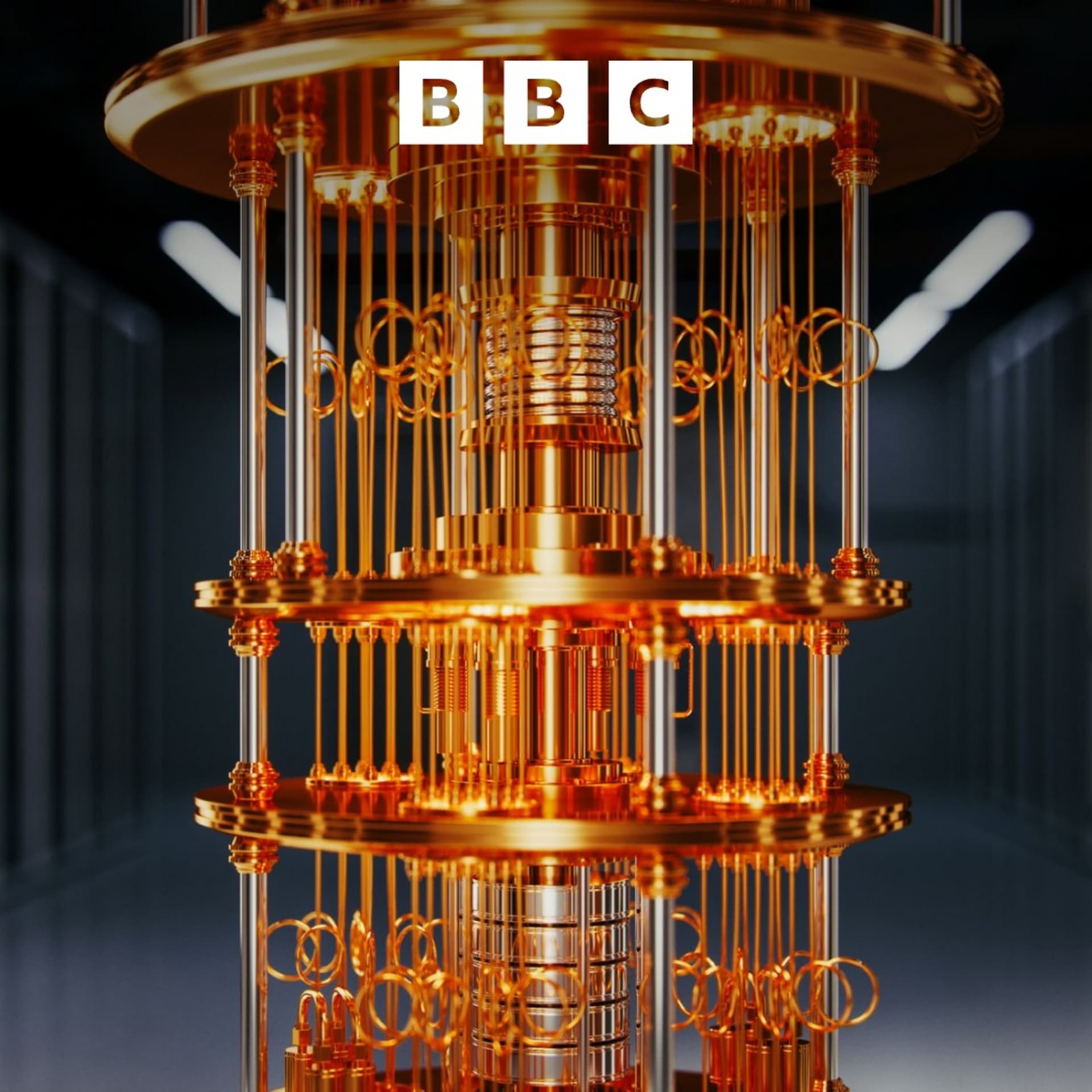
(Photo: An image of a quantum computer inside a high-tech facility. The computer has metallic silver and gold-coloured tubing to assist in cooling. Credit: Getty Images)