In short
Tech Life Podcast Episode Summary: Quantum Question Time
Podcast Overview Title: Tech Life Description: Tech Life explores the impact of technology on our lives globally, featuring innovators, addressing the influence of tech giants, and examining how technology is rapidly reshaping the future.
---
Episode Details Episode Title: Quantum Question Time Episode Description: The episode focuses on quantum computing, addressing listener questions, the future of data networks, and advancements in teaching AI to understand different accents.
---
Key Themes and Discussions
- Understanding Quantum Computing
- Location: UK's National Quantum Computing Centre
- Hosts: Chris Vallance, Michael Cuthbert (Director), and Yashina Lakai (Scientist)
- Key Points:
- Quantum computers utilize quantum bits (qubits) which can represent both 0 and 1 simultaneously, unlike classical computers that use binary.
- Analogy used: Solving a maze by exploring all paths at once versus trial and error.
- Potential applications include optimizing battery designs, drug discovery, and improving logistics.
Listener Questions Addressed:
- Energy Consumption:
- Quantum computers may or may not use less energy than classical computers; efficiency depends on the computational task.
- They could potentially reduce energy used in AI processes, but applications like weather modeling will still rely on classical computing.
- Qubit Functionality:
- Qubits can represent multiple states, allowing complex simulations like those of molecular structures (e.g., caffeine).
- Security Concerns:
- Quantum computers could threaten data encryption due to their ability to factorize large numbers.
- Quantum cryptography offers a means to secure data by alerting users if their data is being accessed.
- Future of Data Networks
- Photonics Networks:
- Explained by Chris Wright, Senior VP at Red Hat and member of the ION Global Forum.
- Photonics networks use light signals to transmit data, improving speed and reducing energy costs.
Potential Benefits:
- Enhanced communication capabilities across distributed networks (e.g., coordinated musical performances).
- Applications in telemedicine and remote surgeries due to low latency connections.
- Improved data transfer and reliability in data centers, aiding disaster recovery and global data management.
- Teaching AI Accents
- Synthesia's Innovations:
- Discussion with Yusuf Alami Mejati on AI voice cloning that preserves various accents.
Key Issues Addressed:
- Disparity in accent representation in AI, often biased towards American and British accents.
- The goal is to make AI-generated voices more reflective of regional accents and languages.
---
Key Takeaways
- Quantum Computing:
- An emerging field with potential benefits and challenges, particularly regarding energy use and security.
- Photonics Networks:
- Represent the next evolution of communication infrastructure, promising faster and more efficient data transfer.
- AI and Accents:
- The need for diversity in AI to reflect cultural identities, recognizing the importance of accents in technology.
---
Listener Engagement
- Encouragement for listeners to submit questions and ideas for future episodes via email or WhatsApp.
Closing Remarks
- The episode wraps up with a reminder for listeners to engage with the show and provide feedback on topics discussed.
---
Produced by: Tom Quinn Edited by: Monica Soriano Presented by: Chris Vallance
For additional inquiries or feedback, contact: techlife@bbc.co.uk or WhatsApp +44 330 1230 320.
Written by AI. May contain mistakes. Listen to the episode to check what was said.
Transcript
Automatic transcript. May contain errors.0:00Welcome to Tech Life on the BBC World Service, the programme about technology and how it's changing all our lives. I'm Chris Valance. This week, we're out at the cutting edge of computer science. We'll step inside a quantum computing lab to answer your questions about technology that promises to revolutionise everything from particle physics to fertiliser production, but is, let's be honest, a bit hard to understand. That's in a moment. And we are all data gluttons. We want more, more, more information, more, more, more quickly. How on earth will our current networks cope? The solution, it turns out, travels at the speed of light.
0:44And how do you teach AI to speak in different accents?
1:08Well, this week, for a change, we're going to start with you, our listeners. Over the past two weeks, we've been asking you to send us your questions about quantum computing, and lots of you have. Quantum computers work in a fundamentally different way from the computers on your phone or laptop. It's hoped one day they might solve problems that these classical computers can't, helping us to develop better batteries, discover new medicines, and even help optimise the delivery route of that new pair of sneakers you ordered. It's super cutting-edge stuff right out at the frontiers of our understanding of physics and computing.
1:47And to help us all get our heads round it, I visited the UK's National Quantum Computing Centre. Its director, Michael Cuthbert, gave me a tour before sitting down with scientist Yashina Lakai to answer some of your questions. Welcome to the National Quantum Computing Centre. We're based here at the Rutherford Appleton Laboratory, the Harwell campus in Oxfordshire. So first of all, before we go into the lab, can I just double check that you don't have a pacemaker? No, I don't have a pacemaker. OK, perfect, because we have magnetic fields in some of our systems, so we need to double check.
2:28So as we come into the lab, you can hear the buzzing sound in the background. So that is all of our cryogenic systems that are cooling our quantum chips down to many times colder than outer space. So quantum computers work very differently from the classical computers, our laptops, the processors in our mobile phones. and we're in a conventional technology we use ones and zeros to do our computation. In a quantum computer we can actually harness quantum physics for those bits to be both a one and a zero simultaneously and that's kind of hard to comprehend about well what does that really mean in terms of running a computation?
3:18So just as an analogy to give you a sense of that if you were in a maze and you wanted to compute your way out of the maze you could put your right hand on the wall and through brute force you could trial and error you could get all your way around the maze keeping your hand on the wall and eventually you would find your way to the exit and a quantum computer rather than that brute force method will actually try and explore all of the potential solutions in parallel. It's an analogy, but it helps kind of get a sense between that brute force one-by-one computation and then exploring all potential solutions in parallel.
4:04We've just come out of the labs, and as I've mentioned, we have lots of questions from our listeners about quantum computing. They're clearly engaged with it, they're clearly excited for this new technology. So I'll start with one question that was really popular amongst the audience, which is this question of the energy use of quantum computers. Bob Church and Tony Ricci from the US wanted to know if quantum computing would require more or less electricity than regular computing. Could it make data centers more efficient if we switch to quantum, Bob asked. And Graham Cobb from Hereford sent in this question.
4:45I think the obvious question is, is that could quantum computing help to reduce the amount of electricity used in getting AI answers and reduce the massive amounts of electricity that artificial intelligence seems to be using? So should we start with just the general question about will these computers use more or less energy than the computers we use every day, classical computers? So the answer is hopefully they will. It's a little bit complicated because we haven't finished building one yet. So we don't know its actual energy usage. Hi, I'm Yashna Lakai. I'm a hardware engineer. We hope that some part of the quantum advantage will be that either you can do the processes more quickly so you lose less energy, or the systems themselves could use less energy.
5:39There's certainly a case to be made for quantum computers being net benefit to the energy landscape because we'll be able to approach problems in chemistry such as can we design better batteries. But as Yasha's just said, it's not clear they will use less energy during the computation, but we'll be able to do more with them. The other thing I would add is that there are certain tasks quantum computers will not be good at. And big data applications is one area. And so things like weather systems, weather patterns will always use classical compute. We had the voice member that was asking specifically about AI.
6:25Does quantum computing offer the prospect of more efficient AI? You can use quantum computing in some forms of the AI landscape, but it's less likely to be chat GPT itself. So in terms of will it reduce the amount of energy that AI is taking? Maybe not, but we might be able to train them more efficiently. So we had a question about the sort of the fundamental building blocks of computing bits, or in the quantum case, qubits. And Derek Pope from the UK says, as a low-level programmer, I have a reasonable understanding of how computers work, but no one ever explains how qubits are useful. If a qubit can return any number of possible values, please explain how that's useful.
7:16It's not so much it's returning any number of values, but it has more states that it can be used for the operation, the low-level operation. I don't think maybe by comparison, if you think of something like a water molecule needs 14 qubits to actually encode, so to write those states that we just talked about. But if one was to extend that to think of a caffeine molecule, so we're all very familiar with it. Many of us consume caffeine on a daily basis. that would require 165 qubits to encode what that molecule looks like in a language of a quantum computer, and classically we cannot do that. Now, I'm sort of old enough to remember the film Sneakers, where somebody came up with a chip that could break everybody's secret code.
8:14It was a Robert Redford movie, if you remember that. We've got a question that's sort of a bit like that, because one of the things that's said about quantum computers is they'll be able to crack encryption. And Angus from Stroud in the UK says, we've been hearing about how quantum computers work in a completely different way to the conventional computers, which are integral to our modern lives. Also integral to our modern lives is data encryption. How does the rise of quantum computing threaten the security of data? If it can solve climate change and world hunger, great. If it means none of my data is safe, not so great.
8:47So one of the things that a quantum computer is really good at is factorising large numbers, which is where the sort of breaking encryption comes from because that's how we do cryptography at the moment. And so it's very good at that process. I would say we're probably not quite there yet. So it's not sort of a short-term worry. And as we move away from that, we also have quantum cryptography. I wouldn't say it was unbreakable, more that you always know whether someone is looking at your data and you can always stop the communication at that point so your data remains safe. How close are quantum computers that will be doing real useful work in lots of different fields in a similar way to the way that classical computers are at the moment?
9:39How far away do you think that is? The UK government's roadmap says we have large-scale machines in a decade's time. I think if we look back in the history of classical computing and ask the people who on this site in the early 60s bought the Atlas computer for being able to number crunch for particle physics how they would imagine classical computing developing, they would never have said we'd all be carrying mobile phones with a computational capability in our pockets. they wouldn't have foreseen it. So I think whilst we are making incredible progress, the 10 years beyond the next decade will also be full of incredible progress as well.
10:27And that was Michael Cuthbert and Yashina Lakai there. And thanks so much to all of you who sent in questions, many more than we could include. I'm particularly sorry we didn't get time to broadcast the answer to Ian Sharpe's question about quantum computing and the multiverse. Somewhere there's an alternative, better universe where we did, Ian.
10:59This is Tech Life on the BBC World Service with me, Chris Valance. And hello to listener Ofiyong Ofiyong, who sent us a WhatsApp message from Abuja in Nigeria. He says, thank you for your educative, informative and inspiring programme. You sure you're listening to the right one, Offian? And he asked, could anything else other than computers be programmed? I heard about gene programming. How does it work? Well, Offian, lots of things other than computers can be programmed. I once had a smart light bulb that needed to be programmed to turn on in the morning. We didn't keep it very long. But your question about gene programming is interesting.
11:38and we'll look into it. Thank you. And if you've got a question or an idea for a future show, do get in touch. Our email address is techlife at bbc.co.uk or send us a WhatsApp or voice note. The number is plus 44 330 1230 320. But please tell us where you live and your name. And still to come, the Next Generation Network that will soon be handling our data at the speed of light.
12:18Now, one of the amazing things about our world is the range of different accents we have, even in countries where we all speak the same language. But accents can also be a source of discrimination. This is the BBC's John Snag explaining why the news was always read in the same accent. Well, listeners will remember that we did try out marked Northern and Scottish voices some time ago. They were liked in their own part of the country, but the majority of listeners seemed to find that they were listening to the way the news was being read rather than to its meaning. Well, thankfully, attitudes have changed a lot since the 1940s.
12:56But does AI discriminate against accents? Shouldn't computer-generated voices reflect the wonderful range of accents found on our planet? Well, Synthesia, a UK-based generative AI company, is launching a new AI system for cloning voices so they can be used as voiceovers and so on. And they say it's much better at preserving Irish, Scots, Australian or New Zealand accents. They also say it can work for accents in other languages too. TechLife's Zoe Kleinman has been speaking to Yusuf Alami Mejati, head of research at Synthesia. Zoe asks Youssef why an accent matters. Well, you know, at Synthesia, we want people to create learning and development videos and we want them to communicate their message in the most effective way possible.
13:49And we have sometimes people that come to replicate their own likenesses. So this is their visual likeness, but there's also their voice likeness. And if you're, you know, if you're like the CEO of a company or if you're just like a regular person, when you have your likeness, you want your accent to be preserved. And we especially work with lots of customers. Many of them are based in Europe or in Asia or even in other parts of the world. And these people tend to have accents that they're rightfully proud of. And when we used to use other providers, what will happen is that they will tend to have American-like accents just because of the fact that, you know, like the models these other companies built and the data sets they used are heavily biased towards English-speaking data sets.
14:40Commonly, with other tools, you find that the English accent is just sort of generically Southern British, isn't it? And Australian accents can sound a bit South African, is that fair? One specific issue that we had regularly is that kind of like the French accents that our customers have tend to be converted to French accents from Quebec rather than French accents from France. And this is just because the companies building these models tend to be North American companies and they tend to have, like the RSS, those are biased towards the demographics that they're in. What are the most difficult accents for AI to replicate and what are the challenges there?
15:21The most difficult accents are the most uncommon accents. at the end of the day is how common is that accent within your data set when you train your model. So the least common the accent, the more difficult the model will find it. And so what we did is we went into great care into creating this big data set that has, you know, a variety of accents. Of course, we try to cover as many accents as possible, as many genders, demographics as possible. And we really, really put emphasis on trying to conserve the identity of our clients. And so what did you do? Was it like a sort of equivalent of Google Maps?
16:02Did you walk about various areas of the UK with microphones getting people to talk to you? I wish that would have been much more fun. No, we created our own data sets. Of course, we recorded a bunch of people with different accents in our own studios. but we also created open source data sets online. There are like a bunch of those that you can use and we created them, we annotated them and we trained the models on them. Now we sent you a recording of a colleague of ours from BBC Scotland called Margaret Montgomery reading a weather report. We sent you the text of what she was reading as well.
16:41Margaret is from the Western Isles in the northwest of Scotland and she has a recognisable accent. So here's a clip of the actual Margaret. Scotland could see its hottest day of the year this weekend, with temperatures possibly reaching 30 centigrade, as several large public events are held across the country. Transmit, the country's biggest festival, is due to begin in Glasgow on Friday, with three days of acts, including headliners Biffy Clyro, 50 Cent and Snow Patrol. You worked on that audio with your AI model, and this is what you sent us back. Scotland could see its hottest day of the year this weekend, with temperatures possibly reaching 30 centigrade as several large public events are held across the country.
17:22Transmit, the country's biggest festival, is due to begin in Glasgow on Friday with three days of acts, including Headminers Buffy Clydeau, 50 Cent on Snow Patrol. So the second clip, is that an AI voice clone? Absolutely. I mean, I hope so. They sounded similar to me, which means that we did a good job. But yes, yes, it's an AI voice clone. And what did you do with it? Well, what we do is we take a recording from a person. And this recording could be, you know, only a few seconds, typically, you know, between 10 to 20 seconds. And we feed that sample to our model. And the model analyzes it and, like, it picks up on, like, the peculiar way people are speaking.
18:08And then it tries to reproduce it. And we can't independently verify what you've done because, obviously, it hasn't been released yet and we weren't there. But you didn't do anything else, did you, to change the sound of that audio? No, we didn't do anything else. I mean, our model normally will be available in the platform in the next three weeks. And so you can do the test yourself. We've been talking a lot about how to try and clone English-speaking accents. But are there plans to broaden this out into other languages and other accents? Because I know there is a sense, isn't there, that a lot of accents and languages are being lost in digitization because they're minorities, I suppose.
18:51Absolutely. Absolutely. So right now we focused on the English language because this is, you know, our biggest market. But obviously we are going to expand on this. And so we will expand this capability to other languages like French, German, Spanish. and with time to like, you know, more uncommon languages, of course, yes. That's Yusuf Alami Majati, head of research at Synthesia, speaking to TechLife's Zoe Kleinman. And do let us know if you find problems engaging with tech because it doesn't understand your accent.
19:32Right now, well, we're just going to pause for a bit because I'm sending my extremely interesting holiday photos to all my friends and neighbours. Well, it's never been easier to share data from holiday snaps to spreadsheets. But as we look to the future, many expect our computer networks to be carrying even more information, more data from more devices. And we'll need it to fly across networks even faster to enable us to remotely control robots or process data internationally. So tech organisations from around the world have formed a group called the ION Global Forum to work on the next generation of communications and infrastructure technology.
20:17And a big part of that is developing something called Photonics Networks. Photonic what? Don't worry. Chris Wright, Senior Vice President at software company Red Hat and senior member of the ION Global Forum will explain it all. Well, the future networks that we're building are called all photonics networks. All photonics networks means everything about the network is connected really through light signals. What's less than ideal today is networks are really a mixture of different types of connections, and those connections can inhibit how much information we can transfer, how quickly we can transfer that information, and maybe really importantly, the energy cost of sustaining all of the infrastructure to move information around.
21:06So very simply, I mean, this is connecting networks. The future, as you see it, are photonics-based networks. What is a photonics-based network? A photonics-based network is using light to transmit signals. And we already have photonics-based networks in some contexts. And you might hear about networks that are connected with fiber optics, optical cables. Those optical cables transmit optical signals. Extending those capabilities, which are relatively narrowly utilized to be the breadth of all interconnectivity, is what we're trying to achieve with all photonics networks. Yes, because some people will have fiber optic broadband connections, won't they?
21:57They'll have fiber optic to their home. They'll have a sort of a different kind of sort of cable that essentially allows light to pass along it, if I can simplify it a lot. Yeah, that's right. In fact, I have that kind of connectivity at my home. And part of the interest I had in upgrading to that connectivity was it gave me better bandwidth so I could share the network with the entirety of my family. So what's the transformation when you apply this technology to a whole network? What do you get? You get end-to-end connections of light signals. And right now, when you transmit information from one point in the network to another point far across the network, there may be some segments that are using these optical cables and optical signals, but there will be many points that are using electronic signals.
22:49And the combination of those things creates bottlenecks or traffic jams. It can slow things down. It can increase the energy consumption and reduce the amount of really bandwidth or ability to transmit large amounts of information by going through all of these different types of technology. So if a listener were to ask, OK, if we converted to photonic networks, what would be in it for me? What kind of examples, practical examples could you give to show that this was worth doing? This transformation was worth doing. The idea of using optical signals to transmit information itself, as I mentioned, isn't new.
23:28End to end, it really changes the performance of the network. And so you can do things that today are just not possible. For example, one of the things I thought was the most interesting display of this technology, we showed a group of musicians who were physically not in the same room. They were distributed many, many miles from one another in different locations. They were able to play well orchestrated music together as if they were sitting in the same room because the distance was was reduced through this low latency connection, which means it doesn't it isn't introducing any of these bottlenecks that I mentioned before.
24:06And would that apply to things like robotic surgery? I mean, you know, there's always this I remember hearing about, you know, the promise of having a doctor in a separate location from the patient. And, you know, the world's leading expert can perform operations around the globe. Is that a sort of a use case there? It's a great another great example. It's as if you're you're bringing things that are physically far apart, much closer together. So, you know, that that remote telemedicine example is a great example. there are many different types of automations that will benefit from this sense of being closer together.
24:44And then there's also large-scale usage of building within a data center of a company. You have all of your compute and data. There's risk of that data being part of a local disaster, being able to share that data across long distances, say for weather issues or something like that, when those long distances are shortened through this better connectivity, it's as if you're just copying your data to the other side of the data center, but it could be maybe halfway around the world. And that's Chris Wright from Red Hat, and also the IOWN Global Forum, speaking to me from Boston in the United States.
25:36Well, alas, we've run out of our allotted quantum of time on Tech Life, so before the end of the programme music kicks in, let me remind you that you can contact us about anything you've heard in this edition. For example, do you think the tech giants have overlooked your accent? Or maybe you can answer Ophiong's question about gene programming. Our email address is techlife at bbc.co.uk or you can WhatsApp us on plus 44 330 1230 320. Please include your name and where you live. Today's Tech Life was produced by Tom Quinn, edited by Monica Soriano and presented by me, Chris Fallons.
From the publisher
We step inside a quantum computer lab to answer your questions about technology that promises to revolutionise everything from particle physics to fertiliser production.
Also this week on Tech Life: lots of us upload and download large quantities of data, and the expectation is that the demand for data will only increase in the future. How will our current networks cope ? The solution travels at the speed of light.
And how do you teach AI to speak in different accents ? We find out.
We enjoy reading your messages about Tech Life. Please get in touch by emailing techlife@bbc.co.uk or send us a Whatsapp message or voice memo on +44 330 1230 320. Please include your name and where you live.
Presenter: Chris Vallance Producer: Tom Quinn Editor: Monica Soriano
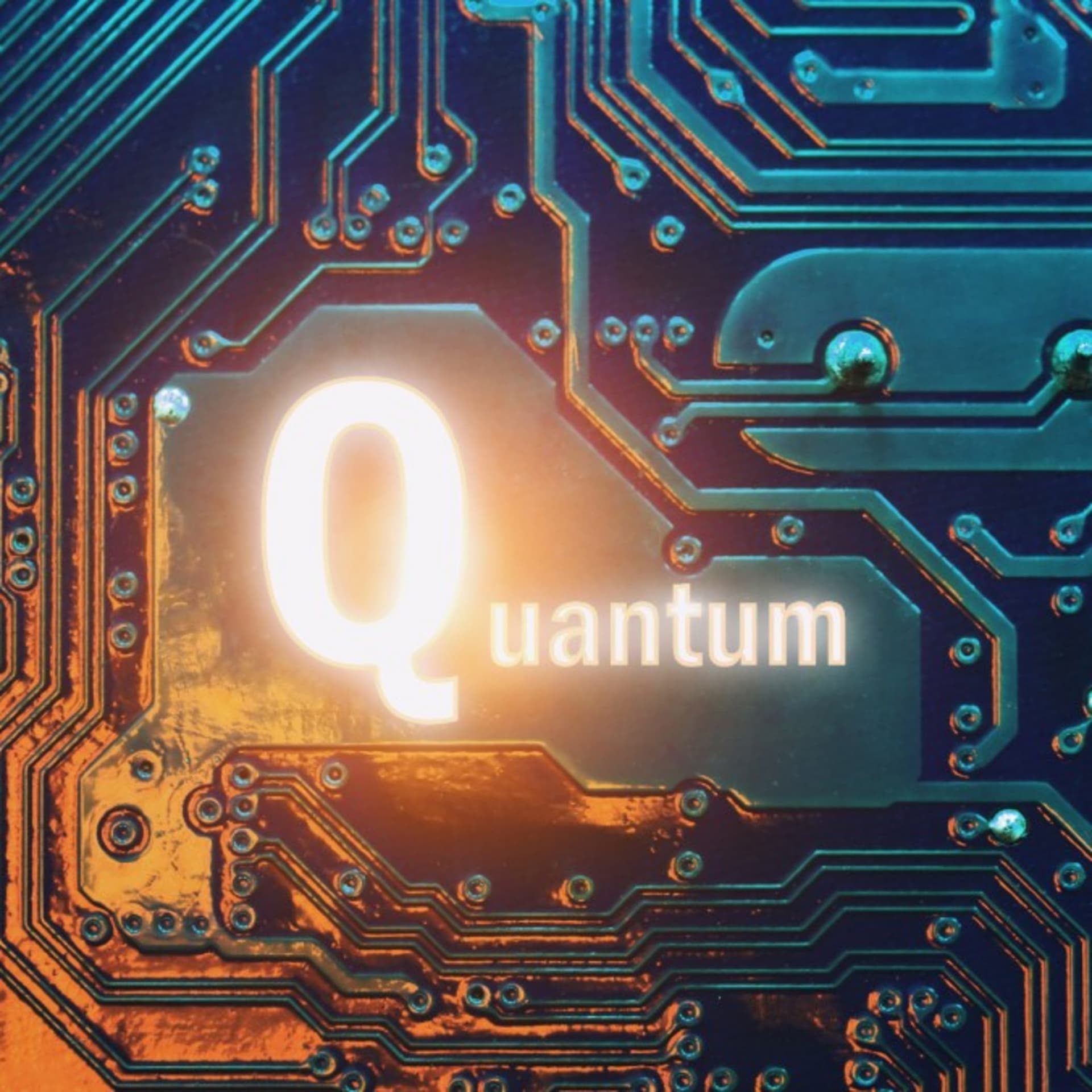
Image: The word "Quantum" is illuminated on a circuit board. Credit: Wong Yu Liang/Getty Images