In short
The episode of BBC World Service’s Tech Life (“School deepfake ransoms”) focuses on how AI deepfakes are being used to extort schools and discusses possible defenses. It also includes two other tech segments: a graphene “smell” microchip and an AI tool for dyslexia.
Guests and backgrounds
Simon Bailey, former UK National Police Chiefs Council lead for child protection, now an online child-safety advisor; Carol Osborne, founder of ADOS, a company that replaces real children’s identities in school images. Dr. Kiana Aron, innovation advisor at Paragraph and professor at UC San Diego, discusses graphene bioelectronic smell chips. Angelus Collins, a dyslexic product design student at Nottingham Trent University, built Lexo.
Key claims and examples
Bailey calls deepfake child sexual abuse a “global pandemic” and describes sextortion/extortion via scraping school websites, including a UK case of 30 deepfaked girls and a bitcoin ransom demand. He says consent doesn’t cover parents being informed about new threats and urges a whole-system response. Osborne says ADOS uploads images before publication, removes real identities, and keeps images inside its infrastructure (no third-party processing; not trained on real children). Aron describes a graphene microchip using insect-like receptors (jumping bristle tail) to detect organic compounds; potential uses include detecting diseases and biological threats. Collins’ Lexo provides one-device controls to summarize, read aloud, dictate, and grammar-correct text for dyslexia.
Written by AI. May contain mistakes. Listen to the episode to check what was said.
Chapters
Tap a time to open that second in VOThe Deepfake Epidemic
3:16 to 4:23
Explore the rise of deepfake pornography affecting schools and the impact on victims.
“It covers a topic you may not want children to hear and which even adults may find upsetting.”
Extortion and Deepfakes in Schools
6:01 to 7:40
Learn how criminals exploit AI deepfakes for extortion in educational settings.
“Many schools post pictures of their students online in newsletters and social media posts or promotional materials.”
Addressing the Deepfake Crisis
10:01 to 11:01
Understand the multi-faceted response needed to combat the deepfake threat.
“and really the responsibility and the hurt should be felt by the criminals?”
ADOS: A Potential Solution
11:05 to 14:02
Discover how ADOS aims to protect children's identities from deepfake misuse.
“As I mentioned earlier, Simon now advises organisations and companies on child safety.”
Discussion on Technology and Image Sharing
14:02 to 15:10
Exploring the challenges of sharing images in today's tech-driven world.
“Is it something that in a way, are you kind of a bit disappointed that you've had to do this?”
Listener Engagement and Feedback
15:10 to 15:45
Sharing listener feedback on previous episode topics, including electric aviation.
Listener Interaction Details
16:05 to 17:13
Providing listeners with information on how to interact with the show.
“Last week, we reported on electric aviation and the extent to which electricity could replace jet fuel to power planes.”
Innovative Smell Detection Technology
17:25 to 19:42
Introducing a new chip that combines biology and graphene for smell detection.
“We've also discussed another source of data on the show before, a sense that we often overlook, though it's right under our noses.”
Applications and Implications of New Tech
19:42 to 22:24
Discussing potential applications of bioelectronic microchips in various fields.
“For example, when you look at moths or dogs, they have much better smell perception than human.”
AI and Data Analysis in Smell Detection
22:24 to 24:00
Exploring how AI can enhance the interpretation of data from smell sensors.
“So it opens a new era of capability for us.”
Show all 12 chapters
Creating Assistive Technology for Dyslexia
24:00 to 28:00
A student presents Lexo, a device designed to aid individuals with dyslexia.
“can have a real impact on life, particularly in education.”
Celebrating Achievements
28:00 to 28:12
Listeners hear about Angelus's academic success.
“And since we spoke, he's got his result and he got a first class bachelor's degree.”
Transcript
Automatic transcript. May contain errors.0:00This BBC podcast is supported by ads outside the UK. Pop quiz. What's in your kid's lunchbox? At Whole Foods Market, they've already done the studying. Over 300 food ingredients are banned from their shelves. No hydronated fats in the peanut butter and no high fructose corn syrup in the cookies. And for sandwiches, there are no synthetic nitrates or nitrites in any of their deli meat. So you can pack lunchboxes with peace of mind. Get back to school ready at Whole Foods Market. Chicago talks a lot. Hold on, let me step over here. People are talking too much. We debate about food, deep dish, tavern style, who's got the best beef.
0:42We yell across rooms, across blocks, across generations. Yes, nice earrings, Grammy. And now we're doing it on our phones too. Video calls from the L train, group chats that never shut up. Neighbors texting you the score before your TV catches up. Come on. Get a load of this guy. Ketchup on a dog. Yeah, we've got thoughts. Too loud? In Chicago, you're gonna hear it. Because nothing here gets built without conversation. Nothing moves without connection. So, if you think you know AT &T, it might be time to rethink that. Because their network has improved, like, a lot. So Chicago can keep speaking its mind with AT &T Wireless and AT &T Fiber.
1:22Chicago won't stop talking. Our improved network backs it up. AT &T, connecting changes everything. AT &T Fibre, limited availability in select areas.
1:34Hi, and welcome to Tech Life with me, Chris Valance. We're a programme about how tech affects all of us every day, for good or for ill. Today, AI generated deepfakes and how criminals have used them to hold schools to ransom. We speak to a company that thinks AI could also offer a way out. We cannot stop criminals from scraping these images. You know, that task is just, it's not a task that we can answer, not a problem we can answer right now, but we can remove real children's identities from online platforms. Then, could humans borrow super senses from other animals? No, not the plot of a new Spider-Man film.
2:15This is purely biology, physics and tech combining to take us far beyond human limits. No radioactive spiders needed. We're sort of borrowing the super sensors that nature has developed over millions of years and using them with the chips to expand our capabilities to detect various things. And we hear from a student with dyslexia who invented his own AI-powered gadget to help him through university. Let's say you just wrote an email late in the day, can't really process to make it sound very professional you could just highlight that text hold down this button say make this sound more professional all that coming up on tech life
3:13Our first item comes with a warning. It covers a topic you may not want children to hear and which even adults may find upsetting. We're talking about AI deepfakes and how they are increasingly being used to generate illegal child sexual abuse images.
3:36The deepfake issue is really significant and serious in South Korea. we have seen a surge in deepfake pornography, particularly affecting schools. The deepfake abuse of children is a growing international problem. Some call it an epidemic. The images, which are generated using artificial intelligence, combine the face of a real person with a fake body.
4:08in some cases children mainly girls are targeted by deep fakes made by pupils in their own schools this is the story of how two teenage boys created more than 300 deep fake nudes of mostly underage girls that wrecked havoc on a small town and an elite private school they may use nudification apps, which use AI to create illegal explicit images featuring their classmates. The impact on the girls has been devastating. Lawyers representing the victims told USA Today that for some high achieving students, they're now just struggling to get through.
4:49Deepfakes are also made by criminals who sell them on the dark web. Innocent social media posts can be turned into deepfakes. Police and campaigners are warning. Parents are being warned about the risks of posting images of their children online due to an increase in AI-generated abuse imagery. Just this weekend, The Guardian newspaper in the UK reported this. The report removed service, which blocks intimate images from appearing online, said there had been a rapid increase in imagery that had been digitally manipulated or faked in some way, including with AI and nudification tools. These figures come from the Internet Watch Foundation, a charity that fights online abuse, and the children's charity, the NSPCC.
5:37In the first six months of this year, it received 420 reports from children of images of themselves that they believed had been faked or manipulated to appear explicit. The number has already exceeded its 2 ,025 total of 397.
6:00But there's another motive behind the creation of these deepfakes, extortion. Many schools post pictures of their students online in newsletters and social media posts or promotional materials. But criminals are using AI to create explicit deepfakes of these images and threaten to publish the images on the dark web unless a ransom is paid. In the UK, broadcaster LBC recently reported that criminals had deepfaked pictures of 30 girls from a school's own website. They threatened to release the child sexual abuse material unless a bitcoin ransom was paid worth more than 330 ,000 US dollars. Simon Bailey is the former National Police Chiefs Council lead for child protection in the UK and now works as an advisor on online child protection.
6:50We are seeing a significant increase in the number of images of generative child sexual abuse material. It is now a global pandemic and it's a public health crisis. And sextortion is part of that this this kind of uh where people are effectively blackmailed using intimate images what we are seeing more in the creation of the extortion of of schools is the scraping of those images those images being turned into sexualized content and then a blackmail demand then being made and in the last few months i have spoken to hundreds of head teachers safeguarding leads and teachers and I can't recall one of them that wasn't aware of the scale of the threat and a number of them had been subject of extortion attempts.
7:44Who is behind this? It'll be serious and organised crime that are seeing an opportunity to extort organisations that they think have wealth and they are, I think they're, as much as anything as well, they're preying on the fact that there will be heads and there will be boards of trustees that will put the protection of the brand of their of their schools before anything else. And in some cases, I am sure, will be paying the demand. What can schools do to protect themselves? There's a very interesting dilemma now facing school marketing leads and school heads and the safeguarding leads, because one of the stock responses that I have had from those colleagues is, Simon, the parents have consented to the children's images being used.
8:29But that then leads on to that natural follow-up question well when that consent was secured were they aware and had they been briefed upon this new and emerging threat and of course in so many cases they haven't and I think the vast majority of parents would turn around and say no I'm not prepared for you to do that because I don't want that situation to arise and what we have seen in situations where that has arrived parents are then going onto the web and they're then trying to find the images of their children in that sexualized exploitive content the parents are then suffering a trauma because of course they'll be viewing probably thousands of child sexual abuse images which are not their children and some of that material is as you might imagine absolutely horrific and they're also placing themselves in legal jeopardy and they are also placing themselves in legal jeopardy but you'll be you'll be aware that it's a it's a habit that everybody's got into i mean I mean, you know, everybody is taking selfies, everybody is putting them up on the web.
9:33Does there need to be a culture change around just pictures of children online? Well, then there needs to be an awareness of the risks and parents, children need to be far more in tune with understanding what that risk is and making sure that the settings within their particular platforms is secure. where the only people that are able to view those images are the people that you trust, that you know, and those criminals can't access that content. What would you say to somebody who says, well, look, this is a crime, and really the responsibility and the hurt should be felt by the criminals? We are dealing with a pandemic of abuse.
10:13There are millions and millions of cases that are not being dealt with because law enforcement around the world can't keep up with the demand. which says to me that if we are going to truly tackle this threat it has to be a whole system response it has to be a multi-faceted response where parents educate their children where schools reinforce that teachers and schools and parents play a role in keeping their children safe the tech companies don't allow you to view child sex abuse material and law enforcement is then able to tackle the highest harm offenders i've painted a picture of what the totality of the response should look like.
10:52It's not just down to one. Tech improvements are not a silver bullet, but the tech companies really stepping up and investing in their trust and safety would go a long, long way to mitigating the harm that's currently being caused. Simon Bailey there. As I mentioned earlier, Simon now advises organisations and companies on child safety. One of those companies is called ADOS, which offers one potential way to deal with this problem. Its founder is Carol Osborne. I was in brand communications before this and I was working directly with schools. And that's where I very first heard about the issue of criminals scraping school websites, taking the images of children and turning that content into harmful content, you know, child sex abuse material.
11:42they would send a sample back to the school and then they would start an extortion attempt. So what is your company's solution or at least attempt to mitigate the problem? Yeah, I think solving the problem is perhaps bigger than your company's. Yeah. How is your company helping schools combat this problem? so with ADOS what it does in its most simplest terms is a school will before they publish an image on their website or social media they will upload it to ADOS and ADOS removes the real child's identity completely from the image and replaces it with a synthetic identity so not a real child we cannot stop criminals from scraping these images you know that task is just it's not a tasks that we can answer and not a problem we can answer right now but we can remove real children's identities from online platforms and and that's what ADOS exists to do it uses AI I assume to change the appearance of children we've tried it out our producer Imran had a go and it did indeed change his appearance yeah I think I think you know the realism of the images was a little variable But, you know, it's definitely not his face.
13:09I wondered, though, if there's any concerns about essentially children's images being uploaded to an AI platform. Are you stopping one problem and creating another, if you like, by uploading them to an AI? All images that are uploaded to ADOS are managed within our infrastructure. So they never leave ADOS, no third party processing, anything like that. and we never ever train from real children's images so all of our data has been made by us and we made that decision because we don't just want to replace one real child's identity with another real child's identity and it's got better and better and better you know things move in technology so fast so so if you listen the product a year ago yeah we might not be having this interview.
14:02That's very open of you to say that. Is it something that in a way, are you kind of a bit disappointed that you've had to do this? Because, you know, when I was growing up, and this was before any of this was really an issue, you know, parents would look forward to seeing maybe a picture of their child in the local paper at the sports day, or, you know, some club doing something and now in a sense you're saying to schools you know we live in a world where you can't have those those pictures yeah it is it's a real shame i think the thing is as technology moves on and evolves technology is incredible it's one you know it's brilliant right but you have to be aware of the people who are going it's not technology that's using itself in a bad way but there are still safe ways to share safer ways to share images with family and with things like that what we're asking people to do is not kind of put them out on a global platform that is open to anybody to see that's the bit that we're asking for people to stop doing and that was carol osborne if you thoughts on what carol or simon told us do get in touch we'll give out our contact details in a bit.
15:45market.
16:04You're listening to Tech Life on the BBC World Service with me, Chris Valance, and with you, our listeners. Last week, we reported on electric aviation and the extent to which electricity could replace jet fuel to power planes. David Akwasi-Amofa emailed us from Ghana to say he was really enthused by the item. He researched the future of electric flight as a student back in 2019 and has been following developments closely ever since. Juan Vitone, from the Lone Star State of Texas in the US, said he would definitely fly on an electric plane, writing easier to maintain, greener to operate and less prone to failure.
16:42The topic also electrified Ibrahim Dumbaya from Freetown in Sierra Leone, who kindly wrote to tell us it was a very educating programme. And thank you also to regular listeners John in Australia and Kadir in Somalia, who both got in touch to say nice things about tech life. Well, thank you, because the show really flies when we get ideas from our listeners. And if you want to send us a message about anything we feature on the show, you can email us on techlife at bbc.co.uk or send us a WhatsApp. The number to save in your phone is plus 44 330 1230 320.
17:25Now, one of the cool things about artificial intelligence is that it's helped us analyse data in visual and audio formats, from smartphone apps to identify plants in photos, to apps that will tell you the name of a catchy song playing in a bar, or even work out a bird species by its cool, as I found out a couple of weeks ago on Tech Life. We've also discussed another source of data on the show before, a sense that we often overlook, though it's right under our noses. We are talking about smell. Well, now we bring you news of a new proof-of-concept chip that fuses biology with one of the most exciting new materials to emerge in recent decades, graphene.
18:06Graphene is an incredibly thin layer of carbon atoms arranged in a honeycomb pattern. It's strong and conducts electricity really well. Paragraph, a UK company, makes microchips out of graphene, and it's now coupled one of these with man-made versions of molecules, known as receptors used by living creatures to detect particular smells. In this case, they've copied one found in an insect, the jumping bristle tail. But in the future, they suggest we could use the tech to borrow the sensory capabilities of all kinds of creatures. To find out more, I spoke to Dr. Kiana Aron, innovation advisor to Paragraph and professor of bioengineering and medicine at UC San Diego.
18:50Graphene is a one-atom thick sheet of carbon and it's extremely sensitive to electrical signals and the field is moving towards using material like graphene to build more sensitive electronic systems. We've created a graphene bioelectronic microchip capable of detecting organic compounds by smell. What's the simple version of that? Biology has been always talking with us with electrical language. For example, cells can send electrical signals. So you can imagine if we have tools to listen to this electrical language, then we are able to actually also listen to biology. So I want to put it this way.
19:37And we are doing something that nature have developed over millions of years. For example, when you look at moths or dogs, they have much better smell perception than human. And we said, OK, what do they do? Where are these receptors? Can we actually borrow these receptors from nature rather than building the whole sensor ourselves? So that was really the whole idea. And we should be clear here. We're not talking about when we say a receptor. People might think you're sort of sticking a nose on a chip. We're talking about an organic compound, a protein in this case. Absolutely. So when you zoom into the antenna of, for example, moth, it has a lot of proteins.
20:19And this is how insects smell, how we smell. We have olfactory receptors or this protein in our nose. Instead of like engineering our own olfactory receptors, we're not as good as dogs or moths. So that's why we decided to get the genetic code for making the proteins similar to moth. And we can do that because biomanufacturing and biotechnology have advanced so much that we are able to basically re-engineer biology, remake those. We don't have to kill thousands of moths to get their receptors. What do you see as the applications for this? Can we, for example, detect malaria? You know, can we put sensors in a train where they can detect a virus floating around?
21:02you know, COVID, flu, can we detect cancer the same way that a dog can detect cancer? So we're sort of borrowing the super sensors that nature has developed over millions of years and using them with the chips to expand our capabilities to detect various things. Also in chemical industry, where you want to detect some chemical, which is indistinguishable to us humans, in agriculture, they can be used. So I think there's a range of application that the sensor can be used for. I've asked this before of people working in this field, but obviously smell is tremendously revealing. You know, we don't think about it as humans because we're not very good at smelling generally.
21:40But, you know, if you get very good at smelling, you can tell all sorts of things about people. You mentioned health conditions. You might also be able to tell, you know, quite personal information. Are they pregnant, for example? Do we need to start thinking about the implications of that now? It sounds like the tech's sort of racing ahead a bit. Yes. I mean, I tend to focus on the positive applications of it because there's a lot of capabilities that this type of technologies can give us. Not only smell, you know, for example, sharks can detect electricity, you know, a snake can detect heat.
22:13You know, there are other species that can detect electromagnetic field. Can we borrow this super sensor and make them work in harmony with electronics to create sensing capabilities that we humans don't even have, right? So it opens a new era of capability for us. But from a positive and negative point of view, from a positive point of view, you can think about, you know, having a watch that could smell or detect someone sitting next to you having COVID. So you want to not sit there when you're on a train or in a car. But you can also think about, you know, building robotics with all of the capabilities that human have and beyond.
22:49So that sort of scares people. But to me, I mean, there are applications for those as well that we could utilize. For example, can we detect biological threats? I think there's a lot of great applications for this type of technologies. What role does AI play in understanding what the chip is telling you? With AI, we can detect pattern. For example, how one of these receptors responding to different orders that we were exposing it to. And then we're getting a lot of information and no human brain can actually analyze those human information. That's what gets me excited. What I want us to be aware of is that the AI revolution, it's giving us a lot of meaningful work.
23:32But we also have to keep in mind that AI needs good data. And this is where, you know, sensors like this can generate real data. and then AI can start, you know, helping us understand that data better because there's more capability with AI than human brain.
23:56If you are a dyslexic or you know someone who is, you'll know that the condition which makes reading and writing harder can have a real impact on life, particularly in education. There's tech out there to help, but 23-year-old product design student Angelus Collins, who has dyslexia, found it hard to navigate the array of different tools. So he decided to make his own as part of his final year project at Nottingham Trent University in England. Here he is describing the result, which he calls Lexo. It's an external device that you just plug directly into your computer. It has like a software side to it as well.
24:36And basically, it just performs language assistant functions, mostly centered around people with dyslexia. That's something you've struggled with, isn't it? Yes. So all my life, I've sort of known I was dyslexic. I can still barely read. I always like kind of avoid reading emails and stuff. And it definitely still has a major effect on my life. And I'm always looking for ways to manage and just kind of try to just fit in. I mean is there a particular incident that in your mind sort of summarizes why it's been a challenge for you I guess it's just seeing other how other people can do work where areas that I struggle in seeing them just be able to almost effortlessly do stuff it's just a constant reminder that there's like that setback or I'm just at a disadvantage because of that certain thing that they can do that I can't.
25:37So you decided to put your other skills to work to help people with dyslexia. You've created a bit of tech called Lexo and I think you can show it to us. Yeah yeah just so this model is working so I could like plug it into my computer and like press these buttons and they'll when the software is like up it will it will do the functions that would be very beneficial for someone with my difficulty so it looks like a little um black bar and is are those play and stop and pause um this first button is like a sort of ask ai summarize or like ask meaning of a word so you highlight that text or send it to ai summarize or or tell you the meaning uh the next one is like a read button so you press that it will start reading that text out loud and then next one after that is like a playback so it'll play to the previous full stop because a lot of the time especially when getting something read out to you with a long piece of text it's easy to miss something then the next one after that is a dictate button so as you're holding that down anything you would say will be like pasted directly into any text area that you're currently selected and then the last one is um a grammar correction one so let's say you just wrote an email late in the day can't really process to make it sound very professional you could just highlight that text hold down this button say make this sound more professional a lot of these features do kind of exist in other products but not all in one place and often require you to copy and paste things into different UIs.
27:19Let's say you're using chat GPT, you would have to highlight text, copy, open a new UI, and that really breaks the flow of work. And so it's a user interface. You're using the phrase UI, so we better explain that. But is this part of your final year project? Yes. So this is my like the main one, my self-directed. And when do you get your results? Tomorrow. So no nerves, no nerves at all. Maybe a little. Try not to think about it. Well, I wish you good luck and thanks very much for sharing your story with us. Cheers. It's been great. Thank you. And that was Angelus Collins. And since we spoke, he's got his result and he got a first class bachelor's degree.
28:05Top marks, in other words. Congratulations, Angelus.
28:11Well, we've come to the end of another edition of Tech Life. If you've got thoughts about anything you've heard today, do get in touch. Our email address is techlife at bbc.co.uk or you can WhatsApp us on plus 44 330 1230 320. Today's Tech Life was produced by Imran Rahman-Jones and presented by me, Chris Fallons.
From the publisher
For many schools, it’s normal to post pictures of their own pupils online, either celebrating events or for marketing. But these photos could also be taken by criminals and used to make distressing deepfake AI images. We speak to the founder of a company which says it has a solution. Also on the programme, the incredible ways graphene can augment our senses – including to smell for diseases. And the student with dyslexia who invented his own tech to help him through his course.
Presenter: Chris Vallance Producer: Imran Rahman-Jones
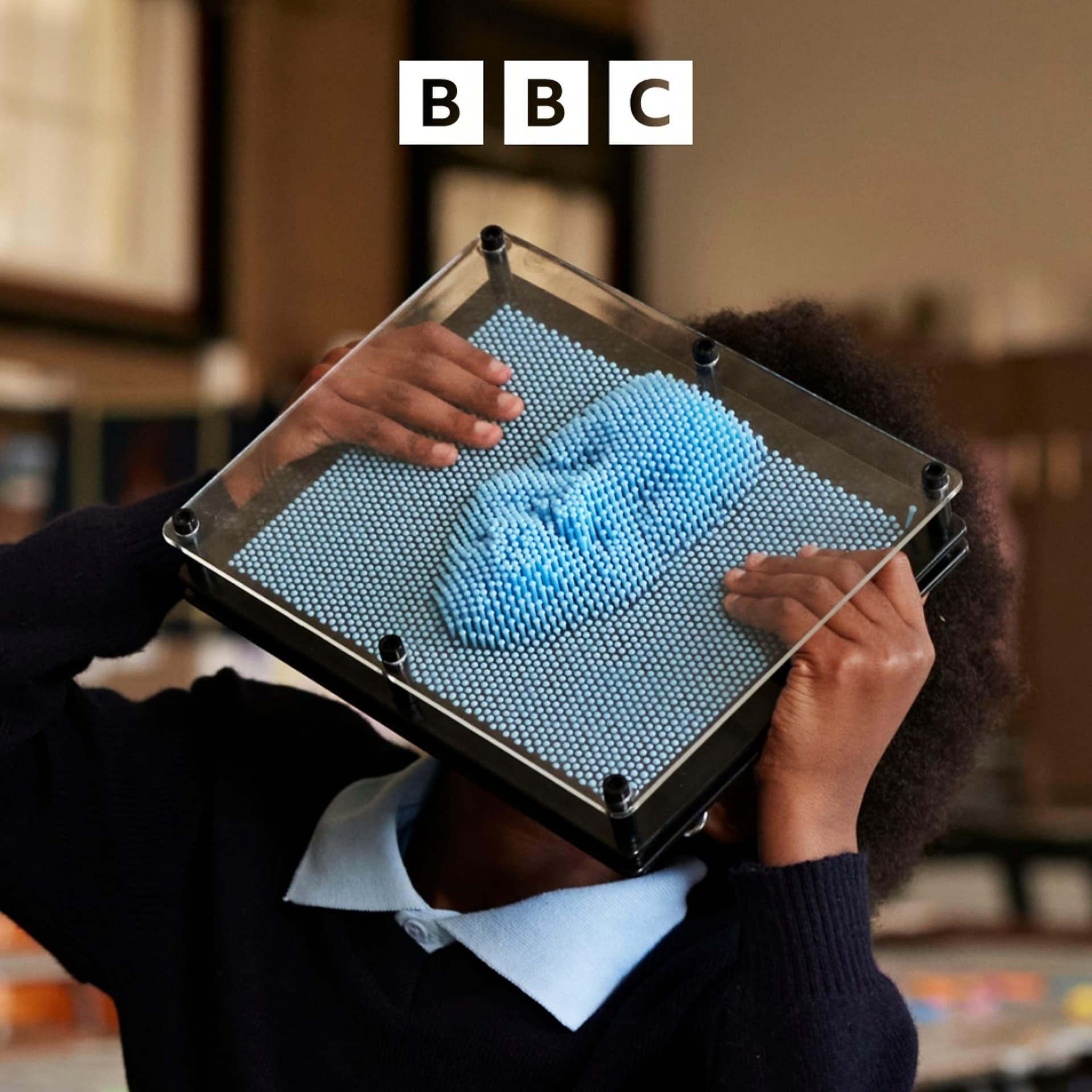
(Image: A child places a metal pin impression toy over their face, so they cannot be identified. Credit: Getty Images)