In short
Tech Life Podcast Episode Summary
Episode Title
Screen Time ‘Rewiring Our Brains’
Episode Description In this episode, the podcast investigates the effects of screen time on babies and young children, featuring insights from parents and experts. It also includes a touching story about how AI helped a listener hear his father's voice for the first time in 50 years.
Host
- Presenter: Shiona McCallum
- Producers: Imran Rahman-Jones and Vuyelo Ndlovu
---
Key Themes and Discussions
- The Impact of Screen Time on Children
- Parental Concerns: Parents express anxiety over their children’s screen time and the balance between digital engagement and physical play.
- Example: A parent discusses the challenge of limiting screen time when friends have devices.
- Statistics:
- World Health Organization recommends only one hour of screen time per day for young children.
- A significant increase in screen usage: 1 in 5 children aged 3-4 have smartphones.
- Parents’ Screen Time and Its Influence
- A study indicates that parents' screen time affects toddlers:
- Children exposed to screens hear fewer words and make fewer vocalizations.
- Dr. Mary Brush's research indicates that toddlers could miss out on over 1,000 adult words daily due to screens.
- Expert Insights
- Dr. Becky Kennedy, a clinical psychologist, highlights:
- The ease of access to engaging content on screens leads to habitual use.
- Proposes practical strategies for parents to manage screen time effectively:
- Avoid screens in shared spaces to reduce temptation.
- Engage children in discussions about screen habits and involve them in setting boundaries.
- Diverging Opinions on Screen Use
- Some researchers argue that evidence linking screens to developmental issues lacks consensus.
- Benefits of Screens: Educational apps and interactive games can aid learning.
- Concerns Raised: High screen time correlates with reduced physical activity and attention spans.
- The Role of Technology and Future Trends
- A report from the UK Parliament suggests:
- The harms of screen time for young children outweigh potential benefits, while limited use may be beneficial for older children.
- Discussion of future tech trends including:
- Devices without screens, such as AI toys, that engage children through audio.
- AI and Voice Technology Personal Stories
- Listener Story: Rob shares how AI voice technology helped him hear his deceased father's voice and allowed his mother, who has dementia, to reconnect with memories.
- Highlights the emotional impact of voice technology in preserving family legacies.
- Conclusion and Final Thoughts
- The episode encapsulates the complexity of screen time discussions, emphasizing both the potential risks and benefits of technology for children.
- Encourages thoughtful engagement with technology, focusing on quality and context of screen use rather than just quantity.
---
Key Takeaways
- It is critical for parents to model healthy screen habits to set a positive example for their children.
- Open discussions about screen use can help families navigate this challenging topic together.
- Emerging technologies like AI voice cloning have profound personal implications and can enhance emotional connections with loved ones.
---
Closing Remarks Listeners are encouraged to reflect on their own screen habits and consider the balance between technology use and personal interaction, especially for children. The episode serves as a poignant reminder of the emotional connections facilitated through technology in both positive and challenging contexts.
Written by AI. May contain mistakes. Listen to the episode to check what was said.
Chapters
Tap a time to open that second in VOUnderstanding Screen Time Concerns
0:45 to 2:10
Discussing parental worries about screen time and children's device usage.
“or limiting their time on the screens just to get them to do something else sometimes can be a bit of an issue because it's what their friends and stuff are doing as well.”
Childhood Screen Time Statistics
2:10 to 3:40
Exploring current statistics on children's screen time and health guidelines.
“According to my phone stats, I'm averaging between three and four hours a day.”
Parent Perspectives on Screen Time
3:40 to 6:35
Gathering insights from parents on their child's screen time habits and challenges.
“Well, we sent Tech Life's James Kelly to St Anthony's Primary School in County Armagh, Northern Ireland, to gauge the temperature at pick-up time.”
Impact of Parental Screen Time
6:35 to 10:00
Examining how parents' screen time affects their children and development.
“Obviously, there's the worry of how much time children are spending on devices, but there's also the issue of how much us as parents are spending on our phones too.”
Balancing Screen Time with Education
10:00 to 12:10
Discussing the potential benefits of screen time for learning and development.
“So the amount of screen time I've told you we're going to have isn't changing yet.”
Future of Technology and Kids
12:10 to 14:08
Exploring the evolution of technology and its implications for children beyond screens.
“Still, we know that tech giants like Steve Jobs and Bill Gates limited or banned their own kids' screen use.”
Parental Concerns Around Screen Time
14:08 to 16:18
Explore the growing parental concerns about screen time and technology use among children.
“songs, and all different types of educational content.”
Designing Technology for Children
16:18 to 18:12
Discuss the importance of designing technology that supports children's learning and development.
“Does it just get disregarded when a child stops using it?”
Tony's Box and Its Impact
18:12 to 19:18
Learn about the longevity and family value of the Tony's box and its environmental considerations.
“We talk a lot at Tony about empowering children and really making sure that when you give your child that Tony Vox or that My First figurine, you know that they are in this safe environment, right?”
Listener's Experience with Voice Cloning
19:27 to 21:41
Hear a listener's emotional story about using voice cloning technology after losing a loved one.
“You can call for it again when you're ready.”
Show all 12 chapters
Family Memories Through Technology
21:41 to 24:18
Discuss the role of technology in preserving family memories and reconnecting with loved ones.
“the difference that that had made to Yvonne's life and what experience do you have then of these voice cloning tools because you also have your own story to tell well my father died when I was eight.”
Passion for Supporting Others with AI
24:18 to 26:58
Explore the passion for using AI technology to support those suffering from voice loss due to illness.
“Tell me about then some of the work or the support then that you have offered some of the local charities that are using similar technology?”
Transcript
Automatic transcript. May contain errors.0:00This BBC podcast is supported by ads outside the UK.
0:30This week on Good Bad Billionaire, how Toto Wolff made his billions. Listen wherever you get your BBC podcasts. Welcome to Tech Life on the BBC World Service with me, Shona McCallum. I'm constantly worrying, you know, whether having too much time on screens or limiting their time on the screens just to get them to do something else sometimes can be a bit of an issue because it's what their friends and stuff are doing as well. That's a parent we spoke to about her child's relationship with digital devices, because today we're looking at screen time in young ones. More of that in a moment. And a few weeks ago, we spoke to a woman called Yvonne, who had lost her voice to motor neuron disease, about how AI had helped her speak again.
1:14That prompted listener Rob to get in touch with his own story of using AI to help hear his father's voice for the first time in 50 years. Playing those to my mother, who is in quite an advanced state of dementia now, every now and then with very old memories, you get a flicker in her eye, which tells you everything. And it was very moving.
2:00Right, this week on Tech Life, we're taking a deep dive into screen time.
2:09How much time do you spend on screens each day? I'll go full disclosure here. According to my phone stats, I'm averaging between three and four hours a day. I know it seems quite a lot, doesn't it? and it feels quite troubling. And I think mainly that's because it's not even something I'm consciously noticing myself doing. A lot of that time is, of course, social media, but also shopping and travel, maps, emails, WhatsApps, text. There's just a lot of digital noise in this modern life. It's really difficult to have a screen break. Now, think back to when you were a child. How much time did you spend on screens then?
2:49In some ways, I feel pretty lucky that screens weren't around as much when I was growing up. But as a parent now, it's something that I think about a lot.
3:01The World Health Organization guidelines suggest one hour screen time a day for young kids. But research suggests that children are spending more time on screens than ever before, whether that's phones, tablets or TVs. The UK media regulator says one in five children aged three to four now has a smartphone. As a parent, I really think there's two challenges. One is trying to set a good example. So not always being on your phone in front of your children. And the other is environments that you can't control. So other families, other parents. And that's when it gets difficult. When your child is asking for a tablet because their friends have one.
3:41I definitely find that a bit tricky. How do you feel about it? Well, we sent Tech Life's James Kelly to St Anthony's Primary School in County Armagh, Northern Ireland, to gauge the temperature at pick-up time. They'll get up in the morning and there's no screen time. They'll go to school and then they'll come home and maybe have like a wee half an hour to watch something. And then they'll go outside and play usually, get dinner. And then night time usually they're allowed on their screens to have iPads or watching Netflix or Disney on their TV. And as a parent today, do you find it make a conscious effort to make sure they're not spending too much time on their screens?
4:17Yeah, yeah. I find that I'm constantly worrying, you know, whether having too much time on screens or limiting their time on the screens just to get them to do something else sometimes can be a bit of an issue because it's what their friends and stuff are doing as well. Could you tell me, how would you describe a typical day in terms of how much time your kids would spend on a screen? probably about an hour to two hours max but that would be it they're mostly out playing and what do you think your kids relationship are with their screens in moderation my son would have too much time and my weeker she doesn't rely on it at all yeah and what ages would they be seven and five and do you find it tricky to try and navigate that definitely and behavior problems as well that comes with screen time and it's always the constant need of wanting more.
5:07My youngest is nine but the other two are teenagers. In terms of a typical day, in terms of your youngest especially, how much time would you say they would spend on the screens? We've had to cut down quite a bit because it gets out of control and then the tantrums but we try to restrict them to about two hours, that's not including homework because he does quite a lot of his homework on Google Classroom and Mathletics and all the rest. And when he's on his screen sort of in leisure time, what sort of stuff would he be doing and watching? He's took off to the VR, so he's very, very active on the VR.
5:44He actually gets more exercise on the VR than he does anything else. How do you feel about the amount of screen time he's getting? Is it something that worries you? Yes and no. Children have to progress with technology maybe an hour or two would be surface but it's down to the parents discretion really you know what do you think your child can handle and what you're comfortable with them being on do you have to make a conscious effort in terms of strategies yeah i have his device wired up so whatever his content he's watching i can see i can actually sit and watch him while he's playing and if there's any inappropriate language or behavior then i can flag it for him because he is only nine, so he still needs an awful lot of parental supervision.
6:30Thanks to Courtney, Tara and Roisin for talking to us. It's clear listening to them that the issue of screen time isn't straightforward.
6:43Obviously, there's the worry of how much time children are spending on devices, but there's also the issue of how much us as parents are spending on our phones too. A study from the Kids Research Institute Australia suggests that parents' screen time does actually have an effect on our little ones. Researchers followed 220 families over two and a half years. They used wristbands to measure the amount of electronic noise and parents' child talk around children aged 12 to 36 months. This included noise from screens used by the parent and the child. The study found that toddlers exposed to screen time at home are hearing fewer words and making fewer vocalisations.
7:25In fact, its lead researcher, Dr Mary Brush, said that three-year-olds could be missing out on over a thousand adult words and 843 vocalisations per day as a result. Other studies have concluded screen time could have an effect on physical activity, attention spans and memory. We spoke to Dr Becky Kennedy, a clinical psychologist and founder of the online parenting platform Good Inside. She says screen time is a topic which comes up a lot with the families she speaks to. I find parents are very, very eager to understand what's really happening around technology in kids and then have practical, realistic things they can do in their home to make little shifts that feel better.
8:10And it comes down to what's going on in our brains. We are all at any age pulled to things that give us good, comfortable feelings with very, very low effort. Our body likes to have ease and it likes to have dopamine without going through a struggle to get there. It's biology. It's not morality. It's not laziness. It's actually just circuitry and biology in our body. And so we're living at a time now where there is endless, constant entertainment and novelty available to children in a small device without those children having to put in really any effort at all or take any risks at all. So Dr.
9:04Becky focuses on what changes can be made by us as adults if we're wanting to cut down on our screen time. If a screen is in a room, you are going to want to use it even more. Now, our brain develops habits. If I'm used to using my iPad as a kid on the couch and I see the couch, I'm going to start thinking of my screen. But if the iPad's on the couch and I come home from school and I'm expected to start my homework after seeing the iPad on the couch. I'm sorry, that's like expecting me to walk into a candy store and not get candy. Like I'm an adult with decent frustration tolerance. I am not going to be successful in that.
9:41I'm not successful at taking my phone if I even tell myself not to take it, right? Is that going to make a difference? Well, here's why it does. The visual, the prompt isn't as much. You can even say to a kid, you know why I moved it? It's actually because it's a really hard thing for me to expect from you to see a screen in a room and not want to use it. I wasn't setting you up for success. So the amount of screen time I've told you we're going to have isn't changing yet. But your ability to see it when it's not screen time, that is actually my job to change. As we heard from parents earlier, sometimes it is hard to change and can lead to some difficult behavior for children.
10:21I always tell parents, and I need to use my own advice, We can be right or we can be effective. You are an adult. You can do what you want. If you want to be effective in having screen time in your home done in a way that aligns with your values, then you as the leader of your home cannot model the opposite of the behavior you're looking for. Honestly, I don't think a parent needs to do a 180. Sometimes it could be on the margin and I'll share something concrete saying to your kid, do you ever feel like I'm on my phone sometimes when you're trying to get my attention? Such a great starter. Every child in the world will say yes.
11:01Okay. You know what I'm going to try to do for the moments after I get home from work, for the moments I'm putting you to bed, for the five minutes I see you before you get on the bus at school, I'm going to put my phone in another room and it's going to be hard because it's hard to change habits. So if you see me on my phone during that time. Can you tell me, preferably lovingly, but just tell me. Now I'm bringing my kid in. Now I'm actually saying we're working on this together. I'm reducing shame. We're on the team. And again, it's manageable. Pick one window to start with. That's what I would say.
11:35Research shows screens can affect children's development from birth. A study by the Education Policy Institute found that high screen time meant less outdoor play, less pretend play, and less reading with babies. But not everyone agrees. Some researchers say there's not enough evidence to prove screens directly harm development. Sleep issues, mental health, it's hard to pin the blame on devices. Self-reported studies, they warn, aren't always reliable either. And screens do have their benefits. Educational apps and interactive games can actually help with learning. Still, we know that tech giants like Steve Jobs and Bill Gates limited or banned their own kids' screen use.
12:21So with all that in mind, what can we take from all of this? A 2024 report from the UK Parliament concluded... The overwhelming weight of evidence submitted to us suggests that the harms of screen time and social media use significantly outweigh the benefits for young children, whereas limited use of screens and genuinely educational uses of digital technology can have benefits for older children.
12:50But tech is moving so quickly that we're not too far off everyday devices which don't even have screens. Many homes already have smart speakers and companies like OpenAI are rumoured to be developing some sort of wearable device which we interact with using our voices. And recently, we've seen toys with AI chatbots integrated into them. Dr Emily Goodacre is a research associate at the University of Cambridge. One of the things about kind of thinking about screen time is that it limits what we mean by digital technology and children's engagement with it and I do think that widening when we're thinking about screen time kind of saying well actually like we have a lot of technology just coming out that we don't know a lot about and that doesn't have screens and And kind of making sure that when we're having these discussions about screen time that we are including devices like AI toys in those discussions.
13:51Let's turn to Jenny McCormick now, Chief Experience Officer at Tony's. Very simply, children as young as one can play independently. they place a figurine on our magical box and audio starts immediately engaging them with stories, songs, and all different types of educational content.
14:20We're all learning much more about the impact of different technologies on developing brains. So parents are thinking a lot about how soon, how much and how intensely their kids interact with different technologies, screen and beyond. And ears and audio allow children to interact and learn in a very different way that complements their growth. You spoke about this growing parental concern around screen time, which is something that's happening all across the world. I just wonder what you think about those discussions and getting children away from technology. Yeah, I think it's not as much as getting them away from technology, but being really intentional about how we use technology with children.
15:09For me, the bar absolutely needs to be higher. And therefore, I think about how to design products that think about childhood first and really think about how children at different stages learn and develop and then see if there's a way that technology can enable that. Now, some argue that kids don't need another gadget. They just need their mum or dad and a story and a physical book. What's your response to that? Yeah, I think there's a lot of moments where we see families coming together and wanting to read and share those stories. And those can be precious memories for both parents and children.
15:51I know I have those. But we also know that parents are in demand and they're balancing so many different struggles in navigating their family's lives. So the ability for parents to have their children be able to play independently, to help empower the children, give them choice while simultaneously giving that parent a peace of mind is really important balance. What happens to Tony's box at the end of its life? Does it just get disregarded when a child stops using it? And do environmental factors play into the design of it? As it is, it's quite a plasticky box, isn't it? Well, I would say there's a couple of answers to that very good question.
16:36First of all, unlike other toy products, Tony's typically enters the household in those early years and stays for six, seven plus. It often also will get passed down from children, the oldest in the family to others. So we have a pretty long duration when you think about not only being in the household, but families actively using it. And we have a Tony's trade-in program in some of our markets where people can have a pre-love box as well. You mentioned there a Tony's box perhaps being passed down between siblings or cousins, because it is obviously an expense. I wonder, is cost a barrier at all?
17:19Because it's not a cheap device. And I wondered if you have also ever kind of considered lowering the cost of perhaps not even the main box, but some of the additional things like the figures. Yes. So what we see and hear from a lot of our consumers is when they compare it to other purchases they're making, maybe in the toy aisle or technology or entertainment, this product has much bigger liked value. And so they see the impact for that. But yes, we are always looking at ways that we can make it more accessible to different families across our markets. Would you market Tony's as a solution for screen time and to parents?
18:01You know, what would be the kind of message to parents when there's so much noise and concern at this point in time around technology and especially around screens? We talk a lot at Tony about empowering children and really making sure that when you give your child that Tony Vox or that My First figurine, you know that they are in this safe environment, right? There's no ads. We don't design for endless engagement loops. We really are meeting the needs of children in a way that hopefully makes family's lives easier. And I think that is something that we've seen tremendous response back some. Thanks to Ginny McCormick, the chief experience officer at Tony's.
18:50It's 2009 and we're in the German mountains. A man straps himself into a car on the world's most dangerous racetrack. He whispers to himself, it's time to put my balls on the dashboard. As he starts the engine. In 15 minutes, he's in an ambulance, unconscious. In 15 years, he's a billionaire. This is Toto Wolff, Formula One's most powerful team boss and the breakout star of Drive to Survive. This week on Good, Bad, Billionaire, how Toto Wolff made his billions. Listen wherever you get your BBC podcasts.
19:27you're listening to tech life on the bbc world service with me shona mccallum lots of you getting in touch with us about the pros and cons of self-driving cars anthony powell emailed in with this potential scenario for an autonomous vehicle your car's got you to your destination you'll not need it for some time and the parking fees are pretty high so you send the car back home. You can call for it again when you're ready. Twice as much energy, twice as much pollution, twice the mileage. Thanks for your thoughts Anthony. And if you want to get in touch on this subject or anything you hear on the programme, email us techlife at bbc.co.uk is the email address or send us a whatsapp on plus 44 330 1230 320.
20:16We've also had a really moving message in from one of our listeners. Rob Jones got in touch from Oxfordshire after hearing our recent item about technology helping people to get their voices back who've lost them through illness, including motor neuron disease or MND. Rob told us how voice cloning technology has helped his family in a deeply personal way and how it inspired him to help others going through similar experiences. Well, I was taken by your article you had about a lady called Yvonne, who was progressively losing her voice, I think through MND, and had the chance to capture some audio of her voice to create a more realistic version for a computer-aided AI tool to help her speak to her friends and family.
21:10Hearing my voice again totally blew my mind. I forgot how slightly cockney I was, seriously. A wave of nostalgia passed through me. I actually felt torn with my emotions. One part was of me feeling proud of my slightly cockney accent and the other part of me feeling so emotional, not having my original voice anymore. ultimately I now have control of the identity that I lost to motor neuron disease I now feel relevant and feel heard and seen in conversation and it was really amazing to hear the difference that that had made to Yvonne's life and what experience do you have then of these voice cloning tools because you also have your own story to tell well my father died when I was eight.
22:04And when we were clearing my mother's house, because she was going to a home because she had dementia, we found a box of audio tapes, reel to reel tapes, which we hadn't heard for 50 plus years. And I hadn't heard my father's voice for that length of time. So I'd completely forgotten and what it sounded like. So I had those tapes digitised and they had some very short snapshots of my father's voice on them, one of which was only about 15 seconds long. There was a small baby called Robert who was just the size of a hobbit. He woke up one night and gave us all a great fright, that terrible hobbit called Robert.
22:57The Robert the Hobbit is a poem read to me when I was two years old by my dad. He made it up on the spot. And that was enough to enable the AI tool to capture his voice. And then I was able to type in some things that he believed strongly in, such as the odd prayer, but some letters he'd written back and forth to our family to bring his voice to life. and when playing those to my mother who is in quite an advanced state of dementia now every now and then with very old memories you get a flicker in her eye which tells you everything and it was very moving Avada, who art in heaven hallowed be thy name thy kingdom come thy will be done on earth as it is in heaven give us this day our daily bread and forgive us our trespasses as we forgive those who trespass against us and lead us not in it was as if he was there in the room reading that letter to her it was very emotional for not just my mother and she can't show it that much these days but my siblings were very emotional and so you can see how AI there is plenty of good to be had from AI And tell me then about your mother because she's in a care home just now with dementia has obviously been able to listen to your father's voice and but you also had some recordings of her So several years ago she told me that she'd written part of her life story and she was a big personality in Oxford particularly in the sort of mental health and care world and she wrote her some of her life story and I asked her to read it to me on video but she only got halfway through before she had a fall and the dementia progressed and we were unable to complete it so we've managed to enable her voice to to finish the rest of her life story verbally.
25:09Tell me about then some of the work or the support then that you have offered some of the local charities that are using similar technology? Well I work with a cancer respite centre you know it struck me that this could be a tool that could be used for friends and families of those suffering from particular types of cancer which cause you to lose your voice such as throat and neck cancer and the leader of the respite Centre is canvassing which and whether families are keen to get involved. In addition, my mum's care home, I've offered it and I have the ability and the skills to have a go. I want to have a go with it and do some good.
25:53You obviously feel quite passionate about this, Rob. Oh, hugely, because I've seen how emotional my siblings got when they heard, particularly my father's voice, after 50 years. And you mentioned Yvonne's story at the start. Yvonne has M &D. You also had a friend who sadly passed away after having M &D. She was a neighbour who I was very fond of and we were fond of each other. She got very quickly to a stage where her voice was not usable. Sadly, her voice capture that she had done was an older version of the AI tool. So it was a little robotic. So it made me very passionate to, I suppose, talk more about this to people so that those suffering MND and the like don't miss out on this opportunity because I could hear what effect it had on Yvonne.
26:48Oh, lovely. And I guess, you know, just to be able to share this story of yours, it's obviously deeply personal, but we're very grateful. Thank you. Pleasure. Pleasure.
27:29This week's programme was produced by Imran Raman-Jones and Vailo Nidlovo and presented by me, Shona McCallum.
27:58minute he's in an ambulance unconscious in 15 years he's a billionaire this is total wolf formula one's most powerful team boss and the breakout star of drive to survive this week on good bad billionaire how toto wolf made his billions listen wherever you get your bbc podcasts
From the publisher
We dig through the evidence on the effect of screen time on babies and young children, with the help of some parents and experts. And after hearing our story of a woman who got her voice back with the help of AI, a listener got in touch to tell us his own moving story of hearing his father’s voice for the first time in 50 years.
Producers: Imran Rahman-Jones and Vuyelo Ndlovu Presenter: Shiona McCallum
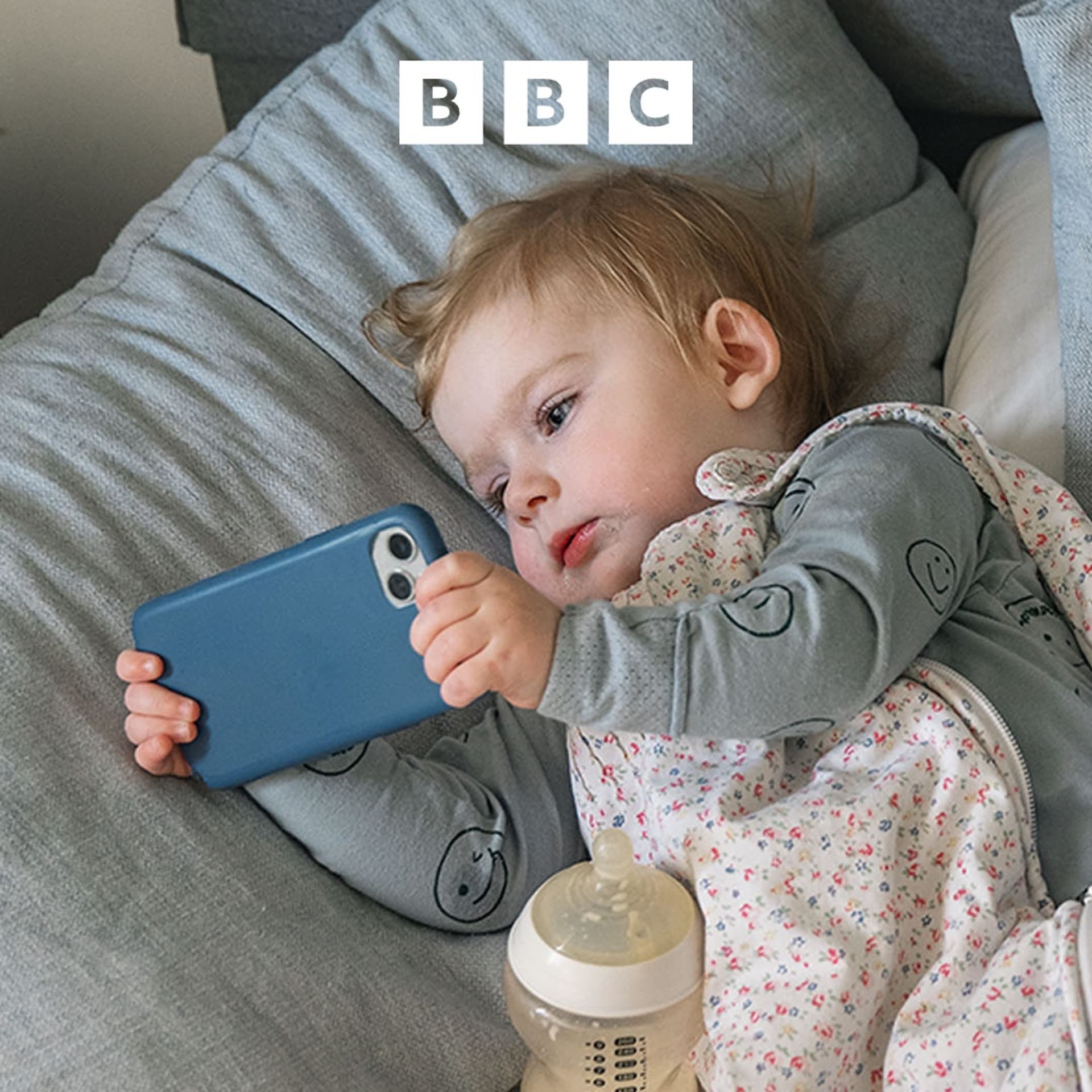
(Image: A baby holds a smartphone, looking at the screen while lying in bed. Credit: Getty Images.)