
In short
How driverless cars should communicate with pedestrians, runners and cyclists; how MarineTraffic tracks ships during the Strait of Hormuz crisis; and Roblox’s new age-check system for children.
Guests/backgrounds
Prof Stephen Brewster (University of Glasgow) leads augmented-reality research; Thomas Gouge (postdoc, University of Glasgow) tests the AR headset; Amar Al-Thai (postdoc at KAIST, South Korea) studies culture-dependent social cues; John Charles Gordon (Kepler vice president, maritime/logistics) explains MarineTraffic; Matt Kaufman (Roblox chief safety officer) discusses AgeCheck.
Key claims
AR headsets can test vehicle-yielding signals; animations suit pedestrians but light rings suit faster runners/cyclists; visual cues must work for colourblind/visually impaired users; AIS data can be supplemented when transponders are off; Roblox AgeCheck estimates age from a short face video and deletes images/video.
Notable examples
“non-yielding” virtual car hits a tester; green/red LED rings (LED layout like traffic lights); MarineTraffic uses AIS plus satellite/shore imagery; Roblox Kids (<9) and Select (9–15) launched globally with reported misclassifications and parent reset/ID options.
Written by AI. May contain mistakes. Listen to the episode to check what was said.
Chapters
Tap a time to open that second in VOExploring Autonomous Vehicles
0:45 to 1:12
Overview of the episode's focus on autonomous vehicles and their communication with road users.
“We start this week with a look at autonomous vehicles from a different perspective, that of pedestrians, runners and cyclists.”
Research on Vehicle Communication
1:12 to 2:23
Discussion on how researchers are examining communication between autonomous vehicles and pedestrians.
“In the case of autonomous vehicles, there won't be a driver.”
Experiencing Augmented Reality
2:23 to 4:05
Host tries augmented reality headsets to simulate interactions with virtual vehicles.
“So you can walk, run, cycle in the real world, on a real bike, with your real feet on the real ground, but then we add virtual vehicles in.”
Pedestrian and Vehicle Interaction
4:05 to 6:00
Insights into how pedestrians might behave differently around autonomous vehicles.
“Now there's a car, a virtual car at a virtual junction.”
Visual and Sound Signals
6:00 to 7:27
Discussion of effective signals for communicating vehicle intentions to pedestrians.
“Well, you might imagine a slim row of LEDs all the way around the vehicle.”
Cultural Differences in Communication
7:27 to 8:01
Examining how cultural differences affect pedestrian interactions with vehicles.
“One of the Glasgow team investigating this recently moved to a South Korean university, where the rules of the road and the way drivers modify their cars are a little different.”
Conclusion of Research Findings
8:01 to 8:49
Wrap-up of insights from the research on pedestrian communications with autonomous vehicles.
“I'm a postdoctoral research fellow at KAIST in South Korea.”
Listener Feedback and Engagement
8:49 to 10:12
Host discusses listener feedback on previous episodes and invites further interaction.
“And that was Amar El-Thai ending that report.”
Upcoming Topics in Tech Life
10:12 to 10:29
Preview of future topics, including age verification technology on Roblox.
“or you can send us a WhatsApp text message or a voice note.”
Marine Traffic Insights
10:29 to 13:20
Discussion about the Marine Traffic app and its importance in maritime navigation.
“When those technologies ask you to move your head to the left and right, One of the things that they're looking for is whether you have ears.”
Show all 13 chapters
Data Sources for Marine Traffic
13:20 to 14:01
Explaining how Marine Traffic collects and processes ship data for users.
“That's reserved for our customers, essentially.”
Understanding Maritime Traffic Data
14:01 to 18:22
Learn how maritime data is collected and processed for tracking vessels.
“themselves, ships containing stuff that we all rely upon, and the ships containing a crew who we ought to think about in this context as well.”
Roblox's Age-Check Technology Explained
18:23 to 25:28
Discover how Roblox uses age-check technology to ensure child safety online.
“about the best way to help keep children safe while they're online.”
Transcript
Automatic transcript. May contain errors.0:00Hello, I'm Chris Vallance and welcome to Tech Life on the BBC World Service, the programme that focuses on technology that's making a difference to all our lives, all over the world. This week I'll be putting myself in harm's way, well sort of, to find out about research to help self-driving cars communicate with other road users. And you've probably seen the app on TV news recently, but how does marine traffic know which ships are doing what in the Strait of Hormuz? Finally, Shona McCallum checks out the changes to Roblox age checks for children.
0:54We start this week with a look at autonomous vehicles from a different perspective, that of pedestrians, runners and cyclists. How will they communicate with one another? Well, to find out more, we need to head out of the office. I'm just walking along a busy road not far from our offices in Glasgow. And one of the things about being a pedestrian is every so often you'll come to a junction and a car will be emerging and the driver will wave you across, letting you know that he's going to stop for you and you can safely cross. In the case of autonomous vehicles, there won't be a driver. So how is that communication going to happen?
1:36That's the question that Professor Stephen Brewster of the University of Glasgow and an international team of researchers are trying to answer. If you're outside the vehicle right now, you can see the driver inside the vehicle, you can wave to them, they can see you, you can make eye contact. But when you come to an autonomous vehicle, there's no person in the driving seat. So how do you negotiate whether they're going to go, whether they're going to let you go? So our research is really thinking about those people outside of the autonomous vehicle and how do they deal with these new vehicles that are coming to the road right now.
2:10Professor Brewster and his team have been using augmented reality headsets to safely test out various ways autonomous vehicles might communicate with us in the future. So you can walk, run, cycle in the real world, on a real bike, with your real feet on the real ground, but then we add virtual vehicles in. The good thing about that is if you get hit by a virtual vehicle, it doesn't do any damage to you. Was it possible for me to try the headset? Absolutely. Can I, can I, I'm not much of a runner, but I'll imagine I'm running for a bus. You can also walk. So what do I need to do? I'm Thomas Gouge.
2:49I'm a postdoc researcher at the University of Glasgow. And it's very simple. You need to pop it on, press go, and then go for a walk. OK, so I'm just fitting the VR glasses on and I can see everybody. This is amazing. so I'm looking right through the through the augmented reality glasses and I'm going to go something I barely I'm going to jog to the end of this road where there's a little junction okay okay so running along the road with the I didn't see that at all I just got KO'd by a an augmented reality car. Did you get hit? Yes, very much so. I only noticed it when it was right, literally on top of me.
3:45So that was one of our non-yielding conditions where by design the autonomous vehicle does not stop for the pedestrian or the runner. Can I have one more go? Of course, yes. Okay, so we're having another go. So there's a road in front of me, a virtual road superimposed on the actual view. There are some virtual buildings to my right. Now there's a car, a virtual car at a virtual junction. And this one has green bars on the side. They're flashing. And I think that means it wants to wait for me and lets me pass. There we go. While the augmented reality headsets have helped them come up with some answers, there are still lots of problems to solve.
4:30I mean, it's just a really interesting area, this whole thing, about how driverless vehicles, these robotic vehicles, are going to interact with other road users. I mean, one of the things, I guess, is people will adapt their behaviours, won't they, to the vehicles. Like, if the vehicles always stop, you know, people are going to figure out, well, I can just walk in front of it because it will stop. Yeah, I mean, you can imagine that if your autonomous vehicle is driving past a school, when the school, the children are leaving, the kids are just going to be testing it, putting their foot into the road, the car will stop.
5:04So you would never be able to get by. Or at a busy crossing, maybe people are crossing all the time, so the cars will have a hard time getting by. So there needs to be some communication in a way that we understand as humans that allows us to negotiate the crossing. What kind of signals worked in terms of alerting pedestrians and runners and cyclists to the intentions of the vehicle? So we found that, or we tested two things. We tested animations and a kind of fixed coloured light rings. The animations, they work well for pedestrians because pedestrians have more time to think. But when it came to runners and cyclists, they have much less time to make their decisions.
5:49So if you do a quick glance at a vehicle, you don't really see the animation. So therefore, the light rings, the fixed-coloured lights, were much more effective. So on a real vehicle, what would they be? Well, you might imagine a slim row of LEDs all the way around the vehicle. So then you might have different colours to indicate things. For example, you might have red on the vehicle might indicate that the vehicle is not going to stop, and green might indicate that the vehicle then is going to yield for you, so you could look at those. I suppose not everybody can respond to visual cues, can they?
6:26I mean, it's a green bar. People can be red, green, colourblind. Or they may have visual impairments that just mean visual cues don't work. We have a spatial arrangement of the red and green bars so that you can see the top one or the bottom one is on, a bit like a traffic light. If you can't tell which is red and green, you know that the top one is red and the bottom one is green. We've also looked at other ways. We've looked at sound. And are the firms who make these vehicles, do they even differentiate between pedestrians, let alone figure out they might need to communicate with them? Yeah, I mean, that's a really great question.
7:02I think right now the pedestrian just appears as a blob to the cameras and the sensors on the autonomous vehicle. And it tries to make some estimation of what they might do, but it's not going to have any idea whether they need some special accommodation. So that's definitely something that's important to think about. And there are further difficulties. Pedestrians and drivers behave and communicate differently in different countries. One of the Glasgow team investigating this recently moved to a South Korean university, where the rules of the road and the way drivers modify their cars are a little different.
7:37I would say that, you know, in South Korea, for example, jaywalking is illegal, whereas in the UK, you know, we tend to jaywalk a lot. And currently, like with human drivers, a lot of the time the windscreen is tinted. So you don't really see much of the driver then. So I wonder if that essentially means that deploying automated vehicles is easier. Does it make it easier in Korea? We're not sure yet. We need to do more research. Hi, I'm Amar Al-Thai. I'm a postdoctoral research fellow at KAIST in South Korea. So whenever a vehicle approaches and there's a driver behind it, we often interact with that driver.
8:13but so we exchange social cues such as facial expressions or hand gestures to understand each other's intentions this is also very culture dependent so you know something like a waving hand gesture could mean you know proceed in one culture but thank you in another and when we currently automated vehicles are very much you know deployed on the west rather than other regions And so the social cues that automated vehicles currently recognise are heavily skewed toward that. And that was Amar El-Thai ending that report. If you've got any thoughts on this topic, we'd love to hear from you.
9:04This is Tech Life on the BBC World Service with me, Chris Vallance. In last week's show, Shona McCallum discussed trust in artificial intelligence. Listener Tony Green wrote in from the east of England to tell us about the risks of AI slipping up. Although I've seen great advances in things like medicine from AI, that's always been from AI developed for specific purposes, Tony writes. But I wouldn't touch generative AI with a barge pole. Back in 1974, I spent a week's wages on a pocket calculator, Had that calculator told me that 2 plus 2 equals a banana, I'd have considered that money wasted.
9:43Until I can be sure AI won't give me that answer, I'm better off without it. Well, thanks, Tony. Thanks for sharing your unfiltered opinion. And reminding me of the old Sinclair pocket calculator we had knocking around home as a kid. And if you want to contact us about something on today's show, it could be about my exploits with driverless cars or it could be about something else, please do get in touch. Our email address is techlife at bbc.co.uk or you can send us a WhatsApp text message or a voice note. The number is plus 44-330-1230-320 and we'll repeat those details at the end of the programme.
10:25And still to come, how does the gaming platform Roblox use tech to verify your age? When those technologies ask you to move your head to the left and right, One of the things that they're looking for is whether you have ears.
10:44Now most of us, certainly most journalists, have been glued to news reports about the situation in the Strait of Hormuz. The waterway is vital to a large chunk of global energy supplies. But the US and Israeli conflict with Iran has seen traffic stalled and ships backed up. The situation is often illustrated by animated maps produced by tools which track the movements of vessels, representing them with small arrows. Of course, we have to say there are various apps out there that provide real-time data on vessels at sea, but many news organisations have used the map and data provided by one app in particular.
11:21It's called Marine Traffic. It's also been a hit with the public attracting millions of downloads, Even the US late-night TV talk show host Stephen Colbert is a fan. Here's a clip of him getting very excited about it on his CBS show. I love marine traffic, OK? It's the best app of all time. It shows you every boat in the world that has a registered AIS transponder and provides its navigational status, speed and reported ETA, and that's for all types of seafaring and river-going vessels. Well, thanks, Stephen, for explaining that much better than I could. Marine Traffic is owned by a company called Kepler with offices around the world.
12:03And John Charles Gordon is the vice president of maritime and logistics at Kepler. Kepler is the parent company. And Marine Traffic is this web application that is essentially a window into the maritime world. It allows users to monitor ship locations in real time, and it gives a context as to what's happening out there on the sea for a global audience. And it also gives you a little bit of insight into the individual ships as well, doesn't it? You can click on one and you get a little rundown of the type of vessel, information about who owns it, all kinds of extra information. Yeah, so it's, and that's part of our job here at Kepler is to bring in these different data sources to really stitch them all together and provide real intelligence for our customers.
13:00So we provide a few bits of information for free, and that's what allows the rest of the world to essentially have a little insight as to what's going on. And then all their more sort of performance-related metrics, statistics, analytics, predictive insights. That's reserved for our customers, essentially. How has the popularity of the app changed since the conflict began and since there was this huge global focus on what's going on in the Straits of Hormuz and the surrounding areas? Yes. I mean, our application has been viewed millions of times over the past few weeks to the point where even our performance in terms of hosting the web application, we've had to do a bit of reworking internally to make sure the app can support all this web traffic.
13:55Let's talk a little bit about the app itself and marine traffic the platform. I mean you see all these little triangles of various colors which are the ships themselves, ships containing stuff that we all rely upon, and the ships containing a crew who we ought to think about in this context as well. Where does all that data come from? So ships over a certain size need to broadcast their position. This is what we call AIS data, or automated identification system. So these radio messages contain the position of the ship, and a few details about the vessel. So marine traffic and Kepler, we have a global radio network, if you will, that captures these radio signals.
14:48So we have radio antenna around the world at different ports along the coastline. And we also have access to satellite data. So receivers on a satellite constellation overhead, listening in to all these radio signals. And so we capture all these radio signals, we integrate them into our system, we process them, clean them, because a lot of it is noise as well. And we then translate that into human readable, interpretable data, such as these little triangles on the map that you see. and then we link all of that data to vessel identity. So we are able to say, okay, this radio transmission comes from that specific vessel.
15:35And so we have a team, a global team of analysts who go through all of this data, make sure it is clean, make sure it is accurate. We then bring in information from the vessel characteristics, the sort of dimensions of the vessel, what type of engine it has, what kind of fuel it uses. We also look at the ownership structure of the vessel, who owns it, who operates it. And what is it used for? I mean, what is it generally used for? So our customers range from governments to shipping companies to insurers, trade finance, and a myriad of other industries that essentially want to track the global flow of goods, vessels, cargo and and so it's used as an intelligence tool and this is the data accurate can a ship turn off its transponder and effectively hide from your data collection yes absolutely so vessels are mandated by the united nations international maritime organization to constantly report their position however some actors choose to turn off their transponders So this is where we use other intelligence, other signal intelligence to understand the location of these vessels.
16:57We use satellite imagery. We use shoreside imagery from photographers around the world. We use all sorts of other intelligence to figure out where all these vessels are. When we see very little traffic going into the Straits of Hormuz, are you pretty confident that's the reality or are there lots of ships sort of, you know, turning off their transponders and trying to get through surreptitiously? Yes. So we've seen a few vessels do this. However, they turn on their AIS or their transmission back on after they've crossed. So even if we do miss some crossings on the data, we're able to marry it up again when they turn it back on.
17:40So we know the position of the vessel before it crossed the strait and then after it crossed the strait. So then we can very quickly figure out those crossings. And do military ships broadcast their location? I imagine they might want to be a bit cagey. Naval vessels, naval assets tend to not transmit on AIS. They may transmit very briefly for certain reasons, but generally they're not transmitting their position actively. And thanks to John Charles Gordon there for providing that insight into the world of marine traffic.
18:22In many countries around the world, a debate is underway about the best way to help keep children safe while they're online. Roblox, one of the world's biggest gaming platforms with lots of young users, has decided now is the time to expand its use of age-check technology, which, it says, is highly accurate, to ensure that children play versions of the game appropriate to their age. Once an age-check has been done, users under nine years of age can have a new Roblox Kids account and users between 9 and 15 can have a Roblox Select account. But parents have told the BBC that some children have been wrongly identified as adults, potentially losing access to safety controls.
19:04Tech Live's Shona McCallum has been speaking to the chief safety officer for Roblox, Matt Kaufman. So we're introducing Roblox Kids and Roblox Select accounts, which leverage our AgeCheck technology to align users under 16 with age-appropriate content and communication. We're launching that later on this month, and it will be available globally at the beginning of June. Can you explain to us how the AgeCheck actually works? Yes. So our AgeCheck technology is pretty simple for the user. When you go through the AgeCheck process, it asks you to take a short video of your face and it takes a picture of your face at the same time.
19:46And two things happen when we do that. The first thing that happens is we make sure there's a real person behind the camera. When those technologies ask you to move your head to the left and right, one of the things that they're looking for is whether you have ears. And the reason for that is if you just take a picture of somebody and maybe you hold a picture in front of a camera, you often don't see somebody's full ear. So when it asks you to move your head, it's making sure that you're a real person. It's also making sure that you're not doing things like using a magic marker to put a mustache on or trying to cheat.
20:19Next, it just takes a simple picture of your face and it estimates how old you are. As soon as we're done processing, we delete the images and the video and we can report back your estimated age. And you're building on this age estimation technology that you already have on the site, what evidence do you have that that tech is accurate? We spend a lot of time looking at the accuracy of age check technology and constantly evaluating our systems. For users who are under 18 years old, the age check technology measures their age within about 1.4 years, plus or minus. And we've seen that be a consistent measure.
21:02We have a number of systems in place that determine whether the user behind the camera is a real user and they're not trying to evade the system. And if we detect anything like that, we will force an age check again. So you're building on the tech that's already been implemented and there already is some classification of groups of older children. We have spoken to a number of parents whose young children have been classified as adults after they used the tech. I just wonder how much confidence you have in the robust nature of this system. You said 1.4 years, but the people I've spoken to, certainly 13-year-olds being classified as 20, etc.
21:47At this point on Roblox, more than 50 % of our daily active users have gone through the age check process. To put that in perspective, we have about 144 million daily users. What we've seen from evaluating the data is that the results are pretty consistent. What we also see, however, is that errors sometimes happen. For an example, often parents accidentally age check on behalf of their kids. We've seen this happen a lot. The kid is asked to age check on the device, and the kid, without thinking, hands the device to their parents. Their parents do the age check on just thinking that it's what they need to do, and then you get somebody who's age-checked much older.
22:30To correct for these problems, we allow parents to go in and reset the age of their kids. We also allow people to use their photo ID in order to set the age check and we let them have like a do-over if the system gets something wrong. The face-to-age estimation is categorically more accurate than simply asking somebody how old they are. That is particularly true If you tell somebody you have to be a certain age to access something on the internet, and then you tell them or ask them how old you are. When you ask them that, just the simple question, users are going to tell you whatever they want to tell you in order to get access to something.
23:12Age checks using your face are categorically more accurate than any other system that we have to do this type of evaluation at scale around the world and for users of all ages. You mentioned their parents able to override or manually correct their child so that they are assigned into the right category. Is that something they can do automatically or will they still be dependent on the Roblox support teams and appeals process? They can do that automatically. There is some nuance that they can only do it if they can also demonstrate that their child age checks to something under 18. We do that for safety purposes.
23:52We don't want adults to age check or to arbitrarily say that another user is a minor. And we do that because we think it's important for play and civility on Roblox to keep kids with kids and adults with adults, especially when it comes to communication. And what are you saying to critics who might say, look, this is all a bit too late. You've got governments around the world legislating, you know, Roblox has been banned in some countries, you know, kids accounts should have been there from the very beginning. I think the level of scrutiny that Roblox is getting, it makes sense because I think parents and regulators are really interested about how kids are interacting online, whether it's online with Roblox or online with any other application.
24:41Because we all know kids have access to devices and they're doing lots of things online. It's not just Roblox. But Roblox is the biggest online gaming platform in the world. And it's unique. And because of that, we do get a lot of attention. And we're working closely with regulators around the world. And I can say that Roblox is going above and beyond what any other gaming platform is doing. We are requiring age checks before anybody has access to communication. And now we are using age checks to determine what content users have access to. We are the largest gaming platform in the world that is going to this extent in order to keep kids and teens safe online.
25:27And that was the Chief Safety Officer for Roblox, Matt Kaufman, speaking to Shona McCallum from California in the United States.
25:41Well, the red warning lights are flashing on the not quite self-driving news vehicle that is TechLife. Just to say, do please keep getting in touch, whether you've thought about being a pedestrian in the age of self-driving cars or the safety of online games. You can contact us by email. The address is techlife at bbc.co.uk or you can WhatsApp us on plus 44 330 1230 320. We also love receiving your voice messages. Please include your name and where you live though. Today's Tech Life was produced by Tom Quinn and presented by me, Chris Vallance.
From the publisher
Chris Vallance finds out about research to help self-driving cars communicate with other road users. Hear what happened when he came into contact with a virtual vehicle!
Also this week: you've probably seen the app on TV news recently, but how does MarineTraffic know which ships are doing what in the Strait of Hormuz? And Shiona McCallum checks out changes to Roblox age checks for children.
Presenter: Chris Vallance Producer: Tom Quinn
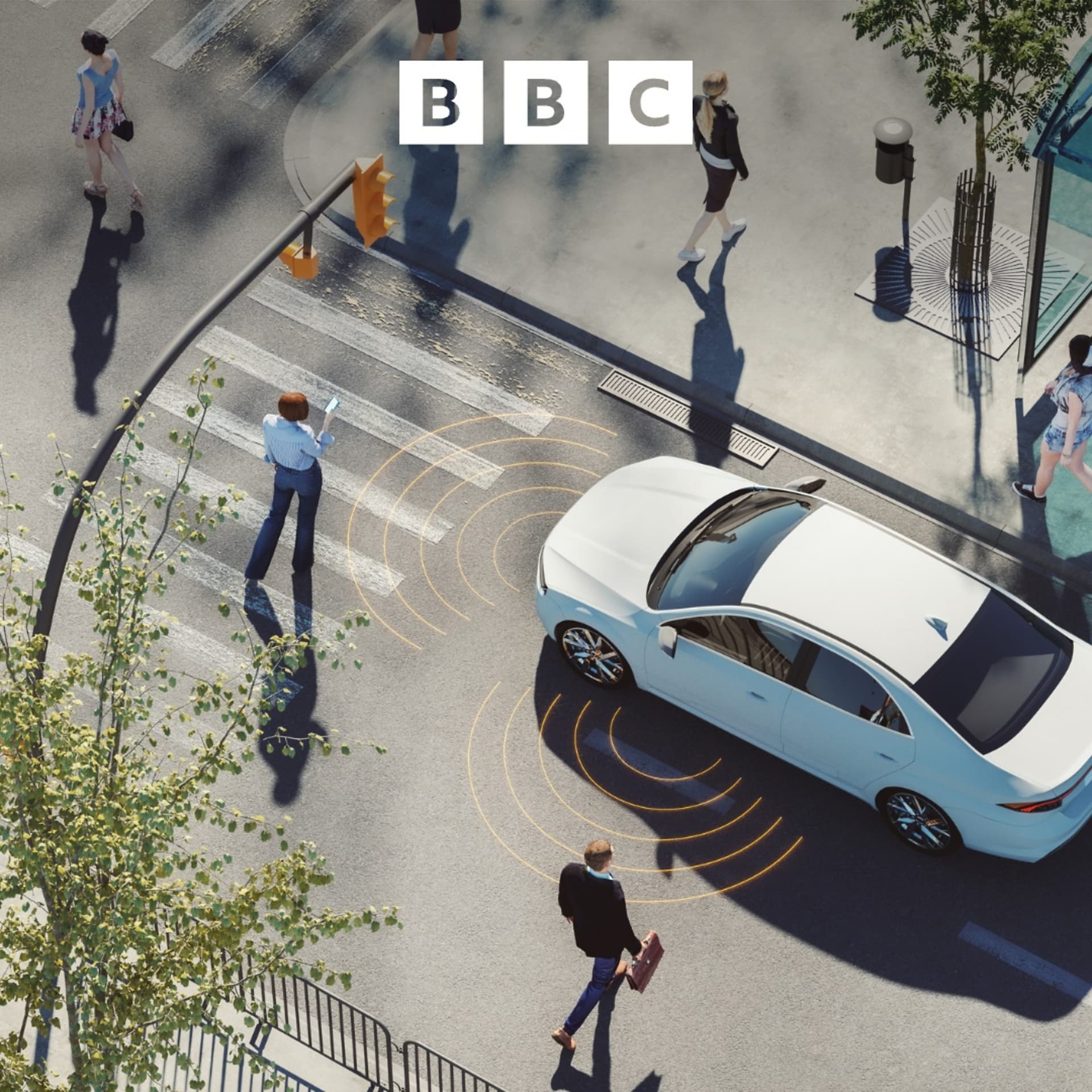
(Photo: An image of a driverless car on a main road. It's approaching a pedestrian crossing, with people walking in front of and around the side of the car. The car has sensors to detect its surroundings. Credit: Getty Images)