
In short
Tech Life Podcast Episode Summary
Episode Title
Should we allow AI into the classroom?
Episode Description This episode explores the growing role of artificial intelligence (AI) in education, focusing on private schools in the United States that are replacing traditional teaching methods with AI-driven learning experiences. The episode features insights from students and educators at Alpha School, a network embracing this approach, as well as a discussion on the alarming rise of online scams globally.
Host and Production
- Presenter: Chris Vallance
- Producer: Tom Quinn
---
Key Topics Discussed
- AI in Education
- Introduction: Discussion on the potential of AI to transform traditional classroom learning.
- Alpha School Model:
- AI-powered learning model replaces traditional teacher-led lessons.
- Focus on two hours of intensive, personalized learning using AI applications.
- Teachers are redefined as "guides" who support students emotionally and motivationally rather than delivering academic content.
Student Experiences
- Alex (17, Senior at Alpha School):
- Describes a unique school day that includes morning exercises and a three-hour learning block using AI apps.
- Engages in self-directed projects, such as developing a startup, with guidance from the school’s instructors.
- Savannah (13, Eighth Grader):
- Highlights the difference between traditional teaching and the guidance model at Alpha.
- Emphasizes self-directed learning with motivation incentives, such as the “alpha” currency system rewarding academic achievements.
- The Role of AI
- Mackenzie Price (Co-founder of Alpha School):
- Discusses how AI creates personalized learning plans based on student assessments.
- AI is portrayed as a tool to enhance education rather than replace teachers completely. Emphasis on the importance of motivation in learning.
- Critique of AI in Education:
- Miles Berry, Professor of Computing Education:
- Cautions against using AI as a cost-cutting measure that could lessen the quality of education.
- Warns that a future reliance on AI might mean only affluent students receive specialized human teacher support.
- Online Scams
- Victim Testimony:
- Anne shares her personal experience of being scammed out of $450,000 through an employment scam, emphasizing the emotional and financial toll of such crimes.
- Expert Insight:
- George Abram (Managing Director of the Global Anti-Scam Alliance):
- Describes the organized crime networks behind online scams, often forcing individuals to participate in scamming operations.
- Discusses the geographical hotspots for scams and the use of AI by scammers to enhance their methods.
- Protection Against Scams
- General advice on how to protect oneself from scams:
- Take your time and consult with friends or family before making decisions based on unsolicited offers.
- Remain vigilant about common online scams, particularly online shopping.
---
Key Takeaways
- AI's Role in Education: While AI holds potential for personalized learning, it raises questions about accessibility and the need for human interaction in education.
- Scam Awareness: Online scams are increasingly sophisticated, driven by organized crime, and affect people across various demographics.
- Critical Evaluation: Both educators and consumers must critically assess the applicability and ethical implications of AI and tech innovations in their respective fields.
---
Conclusion This episode of Tech Life dives into the evolving landscape of education influenced by AI, alongside shedding light on the dark side of technology through the lens of online scams. It calls for a balanced understanding of both opportunities and risks associated with technology in our daily lives.
Written by AI. May contain mistakes. Listen to the episode to check what was said.
Transcript
Automatic transcript. May contain errors.0:00Hello and welcome to Tech Life, the programme about technology making an impact on your life. I'm Chris Vallance and this week we're in the classroom to ask if traditional academic lessons can be replaced by two hours of intense AI-driven learning. We speak to children and educators at the private school network trying to revolutionise school. And we look at the murky world of online scammers. A victim of this industrial-scale crime tells us how she lost hundreds of thousands of dollars. and we speak to an expert involved in the fight against this global crime. People are being locked in a room, sometimes up to a thousand or more, who are being forced to scam other people 12 hours a day.
0:45So it's organised crime nowadays.
1:06Well, we start today in the United States and an AI-assisted approach to learning that's been making headlines. Janet Chamlin has tonight's Eye on America. They're pioneering education's new frontier. Every click, every keystroke at Austin's Alpha School is guided by artificial intelligence. What right now is considered for school time. That's just some of the recent coverage of Alpha School, a network of private schools based in the US. What Alpha calls its AI-powered two-hour learning model has attracted significant attention. So how does it work? Well, to help us give you a sense of that, Alpha School put us in touch with one of their students who goes to school in Austin, Texas.
1:53Hey everyone, I'm Alex, and I'm based in Austin, Texas. I'm a senior at Alpha. I'm 17 years old and my goal is to attend Stanford. I'm hoping to build my startup alongside doing classes there. So that people understand what the day is like for you. Tell me what you're going to be doing today, what you've been doing and what you're going to be doing today. So I come to school. We start off with something called an opening. It's kind of to get your mind running. We like to call it Tony Robbins for kids, right? So we're doing fun exercises, coaching, whatever it might be, getting feedback. Then we'll go into our two to three hour learning block, three hours for high school, and we'll do the Pomodoro method.
2:30So 27 minutes of focus and then five minutes of break time, talking with your friends, maybe going out to get a snack. So we'll finish that three hour block. We'll have lunch. And then in the afternoon, we're focused on building a very cool what we call Alpha X project. So this is usually a very ambitious, Olympic level project, usually more entrepreneurial. real. So for example, I'm trying to build a startup. And in the afternoon, I might talk to investors, I might be building the product itself, you know, lots of different fun stuff like that. So some of your teaching takes place, basically in front of a computer.
3:03Do you want to tell me about that? Yeah, so we actually have no teachers here at Alpha High, we instead have guides. And what guides do is mainly help with your emotional kind of aspect of learning and motivational aspect of learning. And instead, in the morning, we're using fully AI-powered apps. Now, these apps aren't chatbots. We're not just talking to ChatGBC all morning. We are having individualized, personalized applications that give us the content that we need that's at the right difficulty for us. At Alpha School, teachers don't deliver academic lessons in the traditional sense. That's replaced by two hours of intense computer-based learning.
3:40As Alex said, teachers at Alpha are called guides and their principal role is helping students with self-directed projects and keeping them motivated. Alpha put us in touch with a student and guide at their school in Brownsville in the south of Texas. My name is Savannah. I'm 13 years old and I'm in eighth grade. Yes, so my name is Paige Foltz. I grew up in Houston. I was born and raised in Texas. I lived outside of Texas for quite a while and then ended up getting the job as a guide in Austin. And that's where I started. Tell me what a guide is because you described yourself as a guide, not a teacher.
4:21Yeah. I mean, actually, I'd love Savannah. Would you be willing to chime in on what a guide is? Because you've had a teacher and a guide. So I'm just curious. The biggest difference as a teacher is, you know, like you're sitting at a desk and they're teaching you like lessons, math, science, history but at alpha since we learn on ai in two hours in the morning our guides are there for more of like emotional support and they help us learn all the life skills and some of your learning takes place in front of a computer tell me about that what's that like um most of the computer part is during course skills so you take a test and the test places you where you're at and then And once you complete a grade level, you take a test based off of that grade level.
5:04So if I finished eighth grade math and I would take an eighth grade math test. And if I get over 90 percent on the test, then I can move on to the next one. A lot of the learning seems self-directed in the sense of pupils doing things that interest them and they're motivated to do. How do you make sure people learn what they need to learn as well? Because that's not always the same thing. I mean, for example, you know, a lot of people have an aversion to mathematics, for example, but that's obviously a vital, a vital skill, isn't it? For the motivational part of it, we have things called alphas, which are basically for, well, for middle school specifically.
5:44If we reach our goals in academics for the week, then we get 60 alphas, which one alpha is equivalent to a quarter? 25 cents. Yes. Oh, I see. Cash incentive. Yes, yeah. We have multiple other incentives, like weekly incentives, where if we exceed our goals for the week, then students can choose to do something fun on Friday. Savannah is, like Alex, a great ambassador for her school. The school in Brownsville has grown rapidly, Alpha says, doubling in size, and the company claims data from tests shows Alpha students learn twice as fast as the average. But not every parent is happy. About two years ago, a group of five families withdrew their children from the school, some airing their concerns publicly.
6:37Alpha points to a letter signed by many other families defending the school and says its leadership has changed since then. US Secretary of Education Linda McMahon has also praised Alpha's approach. But it isn't cheap, with fees ranging from$10 ,000 to$75 ,000. So is it the future of education? Mackenzie Price is Alpha School's co-founder. What we're doing at Alpha School is redefining what education can look like. And what's really exciting about this time period that we are in is that artificial intelligence is allowing us to truly transform the education experience for every single student by creating one-to-one personalized tutoring.
7:22What exactly is AI used for in this learning process? I mean, where does the artificial intelligence bit come in? I take it children aren't talking to chatbots. They are not. Yeah. In fact, you know, unfortunately, chatbots in education are cheatbots. So we do not use chatbots as part of our education experience. Instead, what we're using AI for is to be able to assess and understand exactly what a kid who comes to us knows and doesn't know. And then it creates a personalized learning plan that meets that student at the exact kind of level and pace that they need. The other aspect of AI is that while a student is using the apps that we have created for them to go through their learning journey, it's measuring to make sure that the student is learning efficiently and effectively.
8:12And these are apps that are quite widely used in other settings by other providers. Is that right? Yeah. We use a combination of apps that are third party apps and then some that we've developed here as well. But here's the problem, Chris, with ed tech that's been the case for the last 15 years. It's never been that fully grail solution that we had hoped. And the reason is because they've always forgotten about one thing that is critical to learning, and that's the motivation part. And so what's really cool about what we've done at our schools is we've transformed the role of the teacher in the classroom.
8:45Instead of having to spend their time creating lesson plans, grading papers and lecturing to a class, our teachers spend all of their time focusing on motivational and emotional support. Just to pick up on that, quite a lot of the coverage has sort of described your school as a school without teachers. Are you contradicting that? Well, I am in one way. I will tell you that there is no shortage of incredible adult interaction that our students are able to get. But the adults in our classroom are not teaching academic subjects. And so we call them guides. People are amazed at how much more social interaction our kids are able to get both with each other and with these incredible adults that are working in the classroom because they've got time freed up to be able to focus on things like life skills.
9:37You've put us in touch with some, I can describe them, I think, from the way they spoke as satisfied customers, some of your students. Our students are fantastic, aren't they? Very bright and articulate people they were. But you'll be aware that there are people out there who describe bad experiences. The case in Brownsville, for example, where they felt, I think, that the system hadn't worked for them or their child. School should not be a one size fits all experience for any student. And just like there's 50 different kinds of cereal when you go down the cereal aisle, I think there should be a lot of different types of schools that allow families to find the type of experience that works for their kid.
10:27And what we are at Alpha, we are definitely a high standards and high support environment. We get very few people who leave. But one of the things that we believe is most important for determining if a student is going to be successful in Alpha is if the family is philosophically aligned with the way that we do education. So, for example, if you believe the best way to learn is with a teacher teaching the academic subject, Alpha is not going to be the right school for that person. Right. So our attrition rate is very low and our families in Brownsville, you know, have been very happy with the education experience.
11:07Does it work for every child? Because, you know, there are some people and some subjects that won't be as enthusiastic, that won't be as motivated to learn. And part of the job of a skilled teacher is, in a way, getting those people through education. Well, that's actually the key to where our success is, is that our adults are focused on motivation for kids. As a result, I do believe that this one-to-one tutoring experience that we've been able to create is helpful for the vast majority of students. For example, in the in the 24, 25 school year, you know, I think we had, you know, fewer than 10 students out of hundreds that left our school because they weren't, you know, doing well in that model.
11:57Well, philosophically, I think some people would say, you know, having a teacher who's a subject specialist, having a human being who can explain their passion for a subject, that that has value that can't be captured by a computer screen and a set of sort of exercises. You know, I think the ideal situation is if every person could have a human tutor who was passionate and excited and a subject matter expert, that would help make something come alive. Unfortunately, that's not the reality. Instead, what you have is 20 kids sitting in a class with a teacher. Even the best teacher who's the most passionate and engaged cannot possibly meet all 20 of those students at the level that they're at or help them find that interest.
12:48And so I do think that this type of tutoring experience ends up providing a more rich experience that meets every kid where they're at. Mackenzie Price, co-founder of Alpha School. Well, around the world, governments are looking at the role AI could play in education. Miles Berry is professor of computing education at the University of Roehampton in the UK. He thinks the essential idea behind Alpha of adaptive, personalised learning has promise. But he warns against AI being used as a cheap fix to replace specialist teachers. One of the things I worry about with this is that this becomes the cheap version of education.
13:31As it stands, it's a very expensive mode of providing education. But you could imagine a future in which there is such a shortage of teachers, that the human teacher becomes something which only the most affluent have access to. And for everybody else, we have automated the whole of this process. And that really does offend me. I feel that that sort of quality personal education should be something which everybody benefits from, no matter what sort of their economic status, their particular background is. That should be an entitlement for all. Miles Berry. And we know the use of AI in the classroom is controversial.
14:11If you have a thought on anything you've heard, do get in touch.
14:26You're listening to Tech Life on the BBC World Service with me, Chris Valance. And we've been emailed by Juan Carlos Dominguez, or JC, in Cuba, about an item in last week's show. JC says, really interesting programme about the digital nomad. Thank you for sharing it. By the way, it's winter here in Havana with 25 degrees Celsius and sunny sky. Cheers from your number one Cuban fan. Well, thanks, JC. It's a lot cooler outside TechLife's global headquarters here in Scotland. The hills nearby are lightly dusted in early winter frost and snow. Alan North lives in the UK. Alan emails, I'm registered as blind and usually catch up with your show when it's on during the night.
15:16The development in tech over the past 20 years has made a vast difference to my life from screen readers to magnifiers. And Alan has an idea for us. I wonder if you fancy doing a show that focuses on how tech has developed for many disabilities. It's a subject we've visited on and off over the last year or two, Alan. but we're always on the lookout for new tech. So if you have a disability and, like Alan, use a piece of tech which makes a real difference to your life, please tell us about it. We might include it in a future programme. You can contact us by emailing techlife at bbc.co.uk or you can WhatsApp us a text message or voice note.
15:57The number is plus 44 330 1230 320. Please include your name and the country where you live. I'll repeat these details at the end of the show.
16:16Well, I don't know if your world is like mine, but pretty much every week I get a scam call or a WhatsApp message and I've stopped trying to count the dodgy emails. Online scams are a big earner for organised crime and they leave a trail of human misery. Anne, not her real name, lives in the United States. She was conned out of hundreds of thousands of dollars last year. This is what happened to her. I received an unsolicited text while I was in the midst of looking for remote work offering me exactly that. I was then referred to someone who trained me to do the work, which was optimizing products on a work platform.
17:03It required me at some point to use some of my own funds to be able to continue the work. And this just spiraled out of control with one thing after another happening, which didn't allow me to withdraw my earnings from the work platform. Advanced fees were involved, which is a term used in financial fraud, requiring me to pay to receive what I was due. And this just, as I said, spiraled out of control and lost a great deal of money. Can you tell me how much you lost and what impact that had on you? I lost about$450 ,000, half of which was retirement savings. I didn't clean out my retirement savings.
17:54I did, you know, retain some of it, but it was it was two thirds of what I had. The rest of it, you know, came from other sources which incurred debt. And I am, as I mentioned, working to be able to pay back that debt right now. That must have been devastating for you. The whole thing was devastating. uh like i said it was the most traumatic and stressful four months of my life it took a huge toll on me in a you know a number of different ways financially emotionally psychologically you know my trust was lost in a number of ways so it's not just the money you know it's it's a whole bunch of other things because i really felt powerless this was seemed to be legitimate i have no way of knowing otherwise and just got caught up in it.
18:50Well, that's Anne talking to TechLife's Tom Quinn. As part of the BBC's Scam Safe Week, we thought it would be worth lifting the lid on how online scamming actually happens around the world. So I've been speaking to George Abram, the Managing Director of the Global Anti-Scam Alliance. So the Global Anti-Scam Alliance, we try to really protect consumers against scams on the global level by bringing all the stakeholders together. So governments, police, banks, telecom operators, social media to share intelligence, but also really work on better solutions to protect people from scams. Loads of us are aware of scams.
19:31I think most of us probably get one or two attempts to scam us pretty much every week on our phones, on social media. who's behind all these scams? It used to be the 16 year old boy being bored setting up an online store and then forgetting to deliver. Nowadays it's organized crime. There are really crime syndicates out there in Southeast Asia, Africa, Mexico where people are being locked in a room sometimes up to a thousand or more who are being forced to scam other people 12 hours a day. So it's organized crime nowadays. Is there a geographic center to scamming? Where does the scamming operate from, if you like?
20:18For the record, every country has its own scamming, both locally as well as internationally. But we see a concentration of scam compounds in Southeast Asia. But that model is being copied now to other countries in the Middle East, in Africa, in Mexico. And even recently, a scam compound was wrapped up in the UK. Do you think some governments turn a blind eye to this sort of organized crime? Yes, especially in very poor countries in the Southeast Asia, we see that local politicians basically are corrupt and protecting these crime syndicates and allowing them to operate. And we have to put a lot of political pressure on the governments to wrap these centers up.
21:04And if we talk about these centers, can you talk me through how they would, their sort of processes, how they're carrying out their business? It starts with actually an employment scam. People from other countries like Philippines, China, Singapore are being lured to these scam compounds, offering a great office job, good pay. But once they arrive, their ID, their passport is taken from them and it becomes very clear that this is not a fun job. And they're being put to work. And if they don't scam and don't go willingly, then they're being forced or beaten. And what are the compounds like? I imagine something that's like a prison camp.
21:47They look like, I mean, we see that in Myanmar and Laos, they often are hotels or former casinos. And the mafia found a more lucrative way of doing business. So people are basically sometimes set in rooms where you can fit in hundreds of people behind desks. It looks like a factory office. But yeah, the business is scamming. Where are their targets? Are they targeting people in particular countries? Yes and no. We see that scammers often focus on a specific target group, and that can be elderly, but it can also be teenagers or kids. We know from our research, everybody gets scammed. Rich, poor, old, young, it doesn't matter.
22:33Of course, developed nations like the United Kingdom, USA, Europe are interesting because lots of wealth. But actually, we see that developing nations are relatively losing more to scams than we in the West. Tell me about the rise of AI, because I think a lot of people are very concerned about how that might empower scammers. We see that the scammers are really starting to use AI massively. I mean, nowadays, the phishing emails, they're written by AI. The English is usually better than you and I can write it. But now we see it also using voice that, hey, mom, I lost my mobile phone. Can you send me money?
23:13The voices are becoming very difficult to distinguish from the real voice. Video, of course, we see I had my own deepfake experience a few weeks ago where I was approached by a scammer who wanted money from me and was using deepfake videos. So, yes, it's out there and it's everywhere and they're automating more and more. So we're going to see a lot more of it. Tell me about your deepfake experience. Who are they pretending to be? We are always looking for new staff. And I was approached by an IT developer. He claimed to be from Serbia. And I said, let's have a video call. And somewhere in the video call, and it was just my gut feeling, I asked, hey, would you mind removing your glasses?
23:54And he broke the connection. And three weeks later, I was approached again with exactly the same text. Hey, I understand you're looking for a developer. And the scam is that, yes, but I only want to start working for you if you first send me a little bit of money ahead. But it's a script and they run it. And removing his glasses would have made it obvious it was AI, would it? Do you think that would have broken AI? Correct. That's something AI has difficulties with. But I'm sure they will have solved that problem in a year time as well. Is there anything that people can do to protect themselves?
24:28I mean, we've said it's very difficult, increasingly difficult. But are there basic things you can do that will reduce your risk? Yes. My advice is if you get an offer, especially if it's unsolicited, talk to your friends, talk to your family and take time. The more time you take to dive into it, to investigate and use the brainpower of your families and friends, the more chance you have to discover this might not be a good idea. Is there any particular type of scam that is the top of the charts when it comes to scammers' methodologies? The online shopping scams still rule, where you buy a product online and it never gets delivered, or you get a fake, or in my case, you get a brick instead of a watch.
25:14So that's still the most common type of scams, online shopping scams. That was George Abraham of the Global Anti-Scam Alliance speaking to me from the Netherlands. And you can find out more about how to protect yourself from scams by searching online for BBC ScamSafe 2025.
25:35Well, we're almost at the end of this week's show, just time enough to delete another couple of texts promising me a lucrative new job working from home. One kind of message we're always pleased to get, however, are emails from you, our audience. If there's anything you'd like to say about today's edition or an idea for a future show, you can email us. Techlife at bbc.co.uk is our address. Or you can WhatsApp us on plus 44 330 1230 320. Tell us who you are and where you live. You can also send a voice message. We'd love to hear from you. Today's Tech Life was produced by Tom Quinn and presented by me, Chris Vallance.
From the publisher
Does AI have a role in education? Some private schools in the United States are swapping traditional teacher-led classroom lessons for laptops and personalised apps. We speak to pupils and the co-founder of the school network embracing AI-assisted learning.
Also in this edition: We're lifting the lid on online scams around the world. Hear how one woman was conned out of a large sum of money, and an expert tells us what we should be wary of online.
Presenter: Chris Vallance Producer: Tom Quinn
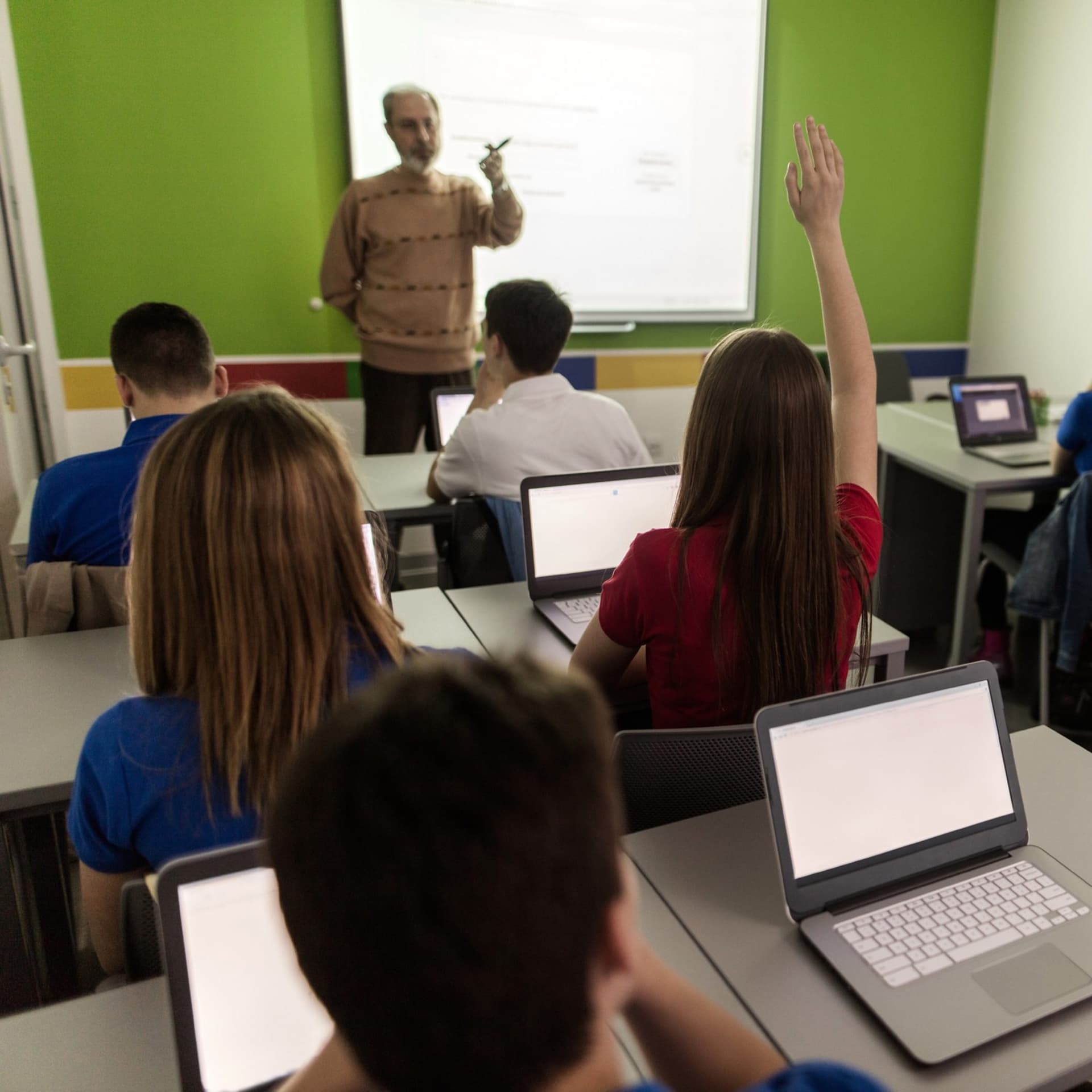
(Image: Rear view of a large group of high school students in a computer lab. They have laptops on their desks. Credit: Getty Images)