
In short
Episode topic: Lithium battery fire risks on aircraft, what regulators and airlines require, and practical packing advice; plus two other tech segments: an AI startup contest in San Francisco and a scholarship training conservation workers in Africa.
Guest backgrounds
Ashley Cranston, watch commander with the Scottish Fire and Rescue Service; Jonathan Nicholson, head of strategic projects at the UK Civil Aviation Authority (CAA). Also featured reporters Lily Jamali (San Francisco) and Corinne Soldatos (Connected Conservation Foundation, Cape Town) interviewing Nyasha Shenje (Zimbabwe Parks and Wildlife Authority).
Key claims
Lithium-ion fires are self-generating (heat/oxygen), burn intensely, and are hard to extinguish in aircraft; power banks are especially risky. CAA urges carrying lithium devices in cabin, not checked bags.
Notable examples
Air China overhead-bin lithium battery fire (emergency landing in Shanghai); EasyJet diversion after a power bank in hold luggage; an Airbus incident where a lithium battery fire reportedly destroyed the aircraft’s top.
Written by AI. May contain mistakes. Listen to the episode to check what was said.
Chapters
Tap a time to open that second in VOThe Risks of Lithium Batteries on Planes
0:38 to 1:24
Discussion of the fire risks associated with lithium batteries when flying.
“When we travel, we love to take our gadgets with us, but the lithium batteries that power them can catch fire and on a plane, that's really bad news.”
Real Incidents of Lithium Battery Fires
1:24 to 3:09
Review of recent incidents involving lithium battery fires on planes.
“A new scheme aims to give conservation workers the latest skills.”
Understanding Lithium Battery Fires
3:09 to 6:15
Insight into the unique challenges posed by lithium battery fires in confined spaces.
“The UK's aviation regulator says portable chargers are causing a growing number of serious incidents on flights.”
Safety Guidelines for Lithium Batteries
6:15 to 9:23
Advice on how to safely pack and carry lithium batteries when traveling.
“They obviously can have access to it, deal with the fire.”
Travel Tips for Lithium Devices
9:23 to 10:40
Recommendations for travelers regarding their lithium devices and power banks.
Startup Innovations and Competitions
14:01 to 18:28
Explore how startups are leveraging AI and competition to create impactful solutions.
“which they can reference as they lobby passersby, seeking to top the massive leaderboard in the middle of the venue.”
Wildlife Conservation Technology Insights
18:28 to 19:08
Learn about the integration of technology in wildlife conservation efforts.
“It's an app called Lifeline AI, a personal safety system that aims to make it easier for someone who feels they're in danger to get help.”
Training for Conservation Tech Experts
19:08 to 28:00
Understand the importance of training conservation technicians using IoT solutions.
“Protecting wildlife is now a high-tech business.”
Transcript
Automatic transcript. May contain errors.0:00This BBC podcast is supported by ads outside the UK.
0:30Ray. Listen on BBC.com or wherever you get your podcasts.
0:37Hello and welcome to Tech Life on the BBC World Service, the programme about technology and how it's changing all our lives. I'm Chris Valance. When we travel, we love to take our gadgets with us, but the lithium batteries that power them can catch fire and on a plane, that's really bad news. We hear about a new campaign urging us to pack with safety in mind. In San Francisco, the BBC's Lily Jamali eavesdrops on an international contest for new AI applications. Will this amateur footy app score with the judges? If you're on my app for more than one minute, you're doing something wrong, because the most important thing is to actually go out and play.
1:16I like this. It's a good idea. And protecting Africa's endangered wildlife is an increasingly high-tech business. A new scheme aims to give conservation workers the latest skills.
1:48okay now have you put your seat belt on and stowed all baggage in the overhead compartment good then let's begin
2:03Whether we are flying for business or leisure, we usually take a lot of gadgets with us. Mobile phones, some wireless headphones, a laptop computer and so on. And to charge it all, we might also take a power bank. All of this tech needs batteries, usually lithium batteries of one sort or another. But these batteries, particularly if they've been damaged, can be a real fire risk on planes. Listen to this from CBS News last October. Dramatic cell phone video of a fire burning in the overhead bin on an Air China flight from Hangzhou, China to Seoul, South Korea Saturday. The airline says a lithium battery stored in a passenger's bag spontaneously caught fire, forcing the Airbus A321 to make an emergency landing in Shanghai.
2:50Well, behind the reporter's words, you can really hear the fear of the passengers. This is the plane's captain talking to air traffic control. OK, so the backpack has been contained. We think it was a lithium battery that caused the smoke and the fire. And only a few weeks ago, the BBC reported on another mid-air incident in Europe. The UK's aviation regulator says portable chargers are causing a growing number of serious incidents on flights. Last week, a Luton-bound EasyJet service was diverted to Rome after a passenger packed a power bank in hold luggage. The Civil Aviation Authority says there needs to be greater awareness of the risk of devices overheating or catching fire.
3:34So why are lithium batteries such a fire risk in confined spaces like aircraft cabins or luggage holds? Ashley Cranston is a watch commander with the Scottish Fire and Rescue Service. With your lithium-ion fires, they generate their own heat and oxygen and keep burning, whereas with conventional fires, they need to bring in oxygen and bring in the heat, whereas with lithium-ion battery fires, they're self-generating, and that is what makes these fires more rapid. The UK's Civil Aviation Authority, CAA for short, is so concerned about the fire risk posed by lithium batteries and power banks in particular, that they're launching a public awareness campaign later this month.
4:17Jonathan Nicholson is the head of strategic projects at the CAA. Power banks are really important that people treat them in the right way and carry them on board with them on the aircraft because they are so powerful. You think of the battery size in a power bank, it's way more than in a phone or a vape or anything like that because it's capable of charging all of those things multiple times. So yes, they come in different sizes, shapes, varieties, power, etc. But all power banks are way more powerful, have much bigger lithium battery in them than anything else. So that then equates to bigger risk if thing goes wrong.
5:00And the risk we're talking about is essentially fire. What kind of challenges does a lithium battery fire present on a plane? We should say planes are very safe. You don't want anybody sort of thinking, you know, I'm not going to get on a plane. But why, if one of these things goes wrong, why is it bad news? Yeah, so I mean, a lithium battery catching fire anywhere is bad news. If anybody's seen a video of one of these things go, they really go. They are intense flames that can go on for a considerable length of time and are quite difficult to put out compared to to other things that could catch fire so obviously on board an aircraft you're in a very contained environment you can't ring 999 and get the fire brigade to turn up you are in in that aircraft and the cabin crew are trained to deal with things like this with lithium battery fires but it's still you know not ideal so we need people to look after them but it is way better to have them in the cabin and something happen to them than put them in your checked bag you must never put them in your checked bag.
6:04If they're in the cabin, it kind of sounds a little bit counterintuitive to have it in the aircraft with you and something happened to it. But that's the best place to deal with it for the cabin crew. They obviously can have access to it, deal with the fire. It's much more difficult if it's in a checked in bag in the bottom of the aircraft with all the cargo. Has this actually been a problem on planes? Have we actually seen planes brought down by these kind of battery fires? So we have had fires on on board aircraft. Unfortunately, it does happen quite regularly with lithium batteries. Normally, obviously, they are contained.
6:41But we have seen quite severe incidents. If people want to Google Airbusan and lithium battery, you'll see exactly what it can do. So basically, this aircraft, it was a commercial airliner. It was thankfully on the ground at the time, but it's believed the lithium battery caught fire in an overhead cabin locker and it completely took out the whole top of the aircraft. If you see pictures of this aircraft, there is no top of it left. I mean, it must be really challenging to put it out. I mean, they're hard enough to put out on the ground when you're in an aircraft. What are the options for the crew?
7:18They are trained. I mean, obviously, you know, as you say, it is not like even a normal electrical fire. But they have sand and other implements they can do to treat with it. Some have special containment bags. It varies from airline to airline. It's their choice how they choose to deal with it. But all cabin crew will be trained what to do with it. But they are difficult to extinguish. And that's why they need to be where the cabin crew can get at them. Are other devices with lithium batteries also a concern? I mean, think about phones, laptops, but there are lots of other devices. Yeah, absolutely.
7:54So anything with a lithium battery, really, people need to be aware of. Vapes is another particular one where people must take them with them in the aircraft. But yes, anything with a lithium battery is a concern because it can catch fire and go wrong. So your organisation, the Civil Aviation Authority, it sets the rules on what people can do on aviation generally in the UK. Are there also international rules on this? Yeah so internationally aviation has a set of rules. They're set by what's called the International Civil Aviation Organization. That's the United Nations body for aviation. So they set a minimum standard of rules for the whole world that everybody has to adhere to and that makes sure everybody is safe.
8:42Then individual countries can build on that if they want to. So the only difference you may find is some airlines may prohibit the use of a power bank completely when you're on board the aircraft. Some may allow you to charge other devices from it. But basically the rules are if you've got something like a power bank or a vape, You must take them with you in the cabin. Do not put them in your checked-in bag. You can take a maximum of two power banks and you cannot charge that power bank itself while you're on board the aircraft. So you can't recharge the power bank. okay so some of our listeners may be about to go on a holiday or a business trip they're packing they're getting all their stuff together they'll have several lithium devices and a power bank what's your advice to them at the packing stage because that's where it matters isn't it that's you've got to get that right then the rest is easier absolutely yeah so anything with a lithium battery preferably take it with you on board the aircraft if it is something like a digital camera where you might have the camera and a spare battery or a laptop and you want to check those in in your in your check-in bag you can but they must be completely switched off not in standby mode so they can't be accidentally turned on if something bumps into them and any spare batteries must be completely isolated preferably in their original packing or or similar and then everything else please take with you into the cabin you know either on person or in your bag that you take into the cabin when you are then in the cabin if you've got something in your cabin bag please take it out and preferably have it with you if it's a lithium battery well thanks to jonathan nicholson there from the uk civil aviation authority and we should say that if you're traveling on a flight soon wherever you are in the world it's best to check with your airline to understand if they have any extra rules for traveling with rechargeable devices.
10:56Every story is a technology story in one way or another. And on the interface, we decode the tech that's rewiring your week and your world. On this week's episode, we dive into the horrifying world of the TikTok farlands, a hidden part of the app where people are hijacking the algorithm. And we'll also look into how AI detection tools may be changing the Listen on BBC.com or wherever you get your podcasts.
11:39This is Tech Life on the BBC World Service with me, Chris Valance, and you, our listeners. In last week's edition, we had an interview with an executive from Microsoft about their latest quantum chip and his prediction about quantum computers possibly leading to better fertilisers, helping to feed more people. Dr Brian Richard Joseph has emailed us from Canada to disagree. He writes, Quantum computing will worsen, not improve global inequality in food supplies, shelter, maternal mortality and life expectancy. The important global problems are political, not technical, he says. Well, thanks for sharing your thoughts, Brian.
12:21And if you have an opinion on tech or an idea for a future edition of the show you'd like to tell us about, we'd love to hear from you. Our email address is techlife at bbc.co.uk or you can send us a WhatsApp text message or voice note. The number is plus 44 330 1230 320. And still to come, the tech and local knowledge needed to protect Africa's wildlife.
12:57Now let's go to one of the epicentres of tech, San Francisco in the United States, where AI startups have been taking part in an international competition. Young founders, each representing the top picks from more than 40 countries, were brought together in one place for the event, sponsored by a well-known energy drinks company. Contests like this are common around Silicon Valley, but the ease with which AI enables apps to be vibe-coded are reducing some of the technical barriers to entry, though US visa rules proved a different sort of barrier to some contestants. Our North America technology correspondent, Lily Jamali, sent us this report from the thick of the action.
13:40The day is young. So much still to come here. We cannot wait. In a converted warehouse on the San Francisco waterfront, hundreds have gathered to size up a few dozen startup founders from around the world. Make some noise for yourselves and let's get this thing started. Thank you. Each founder stands by a booth that displays screenshots from their apps, which they can reference as they lobby passersby, seeking to top the massive leaderboard in the middle of the venue. They're competing for$100 ,000,$25 ,000 worth of Microsoft Azure credits, and mentorship from Red Bull Ventures.
14:20Electronic music blares in the background as entrepreneur and investor Brian Sparks begins his visit with Matias Svitic of Sweden, founder of the startup Allplay. Hi, I'm Brian. Nice to meet you. Nice to meet you. Sparks is here to rank the startups in the competition. So I'm excited to hear what you're building. Svijic launches right in. Go ahead. So it's a platform for spontaneous sports, to bring people together with sports. I started with soccer in Sweden because that's the biggest sport there and it's my background. So you can see when pitches are available, when there isn't like matches, practices or anything.
14:57And you can either, I can show you like this. So you can either join or create matches. Svičić explains those matches can be organized based on anything from age to skill level. If you're on my app for more than one minute, you're doing something wrong. Because the most important thing is to actually go out and play. I like this. So it's a good idea. But tell me where you were when you came up with this idea and what problem is it really solving? So how I came up with this is because I grew up my whole life playing pickup football. I mean, just going out to like a local pitch, meeting people from different backgrounds, neighborhoods.
15:33They spoke like different languages. And that's something like only a football pitch or a sport pitch can actually do. Now, though, that's changed, Svijic explains. Like for the recent years, the same pitch that was full of like emotion and joy is completely empty. And that's what I'm trying to bring back. Svijic says young people are staying inside more. They're alone looking at their phones. But I'm trying to get people back out again, meeting again, like in the real life. Sparks is judging the startups here by four particular metrics. The profile of the founder, the potential social impact the startup may have, the feasibility of the idea, and this one.
16:13So let me ask you one question that I'm asking everybody. Yeah. With AI building so many companies nowadays, what makes you unique? What's your mode? That question is more relevant than ever in the era of vibe coding, the practice of building apps by describing to an AI assistant what you want to make using conversational language. The idea is to create what springs to mind without having to know how to code. It's a concept that seemed pretty far-fetched even a year ago, but vibe coding is at the heart of the Red Bull Basement Startup Competition. Hi. Hi, I'm Patricia. Nice to meet you. Nice to meet you too.
16:52I tag along as Sparks moves to another booth to speak with Patrissa Vowery. She's from Sylvania and has built an app that aims to help kids improve their reading. It's called Whisper Hollow. She's not a programmer, but was inspired by her nephews to build the app. You vibe-coded this on? Clock code, yeah. How long did it take you? So, like, four weeks in total, but I have, like, zero coding experience. Well, very, very little. So, like, four weeks-ish. Yeah. When I debrief with Sparks afterwards, he says the lack of moats, barriers that could stop or slow competitors from replicating what they see, might be the biggest common hurdle.
17:34What's scary is a lot of these early stage companies don't have protection. In other words, there's not a lot of proprietary software. With AI, it's almost like anyone could build something right now, but it's not necessarily protected. Because of vibe coding. Because of vibe coding, anyone could build anything. And that's reflected in the apps on display. From Germany, there's an app called Please Touch This Art, which uses AI to create 3D-printed museum art that people, including the visually impaired, can feel. There's an AI glove that converts sign language into spoken words in real time, from Belgium.
18:12Kazakhstan's entry is an AI tool analyzing colonoscopy images to catch cancer early. Red Bull says the competition started with 140 ,000 ideas. And now we're down to our top ideas in this room. In the end, the winner is... The United States! It's an app called Lifeline AI, a personal safety system that aims to make it easier for someone who feels they're in danger to get help. A young San Franciscan named Darnell Adler had topped the leaderboard for much of the evening. He'll now have$100 ,000 to develop his app further, and he hopes to get it into the public's hands.
18:57And that was Lily Jamali, our North America technology correspondent, reporting.
19:08Protecting wildlife is now a high-tech business. Communication networks, animal monitoring kit, various sensors and cameras, it can take a lot of skills to install and keep it going. The Connected Conservation Foundation, or CCF, is a charity with offices in the UK and South Africa. They've set up a first-of-its-kind scholarship programme combining online learning and hands-on field training to build up conservation tech expertise where it's needed the most. Sixteen candidates from across Africa have been selected and they're doing their training in South Africa this month, equipping them to deploy and maintain modern conservation systems.
19:47I've been speaking to Corinne Soldatos in Cape Town in South Africa. She's CCF's project manager there. And we were joined on the line by Niasha Shenje in Zimbabwe, who is receiving the training. I started by asking Corinne to tell me about some of the work the foundation does. So we have lots of fun projects which we work on. and basically we put IoT and tech solutions in protected areas. So what do you mean by IoT? Sorry, just in case people aren't familiar with that. So everything from we want to track our ranges, track our wildlife, track vehicles and assets in the protected area and then you need to get that information from the field through an IoT network into a control room where you can monitor and see what's happening in real time.
20:33So we'll do everything from LoRaWAN or internet networks or so to putting sensors on animals, putting sensors on game ranges, that type of thing. And then once it's in the control room, you need a solution to kind of visualize what's happening in your park at any given time. So we'll try and get that information into one central map or one central report for a park manager to see what's going on. So when you say IoT, you mean the Internet of Things. So these are essentially gadgets and cameras and other devices that you can get data from, essentially. Correct. So collars to track animals, tracking devices for your ranges, camera traps, fence sensors, even things like when your water tank is running low or a weather station.
21:17And we put, like you say, a full range of gadgets out into a game reserve. And that will send data through an IoT network to your control room or your operations room. So give me a sense of the kind of data that you get back then. So what kind of thing, how closely monitored are the animals? And give me a sense of that. So it depends which parks we support. It can be as detailed as you need. Usually when you're tracking animals, you'll do a satellite collar, which will maybe give you one or two points a day. But if you are able to put a LoRa network into a protected area, you could have every five minutes you can track data from that and get a position and a location of an animal.
21:55If you want to track your ranges, you also put tracking devices on them, and that will usually be every 30 minutes to one hour to get a GPS location. But what's important is to actually have communication with your rangers in the park. Why is it so important to gather all this data? The parks are biased. I mean, you're working with thousands of square kilometres, which you need to protect, and you don't have a huge workforce or sufficient ranges to cover every inch of the park at any given moment. So a great solution which has become available is to put technology into parks. And that way you can monitor your high-risk species or your endangered species and get information coming through for a much greater area than humans on foot would be able to patrol.
22:38And so not only do you need, if you like, rangers who require a certain amount of courage and I'm sure a lot of skill to do their jobs, but you've also launched a scholarship to try and attract people with tech skills. Why have you launched this scholarship? So through our work putting IoT solutions in parks, you can arrive with a beautiful shiny system with great radios and great tracking devices but you're working in very remote areas and as soon as you put up your whole system an elephant can knock a pole over or a vulture will build a nest over a repeater tower and then your whole network goes down so you're not working in a city where it's quick and easy to maintain and fix and in remote areas which often take a day or two to get to your tower to fix a repeater and what we've seen is we put in these great systems but as soon as we leave there's not enough skilled professionals in a protected area to support that system so what we we're lacking is actually conservation technicians and we've just seen I mean connected conservation has been running for 10 years and as great as our solutions are we we still need people on the ground to maintain and support those systems so through that we've actually developed an online training course called Protected Area Technician.
23:53It's freely available to anybody who would like to do it. And we've worked very closely with experts in the field, with NGOs, with conservation organizations to develop the content. The demand and the response has just been amazing. And we then offered a scholarship where we would take technicians to a two-week training course. And this would be a very hands-on practical training course because as much as they want to learn and as great as the videos are, some people have never had the opportunity to hold a route to to hold this tracking device, to connect the two, to get them to communicate. So we're now doing a two-week infield practical training where we kind of turn the theory into practice and give these technicians a chance to learn and hopefully give them the right skills they need to take back into EA parks and support the parks.
24:39Well, we can talk to one of those who's going to benefit from our scholarship, Nyasha Shenje. I hope I've said your name correctly. Tell me a little bit about yourself, Nyasha. I'm based in Zimbabwe. I work for the Zimbabwe Parks and Wildlife Authority and I'm in the IT sector. And I've grown passionate about technology for wildlife monitoring and also to address some of the critical challenges in conservation. As you know, in Africa, one of our critical challenges is trying to fight for spaces between the wildlife and the people. So I do believe that technology plays a huge role. And eventually, that's when I got to learn or get to know about the training which Connected Conservation is doing.
25:23And indeed, you know, you're facing challenges that maybe tech experts in other parts of the world won't. I mean, I loved hearing about the idea that a vulture might knock out a router. what kind of things have you encountered in your training that have sort of excited and interested interested you so they are training us smart conservation whereby we're ensuring that our technology is reliable it's secure and useful for the boats on the ground as karen has said earlier on that we need to to to keep our breast with the technologies and also to protect the people on the ground like you know the rangers most of these protected areas live in areas which have little to no connectivity.
26:07So technology plays a huge infrastructure. So some of the key things which I learned from the program is one of the key things was digital infrastructure and connectivity, where we learned on how to actually come up with some maintaining or building of Wi-Fi in the parks, off-grid environments, and even these new technologies, which they are calling IoT, Internet of Things, which is also something which we learned. we also learned about sensor deployment, which is one of the key things that you can have real time monitoring of our wildlife and also of our rangers. And our thanks to Karim Soldatos from the Connected Conservation Foundation, speaking to me from South Africa, and Nyasha Shenje in Zimbabwe.
26:59well the captain has turned on the fasten seat belt sign and it seems our journey through the world of tech is drawing to a close as ever we'd love to hear from you it could be about the show or it could be about the tech that's on your mind techlife at bbc.co.uk is our email address You can text us on WhatsApp, plus 44 330 1230 320, or why not try sending us a voice memo instead? We'd love to hear from you. Today's Tech Life was produced by Tom Quinn and presented by me, Chris Valance.
27:44Every story is a technology story in one way or another. And on the interface, we decode the tech that's rewiring your week and your world. On this week's episode, we dive into the horrifying world of the TikTok farlands, a hidden part of the app where people are hijacking the algorithm. And we'll also look into how AI detection tools may be changing the way that we all write. Listen on BBC.com or wherever you get your podcasts.
From the publisher
When we fly we love to take our gadgets with us. But the lithium batteries that power them can catch fire. We find out about a new campaign urging us to pack with safety in mind.
Also this week: the BBC's Lily Jamali visits an international competition for new AI applications in San Francisco. And protecting Africa's endangered wildlife is an increasingly high-tech business - a new scheme aims to give conservation workers the latest skills.
Presenter: Chris Vallance Producer: Tom Quinn
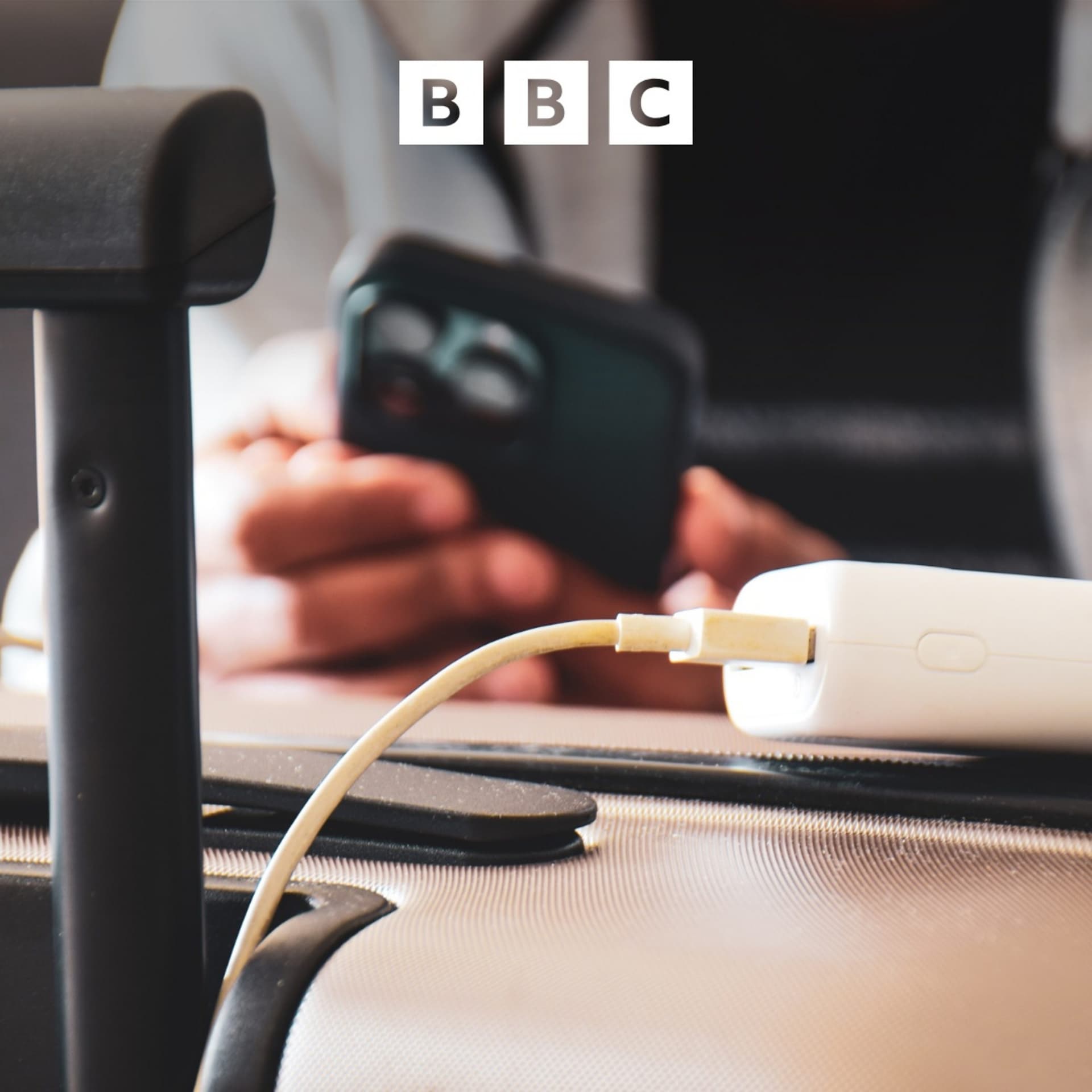
(Photo: A man is in an airport lounge. He is charging his smartphone with a portable charger, which is resting on a suitcase. Credit: Getty Images)