In short
Teaching in the AI world—how AI can support learning without replacing teachers, plus related tech stories (prosthetics and fetal-heart digital twins).
Guest
Ben Gomes, Chief Technologist for Learning and Sustainability at Google; mother was a geography teacher in India; leads Google’s education technology thinking and partnerships in developing countries.
Key claims
Teachers remain “fundamental” because learning is driven by human motivation and curiosity. AI can be “active” (interactive, questionable) versus passive tools like textbooks/videos. AI can help teachers reduce workload and burnout; Google study in Northern Ireland found ~10 hours/week saved. In Sierra Leone, guided learning improved math scores over ~12 weeks (0.3 standard deviations; ~1.7–2.5 years of schooling). AI should complement teachers, not replace them; Google works with UNICEF to implement locally and train educators.
Notable examples
Sierra Leone math gains; Northern Ireland time savings; UNICEF partnerships (Kenya, Pakistan, India, Brazil).
Written by AI. May contain mistakes. Listen to the episode to check what was said.
Chapters
Tap a time to open that second in VOIntroduction to AI in Education
0:30 to 1:42
Explore the impact of AI on job markets and education.
“on a new artificial limb which is making a big difference to the life of a man I recently had the pleasure of meeting.”
Ben Gomes Introduction
1:42 to 2:50
Get to know Ben Gomes and his background in education technology.
“often linked to the growing use of AI across the global economy.”
The Role of Teachers
2:50 to 3:48
Understand why teachers remain essential in the learning process.
“But I began by asking him about something much closer to home, the role of the teacher in today's classroom.”
AI's Active Role in Education
3:48 to 4:50
Discover how AI can enhance learning through interactivity.
“person look at learning a different way and makes them see learning as a way to explore the world rather than a set of facts to be memorized.”
Addressing Teacher Shortages with AI
4:50 to 6:20
Learn about AI's potential to alleviate teacher shortages and improve education.
“In some countries, there are severe teacher shortages.”
AI as a Complement to Teachers
6:20 to 7:40
Find out how AI supports rather than replaces teachers in classrooms.
“AI is a tool in the classroom, The teacher is providing the instruction, is guiding the whole process, and all of this works in that context.”
Local Partnerships and Implementation
7:40 to 9:01
Explore Google's partnerships and the importance of local context in education.
“I don't see it being anywhere close to being a replacement for humans.”
The Creative Role of Teachers
9:01 to 10:48
Understand how teachers can creatively use technology in education.
“You spoke about the partnership that Google has with UNICEF and the AI that's being integrated into some of the education systems across multiple countries.”
Jim's Journey: Overcoming Limb Loss with Prosthetic Technology
14:00 to 19:01
Learn about Jim's traumatic experience and his journey to rehabilitation using innovative prosthetic technology.
“I'm off on my bike and I get hit by a lorry and got run over and got crushed and lost my arm in the process.”
The Challenge of Fetal Heart Monitoring
19:02 to 22:56
Discover how digital twin technology is being used to enhance fetal heart monitoring and reduce diagnostic uncertainty.
“for our final item today we're talking about the very beginning of life if you're a parent or about to be one you'll know that during pregnancy there are lots of checks to keep an on the baby's health.”
Show all 11 chapters
Modeling a Fetal Heart: Techniques and Challenges
22:57 to 26:40
Explore the complexities of simulating a fetal heart's development and the data needed for accurate modeling.
“So we have just a very low resolution image of a beating heart and we need to make that work.”
Transcript
Automatic transcript. May contain errors.0:00This BBC podcast is supported by ads outside the UK.
0:30or wherever you listen.
1:00on a new artificial limb which is making a big difference to the life of a man I recently had the pleasure of meeting. At the time I wasn't sure whether I was going to survive because I had internal injuries but putting that to one side I had something to concentrate on and that was actually working on my own rehabilitation. And find out about the engineering technology that's being used to check the heart health of babies as they grow in the womb.
1:41Barely a week seems to go by without news of another round of job cuts, often linked to the growing use of AI across the global economy. As tech companies pour more money into artificial intelligence, some have also been making thousands of their own staff redundant, And it's not just tech. We've seen similar job losses in banking and the legal profession too. On previous editions of Tech Life, we've talked about how AI could affect something that matters to all of us, wherever we live, education. Some people are enthusiastic about using AI as a tool to support student learning, but that raises an obvious question.
2:22Where does this leave teachers? is a theme I've been exploring with Ben Gomes, Chief Technologist for Learning and Sustainability at Google. Teaching is personal for him. His mother was a geography teacher in India and she helped teach him when he was growing up. These days, Ben spends a lot of time thinking about the future of education and technology and Google has recently announced new education partnerships in several developing countries. But I began by asking him about something much closer to home, the role of the teacher in today's classroom. I think motivation has always been fundamental to learning.
3:00I think in the context of today's world, I believe that the teacher and the people around the person are fundamental in giving them the reason of why they learn to spark that moment of curiosity in them, like my mother did for me and my siblings. I've had teachers who did that in other subjects. So I think now, as always, the human being is fundamental in the process of learning. AI and other tools can make the mechanics of learning much better. But the reason why we learn is almost always because of another person. And that person is often the teacher. It can be parents, it can be your peers, but it is often the teacher who provides that unlock that makes a person look at learning a different way and makes them see learning as a way to explore the world rather than a set of facts to be memorized.
3:58And so you've spoken there about the role that teachers play. What do we mean by AI in education then? So AI is an interesting technology because it is a technology that enables us to use language in propagating information, but also to think about the tool as something active. So if you think about the past, the main tools we had were things like textbooks and maybe more recently videos. While a textbook or a video is passive, you can zoom it. AI can actually be active. You can actually question it. You can interact with it in a way that's different to make that exploration be a lot more possible and keep your mind in a more active state as you're exploring.
4:46So AI can enable that kind of curiosity if it's used appropriately. In some countries, there are severe teacher shortages. In that context, can AI solve a problem? Yes, I think, you know, there's a teacher shortage happens around the world. And I think AI can play two different roles. It can play a role in helping the teacher and AI can play a role in helping with the student. In terms of helping the teachers, we have done a study that shows that AI can help teachers in Northern Ireland save an average of 10 hours a week, which is a lot. One of the reasons there's a shortage of teachers is not just because teachers are not entering the profession, it's because many burn out.
5:30the workload is extremely high and it's really hard to retain teachers in the profession. We believe that as AI can take off some of that workload, teachers are more likely to stay in the profession. The flip side of it is helping students with a more personalized experience. So we have done a couple of studies recently, one of which was in Sierra Leone showing how students can improve their math significantly through the use of AI. And we can talk about that. So tell me then that as an example, perhaps, I mean, you're not talking about children being taught by an AI laptop, or a smartphone, and instead of a teacher, what you're alluding to there is AI complementing the teacher.
6:19Absolutely. AI is a tool in the classroom, The teacher is providing the instruction, is guiding the whole process, and all of this works in that context. It doesn't work without the teacher. In the context of Sierra Leone, the tool that was provided was guided learning, and the idea was to help students improve their math. And over a period of, I think it was 12 weeks, they showed a significant improvement in math scores of 0.3 at standard deviations, which is roughly equivalent to 1.7 to two and a half years of standard schooling. So the use of guided learning, which is a tool we provide for free in Gemini, can actually help students learn the material better than they otherwise would.
7:07But does it mean that the existing teachers are gradually made more redundant because they're relying more on these tools? Oh, absolutely not. What I've seen when this actually happens in classrooms and it's used well is that to some extent it frees up the teacher rather than doing a lecture to have the students interact to some extent with the computer and have the teacher interact with the student. And so it gives the student more time with the teacher and gives the teacher time to interact with the students. Beyond that, it also can help the teacher personalize what's happening with all of the students in the class.
7:46So how will you prevent AI from becoming that kind of low cost substitute education layer, especially when we look at low income economies and places where they could see that perhaps as a substitute that would be an easy fix? I don't see it being anywhere close to being a replacement for humans. We're working, we have announced a partnership with UNICEF, where we're working with them in several countries, in Kenya, in Pakistan, in India, Brazil, because they have the expertise on the ground of what the actual problems are. And quite often the problems are local, very local in nature. And so in Kenya, they're working with school districts and local governments to figure out what's the best way to actually implement AI within that context.
8:39They and their local partners are experts in that area. We are not. So we're working with them to provide training for them, to provide the tooling that they might need in order for them to create these good implementations within that local context. I don't think in any context I see AI replacing the importance of the human in the loop. You spoke about the partnership that Google has with UNICEF and the AI that's being integrated into some of the education systems across multiple countries. You also mentioned that you're working with governments, educators, etc. You know, I just wonder if you could shed light on the role of Google and the tech company within that.
9:24And what do you feel that the role of the tech companies should be? I think our role is to provide the technology and the tools that are appropriate in partnership with the folks at UNICEF. We've also provided similar training and so on for the African Union, for all of the states in the African Union, for educators there. So one aspect of what we provide as a whole is a range of tools. We want to learn from our partners what should be done to make those tools better for the purpose, where they work and where they don't work. And we also want to make sure that there is appropriate training for the teachers.
10:03Like we can see that teachers are adopting AI faster than most other people because it's very useful to them. But still, it can be daunting to take on a new tool and to understand how to use it best. I think teaching is an extraordinarily creative profession. And teachers, if they understand the tools well, can take the tools and make them their own for the sake of the students in their class. All that I've seen of teaching, it's a very personal experience. It is a teacher communicating their love of the subject, their passion, their knowledge to the student. And it's a personal thing. And I think what we can provide is the tooling around that to make that process be easier and better in various ways.
10:47But it only happens in concert with partnerships like with UNICEF or schools and teachers. It doesn't happen just with technology on its own. That was Ben Gomes, the Chief Technologist for Learning and Sustainability at Google.
11:05There's a rare type of Ebola spreading in Central Africa, and it has no vaccine. The WHO has declared a public health emergency of international concern, and the US is restricted entry for people coming from some African countries. What does this deadly outbreak tell us about how prepared, or not, we are for an international health crisis? For more, check out The Global Story on BBC.com or wherever you listen.
11:45This is Tech Life on the BBC World Service with me, Shona McCallum. Now, after my interview about AI in school classrooms, something rather nice happened. Completely by coincidence, we heard from one of our regular listeners, Juan Carlos Dominguez, or JC, who got in touch from Havana in Cuba. JC emailed us to say he's a teacher at Havana University. Despite some limitations and connection issues, He says some of his students are using AI apps on their phones to help with their studies. But, and this is the important bit, he added they still need to demonstrate their ability to learn for themselves.
12:23That's really interesting to hear, JC. Thank you so much for sharing it with us. Andy Jones got in touch after last week's programme on cyber security threats and felt we'd missed a crucial word, resilience. and he writes having resilient systems and business processes can make the difference between surviving and going under and finally brian mccorkle who lives in the north of scotland emailed after hearing our recent item on sleep apnea and the tech we use to get a good night's rest he says i know we're all different my phone sits on the bedside table right next to me when i'm sleeping and it actually puts me to sleep when i play the game words with friends we are all indeed different Brian.
13:03If you want to get in touch with us our email address is techlife at bbc.co.uk or you can whatsapp us a text or a voice memo our number is plus 44 330 1230 320. Please include your name and where in the world you live. Still to come monitoring the health of tiny unborn babies hearts with engineering tech.
13:32We're going to hear the story of Jim Ashworth Beaumont next, a keen triathlete and an ex-Royal Marine from Edinburgh, someone who's always relied on his body to perform, and professionally he's helped others do the same, working in prosthetics. For most of his life, movement and performance have defined both his work and his identity. Until one day, everything changed. I'm off on my bike and I get hit by a lorry and got run over and got crushed and lost my arm in the process. And what was that experience like? Ooh, intense. I was fully conscious throughout. I thought I was going to die. So after six weeks in a coma, I was very surprised to wake up and finding I was still alive with a somewhat modified body shape.
14:23At the time, I wasn't sure whether I was going to survive because I had internal injuries. but putting that to one side I had something to concentrate on and that was actually working my own rehabilitation. As someone that understands prosthetics inside out did that knowledge help you? I think it definitely helped in that I didn't have that extra kind of information to take on I can imagine that somebody coming into my situation without that knowledge would be completely at sea. Having worked in the field for a while I knew that there were solutions to the problems I could see that I had and it was about sort of developing a way to get around it to you know solve my own problems instead of somebody else's.
15:08Jim also knew something else that despite incredible advances in prosthetic technology many people with limb loss stop using their devices altogether, not because they don't want them, but because they're heavy, fragile, unreliable, or demand too much thought just to do everyday tasks. What I was looking for is a device that is reliable, is safe to use, and also enables you to do all the different tasks without swapping between different tools. That search led him to the GEM hand which stands for Grasping, Empowering and Mechanical It is the world's first multi-articulated body-powered hand In Jim's case it is attached directly to his body using a titanium implant fixed into the bone and he's the first person to use it in the UK The GEM itself is quite adaptive in its use in that we can move the thumb around, we can change the grasp pattern unlike many advanced prosthetics gem doesn't use batteries motors or software it's powered entirely on cable and harness mechanics all those movements are basically controlled by one cable and that cable is attached to a harness on my back which allows me to open and close the hand just using the movement of my shoulder blades actually and it's all being developed here at the National Robotarium in Edinburgh by the medtech startup Metacarpal, who are taking a more mechanical approach, while much of the industry focuses on advanced robotics.
16:44Here's their co-founder, Fergal Mackey. Electronics has had so much attention, the robotic or my electric hands. It's maybe not the panacea that we thought it was, and actually users are turning back to mechanical devices and that was what got us really interested to say what is it about these mechanical devices that make them so popular still even when there is such fantastic technology in those robotic hands. At the heart of it is something called reactive grasp technology. As Jim moves the hand automatically adapts shaping itself around objects without needing to switch modes or think about grip.
17:22This isn't just another new technology, this is something that is transforming people's lives. And actually because it's so durable, so reliable, it's taking less clinical time, requires less repairs, so there's less cost over the course of its lifetime as well. The Gem Arm is designed for tough environments and is durable enough to handle demanding physical tasks, making it perfect for Gem at his work. is completely waterproof too. For Jim, that matters. My life is about probably three major main environments. So you've got the work environment, which is really important to me. That was a major goal to return to work.
18:03In the home environment and the social environment. So being able to interact with people in a social way and also do home tasks, if you like, sort of household tasks. And then there's the sport side of things, which is really important to me. This isn't really a story about futuristic technology. It's about something much simpler. It gives me the opportunity to explore new ground. As a transhumeral amputee, I've lost a lot of function. And to be able to use simple but adaptive and sophisticated devices is great. And I can teach other people to use these pieces of kit as time goes on. So we're all kind of learning together, which is kind of exciting, really.
18:46and that's Jim Ashworth Beaumont it was a pleasure to meet him recently
19:02for our final item today we're talking about the very beginning of life if you're a parent or about to be one you'll know that during pregnancy there are lots of checks to keep an on the baby's health. And as the fetus grows, scans can even spot tiny problems in those tiny beating hearts. But there's a catch. Standard scans don't always get it right. Sometimes they flag up false positives, suggesting a heart condition that turns out not to be there at all. When that happens, a pregnancy can be treated as high risk unnecessarily, which can be incredibly stressful for parents. Now researchers in London are asking whether digital twin technology could help reduce that uncertainty.
19:46Using advanced simulation software from the US company Synopsis, the team has created virtual computer models of unborn babies' hearts. These digital twins let clinicians simulate blood flow and really dig into what they're seeing on scans. From that, they can produce a percentage-based risk score, helping doctors make more informed decisions even before the baby is born. I've been speaking to two of the people behind this work. Adelaide Deveke is an academic at King's College London, based at St Thomas' Hospital, where she leads research into digital twins in healthcare. And the first voice you'll hear is Mark Palmer, leads Chief Technologist for Healthcare at Synopsys.
20:29So Synopsys is a engineering technology company that also works with AI and other predictive analytics technologies. So together, these technologies are used across all industry sectors. And most recently, these technologies have been applied to healthcare. So the same technologies that are used to make cars safer or to make airplanes fly in the air are used to model the human body, understand the electrical activity of the heart, for example, or how blood flows through vessels. I think people might be surprised to hear that, you know, simulation technology from engineering industries plays a role in digital twins for healthcare.
21:17Could you tell me how modelling a fetal heart is different from, for example, aerospace or semiconductor simulation work? With the human body, we have to do some steps that we are just provided for with engineering. In engineering, we are given the designs, we're given the drawings, and we can build these digital representations of those structures using that information. With the human body, we have to first go back and in a process called reverse engineering, we have to extract that information from clinical images, from clinical data, and put together a representation of how that individual patient's body works.
22:03And Adelaide, I'll come to you just to get that, I suppose, fundamental explanation of what a digital twin of a fetal heart actually is. Yeah, sure. So a digital twin essentially is a personalized virtual copy of a patient or an individual anatomy or physiology. We tend to focus on single organ at the moment. So for example, in the case of congenital heart disease, we tend to get the information from scans of the heart, scans of the vasculature, and we extract information from these scans to build this computer model of the organ. And what kind of data is needed to build a reliable virtual model from these kinds of scans?
22:50So as Mark said, we don't have the designs of a structure or all the material properties of the wing of a plane. So we have just a very low resolution image of a beating heart and we need to make that work. So it's quite a complicated process. And obviously the more data you have, the better it gets. You can go from non-invasive data like imaging to invasive data like when doctors put a pressure catheter inside the heart to measure the blood pressure in very localized regions. So we have a lot of sources of data and the more data you get, the better the model is. So how do you validate that the data actually reflects what you're looking for?
23:35So there are different ways of validating. Quite often you validate against clinical outcomes. So for example, in the case of congenital heart disease, if the model says this baby will be born with a congenital heart disease, then the baby is born, then you can validate that prediction just by seeing if the heart disease is there or not. And Mark, I'll go to you now. What's the biggest technical challenge when it comes to simulating blood flow in such a small and developing organ? Yes, so one of the biggest challenges is that baby is continuing to grow and change. So the vessel is small, but a week later you go back and measure the same vessel that has changed in size and may have changed in shape.
24:19And how do you handle that uncertainty? Because obviously, as Adelaide mentioned, you do have incomplete data in this modeling process? One of the things that we do is follow that person through time or follow that baby through time. And if the model is able to forecast what you expect in your next measurement and it matches what you actually measure on that next visit, that is also another form of validation in addition to the forms that Adelaide mentioned, like comparing a measurement made with one type of imaging like MRI to another measurement made with ultrasound, that's another form of validation that can be used as well.
25:06I just wanted to add that we tend to think of a prediction as a binary outcome. So this person has a disease and this person doesn't have a disease, but it's not like that and it shouldn't be like that. So I think there should be a shift in the way we perceive this technology, not as like it has the answer, but it will communicate, it will narrow it down to, as you said correctly, uncertainty. So it will narrow it down to a probability of having a certain condition or a certain outcome. And that uncertainty obviously throws up a lot of emotional impact for expectant parents. I just wonder if we can explore, you know, at what stage of pregnancy could this realistically be used?
25:52in routine care and how much would that help to validate parents' choices as they continue with all of the things that go with anticipating a new baby? I think at the moment this particular technology is used in the third trimester and there's multiple reasons. First of all in the third trimester the structures, the body of the fetus is bigger so it's easy to see things. obviously it would be good to know these things as soon as possible obviously but that will mean second trimester and it's the uncertainty of a prediction so early is higher and because uncertainty is one of the hardest parts for parents I think at the moment we are looking at the third trimester as the window for prediction.
26:40My thanks to Adelaide Devecky from King's College London and Mark Palmer from Synopsis in the United States.
26:54well that's it from us here at tech life towers big questions real people and the technology shaping all our lives i hope you've enjoyed listening if you want to contact us about anything that you've heard in today's show please do get in touch our email address is techlife at bbc.co.uk or you can WhatsApp us on plus 44 330 1230 320. You can also send us a voice message. Please include your name and where you live. Today's Tech Life was produced by Tom Quinn and presented by me, Shona McCallum.
27:41There's a rare type of Ebola spreading in Central Africa, and it has no vaccine. The WHO has declared a public health emergency of international concern, and the U.S. has restricted entry for people coming from some African countries. What does this deadly outbreak tell us about how prepared or not we are for an international health crisis? For more, check out The Global Story on BBC.com or wherever you listen.
Read the full transcript
28:10you
From the publisher
We speak to Google about the introduction of artificial intelligence into classroom learning, and what they think this will mean for teachers and pupils.
Also this week: Shiona McCallum reports on a new artificial limb which is making a big difference to the life of one man who has a very personal story to tell. And find out about the engineering technology that's being used to check the heart health of unborn babies as they grow in the womb. Presenter: Shiona McCallum Producer: Tom Quinn
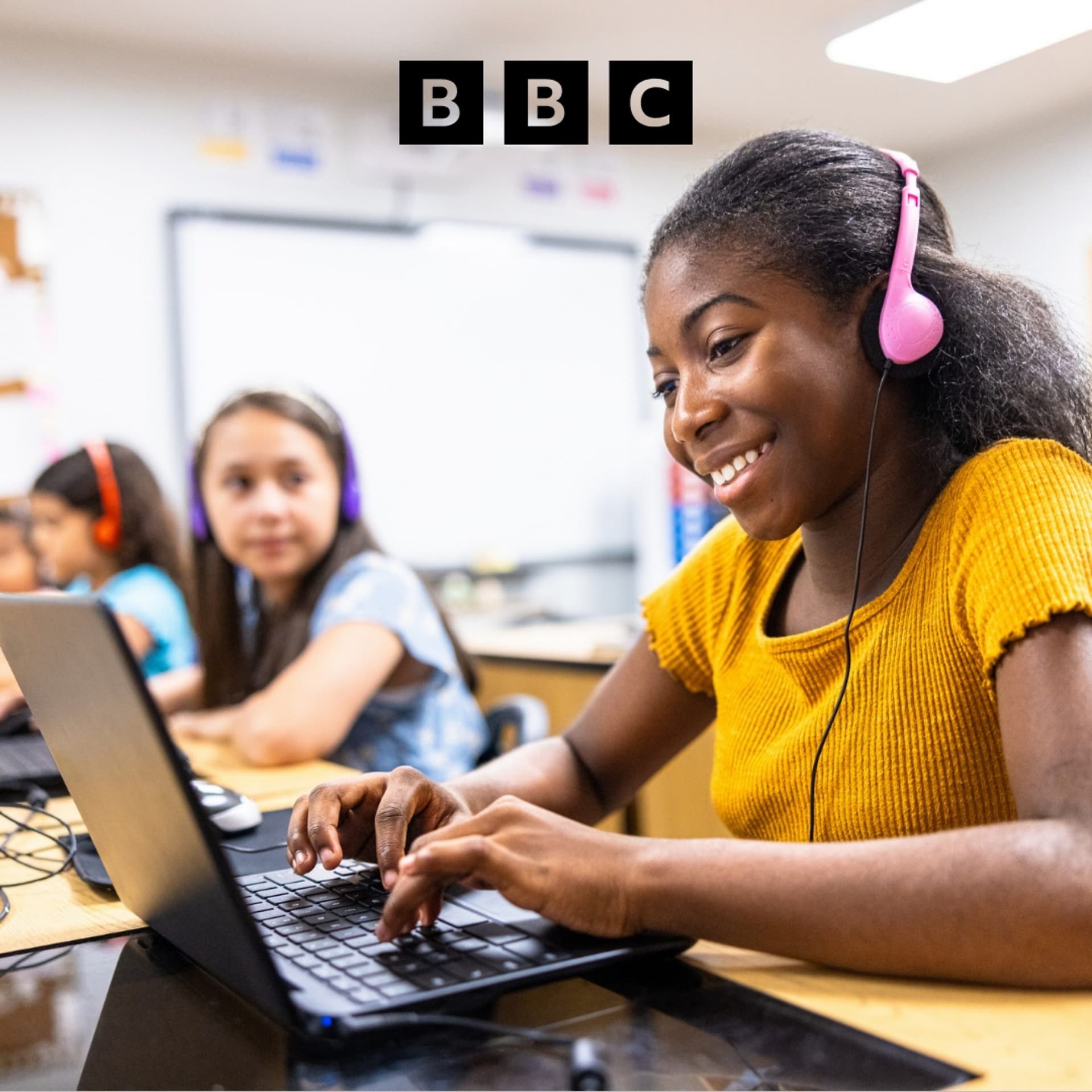
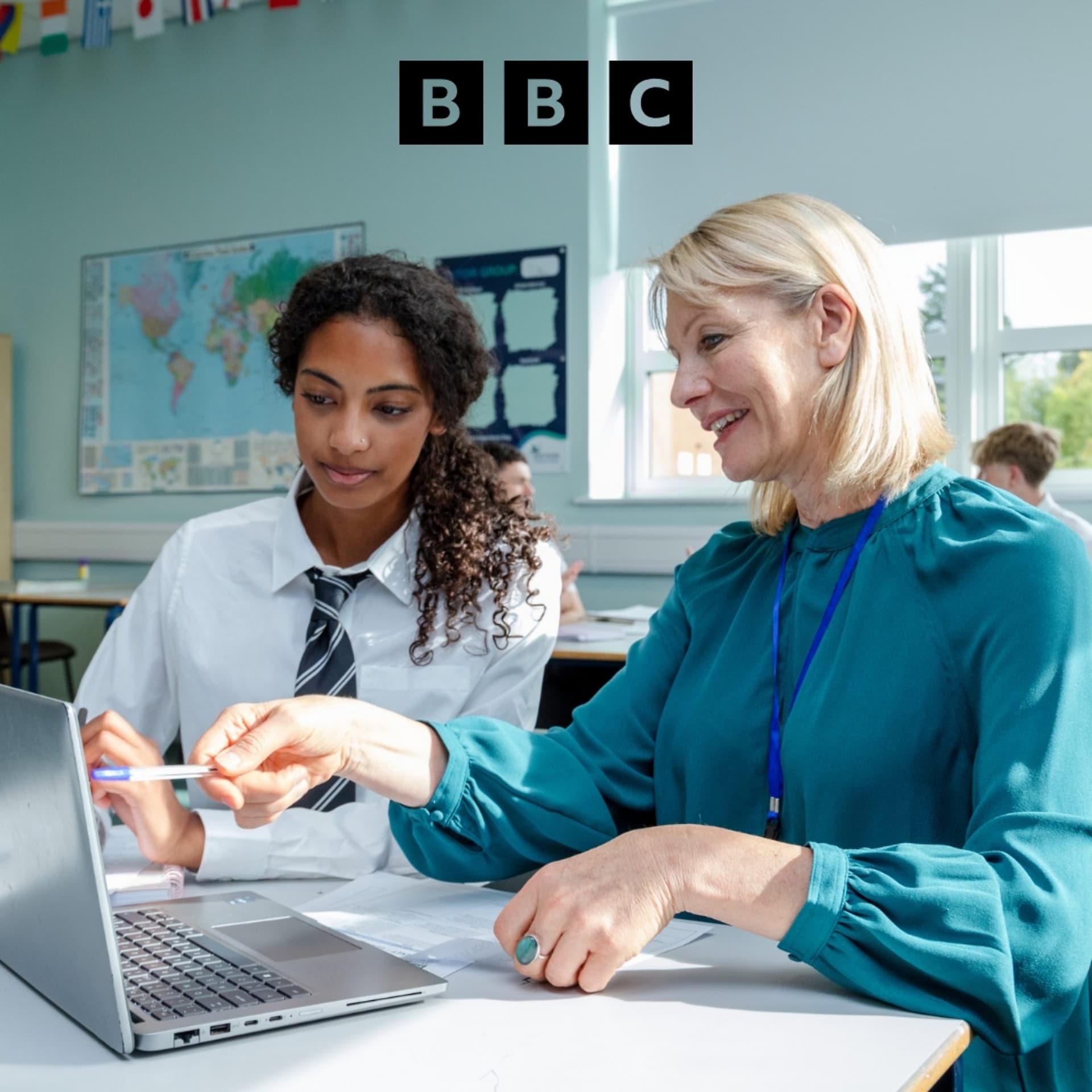
(Image: A female teacher sits at a classroom desk with a female high school pupil. They are looking at a laptop screen. Credit: Getty Images)