In short
Tech Life Podcast Episode Summary
Episode Title
Tech and Performance at the Edinburgh Festivals
Episode Overview This episode of Tech Life explores the intersection of technology and performance at the Edinburgh Festivals, the largest arts event globally, held every August. The festival brings together a myriad of performances, including magic shows, dance acts, and AI-driven improvisation, showcasing how technology is reshaping the arts.
Key Points Discussed
- Edinburgh Festivals: A Hub for Innovation
- Edinburgh transforms into a cultural hotspot each August, attracting around half a million visitors.
- The festivals combine various artistic expressions—comedy, theatre, poetry—with cutting-edge technology.
- The National Robotarium, a key facility in robotics research, symbolizes the city's tech-forward approach with a recent deal to host the UK's largest supercomputer.
- Performance Art and Technology
- Charlie Caper, a magician, incorporates robotics and artificial intelligence in his act, titled "The Future."
- Uses AI to create art based on audience thoughts, a feat made possible by advancements in generative AI.
- Discusses the balance between technological wonder and the skill of live performance.
- Choreographed by Electricity
- A performance called "Score" uses electronic muscle stimulation to control dancers' movements.
- Choreographer Isaiah Wilson explains how a MIDI controller manipulates dancers through electrical impulses, raising questions about free will and the body in society.
- Dancers experience a loss of control, leading to unnerving yet thought-provoking performances.
- AI in Improvisation
- The improv group Improbotics features a robot named Alex, designed to interact with human performers.
- The group explores the unpredictability of AI in theatre, likening it to performing with a challenging improviser.
- The discussion touches on the dual-use of technology and the importance of human creativity in AI-driven performances.
- Art and AI Ethics
- An exhibition entitled "Authenticity Unmasked" examines how AI transforms our understanding of truth and identity.
- Artists presented works that address the implications of AI in creative practices, emphasizing the need for responsible usage of technology.
- Highlights the mixed feelings artists have about AI potentially replacing creative jobs, yet recognizes the opportunities it presents.
Discussions and Insights
- Technological Impact on Creative Arts: Artists express concern about AI's capacity to replicate their work, yet acknowledge that live performances retain a unique allure.
- The Role of Human Agency: Conversations with performers emphasize the importance of human involvement in technology-infused art, ensuring that AI serves to enhance rather than replace creativity.
- Cultural Commentary: The impact of technology on our societal perceptions, including issues of authenticity and reality, is a recurring theme during the discussions.
Final Thoughts The episode encapsulates the vibrant interplay between technology and performance art at the Edinburgh Festivals, raising critical questions about creativity, agency, and the future of artistic expression in a world increasingly influenced by AI.
Listeners are encouraged to reflect on their own experiences with technology and its implications for the arts, while the episode closes with a light-hearted interaction with Alex, the AI robot, showcasing the ongoing dialogue between humans and machines in performance settings.
Written by AI. May contain mistakes. Listen to the episode to check what was said.
Transcript
Automatic transcript. May contain errors.0:00Hello and welcome to Tech Life on the BBC World Service with me Imran Rahman Jones. This week we're in Edinburgh in Scotland for a special episode because every August the whole city transforms, hosting a month-long set of festivals, bringing in comedy, theatre, poetry and all kinds of other cultural performances. In fact, it's the biggest arts event on the planet and brings in an estimated half a million people every year from all over the world. A little bit of us though. Beautiful, I mean one little bit faster, a little bit quicker.
0:38Now, the city was formally established just over 900 years ago. I'm right in the centre on the Royal Mile, and street performers like this one are entertaining crowds on cobbled streets in front of centuries-old ornate churches, statues and old monuments. You guys want to see some danger! But Edinburgh is also home to some cutting-edge tech, including the National Robotarium, the UK's centre for robotics research. And it will soon have the country's largest supercomputer in a recently announced£750 million deal. That's around a billion US dollars. The various festivals attract experts, innovators and experimentalists in tech too.
1:22In today's Tech Life, we'll be speaking to some of them.
1:31I don't want to say that I've sold my soul to the robot overlords, but... It would have been completely impossible just two years ago. What other art form can give you goosebumps? Like, you know, it's so visceral. Oh, whoa. It's lifted my arm. I'm not doing anything.
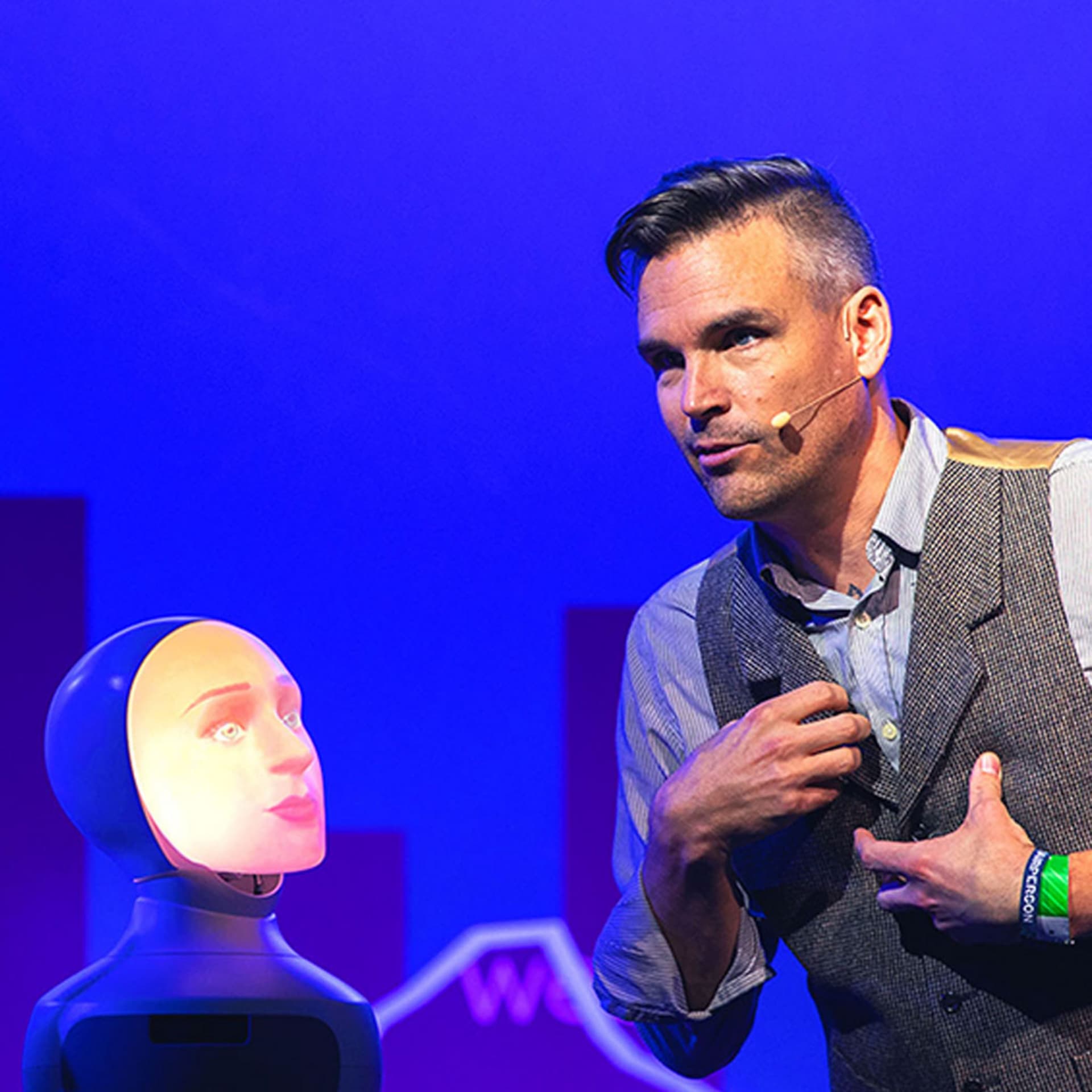
1:55I'm heading off the Royal Mile now and walking a few minutes down the road towards George Square. Now, normally this is the centre of Edinburgh University, but at the moment it's covered in tents. Inside one of these is where magician Charlie Caper has been performing. He uses lots of tech in his act, including a cast of robotic assistants. And his show is called The Future. It addresses questions about the technological revolution we're living through right now. And you'll hear my interview with him after this clip. These were the most intimate objects of our life. Even the jewellery is changing.
2:30It used to be the way we expressed love for someone, and now we just post on Instagram. We used to interact with these objects daily, and now they're gone.
2:47I was one of these kids that learned to program when I was a kid. And for a short time in London, I was a computer game programmer. And then I was a magician for a really long time. but I always had this love for mechanical things and also for coding, creative projects. And I know a lot of people in the artificial intelligence and robotics world. So I also hear things about what's coming down the line. What would be your sort of ideal next big part of the show if you could get your hands on the tech? Ooh, I would love to put a humanoid robot in the show. I mean, that kind of is one. I'm not going to give away too much.
3:27But I would love to do that. I want to put more real artificial intelligence in the show because I'm actually really good at working with it. And right now there's not so much. But the act with the graphics... That was my favorite bit. I thought it was amazing, yeah. What can you say about that for an audience who can't see what I saw? I basically read someone's mind and create art based on what they're thinking of. And it was a huge software. I spent probably 300 hours writing the software for that. And I have to carry around a new gaming computer, a very high-end new gaming computer, to be able to do just that magic act.
4:04So it's quite, yeah, it's really beautiful, right? It becomes something. Yeah, so you're reading someone's mind, and before they tell you what's written on the board, it starts appearing on the screen. And it's something that you can only do it with generative AI, right? This wouldn't have been possible a couple of years ago. No, it would have been completely impossible just two years ago. But still today you don't see anything like it really. I think in three or four years there will be maybe apps that do it that people have or similar kinds of things. But right now it's really quite special still.
4:40Yeah, it's really beautiful. It's something I've not seen before. Is it hard to impress people? Because we kind of assume that tech can do anything now. It's kind of magical in itself. So is it harder now to amaze the audience? there is something in that Arthur C. Clarke thing that any sufficiently advanced technology is indistinguishable from magic and people do think that technology can do all kinds of stuff but you have to kind of push it a lot and I also have a lot of skill as a magician so if they're not impressed by the way I use the technology they will be impressed by the magic hopefully and yeah we should say if I had access to all this tech it's not like I could do any of this you have to have the skill of a magician as well.
5:23Yeah, being a professional magician was basically what I did for 25 years with a strong interest in technology and building stuff and programming microchips and 3D printing gears and that kind of stuff. But actually at the same time, especially with the kind of use of AI, generative AI, there's lots of people in the creative arts, probably lots of people performing here who are quite worried about that and that it might start doing things that they do themselves, take their jobs, take their livelihoods. Is that something you think about? And is being a magician something that is a little bit insulated from that you're kind of future-proof?
6:00I feel quite lucky that as a live performer, I think we're insulated. And I think people that do physical things, I think, are quite fine. If you paint oil paintings, I actually don't think you're very threatened by the graphical generative AIs. and if you live off playing live music gigs, I'm not sure if generative music will affect you very much. But for people that work with digital products, there's going to be quite a lot of work that's going away, I think. It is really sad, but I think there's also a lot of opportunity and new jobs will appear, maybe not as many, but definitely a bunch. And I don't know, for me also, I've always been in the arts because I love it.
6:46So I have very double mixed feelings about it, actually. And I know friends that are losing their job as well. So I don't want to be cold or harsh about it. Yeah, I think having just been in an audience, just seen you perform, I think that will never go away. We'll always want that live experience. So thank you very much. Thanks very much, Charlie. Cheers. Thank you so much. So sweet.
7:11Thanks to magician Charlie Caper there. I'm on the move again down to grass market. the home of Dance Base, Scotland's National Centre for Dance. And this is where I saw a really memorable performance of a piece called Score. It uses electronic muscle stimulation pads attached to the dancers' bodies to make them move and twitch and jerk in a really unnatural and sometimes, I'll be honest, unnerving way. After the show, I spoke to choreographer Isaiah Wilson and one of the dancers, Will Shanroy. We started with Isaiah explaining a bit about the show. So basically the idea was to take a MIDI controller, so a piano, and we took each note corresponding to a muscle.
7:54So you can play a piano and the body basically gets moved by electricity. So I started composing this piece like a musical score. That's where the name Muscle comes from. And the dancers, they are basically sitting on a chair and they're being manipulated and moved through electricity to create a choreography. As one of the three dancers on stage, what's it like to be controlled by Isaiah? Yeah, it's really strange because it's kind of like a puppeteering thing, but with electricity, because we don't control the movements. it's really like electrical impulses in in the body so we have like patches in certain parts of the body like the the arms the legs the back yeah we we don't we have no control about with it and we all three dancers we do it at the same time exactly everything you're kind of wired up you're wearing these harnesses and they're attached to your skin is it just telling giving you a signal to move the arm or is actually physically moving you it's really physically moving us like it's an electrical impulses that goes directly to the patch and it contracts the muscle so yeah with it just happens yeah it's quite i've got to say and don't take this the wrong way it's quite disconcerting to see those kind of elements of horror because the way your bodies move and spasm and twitch is not something i've seen before is that what you're trying to get at that element of kind of loss of control yeah for sure i mean the peace questions free will and also the place of the body in society it's very important for me because i feel like the body is getting lost somehow in society especially when you talk about technology so it's just an open question rather than like a statement i also try to i mean there's a lot of illusion in it because it looks scarier actually than it is because it's unnatural and this is kind of like an uncanny feel to it so we are not used to seeing bodies move this way we are used to seeing the body move in a natural way and this piece really like digs into like this uncanny valley as well with the movement is that maybe you can show us some of the tech yeah for sure i can i can i can hook you up to the to the machine yeah if you want to if you're up for it you know yeah yeah you can give your feedback on how it feels right yeah well yeah i'll do some of your moves i'm just gonna hook up to like maybe your arm something.
10:28Yeah. Not bad. Is this going to hurt? Well you will figure, you will find out. No don't worry, don't worry. It's not good. All right. So I'm now connected to a black and a red wire on the pads on my arm. Okay ready? Three, two, one. Maybe it's two. Is it good? Whoa, whoa. That's a really weird sensation. If you try to relax the arm, really relax, and you see. It's lifted my arm. I'm not doing anything. It's strange, no? That's really strange, yeah. It's really strange because you're not doing anything. It really changes exactly how you put it. Then we can maybe get a movement out of your hands.
11:14Yeah. Oh, yeah. You see? Now you've moved the pads, it's now lifting my hand in a different way. My hand's kind of going backwards. Wow, that's quite an interesting... I don't know how you do this every night for the full performance. Yeah, I think what is also interesting, of course, is in choreographic terms, because it's a choreographic dance piece, is that we have three performers on stage, and they're moving in complete synchronicity, which is impossible, because they don't have to even cognitively use their brain to move. So if I could hook you up to the whole costume, you could be on stage tomorrow and you would do the whole choreography in complete sync with the other dancers.
11:55And that's what is also crazy about it. Thanks for the offer, but I'm too scared.
12:05Thanks to Isaiah Wilson and Wilshard Roy there. Just to let you know, my left arm went back to normal when they detached those electric pads. So I'm pleased to say, I think I've regained full control of my body, I think.
12:25You're listening to Tech Life on the BBC World Service with me, Imran Rahman-Jones, this week coming from the world-famous Edinburgh Festival. Now, for the past few weeks, we've been asking about your mini-adventures with technology. And in the last episode, Tech Life's own Zoe Kleinman shared the story of her lost ring and a kind neighbour with a metal detector who helped get it back after seeing a post on the local Facebook group. That story has prompted Brian from London to get in touch. He was on holiday in Wales when his wife lost her wedding ring on the beach until out of nowhere, he says, a man with a metal detector appeared.
13:03Within seconds of firing up his machine, he found the ring buried in the sand. The timing felt for Brian nothing short of miraculous. The only difference? This was 20 years ago, before we had local Facebook groups or even smartphones. Well, thank you, Brian. And I should say thank you to all the detectorists out there helping find all those lost valuables. You can email your own tech mini adventure to techlife at bbc.co.uk or send us a WhatsApp on plus 44 330 1230 320. We'd love to hear from you. Still to come on Tech Life, the artists tackling the rise of generative AI. But first, I'm off to meet an improvisation group and their comedy AI robot.
13:56Hello, everyone! It's a big robot! My little guest with us tonight, its name is Alex. Alex, do you even know what is the common point between science and improvisation? It's mostly people making stuff up. It lacks funding and can be painful. What you just heard there was a little bit of a show called Robo Tales from an improv group called Improbotics. And I'm here with two of the team, Pyotr Mirowski and Sarah Davis. And Pyotr, maybe you could introduce us to Alex, a robot that's part of your show. Yes. Hello, Imran. I'm so delighted. So Alex is a robot. It's very cute. It's about 60 centimetres high.
14:40Basically, it's a language model. My name is Alex. Alex is an acronym that stands for Artificial Language Experiment. But there is a whole system around this that is built specifically for various improv games that you have developed in our company. I saw the show and there's things like someone wears glasses and the glasses are telling them what to say. You've got like a kind of choose your own adventure. How do those kind of games work? Yes. So for instance, we have the whole concept of a cyborg. So the cyborg means that there's a human actor on stage being fed lines from Alex, from the AI. And then there's this important element of actually acting, like choosing the right timing, choosing the right line, the way to deliver that line.
15:30and this is all brought by the human actor. And Sarah, when you are acting alongside an AI or someone being fed lines by the AI, what's it like and how is it different to performing with real humans? What I love about improv is the element of risk and I think when you add in an unknown factor like an AI that can and can't do certain things then the element of risk is even more. Sometimes I liken it to being on stage with the worst improviser ever or someone who doesn't want to be there, etc. But actually it's the risk and it's trying to make sense of something that can sometimes be nonsensical that's actually really, really fun.
16:08One of the things in the show as well is that you get someone from the audience and you deep fake them so then the performance can be on camera with the audience member's face. Is that an example of how the technology has changed? How has the AI advanced over the last few years? Yeah, so this is an example of a dual use of technology, because obviously DeepFace can be used for the most egregious examples, impersonation and shaming. well in our case it's a demonstration of a fact that first of all this technology is scarily good because if you can make it work in the context of a theater show a fringe from a single picture imagine what we could do if we just took somebody's image how easy it would be but at the same time it's also demonstration that every every technology has a dual usage and that really depends on the responsibility of a user who decides what to make with this.
17:08Piotr, your background, you are an AI researcher. You said that you're kind of focused on human-centered AI. What does that mean and is that what you're trying to look at in the show? Yes, exactly. So I am really interested in how we engage as artists, as citizens, with artificial intelligence in a way that elevates human creativity and human learning, as opposed to going to the replacement and basically trying to see what we can get out of this. And we're trying to use it in ways that complements and inspires the actors. So yes, it's about finding new ways of using existing tools and maybe triggering a dialogue, if possible.
17:51Yeah, and it's very clear from the show that it doesn't, this wouldn't work without the humans there I mean just watching a robot wouldn't be a interesting improv show but I wonder Sarah as a performer when you tell people that you're working with AI in this way given that a lot of people kind of have reticence about it what do they say? Yeah I mean it you know I don't want to say that I've sold my soul to the robot overlords but um I know in a serious note I do I really really understand and respect people's concerns because they're really legitimate and we've certainly seen over the last couple of years you know how that's developed and you know we were doing a show just around for example the Hollywood writers strike weren't we around that time so it's really really legitimate and I think I'm not an AI expert I'm a performer I'm a drama lecturer but I for me it's about how we use this without it having too much of an impact and too much of a restriction on what we do but actually how we play with it how we be creative with it because it is actually here but yeah I completely respect why people would have concerns.
18:49Luckily for you the AI is not very funny so it's up to you to make it to make it a comedy show. Alex is offended. Sorry Alex but I say it's not funny I mean that it's not meant to be funny because it's you guys who bring the comedy. Yes so for us a lot of the delight is in the fact that it says these kind of crazy tangential things or it's yeah not always particularly funny but who knows what the future might hold.
19:18Thanks to Improbotics there As we mentioned earlier, Edinburgh is home to some cutting-edge tech, but also to the National Galleries of Scotland and lots of other arts venues. And those two worlds came together at an exhibition earlier this month at Edinburgh University. It was called Authenticity Unmasked, and programme director Caterina Maruzzi explained the purpose of the show. It presents three newly commissioned artworks that deal with how artificial intelligence technologies are shaping our understanding of truth, authenticity and identity. And in this project we are looking at how generative AI technologies are transforming creative practices with the aim of contributing to an understanding of who is empowered by these new forms of creativity and who instead needs to be protected.
20:07Well, I went along to the opening night to speak to some of the artists. I'm Francesco Taccini, I'm an artist and I'm an artist of artist demystification. Yeah, and I'm Oliver Smith. I'm the other half of Demystification. We're a visual artist duo. And tell me about this piece we're looking at here. So this is called Grok Tung Tung, and it's a 10-minute video work about two characters embodying AI systems that have gone wrong or that are behaving in an anomalous way. And so they're telling each other jokes about deceiving and sort of misbehaving while training. Did you write the script or you used Generative AI in the work?
20:45The scripts are written and then they are composed from sounds that are misgenerations from a text-to-speech model. So similar to a GPT model and it hallucinates, but it hallucinates in audio, which means not necessarily nonsense language, although sometimes, but also like drum beats, music, screams, shouts. And the script itself, even though it's written by us, it's actually real stories of real algorithms that are misbehaving and sort of cheating the system. For instance, one of the stories about an algorithm that's learning to operate in a simulation where it needs to clean a room. And the algorithm basically learns to suck up the dirt and then spit it back out and then suck it up again just to obtain the reward that comes within the simulation rather than learning to clean the room.
21:30And then obviously, you know, in this context, it becomes really comedic and funny that it's just vomiting out all of the dirt. Has it changed since you started this work? Because obviously AI is advancing so quickly. I think the hallucinations are still there, though, no? Like, AI may be advancing, there's maybe speed increases, amount of data increases, but the hallucinations are there. And if we are going to exist in the world with these systems, we need to perhaps understand or relate to them differently so that that hallucinatory aspect, which will remain, becomes part of our life, part of the way they're used.
22:05Maybe they're better at jokes than they are at helping us with, like, scientific issues, right? Maybe that's what they're for. Also exhibiting was Kinari Saraya, an artist from India who used a gaming engine to design a virtual world which was projected onto a large white kite. The audience could then choose a point on the map which changed the virtual landscape and weather using live data from the real world. The system takes location data which uses Google Maps' API, tells Open Meteor's API to collect weather data from that set place, tells Unreal Engine what to change. change. So something like temperature of that said place changes the colour and the depth of warmth in the world and humidity changes how much it rains within the world.
22:52And tell me, why did you want to kind of highlight mapping technology and the weather data that we collect from all around the world? I guess it's to reveal the seemingly everydayness of Google Maps or using these technologies that we do, this work is born out of the fact that Google Maps in real time changes borders, especially contested borders. So from India, you're looking at Kashmir, which is a contested border, and there was a recent war for taking control of Kashmir. It shows that it's in India because India believes it's in India. But if you look at it from Pakistan, it shows it's in Pakistan because they believe that it's in Pakistan, which really changes the agency of who lives in Kashmir and who actually is Kashmiri and that's true for you know Gaza and Palestine right now as well.
23:41The audience are going to come in in a few minutes what do you hope they get out of interacting and viewing your work? I guess just the lens on being able to question these technologies that get given to us by a certain set of people and just trace back to who makes those decisions and who is responsible for coding those. And there was also a musical piece by artist Georgia Gardner. It showed two side-by-side videos of musicians, one of them playing their instruments and the other of them miming playing without the instruments. The sound design was a mix of computerised versions of their playing and the real thing.
24:21Artists with the increased popularisation of generative AI are being devalued and technical skill and embodiment and the emotion of artwork is being deprioritised in favour of more capitalistic values like efficiency and quantity. So on the second channel, with that in mind, there is this image of loss, I would say. What instructions were you giving to the musicians when they were miming? Well, I started it off by saying, think of it like air guitar, but serious. But then I asked them, both channels, I wanted them to perform it as though they were rehearsing for a performance. Little did I know, the musicians were just so amazing, and it was all there, it was all totally in their body, which I loved, obviously, because that is really what I'm trying to speak to.
25:18I felt so wonderful because I was a witness to this beautiful music and this amazing and embodied performance right in front of me that I was aware of myself first as a witness. I think this is a reason where I'm really drawn to music is because what other art form can give you goosebumps? It's so visceral to me. Thank you.
26:13we give the last word to Alex, the AI robot. Today's episode was produced and presented by Imran Rahman-Jones. The editor is Monica Seriano. Thanks for listening. Bye.
From the publisher
A special from Edinburgh, where art and performance meet tech with spectacular results. Including a magician with robot assistants, an AI improv group and an electrifying dance act.
Every August, Edinburgh becomes the centre of the arts world, with half a million visitors and thousands of acts descending on the Scottish capital. Among these are performers using some pioneering tech, asking questions about the role of AI in our lives and even a choreographer stimulating his dancers’ muscles with electricity.
Tell us about your own mini-adventure with tech by emailing techlife@bbc.co.uk or sending us a Whatsapp voice note to +44 330 1230 320.
Presenter and producer: Imran Rahman-Jones Editor: Monica Soriano
(Image: A man in a white shirt a grey waistcoat, on stage with a humanoid robot head. Credit: Getty Images)