
In short
The episode “The AI pothole hunter” (BBC Tech Life) follows three tech stories. First, Universes (Stockholm) fits cars and road-works vehicles with forward-facing cameras and computer vision to create an inventory of road conditions: potholes/cracks (including size and growth over time), obscured signs, streetlights, and detected roadworks. CEO Jonathan Selby says this enables predictive maintenance and faster, cheaper interventions; updates can shift from every five years to about every two weeks using taxi and bin-lorry fleets. He also claims privacy is protected by anonymizing faces/license plates and deleting originals. Second, Cloudflare strategy chief Stephanie Cohen discusses AI-bot traffic and “Papercrawl,” giving creators transparency/control over scraping and potential payment. Third, guest Nate Zalecki (24, Addis Ababa) won an AWS Global Innovation Award for Ivy, an offline AI tutor on low-cost phones, using “proactive learning” in Amharic/English to check study progress and prompt students before exams.
Written by AI. May contain mistakes. Listen to the episode to check what was said.
Chapters
Tap a time to open that second in VOInnovative AI for Road Safety
0:47 to 2:18
Discussion about how a startup uses AI and cameras to detect road issues.
“The Internet's business model is obsolete, some think.”
Camera Capabilities and Detection
2:18 to 4:32
Exploration of how cameras detect road conditions and anticipate potholes.
“and he's been telling us about their work.”
Expanding Vehicle Applications
4:32 to 6:54
Insight into how different city vehicles can utilize AI for road monitoring.
“Your aim is to put this in local authority vehicles, in sort of city-operated vehicles, but could the type of vehicle expand?”
Addressing Privacy Concerns
6:54 to 8:10
Discussion on the privacy implications of using AI in public environments.
“Because I imagine people will think, well, this sounds like it could also be a sort of a pretty nifty sort of surveillance system.”
Listener Feedback and Topics
9:04 to 11:01
Sharing listener feedback and previewing topics of interest.
“You're listening to Tech Life on the BBC World Service with me, Chris Valance, and of course with you, our listeners.”
Cloudflare and Internet Infrastructure
11:01 to 14:00
Exploration of Cloudflare's role in internet performance and security.
“It turned out when Cloudflare caught a cold, a large chunk of the internet sneezed.”
The Rise of Bots and Their Impact
14:00 to 16:40
Explore how the rise of bots is reshaping the Internet and business models.
“and why it's trying to access your information.”
Navigating the Changing Landscape of Content
16:40 to 19:10
Discuss the evolving landscape of content creation and the need for site owners to adapt.
“They need to decide whether they block, just want to block.”
Nate Zalecki: AI and Education
19:10 to 22:00
Meet Nate Zalecki, a young app developer tackling educational inequality with AI.
“But perhaps that's not surprising because it turns out Nate knows a thing or two about learning with access to only the most basic tools.”
Ivy: The Offline AI Tutor
22:00 to 24:40
Learn about Ivy, an innovative AI tutor designed to work offline for students.
“And that problem is mostly in third world countries.”
Show all 11 chapters
Proactive Learning with Ivy
24:40 to 27:30
Discover how Ivy engages students proactively to enhance their learning experience.
“and I'm trying to add support for other local languages as well.”
Transcript
Automatic transcript. May contain errors.0:00This BBC podcast is supported by ads outside the UK.
0:30Listen on bbc.com or wherever you get your podcasts.
0:38This week on Tech Life, the road is long with many a winding turn and many a pothole and many a broken streetlight and many other problems. But perhaps there's tech that can fix all that. The Internet's business model is obsolete, some think. We talk to a big tech leader on what might replace it. and the prize-winning AI educational app that will soon be chasing up students in Ethiopia and beyond. I noticed you haven't studied today. You were doing so well with quadratic equations yesterday. Want to pick up where we left off?
1:34Well, we start this audio journey on the road, and there are miles and miles of roads. I bet if you measured all the roads in Britain, you'd find that there were at least 396 ,700 kilometres of them, at a guess. And as all you drivers and cyclists will know, many of them have dangerous defects, from potholes you could lose a pram in to road signs obscured by trees and dirt. Keeping an eye out for problems and catching them early is a big task, but a start-up in Sweden has a bright idea. Universes is fitting cars and trucks with cameras and using AI to spot potential problems in the footage. The system's being adopted in several European countries.
2:18Jonathan Selby is the CEO of Universes based in Stockholm and he's been telling us about their work. Universe's core competence, real expertise is in computer vision. So we're really good at converting images and videos from cameras into useful data. And so we use cameras mounted in city vehicles or road authority vehicles, mounted much like a dash cam, so looking forward. And we run computer vision algorithms, so AI algorithms on the video streams captured by those cameras. And we're able to extract all of that information. So the road surface condition, the traffic signs, the streetlights, we can create an inventory, we can understand the quality of the health of that inventory and then help those responsible for the roads to direct resources to the best possible place at the best possible time.
3:09So what kind of issues might these cameras been sort of picking out and highlighting to local authorities so they can fix them? Well, so the camera can look down at the ground and detect surface imperfections like potholes and cracks. It's a huge challenge. Many of these roads are in poor conditions. So we can help detect those and send that information back to the road authority. More or less, if you can see it, we can detect it. So traffic signs, roadworks is a big problem. Many cities have a lot of roadworks in them. Here in Stockholm, where the universe is based, there are many roadworks each year.
3:46The city knows exactly where they should be, where they've been scheduled to be, but has very little idea where they actually are. And that means that they find it hard to manage the contractor, ensure that they've started on time, ensure that they've finished on time, ensure they're adhering to the safety regulation. And so this system we've created helps them detect the roadwork and ensure it's being managed in the proper way. I think, you know, most people detect a pothole because they suddenly, you know, their fillings almost fly out when they go over it. How does a camera detect a pothole?
4:21so we look at the image and we have trained an AI network to be able to process all of the pixels in that image and to recognize much like you as a human can look at a picture the pothole in the image we can even triangulate its position in the road and make an estimate of how big it is and what that means we can do is also show how it's growing over time as well and that helps the authority to know exactly when to intervene. Your aim is to put this in local authority vehicles, in sort of city-operated vehicles, but could the type of vehicle expand? I mean, might you see it in, I don't know, bin lorries or in cabs, for example?
5:08Yeah, exactly. So in fact, we already work with a range of different types of vehicles. So we've worked with taxi fleets here in Stockholm. So many of the taxis now carry these cameras and provide the information to the authority. And as you mentioned bin lorries, that's a great vehicle fleet for us. Typically, a bin lorry covers an entire city, a fleet of bin lorries covers the entire city every two weeks. So some of our customers here in Sweden now are receiving updates about their road network every two weeks. And this is a complete paradigm shift. Previously, they used to get an update every five years.
5:45And so, I mean, coming to the point that I guess most drivers and cyclists will care about, will this mean more rapid fixes of potholes? That's the aim, exactly. And it's not only about fixing the existing potholes, it's about anticipating where the potholes will be. And so using this technology, you're able to detect the telltale signs of a pothole forming. And with that information, the authority can then intervene before the pothole is truly formed with a much cheaper fix than it would cost once the pothole has evolved. There's one thing to sort of identify the problems and another thing to actually have the crews to go out and fix them.
6:27I mean, if a local authority is suddenly greeted with a, you know, a much more comprehensive picture of loads of problems, that doesn't necessarily add to their resources to fill in those holes. No, exactly. And I think that's really where this technology comes into its own. Because we have many vehicles out in the environment collecting data on a daily basis, the rate at which the authority then is aware of the problems as they evolve is much, much higher. And that means the opportunity to engage in predictive maintenance, to anticipate when something is going to go wrong and intervene before it happens, means that actually the environment is managed in a much better way and for a much cheaper cost.
7:10Is there a privacy concern here? Because I imagine people will think, well, this sounds like it could also be a sort of a pretty nifty sort of surveillance system. I mean, just to speculate on one use, I mean, these could all be traffic cameras as well, looking at vehicles parked in the wrong place, which, you know, obviously drivers greet with mixed feelings. Yeah, it's a great point. I think privacy is absolutely a cornerstone of what we've been doing here at Universes. The imagery that we collect in the public environment is targeted at assessing the asset infrastructure. There is a possibility that there might be a person standing next to the traffic sign.
7:50We are very careful about what we do with that image. We run it through anonymization. We extract faces. We extract license plates. We extract other personal data and we remove it from the image and we delete the original image. And it is only the anonymized image that is then stored. And because that anonymized image no longer contains the personal data, we can then treat it, we can then sell it to our customers. That's Jonathan Selby, the CEO of Universes, talking to me from Stockholm in Sweden.
8:22Hey, everybody. This is Thomas Germain from The Interface, the show that decodes the technology that's rewiring your week and your world. On this week's episode, we'll talk about how you can use AI without turning your brain to mush, are self-driving cars getting worse, and the secret campaign to make you afraid of Chinese AI. Listen on bbc.com or wherever you get your podcasts.
9:04You're listening to Tech Life on the BBC World Service with me, Chris Valance, and of course with you, our listeners. Last week's show was about a tech solution for sleep apnea and it struck a chord. Paul Simmons emailed to say, I've had this problem for many years and I've had to resort to wearing an air mask every night, which is particularly intrusive for my long-suffering wife. Eric Horde from Arizona in the United States wrote this, I work as a nurse in electrophysiology and we treat atrial fibrillation, which is often exacerbated by sleep apnea. I've never heard of some of those treatment options, so it was really fun to hear about them.
9:42And Adrienne Crow from Dublin and Ireland sent us a voice message on WhatsApp. She used to have a lot of sleep issues, but no more. My dentist suggested a mouth guard. This causes a little bit decrease in the tension in the muscles of the jaw. So I've been using mouth guards ever since. I always use them to sleep. Well, thanks to Adrian and all of you who got in touch. And we'd love to hear your thoughts on today's programme or your ideas for a future show. You can email us at techlife at bbc.co.uk or WhatsApp us on plus 44 330 1230 320. Remember to tell us your name and where you live. And coming up, the Ethiopian app developer who learned to code at 14 using only a pen and paper.
10:44The company Cloudflare might not be a household name, but in November last year, everyone woke up to its existence. Internet users are once again struggling with outages this morning, and this time the internet infrastructure Cloudflare was to blame. It turned out when Cloudflare caught a cold, a large chunk of the internet sneezed. That's because the company acts as an intermediary between websites and the internet, helping to improve their performance and provide protection from some types of cyber attack. About 20 % of the internet sits behind Cloudflare. The decisions it takes about security and about AI could have a real impact on all our tech lives.
11:27Cloudflare's chief strategy officer, Stephanie Cohen, was in the UK last month, and I wanted to hear her vision for the future. But we began with the basics. What does Cloudflare do? We're making sure that good traffic gets through fast, reliably and securely, and bad traffic gets deflected. But as it relates to cybersecurity, you often hear of things called DDoS attacks, which is distributed denial of service attacks, which is someone trying to keep your website, keep your site from being able to be accessed by humans because it's being overrun by bots. And so we make sure that those bots get deflected so the humans that you want on your site can get there fast, reliably and securely.
12:08Now, we've got a sense of how many websites rely on Cloudflare at the end of last year, didn't we? because something went wrong on your systems and it meant that a whole bunch of other websites weren't accessible from X, I think, to ChatGPT. You're not the only company that's had a big outage like that. Why did that happen and how are you going to stop it happening again? So last year we had an error in our configuration and what that caused is a network outage. We know we can't be perfect. So in a world where we can't be perfect, We need to make sure that we fail small, that we limit the blast radius, we control rollouts of configuration, that we ensure that our people have access to systems in the event of an outage, and that if we have to roll back something, it happens simply, easily, gracefully, and our users don't even notice too.
13:02You spoke about Cloudflare and the number of sites that use Cloudflare. And you've used that to roll out some really interesting new tools, if you like, in the era of AI. A lot of site owners, a lot of creative people are worried that their websites, their content are being scraped by bots that are essentially gathering data for the AI companies to train their systems on. You've done something which, if you like, I guess the aim of it is to give website owners and content creators more control over how that happens. Tell me about what you're doing to manage the AI bots. What we want to make sure is that site owners of all shapes and sizes have transparency and control.
13:50That means they understand who what is trying to access their site and then that that bot expresses its intent. that bot tells you what it wants to do on your site and why it's trying to access your information. And with that transparency and control, site owners can decide themselves what they want to do. They can decide to allow. They can decide to block. They can decide that there is a new business model that wants to be created where they're going to ultimately charge for access to their information. I mean, these bots are something that has sort of become a feature of the Internet, aren't they?
14:23They're programs that are essentially going out into the Internet and identifying content and scraping that content. And search engines use them to find information so they can tell people where stuff is. AI companies use it to gather data that will help train their AIs and that their AIs can present to users. What's the scale of that? I mean, have you seen a big increase in bot activity? So if you look at activity on the Internet, We are now at a point where HTML page requests are more bot than human. So there are more bot, agent, automated requests for page access by bots than there is humans today.
15:07And we think that trend will continue. Does the proliferation have negative consequences for site owners? I mean, bots can be useful. I mean, it helps people get their stuff into search engines, help get their stuff out there, if you like. But are there negative consequences for site owners? The fundamental business model of the Internet is changing. So the Internet was built such that you put your content, you put your information out there, you let a bot scrape it, and they will return for the idea that they can scrape you. They will give you traffic, which leads to ads, subscriptions, maybe someone buys something, or just an ego boost that someone was reading your stuff.
15:48and that has just fundamentally changed. And so the way that the exchange that's gonna happen on the internet is just gonna have to evolve. And that's one of the main things why we wanted to give site owners transparency and control around what was happening on their site because they then need to decide how to figure out what their business model is because we need a business model. We need high quality, original, human generated content on the internet. We think it's great for humanity, but it also is needed for AI. But AI is only going to flourish if there is high quality original human generated content.
16:24And so what you're doing is effectively erecting a barrier, a sort of barrier in code that will let them say to a robot from an AI company, no, you can't have our stuff. Or you can have our stuff, but you need to pay us for it. And on top of that, people need to decide whether they need to see what's on their site, which is the transparency and control. They need to decide whether they block, just want to block. We want humans on our site. We want to block because we ultimately want to be paid for it. And if you think about any market in the world, no market exists without scarcity. So if you can get something for free down the street, you're not going to pay for it.
17:01So blocking may not be the end game, but you may need to start there in order to make sure that you create a market for your information. All people paying. Absolutely. People are absolutely paying. So good example, I'll use People Inc. as an example because they've publicly talked about this. So the owners of People Magazine, they have been very aggressive on blocking bots. Their CEO, Neil Vogel, on their earnings call talked about the fact that they had aggressively blocked bots and they are now being paid. So we're seeing large media companies as the first step getting paid. But it's not just them.
17:40The headlines are all about the large media companies, but this idea that AI is looking for very specific pieces of information that they don't already have means things like local news, science, health. Information that is very specific is sought after by AI companies. So we're also seeing AI companies willing to pay companies that look like that. Some of that will be direct, meaning a direct negotiation between those two companies. And some of that will happen more programmatically on a platform like Cloudflare. We announced something called Papercrawl, which is the beginnings of a business model where you can get paid for your content in a more programmatic way.
18:21And that was Stephanie Cohen there. And I should say we recorded that interview before Cloudflare revealed the impact AI was having on its own business and that it was to cut its workforce by 1 ,100 employees in an AI-driven restructuring plan.
18:42Our next guest is a 24-year-old self-taught app developer based in the Ethiopian capital, Addis Ababa. His name's Nate Zalecki, and he's just won a US$10 ,000 prize from Amazon Web Services for his app called Ivy that uses artificial intelligence to help schoolchildren learn. But the really clever thing about Ivy is that even though it uses AI, it can work without access to a top-spec smartphone or a constant connection to the internet. But perhaps that's not surprising because it turns out Nate knows a thing or two about learning with access to only the most basic tools. I started coding at 14.
19:23I was writing code on paper, C++ in different programming languages. So I started pretty young. But doing it on paper rather than doing it with a computer, just sort of you know getting your head around there how it works but doing it with a notepad really yes exactly doing it on paper i had no access for laptop or you know internet or even mobile phone so i had to use paper and i started my first ai startup at 17 as well so that was around like seven years ago so i'm self-taught i'm yeah i dropped out from college first year and I'm working on a lot of startups. Tell us about Ivy. Ivy is the world's first AI tutor that works completely offline on low-cost phones and engages with students proactively and teaches them proactively as well.
20:20Why did you call it Ivy? I called it Ivy because I was interested, when I was in high school, I was interested in Ivy League in the US, so that's why. Right, aiming high. Yes, yes, exactly. So, I mean, there's a lot of interest in AI education. I think that's around the world. People are thinking, well, maybe AI could be used to deliver tutoring. You want to do it to address, I suppose, some issues to do with teaching and education in Africa. Would that be fair? Yes, exactly. I wanted to solve one of the most pressing problems, which is education inequality in Ethiopia, not only in Ethiopia, but in Africa in general and in several countries.
21:06And what kind of inequality are you talking about here? I'm talking about underserved students who cannot access reliable internet and also students and teachers, teachers usually here in Ethiopia. One teacher teaches 70 students, which is not education, which is more like crowd control. So that's what I'm talking about. And I think that's a problem that I think a lot of nations all around the world hope that AI might solve. But you mentioned there a particular problem, which is a lack of Internet connection, lack of good Internet connection. And I guess previously that might have been a real barrier to using AI because most of them require a good internet connection or an internet connection of some sort.
21:56Yes, exactly. That's one of the biggest problems that I've tried to solve. And that problem is mostly in third world countries. And how does it try and solve it? Usually, most AI needs a billion-dollar service, right? Data service. But what I did was compress the AI model so that it fits on normal phone, on a low-budget phone, on$80 phone. So it works offline, and it works forever and for free, yeah. So even if a student is disconnected from the internet for a large part of the day, they can still have their own sort of personalized tutor Is that what Ivy provides? Yes, basically, yeah, that's what Ivy is.
22:44Fully personalized, fully offline. Once you download the app and the model, you will be able to learn and interact with the app and Ivy forever. I suppose one of the challenges with learning through a phone or any other kind of computer is how you know if the kid is actually learning. because I think most people have skived off the odd lesson. How does Ivy deal with that problem? Yeah, very good question. So I try to deal with that problem by introducing a new concept called proactive learning. So what that means is Ivy reach out to the students actually and calling them, checking on them, checking on the schedule and the study plans and everything.
23:31So she actually calls him. If there's an exam approaching, she will call and say, you know, exam is approaching. You need to study this and that. Let's study, you know, just like a real tutorial. In fact, we can hear a recording that you made of Ivy doing this. Hey, Natnell. I noticed you haven't studied today. You were doing so well with quadratic equations yesterday. Want to pick up where we left off? One of the interesting things about it is it delivers teaching in an Ethiopian language, Amharic, if I'm saying it right, and also in English. Were there challenges with getting an AI to work in Amharic?
24:14Because we learned that some languages, the tech companies haven't been so good at making sure their systems are able to deal with and to understand. Yes, definitely. That's one of the challenging parts. and there's not enough training data in different local languages. Amaric is the official language, so Ivy works fairly well with Amaric and I'm trying to add support for other local languages as well. You've won an award for the development of Ivy. So I won the Global Innovation Award for Ivy. The competition was organised by Amazon Web Services and it was one of the largest AI competitions ever.
25:00More than 10 ,000 teams from 115 countries participated. So, yeah. What's it like to be taught by your app, by Ivy? At first, it will seem weird because we're not used to AI calling us. Most of the AI is currently in ChatGPT or any other AI tutor or app. It's not proactive. it will wait for you to chat with them, to write it. But Ivy should reach out proactively. That part is really... Students were really amazed here. They were really excited about it. They wanted to use it because I ran a small pilot for around 10 days, so it was pretty short. But they wanted to access it for a long time. It was a really cool experience.
25:49Would you have any advice for other young people listening? who may be wondering, you know, that perhaps they too don't have access to a lot of computing, but they'd like the idea of getting into computing. This is why I made Ivy. So basically, if I had Ivy at that time when I was 17, it would solve a lot of my problems that I had to deal with. And walking 20 kilometers per day, just to save money for internet connection and stuff like that. So Ivy exactly solves that problem. Anyone with low-cost mobile phone can learn 24-7 about anything, literally. So the only thing that will matter is agency, taste and passion.
26:36If you have something to learn in mind that you want to learn, that you love, you can learn it. And that was Nate Zielecki speaking to us about Ivy from Addis Ababa.
26:51Well, that's it for this week's edition of Tech Life. Just time for me to chase you, our listeners, for your thoughts inspired by this week's show and any ideas you have for future programmes. You can email us at techlife at bbc.co.uk or WhatsApp us on plus 44 330 1230 320. And there's much more tech news from all our team at bbc.com forward slash technology. This show was an A-plus effort from producer Tom Quinn and a more work needed piece of late presentation homework from me, Chris Vallance.
Read the full transcript
27:44Hey, everybody. This is Thomas Germain from The Interface, the show that decodes the technology that's rewiring your week and your world. On this week's episode, We'll talk about how you can use AI without turning your brain to mush. Are self-driving cars getting worse? And the secret campaign to make you afraid of Chinese AI. Listen on bbc.com or wherever you get your podcasts.
From the publisher
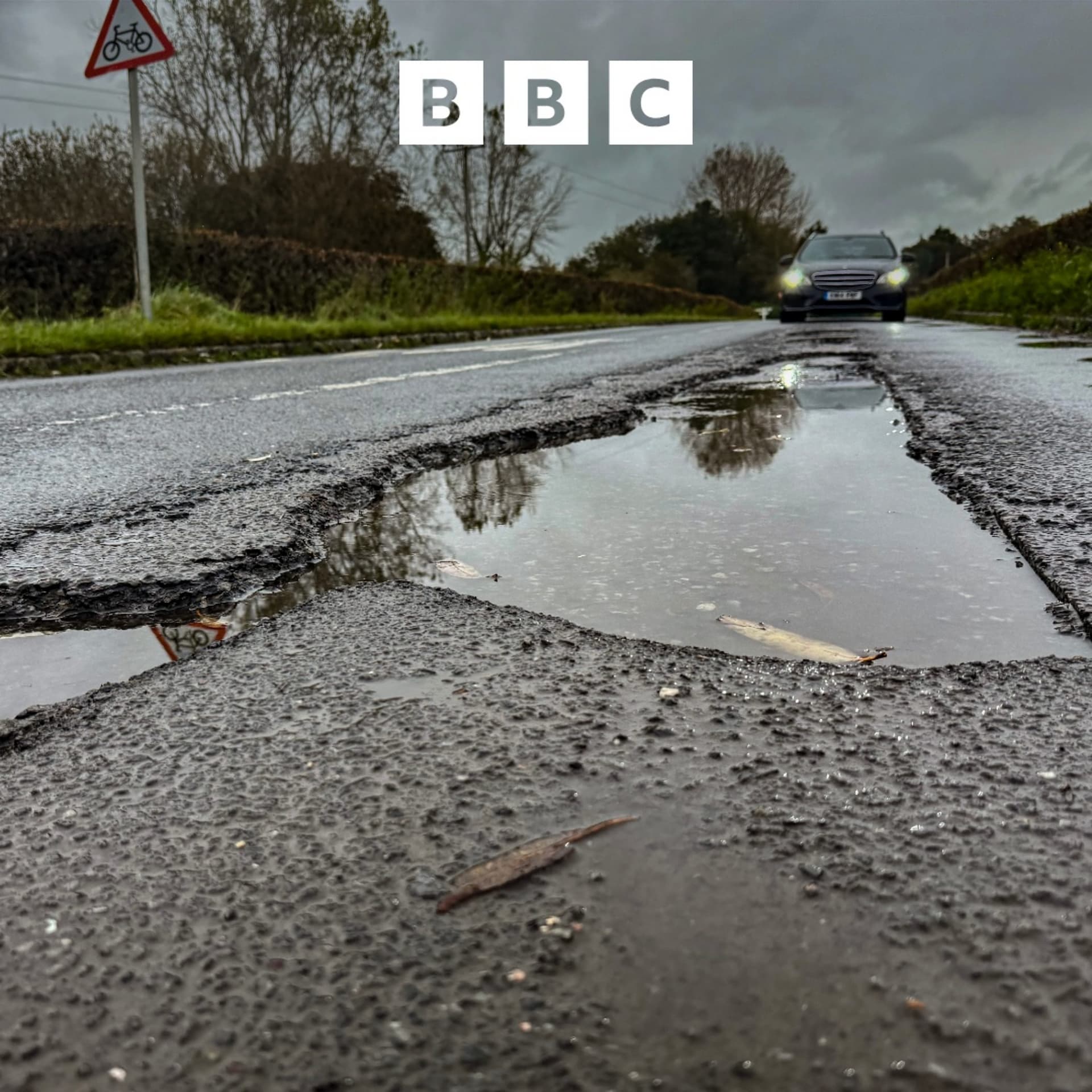
Drivers and cyclists know the dangers of potholes and broken road signs. A Swedish company is fitting vehicles with cameras, and using AI to spot potential problems and defects. We speak to the CEO to find out how it works.
Also in Tech Life this week: some think the internet's business model is obsolete. We talk to a big tech leader on what might replace it. And a young entrepreneur, who learned to code without a computer, tells us about his AI teaching app that will work without the internet.
Presenter: Chris Vallance Producer: Tom Quinn
(Image: Deep potholes have formed on a tarmac road. They are deep enough to catch rainwater. A car is about to drive over them. Credit: Getty Images)