
In short
How social media creators are targeted by “copyright extortion” scams using bogus infringement claims; then how AI could help detect wrong-way driving; plus gaming news from Gamescom.
Guests/backgrounds
Tech Life reporter Imran Rahman-Jones investigates the extortion scheme. Creator “Ollie” (Lost in Time History, 1.4M followers) describes being hit by repeated fake claims and paying ransoms via Telegram/crypto. Digital copyright expert Dr. Andres Guadamuz (University of Sussex) explains why platform-based enforcement enables abuse. Road-safety AI update: Harriet King (Valoran) and Andrew O’Sullivan (Transport Infrastructure Ireland) discuss wrong-way detection using existing CCTV. Gaming: Laura Kress reports Gamescom; interviews include Jeff Adams (Crystal Dynamics) and NVIDIA’s Gabriella Leone.
Key claims
False strikes can trigger account shutdowns; scammers often share generic “artist/nature” names and the same email; victims pay ransoms (e.g., $50 crypto) to restore posts; Meta says it restores content and adds protections.
Notable examples
Ollie receiving eight claims; a scammer demanding $900; AI wrong-way alerts from Waze plus CCTV validation; Gamescom coverage of Lara Croft and NVIDIA DLSS 5.
Written by AI. May contain mistakes. Listen to the episode to check what was said.
Chapters
Tap a time to open that second in VOThe Impact of Copyright Claims on Creators
1:04 to 1:50
Exploring how social media creators face extortion through false copyright claims.
“Welcome to Tech Life on the BBC World Service, the programme about technology that's changing all our lives.”
Ollie's Experience with Copyright Strikes
1:50 to 3:56
Ollie shares his struggles with false copyright claims and the extortion process.
“from influencers doing sponsored content to celebrities using it to help boost their profiles.”
The Mechanics of the Extortion Scheme
3:56 to 6:34
Details on the process of how extortionists operate through copyright claims.
“Yeah, so he says he has made mistakes with copyright before and had legitimate requests from agencies which hold the true copyright.”
Insights from Digital Copyright Expert
6:34 to 9:01
Expert insights on copyright enforcement and the challenges faced by creators.
“What do we know about the people who are making these false claims and asking for ransoms?”
Listener Feedback and AI Discussions
10:04 to 12:00
Feedback from listeners on previous AI discussions and insights.
“This is Tech Life on the BBC World Service with me, Chris Vallance, and with you, our listeners.”
AI and Wrong-Way Driving Prevention
12:00 to 14:03
Exploring AI's role in preventing wrong-way driving incidents.
“Two recent road traffic accidents in two neighbouring countries just days apart have shocked many.”
AI Monitoring of Motorway Safety
14:03 to 21:15
Learn how AI systems monitor Irish motorways to enhance safety.
“where we look at and monitor and watch 1 ,300 kilometres of Irish motorways.”
Gamescom Highlights and Gaming Evolution
21:15 to 27:38
Discover the latest gaming innovations and the evolution of female protagonists.
“and a showcase for some hotly anticipated new titles.”
Transcript
Automatic transcript. May contain errors.0:00This BBC podcast is supported by ads outside the UK.
0:30at Whole Foods Market. John Deere is putting in work and putting up highlights. Oh man, look at those passes. Tillage, planting, harvesting. Three years in and these pre-owned machines are still at the top of their game. We're talking reliability, performance, and long-term potential. And get this, these veteran machines can pick up the latest precision tech with ease. You know it and fans ready to add John Deere certified pre-owned equipment and more options to their lineup can shop at machinefinder.com. Booyah! Welcome to Tech Life on the BBC World Service, the programme about technology that's changing all our lives.
1:10I'm Chris Vallance, and this week, how social media creators are being extorted through bogus copyright claims. We see if AI can help raise the alarm when someone drives the wrong way on a major road. And our own Laura Kress updates us on Lara Croft and all the other gaming news from Gamescom in Germany.
1:49Well, lots of people now make a living off social media. Maybe some of you do too. from influencers doing sponsored content to celebrities using it to help boost their profiles. And there are plenty of people behind the scenes running accounts and posting content. But some of these have been targeted by an international extortion scheme, where their livelihood is put at risk by a flood of false copyright infringement claims that only stop if the extorter is paid. TechLife's Imran Rahman-Jones has been looking into this and joins me. Imran, how does this work? Yeah, so Instagram and other social media platforms have reporting tools where copyright holders can complain if another account is reposting their images or their video.
2:34And normally the platform takes down the content. Then there's an appeals process if the person thinks they do have the rights to the work. But this is where the system can be abused, because if your account gets lots of copyright strikes, then your whole profile can then get taken down. And you've been talking to some people to whom this has happened. Yeah, so someone called Ollie who runs an account called Lost in Time History, which has 1.4 million followers. Mainly, there's a lot of like old photographs being shared. I did post on Native Americans, Wild West, Maori, anything really, anything that people would find interesting.
3:14Now, Ollie says he is careful to either use old pictures, which are in the public domain, so they don't have copyright restrictions, or if he's posting newer pictures, he makes sure to get permission of the copyright holder before. But he's still getting lots and lots of copyright claims against his account, which he says are completely false and not even from the real rights holders. So on the day we spoke, for example, he had eight claims just before we got on the phone. And those kinds of numbers are what cause Instagram to act. You'll get some restrictions applied to your account or your account will be taken down or you'll just receive that message saying your account is in like a warning stage and any more will get it taken down.
3:56And he's convinced this is all unfair. These allegations are all fake. Yeah, so he says he has made mistakes with copyright before and had legitimate requests from agencies which hold the true copyright. But he says they're very easy to deal with, whereas the fake ones are different. They normally call themselves a name like artist or nature or just generic noun. but all the takedowns will be from the same email. So either they own every piece of content on the platform or it's a sign of exploitation that somehow the system doesn't detect. And then what happens next is he'll get a message or email from the person who did the strike and they'll ask to go on Telegram, the private messaging app.
4:40Then they'll demand a ransom to withdraw the copyright strikes which would then restore his account. I mean, that's pretty good evidence that these are not good faith copyright claims, right? It does seem to be. I mean, I've seen a message, for example, from one where they asked for 900 US dollars to withdraw the strike. Ollie says there's normally a bit of back and forth where you can negotiate with them. So he did recently pay a ransom of$50 in cryptocurrency and that did get his post back. But then he was hit immediately by more strikes by someone else. That's the worst part, having to pay the person who's actively put you through all of the like the anguish and only for it to happen straight away again it just feels like blow after blow one of the things in kind of extortion cases is a lot of the time they would say you shouldn't pay because you're kind of encouraging them to do more of it because they're getting rewarded for it how do you feel about giving them money that might encourage them to do more it's always the last resort to do something like that because as well with my own instantly i received more strikes straight afterwards but the account came back which is income i need and i can't really wait either for a police investigation if i was to file it that way or them to respond to the strikes when i get more instantly.
6:08Now Ollie and the other people I've spoken to in different countries say Meta, the owners of Instagram, are quick to take down their content but slow to respond to the counter claims where they submit evidence that they do have the permission to post the images. And they complain of automated systems or even if they do connect with a person on the other end, they misunderstand the claim and essentially it goes round and round in circles. What do we know about the people who are making these false claims and asking for ransoms? Well, I have actually managed to get in touch with some of them. As far as I can tell, they seem to be based in India or maybe in the countries nearby.
6:49And the ones I've been messaging with deny they're doing anything wrong or illegal. And they maintain they're contacted by copyright holders or possibly a middleman in between who's asking them to make these strikes. and they're doing this because they want to make sure the rules are being followed. Two even denied that they made any money off of this at all, but another said that they do get paid and they keep all of the money from the accounts that they do target. But then, even if it was a real copyright claim, the money isn't going to the rights holders, it's going to the middleman. Yeah, exactly, which I think is more evidence that this is a scam.
7:28But actually, it's nothing new as well. fake copyright takedowns have been used for example to try and censor independent or investigative journalists working in certain countries where free speech is limited and i spoke to a digital copyright expert dr andres guadamuz from the university of sussex in the uk and he said it comes down to how the online copyright enforcement works and the fact that it's largely policed by the platforms rather than by law enforcement you could sue that person but the easiest way to go is to actually ask the platform, look, my rights are being infringed. Someone is distributing my music.
8:08Therefore, I want you to stop it. So that's Dr. Andres Guadamuz again. And the other thing that he said is that it's a numbers game. So with things like AI and automation, you can send even more strikes out. And then there's the fact that platforms like Instagram have billions of users, so they can't have a human review every single case. And I heard from victims like Ollie and others that it's very difficult to get Instagram to act quickly. So what has Meta, which owns Instagram, said about all this? They sent us a statement via a spokesperson which said, we understand this can be frustrating for those impacted and our systems are designed to protect people from this happening in the first place.
8:50And then they also said, following our review, we have restored the affected content and added additional protections to safeguard accounts against further attempts of this kind. Well, thank you very much, Imran. Fascinating story. I wonder if we'll hear more about it as time goes on. Thanks, Chris.
9:11September's always busy. Whole Foods Market can help. Their September Stock Up event makes it easy to load your pantry and freezer with flavourful, nourishing food. Even better, there are hundreds of sales. Get dinner going with canned soups and veggies. Lean on frozen pizzas, pastas, and seafood everyone loves. Their Build Your Own Family Meals feeds four for just$35. Stock up at Whole Foods Market. Thumbtack presents Tile Trouble. Every single time I use my sink, I make eye contact with the uneven grout on my kitchen backsplash. The crooked corners eye me and I'm haunted by more tiling questions than I thought possible.
9:50What kind of pro can fix a backsplash? Can I replace one cracked tile or should I replace them all? What? What if I just use Thumbtack? I can hire top-rated pros, read reviews, and compare prices with a tap. All on the app. Thumbtack knows homes. Download the app today.
10:19This is Tech Life on the BBC World Service with me, Chris Vallance, and with you, our listeners. On last week's show, Shona McCallum spoke to Microsoft about Lingua, their project to train AIs on languages which are underrepresented on the internet. Michael Kisa, near Kampala in Uganda, emailed in. I'm a local language enthusiast and I have written some language guides with vocal accompaniment for some Ugandan languages. For example, Lasoga, Luganda, Ronya Kore, Kiswahili and Kenya, Rwanda. I would definitely like to link up with Lingua. Ibrahim Dumbaya in Sierra Leone WhatsAppped us to say thank you.
11:02He heard the same interview. Meanwhile, Zakaria in Mogadishu in Somalia liked Shona's interview about AI-powered tech helping the elderly. He said it was really good and useful to learn about these apps. And Barry Hill in England has emailed about an interview I did two weeks ago about how AI-drafted letters are contributing to increased complaints aimed at local authorities. Barry wrote, surely one option is to simply reinstate the abandoned telephone help desks so that persons needing or wishing to complain by talking to a human being could quickly and easily do so. Well, I'm pleased to report you can certainly reach a human being here at TechLife Towers, though I think the only office landline phone is buried under a pile of paper in a box with a family of mice.
11:49But you can WhatsApp us a text or voice note to plus 44 330 1230 320 or email us at techlife at bbc.co.uk. Please let us know your name and where in the world you live. All correspondence is 100 % human read.
12:16Two recent road traffic accidents in two neighbouring countries just days apart have shocked many. Five teenagers were killed last month in a head-on collision when their car was driven in the wrong direction on a motorway in Ireland. And five young men died only six days later in the north of England when their car travelled the wrong way on a main road and hit a police car. Two police officers lost their lives. But crashes involving wrong-way driving can happen anywhere. CBS News in the United States reported on this just last week. In Colorado, a state trooper took a head-on collision himself on purpose so someone else wouldn't have to.
12:57I just got hit! That's the moment of impact after a red Honda was reported speeding the wrong way down I-76 early Sunday morning, other cars swerving for safety. The trooper then arrested the driver, who now faces multiple charges, among them driving under the influence and with an open alcoholic container. Both the driver and the trooper had only minor injuries. There are lots of potential reasons for driving the wrong way. A deliberate recklessness, intoxication, illness or maybe someone confused by an unfamiliar road system in a country that drives on a different side. In Ireland there are plans to test if an AI system already deployed across its major roads to spot hazards can be adapted to also alert road watchers to wrong way driving.
13:45Last year for our sister programme TechNow I visited a control centre in Dublin where behind a huge bank of CCTV feeds, staff watched the motorway for hazards with a bit of help from AI. My guide was Andrew O'Sullivan from Transport Infrastructure Ireland. This is the motorway operations control centre where we look at and monitor and watch 1 ,300 kilometres of Irish motorways. The lads here are looking for breakdowns. They may be looking for collisions. Another problem we would have is pedestrians and cyclists ending up in the motorway network. It's a lot of road to watch, but also a mountain of information for AI to mine.
14:26Well, as you can hear, the road generates a lot of noise. It also generates a lot of data from things like navigation apps and CCTV. And it's that data that an AI from a company called Valoran mines to alert people in the control room to potential problems. The company's Michael Vardy walked me through one incident. In this case, we had alerts from Waze navigation app. The AI also noticed that traffic speed absolutely dropped to under 40 km an hour. Our AI also sieved through and processed the video footage in the area. What you can see in this replay were vehicles actually stopping in the live lane.
15:07And so when the AI raised all this, the operator looked at this event, immediately validated and sent over a response, and indeed there was a collision. Michael Vardy speaking to me last year. Well, to bring the story up to date and find out how their AI system could be adapted to spot wrong way driving on Ireland's roads, I got an update from Valoran's Harriet King. The way our system approaches it is using the existing camera network. So, you know, many of the motorways and high speed roads in Ireland will have existing CCTV cameras that are used by the control centre to observe the roadway.
15:44These cameras will usually be able to move. They'll pan, turn around, zoom in, et cetera, when they see something. Or they might be in kind of preset positions when when they're just kind of monitoring the road. And what we do is we run a sort of AI technology over the top of those existing camera streams in real time. And we are able to identify the usual direction of travel on that carriageway. So, you know, if you imagine you're looking at a road through a camera, there's a car driving from the bottom to the top of the road. we can identify that's the usual way of travel and then when we see a vehicle going in the opposite direction you know we can infer that that vehicle is driving in the wrong way.
16:24So what would be the advantage here I mean you're piloting it but what do you hope might be the sort of the advantage here? So one is the sort of speed of rollout and what I mean by that is you know we don't have to wait for lots of people to go and install physical sensors on the road we can use the cameras that are already there and because of our existing system that oversees those cameras we already have the integration it's just a case of kind of i mean i'm oversimplifying but you know you can press a button and turn it on and then it starts working right and so is the idea that you know once you've got this hopefully you'll be able to spot people driving the wrong way faster yes exactly so hopefully it will enable transport infrastructure island to spot when this is happening more quickly and then take some kind of response to that to mitigate it and maybe identify perpetrators if it's something that's deliberate or to take mitigations to prevent this from happening there's some some scenarios where we've seen it maybe with other clients or other roads around the world is might be that there's a failing in the way the road is organized that you know maybe there's poor signage that means that drivers are actually accidentally ending up on the wrong side of the road, coming down an exit in error or something like that.
17:42Yeah, I remember the fear I experienced the first time I was driving in the US and I counted a roundabout. I literally didn't know which way to go around. I was kind of mentally sort of come up with an idea about how do I go round a roundabout when they drive on the right, not the left, as in the UK. Yeah, and I think the majority of cases we see are... I mean, I know it's an increasingly dangerous situation and it's something that's happening more frequently, which is concerning. But the vast majority of the time when you see this, in our experience, it is usually somebody doing something in error.
18:18And, you know, if you can identify that happening as a pattern and analyse that information, you can then more intelligently invest resources or energy into mitigating that. So you might improve signs and things like that. Yes, for example, you could improve signs. And in the case that it is something that's a, you know, a dangerous or intentional situation, or even if it's not intentional, but someone's got themselves into a difficult situation and doesn't know what to do, at least the people who are monitoring the road at TAI can be made aware of that within a few seconds, can take steps to mitigate it.
18:54For example, they might change the virtual message signs, which are the big kind of overhead signs that you see on a motorway that say things like slow down or traffic ahead or accident ahead. Those kind of signs can be updated in real time to alert drivers that there's a wrong way driver or hazard and encourage drivers to leave it to the next exit or whatever the appropriate mitigation might be. So you have this AI system that's sitting on top of all the data the roads produce. I mean, what other new uses of your system are you thinking about? One of the big challenges we have with data on a road network is that lots of areas don't have 100 % camera coverage.
19:36So that's why all of this other data, like, you know, as an example, things like Waze or Google, when you get alerting from those, they can be useful. But the trouble with that data is often quite noisy. you know anyone can go on waves press a button and it puts an alert onto the system and it may or may not be true and what we're one of the things we're working on is how to better validate those those events from other sources either with a camera or with other data sources so for example we're looking at how we can identify the location the specific location of a detection from a third party source, like detection of an accident or a hazard or something like that, and automatically pan a camera to observe and provide validation that that event is or isn't true.
20:26Have you deployed the wrong way driving detection anywhere else in the world? We do have another European deployment where again, we're developing this technology. And that's kind of the basis. That's where it's also being used. To be honest, that's a location where we get a lot more examples of the sort of accidental wrong way driving, let's say. And it's actually, you know, really a challenging thing to develop against, because although it's very dangerous when it happens, fortunately, it doesn't happen, you know, as often as you might think. And so getting the data together to actually test and validate the system is challenging.
21:03And that's why it's kind of a trial and a longer term process to do that. And that was Harriet King from Valoran.
21:14Now, Gamescom in Cologne in Germany is one of the largest gaming events in the world and a showcase for some hotly anticipated new titles. Tech Life's Laura Kress was there and hurried back to Scotland to bring us all the news. Hi, Laura. Hello. And you're back from this Gamescom, Games Festival. What is it? That's right. A sort of gaming expo, an exhibition. It's, you know, any game under the sun, basically, you can see and it's fantastic. How loud was it? Incredibly loud, Chris. It was so loud because there's huge crowds that are there to see all the latest games. And these massive halls, there's 10 halls full of games.
21:52You know, if you're into that kind of thing, it's fantastic. Well, let's start. I'm talking to Laura. We're going to talk about Lara. Yes. Lara Croft. There's a Legacy of Atlantis game out, which is a remake of the original Tomb Raider, which was released 30 years ago. Featuring a much more polygonal. Yes, she was. Lara Croft. What's changed for female protagonists? Because I suppose that was one of the things about the original Tomb Raider. You know, this was a female star of a game. I'd say, Chris, in some ways we've come quite a long way. We've got plenty of strong female leads now. There's Alloy in Horizon Zero Dawn.
22:33There's Ellie in The Last of Us. often not sexualized as well. You know, it's more about just them, their character, their personality. But there is still a little bit to go. You know, we have seen still some backlash when games decide to make a female lead, like in the latest God of War game. A minority, but nevertheless, still some people not pleased that a woman is taking the role of what was a male-led game. It was something I was quite interested in when I went to check out the Tomb Raider booth, actually i went to speak to jeff adams who's the experience director at crystal dynamics which is making this new remake i wanted to know really why does he think people still want to play as lara croft 30 years on i think lara is a great role model for anyone who feels like there's parts of their skills that they want to increase and get better at but i think the reason why she is so iconic is because she can move through different periods of gaming and still retain her character still become instantly and only recognizable as Lara Croft, but she can adapt to changing surrounds, changing tastes in gaming.
23:40She's just an icon for a reason. Jeff Adams of Crystal Dynamics there. Well, let's stick with the theme of polishing original content. And we'll go on to something called, I think it stands for Deep Learning Super Sampler. Yes. This is NVIDIA's DLSS 5. you better say what it does and then you've got to see it in action i'm very interested to know what you thought of it so it's this new graphics technology from nvidia and they have been releasing things like this and this is the latest version and it's all to do with ai it's a what they call like a real-time neural rendering ai model and the idea behind it is it generates photorealistic lighting shadows graphics as part of a game and that's in real time which is incredibly expensive to do they said if you're not using AI and as you said I did get to see a bit of inaction they showed me a bit of a demo with this game NBA 2027 which launched with the graphics and that's a basketball game and you you could see the difference they were showing me you know before and after of the basketballers and it was pretty amazing to see the sort of change in the texture of the face that the hairstyles there was a lot more detail so I did have to ask NVIDIA's Gabriella Leone, who's the director of content technology.
24:59I wanted to find out a little bit more. What is this actually doing? So the DLSS 5 is a smart model and it's doing things like adding better contact shadows, better occlusion, better reflection, right? Better subsurface scattering, light enters some surfaces, scatters around, comes out. All these things are very hard to do in real time. Let's move on to a new installment of a reasonably long running game. and a TV show. We call it TV streaming show. Streaming show, I should get to the time, shouldn't I? This is The Witcher's new expansion, Songs of the Past. Tell me about it. So I think there was a bit of a surprise when this was announced a little bit earlier on this year because essentially this is an 11-year-old game and the fact that they are still releasing content for this game, people weren't really expecting that because at some point a sequel is going to happen.
25:51This is a game called The Witcher 3 and as you said they've announced this Songs of the Past a new expansion. I know some fans are kind of criticised it's not as close to the book lore of The Witcher the original kind of book that all of this is based on but when I met the actor Doug Cockle who plays the main lead in this series which is a fantasy series I should say The Witcher is this kind of hunter man who goes and he does all these errands for this kind of medieval area that he lives in And yet he plays a guy called Geralt. He's the main lead. But he really did say to me, he still has fans approach him even now and say how touched they are about his character.
26:32Some people just love Geralt as a character. They love the anti-hero, tough guy who actually has a kind of soft heart. I had someone just last night DM me. They said something like, thank you, Doug. The Witcher saved my life at a time when, you know, I was in a really dark place. and your voice helped me connect the character in a very deep way. That kind of thing. I think Geralt means a lot of different things but very important things to a lot of different people. It's interesting hearing Doug Cockle speak because he does sound quite a bit like Henry Cavill who of course made the role his own in the Netflix show.
27:12How long do you think the Witcher video game series will continue for? Well, they have announced a Witcher 4 So quite a long time, yes. And I imagine then there'll be expansions for that as well when that comes out. And that will be probably quite a long game as well. Interestingly, to tie this all in, Chris, Witcher 4 is going to be played with a female lead. Well, thanks very much for that snapshot of Gamescom and what to look forward to. Thanks very much, Laura. Thank you.
27:46Well, we're down to our last few bars of health here on Tech Life, but the game of hunting for news stories for future episodes continues. If there's anything you'd like to chuck into the loot box from the world of tech, or if you'd like to tell us your thoughts on today's show, please get in touch. Our email address is techlife at bbc.co.uk, or you can WhatsApp us on plus 44 330 1230 320. Please include your name and tell us where in the world you live. Today's Tech Life was produced by Tom Quinn and presented by me, Chris Vallis.
Read the full transcript
28:35Get more with BBC Podcasts wherever you listen. Be the first to listen to your favourite shows like Evil Genius, Good Bad Billionaire and You're Dead to Me with a subscription to BBC Podcasts Premium on Apple Podcasts. You can also enjoy a range of our podcasts ad-free with an Amazon Music subscription.
From the publisher
Lots of people make a living from social media posts. But some have been targeted by an international extortion scheme. It involves a flood of false copyright infringement claims. It only stops if the extorter is paid. Imran Rahman-Jones has the story.
Also this week: could AI help to spot wrong-way driving on Ireland's major roads? And we bring you the latest titles and tech on show at Gamescom in Germany.
Presenter: Chris Vallance Producer: Tom Quinn
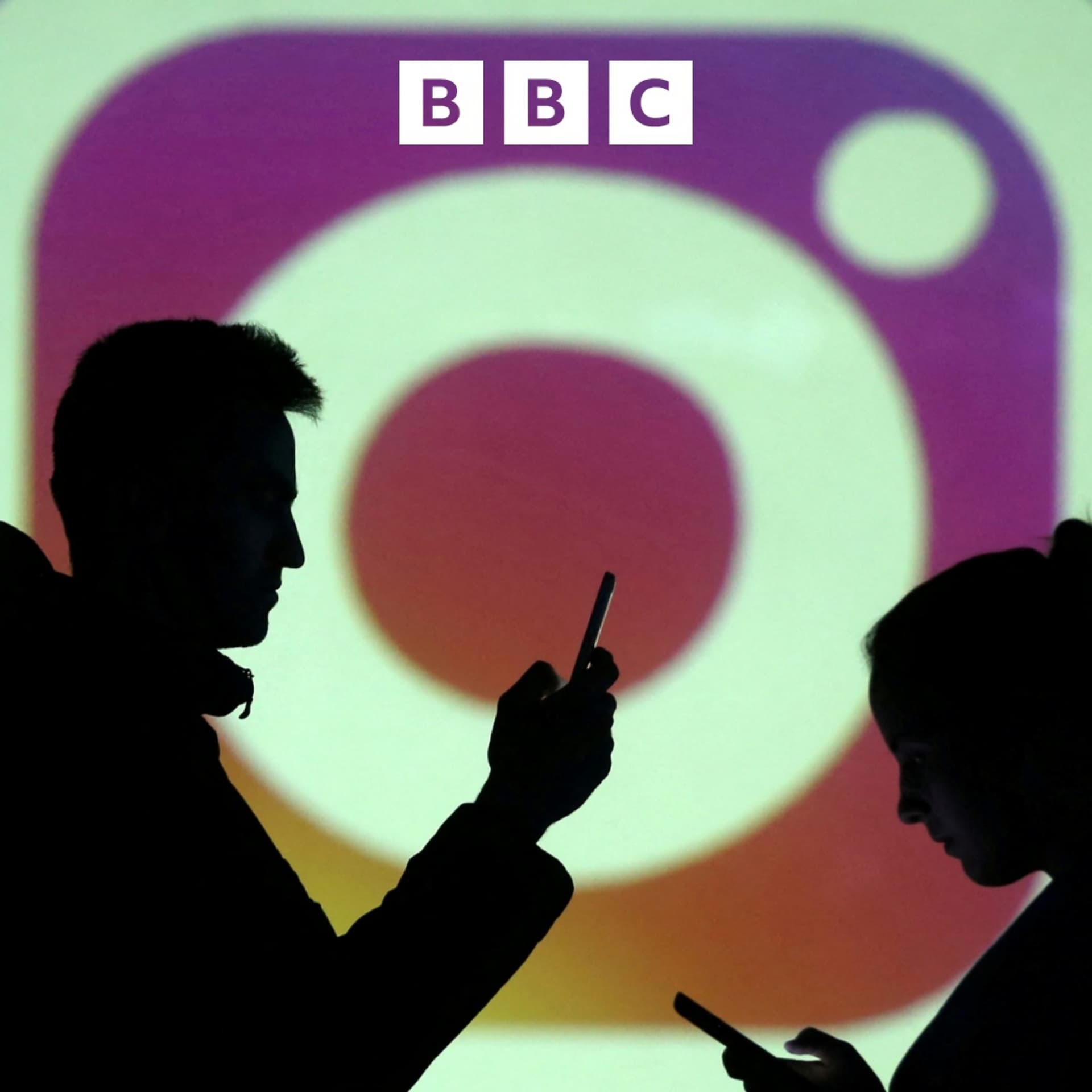
(Image: Silhouettes of mobile phone users are seen next to a screen projection of Instagram's logo. Credit: Reuters)