In short
Tech Life Podcast Episode Summary: The Digital Afterlife Business
Episode Overview
- Podcast Title: Tech Life
- Episode Title: The Digital Afterlife Business
- Presenter: Graeme Fraser
- Producer: Tom Quinn
- Editor: Monica Soriano
- Release: BBC World Service
Episode Description This episode delves into an emerging digital industry that allows individuals to engage with AI-generated likenesses or voices of deceased loved ones, exploring the intersection of technology and grief. It also covers innovations aimed at reducing food waste and the environmental challenges faced by Formula 1 racing teams.
Key Topics Discussed
- Grief Tech and AI Chatbots
- Introduction to Grief Tech: The episode begins with a discussion on AI chatbots known as "griefbots," which aim to help individuals cope with loss by recreating conversations with deceased loved ones.
- Case Study:
- Christy: A woman featured in the documentary *Eternal You* who used Project December to communicate with her late best friend, Cameroon.
- Concerns: The unpredictability of griefbots' responses can lead to distressing outcomes, such as a bot suggesting that a deceased person is in hell.
- Expert Opinions:
- Elaine Casket (Cyber Psychologist): Points out the individual nature of grief, emphasizing that while some may find comfort in griefbots, others might be negatively impacted.
- Justin Harrison (CEO of You Only Virtual): Argues that AI versions of loved ones can provide meaningful connections, drawing from personal experience with his mother's digital avatar.
- Security and Ethical Concerns:
- Elaine Casket: Raises issues regarding data security and the ethical implications of using deceased individuals' data without consent.
- Justin Harrison: Assures that high-level encryption is utilized for data protection in his company.
- Innovations to Combat Food Waste
- Young Inventors Prize: Discussion of a competition promoting technology that supports sustainable development goals, particularly in reducing food waste.
- Interviews with Innovators:
- Luis Chimeno (Asylum): Developed biodegradable smart labels that change color to indicate food freshness, targeting meat and fish products.
- Samuel Moyeta and Sandra Nambuzo (Carpalax): Created biodegradable sachets that release natural compounds to extend fruit shelf life, using organic materials.
- Eco-Friendly Developments in Formula 1
- McLaren's Sustainability Initiative: Overview of McLaren Racing's efforts to achieve net-zero emissions and promote circularity in car manufacturing.
- Kim Wilson (Director of Sustainability): Discusses the creation of a handbook to measure sustainability practices across all Formula 1 teams.
- Use of Recycled Materials: Highlights the integration of recycled carbon fiber into car designs without compromising safety or performance.
- Digital Art Insights
- Digital Art Awards: Introduction to the first Digital Art Awards, including discussions on the blending of traditional and digital art forms.
- Simonida Pavicevic: Co-founder of the awards, elaborates on the definition of digital art and its growing market appeal.
Conclusion The episode concludes with a call for listeners' input on their must-have technology and a preview of future discussions on digital art.
Key Takeaways
- Griefbots are becoming increasingly common, raising both hopes for emotional connection and concerns about ethical implications.
- Innovations in technology are actively addressing global challenges such as food waste and environmental sustainability in high-performance industries.
- Digital art is evolving, blurring the lines between traditional and contemporary artistic expressions, with a growing interest from collectors.
Contact Information
- Listener Interaction: The podcast encourages listeners to share their thoughts via email (techlife@bbc.co.uk) or WhatsApp (+44 330 1230 320).
---
This summary encapsulates the rich discussions and innovative ideas presented in the episode, providing a comprehensive look at how technology is shaping our interactions with grief, food sustainability, and the evolving landscape of art.
Written by AI. May contain mistakes. Listen to the episode to check what was said.
Transcript
Automatic transcript. May contain errors.0:00Welcome to Tech Life on the BBC World Service, the programme about technology and how it affects all our lives. I'm Graeme Fraser This week we are looking at a growing digital industry which allows people to interact in a way with the likeness or the voice of someone they care about who has passed away It involves AI chatbots We'll have more on this in a moment We'll be finding out about two tech solutions to the problem of food which goes to waste and later on the challenge of making a Formula One car more friendly to the environment
0:52We start this week's edition talking about subjects that can be a difficult listen. We'll be discussing some issues around death and grief, one of the most challenging parts of life for us all, wherever we live in the world. If that is something that's hard for you to listen to right now, you might want to come back to us in about five or six minutes time. That's because we're going to discuss grief tech. TechLife's Yasmin Morgan-Griffiths has been looking into this for us. Hi Yasmin. Hi Graeme. Now how did you first hear about this area of tech? Well, first let me play you this short clip from a woman called Christy.
1:27If you had a chance to talk to someone that died that you love, would you take it?
1:37Now, listening to that, you might think Christy's a character from a film about the supernatural. She's not. She's speaking in a television documentary called Eternal You. The film explores a growing digital industry, which allows people to recreate the likenesses of loved ones who've passed away using AI chatbots. I wanted to find out more about why some people buy into the idea that these chatbots might be able to help them in their grief. So we heard that clip of Christy. Tell us a little about her. Well, Christy used a service called Project December to speak, in air quotes, to her late best friend Cameroon.
2:14Here she is again, speaking in the documentary. I was like, they can do that? And it's just like the person? I was like, OK, maybe I should do it. So how do we actually go about recreating a person in AI? That's a good question. There's an increasing number of startups using large language models to create these chatbots, often called griefbots. They're trained on an enormous data set to learn how humans speak, a bit like ChatGPT. But here there's a key difference. Griefbots are trained on the data left behind by a deceased person. For example, text messages, emails or voice notes are all fed into the model.
2:54And so the idea in theory is that when you talk to one of these bots, it will respond to you sounding just like the person who's passed away. The problem is, nobody, not even the creator of the grief bot, has control over what it'll say in a conversation with a user. And this means that for some people, things can get a bit uncomfortable. One of the most shocking examples of this in the film was when Christy asked the chatbot version of Cameroon where he was, and it responded that he was in hell, which as you can imagine was very distressing for her. It was creepy. There were things that scared me and a lot of stuff I didn't want to hear.
3:36So it looks like there's been some risks to consider when using these grief bots. How much can they really support bereaved people through their grief? Well this was the question that I was the most interested in when I first started looking into this. I spoke to two experts. This is Elaine Casket. She's a cyber psychologist who studies how the digital world affects our life experiences. Grief and loss has always been really individual. So if somebody in their own grief is going to use technology, including AI, for person A, that might prove a really helpful, useful, comforting thing. For person B, it might be quite different.
4:17I'm worried about people's vulnerabilities being exploited by for-profit companies who sell the idea, but maybe it's somehow fixing a problem. And grief is not a problem or an illness to be solved. Justin Harrison disagrees with this. He's the founder and CEO of a startup called You Only Virtual. His company creates AI versions of people called called Versonas, and the very first one he created was based on his own mother. I'm now going to call my dead mom and wish her a happy birthday. Connecting to your Versona. I love you and happy birthday. Thank you, baby. I love you too. My mom was diagnosed with stage four cancer.
5:04It became very much this sort of existential crisis. It triggered in me like we've got to do something different about that. And I felt like this is one of the many problems that we're meant to solve. There are moments when only your mom or only your dad can make you feel better. They're the only ones that can say that right thing in the way they would say it to you. And that's an inquantifiable help. I don't think it's out of the realm of possibility to say that in our lifetimes, we're going to see Versona's or Versona-like technology integrated with very realistic robots. And frankly, I'm excited about it.
5:40That's quite a thought. Is that really where we're headed? Well, I think it could be quite some time before we approach anything nearly as realistic as what Justin's describing. Some companies in the Far East, though, like South Korea, are creating strikingly realistic avatars in virtual reality. But the more realistic these grief bots become, the more security risks could come along with it. Here's Elaine Casket again. My concerns go beyond the psychological with this. There's real identity verification and data security issues here. I can't think about replicating the dead without also thinking about things like deep fake technologies.
6:19It's important that we not use the data of the dead who cannot protect themselves to create something to fool somebody's bank or create something to fool or distress someone's relative. We really need to step in and protect it with some kind of global convention for regulation. And this is what Justin Harrison had to say. We use the same, you know, high level encryption systems that banks and other entities that have sensitive data use. But we also give full and complete control to the user. So Yasmin, are grief bots here to stay? Well, whether or not you think grief bots are a good idea, it looks like this technology is going to be with us for the time being.
6:59If you're in the UK, you can watch Eternal You on the BBC iPlayer. I should also mention that you can find advice and support about bereavement at www.bbc.com forward slash action line. Thanks, Yasmin. That was Yasmin Morgan-Griffiths, who's been looking into grief tech for us.
7:26If you were listening to last week's Tech Life, and we hope you were, we were learning about patents and why they're important for inventors well, we've since found out there's a competition underway at the moment called the Young Inventors Prize hosted by the European Patent Office it's aimed at individuals under the age of 30 who contribute to the UN's sustainable development goals using technology 10 sets of entrants have already been awarded the Tomorrow's Shapers status which comes with a cash prize and they're in the running for a final set of prizes to be awarded in Iceland next month. Interestingly, two of the top ten innovators have designed tech to avoid food waste, so we thought we'd speak to both.
8:08First up is Luis Chimeno from Spain. With university colleagues Pilar Granado and Pablo Sosar Dominguez, they set up a company called Asylum and developed biodegradable smart labels to monitor food freshness in real time. Luis told me how it all came about. The interesting story behind the invention is that we meet each other actually during the university while we were studying biotechnology. We lived together in that moment. And the story started in a situation or thanks to a situation that I think most of the consumer has faced at least once, which is going to the fridge. You have a piece of meat that you don't really know if it's good or not.
8:52In this case, it was Pablo's. and yeah the thing was that it has really strange color and strange smell but he didn't have anything else at that moment and it was sunday so everything was closed and he decided to cook although people around me were telling him not to but he did nothing happened and was that moment where where this spark came right like okay how many people would have been throwing this away right this is where the idea came and we thought okay there should be some intuitive way in which we can really understand if we can still eat this product or not. And this is how the whole idea came.
9:31So what is your invention? Well, we wanted something that is intuitive for everyone and that doesn't need any digital or technology itself so that it can be actually accessible for every part or every segment of the population. So we thought, okay, we could think about something that could be intuitive, like a color change, for example. That's how we started the whole idea. And what we invented, it's a biosensor, a smart label. It reacts with different aspects or different properties of the meat in itself, including bacteria. And that interaction with the bacteria is activating a color change reaction.
10:11So the thing is that through the color changes, it starts in a white color. It goes slowly to a dark color with a gray palette of colors. it indicates when the product is still edible, when the product should be consumed soon, and when the product should be thrown away because it's completely black. So this is basically the functioning or how the technology works. And does it just work on meats or does it work on other types of food as well? The technology works on matrices like meat and fish as well, and also products that are kind of pre-cooked or pre-ordered. basically everything that is affected by the certain bacterias that we are detecting on the product.
10:55That's Luis Chimeno, who was speaking to me from Alicante in Spain. The other team who focused on food waste is Samuel Moyeta and Sandra Nambuzo from Uganda. They founded a company called Carpalax and developed biodegradable sashes which extend the shelf life of fruits. Using natural compounds, they hope to help smallholder farms and retailers cut waste while making fresh produce more widely available. Samuel's been telling me about his and Sandra's shared interests. I am personally having a background in civil and environmental engineering and my colleague is having a background in industrial chemistry and chemical engineering, both of us from Macare University.
11:37So we met and basically out of our experience that we shared from our past, We realized that both of us carried similar pain problems of food waste that sparked our kind of working together. So what is your invention? The invention basically is a cup of luck sachet that uses natural biocompounds that are extracted from natural plants. and when placed within a sachet, they are able to be released over a sustained period of time to enable the extension of the shelf life of fruits in a much more sustainable way. So that's the invention that we are carrying and having at the moment. And I believe there are sachets already available that can be packed into fruit boxes to extend their shelf life.
12:28So what makes your invention different from the others on the market? We are offering an organic solution which appeals so much to the hearts of many people that are looking out for things that are organic, things that are derived from nature. And that literally sets us apart from many of the solutions on the market. So what are in-your sachets and how does it work? So how it works is once a sachet is placed within a fruit box that is either in storage or in transportation, it continues and goes on releasing specific bioactive compounds within the sachet or the surrounding of the fruits, either in storage or in display or in transportation.
13:15So they contain a blend of naturally organic volatile compounds. And I could list some of them. we have igno, thymoy, xanol, methyl silicate, and geranoid that, number one, have a natural emission that is released in a vapor form over a period of time. And then number two, there is a microbial inhibition where these volatile organic compounds I've talked about carry a very strong antimicrobial and antifungal properties that end up disrupting microbial cell membranes and inhibit the growth of spoilage mechanisms or organisms that are oftentimes growing around the fruits. Is your sashi already in use by farmers and exporters in the real world?
14:02Yes, yes. We are currently working with a number of farmers and exporters here in Uganda who are actively using this product in the various value chains. My thanks to Samuel Moyeta, speaking to me from Kampala in Uganda. and all 10 teams involved will find out about the final Young Inventors Prize Awards in Iceland next month.
14:34You're listening to Tech Life on the BBC World Service with me, Graham Fraser. Let's say hi to Bob from Kitwe in Zambia. Bob's contacted us on WhatsApp and says, I'm enjoying Tech Life, keep it up. We'll do our best, Bob. You'll know by now we are super keen to hear about the one item of tech you can't do without. And we're still getting responses. Raul Munoz emailed us to say his one piece of tech is barcode technology. He says, I use it every day in my work as a pharmacy technician in Chicago. It's used every step of the way, from ordering, receiving medications, storing, making, delivering and administration.
15:14Raul says we should make a show about it. We need all the ideas we can get, Raoul, so thanks for that. Michael Omugon from Lagos in Nigeria has been in touch. He asks, how can I access recordings of your programme? Should I miss an edition? Well, the good news is, Michael, that you can find Tech Life as a podcast, either from a usual podcast provider, or you can search online for BBC Tech Life, and you'll find our homepage with podcasts available to stream or download. If you want to tell us about the tech you can't do without, or anything else about today's show, you can send us a voice note or a text message on WhatsApp.
15:51Our number, plus 44 330 1230 320 or send us an email to techlife at bbc.co.uk. And still to come, we delve into the world of digital art.
16:12If you like a Grand Prix, you'll be interested in this.
16:20Motorsport fans know all about the amount of tech packed into a winning race car. Often that technology eventually transfers over into ordinary road vehicles, which you and I might use, although they drive slightly slower. Well, Formula One teams are looking at ways of making their cars more environmentally sustainable to meet climate targets. The McLaren team, whose F1 drivers are Lando Norris and Oscar Piastri, have developed a handbook to figure out just how sustainable their cars are. And they're taking the unusual step of shaming it with their rivals. Tech Life's Alistair Keane visited the McLaren Technology Centre in the south of England to see how recycled materials can make a difference.
17:01He's been speaking to Kim Wilson, the team's director of sustainability. So at McLaren Racing we focus on two main things. One is achieving net zero and the other one is circularity. We are the only Formula 1 team to have our targets validated by an external credible party in terms of net zero. That means reducing our emissions by half against our baseline by 2030 and achieving net zero by 2040. So to do that, we'll have to reduce our emissions by 90%. And then we will also have to invest in removals of the excess carbon from the atmosphere for the remaining 10. So that gets us to the net zero point.
17:38in terms of circularity circularity is helping us move from a world where we're taking resources from the environment we're making something and we're throwing it away so we want to close that loop so in doing that what we're doing is making sure that we think about how we recycle our waste how we use less materials take you know getting more from less and how we are using more bio-based sort of materials that go into what we do in terms of manufacture of our car and so now you've developed this handbook. Tell me about that. So we have set ourselves as an ambition to research and develop a circular Formula One car.
18:16Now the reason why that's important is in a world where we have supply chain resilience as a challenge, we have finite resources on the planet and we also want to invest in research and innovation. We want to look at how we can find new materials and recycle more. Now, when we set ourselves this challenge, we realised, well, hang on, how do you measure this? So that's where we've worked with our partner Deloitte to develop a methodology that can be consistently applied, not just by McCarran as a team, but across all Formula One teams to measure all the materials that come into our process to research and manufacture and develop the car.
18:57So it's not just what you see on the car, but it's everything in the factory and the run-up to that and then also what goes out of the factory at the end of the season what happens to all those materials that we don't need anymore and we end up with a metric and that metric tells us what percentage of our car has the qualities of circularity so bio-based materials more recycled content for the input as well as more reuse and recycling for the things going out of the factory and the higher the number as a percentage obviously the better I mean these are the Formula One cars they are highly engineered bits of technology designed for performance what does a circular Formula One car look like?
19:35Well I think there are two things to point out here first of all I'm hoping you can't tell the difference when you look at it it's going to look exactly the same the second thing is it doesn't affect performance we're never in a space where we want to affect on-track performance in the name of sustainability we have as a team pioneered the use of recycled carbon fibre. Now that's 90 % less carbon intensive than virgin carbon fibre and that's something that we've used on some of the panels on the car where it hasn't affected performance or safety or anything like that to prove the concept. And we've also used flax fibre in Lando's seat and that's something that again shows that there are alternatives that you can use that are more sustainable whilst not affecting on-track performance.
20:20In the world of Formula One, there's lots of secrets and teams are competitive and don't want to tell other teams what they're doing. Yet you've created this handbook that you're sharing with other people. Yes. So someone had to start. And it's something that we have done with the permission of our regulator, the FIA. And that's important because we want to make sure that it's all above board. Nobody thinks we're doing this for any other reason than we believe we can innovate. we can be pioneering and Formula One should be giving back to society, as we have done in the past, but in the space of sustainability.
20:56So we're hoping that some novel materials and processes that come out of this approach will ultimately be translated into not only the automotive industry, but into other industries as well. And there's absolutely no reason why that shouldn't happen. That's Kim Wilson, McLaren Racing's Director of Sustainability, speaking to Alistair Keane.
21:23Now, let me play you some sound from a piece of digital art.
21:33I love you.
21:39This soundtrack is from the animated digital artwork called Hands of Time by the artist DK. It was one of the winning submissions at the first Digital Art Awards, which recently took place in London. But what is your idea of digital art? Well, Simonida Pavicevic co-founded the awards and sat on the judging panel. She told my TechLife colleague Zoe Kleiman how she defines digital art. You know, I'm coming from a physical art background and I tapped into digital art a couple of years ago. And digital art is all about the medium. Before it was a brush and canvas, but now more and more artists use digital tools and technology to create art.
22:23And that's why the art is becoming more contemporary and they call it digital. If something is created more by machine than by human, and I suppose you could also relate this to content generated by artificial intelligence, does that shift the definition of the word art? Not really. I mean, first of all, you know, I always say to certain collectors, the machine doesn't wake up in the morning and starts doing art without the human. So this is a purely human machine collaboration, where human directs the machine what they want to do. And the art, digital art that is made using technology as AI and using data, this is basically a digital art.
23:08for most of the collectors, if I would explain to them what they ask me. Is there a big market for it? More and more. We have seen that physical art collectors are merging into digital art. And more and more they're intrigued and they start collecting different... I would say, you know, we specialize in digital art, which is physical art as well. It's digital physical, where you have light boxes, where you have beautiful prints, where you get an NFT with the print, but it's as well physical in a way. So this is an easier way that the collector decides to tap into this direction of art. You've just had the Digital Arts Awards and named your winners.
23:53Give me a flavour of what kind of entries you had and which ones you were impressed with. There were many artists. We had over 250 artists from all around the world applying for this award. And it was a really, really hard task to choose who is the best because they're all very, very creative and innovative. And it was weeks of deciding with 20 people on board who is going to be really a winner. So that was a very, very difficult task. Sounds tough. And yeah, definitely, because they are all absolutely incredible artists. And at the end, of course, for Innovation Award, Maya Petrich won. For Still Image Award, Zach Lieberman won.
Read the full transcript
24:39For Moonbeam Image Award, DK won. And for Experiential Award, Operators won. Can you describe one of them to me? So let's start with Maya Petrich. And she uses Meta and Microsoft. And she creates immersive installations that use light AI and real-time environmental data. So she's basically using the real-time of environmental data showing the changing of temperature on the world. And then you can see the light coming out and coming down. So it's really interesting. It's like a lightbox installation. That was Simonida Pavicevic, co-founder of the Hoffer Gallery and the Digital Art Awards, speaking to Zoe Koiman.
25:27and you can see the digital artworks we've been talking about at www.digitalartawards.io
25:39The clock has beaten us again and we've reached the end of our programme but we'll be back next week. If you've any thoughts on grief tech or anything else you've heard on today's edition please get in touch and we still want to hear about all the tech you simply can't do without. WhatsApp us on plus 44 330 1230 320 or email us at our address techlife at bbc.co.uk Voice messages are also welcome. Today's Tech Life was produced by Tom Quinn, edited by Monica Soriano and presented by me, Graeme Fraser.
26:26you
From the publisher
This week we're looking at a growing digital industry which allows people to interact - in a way - with the likeness or the voice of someone they care about who has passed away. It's not science fiction, and it does involve AI chatbots.
Also on Tech Life this week, we'll be finding out about two tech solutions to the problem of food which goes to waste. Tech Life's Alasdair Keane explores the challenge of making a Formula 1 racing car more eco friendly. And what is digital art ?
We enjoy reading your messages about the one item of tech you simply can't do without. If you want to tell us about your must-have piece of tech, please get in touch by emailing techlife@bbc.co.uk or send us a Whatsapp message or voice memo on +44 330 1230 320.
Presenter: Graham Fraser Producer: Tom Quinn Editor: Monica Soriano
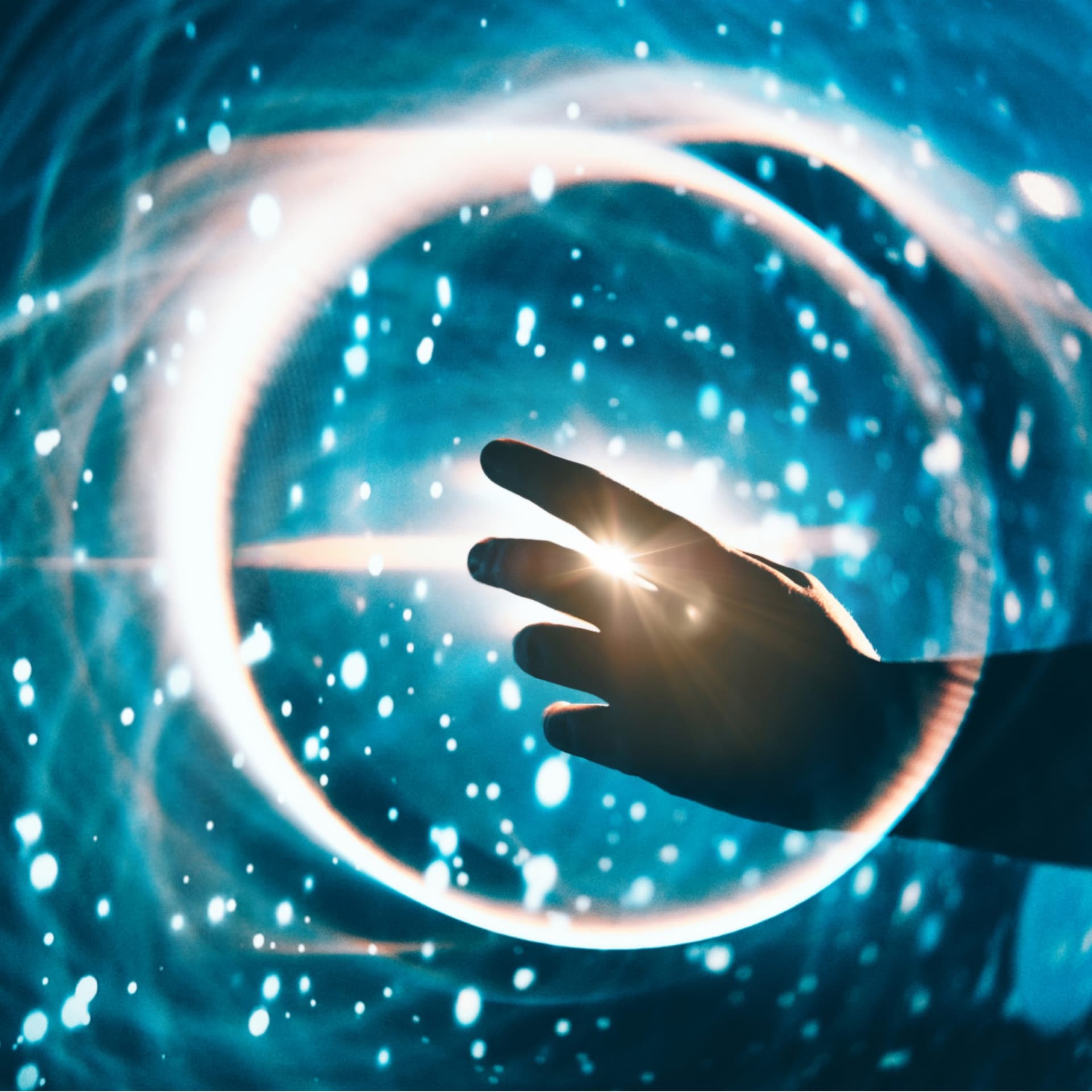
Image: An illustration of a human hand reaching toward the unknown. Science fiction becoming reality. Credit: Yana Iskayeva/Getty Images