In short
Tech Life episode on the future of flying, focusing on electric aircraft for short-haul routes, plus a separate segment on protecting children from online harms.
Guests/backgrounds
Professor Patricia Thornley, UK Department for Transport Chief Scientific Advisor; Simon McNamara, Head of Government and Corporate Affairs at Loganair (Scotland-based regional airline); Kyle Clark, founder and CEO of Beta Technologies (electric aviation company in Vermont); Theo Toroson, psychologist at Save the Children Sweden specializing in children’s digital lives.
Key claims
Aviation electrification is possible but “a long way off,” with best guess 2050+. Loganair expects ~80% operating cost savings from electric trials and plans electric cargo first, passenger flights later, aiming for an electric fleet by 2029. Beta says batteries aren’t fundamentally too heavy; electric propulsion can be 95–98% efficient vs ~30% fuel-to-propulsion efficiency, and routes under 500 miles suit all-electric. Save the Children warns against blunt social-media bans, citing bypassing and loss of trust; instead, design safer platforms for children.
Notable examples
Loganair buying five Beta all-electric aircraft (options for five more); Scotland’s many short flights over water; battery energy density improving 5–7% per year; Theo cites “streaks” and manipulative design choices as drivers of excessive use.
Written by AI. May contain mistakes. Listen to the episode to check what was said.
Chapters
Tap a time to open that second in VOCurrent Events Overview
0:30 to 1:03
Discussion of a recent tragic incident in Iran.
“It's been five months since the deadliest civilian strike of the U.S.-Israel war in Iran.”
Aviation's Shift from Jet Fuel
1:15 to 1:41
Exploration of the aviation industry's move towards sustainable alternatives.
“and technology has a huge part to play, as I've been finding out.”
Electric Aircraft Developments
1:41 to 2:18
Insights on discussions around electrifying aviation and current projects.
“about the best way to protect younger children from online harms.”
Loganair's Electric Fleet
2:18 to 3:17
Overview of Loganair's plan to acquire electric aircraft.
“Electric cars are becoming increasingly common and governments are encouraging drivers to make the switch.”
Interview with Simon McNamara
3:17 to 4:28
Discussion with Loganair's representative about benefits of electric planes.
“Right, Tech Life producer Tom Quinn has stepped out of the control room to join me in the studio.”
Aircraft Specifications and Performance
4:28 to 6:22
Examining the design and operational features of the new electric aircraft.
“But also they are lower cost to operate and that's a very important thing for airlines.”
Charging and Operations of Electric Aircraft
6:22 to 7:21
Discussion on how electric aircraft will be charged and operated.
“But the good thing is that our network is actually very short flights.”
Public Perception of Electric Planes
7:21 to 9:05
Gathering public opinions about flying on electric aircraft.
“get charged once a day or will they get charged before every single flight?”
Challenges Facing Electric Aviation
9:05 to 11:16
Insights from Beta Technologies CEO on the barriers to electric aviation.
“Well, naturally, there's a common misconception that batteries are fundamentally too heavy to fly.”
Future of Electric Aircraft
11:16 to 14:01
Discussing the future developments and ambitions for electric aircraft.
“So here at Beta, we have designed, basically we've wrapped an airplane around a battery.”
Show all 17 chapters
Future of Aviation: Larger Aircraft
14:01 to 15:19
Learn about the ambitions and innovations in building larger aircraft.
“However, we've flown our planes 336 nautical miles.”
Listener Engagement: Feedback and Ideas
16:48 to 17:47
Hear from listeners about their thoughts on electric planes.
“Would you pay to fly on an electric-powered passenger plane?”
Children's Safety Online: Changes and Challenges
17:47 to 20:14
Explore how smartphones impact children's safety and internet use.
“Now we're returning to a subject I've been exploring in recent editions of Tech Life.”
Psychologist Insights on Social Media's Impact
20:14 to 22:30
Get expert insights on how social media affects children's mental health.
“And we should not do that with them online either.”
Designing Safer Digital Spaces for Kids
22:30 to 26:19
Discuss the need for technology to prioritize children's safety online.
“Are you seeing problems with addiction then?”
Practical Advice for Parents on Smartphone Use
26:20 to 27:40
Receive actionable tips for parents on managing children's smartphone access.
“So we know that there are positives as well, right?”
Insight on Migration in Ceuta
28:36 to 29:05
Exploration of the migrant surge in Ceuta and its political implications.
“But what really happened in the tiny Spanish enclave known as Ceuta?”
Transcript
Automatic transcript. May contain errors.0:00This BBC podcast is supported by ads outside the UK.
0:30School ready at Whole Foods Market. It's been five months since the deadliest civilian strike of the U.S.-Israel war in Iran. 120 children killed at a school. Experts say the evidence indicates it was American forces that hit the school. But the U.S. government has not admitted responsibility. I'm Asma Khaled, and I host the Global Story podcast on the BBC. The BBC has now visited the site of the school and spoken to Iranians about what they saw. For more, listen to The Global Story on BBC.com or wherever you get your podcasts. Hello, I'm Shona McCallum and welcome to Tech Life, the programme about technology and how it affects all our lives.
1:10This week we're putting our tray tables up and fastening our seatbelts because we're looking at the aviation industry's gradual shift away from jet fuel and towards less polluting alternatives. and technology has a huge part to play, as I've been finding out. Now, it will take time for the aircraft to get larger and larger and larger and accommodate more and more payload, but that's just an engineering and technical development effort. It's not a fundamental physics challenge. More on that soon. And discussions are going on around the world about the best way to protect younger children from online harms.
1:47I've been speaking to Save the Children, a leading charity that works in over 100 countries about the issues that parents need to be thinking about.
2:13In many parts of the world, a transport revolution is gathering pace. Electric cars are becoming increasingly common and governments are encouraging drivers to make the switch. But look up into the skies and it's a very different picture. Almost every passenger plane is still powered by jet fuel. Recently on Tech Life, my colleague Chris Vallance spoke to the Chief Scientific Advisor at the UK Government's Department for Transport, Professor Patricia Thornley. Chris asked her the big question, will aviation ever be electrified? I think that the rate of pace of change with batteries and electric shouldn't be underestimated.
2:55So I think that it is possible, but I think that it is a long way off. My best guess would be 2050 and beyond. A number of you got in touch afterwards to tell us about electric aircraft projects happening around the world. Well, it seems the pace of change is picking up and one of the latest developments is happening here in Scotland. Right, Tech Life producer Tom Quinn has stepped out of the control room to join me in the studio. Hi Tom, take a seat. Hi Shona, it's nice to join you in the studio. It's very rare for me to be sitting this side of the glass. You're very welcome. So what's the new development?
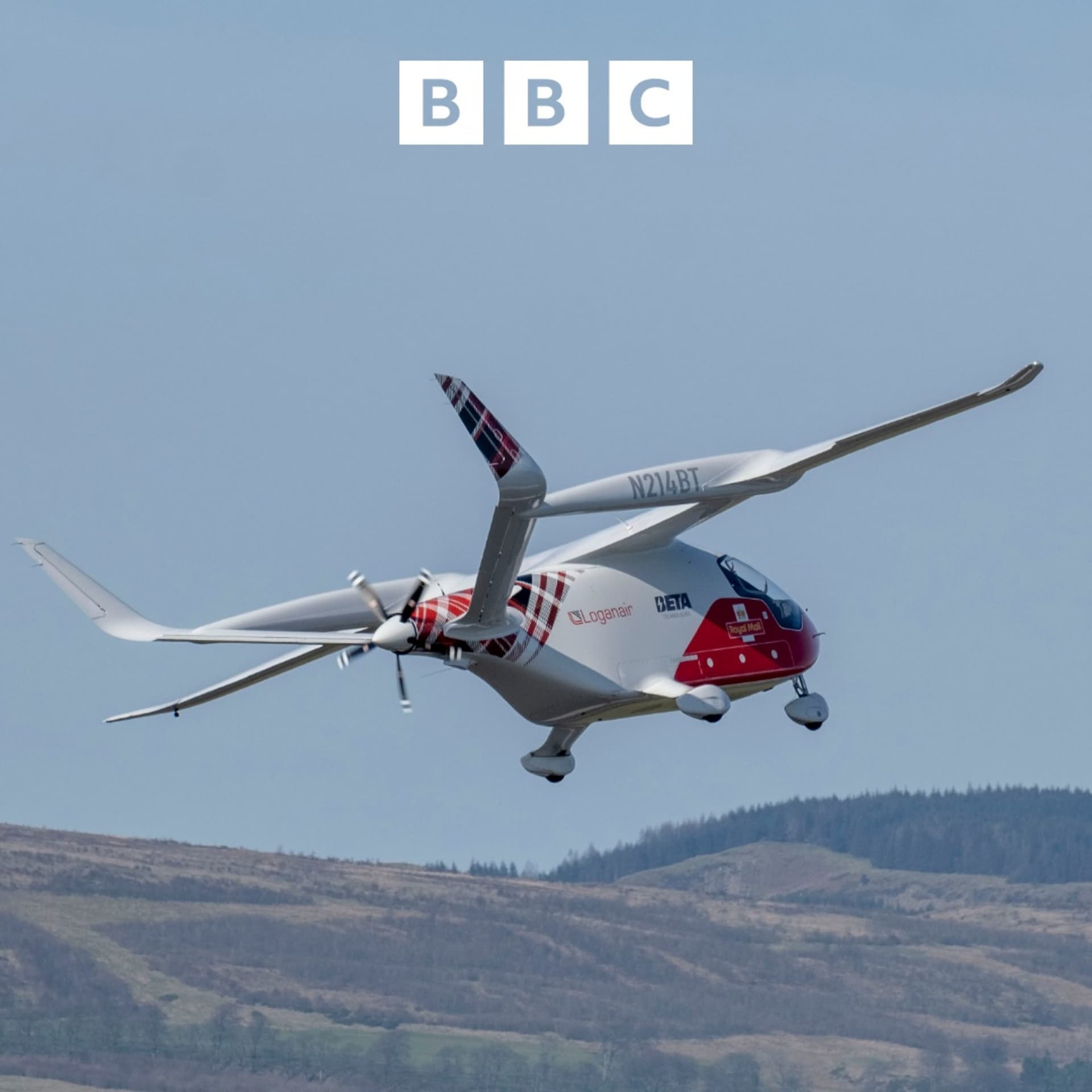
3:33Well, Logan Air is the United Kingdom's largest regional airline, based not far from our studios here in Glasgow and Scotland. The company's announced that it's buying five all-electric aircraft from Beta Technologies. in the United States. And the company has options on five more. The interesting thing, Shona, is that the company aims to become Europe's first commercial airline operating an electric aircraft fleet, carrying cargo and passengers just three years from now. I've been speaking to Simon McNamara, Head of Government and Corporate Affairs at Loganair, and I asked him why they were buying electric planes.
4:13So Loganair is a regional airline based in Scotland. We fly essential flights out to island communities and we have a strong commitment to sustainability and making sure that in the future aviation does what it needs to do to protect the climate. And actually electric have that potential to do that because they will be zero carbon. But also they are lower cost to operate and that's a very important thing for airlines. So tell me about the benefits, the nuts and bolts of the economics. How much of a saving can you make compared to a conventional aircraft? so on the savings so we did a trial of this particular electric aircraft that we're buying we did a trial back in march and we were recording around 80 percent operating cost savings and it's you know it's simple it's it doesn't use fuel it uses electricity so that's cheaper but also it's cheaper to maintain so if you think about electric cars there's far less moving parts there's not an engine there's just an electric motor and they're far simpler to maintain so the combination of lower fuel costs and lower maintenance costs means they're much cheaper to operate.
5:13And critical to cost is size. How big or small are the planes and how many passengers could they fit? It's a very conventional aeroplane to look at. If you look at it you wouldn't think it's unusual. It's propeller powered and it can seat five passengers or 500 kilograms of cargo. Is it one propeller or two? It's a single propeller and it's got what's called a pusher propeller so that pushes the aircraft along and it's driven by, in fact, it's driven by two electric motors, but it's a single prop. Now, there were limited people allowed to actually be on the plane during the test flight, but you saw it take off on land.
5:50Does it behave like an ordinary aircraft? Does it sound like an ordinary aircraft? So it looks like a conventional aircraft, but the difference is that, well, one of the odd things is that when it stops, the propeller stops when it's taxiing along the ground, so it's completely silent when it stops. When it flies it's much quieter as well both for the passenger perspective but also just for the external noise because there is no gas turbine engine there's no jet engine in there driving the propeller it's an electric engine so it looks normal but it sounds very quiet and that's a big difference Now you're a regional airline your flights are short hops rather than big long flights is that the benefit here for using an electric aircraft lots of short regular journeys Yes, because the technology, a little bit like electric cars when they first came, they have a limited range.
6:41But the good thing is that our network is actually very short flights. So 70 % of our flights around Scotland are over water and it's much quicker to fly. So we think that new technology like electric or hybrid electric or even hydrogen will appear first in smaller regional aircraft. So you're not going to be flying off on your holidays to America or to Asia. on an electric aircraft, but you will be taking short hops on regional flights. So we think we're a perfect test case for that. So when your planes start flying in 2029, you're going to start with cargo and then move on to passenger flights.
7:18How is this actually going to work? Will the planes get charged once a day or will they get charged before every single flight? Yep. So we're, as you rightly say, we're starting with cargo and moving to passengers. So the aircraft is a plug-in charge. So if you think of the analogy of an electric car, you plug it in, it charges up. So depending on the range and how far you fly, you might need to charge it for longer. So depending on the length of the route, you could do a round trip without charging or you could charge at your end point. So it would be very much dependent on how far the aircraft flies for how long it needs to plug in.
7:53That's Simon McNamara from Logan Air talking to Tom Quinn. Of course, new technology only succeeds if people are willing to use it. so earlier today I spoke to some ladies near to Techlife HQ here in Glasgow and asked them a simple question would you be happy to fly on an electric plane? How many backup batteries would they have in the back of the plane? I thought they had a proper test for all the what ifs where we passed I would definitely consider it I don't mind planes like the way they are now and if they worked the same I probably wouldn't know any different but yeah as long as it's safer isn't it?
8:30I would take a very short flight to begin with to see how I felt. I think that would be a good compromise. I'd maybe go to sunny Spain and then if it got better then maybe in Morocco. Then further on and further on. I don't really enjoy flying. Yeah, I didn't fly this year. I would do hybrid and I would do electric if it was a short flight. Somebody has to be first to do everything. So I would be first. If they gave me a free flight and a free holiday, I'd be first to try the electric plane. that's the view of some potential passengers about electric air travel the aircraft logan air has ordered is a conventional takeoff and landing plane built by beta technologies the company also makes a version capable of vertical takeoff and landing i spoke to beta's founder and chief executive kyle clark and asked him what's stopping the aviation industry from moving away from jet fuel and embracing electric power.
9:25Well, naturally, there's a common misconception that batteries are fundamentally too heavy to fly. That's not true. We've proven over and over again that we can do commercially viable missions with electric propulsion and batteries. And the regulations in the FAA, EASA, and the CAA in the UK have been catching up. And we are nearing the point at which commercial aviation is going to start using electric airplanes. But is it that fuel delivers more energy for its weight than electric batteries? Yeah, that's unquestionably true. There's more energy in fuel than there is in batteries per weight. However, the conversion efficiency of that jet A or that fuel into propulsion is really poor.
10:14It's like 30 % where when you convert energy stored in batteries to propulsion, it can be upwards to the shaft of 98%, 95 % efficient. So you get a lot of recovery there. But ultimately, the question is not which has higher energy density, is which propulsion and energy storage makes more economic sense for the routes that you need to use it on. And can you explain to me then what does make that sense? Yeah, I mean, really, any route under 500 miles probably costs significantly less to fly all electric than it does with Jet A. And unless you're going for long haul flights, electric aviation is a perfectly viable alternative.
11:02Now, it will take time for the aircraft to get larger and larger and larger and accommodate more and more payload. But that's just an engineering and technical development effort. It's not a fundamental physics challenge. And so tell me about what you're doing then and what's changing. Sure. So here at Beta, we have designed, basically we've wrapped an airplane around a battery. And that battery really defines the configuration of the airplane. And we add electric motors to that airplane in very specific spots. We call it distributed propulsion to allow us to take off like a helicopter, fly like an airplane and land like a helicopter.
11:42which takes the challenge of getting near an airport or to an airport out of the equation. So what we've done is we often say that we exploit the benefits of electric propulsion while respecting the detriments. Electric propulsion will start with high cadence, a lot of flights per day, short flights that are cost sensitive. And are your batteries improving? Is the technology getting better all the time? Well, Shana, you just asked exactly the right question. Jet A will have the same energy density forever, but batteries every year get 5 % to 7 % higher energy density, which equates to more than that in extended range.
12:27When I started this company Beta Air or Beta Technologies about nine years ago, batteries were less than half the energy density than they are today. That means with the same weight battery we're flying more than twice as far. So that's compounding and moving quickly. So energy density getting better. The batteries are also becoming lighter. Can they go for longer as well? Yeah, the energy density can be traded for longer range or a lighter airplane to carry more payload, right? So if you have an energy density of 500 versus 250, you can carry the same amount of energy with half as many batteries, or you can carry the same amount of batteries at the same weight and go twice as far.
13:15So you can trade it for whatever your route needs. Like in Scotland, the routes are pretty short and they want to carry more payload. But if you're out in the Midwestern United States, the routes are longer and you're okay with less payload. So it's a trade. Talk to me about your planes then. Your planes are small. They can carry around five passengers, is that right? That's correct. And about 200 cubic feet of cargo. Can you tell me about the distances they can fly then before having to dock and recharge? Yeah, no, you got the data right. Our initial airplane is six people, so one pilot, five passengers, 200 cubic feet of cargo is about three pallets of stuff.
13:58Now you ask about the range. The typical range of these feeder fleet airplanes is 100, 120, 150 nautical miles. However, we've flown our planes 336 nautical miles. So you've more than doubled the average route of these small aircraft routes. Okay, so what you're describing there are quite small loads. I mean, is the ultimate ambition to make bigger planes or not? 110%. We are building larger and larger aircraft. You know, we just came back from the Farmborough International Air Show in London, where we flew the highest altitude hybrid aircraft ever. We partnered with GE to do this, along with NASA and Boeing, and it was a tremendous success.
14:48But that's the entire direction we're going, and we are involved in several other large aircraft programs, we are pursuing our own large aircraft programs. And that's just a product of product development strategy. We're not going to try and eat the elephant in one bite. We're developing those systems and technologies to build larger and larger aircraft that go further and further across time. That's Kyle Clark from Beta Technologies speaking to us from the company's production facility in Vermont in the United States. And if this story has whetted your appetite, buckle up. We'll have more on the technology that's shaping the future of aviation in the weeks ahead.
15:32Pop quiz. What's in your kid's lunchbox? At Whole Foods Market, they've already done the studying. Over 300 food ingredients are banned from their shelves. No hydronated fats in the peanut butter and no high fructose corn syrup in the cookies. And for sandwiches, there are no Synthetic nitrates or nitrites in any of their deli meat. So you can pack lunch boxes with peace of mind. Get back to school ready at Whole Foods Market. Saving money on your summer project at Menard. Transform your garage with rock solid floor coatings. Complete your project with a showroom quality finish in one weekend.
16:08A one car kit covers up to 250 square feet. Get everything you need to complete your project with rock solid floor coatings. Our knowledgeable team is ready to help bring your dreams to life. one gallon at a time. Plus, check out our weekly flyer on Menards.com for all the great deals happening now. Save big money at Menards.
16:41This is Tech Life on the BBC World Service with me, Shona McCallum. Today we've been looking at electric aircraft and how passenger services are moving closer to becoming a reality. I'd love to know what you think. Would you pay to fly on an electric-powered passenger plane? Would you have any concerns or would it not bother you at all? Right now it's time to say hello to one of our listeners. Joshua Boyado sent us a short WhatsApp message from Accra in Ghana. Joshua, thanks for getting in touch. It's great to know that you're listening to us in West Africa. If you'd like to say hello like Joshua, comment on this week's programme or suggest a topic that you'd like producer Tom and me to explore, then we'd love to hear from you.
17:23You can email us at techlife at bbc.co.uk or send us a WhatsApp text message or a voice note on plus 44 330 1230 320. Please remember to include your name and the country where you're listening from.
17:47Now we're returning to a subject I've been exploring in recent editions of Tech Life. How do we keep children safe online, particularly when it comes to smartphones? Around the world, governments are increasingly looking at ways to protect youngsters on the internet. Some have already introduced restrictions while others are considering them. Australia is perhaps the best known example with legislation designed to prevent under-16s from accessing social media. It's a conversation taking place in homes, classrooms and governments around the world. We've heard the views of parents and teachers before.
18:24Today we wanted to hear from someone working on the front line with families and children every day. What do they make of the changes they're seeing? Well, Save the Children supports young people in more than 100 countries around the world. Theo Toroson is a psychologist at the charity in Sweden where he specialises in children's digital lives. When we spoke recently, I asked him how, from his experience working with children and families, smartphones have changed childhood over the past decade. The biggest difference between smartphones and other devices is that you, well, you carry them with you all the time, right?
19:01And that makes for quite a big difference in the way they're used. So previously, it was a lot easier to set a set of regulations or maybe have a structure for how you use the computer or the console. But with the smartphone, it's a bit different because you can use it all the time. And I would say that's especially difficult for children as they have not fully developed brains. and therefore, you know, it's more difficult to plan ahead, to sort of make long-term healthy decisions and impulse control and all of those things. Are there particular age groups where you see the strongest effects, be it positive or negative?
19:47I would say the effect is different depending on age group, of course, and depending on how you use it. So when we're talking about the children I mostly meet, they would be from maybe seven or eight and upwards. And those are the children that in the recent years have gotten access to smartphones at a quite young age. So we see a bit of a trend now where parents are postponing that a bit. And I think it's because they're realizing, you know, you wouldn't let children that age out in the city by themselves. And we should not do that with them online either. So I would say that for these children, having free access to social media that is meant for older children, that's particularly detrimental, actually.
20:38And the reason I also feel I can say this with confidence is because when I've talked to children older than that, you know, maybe around 18, 19 years old, they would themselves actually say that, no, this was too young. I'm not going to give my child a phone by themselves when they're that young. You mentioned your work Meeting Children. Do children describe themselves on social media as something that's stressful, complicated? What are they saying to you about how they're affected by social media? It's interesting to get that perspective of the older teens reflecting back on how it perhaps affected their self-esteem or their mental well-being.
21:22When they're sort of in the middle of this, so maybe we go back a few years, maybe to around 14 years or 15 years, they describe that they are, well, they actually use the word obsessed themselves, some of them, but it's not only a negative for them. It's a way to sort of describe they are consumed by it and they feel a lot of fear of missing out. and I think when they look at it that's the difficult part because they're not asking us to take this away from them it's it's their whole well for many of them it's a big part of their lives and it's the way it is right now but they have difficulty actually getting to sleep because they feel that if I go to sleep now maybe something will happen I will be outside of my friendship group tomorrow.
22:11I won't be able to talk about that. And yeah, they also, you know, describe that it's a way for them to connect to their friends, to meet new friends. At the same time, as they're saying, they use it more than they want to. So it's a really complicated issue, actually. You mentioned the word obsessed. Are you seeing problems with addiction then? Addiction, behavioral addiction is also a bit of a messy concept. It's difficult to know what an addiction is. We don't have that diagnosis for social media yet, at least. I would say that it's a bit more nuanced than when it comes to other types of addictions, because it's not really like I have to, you know, I need this substance right now.
23:01It's more a way of everything is happening here. And if I'm being left out, I won't be able to participate. Obviously, you work for Save the Children. Does Save the Children take an official policy view on restricting access for children to smartphones or on social media? Well, when it comes to social media, we are quite worried about the bans that are being rolled out right now around the world. because the reason is that we see great risks about the way it's done right now. So to give you an example, as I just said, these children, they spend a lot of their time and lives here and it's the way they are used to.
23:47And we've already seen a lot of examples of children bypassing these systems. And when you do actually bypass a system, like you do something you're not supposed to, that is not a good foundation for seeking help or support from your parents or trusted adults because if you've done something and you should not have been there in the first place why should you go to your parent and and ask them for help at other words because you've sort of there is a breach in trust from the beginning so we are sort of forcing them into when when we do these very definitive bans. And there's also a great risk that they would seek themselves to even more unregulated spaces, actually.
24:34Okay, so what you're saying is if they're banned from social media as it is, they might go to darker places of the internet to get that connection or experience that they are no longer allowed to? Either that or they bypass the regulation. We see in Australia already, it's very difficult to uphold this. And children create new accounts and it's all they talk about. And so what we see is that, say, the children, the most important thing is to create, like we need to create an internet that is designed with children's safety in mind. And what this means is, of course, that the tech has a huge responsibility in doing so in designing spaces that are adapted to children's needs and depending on their age.
25:25And the way it is designed right now, I would say the manipulative design choices make for children to use it more than they want to. To give you an example, like the system of streaks, for example. So maybe you have a streak with a friend. You need to connect to that friend every day in order to get that streak going. And these kind of small design choices, they make for you to return all the time. And it's not really needed to be there, but it's because our children are being treated as a commodity because their attention is something that is very valuable. And so if we were to sort of get rid of these design choices, I am absolutely certain we can create a social media that would be safe for children and that would give them access to what they actually need.
26:17and what they have right to. And that is, of course, you know, connecting to new friends, finding information. So we know that there are positives as well, right? And what would your advice be to parents, practical advice to parents listening about, you know, when to give a smartphone, what boundaries they should set, perhaps conversations they should be having to make sure their children have healthy digital behaviours? I have a lot of sympathy for, you know, it's very difficult to be a parent in this age because the children usually, you know, their friends have it. I should have it. And then it's sort of like a lot of parents I talk to feel the same thing.
27:02So my my advice would be to try and talk to the parents of your your child's friends and see if you can find a common ground. maybe, you know, agree on this is what we think. This is the way we think that our children need to be able to use smartphones. Or if it's maybe, you know, if you're looking at their needs, actually, if it's younger children, maybe they have a need to be able to contact you, but they don't have a need to have free access, full access to the Internet. So then you might be able to find other ways to fulfill that need. That's Theo Taurasen from Save the Children Sweden. and he was speaking to me from Gothenburg.
27:48That's it for today's Tech Life. If you'd like to share your views on how to keep children safe online, I'd like to hear from you. Do get in touch if you've anything to tell us about electric aircraft too. Would you fancy a flight in one? Techlife at bbc.co.uk is our email address, or you can WhatsApp us a text or voice message on plus 44 330 1230 320. Please remember to include your name and where you live. Today's edition was produced by Tom Quinn and presented by me, Shona McCallum.
Read the full transcript
28:35President Trump has described the surge of migrants into Spain as an invasion. But what really happened in the tiny Spanish enclave known as Ceuta? I'm Asma Khaled, and I host the Global Story podcast on the BBC. Last week, tens of thousands of migrants from Morocco streamed into Ceuta. It ignited a political storm in Europe and even here in the US. But who's really to blame? For more, listen to the Global Story on BBC.com or wherever you get your podcasts. Thank you.
From the publisher
The transition from petrol to electric cars is well underway. But why are most aircraft in the skies still burning jet fuel? We look at new developments in electric aviation.
Also this week: keeping children safe online - a leading international child charity talks to Tech Life.
Presenter: Shiona McCallum Producer: Tom Quinn
(Photo: An all-electric CX300 aircraft from BETA Technologies takes part in a demonstration flight in Scotland. It is a small white aircraft, flying at low altitude. The propeller can be seen at the rear of the fuselage. Credit: Loganair/BETA Technologies)