In short
The episode of BBC Tech Life focuses on two tech labor and infrastructure stories plus AI communication advice. First, it examines revelations that Meta’s Ray-Ban smart glasses relied on outsourced data annotators in Nairobi, Kenya, employed by SAMR. More than 1,108 workers were laid off after Meta paused work with SAMR and ended the contract, citing SAMR not meeting its standards. Workers and Swedish newspaper reports alleged they reviewed footage including sexual activity and people using toilets, with imperfect automatic blurring. Meta says contractors review user-shared content with consent to improve product performance.
Guests
Mercy Mutemi, a lawyer and executive director of the Oversight Lab; Naftali Wambalo, former SAMR labeler/moderator and secretary of the Africa Tech Workers Movement. Key claims include outsourcing secrecy and potential retaliation for speaking out.
Notable examples
smart-glasses video of a couple changing clothes; prior SAMR Facebook moderation layoffs and legal action. Later segments feature author Jamie Bartlett on how to talk to AI (hallucinations, sycophancy, paperclip creativity test) and Edward Fitzpatrick (Conflow) on solar lamppost “distributed data centres” in Katsina State, Nigeria.
Written by AI. May contain mistakes. Listen to the episode to check what was said.
Chapters
Tap a time to open that second in VOThe Situation of Kenyan Tech Workers
0:45 to 1:53
Exploring the layoffs of outsourced tech workers in Kenya.
“Today we're looking at revelations about outsourced tech workers in Kenya and we try to find out why more than a thousand of them have been made redundant.”
Smart Glasses and AI Integration
1:53 to 3:38
Discussion on Meta's smart glasses and their reliance on data annotators.
“We hear a lot about the billionaires at the top of the tech industry.”
Revelations from Data Annotators
3:38 to 6:04
Stories of data annotators reviewing sensitive content for AI.
“Starting out as a non-profit, the company has for many years provided much-needed tech jobs, helping to train AI to identify everyday objects by labelling items in photos and video.”
Legal and Social Implications
6:04 to 7:22
Examining the legal issues surrounding layoffs and privacy concerns.
“It's also a mystery to SAMA, who told us.”
Outsourcing and Its Consequences
7:22 to 8:21
Discussion on the implications of outsourcing in the tech industry.
“a non-profit organisation pursuing fair and equitable technology across Africa.”
Impact of Redundancies on Workers
8:21 to 9:46
Understanding the immediate effects of job loss on tech workers.
“We've been told that this is our in route into the AI ecosystem.”
Listener Interaction and Upcoming Topics
11:11 to 12:20
Engagement with listeners and preview of upcoming discussions.
“This is Tech Life on the BBC World Service with me, Chris Vallance.”
Talking to AI: Tips and Pitfalls
12:20 to 14:08
Insights from Jamie Bartlett on the nuances of communicating with AI.
“And still to come, is it possible to cram a data centre into a lamppost?”
Understanding AI Hallucination and Sycophancy
14:08 to 16:49
Explore how AI generates responses and the importance of skepticism when using it.
“How can learning to talk to an AI actually solve the hallucination problem?”
Creative Potential of AI
16:50 to 18:13
Learn about the creativity of AI and how it can generate innovative ideas.
“I mean, actually, these machines are capable of incredible feats of creativity.”
Show all 13 chapters
Testing AI's Creative Capabilities
18:14 to 21:00
Hear a practical test demonstrating AI's ability to generate uses for a paperclip.
“I wonder if we can put this to the test we've got a an AI model on a phone here.”
Transforming Lampposts into Data Centres
21:01 to 22:58
Discover a novel idea of using solar-powered lampposts as AI data centres.
“The online world, from AI systems to online shops, is powered by huge buildings stuffed full of computer servers, otherwise known as data centres.”
The Feasibility of Lamppost Data Centres
22:59 to 26:43
Discuss the practicality and challenges of integrating data centres into lampposts.
“Where would the computer be in the lamppost?”
Transcript
Automatic transcript. May contain errors.0:00This BBC podcast is supported by ads outside the UK.
0:30serious journalists on bbc.com or wherever you get your pods. Hello and welcome to Tech Life on the BBC World Service, the programme about technology and the changes it can bring to all our lives. I'm Chris Vallance. Today we're looking at revelations about outsourced tech workers in Kenya and we try to find out why more than a thousand of them have been made redundant. That's coming up in a moment. Later, are you getting the best out of artificial intelligence. Could changing how you communicate with AI make a difference? I speak to an author and put his recommendations through an AI test. Ah, a fellow gnome enthusiast.
1:13On our snowy volcanic outpost, that paperclip becomes vital for securing tiny hats to resist the wind. And could small computers in lampposts take on the work of a data centre? This man thinks so. This is not a pipe dream. At scale, this is actually a better bet than a data centre. A data centre has to be cooled down. We don't have to cool ours down.
1:53We hear a lot about the billionaires at the top of the tech industry. But on Tech Life, we're keen also to bring you news of tech's less well-known labour force, the outsourced workers on modest salaries on whose backs some of the billions are made. This next story concerns Facebook owner Meta and over a thousand Kenyan workers who at the end of February were told they'd lost their jobs. But it begins with a pair of glasses, smart glasses made by Meta in conjunction with brands Ray-Ban and Oakley. Here's Mark Zuckerberg talking about their latest features at Meta Connect last year. I want to start with these, the next generation of Ray-Ban Meta glasses.
2:42Now these are the original and iconic design. I think that this is actually the most popular glasses design in history. And now with double the battery life. The glasses have a built-in camera and microphones and can answer questions about what they can see and hear using Meta's AI. We've had a pair in the TechLife studio too, demoed by our very own Alastair Keane. So they look like normal sunglasses, but as you might have heard there, I can ask it questions and it will tell me information. They can take photos and also video. And generally they can be an AI assistant in your life. AI integration helps the glasses do cool things, like describe the world to people with visual impairments.
3:29But these AI features of the glasses in part depend on workers thousands of miles away from Silicon Valley, in Nairobi, Kenya. They're called data annotators and they worked for an American outsourcing company, SAMR. Starting out as a non-profit, the company has for many years provided much-needed tech jobs, helping to train AI to identify everyday objects by labelling items in photos and video. Here's the BBC's Dave Lee visiting their offices some years ago. When artificial intelligence works, it sometimes feels like magic, but really what it is is data, lots and lots of data. If you want a self-driving car to know what a person is, you have to feed it loads of pictures of people.
4:15if you wanted to know what a tree is. It takes millions and millions of pictures of trees. That's what's called training data. And it's here where that data is created. So depending on the instructions, you're going to basically tag or annotate items of interest. Okay. Right. From the street to the vehicles, the buildings, even to the sky. Well, that was 2018. Fast forward to 2026 and some data annotators working for SAMA were about to tell journalists from two Swedish newspapers, Svenske Dagblad and Göteborg Posten, an astonishing story. They said they were being asked to review footage captured by MetaSmart glasses.
4:59It included, they said, sexual activity, people leaving bathrooms naked, even people using the toilet. One of the unnamed workers told journalists. I saw a video where a man puts the glasses on the bedside table and leaves the room. Shortly afterwards, his wife comes in and changes her clothes. Those words there, read by a BBC colleague. The workers said faces in the videos were automatically blurred, but it didn't always work. After the revelations, Meta put out a statement saying that When people share content with Meta AI, we sometimes use contractors to review this data for the purpose of improving people's experience, as many other companies do.
5:41Well, following the news, privacy and data watchdogs in the UK and Kenya began looking into the issue. And then, just two months later, came a bombshell announcement. SAMA, the company employing the data annotators, said because Meta had cancelled a major contract, 1 ,108 of its employees would be laid off. Asked if the redundancies were linked to the smart glass reports, Meta told us Last month we paused our work with SAMA while we looked into these claims We take them seriously Photos and videos are private to users Humans review AI content to improve product performance for which we get clear user consent We've also decided to end our work with SAMA because they don't meet our standards But how SAMA failed to meet those standards, Meta has so far not revealed, though we have asked.
6:35It's also a mystery to SAMA, who told us. SAMA has consistently met the operational, security and quality standards required across our client engagements, including with Meta. At no point were we notified of any failure to meet those standards, and we stand firmly behind the quality and integrity of our work. Well, the situation is even more extraordinary because, as Tech Life listeners will know, in 2023, SAMA ended its work to moderate Facebook posts, resulting in over 200 workers being laid off and continuing legal action by former employees, some of whom claimed they were traumatised by being exposed to graphic content.
7:14SAMA later said it should not have taken the work. Mercy Mutemi is a lawyer representing those employees and is also the executive director of the Oversight Lab, a non-profit organisation pursuing fair and equitable technology across Africa. She says the Kenyan government is trying to protect tech firms with legislation to stop them being sued in the country being planned. Meta's statement about why the contract was terminated shows, she says, this is a misguided policy. I would very much like to urge the Kenyan government to read that statement and realize that what we are hedging as our participation in the AI ecosystem is actually a house built on sand.
8:02So you think about how it's all structured that Meta gets to call the shorts, right, of the work. And this is the nature of outsourcing. We cannot deny that. The thing is, the implications are far much dire because we are talking about an entire country's participation. We've been told that this is our in route into the AI ecosystem. This is a very flimsy foundation to build your entire industry on, right? Naftali Wambalo is the current secretary of the Africa Tech Workers Movement. He's been a data labeler and content moderator for SAMR in the past and is a petitioner in the legal cases and is in touch with some of the smart glass workers.
8:47Naftali argues there is another reason for ending the contract. Meta didn't want workers speaking out about reviewing content captured by the smart glasses. I just wanted to chime in on not met our standards. Meta has been working with SAMR, I think, from way back, I think, 2017. until a company of that scale cannot have woken up eight or nine years later to realise that they have not met their standards. What I think the standards they are talking about here are standards of secrecy. Well we put Naftali's point to Meta. They didn't respond to it but they have previously said human review is in Meta's terms of service.
9:28What will the impact of these redundancies be on the workers themselves in terms of their lives, if you like? First of all is they will immediately lose their income, even however little they will lose their income. So beyond the losing their money, there is a shock, the mental aspect of it where it's something that comes abrupt, that maybe someone has been working on that for quite a very long time and then just like kind of an instant accident that happened. And then all of a sudden you're not working on the same data. But also I was saying that there are many, many other effects they are going to suffer, but the immediate effect, the loss of income and to have to deal with the shock of losing their job within a span of seven or ten days.
10:18That is something down. Those are top on the list. And that was Naftali Wambalo of the Africa Tech Workers Movement. Can a royal visit help fix the so-called special relationship between the US and the UK? This week, King Charles is visiting America, but it's a tense moment for the US and the UK. I'm Tristan Redman. And I'm Asma Khaled. And we host the Global Story podcast from the BBC. We speak to the former British ambassador to the United States who knows a thing or two about getting on the wrong side of President Trump. For more, listen to The Global Story on BBC.com or wherever you get your podcasts.
11:11This is Tech Life on the BBC World Service with me, Chris Vallance. Last week, Shona McCallum spoke to Pam Cronrath, whose husband, Bill, died in 2025. Pam had promised Bill a super wake, so she organised a lifelike speaking hologram of her husband Bill for everyone to see and hear at his memorial event. You can still hear Pam's emotional interview via the BBC Tech Life homepage or by finding last week's podcast. Well, Kasuba Sykamo from Zambia heard Pam and Shona and sent us this on WhatsApp. He said, I watch YouTube videos of my deceased father. It's really difficult, but great to hear his voice and see him alive again.
11:57Well, thank you for sharing that with us, Kasuba. And if you'd like to send us a message about anything on today's show, then do get in touch. Our email address is techlife at bbc.co.uk or you can send us a WhatsApp text message or voice note. The number is plus 44 330 1230 320. 0. I'll repeat those details again later. And still to come, is it possible to cram a data centre into a lamppost?
12:30Now, do you regularly chat with a chatbot? Millions of us do for work and pleasure, but we need to be wary. They can behave like sycophants encouraging us to pursue bad ideas. They can just make stuff up or get things wrong. And sometimes they're such good talkers and listeners that we can become emotionally dependent on them. What's to be done? Author and journalist Jamie Bartlett has just published a new book, How to Talk to AI and How Not To. So why do we need to know how to talk to AI, Jamie? Well, because we don't know the exact numbers, but almost certainly over a billion people regularly talk to one of these AIs, these large language models, like chat GPT or Claude or the others.
13:13And most of us, I don't think really know what we're doing. I don't think we understand really how they work. I don't think we know their strengths, their weaknesses. We don't understand the incentives of the businesses. And we're using them in all sorts of ways now, everything from helping with our business ideas and writing our business emails or work, PowerPoint slides all the way to therapeutic advice and even falling in love with them. What are the big pitfalls in terms of talking to AI? We all now roughly know that they do often hallucinate or make errors, factual errors, or make statistics up, or fabricated research papers that don't exist.
13:55A machine can hallucinate for hundreds of thousands of words, it can create entirely fabulous, made-up universes of nonsense in extremely articulate and detailed ways. How can learning to talk to an AI actually solve the hallucination problem? They are, as you say, very plausible inventors of things. So how does the way you talk to them get rid of that? Well I don't actually think you're ever going to get rid of hallucinations because it's just part of the way they're created. You know they are designed to be machines that generate statistically likely and plausible answers and sometimes statistically likely and plausible is not the same as correct.
14:49There are certain little techniques you can use. I mean, if you ask a machine, a large language model to do its sort of chain of reasoning when it answers and explain how it's reasoned to get to an answer, some evidence suggests that reduces the hallucination rate, but doesn't eliminate it entirely. And some of it is just having a baseline level of scepticism. I mean, I've found personally that when you go on there, and I think a lot of people do this, kind of half already know what you want the machine to tell you. hi uh hi uh one of the large language models i needed i need some evidence to prove that x y and z happened and it gives it to you uh you should be very very skeptical about that i suppose also as part of that there's there's the problem with sycophancy isn't there and you know we've had warnings about this including warnings from the government's ai security institute not so long ago about being aware of its desire to please its users, or rather I should say that it's been programmed to try and please its users because obviously that makes users more likely to stick with it, if you like.
16:00So, I mean, how do we deal with sycophancy? It's partly just the product of a training system that almost inadvertently has created that. So, unfortunately, these machines in their post-training phase, a lot of humans go through answers and give them sort of thumbs up or thumbs down to be very simple. Humans like answers that agree with them, unfortunately. And so the model sort of learned that and it's learned that in its training data as well. Every single model has been shown to be sycophantic. And obviously, it's quite risky to be surrounded by a brilliantly intelligent, super fluent machine telling you what you want to hear.
16:36And so here's a little piece of advice. unfortunately if you think you've got a brilliant idea a new business plan or a piece of writing you've done and you think it's brilliant and the machine tells you it's brilliant just be very skeptical about that in terms of actually getting useful output from an AI I mean you spoke about that there were things that you could ask them there were uses that it that are quite valuable what's your sort of tips for for that kind of conversation I think one of the things people don't seem to fully have grasped yet. It's just how creative they are. I mean, actually, these machines are capable of incredible feats of creativity.
17:16There's a famous creativity test about asking people how many uses they can come up with for a standard paperclip. And, you know, we might come up with half a dozen. They could come up with thousands and thousands, and many of them far more creative than anything I could imagine. And if you ask a machine, for example, to input two completely unrelated ideas or concepts or words, it will find a creative relationship between them. Now, you might think that's pointless, but if you're trying to generate new business ideas or you're struggling with writing and you can't come up with ways of connecting thoughts, they can actually be incredibly useful.
17:52And they are brilliant debaters. They can out-debate humans often. So if you want to test your ideas against a debater and you take that exercise seriously it could actually really open your mind to certain ideas and thoughts and all of those things come with caveats and problems but used carefully they can be very very helpful. I wonder if we can put this to the test we've got a an AI model on a phone here. Sure and the thing is the great thing about these models is that if you the more you can strain it by giving it limitations, the more creative it becomes. So if you create a bizarre persona for it to play, literally as weird as you want to make it, and then ask it to come up with as many uses for a single standard issue paperclip as it can, it will come up with stuff you'd never have dreamt of.
18:47Okay, well, let's give it a persona of somebody very good at inventing something. So let's say, hi, I'd like you to imagine that you are an entrepreneur like Elon Musk with discoveries, developments, inventions in various fields from orbital rockets through to electric vehicles and robots. Can you give me possible uses, alternative uses for a paperclip? As an entrepreneur, you see potential in everything, even the smallest tools. So here's a list of uses for a paperclip. As a reset button presser, a lock pick, a makeshift zipper pull, an emergency hemlock. Need more ideas or do you want to focus on a specific area?
19:36Well, perhaps you could imagine that you are a person obsessed with garden gnomes who happens to live on a very small volcanic island near the South Pole. Could you suggest some uses for a paperclip? Ah, a fellow gnome enthusiast. On our snowy volcanic outpost, that paperclip becomes vital for securing tiny hats to resist the wind, etching custom little designs on new gnomes. Are there any particular gnome emergencies you need to solve? Well, one would be how to find a supply of paperclips. Ah, well, that's a challenge. Perhaps they wash ashore from shipping lanes, or you might find them among Old and Mesearch Station.
20:22That could be a goldmine. If not, you might have to resort to bartering with the penguins. Are you seeing any potential sources nearby? No, but thank you very much for your thoughts. It could pretty much go on forever. Yes. In this vein. And again, I would struggle to come up with anywhere near that number, even at the time. It could come up with another thousand if you wanted. That's the author Jamie Bartlett there. And if you've a tip-top tip for chatting to AI, do talk to us. All responses are read by human beings. Well, for now, anyway.
21:01The online world, from AI systems to online shops, is powered by huge buildings stuffed full of computer servers, otherwise known as data centres. Over the years, to minimise the environmental impact, people have proposed putting data centres in all sorts of places, from under the sea to outer space. But what about putting them in solar-powered lampposts? Yes, you heard me right, lampposts. Well, that is the bright idea the government of Katsina State in Nigeria is getting behind. They've signed a deal with the British firm Conflow to deploy 50 ,000 eye lamps, the firm's solar-powered smart streetlights, that can double as a distributed AI data centre, or so the company says.
21:44The idea is that each light will contain an NVIDIA Jetson GPU drawing 15 watts of power, link them up, and a road might become a kind of spread out data centre. To illuminate the promise and the pitfalls of this idea, I spoke to the boss of Conflo, Edward Fitzpatrick, at an appropriate outside location. Now we're in a street in central London and like streets everywhere, right next to us is a lamppost and for decades lampposts have been doing one thing, providing us with light, but your company thinks they can also become data centres. How's that going to work? Okay, so we put a computer chip, a GPU, more commonly known as a GPU inside the streetlight.
22:32It's powered by solar, so it's also autonomous. It also makes it no single point of failure. It also makes it on the edge where you need the compute. And we can do enormous amounts of compute. So scaled, at scale, we're comparable to a 20-megawatt data centre. OK, well, let's talk about this. Let's imagine, because your data centre streetlights have been deployed. They're not deployed here in central London yet. I'm afraid not. But let's imagine this were one of your data centre lampposts. So how would it work? Where would the computer be in the lamppost? Okay, so the computer would go inside the housing that you see at the bottom of the streetlight.
23:10So inside there we have an access point there, and we also have an access point here. And then inside there's a whole rack that takes you all the way up to the solar unit. The solar unit's not flat, it's circular. So there's a solar panel on top providing the power? Yeah, the solar panel starts about here and goes all the way to the top. then there's a light on top of that. The thing is data centres are absolutely massive. You've got one lamppost with one small computer inside it. So how does your lamppost compete with those giant warehouses full of computers? So it's at scale. So if you were in America they have 27 million streetlights.
23:46If they replaced all of those with an eye lamp then they would have the biggest data centre in the world by an order of magnitude and not even China could catch them with 45 nuclear power stations because we're at scale. So if I can put one GPU in there and then another GPU in there, now I've got two sets of 275 tops. That's trillions of operations per second. That's the genius of NVIDIA. So NVIDIA is the company that's created a small enough chip powered with 15 watts of power so it can be powered by solar and we can put that inside a streetlight because it's yay big. But is there any market for a data centre that only works when the sun's shining?
24:26I mean, how does it keep operating? Yeah, I mean, we don't have a problem with the sun shining. We only need ambient light. The solar panel is circular, so it's a cylinder solar panel, so it gets morning and evening light, and we're obviously putting them in environments where they're sunny. Why there's none here? You know, because even in London, that lamppost probably wouldn't work because it's not getting any sun. It's got a building right next to it, so we're not putting it in places where it just won't work. we can put our streetlight on the grid so it can have solar as primary and grid as backup how do you get information into and out of it because one of the other things about a data center is it's all in one place so you can have a really fast internet connection you know you're thinking of data centers that are effectively sort of strung out along a road or several roads that's actually an advantage to us because right now if you're using ai in bbc headquarters here your data is maybe going to Seattle and coming back.
25:21It's going to the cloud and back. We don't need to go to the cloud because it's being processed on the unit. So all processing is happening on the unit. That means it's on the edge. So a term in the industry is on the edge. So if the processing is done on the edge it's safer from a latency perspective or it's better from a latency perspective but it's also safer from a security perspective. You mentioned security. I mean these processing units are worth a fair bit of money. what's to stop somebody coming along with an angle grinder and sort of obtaining an nvidia gpu what we're doing to do to combat that is we simply make the gpu fried if someone takes it out incorrectly now maybe i shouldn't have told you that because but but it's kind of like a little secret because if it's worthless they're going to stop stealing them obviously we have anti-tamper devices and all of those things to help that but it is a concern surely letting people know that the GPU will be worthless if it's taken out is to your advantage.
26:18You make a very good point. You make a very good point here. That's Edward Fitzpatrick there. Well, were you convinced? Some experts we've spoken to point out that there's a reason for big data centres and that the streetlights aren't powerful enough and wouldn't communicate with each other fast enough to be useful for applications like training AI models. But they also point out there could be a role for them in less demanding applications. Well, what do you think? Is it a light bulb moment or a road to nowhere? Do let us know.
26:55Well, the not at all smart light in our TechLife studio is flickering. That could mean it's the end of the show or someone's forgotten to pay the bill. If you want to contact us about anything, and we especially want to know how you talk to AI, then here are our details. Email techlife at bbc.co.uk or WhatsApp us on plus 44 330 1230 320. Please include your name and where you live. Today's edition was produced by Tom Quinn and presented by me, Chris Valance.
27:40Can a royal visit help fix the so-called special relationship between the US and the UK? This week, King Charles is visiting America, but it's a tense moment for the US and the UK. I'm Tristan Redman. And I'm Asma Khaled. And we host the Global Story podcast from the BBC. We speak to the former British ambassador to the United States, who knows a thing or two about getting on the wrong side of President Trump. For more, listen to The Global Story on BBC.com or wherever you get your podcasts.
From the publisher
We look at revelations about outsourced tech workers in Kenya, and try to find out why more than a thousand of them have been made redundant.
Also this week: are you getting the best out of artificial intelligence? Could changing "how" you communicate with AI make a difference? We speak to an author and put his recommendations to an AI test. And we hear from a company turning lamp-posts into data centres.
Presenter: Chris Vallance Producer: Tom Quinn
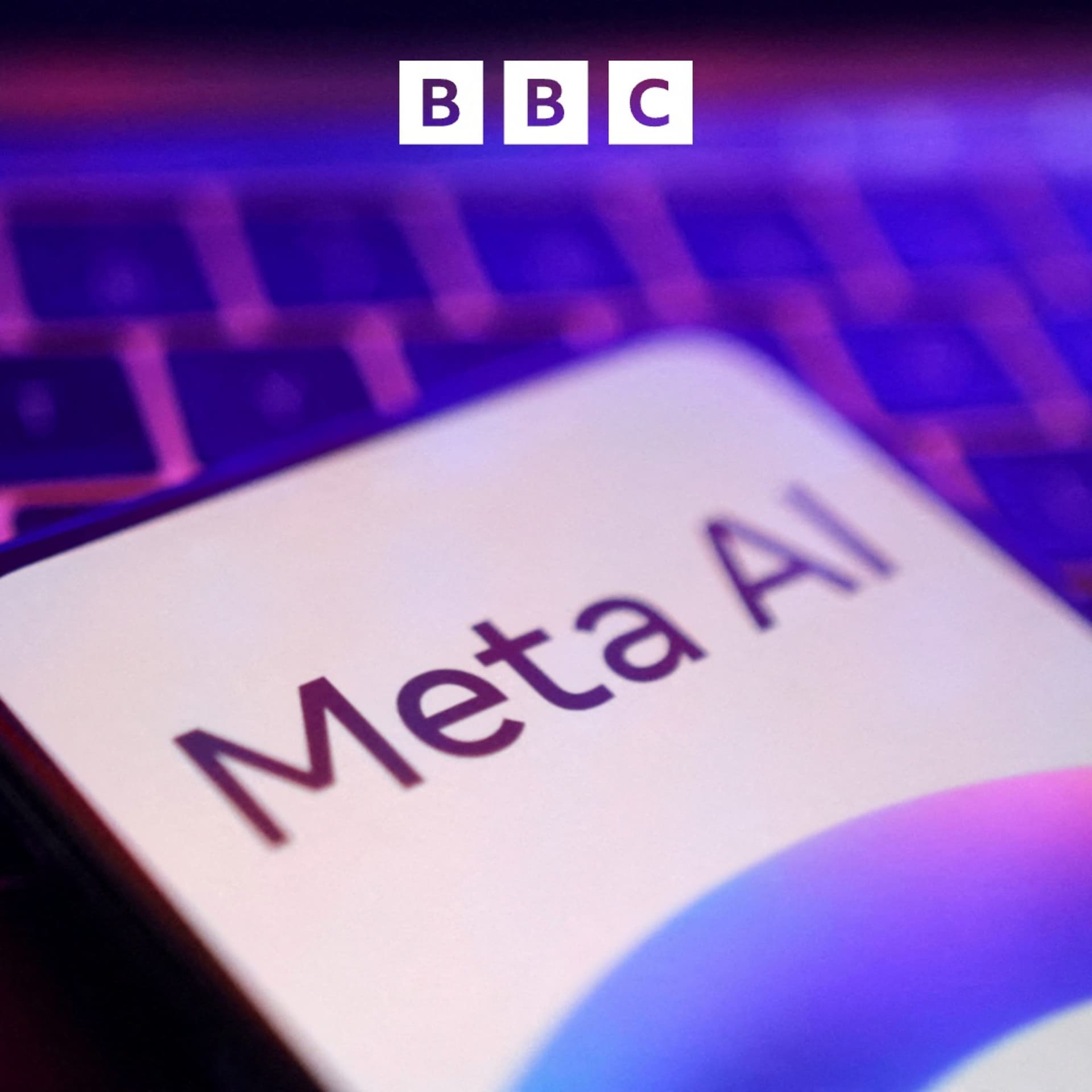
(Image: The words "Meta AI" are displayed on a smartphone screen. The phone is resting on a laptop keyboard. Credit: Reuters)