In short
Tech Life episode “Viva technology!” covers Shona McCallum’s reporting from VivaTech in Paris and a later interview on data centres. Topic: VivaTech’s 10th anniversary themes, AI’s concrete applications, and standout demos (AI fridges, scalp/skin health scoring, AI perfume design).
Key claims
VivaTech’s Managing Director François Bithouzet says this year focuses on practical AI across ~30 sectors; Jeff Bezos argues AI will accelerate invention and create labor demand, not redundancy, via his venture Prometheus for faster physical manufacturing.
Notable examples
Bezos on quantum computing and robots; Klaus van der Boekert (IBIS) demos smartphone at-home visual acuity testing for triage/monitoring; Otman Cheeheb (HABS) describes emotion-reading via a headband and neural AI, with healthcare/training uses.
Guests
François Bithouzet (VivaTech MD), Jeff Bezos (Blue Origin/Amazon founder), Klaus van der Boekert (IBIS CEO), Otman Cheeheb (HABS CMO), Andy Power (Digital Realty CEO).
Written by AI. May contain mistakes. Listen to the episode to check what was said.
Chapters
Tap a time to open that second in VOExploring Viva Tech
0:41 to 1:18
Overview of the excitement and significance of the Viva Tech conference.
“Hello and welcome to Tech Life, the programme that explores technology and how it's shaping your world, wherever you are.”
Challenges of Data Centers
1:18 to 2:20
Discussion on data centers and the challenges they face in today's world.
“They're huge, they're hungry for power, for water and they don't always win friends locally.”
François Bithouzet on Viva Tech
2:20 to 4:12
Interview with François Bithouzet about the evolution of Viva Tech and its themes.
“Now in its 10th year, it's one of Europe's biggest tech conferences.”
Jeff Bezos at Viva Tech
4:12 to 6:27
Jeff Bezos shares his vision on AI, space exploration, and its impact on labor.
“One of the highlights for many people was seeing the French President Emmanuel Macron and the Indian Prime Minister Modi.”
Germany's Spotlight at Viva Tech
6:27 to 7:42
Focus on Germany's participation and innovations showcased at the conference.
“So a more positive take on AI than I've heard in a long time, and certainly at odds with some of the other political figures on this topic.”
Innovative Eye Testing App
7:42 to 11:29
Interview with Klaus van der Boekert about a new app for vision testing at home.
“Now, one of the things I really like about VivaTech is that each year it puts a different country in the spotlight.”
AI and Emotion Tracking Technology
11:29 to 13:35
Discussion about the interaction with a humanoid robot using thought tracking technology.
“Elsewhere I witnessed huge crowds gather in front of Unitree's humanoid robot experience.”
Electric Aviation Innovations
14:38 to 15:46
Discussion on emerging electric aircraft trials in the UK and Canada.
“If you were listening to last week's show, you'll have heard Chris Vallance talking to the Chief Scientific Advisor to the UK Government's Department for Transport.”
The Importance of Data Centers
15:46 to 16:14
Exploring the critical role of data centers in modern life.
“you can email us techlife at bbc.co.uk is our email address or you can whatsapp us a text message or a voice note.”
Interview with Digital Realty CEO
16:14 to 20:43
Insights from CEO Andy Power on the challenges and advancements in data centers.
“Data centres need a lot of electricity to keep thousands of computers running around the clock.”
Show all 11 chapters
The Future of Data Centers
20:43 to 26:42
Discussion on the long-term future and sustainability of data centers.
“So 300 data centers, one's the biggest in the world, and our water consumption, because of how we've invested in our data centers, uses less water than 18 California golf courses.”
Transcript
Automatic transcript. May contain errors.0:00This BBC podcast is supported by ads outside the UK.
0:30be good. Listen on bbc.com or wherever you get your podcasts.
0:41Hello and welcome to Tech Life, the programme that explores technology and how it's shaping your world, wherever you are. I'm Shona McCallum. Today I'm taking you to one of Europe's biggest and boldest tech gatherings. It's the place where shiny new ideas, big promises and the occasional head scratcher all collide. And I'll admit it, I love nothing more than wandering a vast convention centre hunting for what's new, what's clever and what might soon be landing in your life. So brace yourself for the noise, the colour and the sheer scale of Viva Tech. That's coming up. And later, data centres. They're huge, they're hungry for power, for water and they don't always win friends locally.
1:27I'll be talking to the boss of a major international data centre company about the growing challenges facing the industry and what they say they're doing to tackle them. I think there's so many things that the average person just may take for granted but wouldn't be happening without our data centers.
2:03Right, it's been a few weeks since I last hosted TechLife, and there's a very good reason for that. I've been out and about talking to fascinating people, from scrappy tech startups to global CEOs and quietly stockpiling stories that I'll be bringing to you very soon. Just last week, I was at Viva Tech in Paris. Now in its 10th year, it's one of Europe's biggest tech conferences. And honestly, this is where tech really comes alive, out on the show floor, seeing ideas up close and meeting the people building things that may well end up shaping all of our futures. I saw AI-powered fridges that warn you when your food's about to go off.
2:43I tested a device that scans your scalp and skin and gives you a health score complete with product recommendations. And I even watched an AI experience design a personalised perfume through a live chatbot conversation. But first, I managed to catch up with the man who started it all. I'm François Bithouzet, Managing Director of VivaTech. 10 years of VivaTech. Tell me about what it's taken to get to this moment? Ten years ago, it was nothing. Nobody believed that it could happen once. Nobody thought it could happen twice. And now it's the 10th anniversary. So it's a great moment. What themes are you seeing emerging at this year's conference?
3:22This year it will be about concrete application for AI. In something like 30 business sectors, it can be banking, health, it can be insurance, luxury, etc. we will explore how AI is really concretely changing the game. For instance, the way we work, the way we produce, the way we sell. And what are you most excited about? Any kind of favourites? My adult brain is crazy about quantum computing. And so you will see at UlaTech, Candelavra. So it's an amazing quantum computer. And my, I would say, kid brain is crazy about robots. and you will see a lot of them and they are amazing. More than 180 ,000 people from all over the world were in Paris for VivaTech and the geopolitical significance of the sector wasn't lost there.
4:16One of the highlights for many people was seeing the French President Emmanuel Macron and the Indian Prime Minister Modi. But by far the biggest crowd I saw was for this man. A remarkable entrepreneur who started the simple idea of everything in store online with books, and you know what happened with Amazon. Now flying rockets to new frontiers, and step by step, they are building a new road to space with Blue Origin. Please join me in welcoming to the VivaTech stage founder of Blue Origin, Jeff Bezos.
5:03Of course, Jeff Bezos talked about the space race and his long-term vision for space exploration, including how humans will go to the moon to stay, not just to visit. He also made it clear that he believes tech will unlock new opportunities and increase demand for human labour, not shortages. I know there's a lot of concern that many people have, including many smart people, that AI is going to make humans redundant and so on. I totally disagree with this point of view. And I think, in fact, AI is going to create a labor shortage because it's going to make it possible for people to identify more problems.
5:42We have an endless set of things to invent. And we are only limited. Today, we are limited not by our imaginations, but by what we can actually do. I promise you every single person in this audience has had an idea for a new business or a new product or a new device that they wish they could manufacture. And that idea stayed in your head and went nowhere. And the reason it stayed in your head and went nowhere is because it's too hard to do and it wasn't worth it. And if we can accelerate the dream build loop, all of the ideas will then become possible. And then we end up being limited not by our capabilities, but by our imaginations.
6:27So a more positive take on AI than I've heard in a long time, and certainly at odds with some of the other political figures on this topic. Mr. Bezos was also speaking about his new AI venture, Prometheus, which is focused on accelerating physical manufacturing, a sector which is becoming increasingly automated. Here's a flavour. Prometheus is building a set of tools that's designed to empower engineers to really invent and build much, much faster. If you take a step back, broadly, civilizational wealth, all of civilizational wealth is driven by invention. 6 ,000 years ago, somebody invented the plough and we all got wealthier.
7:18And then much later, somebody invented the steam engine and we all got wealthier. And this cycle continues. And if we can accelerate that cycle, that dream build cycle, it will create real productivity, real prosperity. So that was Jeff Bezos, founder of Amazon and Blue Origin, speaking on stage at Viva Tech. Now, one of the things I really like about VivaTech is that each year it puts a different country in the spotlight. This year, it was Germany's turn. More than 200 startups from the region descended on the show floor, effectively taking over a huge section of the hall, decked out in German flags, logos and no shortage of companies competing very hard for my attention.
8:05And one in particular quite literally caught my eye. Now, if you're a regular Tech Life listener, you'll know I'm especially drawn to health tech. And this one is an app that tests your vision. I love seeing practical tech tackling real health care problems. Check it out. I'm Klaus van der Boekert. I'm CEO of IBIS and we do visual acuity testings on your smartphone at home. OK, great. So interesting health innovation. Tell me a little bit about the backgrounds to your company. We saw that there's a huge lead to digitalised eye examinations for multiple reasons. You can use it for triage to get a quick specialist appointment if you need one.
8:48You can use it to monitor chronic eye diseases. You can use it to monitor your glasses, see if you need reading glasses or whatever. Because this system, you have so long waiting times for specialist appointments. We think we can alleviate the burden for that. Tell me a little bit about eyesight then and how crucial it is to getting this diagnosis because it's such a vital thing for humans, isn't it? If you ask patients to choose what you want to lose, they usually say eyesight last because it's so vital in your daily life. Without that, you don't have any orientation. You're basically left on your own.
9:24I come from a research university. we know that there's some very severe chronic eye diseases that will deteriorate your vision that is for example age-related macular degeneration we have that on people age 65 and above and that can actually need to completely block complete blindness so you cannot read anymore you cannot drive anymore you cannot do your grocery shopping so forth we want to create easy monitoring solutions. Am I still good? Do I need to go to the doctor again? Easy to do on our smartphone. Pretty much everybody has a smartphone at home. So yeah, why don't do it on there? Okay, ideal.
10:04So you're going to talk me through the technology. Tell me about the objective then of what I'm going to be doing now. We do several eye examinations. It starts with a simple visual acuity assessment. You will know that from your optician, your optometrist, your eye doctor, where usually you have a reading chart and you will read numbers and they get smaller and smaller. You can also do that on a phone. And the beauty in it is the phone can see that you're doing it right. So you always need a fixed testing distance. So you just hold your phone closer to cheap. The software will recognize that and adapt for that.
10:42Usually you just test one eye at a time, right? So we'll check that you're closing the other eye. and if you start peaking it will also abort the test so we could actually show that these measurements that we do that way they're just as reliable as if you would do it at your local optometrist okay so there's no cheating allowed because the tech doesn't allow that to happen you can try okay well i might try okay so that is actually very nice it says your visual acuity is 125 % that is an excellent result. Most young people are in between 100 and 125%. So at least both eyes combined they're working perfectly.
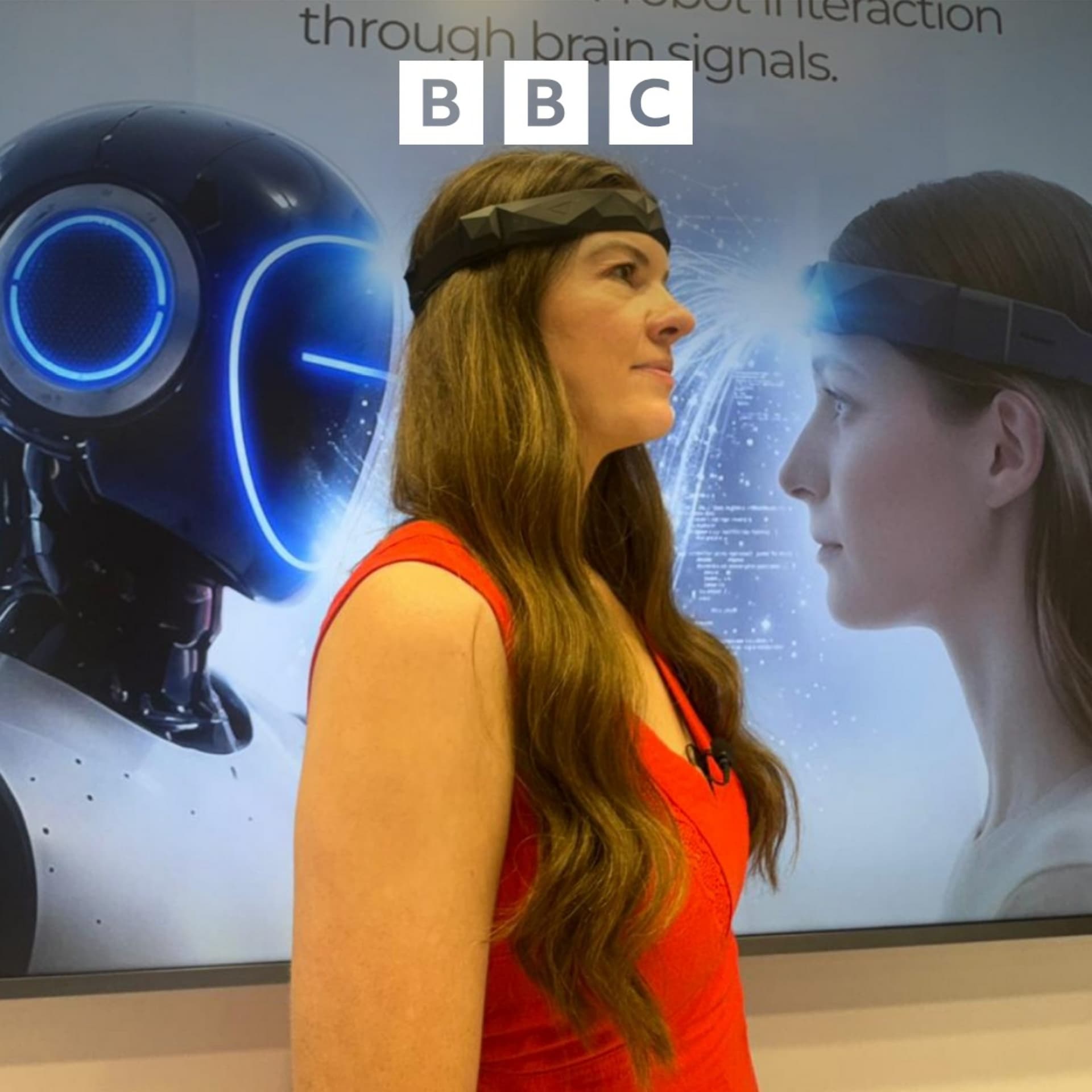
11:25So we know that both of my eyes are working perfectly. Elsewhere I witnessed huge crowds gather in front of Unitree's humanoid robot experience. It's the latest venture with French neuro AI company HABS. That's short for Human Augmented Brain System. Now, brace yourselves for this one, as it really did blow my mind. I was able to interact with one of their robots using my thoughts rather than speech. This was all done via a headband, which I put on around my temples. The headband uses small metal probes called electrodes that touch the scalp and are packed with sensors and it was able to track my emotions.
12:08It works by capturing signals from my body, such as my eye movements, and transforming them into cognitive data. Opman Cheeheb is their chief marketing officer. He can explain. Your brain is emitting continuously electric signals and an emotion is a combination of electric signals and not only brainwave but also neurophysiologic. Your eyes are evolving, your respiration, etc. Our neural AI have a clear understanding on what are the brainwave signatures corresponding to each emotion. And once our neural AI detects this signature, it measures its intensity. So for example, the focus, we know exactly how your brain reacts to focus.
12:50And once our AI detects it, we are able to measure it. So for example, this is an experience that we have with energy music, where people listen to music and in real time, we measure the intensity of six emotions. on this. So as we have a better understanding of how they feel about the music. And once all this data has been gathered, there are some real use cases. So to give you an example of the usage, for example, in a healthcare industry, we have the potential to measure the pain level of a patient that cannot express himself. Or in the training purpose, our neural AI is able to measure in real time the focus or the cognitive clarity or the stress in real time, because we know that we cannot improve what can be measured.
13:33That was Otman Cheheb, the Chief Marketing Officer from HABS. So that's just a tiny flavour of what I witnessed at VivaTech in Paris. I hope you enjoyed it. As ever, if you have any questions, don't hesitate to get in touch. Our details are coming right up.
13:53Every story is a technology story in one way or another. And on the interface, we decode the tech that's rewiring your week and your world. On this week's episode, we look at the UK's teen social media ban and ask what happens next? Why are AI companies so interested in nuclear fusion energy? And will the new iPhone AI update mean that Siri will finally be good? Listen on bbc.com or wherever you get your podcasts.
14:37This is Tech Life on the BBC World Service with me, Shona McCallum. If you were listening to last week's show, you'll have heard Chris Vallance talking to the Chief Scientific Advisor to the UK Government's Department for Transport. After a chat about electric cars, Chris asked the big question, could aviation ever go electric? The answer was yes, but not any time soon. Battery-powered planes, we were told, might still be decades away. Think 2050 and beyond. Well, Anne Thomas from the north of Scotland emailed us to say electric planes are already being trialled around the Scottish Highlands and Islands.
15:15She said the company is aiming to use them for mail deliveries to remote locations. So we looked into it and Anne's absolutely right. The plane is quite small, it's not a drone, and it does have a pilot flying it. More tests are planned. Meanwhile, Darcy Takeachuk in Canada told us about a project in British Columbia that's turning seaplanes into e-planes. So thank you to Anne and Darcy for flagging that up. It's clearly an area worth watching and one we'll be coming back to in a future edition of Tech Life. If you have any suggestions for a future show or if you want to comment on this week's programme, you can email us techlife at bbc.co.uk is our email address or you can whatsapp us a text message or a voice note.
15:59The number is plus 44 330 1230 320. Please include your name and the country where you live.
16:13next up on tech life data centers they may be out of sight but they're absolutely central to modern life every email you send every contactless coffee you buy every video call with family overseas even that film or song you're streaming all of it passes through a data center and as we reported before on TechLife, they can be controversial. Data centres need a lot of electricity to keep thousands of computers running around the clock. All that power generates heat, which means water is needed to cool everything down. And both the energy use and the water demands can have a real impact on nearby communities.
16:53So it's not every day we get to speak directly to the boss of a major data centre company, but recently I had the chance. Andy Power is the president and CEO of Digital Realty, which is headquartered in Texas in the US. The company has just opened a new innovation lab in London in the UK. I wanted to ask Andy about some of the big challenges facing the industry, but first we started with the company itself. Digital Realty for the last two decades, it's been solely focused on data centers and digital infrastructure. We build, own, and operate data centers that span 300 across 55 metropolitan areas and six continents.
17:36We're supporting nearly 6 ,000 customers with their data center and connectivity needs. So think of the likes of major financial services firms like JP Morgan to manufacturing, healthcare, retail, all the way to the major hyperscale cloud companies, the likes of Microsoft, Amazon, Google, and on down the list. So quite a lot would break in everyday life if your infrastructure disappeared then. So probably the worst name that ever came to data stores was the cloud, because so many people think that means that the data just floats up into the ether and magically arrives back on our numerous devices.
18:18But that's not true. So we actually are the home of the cloud where our customers, be it those Hyperscale cloud providers, put their servers, their chips that you hear about, the CPUs, the GPUs, the TPUs, as well as software, and bring that technology to life. I think there's so many things that the average person just may take for granted but wouldn't be happening without our data centers. I guess that's all why the public should care about data centers. I just wonder, do you think the industry has done enough to explain itself to the public? We've kind of been thrust into the spotlight because our customers probably more than ever have been put in the spotlight.
19:03I don't think you can read anything in the media and not hear something about what the likes of Google is doing. And it's certainly put on everyone's radar. And I think that has raised the bar and we welcome that. And part of that is our role and responsibility and making sure we communicate how we are actually a positive to electrification. We're investing in substations. We're strengthening the grid. Power is actually a pass through for our business and our customers, as well as we have made commitments to lower everyone else's power prices along the way. And you mentioned electricity there.
19:40I mean, do you carbon offset your electricity use? So today we operate about three gigawatts worldwide. And we just are about to put out our impact report that's going to mention that we're north of 90 % renewable power sources. Now, we don't have the luxury of creating those renewable power sources right next to the data centers because our data centers have to be in locational or latency sensitive locations where the data has to be close to GDP, populations, network connectivity. But we make long-term investments that get green power sources up and running with all our dollars, our balance sheet.
20:20Because one of the ways that you often get criticized is that data centers are energy hungry, they're water intensive. Do you think that criticism is fair given what you've just said? No. Unfortunately, I think we're living in a very politicized world where folks often don't let the facts get in the way of a good story. The water one, our designs, our use of water really has been optimized to have minimal impact. So 300 data centers, one's the biggest in the world, and our water consumption, because of how we've invested in our data centers, uses less water than 18 California golf courses. There's 16 ,000 golf courses just in the United States.
21:06That's less than half there are in the world. To give you just orders of magnitude about our use of water. I'm quite keen to kind of drill down on this as to what part of this is being misunderstood then or exaggerated, because it's a well-cited fact, isn't it, that data centers are using all this water. Why do you think that that's not landing with the audience? I think, unfortunately, folks can take one anecdotal observation of one data center and see, wait a minute, it has an evaporative cooling, meaning they let the water go into the ether and say, wait, all data centers are massive in size.
21:48All data centers are going to be designed like that. All data centers are going to be taking more water and not then go to page two of the book and say, wait a minute, that's a far out exception. And look at Digital Realty, a public company, and I just told you how little water we use. If you take it to just a simple thing, when we use significant amounts of water, it's in a closed water loop system. Literally, you fill it up once and it runs. And so think about like one swimming pool's worth of water being utilized to operate the data center. You've obviously got data centers also in Paris, Barcelona.
22:32You know, these are big cities. what criteria has to be met in order to say, right, that looks like a place that we could potentially have a new data centre? So think about the data centres as that there's different form factors and locations for different use cases. And a good analogy I think of is think about like all the ways of transportation, right? And London's a great example, shiny example. You have the tube, Paddington Station, like landmark connection hubs. You have Heathrow. You have other airports. You have ports as well. And that's all facilitating the flow of people, the flow of goods and commerce, right?
23:14And our data centers operate in the same way. And just like Paddington Station serves a tremendous value add to its constituents, and Heathrow does the same, they're doing different things, right? They're different sizes. They're different locations. And just use that analogy and replace the flow of those goods and commerce and people with data, the bits and bytes. Some of those other markets you mentioned, like in Barcelona or Marseille or Lisbon, those are more akin to the Paddington Station. Smaller, but the flow and the criticality of that location is unrivaled. And instead of having more trains and the tube line all coming into padding station, we have subsea cables that are connecting Barcelona or Marseille or Lisbon to Africa, to the Middle East, to Asia.
24:09And that's incremental flows of data around the world for our numerous customer bases. Now, I want to talk about hardware because you're relying on constant hardware upgrades. Is there a problem with e-waste? So the thing to remember, what we are doing is the physical infrastructure that supports our customers' servers and their chips that are more akin to the e-waste you described. So think of our buildings as heavy floor load buildings, giving the weight of the infrastructure going into them, power redundancies, backup power generation, connectivity, fiber optics, cooling equipment, physical security.
24:58But it's our customers that are essentially refreshing their servers. As you've seen, the length of a server's life has been lengthened. So customers are using their servers for different use cases for longer duration. And is AI having an impact on that? Just that it's incremental growth, incremental needs. The benefit of what we've seen with AI is people are really pushing the limits of their infrastructure and trying to use them for longer durations of time. There has been a thesis that the latest version of the GPUs would be done and we'd be moving on to the next one. And what's been proven out now, now that we're caught several years into just the early innings of AI, is yes, new GPUs are coming on board and rolling out.
25:44But the old ones still have a very prominent role and their life cycle is getting extended, which is great. And looking to the future, what's the long term future for data centers? I think this is critical infrastructure. we at Digital Realty are going to try to lead in the right way where we rebuild this infrastructure and be good stewards for our communities on the ground and global participants supporting the environment long run. But I think this technology is really going to bring a lot of the science fiction things we've seen come to life. I just look at the things that I've been able to see come in just my lifetime.
26:24And I have two young girls. We got one that's today's last day of kindergarten. I mean, she's going to be able to live in a world where this technology that's built inside digital realty data centers are going to change her life, her health, her safety, her longevity, her opportunities for growth. I just think it's really going to be something that's going to be a foundational for many decades into the future. My thanks to Andy Power there, the President and CEO of Digital Realty, which operates more than 300 data centres worldwide.
Read the full transcript
27:01Well, our data allowance for this edition of Tech Life is running low. But don't worry, we'll top up for next week. If you've got anything to say about today's programme, maybe about data centres or the new tech that I found in Paris, do get in touch with us. techlife at bbc.co.uk is the email address or WhatsApp us on plus 44 330 1230 320. Today's Tech Life was produced by Tom Quinn and presented by me, Shona McCallum.
27:51Every story is a technology story in one way or another. And on The Interface, we decode the tech that's rewiring your week and your world. On this week's episode, we look at the UK's teen social media ban and ask, what happens next? Why are AI companies so interested in nuclear fusion energy? And will the new iPhone AI update mean that Siri will finally be good? Listen on BBC.com or wherever you get your podcasts.
From the publisher
Shiona McCallum visits a huge technology show in Paris. There, she finds some of the latest kit that could be in your home or workplace before too long. And we're talking about data centres. They are central to our modern online lives. But not everyone thinks they are great. Shiona speaks to the head of a big global data centre company about some of the challenges facing the industry.
Presenter: Shiona McCallum Producer: Tom Quinn
(Photo: Shiona McCallum tries on some wearable tech at VivaTech in Paris. Credit: BBC)