In short
Tech Life Podcast Summary
Podcast Details
- Title: Tech Life
- Description: A program exploring how technology is transforming our lives globally, featuring innovative ideas and holding tech giants accountable for their influence.
Episode Details
- Episode Title: Weighing the world's forests
- Description: This episode discusses a groundbreaking satellite mission that will help measure the impact of the world's forests on climate change. It also explores the origins of the "like" button, and highlights how technology is revolutionizing agriculture in Ghana.
Key Topics Discussed
- Space Mission to Measure Forest Biomass
- Location: French Guiana, near the Amazon rainforest.
- Mission: Launch of the Biomass satellite by the European Space Agency.
- Objective:
- To measure the mass of the world's forests from space.
- Understand how much carbon dioxide is stored in trees and how deforestation contributes to climate change.
Insights from Professor Sean Queegan
- Significance of Wood:
- Wood is essential for construction and plays a vital role in carbon storage.
- Understanding forest biomass helps gauge the balance between carbon emissions and absorption.
- Challenges in Measurement:
- Measurement of biomass in tropical forests is complicated due to diverse species and limited data.
- Impact of Deforestation:
- Deforestation contributes to climate warming by releasing stored carbon dioxide.
- Potential Outcomes:
- The satellite will enhance forest management practices in tropical countries.
- It will assist countries in crafting accurate climate change mitigation strategies as part of the Paris Agreement.
- The Like Button Phenomenon
- Background:
- Billions of likes are clicked daily, impacting user engagement and social media dynamics.
- Innovator Bob Goodson:
- Co-author of the book "Like."
- Discussed the evolution of the like button, originally developed at Yelp in 2005.
- Historical Context:
- The concept of liking can be traced back to ancient Rome, where thumbs were used for real-time voting.
- Design Challenges:
- The button's design and functionality evolved through collaborative efforts, highlighting innovation as a collective process.
- Digitizing Agriculture in Ghana
- Company: Complete Farmer
- Founder: Desmond Coney, who grew up in a farming family.
- Objective:
- Streamline the agricultural process by connecting farmers directly with buyers, reducing reliance on middlemen.
- Challenges in Traditional Farming:
- Delays in receiving agricultural inputs, lack of access to markets, and inability to meet international quality standards.
- Technological Solutions:
- A web-based marketplace and app that provides:
- Direct access to buyer demands and pricing.
- Cultivation protocols to help meet market standards.
- IoT sensors for real-time data collection on weather and soil conditions.
Key Takeaways
- Technology's Role in Climate Change:
- The Biomass satellite represents a critical advancement in understanding forest dynamics and climate impacts.
- Evolution of Digital Interaction:
- The story of the like button illustrates the collaborative nature of technological innovation and its massive influence on modern communication.
- Empowering Farmers through Technology:
- Platforms like Complete Farmer highlight the transformative potential of tech in agriculture, improving livelihoods by enhancing efficiency and market access.
Call to Action
- Listeners are encouraged to share their indispensable tech items by emailing techlife@bbc.co.uk or sending a voice note via WhatsApp at +44 330 1230 320.
Production Credits
- Presenter: Chris Vallance
- Producer: Tom Quinn
- Editor: Monica Soriano
---
This structured summary captures the essence of the podcast episode, highlighting key discussions and takeaway points in a clear and organized manner.
Written by AI. May contain mistakes. Listen to the episode to check what was said.
Transcript
Automatic transcript. May contain errors.0:00Welcome to Tech Life on the BBC World Service, the programme about technology and how it's changing the world all around us. I'm Chris Valance, and this week we're heading into orbit with a groundbreaking space mission that will help scientists peer through the densest jungle canopy to measure the difference the world's forests are making to climate change. And it's clicked billions of times a day, but do you know how it started in the first place? We find out why the world gave a big thumbs up to the like button. And digitising agriculture in Ghana, how tech is streamlining the growing and selling process for thousands of farmers.
0:42MUSIC
0:59Well, we start today in French Guyana, on the edge of the Amazon rainforest, where the early morning sky was lit up by the launch of a European space agency rocket. The rocket was carrying the biomass satellite into space. The first of its kind mission will allow scientists to peer through clouds and dense leafy canopies to determine the mass of the world's forests. Vital information if we are to understand how much planet-warming carbon dioxide is locked up in the trunks and branches of the planet's trees. Biomass is the brainchild of Sean Queegan, a professor at the University of Sheffield in the UK.
1:53The launch was the culmination of 20 years of work for Sean, and in the nervous days just before liftoff, he was kind enough to tell me about biomass and why it mattered. It's a mission whose purpose is essentially to weigh how much wood there is in forests from space. At a scale of about 200 metres, it's four hectares. We all know wood is important. I mean, we've used it for building for millennia. But what's changed the game is that we realised in the last 20, 30 years that it's really important for climate because about half of wood is carbon. We all know that carbon dioxide is what's driving climate change.
2:33So when you burn a forest, you send carbon dioxide into the atmosphere. If you grow a forest, you take carbon dioxide out of the atmosphere. So you've got these two rolls of wood in forests of helping to drive climate change and helping to mitigate climate change. But we don't know how much wood there is actually there. So that's what the biomass mission is about. Not knowing how much wood there is there. It seems such a simple thing just to measure the amount of wood in the world's forests. But presumably it's not simple. Hence the mission. Have you ever tried? I confess, no. Now, when you go to a tropical forest, there's not many measurements in the tropical forest.
3:13So we've only got a very small number of research plots where things have been measured in the tropics. But those trees are very complicated. They are the highest carbon density on the planet apart from the Pacific Northwest. they're higher you know then they're complicated and multiple species and so it's in the tropics where we really don't know very much it's in the tropics where the deforestation is going on and which is most important for climate. I suppose this will tell us you know about the health of the forests what would be the consequences for the climate if we if we do lose forests I mean there's a lot of concern about this there's a lot of deforestation going on.
3:55Lots of forest changes There's a lot of things, only some of which are to do with climate. They affect biodiversity, they affect soil moisture, they affect local rainfall, they affect local temperature, they affect local wind patterns. In terms of climate, the important thing in the big picture is that when you're losing forest, you're actually turning all that wood into carbon dioxide. and that means you're actually adding carbon dioxide to the atmosphere and so you're tending to help to warm the planet. So that's what the losing of forest does. And will this help us understand how best to sort of, if you like, mitigate the effects of climate change?
4:37Because, of course, one solution that's frequently sort of cited and is there in people's imagination is planting trees is good for the planet. It depends where you plant them. For example, if you plant trees in the north countries where are snow-covered, trees are dark, so they tend to absorb sunlight, so that tends to warm the planet more than if you've just got snow on the ground, which is reflecting sunlight back to the atmosphere. Once you're in the tropics, or our area, like the temperate forests, then it's definitely a plus to actually have them taking calm, dark side out of the atmosphere.
5:14So if I asked you, give me the sort of the top questions that this satellite is going to enable us to answer for the first time, what are they? Can we pin down much better how much of our climate warming is coming through loss of forests? And then on the other side of that, can you then also try and pin down how much the forests are contributing to taking carbon dioxide out of the atmosphere? So if people listening live in countries where there are lots of forests and where it's where it's a question, you know, this issue of forest management is a question that might impact them directly. What kind of changes in how people do that management might we get as a result of findings from from the biomass mission?
6:02We've all heard of the Paris Agreement. And as part of the Paris Agreement, countries, all countries, agreed to what they called a nationally determined contribution about what they would do in that country to help to combat climate change. and for the tropical countries with lots of forests almost every one of them has got better forest management as part of their contribution but for very many tropical countries they just don't have the infrastructure or the history of measurement that goes with knowing what their forests look like or what's happening to them and constructing that infrastructure is a serious issue I mean the Amazon for example is two million square kilometers that's a very big area to start thinking about putting things on the ground.
6:50So having the ability to do this from space provides them with a way of actually doing their own, if you like, inventories without investing millions upon millions in ground infrastructure. So tell me about the biomass satellite. What's special about it? What's unique about this satellite is that it's like a special sort of radar that's never been flown in space before. And it's one with very good sensitivity to biomass. And it has extra capabilities which are attached to that ability to measure biomass. One is it can measure height consistently across the planet. So we get both biomass and height.
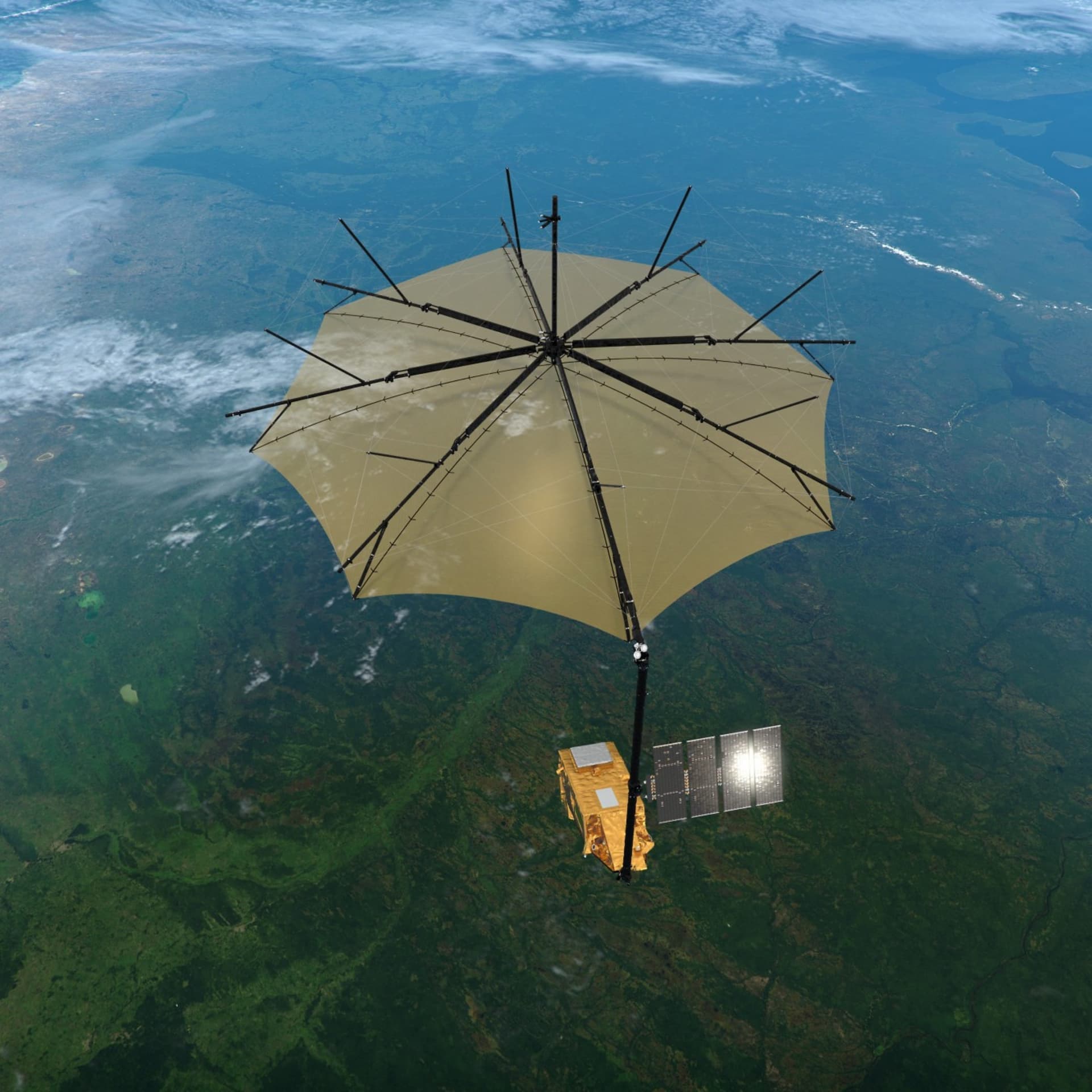
7:31And having both numbers helps us to get just a better estimate overall. So this is the height of the trees and the biomass is, if you like, the wood and the branches. Yes. And the second really important thing it can do, and again, utterly unique, is it can produce 3D images of forests. So it effectively can look at the forest and see layers within it. And that helps us to know what the structure of the forest is and how the forest is functioning. And again, that helps us to understand and measure the wood and the biomass in the trees. Tell me about the satellite itself. it's got quite an unusual design and shape I might say what does it look like I mean what does it look like when you see it on the ground and what's what what's it like in space well when you see it on the ground it looks as though it's got a really big umbrella stuck on one side because it's got this huge antenna which is a 12 meter antenna which has got to unfold in space which gives me the bejebus actually because if that doesn't unfold things won't work well but of course the whole thing's encased in a nose cone which isn't letting this umbrella be subject to all the atmospheric effects when you're launching.
8:43But if you saw a picture of this thing it would look like a really big dish which is the antenna and a little thing stuck on the end with a boom on the end of it and that's the actual satellite. But the satellite itself is five and a half metres high, but it's dwarfed by the antenna. That's Professor Sean Queegan from the University of Sheffield in the UK.
9:16You're listening to Tech Life on the BBC World Service with me, Chris Valance. Well, as regular listeners will know, for the past month or so, we've been asking you to tell us about the piece of tech you couldn't do without. And you've been great. Lots of you've got in touch to tell us about that vital gadget you depend on. Ian, who listens to Tech Life in Barbados, sent us a WhatsApp message to remind us that vital tech doesn't need to be high tech. He's a fan of a bit of TikTok, not the video sharing platform, but a good old fashioned clock, which keeps his life ticking along. Ian says, I do not have internet, TV or even a cell phone.
9:58I just listen to the BBC by FM radio. Ian even had to borrow a phone from a family member to send his message to us, presumably because his carrier pigeon was resting. Thanks for getting in touch, Ian. Tommy Wright from the UK also relies on a timepiece, his Garmin watch. He emailed to say he is a keen ultramarathon runner doing numerous trail events in places like the Lake District in the north of England. He says, my watch is so important to me as it allows me to upload the route so I don't get lost. And Sankalpa Chakma from India emailed to say, the technology indispensable in my life would be my AirPods or Bluetooth speakers.
10:40The reason being, I'm a rather voracious consumer of audio content in the form of podcasts and audiobooks. Well, thank you for putting Tech Life on your audio menu, Sankarpa. If you have a piece of tech that you simply can't do without, please tell us about it. You can send us a voice note or a text message on WhatsApp. Our number is plus 44 330 1230 320. Or send us an email to techlife at bbc.co.uk. And still to come, how tech is simplifying farming in Ghana.
11:25Well, sometimes things on the internet are so ubiquitous we barely give them a second thought. Take liking things. Billions of little thumbs up or heart shaped buttons are clicked every day. And many of us will experience the joy and disappointment of counting the likes on our own videos and social media posts. But how did this modest little button with an outsized impact come about? Bob Goodson is co-author of Like, which is published this week. So how much do we like likes? We seem to like it very much. You know, this little user interface feature that didn't exist 20 years ago is now clicked more than 7 billion times a day.
12:077 billion times. And in your book, there's this amazing graph of the total likes as well. We're up in the trillions per year around the world. So who invented the like button? You've kind of got a bit of a claim to be one of the pioneers of it, certainly. The button is something that really evolved through many hands over the past 20 years. and I found myself among them in the sense that at Yelp, where I was a product manager working for the co-founders, we were the first to put multiple emotions on a piece of web content, giving you different ways to express your reaction to it. And we were also the first to put a button that didn't require you to refresh the page, which we got used to, right?
13:03You just click it and it changes color or it indicates that you've interacted with it, but you don't need to refresh the whole page. That seems obvious now, but we were the first to do that as well. And this was way back when the Internet was, well, not the Internet perhaps, but social media and things like that. It was in the early days of all of that, wasn't it? Yes, this was in May 2005, so 20 years ago. And I found myself there as a product manager and front end engineer, helping with various consumer internet companies in San Francisco. It was quite a small community of people who were building many of the companies that we now use every day.
13:51In fact, there was a little drawing that you did that's in the book of the sort of early concept, if you like. And that's quite significant. I say if you like, because the drawing, it wasn't derived from your drawing, but your drawing was prescient. Let's put it like that. Professionally and personally, I've always had this habit of keeping everything I can that sort of tracks my life, thinking that one day it might be helpful. and but this is one of the notes that that I discovered when I was moving house and I showed it to a good friend of mine Martin Reeves who you know we've collaborated on some things before written some articles together and he was just fascinated by it he created something called the Napkin Gallery which is a collection of first sketches of interesting inventions over time which he's painstakingly put together and has a virtual gallery on it and I think there was something that intrigued him about it and he asked the question well does this mean you invented the like button and you know i answered well of course not you know there's many people that contributed to it but then he he asked well then who did invent it and it sent us down this you know research path um to to try and answer that question and what we learned in the process of you know three years of research is that this is a great example of how innovation actually happens and how technology really gets developed, which is through many hands working on something with a sort of evolutionary process that comes into being and fulfills what it's meant to be over time without really any single person being behind it.
15:30We should describe the little sketch you did. Tell us about it. We only worked on it for an afternoon. So I spent the afternoon looking at all of the closest precedence to this kind of interaction element to research what people might expect. Because when you design for the web, you always should start with what people would expect to happen based on precedence. So it's a little hand-drawn thumb icon with, you know, like it in my squally handwriting. The thumb icon was subsequently, of course, the icon for likes that Facebook made globally famous are you sorry that that you know your thumb didn't become the default for for yelp yeah that's right we we although i sketched the thumb and the word like as an option we we actually went with useful funny cool and without an icon we just made them three buttons and so we didn't use that design and about three years later facebook paired the word like with the thumb and we track in painstaking detail and and and you know with our research like how did the thumb come to be used by Facebook and why the word like because it wasn't obvious it sounds obvious but but it wasn't and people tried all kinds of things why a thumbs up you know there are so many things that we tried over those early years and the thumb really became the most popular and there was definitely an evolutionary process to selecting it.
17:04And so we track the pre-digital origins of the thumbs up and we trace all the way back to the gladiatorial arenas of ancient Rome where you had people in a sort of amphitheater so that they could see each other on tiered seating. So they were able to vote in real time, as it were, to the fate of the gladiator and they used their thumbs it seems obviously it's hard to say because of the historical records are not perfect in this regard but from what we can tell the thumb was used and it was probably drawn across the throat that was probably the way that they indicated that they wanted the gladiator to pay the ultimate price and um and they may have angled the thumb downwards as though sheathing a sword to represent, you know, that he should not die.
18:01So there is a slight downward angle of the thumb in that setting. And that's just fascinating to me that one of the first things we ever used as people when doing real-time voting was the thumb. And there's something powerful and persistent about that. And it's kind of found its way without anyone planning it into the digital realm. That's Bob Goodson, the co-author of Like, and we'd love to know if you like the Like button. Has it been a force for good? Or do you think it's had a negative effect on our online lives? A big thumbs down. Let us know.
18:39We're off to Ghana now. Over half of the West African country's workers are employed in farming, and agriculture is a huge part of its economy. so being as efficient as possible is really important and that's where tech is helping. Complete Pharma is a company based in Ghana and they're trying to digitise the process for growers and buyers creating a web-based marketplace and an app to help farmers grow their crops to meet the demanding standards of international buyers. So far 45 ,000 farmers have signed up in Ghana and they're starting up in neighbouring Togo too. Desmond Coney is the founder and chief executive.
19:20He's been telling me how he got into the agri-tech business. I grew up in a farming family. My dad was a farmer, but I didn't like farming. I studied engineering, so I'm a mechanical engineer. And yeah, life got me back into agriculture. So I would say my background is in both tech and farming. So the two parts of your lives kind of united in this project, essentially. Yes. What kind of farming was it that you grew up with, if I can ask? So my dad was a pineapple farmer. He had a commercial farm where he grew pineapples for exports, mainly to Europe. And so I think I grew up seeing like the first hand challenges most farmers have in trying to just get their farms going and also just being able to get value for their hard work.
20:09And I think that's really what made me think, look, let me study to become an engineer and maybe I would have an easier life. But it turns out nothing in life is that easy. Well, tell me a little bit about the challenges that you saw firsthand through your father's work. I mean, because that's sort of the starting point. You want to fix these. So tell me about those challenges. growing up i think some of the key challenges when we grew up on the outskirts of accra it's a capital city but it's still a bit rural and there were a lot of challenges getting just the the input so seeds would delay in coming on they would have like shortages of fertilizer and you know farming is a seasonal activity so once there is a delay it has knock-on effects for for most farmers and so just being able to get the right seeds get the right fertilizers on time was a big challenge.
21:08And there wasn't really a lot of agronomic knowledge on what they were doing. I think I saw my dad have farmer groups. So these were other farmers that would come together and sharing what works for them and what doesn't work. There really wasn't access to scientific knowledge. A lot of farmers in Africa have to sort of resort to this empirical knowledge on how to grow a particular crop. And then after After going through all of this hassle, selling was also like, selling the product was quite challenging. Most of these farmers do not have access to the big market buyers themselves. So they have to deal with a lot of middlemen.
21:52And obviously with middlemen, they want to buy for as cheap as they can and be able to add a markup to that. And so a lot of farmers end up selling for so little. and for commodities like pineapple that are perishable, they had no option because you just had to sell. If not, you would have all your year of way go waste. So what does your app do? I mean, you've mentioned middlemen. What does the Complete Farmer do? So Complete Farmer, basically, it's a way for farmers to be able to escape the middleman. So what we've been able to do is to digitize the value chain or the supply chain and giving farmers a way to sell directly to the big buyers.
22:38So that way they get more for what they've done. So on the Complete Farmer app, farmers can have access to the demand these buyers want to offtake and also get it at the price that the international market pays for that commodity. And then we sort of enable the supply chain. So the app provides full traceability. A buyer anywhere in the world, say Singapore, can see every step and every decision the farmer is making from what inputs they are applying, how they are growing, what sort of production methods they are using to be able to produce these crops. The buyers are able to see all of this and how it gets transported to them as well.
23:22I have to ask at this point, of course, how do you make money? So the way we make money is all the markups that the middlemen would have added, right? What we've done is to reduce the amount of them in markup to make sure that the farmer is getting paid a bit more and the buyer is also paying a bit less and still leave a wiggle room for complete farmers to be able to make money. And an interesting feature of the app is it gives advice to farmers about growing the crop. the challenge a lot of farmers have it's not just the middleman it's being able to meet the quality so what we do see is for a farmer to sell their product to europe european buyers or even the european union has certain specifications farmers need to meet now the challenge is some farmers may have had a lot of years of experience growing these crops but do not know how to meet these specifications of these markets.
24:20And that's also one of the gaps that the platform helps to resolve. And we do that by giving what we call the cultivation protocols to farmers. Obviously, to give advice, you need data about all sorts of things, don't you? You need data about the weather, you need data about the soil conditions and so on. And you're actually gathering some of that data yourself through sensors. Yes. So I think to be able to make sure that the advice we are giving farmers is relevant for the geographies they are in. We've had to deploy an IoT network of sensors. We have weather sensors, soil probes, monitoring like the changes in the physiology of the soil.
24:58We also equip some of our agents with sensors that they put on drones to help them collect large sets of data when they visit farmers. And all this data is then stored in the cloud. And that's basically what then builds the recommendation systems or feeds the recommendation system to give this advisory to the farmers. That's Desmond Coney from Complete Pharma, speaking to me from Accra in Ghana.
25:28Well, our clock's run down and we're almost at the end of this edition of Tech Life. Just time to say that we're keen as ever to hear from you, our listeners. perhaps you'd like to plant the seed of an idea for a future programme or tell us about something you like in a show we're still working on a dislike button but you can send us those too and we still want to know about the tech you rely on every single day whether it's a drone or a paper diary you can email us at techlife at bbc.co.uk that's our email address or you can WhatsApp us on plus 44 330 1230 320. Remember to include your name and where you are.
26:12Today's Tech Life was produced by Tom Quinn, edited by Monica Soriano and presented by me, Chris Valance.
From the publisher
A groundbreaking space mission will help scientists peer through dense jungle canopy to measure the difference the world's forests are making to climate change. We interview the expert who came up with the idea.
Also on Tech Life: It's clicked billions of times a day, but do you know how it started in the first place ? We find out why the world gave a big thumbs up to the 'like' button. And digitising agriculture in Ghana - how tech is streamlining the growing and selling process for thousands of farmers.
Tell us about the one item of tech that you simply can't do without – please get in touch by emailing techlife@bbc.co.uk or send us a Whatsapp message or voice memo on +44 330 1230 320.
Presenter: Chris Vallance Producer: Tom Quinn Editor: Monica Soriano
(Image: An illustration of the Biomass satellite in space. Credit: ESA/ATG medialab)