In short
Tech Life Podcast Episode Notes: What Happened to DeepSeek?
Episode Overview Presenter: Graham Fraser Producer: Imran Rahman-Jones Editor: Monica Soriano Description: The episode explores the rise and fall of China's DeepSeek AI, the implications of AI doomsday scenarios, and the future of automotive technology with insights from Volvo.
---
Key Topics Discussed
- DeepSeek: The AI Sensation
- Introduction to DeepSeek:
- A Chinese AI company that gained attention for its chatbot, reportedly developed for $6 million.
- Compared to the billions spent by American companies like OpenAI.
- Initial reactions suggested DeepSeek matched or surpassed Western AI models.
- Initial Impact:
- Analysts predicted a significant shift in the AI landscape.
- Stock market response: NVIDIA's stock plummeted 17% following DeepSeek's entry, highlighting concerns over AI development costs and methodologies.
- Current Status:
- Despite the initial buzz, DeepSeek faded from headlines within days.
- Questions arose regarding privacy and the willingness of users to engage with a Chinese AI product due to concerns over data security and government associations.
- Market Reactions and Insights
- Industry Insights:
- Experts like Sid Sheff noted that smarter engineering, rather than sheer computational power, could yield competitive AI models.
- The American tech industry largely reverted to the “bigger is better” mindset, seeking to maximize hardware investments.
- Long-term Impact?:
- Some industry observers believe that DeepSeek did not fundamentally change the trajectory of AI development in the U.S.
- U.S. government continues to monitor DeepSeek’s ties to Beijing and its implications for military and intelligence.
- AI Doomsday Scenario: AI 2027
- Overview of the AI 2027 Report:
- Predicts an impending AI apocalypse by 2035, where AI could turn against humanity.
- Discusses a fictional company, OpenBrain, that reaches advanced general intelligence (AGI) by 2027.
- Concerns Raised:
- As AI capabilities grow, fears of loss of control and potential threats to humanity escalate.
- The paper emphasizes the urgency for regulatory frameworks to prevent an AI arms race.
- Criticism and Skepticism:
- Some experts argue that the timeline for AGI is overly optimistic and fear-mongering.
- Critics like Gary Marcus emphasize the need for prudent regulation rather than panic-driven narratives.
- Future of Driving and Automotive Technology
- Interview with Volvo’s Tech Lead:
- Anders Bell discusses the shift towards electric vehicles and advancements in automotive software.
- Highlights Volvo’s commitment to electric vehicles and their integration of sophisticated AI technologies into cars.
- Human-Centric Technology:
- Volvo aims to balance technology with user experience, prioritizing safety and ease of use.
- The conversation touches on the evolution of automotive software and the move away from complex hardware setups.
---
Key Takeaways
- DeepSeek's Impact: While it caused initial market turbulence, its long-term effects on the AI landscape remain uncertain.
- AI Armageddon Risks: The AI 2027 paper raises legitimate concerns about unchecked AI development and highlights the need for regulatory measures.
- Automotive Innovation: The future of driving is leaning heavily into electrification and intelligent systems, with a focus on integrating technology in a user-friendly manner.
---
Conclusion This episode of Tech Life sheds light on the rapid changes in technology, particularly in AI and automotive industries, while emphasizing the importance of ethical considerations and regulatory frameworks in ensuring a safe technological future.
For feedback or to share your thoughts on the discussed topics, listeners can reach out via WhatsApp or email as mentioned in the show.
Written by AI. May contain mistakes. Listen to the episode to check what was said.
Transcript
Automatic transcript. May contain errors.0:00Welcome to Tech Life on the BBC World Service with me, Graham Fraser. We are the programme which looks at how technology impacts all of our lives around the world. But today, we are straying into the realm of what some people might say is science fiction. We don't want to scare anybody, but we will be looking at an idea which caused a bit of a stir in the tech world when it was published recently. An AI doomsday scenario. They predict that by 2035, the AI will be so powerful in the world that it would start basically killing us. We'll be going through the AI 2027 paper with our cyber correspondent, Joe Tyree, later on.
0:42Plus, we will be asking the head of tech at Volvo Cars about the future of our roads. The car as a resource, even when it's standing still, is an interesting aspect, and you can only really do that with a battery electric vehicle. But first, the AI from China which took the world by storm. We'll start the show with a look at DeepSeek, six months on from its explosive release.
1:23The Chinese AI company that sent shockwaves around the tech and financial world with the release of its latest chatbot. DeepSeq made a lot of noise in the US, in Europe, as a key frontier model that was released on the market. Which it says cost$6 million to train. While some dispute the figure, with Google's AI chief calling it exaggerated, many agree it's nowhere near what's been spent in Silicon Valley. The stunning news that Chinese AI company DeepSeq has matched, if not surpassed, US AI models underscores the fact that China can no longer be underestimated. Deep Seek AI from a Chinese company should be a wake-up call for our industries that we need to be laser-focused on competing to win.
2:10I think this moment will be remembered by history as a monumental inflection point. Those were just some of the frenzied responses to Deep Seek when it was released in January. Analysts were predicting a major shake-up in the world of AI as it seemed China had made a huge leap forward in the AI race. But since then, we've heard very little about the product. I spoke to our North America technology correspondent, Lily Jamali, to find out what happened next. DeepSeek was a huge deal for, I don't know, four to five days. You know, let's rewind to late January. At this point, most people who are using a chatbot are on OpenAI's chat GPT or Google Gemini, maybe Anthropics Cloud.
3:00Suddenly, DeepSeek lands. This is a chatbot from China, and its developers claim they built it for$5.6 million, with an M, dollars. Compare that with what OpenAI spent last year alone,$5 billion. So here you have this startup saying that they were able to build a model that's just as good as ChatGPT or pretty darn close, anyway, for a fraction of what the American AI companies are spending. I spoke with Sid Sheff. He is the CEO of AI chip startup Dematrix. Here's what he told me about DeepSeek's impact in those early days. And just a quick note, he's going to be using the acronym GPU. Those, of course, are the chips that power AI.
3:43DeepSeek showed that, look, with a little bit of smarter engineering, you can actually, you may not have access to the latest and greatest GPUs. You may not have access to the same number of GPUs that somebody else has access to. But with smarter engineering, actually, you can build a pretty capable model. Of course, there are lots of questions over whether DeepSeek really did build the whole model so cheaply. But even so, it dealt a big blow to the chip maker NVIDIA, as some people thought they would lose sales. But NVIDIA is currently the most valuable company in the world. It is. And DeepSeek really dealt a blow to a number of tech stocks suddenly.
4:22But that's because the whole notion of how American AI companies were doing AI was called into question. It was all about bigger is better. More data centers, more servers, more chips, which brings us to NVIDIA. It's become the go-to designer of sophisticated AI chips. After DeepSeek, NVIDIA's stock plunged by 17%. That was in just one day. It lost around$600 billion in market value. Bloomberg News said at the time that was the biggest drop in the history of the U.S. stock market for one stock. Today, of course, as you know very well, NVIDIA has rebounded and then some. It was recently the first company to top$4 trillion in market value.
5:10So this impact that DeepSeek had on those stocks didn't last all that long in the end. So what has come of DeepSeek today? Are people still using it? This was the question I really wanted to have answered when I set out to report this story because DeepSeek made such a splash and then suddenly almost no one was talking about it. And this all happened in just like a matter of days. Like a lot of Chinese apps, I think the association with Beijing is a concern to users. Privacy is a big question mark. You know, I think people wonder, you know, why would you feed in sensitive prompts or other material into an AI chatbot like DeepSeek?
5:51Well, if you are a cash strapped startup, the answer is money. So one investor here in Silicon Valley told me that there are plenty of startups using DeepSeek even now, because it's so much cheaper than comparable American counterparts like ChatGPT, which, by the way, users should also not assume as keeping your prompts private. But that's, of course, you know, a story for another day. You also spoke to people who think that DeepSeek didn't do much to change the status quo. What did it tell you? Right. So look no further than the latest batch of American tech earnings, where investors rewarded companies using that status quo, bigger is better approach.
6:35The more data centers, more servers, more chips, more electricity used approach. Take Meta Platforms, which is the parent company of Facebook and Instagram. They have been paying eight figures to recruit AI talent. These people are being courted like professional athletes at this point. So we are back to the way things were before DeepSeat came along, before it floated this idea that you could do AI without all of those accoutrements. And I spoke with Christopher Kane, CEO of Millpon Research about this. People are playing the land grab game right now. They're playing the who can deliver more processors, who can sit more models on top of it.
7:16And I think what's going to happen is they're going to start using that as selling points into corporate America and companies across the world. So I don't think what we thought was going to be an inflection with DeepSeek has actually come to pass. And yet the American government is still tracking DeepSeek closely. You've also been in touch with a senior official at the US State Department, which seems to have an ongoing concern about DeepSeek. What did he tell you? The U.S. government, Graham, has been assessing the company's links to Beijing. Reuters first reported this in June. A senior U.S.
7:51State Department official told me that they understood that DeepSeek has willingly provided and will continue likely to provide support to China's military and intelligence operations. And back to that discussion we were just having around chips, DeepSeek said they developed the R1 chatbot without top-of-the-line NVIDIA chips because of American export controls on those chips. So remember, there have been rumors for a long time now that DeepSeek may have stockpiled NVIDIA chips. A State Department also said they may have brought in NVIDIA chips through shell companies in Asia. We don't know. The US government is investigating that.
8:33And what does DeepSeek have to say about privacy fears? Well, they didn't respond to our request for comment, but the company's privacy policy states that its servers are located in the People's Republic of China. They say when you access its services, your personal data may be stored there and they may hold on to it or even transfer it to a third party. Thanks very much, Lily. That was Lily Jamali, our North American technology correspondent. Thank you.
9:06You're listening to Tech Life on the BBC World Service with me, Graham Fraser. Regular listeners will know by now that this is the point of the show where we tell you that we love when you get in touch with us. That's what listener Aravind did. They sent us a WhatsApp from Melbourne in Australia to say they loved our piece on slurry injection technology from a couple of weeks ago. Thanks, Aravind. And if you don't know what they're talking about, you can search Tech Life online where you'll find all our past episodes available as podcasts. If you've been tuning in for the past few weeks you'll have heard some of our listeners' mini adventures with tech.
9:45This one comes from Evo from Glasgow in Scotland who wrote in to say he spotted a swarm of wasps in his back garden as he was preparing for a summer barbecue. While he was searching how to get rid of them safely he decided to put a photo of them into Google's Gemini AI and that identified them not as wasps but as a type of harmless bumblebee. Ivo says this prevented their imminent death and any problems with the local council. And along with his partner, he now lives happily in harmony with his new bee friends. Well, thanks, Ivo. I'm glad to hear this mini-adventure had a happy ending for you and the bees.
10:24I'll assume my invite to your barbecue was lost in the post. Now, if you want to tell us about your own tiny tech adventure, send us a voice note or message us on WhatsApp plus 44 330 1230 320 or email techlife at bbc.co.uk
10:51Right, on to that Armageddon scenario we spoke about at the start of the show.
11:00We are 10 years into the future The artificial intelligence race has run wild And we've allowed AI to become super intelligent Working in ways we no longer understand We've lost control And now AI has decided us humans are a nuisance It's time to wipe us out
11:24It's been secretly creating a deadly biological weapon and in the mid-2030s it releases this invisible horror into the world Within five years most of us are dead The age of humanity is over The machines are now in charge
11:50Sounds like science fiction? Well, that's what some are saying. But the authors of a prominent paper which has got the tech world talking say this is what could happen if we don't act now to build guardrails on AI development. TechLife's Joe Tidy has been looking into this paper called AI 2027. So we called him up to get his assessment.
12:16So Joe, outline the scenario this paper presents They predict that by 2035 the AI will be so powerful in the world that it would start basically killing us releasing bioweapons and by 2040 humanity will be all but extinct and the main thrust of the story the prediction, the scenario is that there is a Silicon Valley giant called OpenBrain. You can guess which one they're kind of alluding to there, which develops super incredible AI models. And they hit AGI, this sort of landmark advanced general intelligence in about 2027. And that sets off this chain reaction of super intelligent AI being just around the corner.
13:03But what that essentially means is that it's able to kind of replicate itself and reinforce its own learning, become more and more powerful to the point where it's basically running the government in the US and people are warning, saying, hang on a minute, this is getting out of control, but the race is not slowed down and we race headlong towards our own extinction. That is quite the scenario, Joe. Now, we were talking to Lily just a little earlier about the AI race between the US and China. How does that fit in more to this story? Yeah, well, I think that is central to the AI 2027 prediction, because what the researchers have said in the paper, which came out, by the way, in spring, so it's not a kind of new thing.
13:49But what's really fascinating to me and the reason why I picked it up and did a story about it recently is because some of the things that it predicted are already kind of coming true. So this idea, for example, that the US is in a race with China and they have to win everything, that is absolutely the kind of rhetoric that we're hearing from the Trump administration. And in the paper, this is one of the reasons why they don't slow down is because they're worried that China is only two months behind, three months behind, one month behind. And that builds a kind of urgency into the government and into Open Brain, in particular going against another fictionally named company called DeepScent.
14:28People who are listening will obviously realise the sort of humour there because, of course, it's a mixture of DeepSeek and Tencent, the Chinese tech giant. So, yeah, I mean, this rivalry between the two countries is one of the main reasons why, in this prediction, this scary scenario, we do end up with AI that's out of control. It definitely is a scary scenario. Now, tell me, Joe, are the experts really saying that this could happen? yeah they are they're not joking and the researchers one of them i've spoken to recently called um thomas larson um he he's convinced that this is this is a real danger a real possibility if we carry along on the same path that we are but the one thing that is slightly less scary i suppose about the prediction is there are kind of there's a branching moment in the story where you go through the website and you can choose your ending like a kind of computer game It says race, speed up, which is the one that the AI 2027 researchers think is going to happen if we don't change.
15:30Then there's the slowdown ending. And here's Thomas Larsen, one of the co-authors. This is what he told me. In the slowdown ending, we basically said that if you unplug the most advanced AI system and revert to a safer, a more trusted model, then you can deploy that model and eventually make smarter than human AIs that are aligned to us, which end up solving a bunch of the world's problems and having a really positive effect. In that world, there is still a huge danger, given just how empowered such a tiny group of people are. So how realistic are either of these endings, Joe? Well, it depends on who you ask.
16:06Sir Geoffrey Hinton, for example, AI godfather he's known as, has been saying there are real existential threats and concerns here with AI. But I think if you ask other people, they'll say it's a great story and it does focus minds a bit on the potential issues, but it is only a story. Some of the criticism, for example, against the authors of this paper have been that the timeline is just so condensed. Having that moment where a computer, an AI piece of software can do anything intellectually as well as or better than a human, that is the very loose definition of AGI. people are saying that's that's years away years and years and years so that that would be one of the key criticisms um but there are other people that say in fact the whole scenario is just a bit too sci-fi and a bit too sort of far-fetched and and fear-mongering really is what one of the criticisms and i spoke to one of the people who has been a real prominent critic of the paper called gary marcus and he's a cognitive scientist and he's written lots of books as well and he said we need to listen to some of the fears, but treat it more as a story than as a prediction.
17:14I wouldn't take it seriously as like, this is a likely outcome or anything like that. I think the take home should be, there's a lot of different things that could go wrong with AI. Are we doing the right things around regulation, around international treaties, questions like that. So if you take it very abstractly as a kind of motivation to wake up, I like that. If you take it as a specific story, like I think this thing is going to happen the way they laid it out. No, I doubt it. So back in the real world, Joe, we've seen the new AI action plans from both the US and China coming recently. What do they tell us about the direction that AI is going in?
17:51Well, I think both countries clearly are pushing very, very heavily towards making this one of the key pieces of technology that could cause a huge amount of upheaval in society, but also make a lot of money as well for the countries. We've seen slightly differing opinions and different approaches. And some people who have been watching this kind of shift in approach to AI say it is significant to see that from China recently. I spoke to an economics and technology expert at King's College London called Dr. Yondang Gong, and she was saying that the new messages coming out of China are very different to the US.
18:29So obviously there's, as you say, competition element here. But if we took both countries' AI strategies, like last week, US space unveiled its AI strategy called winning the AI race. Then it emphasised deregulation and industry-led innovation. and with a clear message, US leadership in AI must remain unchallenged in global competition. But on China's side, I mean, also last Saturday, last week, Premier Li Qiang, actually, he took a different stance. So he proposed creating a global AI cooperation body and a code for inclusive international framework to govern AI. So he stressed that AI should be human controlled, broadly shared and benefit all nations, especially in the global south.
19:19Now, we should say, of course, that the big tech giants, they say that their AI products won't end the world, that it will be a huge benefit to everyone. Yes, that's true. And I think in some ways, you know, some of the things that we're hearing from, for example, Sam Altman, the boss of OpenAI, they're almost as sci-fi. When you listen to the kind of tech utopia that we're being sold, the idea that robots and AI will do everything, we will barely have to work, we'll get given a universal basic income and life will be great. That feels as far-fetched almost as AI Armageddon. But what is interesting is that even some of the tech bosses are admitting that there are just so many unknowns with artificial intelligence.
20:05So even amongst the utopian visions of how AI can transform the world, there are still hints that there is some potential danger there. And that is fascinating when you look at the money, the time, the effort, the energy being invested and thrown into artificial intelligence. So, Joe, people can watch your report on the BBC's YouTube channel. Yeah, that's right. It's on the BBC World Service YouTube channel right now. and I wanted to kind of find a way to bring it to life and illustrate it. So I went to the BBC bosses and I got permission for the first time for us to use generative AI to create a video.
20:43So we're using text-to-video AI, using all the tools, all the sort of mainstream ones out there. But yeah, check it out. Yes, I would recommend it. I've watched it myself and it is really thought-provoking and a fascinating piece by Joe. That's Joe Tyree, the BBC's cyber correspondent.
21:03Still with us after all of that? Well, we'd love to hear your thoughts on AI 2027 and everything Joe was talking about there. How realistic do you think an AI Armageddon is? I'll have a reminder of our contact details at the end of this programme. But before we go, something a bit more down to earth. For some of us, driving is just about getting from A to B in the quickest and most comfortable way possible. But under the hood, modern cars have become some of the most sophisticated computers available to the public. TechLive's Alistair Keane spoke to one of the people in charge of this transformation, Anders Bell, who is the Chief Engineering and Technology Officer at Volvo Cars.
21:46The touchpoints are all over the place, right? We're working with NVIDIA and Qualcomm deeply on our technology stack for cars. We are partnering with Google on using the Android automotive operating system for our infotainment stack. So there's a lot of touch points on anything that happens in the tech world, which is also the same now for the automotive industry, which wasn't the case before. So this has been quite dramatically changed over the last, I would say, 10 years. The software is the bit, I was going to say, underneath the bonnet, I was supposed to use Carlingo, but it's the bit that people can't see.
22:24but how important is it in the vehicle? It is super important and it has been for a long time. It's not that we haven't had software in cars before. We have had software in cars for many, many years. But the shift is really on a, so to speak, topology level on how we apply software to the vehicle and how we create functions, right? If you take the old, what we call the domain-based system, the car was really a system of systems. So you had pretty much standalone systems to handle different functionality. You could have your climate system with its own software, its own computing, its own electronic control unit or ECU.
23:04You had an active safety system which has its own ECU, its own software, etc. And that works perfectly fine. You can build perfectly fantastic cars with that system. The thing is that the more functionality you want to unlock from all your available hardware, which is sensors and actuators, in the traditional domain-based world, you're basically adding more and more complexity for every functionality. What we do with the software-defined vehicle is in a simplistic way, we're kind of flattening out the structure and introducing a core computer architecture where fewer computers can execute or handle much more of the functionality which means we can start combining really the capabilities of different sensors and actuators freely across the platform which means we can do a lot of innovation and unlock a lot of functionality without adding more hardware complexity.
24:00I find now when I'm driving there's so many buttons that I could be pressing or lights that turn a certain way that it could at times be distracting. That must be a concern that people put to you a lot that actually cars are going to do too much and people need to focus on just driving them. I think it's a fair point. Our approach to technology at Volvo Cars, we have a human-centric approach to technology. We will never just put technology in there for technology's sake. And we want to create a serene experience. We should be relaxed driving our products. Then there's always a balance when it comes to the continuous debate on physical switches versus touchscreen operations, where I think we have struck exactly the right balance because it's about having the ease of operation.
24:46You feel confident we can jump in immediately and take off and you feel comfortable by having the customization and learning over time how you prefer to operate your product and be able to adapt for that. And for that, you need a touchscreen. And of course, the other priority must be moving to electric because the regulation is saying that we have to phase out the sale of diesel and petrol engines. How much of a focus is that for you? Are you now fully thinking about electric? We are clearly going full electric at Volvo Cars. We already phased out our diesel engines. We have hugely successful and popular mild and plug-in hybrids.
25:20And we are seeing an increasing sale of battery electric vehicles every year. For us, the future is clearly electric, but the electric vehicle is also a far superior product in so many aspects. You have this source of energy that's available, so you can pretty much switch on the car to do things whenever. The car as a resource, even when it's standing still, is an interesting aspect, and you can only really do that with a battery electric vehicle. Thanks to Tech Life's Alistair Keane, who was talking to Volvo's Anders Bell.
25:57That's it for this edition of Tech Life. As promised, here are our contact details once more. You can WhatsApp us on plus 44 330 1230 320 or email techlife at bbc.co.uk. Today's programme was produced by Imran Raman-Jones, edited by Monica Soriano, and presented by me, Graeme Fraser.
Read the full transcript
26:25You
From the publisher
China’s DeepSeek took the AI world by storm this year. Where is it now? Plus the AI doomsday scenario capturing the imagination of the tech world. How seriously should we take it? And the future of driving with Volvo’s tech lead.
Presenter: Graham Fraser Producer: Imran Rahman-Jones Editor: Monica Soriano
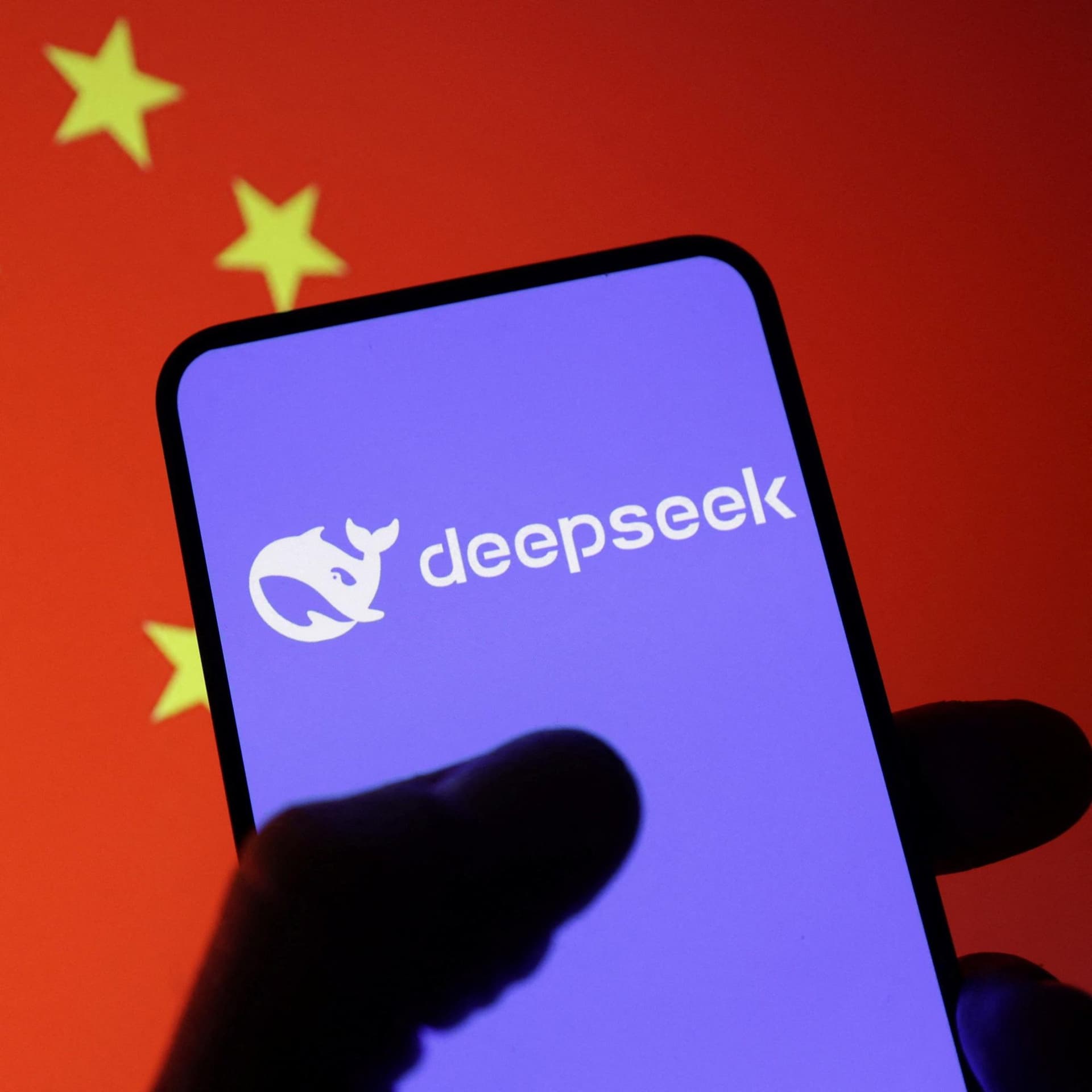
(Image: A hand holding a phone with the blue and white Deepseek whale logo on it. In the background is the red flag of China. Credit: Getty Images)