In short
The episode examines “shadow banning” and content moderation on social media, focusing on how women’s health information (periods, breastfeeding, reproductive health) can be hidden or restricted without removal. It also covers GTA 6’s rumored/announced download-only physical release controversy and profiles the Global Gaming League’s push to make gaming a spectator sport.
Guests and backgrounds
Dr. Carolina Arie, a digital criminologist at the London School of Economics and pole dancing instructor/blogger; Emily Darlington, Labour MP; Kate Prince, Head of Public Affairs at Essity (UK/Ireland), a health and hygiene company behind Bodyform/Libres; Liv McMahon, Tech Life reporter summarizing TikTok/Meta responses; Clinton Sparks, CEO of the Global Gaming League.
Key claims
Shadow banning reduces visibility and earnings; appeals are underinvested/ineffective; moderation may be overbroad, delaying diagnosis and harming mental/physical wellbeing. Essity says Meta asked for an 18+ warning and they were blocked 22 times in a month for “Vaginas Uncensored.”
Notable examples
Posts about periods/heavy periods/endometriosis; Meta/TikTok policy explanations; GTA 6 physical editions reportedly containing only download codes; Global Gaming League celebrity teams and multi-title live matches.
Written by AI. May contain mistakes. Listen to the episode to check what was said.
Chapters
Tap a time to open that second in VOCultural Influence and Online Communities
0:30 to 2:15
Discussion about American influence and the gaming community.
“The United States is about to mark its 250th anniversary.”
Women's Health and Online Censorship
2:15 to 4:02
Exploration of women's health topics facing censorship on social media.
“We're about to talk about women's health and some adult topics, including parts of the human body.”
Personal Experience with Shadow Banning
4:02 to 6:28
Dr. Carolina Arie's experience with shadow banning in the pole dancing community.
“So let's talk to someone now who's actually experienced shadow banning firsthand.”
Essity's Challenges with Health Information
6:28 to 12:16
Kate Prince discusses how Essity faces censorship in health-related content.
“who's also a pole dancer and instructor.”
Responses from TikTok and Meta
12:16 to 13:25
Overview of TikTok and Meta's responses to the shadow banning issue.
“We did ask both companies for a comment.”
Listener Engagement and Feedback
14:21 to 15:25
Encouragement for audience interaction regarding shadow banning experiences.
“Listen on bbc.com or wherever you get your podcasts.”
The Shift to Digital Gaming: GTA VI
15:25 to 21:39
Discussion on the significance of Grand Theft Auto VI being download-only and its implications for physical game sales.
“Still to come, the gaming league with global ambitions.”
Introducing the Global Gaming League
21:39 to 27:43
Interview with Clinton Sparks about the Global Gaming League and its unique approach to gaming as a spectator sport.
“And behind it all is Clinton Sparks, CEO of the Global Gaming League.”
Listener Engagement and Production Credits
28:00 to 28:38
Learn how to engage with the show and who produced it.
“Our email address is techlife at bbc.co.uk or you can WhatsApp us on plus 44 330 1230 320.”
Transcript
Automatic transcript. May contain errors.0:00This BBC podcast is supported by ads outside the UK.
0:30Whole Foods Market. Make your summer sizzle. The United States is about to mark its 250th anniversary. And so on the Global Story podcast from the BBC, we're telling surprising tales of American influence on the world stage and in ordinary people's lives all across the globe. We have this ability to export our story and a lot of people have bought it. I feel like the American dream is alive but not well. From the BBC, it's the United States at 250. Listen on BBC.com or wherever you get your podcasts.
1:28Theft Auto 6 is due out later this year, but it's already stirring up a bit of a row. Some fans are unhappy they won't be able to buy a physical copy of the game on a disc. The launch of GTA 6, it's expected to be a huge, huge event. So anything really this series does, it makes waves across the industry. And turning video gaming into a spectator sport. I speak to the man who's at the helm of the Global Gaming League.
2:15Before we start, a quick heads up. We're about to talk about women's health and some adult topics, including parts of the human body. So if you've got young children around and you'd rather they didn't hear this, now might be a good moment to turn the volume down. Social media companies get a lot of criticism for what appears on their platforms and most of us are used to content moderation. That's when posts are being removed or restricted if they're illegal, offensive or not suitable for children. But there's a growing concern that these systems sometimes go too far. Some women's health organisations say perfectly legitimate posts about periods, breastfeeding or reproductive health are being taken down or quietly hidden.
3:01Complaints have been raised around the world and the issue was even debated in the UK Parliament recently. Here's Labour MP Emily Darlington. The online world is where women ask questions where they're often too embarrassed to ask elsewhere about period pain, discharge, lactation or how to use a tampon safely. Some creators say their posts are removed. Others say they're hit with sensitive content warnings and some believe they're being what's known as shadow band where the posts stay online but are shown to far fewer people. Here's Emily Darlington again. Ultimately this debate isn't only about algorithms it's about power, who gets heard, who gets visibility, whose bodies are treated as acceptable, whose health is considered legitimate.
3:53And right now, the message many women receive online is this. Your body is inappropriate. Your anatomy is shameful. Your health is controversial. So let's talk to someone now who's actually experienced shadow banning firsthand. Dr. Carolina Array, known as Blogger on a Pole, is a digital criminologist at the London School of Economics as well as being a pole dancing instructor. Pole dancing has a huge online community. It's how pole dancers promote themselves and their classes. It's also how you share your progress and you realise three months ago you couldn't do anything and all of a sudden you can do something really cool and you're really strong.
4:32I started blogging about it. I gained a bit of a profile in the industry and in the community. Then all of a sudden I would notice that posts that would blow up suddenly were not seen by almost anyone. Sometimes even they weren't seen by people within my following or within my friends group. And it felt very frustrating. It felt incredibly sad. There was an element of how much is the fact that a lot of my posts are restricted and don't reach as many people as they did affecting my earnings. I also asked Dr. Ari if she recognised the arguments that platforms say they're trying to protect younger users from explicit content.
5:16And could she see why they might take that cautious approach even to legitimate health information? I am okay with platforms erring on the side of Hoshan because once something reaches an exponential audience, if that something is really harmful, then the image damage to the platform, but also the damage to the audiences themselves is potentially huge. However, only if there is a transparent, fair and swift appeal system in place to counteract that. Because if you want to delete my content, but then I click a button, a human looks at it, and like five minutes later, the content is back, and it's as if nothing happened, then that's not a massive issue for me.
5:58But the issue is that platforms have underinvested in appeals, which are a tenet of any democratic society, to the point where I know that a lot of users in my network, when their accounts are outright deleted, they can't reach anyone at the platform, the appeal doesn't work and they have to pay for hackers who claim to be working inside the platform to get their account back. That's Dr. Carolina Arie, a digital criminologist at the London School of Economics who's also a pole dancer and instructor. Now, one company worried about legitimate health information being shadowbanned is Essity, a Swedish-based global health and hygiene firm.
6:40It says important information is being hidden online. I caught up with someone at the heart of their plight. My name is Kate Prince and I'm the Head of Public Affairs at Essity in the UK and Ireland. And tell me about Essity. Essity is a global health and hygiene company. Our aim is to break barriers to improve the well-being of health for consumers, for patients, for caregivers and customers everywhere. And what products would people recognise? We have a number of household brands, including Cashel and Plenty, which are the toilet paper and household kitchen towel. And we also have health brands like Tenor, the period brand Bodyform, which is called Libres in a number of places around the world.
7:27and also tenor. Now tell me, you are involved in a debate around shadow banning. Can you explain that term to me? Yeah, so shadow banning is essentially when content on social media is hidden from the end user, so it might not appear on algorithms, but it could also be censorship in terms of blocking posts as well. Some listeners might ask, why is a hygiene products company involved in this debate then can you explain yeah of course so one of our brands body form as i mentioned we have been regular regularly censored on social media platforms for using everyday terms to describe the body and health conditions also like periods and menstrual health and so a couple ago we created a campaign called Vaginas Uncensored to really highlight this problem and when we posted about menstrual health that post was deemed to be sexually explicit and we were asked by Meta to put an 18 plus warning on that post.
8:36The campaign went on to post and we were blocked 22 times in one month so it really is an issue for our brands. Without being too graphic what kind of language and content is proving to be the problem here? So as a period brand, we regularly communicate about periods, obviously. So we'll be using language like menstrual health, and we'll also be talking about periods. And this is the kind of language that is being blocked. But also, we might be talking about heavy periods. And so talking about medical conditions like endometriosis. And we find that this content is also blocked. Obviously, there's consequences then if the information is blocked and women's health information doesn't reach the intended audience.
9:31Well, yeah, exactly. And the impact is that, you know, women and girls are visiting social media platforms to find out more about their health and they simply can't find it. So, you know, this can delay diagnosis and it can cause lasting harm, you know, both physically and mentally. Now, do you see this as an unintended consequence of social media companies trying to protect people and especially children from potentially offensive material? Yeah, I mean, I can only assume that's the reason. But we've tried to engage with social media platforms to ask them, you know, what exactly is happening?
10:12How are they moderating this content? And so why is it happening? And what can we do about it to change that? And have any of the social media companies acknowledged this problem? We have struggled to engage. We had a roundtable in Parliament where we brought together lots of companies, brands and charities, along with experts in this area, censorship. we presented the evidence and we invited them all to come along. TikTok did come along to the event but unfortunately we haven't had much engagement since. Now what do you think of the online safety frameworks that there are? Do you think it goes far enough to protect legitimate health information or do you think that's something that could be changed?
11:00Oh I think a lot needs to be done to be honest I think we need to understand better how the companies are moderating this content they need to explain to us how it's done we need to know more about how the algorithm is working so that these posts aren't being hidden and then we need a better appeals process I think as well because at the moment we don't have any recourse on on how to take action so in the EU they have the Digital Services Act. So it is possible to complain that way. But in the UK, that doesn't exist. So we'd like to see some consistency really, so that there's a clear process for what companies like ours can do in the event of appealing.
11:49And do you have wider international support for an end to shadow banning? It's an issue that's impacting everybody. So yes, Yes, I would say there is a groundswell of support internationally. And together, we all need to approach our platforms locally to do something about it, I think. That's Kate Prince from the health and hygiene company Essity. Kate's interview mentioned TikTok and Meta. We did ask both companies for a comment. And Tech Life's Liv McMahon is here to give us a quick summary of what they said. Firstly, TikTok. So TikTok told us that certain content isn't eligible for recommendation for the broad audience of its For You page.
12:34And they say they're transparent about what types of content fall into that category. TikTok also notifies creators when their content isn't eligible for recommendation and provides them with the opportunity to appeal. They also told us they continue to engage with policymakers on discussions around women's health. And what about Meta? Meta shared with us their community standards, which outline what isn't allowed on their social platforms. They say while posts about women's sexual health are allowed, including from individuals under the age of 18, they do have policies on adult nudity and sexual activity.
13:09Meta also said user content on women's health, such as periods and menopause, on its own wouldn't violate any adult content policies. There are no restrictions in their content policies regarding the discussion of these topics or discussion of menstrual health in general. Thanks, Liv. The ultimate cookout starts with the ultimate ingredients. At Whole Foods Market, no antibiotics ever, burgers and kebabs, are prepped and ready to throw on the grill. Fire up a juicy ribeye. Grab creamy potato salad and savory flatbreads from the prepared foods department and round it all out with 365 brand condiments, chips and dips at everyday low prices.
13:52Whole Foods Market. Make your summer sizzle. The United States is about to mark its 250th anniversary. And so on the Global Story podcast from the BBC, we're telling surprising tales of American influence on the world stage and in ordinary people's lives all across the globe. We have this ability to export our story and a lot of people have bought it. I feel like the American dream is alive but not well. From the BBC, it's the United States at 250. Listen on bbc.com or wherever you get your podcasts.
14:38This is Tech Life on the BBC World Service with me, Shona McCallum. So what did you make of our item on shadow banning? Have you experienced it yourself? We'd really like to hear from you. Our contact details are coming up in just a moment. But first, a quick hello to Chwar Farchani, who's been in touch on WhatsApp, to say he's listening to Tech Life in South Sudan. Well, it's great to have you with us. If you want to comment on this week's show or tell us about any tech that's on your mind, you can email us techlife at bbc.co.uk is our email address. Or you can WhatsApp us a text message or a voice note.
15:16Our number is plus 44 330 1230 320. Please remember to include your name and the country where you live. Still to come, the gaming league with global ambitions.
15:37One for the gamers in our audience next. You might still buy your favourite titles on a disc from a local shop, but plenty of players now go fully digital, downloading games straight onto their consoles or PCs. Now, an announcement about Grand Theft Auto 6 due out this November is causing a bit of a stir. The hugely anticipated next instalment on the GTA series will be download only. Its developer Rockstar Games says that even customers who buy a so-called physical edition will just get a box with a download code inside. so what's behind this move and does it mean the disc is finally on its way out tech life's laura kress has been digging into this and she's with me in the studio now laura this isn't the first time we've seen a physical release like this but why is this decision around grand theft auto 6 such a big deal yes you're right we have seen some companies decide to just put out codes in a box or something that isn't exactly a disc.
16:43It's still quite unusual that we would see a physical edition at launch not have a disc at all. And as you say, Grand Theft Auto, it's such a huge game and franchise altogether. The last game, GTA V, that sold nearly 230 million copies. And the launch of GTA VI, it's expected to be a huge, huge event. So anything really this series does, it makes waves across the industry, and it can affect what other studios do as well. And I think that's really the reason it's been talked about. Will this make it more likely after this launch that smaller companies will follow suit? And has gaming been moving away from hard copies of games on discs for a while now?
17:23Yes. So digital downloads for games, they've been available alongside discs for, I would say, maybe over a decade now. There's a PC platform called Steam. There's also Xbox and PlayStation. They have their own online stores. we've also seen consoles like playstation 5 have digital only versions so no disc drive at all so you can't use a disc in that console at all and physical media in general it's been in a bit of a decline last year sales for physical games they fell to an all-time low so are there benefits to having a game on a disc instead of a download from a user point of view obviously if you have that physical disc once you finish the game you can lend it to a friend you can resell it you can And also potentially, if you go to one of these retailers, get it for a cheaper price if it's used.
18:10And I think other people are pointing as well to the fact that if you're only buying a code rather than a physical copy, then publishers have more control because you are essentially buying a license rather than owning the copy yourself. So if we look at, for example, GTA, it's well known for its soundtracks of licensed music. But as time goes on after launch, some of those songs featured in the game on day one, they might be removed, you know, in 10, 20 years time. because of licensing agreements. Now, if you own the game on the disc, there's no way for publishers, music publishers, to remove that content if you install that game offline and just put the disc content on your gaming console.
18:47So effectively, people are concerned not just about owning the disc, but also what it means for the content on the game as well. So the reaction then from people about GTA 6 being download-only is mixed, it's fair to say. That's right. So some people saying, well, I'm used to downloading games, I don't buy discs anyway, so it's not bothering me. Others people talking about that ownership and what it means to own a game. And also a lot of people reminiscing about the previous games where there was that extra content, that physical content that you could own and what it will look like at launch.
19:22And what have Rockstar, the game developer, said about this? Any reasons? So they have given no reason. They have not commented. They've simply said that this is what's happening. Of course, we've seen a lot of analysis as this is such a big series. Everybody's talking about it. So some people have suggested it could be to stop any leaks because they have been prone to leaks previously. And it's such an anticipated game. People will be trying to get as much information as they can on it. If there is a disc and it will be released prior to the actual launch. So you can go and pick up a disc before the actual game becomes available so that you can preload that content because it's going to be so huge.
19:58People are imagining. there is a worry that potentially you know people could rip the data from the disc so there's a concern about leaks and that's although Rockstar haven't said that that's the reason they've given another potential reason the game's already been delayed twice so other people have suggested maybe the development will be so close to the wire that if you pick up a disc it might be out of date in comparison to if you download it. Laura thank you that's Laura Kress and Laura's written more about this story you can find it in the technology section of the bbc news website if you're a gamer with an opinion on discs and perhaps the end of them we'd like to hear from you our contact details will be repeated at the end of the show
20:50Well, we're sticking with gaming now because we're about to talk about this I feel like I'm going to win This is the Global Gaming League A multi-title league where celebrity team owners and their teams compete in both modern and classic video games
21:12Well, that was a clip from a promotional video for the Global Gaming League. And yes, it's exactly what it sounds like. And as the big voiceover guy just told us, it brings together celebrities, video games, competitions and a league title up for grabs. It launched at the end of last year with a pretty bold goal to turn gaming into a proper spectator sport. something you don't just play, but you actually watch, follow and cheer for. And behind it all is Clinton Sparks, CEO of the Global Gaming League. He's based out in Las Vegas in the United States, and I caught up with him to find out more. The Global Gaming League is a video game league of celebrity-owned teams whose four-player teams compete in live events, playing everything from modern games to classic video games and everything in between, combined with an online gaming platform where any casual player from around the world can join, compete and rise in the ranks from our Primes League to our Minor League to get drafted to our Major League to be on one of those celebrity-owned teams.
22:15And who are the celebrities that run the teams? We have a bunch of celebrities that own teams in the Global Gaming League from Howie Mandel to T-Pain to Neo to Flavor Flav, Gillian Wallow and many more. And what games do they play? We are a multi-title league that plays all types of games from Call of Duty to Tetris to Tekken to Fruit Ninja VR. We even in our last match actually played a physical game of Uno. And what gap in gaming did you feel that existing esports perhaps weren't addressing? So you have esports on one side and then you have gaming on another side. And esports is much smaller than the entire world of gaming.
22:58So I wanted to build something that could resonate and connect and relate to the billions of casual gamers around the world to also have an opportunity to play video games, compete, make money and rise in the ranks. And you're turning this into a spectator event. So could you tell us what spectators see and how they actually see it? Are they logging in online? Yeah, the Global Gaming League has live events that are here filmed in Los Angeles. It's a red carpet event. There's all types of celebrities and influencers and creators from the UFC to WWE to actors that pull up to come see what's going on.
23:35And when you're watching the stage, you're looking at two teams, one on the left, one on the right. There's four players on each team. Each match has four different rounds and each round has a different game title. So you want to draft like well-rounded players that can defend your team in whatever game and round that you guys are going to play. We have a halftime show at every show. There's all types of exciting things that go on to bring the best of every sport into one kind of league called the Global Gaming League. And you're blending this with music, sports, celebrity, live events. I mean, why do you think this crossover is so important?
24:11Because gaming is so large and everybody games, which is our tagline. So since everybody games, there needed to be something created for everybody. because until now it wasn't. Esports was reserved for the hardcore endemic gamer that grinds eight to 15 hours a day, hoping to be on an esports org that then gets selected to be in a league. But there's billions of casual gamers around the world that don't consider themselves a gamer because they're not a professional esports player. So I wanted to create something where all gamers could feel like they're gamers, be proud to say they're a gamer and have the opportunity to really game on a big stage and become a breakout star in the Global Gaming League.
24:52Your positivity and your enthusiasm is really coming across. But I just want to rewind a little because I think it's fair to say that you had perhaps a difficult start in life and have obviously found your way now with gaming. Can you tell me about where things began for you? Sure. I was just a broke kid from a broken home, born in Boston, Massachusetts, sits, single mother, was sexually abused as a kid, was bullied, was homeless as a teenager, didn't graduate high school. And music was always a passion of mine. I did it in my bedroom as a kid. And then when I grew up and realized I got hurt, I got a full-time job at UPS.
25:36After a couple of years, I hurt my spine. And when I did that, I was like, oh man, I can't do hard labor. I didn't graduate high school. I have to make my music thing a reality. so I worked really hard and became a multi-platinum Grammy nominated producer I've sold over 80 million records I built my own radio show around the world in 22 markets and was very fortunate enough to become successful to work with the biggest artists Lady Gaga out of Beyonce Pitbull Akon Ludacris Rick Ross Snoop Dogg TI you name it and as I did all those things I was really building relationships and a powerful network because I always wanted to be somebody that I built businesses that would help other people.
26:13And I can go on a list of all the things that I've built throughout my career. But when I got introduced to the gaming industry through e-sports in 2017, I realized all my skill set, all my relationships and my understanding of building culturally impacting companies would serve well in the gaming industry. So I helped build two organizations called FaZe Clan and another one called Xset. And then I'm like, man, if I can really build teams, why don't I build the league? so I called my friend T-Pain and I said this is my idea he said let's do it and that's how the Global Gaming League was formed.
26:45How do you reflect on the journey that you've just described? That it's not over and I haven't done enough. Okay well you're still doing more the Global Gaming League Primes is the next thing that you're launching can you explain that to me? Yeah so you know we launched this with just the celebrity teams competing which you can see at globalgamingleague.com or on our YouTube page at Global Gaming League. But I was like, how do we get everybody around the world to be able to participate and have an equal level playing field so they can all compete and rise and be on one of these celebrity-owned teams?
27:21So we launched GGL Primes, which is our online gaming platform where anybody can join, compete, rise in the ranks and inevitably be on one of our celebrity-owned teams. My thanks to Clinton Sparks, the CEO of the Global Gaming League.
27:41well if we can stretch the gaming references a little further we've run out of lives for this show but we'll be back next week armed with cheat codes and a few extra power-ups remember we love to hear from you whether it's gaming game discs shadow banning or anything else in the world of tech that's caught your attention maybe there's something we should be talking about next time Our email address is techlife at bbc.co.uk or you can WhatsApp us on plus 44 330 1230 320. Remember to include your name and where you live. Today's Tech Life was produced by Tom Quinn and presented by me, Shona McCallum.
Read the full transcript
28:37The United States is about to mark its 250th anniversary. And so on the Global Story podcast from the BBC, we're telling surprising tales of American influence on the world stage and in ordinary people's lives all across the globe. We have this ability to export our story and a lot of people have bought it. I feel like the American dream is alive but not well. From the BBC, it's the United States at 250. Listen on BBC.com or wherever you get your podcasts.
29:33and wherever you get your BBC podcasts.
From the publisher
We look at an issue known as shadow banning. What is it? How does it work? And could it be affecting health education messages for women and young girls?
Also this week: we're feeling nostalgic about the discs that hold our favourite video games. And Shiona McCallum speaks to the founder of the Global Gaming League.
Presenter: Shiona McCallum Producer: Tom Quinn
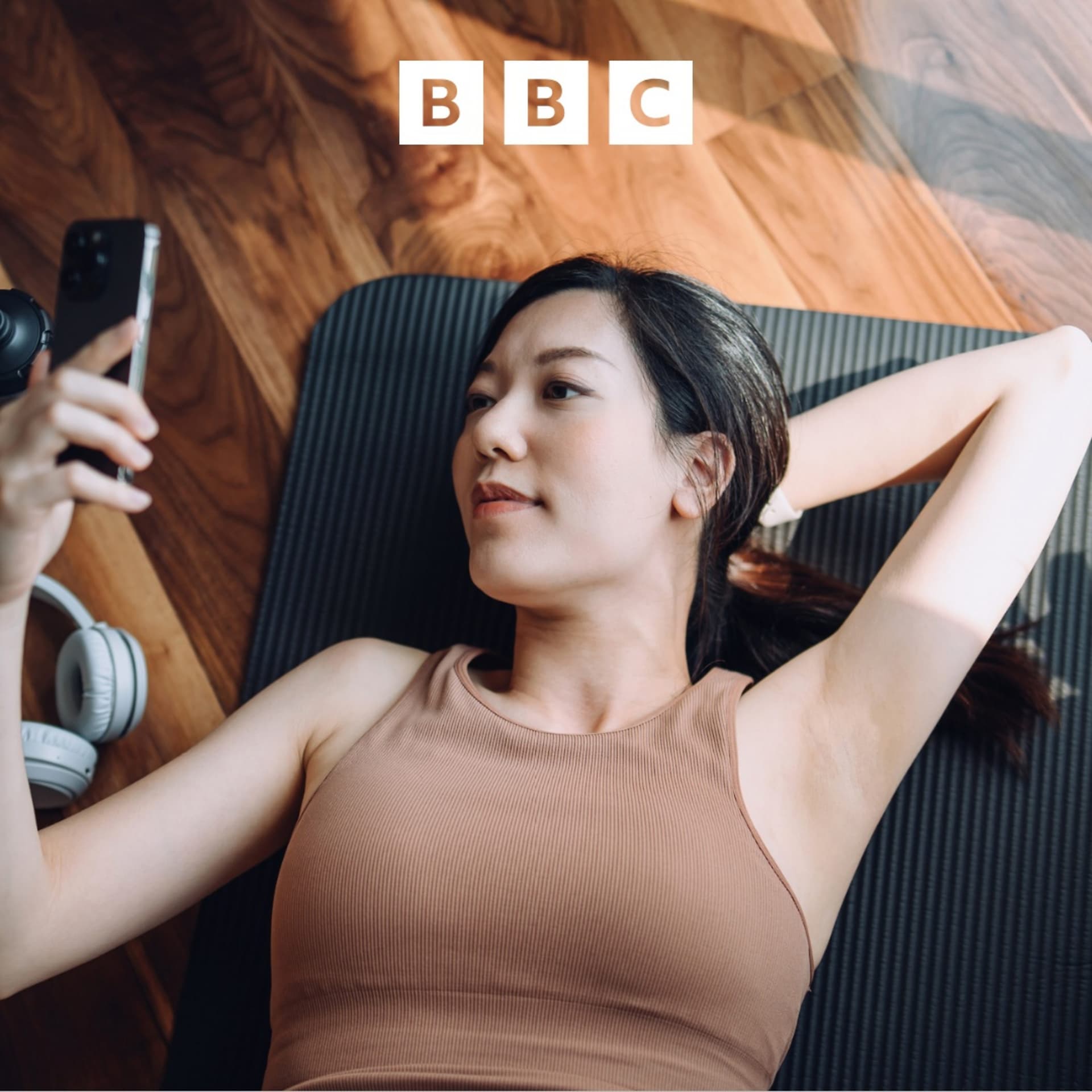
(Photo: A young sports woman relaxes after a workout. She is lying on a yoga mat, looking at her smartphone. Credit: Getty Images)