In short
AI language access, tech regulation, and age-tech for older adults.
Guests
Juan Lavista-Ferez, Microsoft chief data scientist and leads Microsoft AI for GoodLab; Peter Otto, CEO of Senta (UK) voice-assistant company; Rita Barbosa, CEO/co-founder of Guardian Labs (anti-fraud app); Zach Myers, Director of Research at CER (Centre on Regulation in Europe); Roland Pilgrims, founder/CEO of Nobi (smart ceiling light for fall detection); Dorr Schooler, CEO/founder of Intuition Robotics (LEQ AI companion).
Key claims
English-heavy internet data leaves underrepresented languages poorly served; Microsoft’s Lingua aims to collect/train on more languages to improve access and preserve at-risk languages. Examples: Malawi legal-info project for women/children (with Oxford and Women Lawyers Association of Malawi); food-security/agricultural guidance needing local-language models; Inuktitut work in Nunavut. Regulation segment: Europe emphasizes fundamental rights and competition; US is more techno-libertarian/dynamic-market; AI agents raise transparency and rights concerns. Age-tech examples: Senta conversational iPad hub; Guardian App intercepts scams on-device; Nobi light asks after falls and alerts caregivers; LEQ uses robot body language and a screen for hearing/speech challenges.
Written by AI. May contain mistakes. Listen to the episode to check what was said.
Chapters
Tap a time to open that second in VOThe Language Challenge for AI
0:45 to 2:18
Exploration of how AI technologies struggle with underrepresented languages.
“podcasts ad-free with an Amazon Music subscription.”
Microsoft's Lingua Project
2:18 to 3:26
Discussion on Microsoft's initiative aimed at improving AI support for underrepresented languages.
“There are around 7 ,000 languages spoken in the world today, but how many can AI understand?”
AI's Impact on Legal Access in Malawi
3:26 to 6:12
Insights from Juan Lavista-Ferez on using AI to improve legal access for women and children in Malawi.
“He's Microsoft's chief data scientist, and he leads Microsoft's AI for GoodLab.”
Preserving Languages with AI
6:12 to 10:46
Discussion on how AI can be used to preserve languages and the cultural implications involved.
“And have you seen that playing out on the ground?”
Listener Feedback and Community Engagement
11:46 to 13:33
Engagement with listeners' thoughts on AI and technology experiences.
“Be the first to listen to your favourite shows like Evil Genius, Good Bad Billionaire and You're Dead to Me with a subscription to BBC Podcasts Premium on Apple Podcasts.”
Technology for Aging Population
13:33 to 14:00
Introduction to technology designed to assist older adults, focusing on a voice assistant.
“edition or you have an idea for a future show, you can email us.”
Introduction to Sentai Voice Assistant
14:00 to 15:10
Learn about Sentai, an AI voice assistant designed for the elderly.
“It's certainly a topic that's rarely out of the news.”
Guardian App: Combatting Phone Scams
15:10 to 17:53
Discover the Guardian App, designed to protect elderly users from scams.
“and have that everyday companion, a highly intelligent companion who can hold up a long conversation with you if needed.”
Tech Regulation: A Global Perspective
17:53 to 19:29
Explore the differing approaches to tech regulation in Europe and the US.
“And what it is essentially is the first layer of scam protection on mobile phones that uses AI to intercept fraudulent calls and messages before they even reach a device in a proactive and invisible way.”
AI and the Future of Regulation
19:29 to 23:00
Understand the future implications of AI regulation across different regions.
“Do you think there are two fundamentally different visions for the future of tech, one being the European and the other the American?”
Show all 12 chapters
Nobi: The Smart Light for Safety
23:00 to 24:53
Learn about Nobi, a smart light equipped with fall detection technology.
“Right, let's return to technology aimed at helping us when we get older.”
LEQ: AI Companion for the Elderly
24:53 to 26:55
Discover LEQ, a robot designed to provide companionship for older adults.
“And finally, a robot designed to offer conversation and companionship.”
Transcript
Automatic transcript. May contain errors.0:00This BBC podcast is supported by ads outside the UK.
0:30at Whole Foods Market. Get more with BBC Podcasts wherever you listen. Be the first to listen to your favourite shows like Evil Genius, Good Bad Billionaire and You're Dead to Me with a subscription to BBC Podcasts Premium on Apple Podcasts. You can also enjoy a range of our podcasts ad-free with an Amazon Music subscription. Hello and welcome to Tech Life, the programme about technology and how it affects the world around us. I'm Shona McCallum. This week, what if AI doesn't speak your language? English dominates the internet and that online material helps train the AI tools millions of us now use.
1:10So where does that leave people whose mother tongues barely feature online? I'll be finding out about a project helping AI work in more of the world's languages and why it matters. If you have a large language model that can speak a particular language, it will have the ability to translate and it also will have the ability to even teach other that particular language. Also coming up, regulating tech might sound as appealing as a trip to the dentist, but like your checkup, it's important. With Europe and the United States taking different approaches, we'll ask who gets to set the rules and what that means for the rest of us.
1:46And from helping people stay independent to offering companionship, there's a growing range of technology aimed at older people. We'll look at some of the products out there and ask how useful they really are.
2:17Let's start with something we all use. Language. There are around 7 ,000 languages spoken in the world today, but how many can AI understand? Tools like ChatGPT, Gemini and Claude learn from huge amounts of text, much of it found online. And some languages, particularly English, are far better represented than others. So if your mother tongue is one with very little material online, those tools may struggle to understand you or give you a useful answer. Microsoft hopes a project called Lingua will help change that by creating more material in underrepresented languages to train AI models. There's also the hope that it could preserve languages at risk of disappearing.
3:01The project involves work in Africa and Europe and in the Nunavut Territory in northern Canada, where Inuktitut is the local language. Here's a little of what the language sounds like in a clip from Microsoft's promotional video.
3:22So that's Inuktitut. It sounds beautiful. I've been speaking to Juan Lavista-Ferez about Lingua. He's Microsoft's chief data scientist, and he leads Microsoft's AI for GoodLab. In the era of AI, it's critical for people around the world to be able to interact with AI and to use AI. And if you live in regions like the US or Europe, that's something that usually is given for granted for majority of the countries in a lot of languages. But that's not the case for a significant part of the world where people do not have access to AI in their own language. And the whole idea of Lingua was to make it easy for people to train models.
4:04And that started by the idea of collecting data in their own languages. And what problem are you trying to solve with your Lingua initiative? The problem is like access. So if you don't have access to AI in your own language, you might fell behind. Like this is something that that digital divide that happened back in the 90s where people didn't have access to computers or people that have access to computers created a gap. We feel that there might happen the same with the AI digital divide, where even if you have access to a computer and have access to the Internet, that if you don't have access to AI in your own language, you will not be able to use it and learn from it.
4:43Could you give us a flavour of some of the languages that you've been working with then? Yes, in Europe we're working in languages like Icelandic, Maltese, Romani, Luxembourgish, Basque. In Africa we have languages like Chichewa, the Tanzanian sign language, Wallaf in Senegal. So these are some of the examples that we have and we've been working with. Once an indigenous population does get access to an LLM in their language, how can they leverage their existence and I guess using it to their advantage? Yes, so for example, in Malawi, we are working in collaboration with Oxford, the University of Oxford and the Community Foundation for Justice in bringing the ability to use AI models mainly for women and children.
5:32So Malawi is a country that has 22 million people and around 800 lawyers, which makes it impossible for people to have access to legal information. The project that we have is the ability, this is also in collaboration with WILA, that is the Women Lawyers Association of Malawi. This is a group of amazing women that are providing legal advice and legal information for pro bono, but there's no way for them to scale. Our work there is to use AI to help people, first responders and these lawyers, to get access to legal information so women and children have more access to legal information that can help and benefit them.
6:12And have you seen that playing out on the ground? We are in the final weeks of testing. I'm going to be in Malawi in two weeks to help understand how they're going to be using these tools. but we hope that in the next few months we will see this in production. And obviously you've engaged then the legal community because of course when it comes to things like advice you need to get that completely accurate. There can be a lot of jargon involved as we know so does that create an extra layer of complexity? Yeah, every project we have we always partner with experts. We don't take in single project where we don't have an expert here.
6:50And are these the types of things that you're honing in on then, you know, looking at populations and figuring out what's a big problem here and how can the AI really help? Yes. Another example, for example, is food security. The ability for people to have access to agricultural information and have the ability to consult with an expert. Right now, a lot of countries, particularly in sub-Saharan Africa, you have people that need to make decisions on what to plant, when to plant. And these models can bring amazing critical information for them, but that requires these models to speak the language.
7:31And what happens to communities whose languages don't have any digitized material? That is very common in some languages. And the idea here is to work with those communities to bring information from their communities, either from scanning materials to creating materials. But the idea is you need to have the ability to have data from those languages accessible for AI to be able to train on. Can you explain then how it works? How are you gathering the data? Are you on the ground recording, spending time in those communities? What we are doing for Lingua is to work with organizations that are doing that.
8:10There's two components here. On the first side is to make it easy, provide the tools for these organizations and groups and regions to be able to record information. But we are not the ones recording. For example, University of Luxembourg, they're going to be working, collecting the data on their side. On our side, what we provide is we provide a grant. We provide the compute to train these models. And we also provide the expertise to help them understand what type of information is the one that they need to collect. And what about accuracy then? How do they measure accuracy if there aren't that many fluent speakers?
8:50Both in Europe and in Africa, we are working with languages that have a significant portion of population that can speak, but those languages do not have enough digital presence online for models to be trained on. There are languages out there that are disappearing, and those are very challenging. There's not enough speakers and there's not enough content to be used. And so are those languages just going to get left behind? They're not necessarily left behind. It's a bigger effort. A bigger effort starts by the fact that they need to collect the data. So, for example, we are working with Inactitude in northern Canada, and that's a language that could potentially be at risk of disappearing, but they have enough content to train the model.
9:36One of the great things about large language models, about AI, is that the ability to translate a language predates the large language models, but it would require a significant amount of data before. Now, thanks to AI and large language models, you need less amount of data, but you still need some data. And obviously, communities who speak indigenous languages live together, they speak their languages to each other. How are you actually preserving the language just in terms of the preservation and language learning that's actually taking place after it's kind of fed into the Microsoft AI system?
10:14I think there are two different components here. One is access to AI, correct? So you have countries where majority of people in a country do not speak another language and they don't have access to AI. A different scenario are regions or countries that speak other languages. For example, Luxembourg is a great example of this. Majority of people speak Luxembourgish, but speak other languages too. So the access to AI is not the issue there. It's more a cultural heritage. It's the ability to preserve a language. If you have a large language model that can speak a particular language, it will have the ability to translate.
10:51It will have the ability to use and recover information from that. And it also will have the ability to even teach other that particular language. So this is why it's so critical from a cultural heritage point of view. My thanks to Juan La Vista Ferres there, Microsoft's chief data scientist. And if you'd like to tell us about a language that could do with some AI preservation, please let us know. Our contact details are coming up. Prep for a busy week with Whole Foods Market. Start your day with fully cooked breakfast sausages from Amy Lu, 365 brand frozen waffles with no bleached flours, and of course Whole Foods Market eggs, which are all cage-free or better.
11:34In the evening, bring home a build-your-own-family meal that feeds four for just$35. Choose one entree and two sides. Shop smarter, not harder, at Whole Foods Market. Get more with BBC Podcasts, wherever you listen. Be the first to listen to your favourite shows like Evil Genius, Good Bad Billionaire and You're Dead to Me with a subscription to BBC Podcasts Premium on Apple Podcasts. You can also enjoy a range of our podcasts ad-free with an Amazon Music subscription.
12:16This is Tech Life on the BBC World Service with me, Shona McCallum. Last week, my colleague Chris Vallance reported on concerns from local government officials in the UK about an increase in complaints written with the help of AI, An organisation called Lawyers in Local Government told him as well as seeing more complaints, many were unnecessarily long and complex, stretching resources. One of our listeners emailed us to say that he's used AI to write to his local authority. He told us, a council that meets its legal duties gets very little to complain about. So this surge is not a nuisance the technology invented.
12:53It's a measure of the gap between what public bodies owe and what they actually deliver. and Mark H, we don't have your full name, wrote this about councils. The answer is simple, fire up the phone support for complaints if you don't like AI complaints. Over on WhatsApp we've also had a flurry of messages. Cholpar from the Republic of South Sudan says he's been listening to Tech Life for a couple of months now. Welcome aboard. Bellamin says he's listening to us in Cameroon and Isaac Chongo in Zambia heard my recent discussions about smartphone addiction and children, he's in favour of giving younger users a basic or a brick phone rather than a smartphone.
13:30Thanks to everyone who contacted us. If you'd like to comment on anything you've heard in today's edition or you have an idea for a future show, you can email us. Our address is techlife at bbc.co.uk or WhatsApp us with a text message or a voice note. It's plus 44 330 1230 320. Please include your name and the country where you live.
13:59Over the past few weeks, I've been looking at some of the technology designed to keep children safe online. I hope it's been useful. It's certainly a topic that's rarely out of the news. Today, though, I'm turning to technology aimed at helping us as we get older. From staying independent to avoiding scams, there are plenty of ideas out there and a few have caught my eye. Let's start with a voice assistant called Sentai. Peter Otto is the CEO of the UK company behind it. So, Senta, it's an iPad voice assistant, which interacts through natural conversation with those who need help and support at home, particularly targeted at the elderly.
14:38There is no screens, no buttons, nothing to wear or charge. It's basically a conversational interface that uses a little hub that people can interact with. It also has a presence in movement sensors, so you know whether the person is up and about. And that means for users, a daily conversation about their well-being, a warm hello in the morning, gentle reminders to maybe take their medication and critically connection to their loved ones if they can't be around. So it's easy to send just a message and have that everyday companion, a highly intelligent companion who can hold up a long conversation with you if needed.
15:20Tell me how Sentai came about then. What was the inspiration for it? You have millions of older people living home alone, right? And many of them have unmet care needs. They're normally helped by an army of informal carers. But those informal carers, they can't always be around, right? They cannot be around 24-7. So we've built Sentai so they have the ability to connect, stay connected and receive insight when they can't be around between visits. So what makes that difference to a smart speaker then? The conversation. So smart speakers, first of all, the answers that are required, they don't really allow for ambiguity.
16:04And you've probably been there with a smart speaker, you have to say yes, no, you have to give a very specific answer. If you go back to like, oh, I don't know, or let me have a look, the smart speaker gets stuck. We use artificial intelligence to hold up a human-like conversation. So, Sentai will just respond, oh yeah, no worry, take your time, or shall I come back in a few minutes and respond dynamically to what the user is saying. So, that's Peter Otto describing the company's AI voice assistant. Our next piece of Agetech isn't actually hardware. It's an anti-fraud app for older phone users from Guardian Labs and it's launching in Portugal.
16:42It's called the Guardian App and there's an interesting story behind it. I'm Rita Barbosa. I am the CEO and co-founder of Guardian Labs and I'm 25 years old. My grandma was the one who inspired me to build Guardian Labs. She lost a lot of money to a phone scam a few years ago and we saw that this impacted her greatly. It was very heavy on us at home. Besides the money, she also lost trust in herself. She started being scared to use her phone and do phone calls, something that she usually did. So she really started losing her independence. and I saw that besides my grandma, this happens to so many other families.
17:31And to really face this problem, I did a prototype, which I presented to the biggest AI programming competition in Germany. And I won first prize out of 400 people, more than 100 projects with the Guardian app. And what it is essentially is the first layer of scam protection on mobile phones that uses AI to intercept fraudulent calls and messages before they even reach a device in a proactive and invisible way. It's proactive because it protects automatically always on the front line of defense and it's invisible because you don't even need to know that it's active and it's always defending you.
18:13How exactly does the technology prevent another person from receiving a scam call or message then? So what we do is we have this free of charge app people install in their own devices. They give the permissions and then on device it checks the messages and calls and decides based on what the information we already have, the AI that we train, if the call or message is a scam or not. That's Rita Barbosa in Portugal and we'll be having a look at some more tech aimed at older users in a short while.
18:58Who should set the rules for technology we all use? In Europe, there's a push to keep the biggest tech companies in check, but that's putting Brussels on a collision course with Washington and raising questions about whether those rules protect us or hold back innovation. And wherever you live, the outcome could shape your digital life. I've been speaking to someone who studies these tensions and what they mean for all of us. I'm Zach Myers. I'm Director of Research at CER, the Centre on Regulation in Europe. We're an independent think tank and I commission and lead research on technology regulation and innovation.
19:35Do you think there are two fundamentally different visions for the future of tech, one being the European and the other the American? Yeah, I think Europe has always been much more focused on fundamental rights. And even when we think about competition in a market, we tend to think about it quite differently in Europe, which is to say that we want there to be multiple different players that people can choose from. And in the US, I think this has seen firstly much less about fundamental rights and much more about letting the free market, letting firms become as big as they would like to be. And it's because they can.
20:10And at the same time, they think of competition in, I guess you could call it a more dynamic way, which is to say it doesn't matter if there's a market where there's only one player as long as there is lots of innovation happening and that player isn't going to be able to sit on their laurels and become lazy and stop innovating. And when it comes to regulation, it feels like Europe is much more active. What do you think gives Europe the confidence to take on some of these big companies coming from the US? Because that's what we're seeing now, isn't it? Yeah, I think there's a few reasons for this.
20:43One is that Europe doesn't have companies in the tech sector that are any way near as big as these American ones. And so maybe Europe thinks that, you know, there isn't that much to lose by holding them to account and making sure they leave some opportunities for smaller companies, whether those are European companies or American companies or from anywhere else in the world. But there's also, I think, this underlying concern that we don't want companies to be so big and have so much control, not only over economic markets, but also politics and social attitudes. And we know that AI is the next frontier.
21:16Do you expect the same tensions we're seeing over search and app stores to play out over AI as well? Yeah, absolutely. I mean, I think in the US, their approach is very techno-libertarianism focused, which is to say, you know, just let companies essentially do what they want. I think what we've seen is that because AI has such a huge set of consequences for national security, that even Washington now is starting to say, well, hang on a minute, we can't let these companies do whatever they like. We may want to make sure that this technology isn't getting into the wrong hands. But of course, I think in Europe, all the concerns that we've had before in tech, I think, are on steroids when you think about AI, because, you know, you think about the next generation of AI, which would be AI agents.
22:01They'll be making transactions on behalf of people. They'll be making decisions for you. They'll be deciding what you get to see. So all these questions about, you know, is the technology transparent? Is it respecting fundamental rights? Is it behaving in a way that is giving people the confidence that they actually want to be able to use it. These are all things that Europe is much more worried about than America. Do you see a world in which perhaps we have one set of rules in Europe, another in the US, another in China? I think that's quite likely. China actually has quite a large amount of regulation, which reflects, I guess, the fact that it's a much more state-centric economy, where intervention by the government is kind of much more expected.
22:42But certainly the types of things that China is worried about when it regulates AI are very different to these types of fundamental rights concerns that Europe has, and are again very different, I think, to what the US is doing. That's Zach Myers, the Director of Research at SAIR, the Centre on Regulation in Europe.
23:04Right, let's return to technology aimed at helping us when we get older. I've been looking at two more products and the next one is a light. I am Roland Pilgrims, founder and CEO of Nobi, the smartest light in the world. Okay, so in a sentence or two, tell us about Nobi. What does it do? It's all about beauty on the outside, intelligence on the inside, and we use that intelligence for fall detection, fall prevention, lifestyle monitoring, anything we can do to keep elderly safe and caregivers happy. And why put this technology into a light? Well, we strongly believe that beauty is a moral duty or that ugliness kills.
23:44And good technology that is in people's houses should be desirable, not only functional. And no better way to hide complex technology than in a ceiling mounted light fixture. That is a guardian angel that has a central vantage point, but looks like an ordinary object of interior design. And so it's a lot more than just a bulb and a lampshade. What exactly does the light do? Oh, absolutely. So it is full of sensors and computing power and communication abilities. So imagine that an elderly person would fall, then the light would notice immediately. After 30 seconds, it will ask, hey, did you fall?
24:28And if the answer is anything but a very clear no, then the light will call for help so that your caregiver can assist you when you're in need of help. So that's the primary function where it all started with. And then today we also do fall prevention by light automation, by analysis of your movement patterns, and by basically giving all the data and insights to your care team they need to keep you safe. So that's the Novi lights there. And finally, a robot designed to offer conversation and companionship. It's called LEQ. My name is Dorr Schooler. I'm the CEO and founder of Intuition Robotics that makes LEQ the AI companion for older adults.
25:10I wish we could just wave a magic wand and not have a need for this product. But the fact of the matter is that our older adults, which means our parents, right, and our aunts and uncles, are actually many times lonely and isolated. For those people that are lonely and isolated, it is now absolutely proven that spending time with an AI companion, if done right, if done ethically, if done in a way that doesn't take advantage of them, actually changes their trajectory of their life. Dora, you've got, obviously, you've got EliQ there with you. Can you just describe, you know, what she looks like and her movement?
Read the full transcript
25:50Sure. So L.E.Q. is a desktop device. She is a robot and she moves, but she moves in the purpose of creating body language. What we found through a study in academia called HRI, human robotic interactions, that the movements, the nonverbal movements of a robot really affect how we feel as humans. So you'll see her kind of, she has almost two cones on top of each other that look like a lamp with light that she uses as a language of when she's listening, when she's talking, when she's looking things up and thinking. There's a screen next to her to help overcome some of the challenges older adults might have of being hard of hearing or maybe slurring their speech so they can press on the touchscreen.
26:30But really what you feel is when LEQ talks to you, she will see you. She will pivot to look at you. She will lean in. She will light up. She can show happiness or confusion or anger through these motions, kind of help our users intuitively understand where the conversation is going and help us create a deeper level of engagement with our customers. I hear that bingo night was a huge hit last night. Anne B from New York took home the grand prize. What a champ. You never know. Next time could be our turn for the big win. That's the voice of LEQ rounding off our look at some of the technology being marketed to older people.
27:13I'd love to hear whether you've tried any of these products or something similar. Perhaps you bought it for yourself or for a parent or grandparent. Has it made life easier or has it fallen short of what you'd hoped? Our contact details are coming up.
27:30Well, that's all from Tech Life for now. But don't worry, we'll be back to do it all again next week. You can let us know what you think of today's programme. Maybe there's something you'd like to hear in a future show. Our email address is techlife at bbc.co.uk or you can WhatsApp us on plus 44 330 1230 320. Please share your name and where you live. Today's Tech Life was produced as ever by Tom Quinn and presented by me, Shona McCallum.
From the publisher
English is the most widely-used language online. Internet material helps to train AI tools. So where does that leave people whose native language barely features on the web? We find out about a project helping AI to work in more of the world’s languages.
Also this week: regulating tech might sound about as appealing as a trip to the dentist. But, like your check-up, it is important. With Europe and the United States taking different approaches, we’ll ask who gets to set the rules, and what that means for the rest of us. And there’s a growing range of technology aimed at older people. We’ll look at some of the products out there, and ask how useful they really are.
Presenter: Shiona McCallum Producer: Tom Quinn
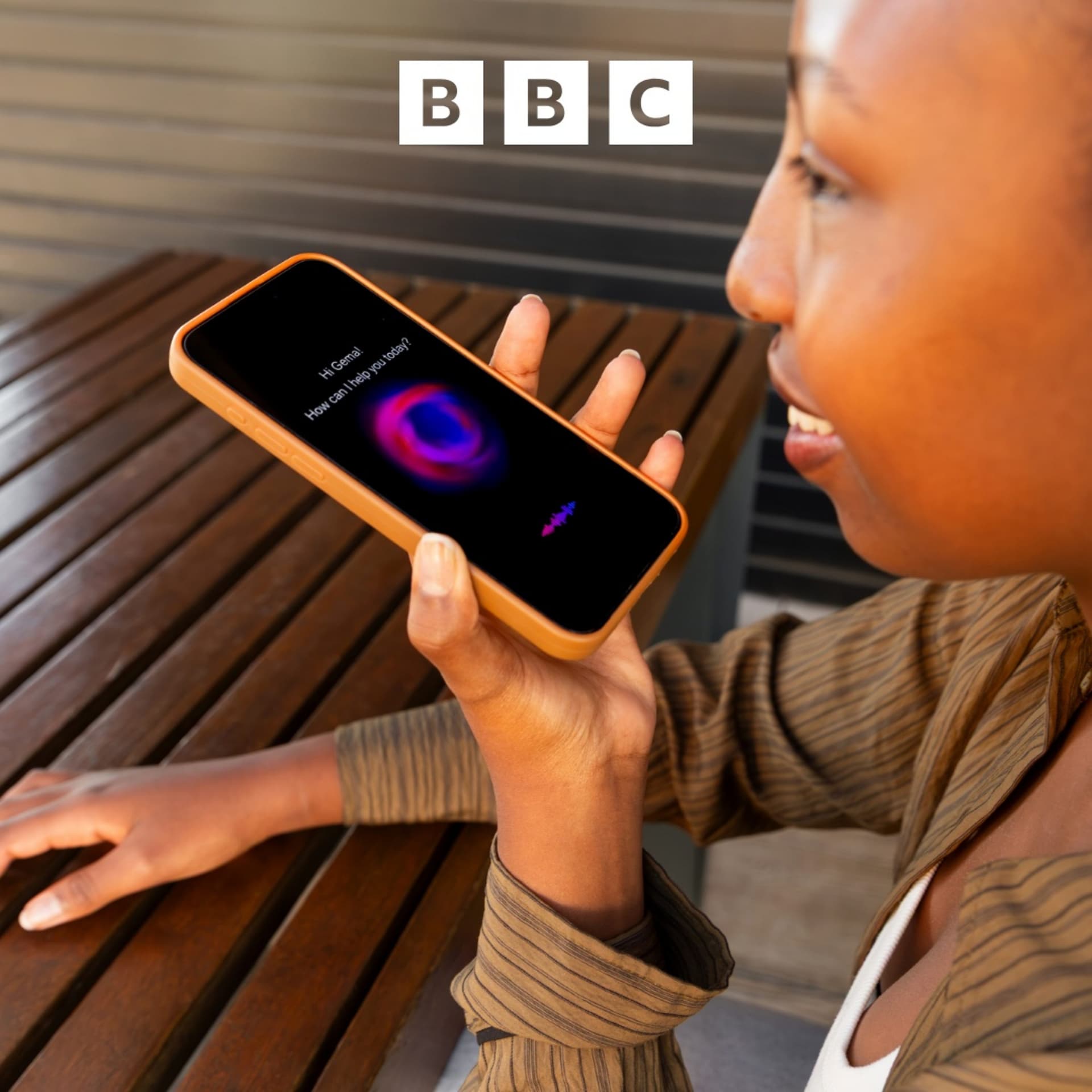
(Photo: A young woman holds a smartphone to her mouth while sitting at a table. She is using a smartphone AI voice assistant. Credit: Getty Images)