In short
Tech Life Podcast Episode Summary: When will a robot do my laundry?
Episode Overview In this episode of Tech Life, presenters Chris Vallance and Joe Tidy explore the current state of humanoid robots designed for home assistance. With a surge of new robotic technologies showcased at CES (Consumer Electronics Show) in Las Vegas, they investigate the feasibility of integrating these robots into everyday home life. The episode raises questions about automation, safety, privacy, and the actual capabilities of these robots.
Key Themes
- Humanoid Robots: The emergence of robots designed to resemble humans aimed at performing household chores.
- Current Limitations: Despite advancements, many robots struggle with basic tasks, indicating a gap between expectation and reality.
- Future Prospects: The episode discusses when we might realistically see these robots in homes and the implications of their use.
Main Discussions
Introduction to Humanoid Robots
- CES Showcasing: Chris and Joe highlight the focus on robot technologies at CES, noting that companies are increasingly looking to develop robots for domestic settings.
- Public Perception: The hosts discuss how perceptions of robots have shifted from replacements of labor to companions designed for social interactions.
Notable Robots and Their Capabilities
- NEO
- Overview: Introduced as a humanoid robot for home use, designed to assist with chores.
- Capabilities: Currently requires human operation via VR, lacking autonomy.
- Company Perspective: Bernd, the founder, emphasizes the importance of data to enhance robot performance.
- Eggy
- Description: A robot designed to operate in home-like environments, performing tasks such as stripping beds.
- Operation: Currently remote-operated, demonstrating the challenges in creating fully autonomous robots.
- Memo
- Functionality: Capable of performing tasks autonomously, such as making coffee, but still requires oversight.
- Training Method: Uses data collected from real homes to improve AI capability.
- Isaac
- Specialization: Focused on folding laundry, showcasing the iterative learning process of the robot as it practices tasks in real-world settings.
Challenges in Development
- Technical Hurdles: The hosts discuss the inherent difficulty in programming robots to perform simple tasks that humans naturally find easy, such as loading dishwashers or picking up objects.
- Ethical and Safety Concerns: There are concerns about privacy when robots are controlled remotely, especially in homes with children. Safety standards are emphasized to ensure safe interaction with humans.
Market Dynamics
- Race to Dominate: Joe notes a competitive landscape among tech companies in the U.S. and China to release these robots to market quickly.
- Consumer Adoption: Discussions touch on the financial implications for consumers, with high costs potentially limiting access to wealthier households initially.
Expert Insights
- Professor Subramanian Ramamurthy from the University of Edinburgh provides commentary on the importance of embodied robots in everyday settings and the complexities of programming them for common tasks.
- Long-Term Outlook: The discussion hints at a gradual introduction of robots into homes, with hopes that they will eventually overcome current limitations.
Listener Engagement The episode invites listeners to contribute their thoughts on whether they would trust robots for household chores, concerns regarding job displacement, and openness to new technology.
Conclusion The episode wraps up with a reflection on the potential of domestic robots, their current limitations, and the ongoing race within the tech industry to innovate and deliver functional robots into consumers' homes. The hosts express cautious optimism about the future of humanoid robots and their role in daily life.
---
This episode provides valuable insight into the ongoing developments in home robotics, highlighting both the excitement and skepticism surrounding the integration of technology into personal spaces.
Written by AI. May contain mistakes. Listen to the episode to check what was said.
Chapters
Tap a time to open that second in VOExploring Humanoid Robots
0:46 to 2:10
Discussion on the rise of humanoid robots designed for household chores.
“Some could stack and remove items from shelves.”
The Future of Robots
2:11 to 2:52
Insights into how robots may blend with human culture and automation.
“I don't know, Joe, if you had a favourite robot home helper from sci-fi or comics?”
Joe's Experience at CES
2:53 to 4:50
Joe shares his experiences and findings from the CES regarding household robots.
“Companies in the US and China have been advertising for humanoid robot helpers around the home.”
Meeting Eggie
4:51 to 6:53
Discussion of Joe's visit to a robot called Eggie and its capabilities.
“Can you describe what we're seeing here then?”
Introduction to Memo
6:54 to 9:20
Exploring another robot named Memo and its advancements in autonomous tasks.
“and there's just a man in a suit who's controlling it.”
Training Robots with AI
9:21 to 11:15
Discussion on how robots are trained and the implications of their operation.
“but there's no doubt this is one of the most capable bots in the world.”
The Ethics of Domestic Robots
11:16 to 13:26
Exploring the ethical concerns surrounding robots in homes and potential job impacts.
“Are we going to have to worry about robots being hacked?”
The Rise of Domestic Robots
14:04 to 17:28
Exploring the competitive landscape of domestic robots and their capabilities.
“No such warnings in the US, but the competition is indeed fierce.”
Inside the Robot Neo
17:29 to 19:39
A deep dive into Neo’s functionality and its current applications in homes.
“But they also said in the same report that if a device can come down to about$20 ,000, then they might see about a million of them a year sold.”
The Folding Robot Isaac
19:40 to 21:52
Investigating Isaac's laundry folding capabilities and efficiency improvements.
“And of course, when it comes to folding T-shirts, you wouldn't do it all day, every day.”
Show all 12 chapters
Challenges in Robotics Development
21:53 to 24:25
Discussing the complexities and challenges in developing practical domestic robots.
“So some of the hardest things are commonsensical things that people just take for granted.”
The Future of Robotics and AI
24:26 to 25:56
A look at how robotics firms are innovating and the potential future of domestic helpers.
“So to that extent, if we were beginning to see kind of, you know, glimpses of these kind of phenomena, then they have to be in embodied machines.”
Transcript
Automatic transcript. May contain errors.0:01Hello and welcome to Tech Life on the BBC World Service with me Chris Vallance and for a special episode with the BBC cyber correspondent, Joe Tidy. Hi, Joe. Hi, Chris. Great to be here. And we are talking about these guys. Hi there. I'm Memo, your future home robot. I'm built to help with chores. Last week, Tech Life was at the biggest consumer electronics show in the world, CES, in Las Vegas, and there was no shortage of talking robots there. That's right. This year, there was a real focus on robot tech, which could help us. We think about robots very differently. They're not here to replace physical human labour, but to have social interactions with humans.
0:40And so we build our robots to look very humanly. And there were many robots designed to help around the home. Some could stack and remove items from shelves. One was spotted loading up a washing machine. And as it was Vegas, a robot holding all the cards. I'm going to deal a card to the player on my left. Well, that got us all thinking. why the sudden tsunami of companies promising us domestic robots to help us at home? Which is why we're dedicating this week's episode to robotic home helps, humanoid robots to help around the house. A robot? Here is me. It's our new domestic model. Oh, no.
1:26And it can handle anything from a soft-boiled egg to a ladle full of hot molten metal and a pot of tea if you like. I wonder if we will make robots so much like men and men so much like robots that eventually we'll lose a distinction altogether and have a combined culture. Automation, it's a frightening word, a nightmare word, this idea of press button factories. But to get it down to the ordinary things of life, all this that's going on around me here, That's automation in a sense. And you know what they're doing? The laundry.
2:05The comics and sci-fi of my youth were filled with robot home helpers, but as 2000 AD wheeled past and the decades after, the dream never really came true. I don't know, Joe, if you had a favourite robot home helper from sci-fi or comics? No, I always liked Red Dwarf, the TV show with Crichton, the kind of sarcastic, sardonic robot helper that the spaceship has. But I suppose that's very different operating a spaceship than it is sort of a normal house. It's funny, we seem to like kind of rather cold robots. I was a fan of the Hitchhiker's Guide and Marvin, the paranoid android, who was always depressed and said he had a brain the size of a planet and all they asked him to do was pick up bits of paper.
2:47Anyway, now we seem to be sort of stepping away from sci-fi and something seems to be changing, bringing it closer to reality. Companies in the US and China have been advertising for humanoid robot helpers around the home. My name is Bernd, and today we're launching NEO, our humanoid for the home. NEO, the robot, Nanny. Let you live with it? Yeah. Well, what does it do? Like my chores, I just leave and I come back and they're all done. Are you kidding me? No. Hold on. Well, Joe, you've been to the United States to see some of these robots in action. Why did you start looking into this? Yeah, so Neo was the first one that got me interested.
3:31I saw a video pop up on a social network, I can't remember which one, and I thought, hmm, this is interesting. Is this real? Because, of course, in the modern world of AI slop, you just don't know these days. So I contacted the company and they said, yeah, this bot is real. You can come and see it if you want. eventually went a couple of weeks ago and went out and saw NEO. And then while I was there, I managed to meet four other different companies that were making AI robotics solutions and three other robots as well. Well, let's talk about one of those robots you went to visit. I gather he's called Eggie.
4:06And the thing that interested me was that the lab kind of looked like a suburban home. Yeah, it was exactly that. They gave us the address for their office, this startup called Tangible AI. and they said, see you there at 10am. We drove up and we went around the block a few times. We're like, we can't see it. There's no office here. But then that's the point. You know, they are building a robot for the home. So they decided to make their HQ a home. They just rented this big house in Palo Alto and they've got all the team there and they're running Eggie through different processes of, you know, wiping down counters in the kitchen or unloading the dishwasher, that kind of thing.
4:41And in fact, they're really living the Silicon Valley startup life because the head of the company, Bipasha Sen, and a few others, they actually live there as well. Well, let's hear a little bit of your meeting with Bipasha Sen and the robot, Egi. Can you describe what we're seeing here then? So you've got the robot, there's someone wearing some of the similar kit. Yeah. How's it all working? So we have a teleoperator who is wearing a suit to teleoperate the robot. So what's the task here, Bapasha? What are we asking the robot to do? So the robot is going to strip the bed. As an MIT robotics dropout, Bapasha spun out a student project, quickly convincing investors to put money into her vision.
5:30Eggy's capability is growing, but everything we were shown involved someone teleoperating the bot, wearing sensors to control it. How long do you think it'll be until Eggy or a robot like Eggy can be in someone's home autonomously carrying out chores. We will see robots in people's homes do something very soon. But if you really want it to become the next car, like we believe today people have two aspirations, usually like a car and a house. In the future, they'll have three aspirations, a car and a house and a robot. So, Joe, was Eggy all he's cracked up to be? Yeah, I know. Ten points for that one.
6:10I mean, he's remotely operated and he still couldn't do all the tasks. Yeah, that's right. Yeah, so Eggie is about five foot, I don't know, five and a half foot, that kind of height, and really quite muscular in a sense. Coloured like an egg, so eggshell, hence the name. And then has normal kind of human-like hands, so quite dexterous hands, but rolls around on wheels. And yes, so when you sort of go in there in this sort of test environment and you see it stripping a bed and hanging up a coat and wiping down a surface of a kitchen top that's got a spill on it, you think, wow, okay, this is actually quite interesting here.
6:49It's moving very slowly, quite stuttery, but it's doing a job. But then, of course, you look across the room and there's just a man in a suit who's controlling it. So what they're doing with Eggy right now is they've got a neural network running, so like an artificial intelligence program, which is learning every time that the human moves the hands and moves around and learns, all right, if I pick up the cloth like this, the physics of that cloth moving in my hand will be such, and then if I wipe the spill, blah, blah, blah. This is the problem, of course, with this type of AI, this physical AI, is training a robot to operate in that kind of environment with artificial intelligence is a massive challenge.
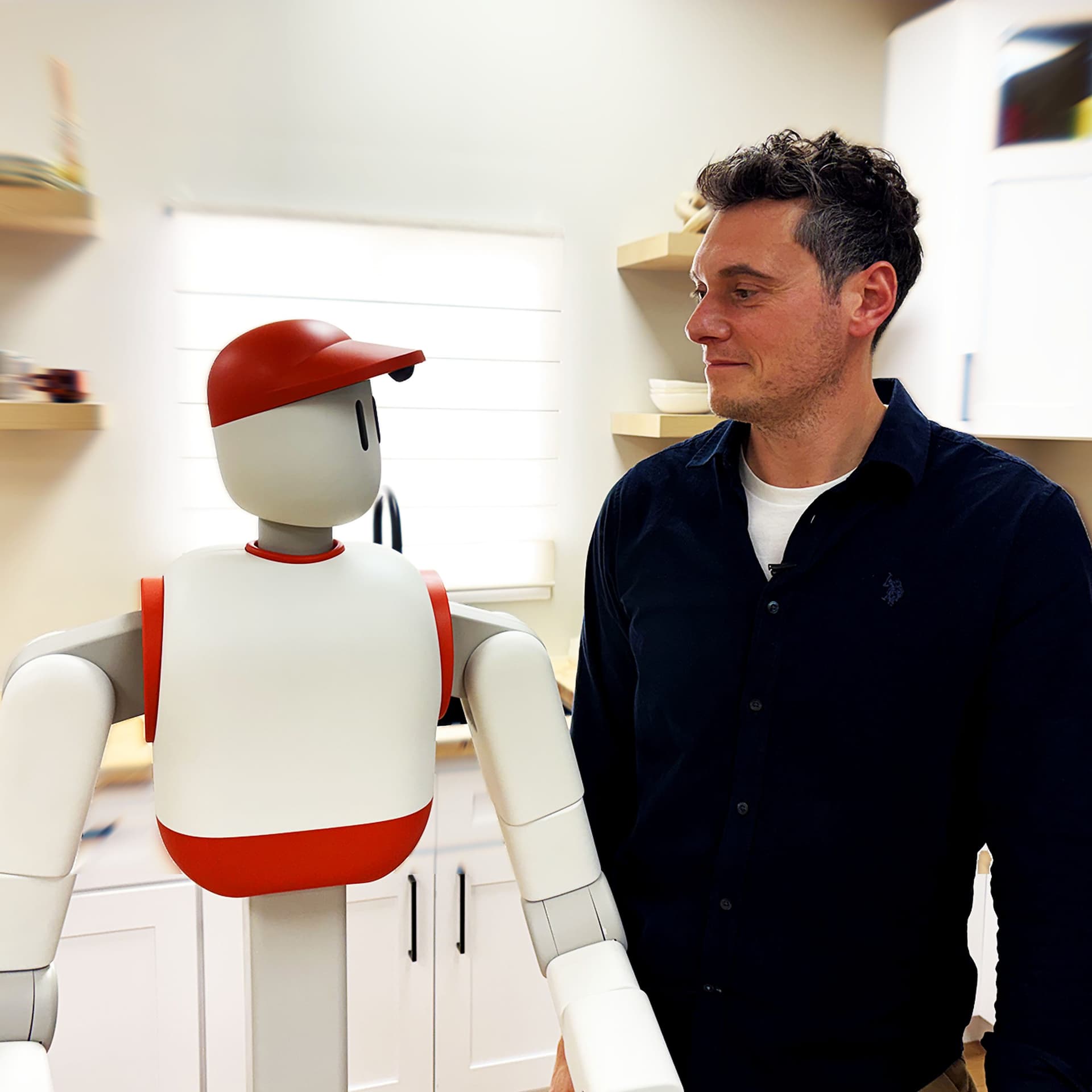
7:27OK, well, let's move on to your next stop, and a robot called Memo. Yes, so Memo, in the same way as Eggy, it's a sort of like half-humanoid shape, so no legs and no feet, what rolls around on wheels, but a head and arms as well. It's also adorable, which really helps. It's got an orange baseball cap on its head, which is how they very cleverly hold the camera, which is how it sees the world. And they have genuinely made some leaps and strides in this company. It's called Sunday AI, the company, and they've managed to teach Memo to carry out many tasks completely autonomously. Well, let's hear a little bit of Memo and the CEO of the company, Tony Chow.
8:11Can you just go make us a cup of coffee? It's after 2 p.m. Would you like me to go ahead and make that cup of coffee for you? Yes, please go ahead. I'm on it. Making your coffee now. So, Tony, can I just check with you? There's no one that we can't see doing this for the robot. This is all autonomous. Yes, it's one single neural network controlling the whole body movement of the robot. Wow.
8:41It was all going smoothly. Then Tony paused the demo as he saw something was off. Maybe we need to restart this. Can we restart this? I think there's a... Can you stop it? I think we might need to do it again. I saw there's some peeling off here. Sorry about that. Let's just try again. Maybe I'm overly cautious.
9:07Oh. Oh, holy. I've never seen this in my whole life.
9:16After a reset, Memo smoothly cleared away the table. There's obviously work to be done to get it ready for Holmes, but there's no doubt this is one of the most capable bots in the world. Can you fold my socks?
9:32How have you got the robot to be this advanced? How have you done it? So I think normally the way we train AI is to teleoperate the robot in people's homes or in other places and gather the data and train the AI. And what we're doing is different, as in we don't need robot data to train the robot. And instead we build these gloves and And people just wear their gloves in their homes and collect data for us. And that gives us really diverse data because we now see more than 500 homes and also all the different ways they go about doing the task. Sunday's army of robot teachers are all being paid to do repetitive, everyday tasks, a reminder of the human drudgery underpinning how these machines learn.
10:14The staff allow cameras and sensors to record their every move at home. But Sunday plans to start shipping memos next year. So if the bot needs to be remotely controlled, it will raise privacy considerations for customers, as well as questions about safety in a domestic setting. There will be kids running around. Kids will be climbing on a robot. So we really want to make sure that we put safety as the most fundamental consideration when we design these robots. You mentioned the training of this, and you've obviously got people watching these robots. I mean, is this tech in general terms? I'm not talking about a specific company here.
10:51Is this going to be more outsourcing where, you know, there are robots essentially doing chores in rich people's homes operated by people in, you know, the global south, for example? I think there's a good chance of that. At the moment, I think the idea is that these companies will have those sort of capabilities in-house. But eventually, yes, I think there will be a move towards making that labour cheaper and therefore outsourcing it to other countries, which will eventually obviously dissolve away as the robots become more capable. And you're our cyber correspondent. Are we going to have to worry about robots being hacked?
11:24No doubt. Yeah, it's the same as the driverless car problem, isn't it? I often get questions, when will there be a hack on a driverless car fleet, which causes mayhem? All of these companies will say that there are safeguards in place. But we are entering a very uncertain time where this technology is both exciting, but also potentially maybe troubling. Well, thanks, Joe. Thanks for running us through that. It's fascinating stuff. We'll be back with you shortly. My robot producer is telling me I have other things to do for a few minutes.
11:59you're listening to tech life on the bbc world service i'm chris valance and today we're dedicating the whole program to a futuristic new generation of domestic appliance humanoid robots you'll know if you're a regular listener that we love it when you get in touch and this week we're hearing from two people in singapore about having robots in the home i think humanoid robots would be very helpful for my day-to-day life because I'm working in office, so there are certain chores at home that can potentially be replaced by humanoid robots. Have you heard about humanoids and is it something that you are interested in?
12:39I think it's good. It helps our daily day-to-day activities. Technology is improving. I feel it's good and if it is very less price, that will be more better and more comfortable. A couple of opinions there about domestic robots from people in Singapore, speaking to the BBC's Jalston Chumar. And we'd love to hear your thoughts on this. Would you trust a robot to do your household chores? Would you pay the thousands of dollars some robots currently cost? Or do you worry domestic robots might take your job? We'd love to know what you think. You can WhatsApp us a voice note on plus 44 330 1230 320 or email techlife at bbc.co.uk Now back to our cyber correspondent Joe Tidy who's been visiting some of these robots in California.
13:34Joe, is there a race going on between companies to be the first to get these robots to market? Oh yeah, for sure. There is a big race going on. Not just in amongst the kind of Silicon Valley bubble, and it is a bubble. I didn't travel very far. And I spoke to five different companies in Palo Alto and in San Francisco. But it's also against the Chinese companies as well. Because of course, we know that the Chinese humanoid robot industry in general is so hot, in fact, the Chinese government recently warned that a bubble might be bursting. No such warnings in the US, but the competition is indeed fierce.
14:07I think the reason for that is because when you can get first to market, then I think you've already got a head start on the competition. But not only that, when you get the bots out to as many people as possible, they can get better. They can learn from lots and lots of different homes on how to do different tasks in different settings. OK, well, let's visit with another of these robots competing to be the leader of the pack, as it were. Something called Neo. Yes, it's a very sort of cute looking robot, about five foot six, I think it is. And it's got these two beady eyes, no mouth or anything.
14:41and it's got legs and feet and it's covered in knitwear. So it's the kind of robot that you could sort of cuddle if you wanted to. And of course, that's the point, because they're trying to appeal to the market of domestic owners that you can have this thing in your house plodding around and being a nice addition to your family and doing all your bidding. Well, let's hear about Neo, Joe. And when you visited, it was turning its hand to gardening, watering the plants in the office. We've just walked up to see Neo in action and someone is operating Neo right now and watering all the plants. I've just been told this is what they do all day.
15:17So there are people in the office operating Neo with a VR headset, carrying out tasks and testing all day long. Good accuracy. Oh, I spoke too soon. Founder Bernd Bornic is pushing hard to get Neo out to homes. He says thousands of people have already pre-ordered. So what can Neo do right now for me? in my home? Yeah, so let me tell you what Neo does in my home. So does a pretty good job of like tidying, so like resetting my living room and my house in general, wiping surfaces, like cleaning the counter, like these kind of things. And that's all someone with a VR headset? It's a mix. It's a mix.
15:58So in my home, we have a lot of data. So a lot of the stuff in my home can get automated because we have data there. Periodically, someone kind of steps in and helps if the robot does not know exactly how to move on. Your first set of customers then, they have to be quite wealthy and they have to be willing for NIO to make mistakes, essentially. Well, I don't think they have to be quite wealthy. It's thousands of pounds though, isn't it? I don't know how much it is. Well, it depends. £40 ,000? Yeah, like are most people who have a car quite wealthy? So you liken it to a car? Yeah, I mean, it is a pretty affordable car.
16:29It depends on your needs, right? A lot of our early customers are people that actually will have a lot of value from this. getting the right customers is more important in the beginning. Distribution with the right customers. So we can really use these amazing people that are our early adopters to help us make this work. They made this claim that NIO could do some of this work autonomously. I mean, but were you able to verify that? No, not at all. And we pushed pretty hard for them to show us some tests, but they wouldn't show us anything autonomous. They did begrudgingly show us some movements of NIO.
17:04For example, he, as you heard there, watered some plants and fetched me a water and then tidied away some cups and things into a cupboard. But that was all done by someone wearing a VR headset somewhere else in the office controlling Neo. So how long before these robots are a reality? I mean, in years, a guesstimate? Well, I think this year or next we will start to see these things shipping. And I think if you speak to the International Federation of Robotics, they will say, you know, it could be a long time, maybe 20, 30 years until these are kind of mainstream and useful. But they also said in the same report that if a device can come down to about$20 ,000, then they might see about a million of them a year sold.
17:46So I think we might be approaching that already. Now, the last robot you visited was one called Isaac, which had a very limited job folding T-shirts. But your report showed practice made perfect. Yes, so Isaac is a stationary humanoid or half-humanoid robot, and we went to see it in action gathering real-world data, which is all obviously helping it to get better. And it was folding laundry, so it was in a laundrette in the corner on a table, and we watched it for about an hour or so, folding dozens and dozens of T-shirts pretty effectively. This is the CEO and founder, Evan Wineland. deployment is the strategy nothing counts if it's sequestered away in a lab this is the very task that we'll also be doing in homes and here we get to prove that it works in the real world bring down the time per article of clothing that we mold here's a t-shirt we'll do a live demonstration there we are okay so this is a lot slower than a human can you can you tell us why it is impressive It is impressive because this thing can run all day.
18:48You often hear that robots are best suited to tasks that are dull, dirty or dangerous. We want to make clothing folding optional for people. Oh, here we go. Hang on a second. Struggling with a little bit at the end there. You know, we kind of care about getting presentation right. That is way better than I would do it. when you first put this robot here how long did it take to do one t-shirt i think that we were looking at two 230 so already what in how many months that's in a month and a half in a month and a half you got down to 130 just over 130 do you reckon you could beat 130 joe uh yeah but it wouldn't be as neat as that it was a perfectionist uh was isaac and that's one thing that weave robotics you know they they they have specialized in this one area but They do it very well.
19:40And of course, when it comes to folding T-shirts, you wouldn't do it all day, every day. And that perhaps is part of the attraction. Joe, your report threw up so many big questions, moral questions, questions about privacy, safety, and above all, how tough a problem building domestic robots seems to be. We can get chatbots to answer PhD-level questions in chemistry, but they struggle to lay a table. Well, to get some answers, I visited the University of Edinburgh. Hello, my name is Subramanian Ramamurthy. I'm a professor in the School of Informatics at the University of Edinburgh. We are in a lab that we call the Field Robotics Lab.
20:17By field robotics, we mean robots that are going to go out into the real world. Initialization finished successfully. It could be oil rigs, it could be construction sites, or it could be just, you know, anywhere around your home. You've got one of your robots that's just charging up. We heard it a little earlier. Yeah, this robot is pretty similar to a human in the sense that it has two legs, two hands and arms. I have to say, I'm slightly nervous. I didn't think I'd feel nervous, but it's very big and heavy looking. It is indeed big and heavy looking. These are all still experimental platforms.
20:53There is a safety harness, which is both for the robot's own good, but also for health and safety of the experimental facility.
21:03I'm Talos, a humanoid robot designed to work alongside humans and enhance their capabilities. I'm eager to help with any task, big or small, and look forward to collaborating with you. Why humanoid-shaped robots? There are two reasons, really. One is just our fascination with ourselves, as it were, and we'd like to see what it would mean to replicate that in a machine. But a much more pragmatic reason is simply that the spaces in which they have to operate are already designed for us. Our kitchens, our hospitals, our warehouses, they're all designed with the ergonomics of a human person in mind.
21:45I mean, these apparently simple tasks like loading the dishwasher, these are really tough problems, aren't they? That's absolutely right. I think what people who haven't worked in robotics might find quite counterintuitive is that things we find very, very easy, things we learned when we were two years old or four years old are very hard for robots. And things we seem to find difficult, and this is known in the rest of artificial intelligence as well, you know, chess is much easier than people initially thought it was, precisely because computers are well adapted to doing those things. So some of the hardest things are commonsensical things that people just take for granted.
22:24But it's not that we take it for granted. It's that evolutionarily that's what we learn to do well because of all the pressures. Do you think people will be happy to sort of delegate maintaining their home, which is their most private and precious sort of space? Will they be happy to delegate that to a machine? I think so. I don't see any fundamental reason why we wouldn't delegate. We already delegate to other people. So as an example, it's pretty common for people to have, let's say, somebody to help with cleaning or with cooking. I mean, there is a question of safety, isn't there, here with these machines.
23:05I mean, they're big, they're powerful, and they're handling things that are dangerous. I mean, you know, gas cookers. This is why I think they're going to be introduced slowly. They're going to take on tasks where small failures, a little bit of failure here and there can actually be accepted. No technology is going to be introduced where its very first use case is absolutely safety critical. That's not how engineering has worked. I mean, there is this sort of school of thought that if you're talking about the development of things that to us are recognizable as consciousness, that needs to be embodied that that needs to be in creatures that are a bit like us in robots that are a bit like us they see the world, they experience the world like us that leads me to ask the question do you think we'll start to see that sort of development first in robots rather than in big sort of language models or databases and data centers?
24:04Yeah, this is a very good question consciousness is a kind of long-standing philosophical question and I don't think there's any settled view on what it is. That said, I think many people believe that consciousness has to derive from embodied experience. You can't have a completely disembodied, you know, brain in a vat, as it used to be called, kind of view. So to that extent, if we were beginning to see kind of, you know, glimpses of these kind of phenomena, then they have to be in embodied machines. A bit of future gazing there with Professor Subramani and Ramamurti. So, Joe, you went round all these different robotics firms, each with a different way of trying to crack the same problem.
24:51What impression were you left with? I think the thing that really impressed me was that these companies in Silicon Valley, they are working in a bubble, but that bubble is very, very well funded and it's very energised to build the future. I was in some of these labs and I went to a lab that was trying to make the brains for robots so not the robots themselves but the artificial intelligence software that you could plug into any dumb robot and it would suddenly be much more capable and it was quite incredible to see these individuals, these engineers all sat round either operating and using robotic type arms and hands or just sitting back and taking notes as these robot arms did things like spread and make a peanut butter sandwich You know, it's just incredible, really, and the money that's being poured into this industry, because none of these companies have made a penny yet, have they?
Read the full transcript
25:43So they're really hoping that this will be a big market. And they're convinced that their vision of a domestic helper robot is not only on the right track, but we'll all eventually want one. Well, that's a strong bet, isn't it? Let's see if it pays out. And, Joe, thank you so much for this tour that has made the sci-fi of my youth something of a reality. Pleasure. It's been an absolute pleasure. having you on the program. Thank you. And if you want to see some of these robots in action, Joe's report is up on the BBC World Service YouTube channel right now. It's called The Race to Create the Ultimate AI.
26:18It really is worth your time. Today's episode was presented by me, Chris Vallance, and produced by Tom Quinn and Imran Rahman-Jones.
From the publisher
How close are we to humanoid robots in the home? A flurry of new robots, designed to look like us, have been revealed recently, with many in Silicon Valley excited that this is the next big leap in AI. But many humanoid robots still struggle with the basics, such as picking up a glass or watering a plant. The BBC’s cyber correspondent Joe Tidy meets some of these robots and asks: Will we really let them into our homes in the next few years?
Presenter: Chris Vallance and Joe Tidy Producers: Tom Quinn and Imran Rahman-Jones
(Photo: Joe Tidy looks at a white humanoid robot wearing a red baseball cap, looking back at him, inside a domestic kitchen setting)