In short
Tech Life Podcast Episode Summary
Episode Title
Would You Wear Smart Glasses?
Overview In this episode of the Tech Life podcast, host Shiona McCallum explores the rising trend of smart glasses, their features, and their potential impact on consumer technology. The episode includes discussions on innovative wearable technology, the introduction of smart bricks from Lego, and the development of AI for underrepresented languages, specifically Cantonese.
Key Discussions
Smart Glasses
- Mainstream Potential: The episode questions whether 2023 will be the year smart glasses become mainstream, with tech companies betting on their widespread adoption.
- Features of Smart Glasses:
- Hands-Free Messaging & AI Assistance: Smart glasses offer functionalities such as taking photos, making calls, sending messages, and controlling media.
- Design and Comfort: Modern smart glasses are designed to be more fashionable and comfortable than earlier models, like Google Glass.
- Different Varieties: A variety of smart glasses exist, from those that offer visual displays to audio-based models without displays.
- Alasdair Keane's Demonstration: The resident tech expert, Alasdair Keane, provides a hands-on demonstration of several smart glasses, including:
- Ray-Ban Meta Sunglasses: These allow users to perform tasks via voice commands and are designed for comfort.
- Even Reality G2 glasses: These feature a display and AI functionalities, including real-time translation and note-taking during meetings.
Privacy Concerns
- Keane highlights privacy issues related to smart glasses, particularly the ability to record images and video without others’ consent.
- The Vice President of Wearables at Meta, Alex Himmel, emphasizes their commitment to user comfort and awareness of privacy implications, mentioning the use of an LED indicator to notify when recording is happening.
Smart Bricks by Lego
- Lego is introducing 'smart bricks' infused with technology such as lights, sensors, and motion detection, enhancing traditional play experiences.
- Demonstration: Shiona McCallum plays with the smart brick, showcasing its interactive features, including sound responses to movements and the integration of storytelling through play.
AI for Underserved Languages
- The episode discusses Voti AI, a company from Hong Kong, that has developed a large language model specifically for Cantonese, addressing the gaps left by dominant AI models focused on English and Mandarin.
- Cultural Importance: The emphasis is placed on preserving cultural nuances and tones within the Cantonese language, aiming to improve user experience in customer service and other applications.
- Future plans for Voti AI include expanding to other low-resource languages and partnerships to further develop language models.
Key Takeaways
- Adoption of Smart Glasses: While smart glasses have potential, adoption may be gradual as consumers weigh functionality against privacy concerns and usability.
- Innovative Play with Technology: Lego's smart bricks illustrate how traditional toys can evolve to incorporate technology, enhancing creativity without losing the essence of play.
- Importance of Language Inclusion in AI: Developing language models for underserved languages is crucial in preserving cultural heritage and providing equitable access to technology.
Conclusion The episode provides a comprehensive look at the intersection of technology with daily life, focusing on smart glasses, innovative toys, and the importance of language representation in AI. It invites listeners to consider how these advancements will shape the future of consumer technology and cultural preservation.
Contact Listeners are encouraged to share their thoughts on the episode and their experiences with smart glasses via the podcast's email or WhatsApp.
---
This easy-to-read markdown format provides a structured overview of the podcast episode, highlighting key discussions, themes, and insights.
Written by AI. May contain mistakes. Listen to the episode to check what was said.
Chapters
Tap a time to open that second in VOIntroduction to Smart Glasses
1:08 to 2:18
Discussing the potential mainstream adoption of smart glasses.
“Hello, I'm Shona McCallum and welcome to Tech Life, the programme about technology and how it affects all of us.”
Exploring Smart Glasses Features
2:18 to 4:23
Detailed discussion on what smart glasses can do and their design evolution.
“For decades, wearable tech has promised to put the digital world in front of our eyes and now smart glasses might be finally having their moment.”
Smart Glasses Demonstration
4:23 to 6:50
Alistair showcases the capabilities of smart glasses and how they work.
“Now, these are the sunglasses that you've got on, but not all smart glasses protect you from the sun.”
Privacy Concerns with Smart Glasses
6:50 to 7:42
Delving into the privacy implications and concerns of using smart glasses.
“So there is some very cool technology being packed into some of these smart glasses.”
Even Reality's Smart Glasses
7:42 to 11:48
Discussion on Even Reality's latest glasses and the future of smart eyewear.
“One of the big concerns people have with your glasses is the cameras and are they recording them without people knowing about it?”
Future of Smart Glasses
11:48 to 13:06
Final thoughts on the adoption and potential of smart glasses in daily life.
“the Chief Strategy Officer from Even Realities there.”
Listener Feedback on Driverless Cars
14:22 to 15:56
Listeners share their views on driverless cars, highlighting skepticism and concerns.
“This is Tech Life on the BBC World Service with me, Shona McCallum.”
Introduction to Smart Bricks by Lego
15:56 to 20:03
Lego discusses their new smart brick technology, enhancing play with interactivity.
“Even the name comes from the Danish words leg goat, meaning play well.”
Integrating Technology with Creativity
20:03 to 20:48
Lego emphasizes the balance of technology and creativity in their products.
“undermining the distinct simplicity of the plastic brick in a digital world.”
AI Language Models and Cantonese
20:48 to 21:28
Discussion on Voti AI's Cantonese language model, addressing underserved languages.
“And now it's time for our next story about something we cover here on Tech Life a lot, AI.”
Show all 11 chapters
Cultural Impact of AI on Language
21:28 to 26:59
Exploration of how AI can help preserve endangered languages and cultural heritage.
“But a tech company based in Hong Kong wants to change that.”
Transcript
Automatic transcript. May contain errors.0:00This BBC podcast is supported by ads outside the UK.
0:30Find out more at polandyourplacetogrow.com. I am Nina Khrushcheva, the great-granddaughter of Nikita Khrushchev, the leader of the Soviet Union in 1962. And I'm Max Kennedy, the nephew of U.S. President John F. Kennedy. We explore what was a terrifying moment in history. The story of the Cuban Missile Crisis. How close the world came to nuclear war. And what they had to do to pull it back from the brink. The Bomb, Kennedy and Khrushchev. All episodes available now, wherever you get your BBC podcasts.
1:08Hello, I'm Shona McCallum and welcome to Tech Life, the programme about technology and how it affects all of us. Could this be the year when smart glasses really become mainstream? Whether you need spectacles to improve your vision or you just like wearing cool looking sunglasses, Tech firms are hoping you'll be buying their latest wearable devices. Alistair Keane's been busy road testing some of the latest on the market. Hey Meta, tell me about these smart glasses. We'll have the answer in a moment. And from smart glasses to smart bricks, it's been a childhood favourite for decades. Now Lego is packing its colourful plastic with lights, sensors and sound synthesizers.
1:50I'll be having a play with it. And we'll be hearing from a Hong Kong tech company that's developing AI for neglected languages, starting with Cantonese.
2:18For decades, wearable tech has promised to put the digital world in front of our eyes and now smart glasses might be finally having their moment. From hands-free messaging and AI assistance to subtle displays woven into everyday eyewear. The technology is moving fast and big players are betting it could change how we work, communicate and see the world. So is the future just a glance away? Well, our resident smart glasses expert is TechLife's Alistair Keane. And you've got some props with you today, Alistair. You're in the studio looking very dapper with some smart glasses on. I feel like I should be at the beach right now rather than wearing sunglasses inside and it's making everything very dark.
3:01But what do these glasses do? Well, I can ask them and it will hopefully tell us. Hey Meta, tell me about these smart glasses. You can use Hey Meta to answer questions and express yourself hands free. You can also take photos and videos, make calls, send messages and control media and volume. For more info, check out the help center and device settings. So they look like normal sunglasses, but as you might have heard there, I can ask it questions and it will tell me information. They can take photos and also video. And generally they can be an AI assistant in your life. And comfortable? They are comfortable.
3:40They're quite light, which is one of the big challenges with this kind of tech. Is it going to be too heavy to wear on your face? But actually, no, these are OK. That's always the thing, I think, is the kind of clunkiness of them and the fact that there's the camera embedded. obviously there's quite a lot of tech in the side of the glasses and historically they have looked quite techy for want of a better phrase. I think when people think of smart glasses, they think back maybe 10 years ago or more to when Google announced the Google Glass, which was, let's just say, not very fashionable. What is coming onto the market now in the smart glasses space has definitely come from a point of view of trying to look fashionable and hoping that that will make people adopt them.
4:23Now, these are the sunglasses that you've got on, but not all smart glasses protect you from the sun. Some have displays, others don't have any displays at all. There's quite a range out there, isn't there? There's loads, and there are loads of companies now coming onto the market to try and get some customers. I've got a couple of pairs with me here in the studio. So I have the Ray-Ban Meta sunglasses, but they also come in a clear lens, and we can talk to them, and it's all very audio-based, the response that I get. But I have this other pair with me, which have a display on them, and they don't have any audio.
4:57When the smart glasses have displays, it means you might see your emails appear in front of you. As I say, I mentioned the Meta and the Ray-Ban. In most parts of the world, they're still only selling this version with cameras and audio, but they also have the Meta Ray-Ban display glasses coming to the market. At the moment, they're only on sale in the US. there have actually been supply issues which is going to pause that rollout. But that means you can see things appear in front of you. If you want to take a picture you can actually see on the right lens what you're taking a picture of to make sure you're getting it in shot.
5:32And they've got a very unique way of controlling them. So you wear a band on your wrist which means you can make movements with your hand and that controls the glasses. And you've had a try, lucky you. I've had a try, yep. and Carolina Arguilas-Navis from Meta talked me through how they work. So you're going to take your thumb and your middle finger and double taps. There we are. The display is just popped up. The display is on. You're on the settings page. How it works is it's called an electromyography technology. These sensors that are on the inside of the band, it's actually going to pick up the electrical signals in your wrist that controls different gestures.
6:09So when you take your thumb and your index finger and you tap, then you're selecting and we know how to read that signal and it changes on your glasses. So using those simple actions, so pinching, I was able to move around a display that, as I say, was appearing just in front of my right eye and I could read my messages. I could do translation. So if you were speaking to me in French right now, it would be translating as you speak into English on my glasses. But one of the coolest features, and I have to say this was crazy actually to be able to do this, was I could write out just on a table using my finger the letters of the text message I wanted to reply and through that neuroband that we were describing it was able to translate that into the text message and ping it off.
6:54So there is some very cool technology being packed into some of these smart glasses. And that was instant? Instant, yeah. Amazing. And my handwriting is terrible and it still managed to understand what I was trying to say. No spelling mistakes? No spelling mistakes. There is this question of privacy though And I think that that's really important that we point out because it's one of the concerns around this type of technology. People are able to record images and video. And some of the glasses do have little lights on them to make people aware that that's happening, but not all of them. No, and not all smart glasses are designed to take pictures of video.
7:31They don't all have that feature. but there is a lot of concern, yes, that people might be filming at inappropriate times or filming or taking pictures of people who don't realise that's what's going on. It's a question that I put to Alex Himmel, who's the Vice President of Wearables at Meta. One of the big concerns people have with your glasses is the cameras and are they recording them without people knowing about it? Well, it's really important to us that not just do you like how the glasses look and how you feel wearing them and that you get value out of them but equally important is that the people around you feel comfortable that you're wearing them because if they don't, you're just not wearing them.
8:06The right side is the privacy LED. When you take a photo, it flashes once. When you take a video, it continuously pulses for the duration of the video. We actually have a light detector on the LED. So when you activate the camera, we detect if light is able to enter that LED. And if it's not, it means someone's trying to cover it and the camera doesn't work. Okay, so we've spoken quite a bit about Meta's glasses, the ones that you had the demonstration of and the Ray-Ban sunglasses that you've been wearing. But you also have the Even Reality's glasses with you, the G2 model, their latest model.
8:42And you did use them earlier on in our editorial meeting, which was interesting. Yeah, I've just done a quick switch of glasses. That was the case shutting there. in the room and now that I don't have sunglasses on I've realised I'm in a bright studio that I can see everything that's going on now. These are very neat glasses because they have a green display on them and it shows me the time, it shows me any messages that are coming in, it can do translation. I've tried out the translation in the wild in a museum in Germany where the person behind the front desk was chatting to me in German and it was able like subtitles to appear before me.
9:20But in the meeting today, I used a tool on these glasses, which was able to listen to the whole meeting, and then take a record of what was happening and give me notes throughout, including at one point, it flagged up an exclamation mark and said fact check. And when we clicked on it, in fact, some information that a colleague had given us wasn't quite correct. And it was doing it all in real time. So yeah, some of these tools have immense power. The glasses are connected to my phone and my phone was on Wi-Fi but if I had been using a data or cellular signal it might have cost me a fair bit over time to use these tools.
9:56They do need to be connected to the internet but yeah very impressive. And also connected to the ring you mentioned the wrist feature for the Meta glasses but this one is a smart ring. Yeah I've got a ring on which is similar to other wearable rings technology where you might count your steps and your heart rate and things. But it is also allowing me to swipe through a menu and control and I can read the news and I can swipe through the articles using swipes on a ring. Well, actually, I've been speaking to the company's global brand builder, Nikolaj Schnur, and I asked him about Even Realities.
10:29So Even Realities is distributed through top opticians. In Europe, we have over 300 top opticians. In the UK, we have in Denmark, we have Germany, Italy. I think we are now in 40 countries represented and the optician is important because he can do the eye test he can do the fitting for the lenses that is kind of a game changer for the smart glasses that you can fit them with your prescription lenses even progressive lenses. In terms of the overall picture then and the market you know how do you see these becoming more popular? I think there's a big shift in the eyewear industry I have been myself in it for 25 years this here is kind of the big moment for eyewear in general.
11:13Smart glasses will be the most obvious device to wear because 80 % of the population is wearing them anyway and already. So you're not adding on a next device around your neck as a chip or as a pin or as something else. It's just a question of what do we put into the glasses? How easy are they to maneuver in? How easy are they to control? how easy it to turn on and turn off when you don't want it. So we see the glasses will be kind of your centre point for your connectivity in the future when you're outside of your house. So that was Nikolai Schnur, the Chief Strategy Officer from Even Realities there.
11:53Now, tell me then, after all of this discussion and everything that you've seen in smart glasses, you've tried quite a few pairs on now, do you think this tech is going to take off? Do you know, it feels like we are on the cusp of something here, partly because glasses in general is something that people are used to wearing. So as a tourist walking around a city, wearing sunglasses, being able to chat away to them and find out more information about where you are without having to get your phone out and be glued to that is a very impressive and helpful tool to have. So it does feel like some of this could be about to happen.
12:29I think some other big players like Google, maybe even Apple down the line, will also release smart glasses. And that might bring them into a bigger market. To start with, I think it will be slow. I think they offer great accessibility features for people perhaps who are visually impaired, who using the audio based glasses will be able to experience the world in a different way. They might be an early adopter of them. But yeah, definitely I'm going to be looking out a lot more in the street now for people who have them on. Okay, great. Lovely to chat to you, Alistair Keane, and talk through this tech and actually have some tech here in the studio as well.
13:03It's fun to play with it. Absolutely. Thank you so much. Speak to you soon.
13:26momentum, resources, and reliability you need to take your business further. Poland, where businesses don't just grow, they're built to last. Find out more at polandyourplacetogrow.com. I am Nina Khrushcheva, the great-granddaughter of Nikita Khrushchev, the leader of the Soviet Union in 1962. And I'm Max Kennedy, the nephew of U.S. President John F. Kennedy. We explore what was a terrifying moment in history. The story of the Cuban Missile Crisis. How close the world came to nuclear war. And what they had to do to pull it back from the brink. The bomb, Kennedy and Khrushchev. All episodes available now, wherever you get your BBC podcasts.
14:22This is Tech Life on the BBC World Service with me, Shona McCallum. Last week we were talking about driverless cars. We asked for your thoughts on the technology and we've been sent this short voice memo on WhatsApp from the Caribbean. Yeah, hello BBC. My name is Tyron Freelfield. I'm from Dominica. And I don't think anytime soon we'll have driverless cars in our country now. Well, thanks, Kyron, for sending us that. I'm glad to hear that you're listening to us in Dominica. Not too far away, I suppose, a regular Tech Life contributor, Juan Carlos Dominguez, he emailed us from Cuba saying getting in an autonomous vehicle will be scary and weird at the beginning.
15:03Let's say hello to Wally McKinnon. You emailed us from Ontario in Canada. At some time in the future, I would like to switch to a hybrid or an all-electric vehicle, but I have absolutely no interest in buying a car that can drive itself. Well, fair enough, Wally. I'm not sure they'll be for sale for a long time anyway. A little closer to TechLife Global Headquarters now, Roderick Urkert emailed us from the northwest of England to ask how driverless vehicles would cope with potholes. He says many roads are already in poor condition and the rapidly increasing numbers of heavier electric vehicles will only make the situation worse.
15:40Yeah, good question, Roderick. The wet and cold winter climate here in the UK does create some nasty holes in our roads. Well, thanks to everyone who contacted us. We've read all your messages. If you want to tell us about any tech that's on your mind, you can email us. Particularly if you've tried smart glasses, what did you think? techlife at bbc.co.uk is our email address or you can WhatsApp us a text message or a voice note the number is plus 44 330 1230 320 please remember to include your name and the country where you live
16:19From a carpenter's workshop in Denmark to a global icon of creativity Lego has been teaching generations how to build, imagine and experiment. Even the name comes from the Danish words leg goat, meaning play well. Now the company is giving the simple plastic brick an upgrade, launching the smart brick. What if you could bring your imagination to life for real? Play with your creations and let them play back with you? Well, that's exactly what we've built. Julia Golden is the Lego Group's chief product and marketing officer. The brick is packed with a tremendous amount of intelligence that's all stored in a silicon chip.
17:01The new smart brick is packed with sensors, light, sound and motion. It is designed to bring physical play into a new tech-powered dimension. Think of it as a brain for the bricks. It also connects to tags and minifigures and then responds in different ways. The whole system that we introduced has over 20 different patents associated with them, so it's very proprietary technology, but essentially it's a super intelligent brick. I gave it a go at the launch in Las Vegas. If you just put this first tag onto the smart brick, now we start the magic, because if you actually turn the brick a little bit around, you will actually see that the sound is actually responding to how you move the brick.
17:45Soren Holm is the Lego Group's lead producer. Try a different one. So you actually have the same brick now. But now the tag shows the smart brick. It's a helicopter. I might need to fly it. I think you need to fly it a bit in the air.
18:01Do you feel that it's responding to how you're actually moving it around? It is, yeah. Yeah, yeah. What happens if you turn that upside down? Oh yeah, not good. Dangerous flying. And another demo, this time with a quick game of cops and robbers. Let me show you, play out a little story for you so you can see how it works. So he will go here. Oh no, now the alarm went off. Go away, I will come. And then when the policeman is in the front seat and drive, then you will get it. Now of course it's the policeman in the front seat so now it will be chasing the robber. There's no app or screens involved, but a potential issue for creative kids who want to play for a long time is battery life, which only lasts between half an hour and 45 minutes.
18:46Tom Donaldson is the Senior Vice President at the Lego Group. A simple way of thinking about it is the brick is a bit like a console. It's something that doesn't have a particular play experience. It just has a lot of capabilities that can be used for many play experiences. And both the tag and the minifigure are the play experience. The brick has a sensor, a light sensor, a colour sensor, but it doesn't say what to do with a light sensor or a colour sensor. The tag has some code that says, when it's dark, turn the light on. When it's light, turn the light off, something like that. That's on the tag.
19:16The brick is the broad capabilities of sensing the light and responding and communicating. The first collaboration that Lego are doing with the smart brick is with Star Wars, a partnership that they've had for 25 years. It went down really well with the adults in the room at their launch event, but the big test will be in March, when it's released to children. You've obviously tested this technology with children already, but what's your expectation when the product does come to market? We want to see this platform starting to grow into how the fans are actually experiencing the Lego system on play.
19:49We know that kids love mashups, so they will take different sets, mesh them together, they will bring different characters into a scenario, even though they might come from different worlds. And this just gives them an opportunity to take it to another level. There have been concerns about the new tech-enabled products undermining the distinct simplicity of the plastic brick in a digital world. Is Lego feeling the pressure to stay relevant in the digital age? Yeah, actually we have not looked at it as a threat. We've looked at digital as a massive opportunity and we've really embraced it. Rather than looking at it as digital screens, games, opportunities for engaging experiences, we're looking at technology and what's the advancement in technology enabling us to do.
20:34And I think what we've done today is shown interactivity that can work itself seamlessly into physical products. That has never been done before. And in this connected world that we live in, LEGO is betting that smarter bricks don't replace imagination. Just blow into the brick. They just give it more to play with. Happy birthday. Oh, happy birthday. That's really nice.
21:04Right, the time for play is over. And now it's time for our next story about something we cover here on Tech Life a lot, AI. But most of the artificial intelligence we talk about comes from just two places, the United States and China. And that means AI chatbots are usually built in two languages, English or Mandarin, which means some of the other languages can get overlooked. But a tech company based in Hong Kong wants to change that. Voti AI claims it has built the city's first large language model designed specifically for Cantonese, a language spoken by millions but rarely prioritised in AI.
21:44And the company says this is only the start. Pak Sung Ting is the CEO and co-founder. You know, we built the Cantonese large language model. And so it's a specialised foundation model. So it understands authentic Hong Kong Cantonese. And this includes, obviously, formal Cantonese, but also includes slangs, tones, and mixed language usage. So it does also support chatbots or what we call text-to-text interactions. But beyond that, it supports a much bigger sort of mission, which is to unlock the enterprise-grade-like solutions similar to what we see in the U.S. So that includes voice agents or meeting assistants, things that large language models are actually really good at doing.
22:32And why a Cantonese LLM specifically? Cantonese carries a very unique cultural and linguistic nuance that a lot of the other AI models, like the global ones we see, they often fall short when it comes down to understanding spoken Cantonese. You know, this again goes down to colloquial expressions, to tonal subtleties, and code switching with English. Code switching is something that, I know it's a term that we use in Hong Kong, we speak in Cantonese. But throughout the sentence, we'll switch to English and then switch back to Cantonese. So these are what we call code switching. Now the problem with large language models is that when you have, when it's dedicated to a certain language, it tries to understand only in Cantonese or only in English.
23:22But things like in Hong Kong where we do a lot of slangs and code switching, it starts to break down. And where it becomes very useful is when you call customer hotlines, for example. And the customer agent would speak to you, of course. And then when you're using large language models to hopefully replicate that service agent, that's where it breaks down. So the gap really leads to misunderstandings, compliance risk and poor user experience. Having a dedicated Cantonese large language model, one, you ensure accuracy. Two, you build trust. And three, you support regulatory needs. And then there's also a social mission behind this whole thing, which is to preserve language digitally.
24:05You mentioned Hong Kong. Is this specifically for Cantonese speakers there? Is it for anyone anywhere in the world that speaks Cantonese? Yeah, it's a good question. So in Hong Kong, there's about 7 million people who speak Hong Kong Cantonese, what we call Hong Kong Cantonese. But globally, the number of Cantonese speakers is actually 10x. So there's over 80 million people who speak Cantonese. So it's actually good for Chinatowns overseas. It's not just for Hong Kong Cantonese. It's for anyone who speaks Cantonese. And what's next for your product? Yeah, so Hong Kong Cantonese was, I would say, the sort of start for this whole push towards building more languages for emerging markets or what we call low resource language.
24:50You know, there's over 7 ,000 languages in the world, a lot of them being endangered. You know, one of the things we built to tackle this problem was we built a platform called VotiMagic. And Voting Magic helps us build the infrastructure to help build enterprises and create more sovereign domain-specific models for underserved languages. More specifically, I'm here in Jakarta. We're looking to Southeast Asian languages. Indonesia, they have more than 700 languages, for instance. We're also looking to African languages. We're also looking to languages in Canada that are considered endangered, which are spoken by Indigenous people.
Read the full transcript
25:31It's a really interesting topic and one that we have covered on the program before. Do you think that there is a worry for people who speak underserved languages that they could be left behind in this AI age? I think this is the exact reason why we set up this company and this mission as well. So by some estimates, languages are dying every two years or three years. With this whole AI revolution, there's a big blind spot. And this blind spot are these languages that have been underserved, or what we call low-resource language. And what happens is that you either use sort of flawed tools, like tools that say, let's say, the big models, but then translate it back into their own language, or they're forced to use English.
26:19Either way, you're kind of marginalizing languages that have already been neglected. And so if you include these languages, these training sets that are part of these endangered languages, be part of this whole LM training, large language model training, then at least for one, you can preserve these cultures, these heritage that are inherent in these languages. And a lot of things can actually be old knowledge, old medicinal knowledge. These can actually be sort of captured through this digital revolution. And what do you think needs to be done across the industry then to make that a priority when tech companies are making these LLMs?
27:06I think it's really just the way we sort of tackle this, which is to do partnerships, not just from a private sector apart, but also with governments, with universities, with academia. That's one. And then two is, once you build a large language model, you have to evaluate this as well, which means you have to hire people that speak these endangered languages. It's almost like building an ecosystem, a community. And over time, as models are able to speak more and more languages, this kind of hopefully sets a bigger economic reality for larger companies, which then hopefully they will also see this as something that they need to also fulfill.
27:48My thanks to Pak Sung Ting from VOTE AI, speaking to me from Indonesia.
28:01Well, we've reached the end of this edition of Tech Life. Thanks for listening. Remember, you can contact us by email about any tech that's on your mind. The address is techlife at bbc.co.uk. Or you can WhatsApp us on plus 44 330 1230 320. You can also send us a voice message. And please remember to include your name and where you live. Today's Tech Life was produced by Tom Quinn and presented by me, Shona McCallum.
28:43This advertisement feature is paid and presented by Poland's Ministry of Foreign Affairs. Looking for the perfect place to grow your business? For over 30 years, Poland has been a launchpad for innovation at the heart of Europe, powered by world-class research and ambitious young talent. From bold startups to established powerhouses, Poland offers the momentum, resources and reliability you need to take your business further. Poland, where businesses don't just grow, they're built to last. Find out more at polandyourplacetogrow.com. I am Nina Khrushcheva, the great-granddaughter of Nikita Khrushchev, the leader of the Soviet Union in 1962.
29:19And I'm Max Kennedy, the nephew of US President John F. Kennedy. we explore what was a terrifying moment in history. The story of the Cuban Missile Crisis. How close the world came to nuclear war. And what they had to do to pull it back from the brink. The bomb, Kennedy and Khrushchev. All episodes available now, wherever you get your BBC podcasts.
From the publisher
Is this the year when smart glasses become mainstream? Whether you need spectacles for your vision, or wear sunglasses, tech firms are hoping you'll buy their latest devices. Tech Life's Alasdair Keane has road tested some of the latest wearables on the market.
From smart glasses to smart bricks! It's been a childhood favourite for decades, and now Lego is packing its colourful plastic with lights, sensors and sound synthesisers. Shiona McCallum plays with the new tech.
And we hear from a Hong Kong tech company that's developing AI for neglected languages, starting with Cantonese.
Presenter: Shiona McCallum Producer: Tom Quinn
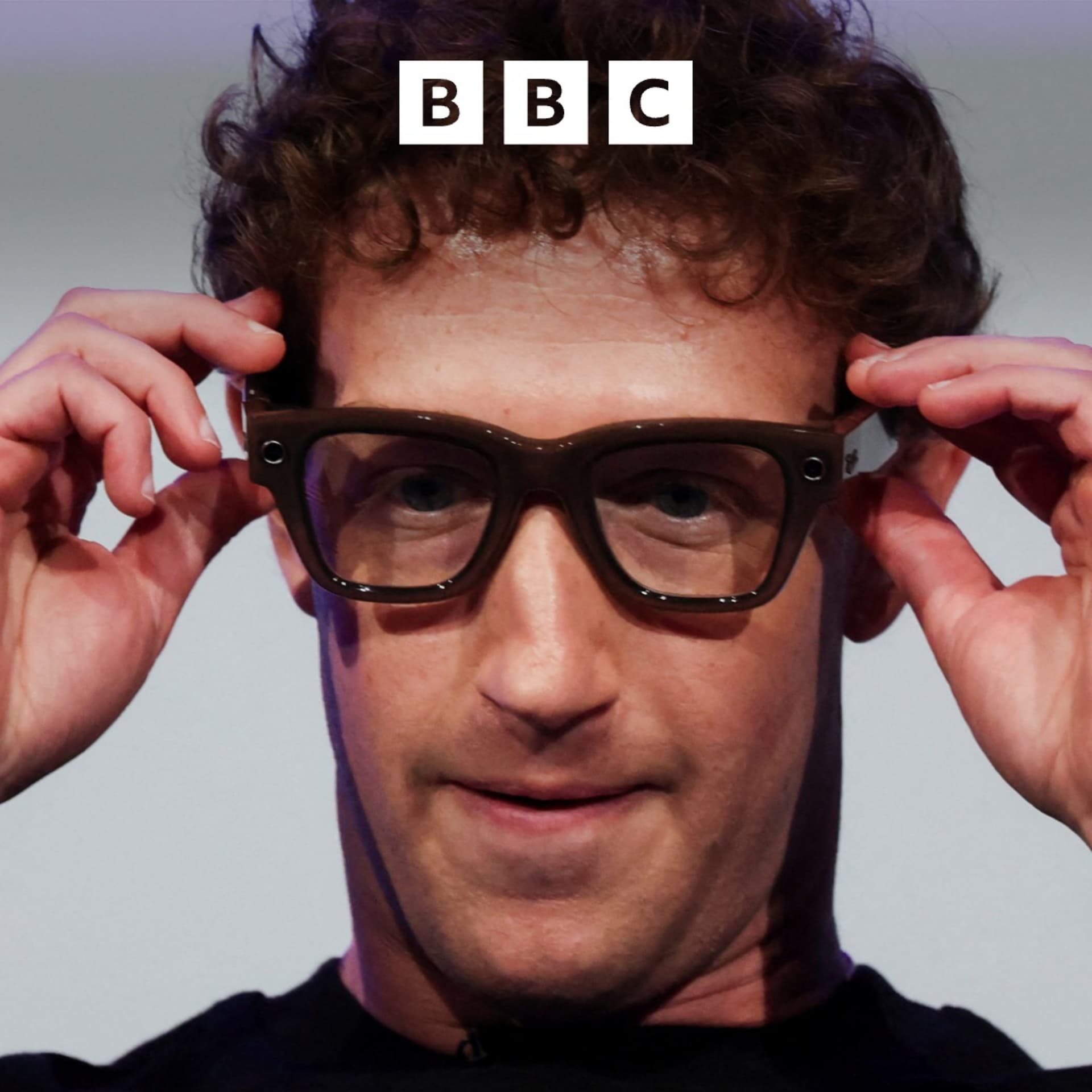
(Image: A photo of Mark Zuckerberg, the CEO of Meta. He is wearing dark-rimmed smart glasses. Credit: Reuters.)