Ask ChatGPT
 The Bottleneck Podcast
18 Oct 2026 · 1h 13m · 26 chapters
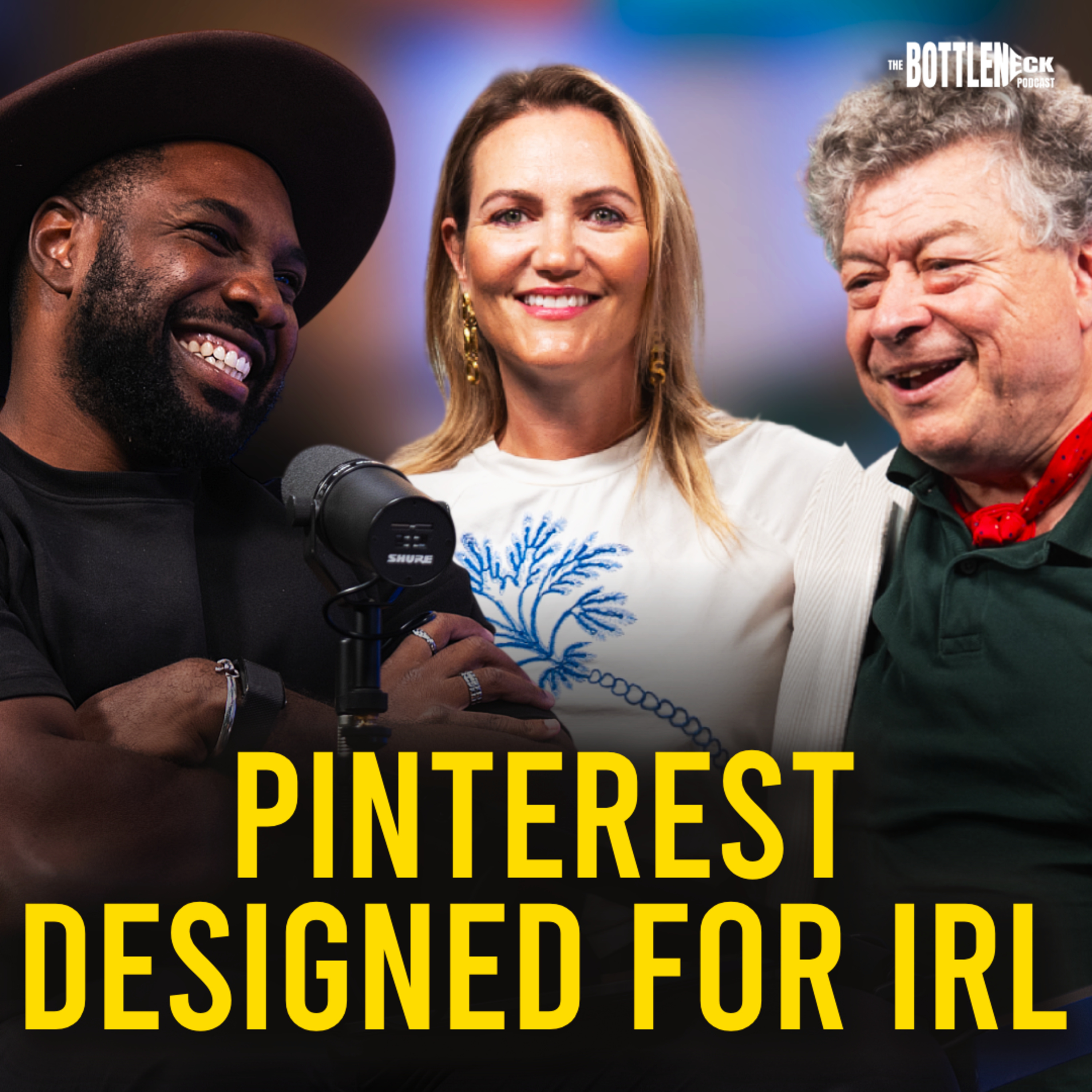
Fear of Better Options (FOBO) and why “considered” decisions need different advertising and measurement than impulse clicks. The episode argues that platforms like Pinterest help people plan real-world actions by matching intent, reducing return rates, and enabling confidence through taste-based personalization.
Written by AI. May contain mistakes.
Exploring Caroline's background, her views on Pinterest, and marketing bottlenecks.
“what you do, and what are some of the bottlenecks that are existing within your line of work and your space.”
Discussing the importance of real-world actions and consumer intentions on Pinterest.
“And actually even the measurement online, it's not always that simple.”
How Pinterest's data can accurately predict future trends and consumer behaviors.
“Can you do a deal where it's available on Samsung TVs?”
Examining how long-term trends influence consumer decisions and marketing strategies.
“So, you know, and we've got color palettes and it's across a whole horizontal bunch of things.”
Discover how Pinterest identifies long-lasting trends and the cultural shifts influencing them.
“And essentially what Pinterest is doing is based on intentionality themes that they're seeing on the platform, because there's like a future intention.”
Explore Caroline's unique career path and the lessons learned from diverse work environments.
“Old people come to say, can you help me?”
Discussing the increasing importance of emotional intelligence in leadership roles.
“That's the only way you're going to be able to set yourself apart.”
Exploring the significance of understanding why customers behave as they do.
“But I completely agree with you on the sort of rise of the CMO CEO.”
Analyzing brands' current strategies and the shift towards creativity over metrics.
“So what's one of some of the funny things, and actually this is to both of you, what's some of the funny things that you're seeing brands do that you're like, that's not going to work going forward.”
Examining the challenges of AI in personalization and the risk of it being intrusive.
“we want all the benefits that come with AI.”
Discussing the complexities of choice in relationships and the impact of first impressions.
“I think you can't mention AI without talking about personalization.”
Exploring how first impressions influence relationship dynamics and consumer behavior.
“It's a market-clearing mechanism, which is that our tastes diverge massively on contact.”
Discussion on the Argo appliance and its relevance to first impressions in dating.
“it wood fired it's an argo I live in Surrey, I apologise I apologize.”
Exploring the personal intricacies involved in booking travel and making choices.
“I never allow anybody else to book my travel.”
How major life changes affect brand loyalty and consumer behavior.
“The other thing about, it's a slight tangent, but the other thing about choice, and you'll know much more about this than me.”
Impact of formative experiences on brand preferences and consumer habits.
“certain brands does everybody here remember EMA?”
Discussion on the nature of friendships and loyalty in social media contexts.
“There's an evolutionary theory to that, which is that for two compounding reasons, the gains to experimentation are higher when you're young.”
Exploring how personal taste influences creativity and social connections.
“And I think that whenever people talk about relationships, they often go straight to dating, but they don't think about friendships.”
A critical look at the complexities of social media and potential government bans.
“And I think play is really important and joy is really important.”
Explore how time pressure and stress at airports lead to impulsive buying decisions.
“So we talk about time well spent as opposed to time spent.”
Discuss the relationship between spending and enduring happiness, referencing experts and personal insights.
“But it's not conducive to good decision-making.”
Analyze the motivations behind gift purchasing, particularly at airports, and the psychological implications.
“kicking around as well you can't go wrong with that vintage and that's actually very nice thank you I've got you brilliant I'm doing a watch a watch comparison yeah I'm not in this game but but That's fantastic.”
Examine how consumer behavior changes in response to economic factors and trends, such as GLP-1 drugs.
“But sometimes it's just you're away from your loved one for a little bit.”
Explore creative marketing strategies and the importance of understanding consumer behavior.
“Because I always tell people that I have my Marcus Aurelius marketing and then I have my Machiavellian marketing.”
Learn why finding reasons to go offline can benefit individuals and society.
“because I don't think we are serving either the goals that you've got all society very well by keeping us endlessly entangled.”
Discuss the concept of intentionally worsening user experiences for profit.
“And also to go offline to play and dream.”

Get the gist, explore an idea or ask about something said.
 Claude
On The Bottleneck Podcast, what are the key points of this episode?
Searching your listeningAutomatic transcript. May contain errors.
0:00When you need to build up your team to handle the growing chaos at work, use Indeed Sponsored Jobs. It gives your job post the boost it needs to be seen and helps reach people with the right skills, certifications, and more. Spend less time searching and more time actually interviewing candidates who check all your boxes. Listeners of this show will get a$75 sponsored job credit at Indeed.com slash podcast. That's Indeed.com slash podcast. Terms and conditions apply. Need a hiring hero? This is a job for Indeed Sponsored Jobs. Propel Fitness Water with Gatorade electrolytes, zero sugar and vitamins.
0:35Propel hydrates better than water to help you get the most out of your workout and get back to your best self. What propels you? Propel with Gatorade electrolytes.
1:00Caroline, I'm really excited about this episode. You're one of my favorite people, purely from your energy, your creativity. We all, well, Rory and I met at WPP Stream in Greece. We met in Cannes with Rory as well. We were sat next to each other at a dinner, and we basically spoke for like two hours. And it was exciting. And then now we're here on a podcast. So I was excited to be able to get you on here. I think the work you're doing is phenomenal. And we were eager to get you here as a guest. But without further ado, we love to make sure that our guests own their own, basically their own narrative, and they introduce themselves for the audience, for our audience that may not know about your work.
1:43So it'll be great to give you the floor to tell us about yourselves, what you do, and what are some of the bottlenecks that are existing within your line of work and your space. Okay. Wow. I love meeting you. You're my new BFF. We've known each other a long time. So I'm Caroline Orange-Northy. I'm the Managing Director of Pinterest in the UK and Ireland. My origin, I'm originally from the North East or beyond the wall, as my husband likes to say. He's very distinctly Lannister and I'm either Queen of the North or Wildling, depending on the day. But it means that I've always had a very practical view on what's important.
2:25You know, like real life, real people, real outcomes. And my Pinterest usage is very typically me. So I have these like quiet moments. Someone called Pinterest the last quiet corner of the internet, which I loved. But I have these quiet moments where I'm planning what to wear, where to travel, you know, what to do with the house. Actually, I've got a mild obsession with reclaimed encaustic tiles from Cadiz circa 1900. Wow. I know. Well, that's what Pinterest does to you. But I also really love the platform because I feel like it's not about the endless scroll. Yeah. And what people are planning on Pinterest, they ultimately want to do in the real world.
3:12And I think that the bottleneck that we experience in marketing sometimes is that for a long time, we've been optimizing for the wrong things. Which is effectively find something online, buy something online in other words go and live your life yeah go and live your life in fact our new brand campaign is about the best thing to find online is a reason to go offline ooh and I think I think that I think that's really cool because if we're optimising for clicks over decisions reach over resonance volume over value I think we've lost the point of marketing because most brands most brands actually want you to do something in the real world yeah the goal isn't attention for the sake of it They want you to go and wear the outfit.
3:55There's also a problem where you're a very necessary corrective because if you sell something which is predominantly available online, your tracking and your accountability figures are all very fast and very reliable. They saw this, they did that. Measuring what happens in the real world is harder. Consequently, too much online advertising is of necessity because it's self-justifying, is encouraging people to stay online. when actually what marketers want people to do is to get out there and actually do something. If you're CPG, you eat it, you wipe it. You exist in the real world. Yes. Very few things.
4:31And actually even the measurement online, it's not always that simple. I think the problem is that we've optimized towards the things that are simplest to capture. We've been doing it for so long that spreadsheets have become realities that we trust. But, yeah, I think that's a really special moment where we think about how do we manage the exit? I don't think we're designing for the exit because endlessly scrolling is inaction. And what's the point of that if you're trying to sell something? Yeah. And that's phenomenal because there's a lot of things there. I think that Pinterest is vastly underrated because when we were at Gymshark, we always talk about the concept of IRL to disrupt URL.
5:17So you do things in real life that you can actually storytell digitally. But then we also realized that there's a lot of intention that people are pinning on Pinterest. And whilst we were focusing on other platforms to ensure that we got awareness, et cetera, et cetera, we could see intentionality of what people actually had an interest in and what they were actually going to buy. Maybe not today, but at least within the next 30, 60, 90 days based on the trends that we saw on Pinterest. So on Pinterest, you could see further out. It was further ahead. It's almost like future. It tells you about the future.
5:50We'll probably get a guest on from Tickle, which is interesting, which is, I don't know if you come across them. It's a banner advertising technology where the call to action is saved to wallet, not by now. Yeah. So it's a bit like direct mail in that it's capability. And, you know, when I'm next in Sainsbury's, I will buy this shampoo rather than buy the shampoo now. Yeah. And if you think about online advertising, it's hugely geared towards impulse purchases, which you buy immediately online, because that's where the tracking looks attractive. And actually, you know, nobody buys a toilet on impulse, right?
6:26OK, there are a few... Well, again, if you want to go into design lending... Or a shower. I actually had a whole pinboard of Lou's, but yeah. I'm going to ask a favour. Now, some people's Pinterest are going to be very, very private to them because apparently there are women who have wedding Pinterest of which their partner is completely unaware. We advise keeping those private. I will give you a real-life example, right? So yesterday I'm having some dinner with some friends and we're talking about Pinterest, right? And what happened was I basically told them, do you know that most women have a Pinterest board?
7:07I was like, my partner has one for the wedding day, etc. And he was like, oh, that's crazy. And then he went to his partner and said, do you have one? She was like, yes. And they all had one. It's all structured. It's like the invites and everything like that. And they don't even know. Like that literally happened to me yesterday. So they're not engaged? Not yet. There's a clear buying signal there. There's an intentionality there. I think intentionality, I mean, I often talk about attention is fragmented. Intention is usually whole. Oh, beautifully put. Thank you. But I think when you come to Pinterest, so we see ourselves as a visual search and discovery platform.
7:49But there's a lot of commercial intent behind those searches. More than 50 % have commercial intent behind them. People are coming because they want to do something in the real world. Can you do a deal where it's available on Samsung TVs? Have you ever thought of this? Because Pinterest on the big screen would be fantastic. Yep. I mean, good news for you is folding phones. That's inherently good news. There's a fascinating fact, by the way. I speak to Benjamin. But there's a fascinating fact which really interests me, which is that the average scroll speed on Pinterest is about three times slower.
8:20It's three times slower than people's scrolling behavior on anything else. So it's the quiet, slow corner of the Internet as opposed to the dopamine hit Internet. Yeah. And I think that sometimes we're undervalued, particularly within media agencies, when that dopamine hit means sometimes you're sharing. you're less likely to say, look what I was pinning last night. And my team talk about Pinterest being for yourself, not your selfies. But that lack of dopamine hit means it's a more considered purchase. And one thing that no one ever factors in, I don't know if you ever did at Gymshark, does anyone ever factor in along the media line the cost of return against the media ROAS?
9:03Because at a dopamine platform, you might buy 10 tops and send nine back. If you've made a more considered purchase, you might buy two and keep them both. Somebody else was making exactly the same point, which is that if you put higher quality retail information on a retail site, the value of that may be partially in an increased, possibly even a decreased, a marginally decreased level of sale. Yeah. But the real gain is a vastly lower level of return. Well, actually, you've touched on something there, which is around confidence in a purchase. Because actually when you look at things like cart abandonment, the cart abandonment level is like 70 % and it has been for a really long time.
9:45And we think it's because people have FOBO. Have you heard of FOBO? Fear of better options. Oh. So we make 35 ,000 decisions a day according to the University of Cambridge, so you know it's good. But it's about having confidence in making those decisions. So actually what happens, you've done it yourself, right? You're planning a trip, you open a tab and you open another one and you start comparing and you don't actually take the action because you're worried that there's something else that you're missing out on. So it's not about not having the intent, it's about not having decision readiness.
10:23The confidence. Okay, this is why I think sometimes long copy advertising was effective because there was a fact buried within the copy which clinched the deal. Okay, fair enough. I suppose that was probably why the USP worked well, because it focused your attention on something you couldn't get from anybody else. Therefore, you attached greater weight to that thing, and then it made your decision fundamentally confident, because you said, well, this thing I like is not available anywhere else. And then the coupon sealed the deal. The king, absolutely right. Or his penchant for coupons. No, no, no.
10:59There's a lot of wisdom from, literally, from Edwardian advertising, which I think we've sometimes lost. But that slow question, the considered purchase, is actually really important to the economy. Because if we have, my argument is that a proper advertising ecosystem should have advertising, I should see advertising roughly in proportion to where the contents of my wallet go. And if online advertising is optimized to a very small part of my overall consumption. I never see shampoo or toothpaste advertised online. I see a lot of clothing advertised online because that's probably an impulse buy.
11:38And also it's bought directly, and it's higher margin and so on and so forth. And if we have this weird world where, effectively, one part of the economy is disproportionately featured in people's advertising, when you think about it, at the collective level, that's a distortion in overall spend. It will result in a distortion in overall spend. So the fact that there's a medium for the considered measured purchase, or indeed the purchase you need to discuss with somebody else. But that also means that if it is very considered high-ticket items or things like redesigning your house, the car, going to a particular trip, where you're putting really big investments.
12:18So the quality of the purchase and also the quality of the audience and the intentionality of the audience is sky high. And with that kind of data, you can pretty much predict the future, at least the near future, right? Yeah, no, I always talk about our trends because it's a platform based on, and it's not always in a year's time. Sometimes it's a kid's birthday party in three weeks' time, but it's not I'm at my kid's birthday party now or it happened last week. And it means that we have phenomenal accuracy. So if you consider all of that data about what people want to do next, billions and billions of boards, lots of clever machine learning.
12:58So we release a report, the not yet trending report, every year about what's going to trend for the full next year. So not something faddy that's going to be gone like that. We call it Pinterest predicts. And over the last six years, we've got 88 % accuracy. And we just give this away. Over what time frame? So we say Pinterest predicts 2026. Wow. Yeah. So, you know, and we've got color palettes and it's across a whole horizontal bunch of things. So it could be, you know, where people are going to travel. Yeah. I'm going to the Albanian Riviera in a few weeks. Yeah, my daughter's just been there.
13:33There's been a lot of talks about Albania. I feel like everybody had the same idea as me. So that's the kind of thing that Pinterest is very good at predicting and seeing into the future. Yeah, because you always see a lot of business gurus that talk about predicting which kind of companies are going to come about, which innovation is going to happen. And you realize they just go to Y Combinator and they see what are the businesses that are being pitched and the trends. And you can predict that because those are businesses for the next seven years. And essentially what Pinterest is doing is based on intentionality themes that they're seeing on the platform, because there's like a future intention.
14:12Yeah, it's a longer lead time. Yeah, you can pretty much see what's going to happen. And if you can tap into that data, you can know what trends to focus on and capitalize on, especially if you're in those high-value industries, right? 100%. And trends on Pinterest last twice as long as anywhere else. Because I think, you know, there is value also to quick trends if you're really quick. That's the Lindy effect, which I learned from Nassim Talad, which is, you know, it's true of things like, of all kinds of things. there are flash-in-the-pan things, and that would apply to, say, fashions in children's names.
14:47Yes. If it rises very quickly, it tends to fall off very quickly. Yeah, yeah. You might have something, a really slow trend would be something like Emily, OK? OK, that's a sort of 10-year trend of growth, and they tend to endure. A jack. And so it's roughly, I think it came from the fact that the best way to predict how long a Broadway show is going to run is how long it's already been running. That's the most... So if a show's been running for five weeks, you can predict it's going to last another five weeks. If it's been running for five years, it's going to last another five years. And so it's a really interesting kind of chronological symmetry.
15:21And so because you're slower, you will identify the things which are also more enduring. It's exactly that. That's fascinating. It's being durable and enduring. But also, so we release about 21 trends a year. So we confidently expect 18, 19 of them to work. Wow. So this is over multiple, multiple years. But we also, for this year's trends, we commissioned some research with Wade on the Curve, looking at the bigger cultural shifts that are underpinning the trends. And I think one of the things that's really interesting is, you know, we talk a lot about AI. We're really passionate about AI at Pinterest.
16:06It's the kind of what powers things like our taste graph. but at the same time I think there's a craving for people to have sometimes kind of more analogue experiences. So we've seen a rise in pen palling amongst Gen Z. Gen Z? Gen Z? Yeah. I wouldn't have thought you'd be saying that direct mail was back of the vengeance. But they write physically to each other. It's physically right to each other. They put a huge amount of love into the stationary, into the envelopes, the stamps. So it's vinyl, effectively. It's cool again. The whole thing is actually really novel to a generation that didn't grow up with it.
16:43They call it not-stalgia. So it's having nostalgia for something that wasn't around when you were younger. And that's also something like Pinterest is very Gen Z. It's 53 % Gen Z and it's aging down. A lot of people think that Pinterest is more millennial going forward. Middle-aged women like me choosing their pink shade. It's fair to say, isn't it? It does seem female, yeah. But, I mean, that's actually an opportunity as much as anything else. So does disposable income. Yeah. A good point. So does deciding what you're allowed to buy, in my experience. Well, that leans female. Influences many things.
17:23But, yeah, I think that's really interesting. If I'm honest, it was surprising to me as I lent into the company during the kind of process of coming into Pinterest. and I don't think it's because we set out to target a particular audience cohort. I think it's just because it's an environment that is positive and not overwhelming and that you're not chasing likes and followers and I think that it's an oasis on the internet in that sense and that really attracts younger generations. Really fascinating. Do you ever see sudden sort of weird, in other words, Obviously, there are going to be categories which are very dominant.
18:05The wedding category or wedding planning will be one. Interior decoration will be another. Architecture, Pinterest, very interesting food. Do you ever see suddenly this weird emergence of something completely new? Oh, yeah. I mean, and things like paddle a few years ago. Interesting. Yeah, so that's the kind of... Are they pinning paddle courts, paddle equipment, paddle... No, I think it was a trend in 2020. So this is the difference between early warning radar and listening for incoming planes, isn't it? So fundamentally you get that much more advanced notice. Yeah. This is really interesting.
18:43Yeah, it's really interesting. And, like, you know, searchers are unbranded typically, 96 % of them. Yeah. So there's an opportunity. That's what I was kind of saying about optimising towards clicks over decisions. Clicks are the signal. The decisions are the outcome. So actually, you could go on to Pinterest to shed some color over why people are clicking on certain things. So the click is the curiosity, and then they're basically mapping out what they want to do with the products that they're clicking on or whether it actually fits the bill with the other stuff that they've been considering, which is really, really interesting.
19:19And you said there, we're talking about Gen Z, and them trying to go offline and trying to do things that are new and different. And I do think that it's because of what's been happening with AI. What happens when you initially double down on AI and digital is that first it's something new and it's a point of difference to do high quality work better. And then people use it to just like bombard people. And then what happens is people get really, really overly stimulated and then they say, okay, I need to do something different. But then also, what you realize sometimes culturally, it seems like they don't make sense, but people always like to do the thing that your parents or older brothers or sisters are not doing anymore, so they can be completely different.
20:05So now that we're going more digital, they're saying, well, we're going to do this instead. The older generation are going more techie. Yeah. My mom runs, she's 83. She does tea and tech on a Thursday. So old people bring her their technology and she helps them download apps. When you need to build up your team to handle the growing chaos at work, use Indeed Sponsored Jobs. It gives your job post the boost it needs to be seen and helps reach people with the right skills, certifications, and more. Spend less time searching and more time actually interviewing candidates who check all your boxes.
20:38Listeners of this show will get a$75 sponsored job credit at Indeed.com slash podcast. That's Indeed.com slash podcast. Terms and conditions apply. Need a hiring hero? This is a job for Indeed Sponsored Jobs. Propel Fitness Water with Gatorade electrolytes, zero sugar and vitamins. Propel hydrates better than water to help you get the most out of your workout and get back to your best self. What propels you? Propel with Gatorade electrolytes. Really? Yeah. What do they get together and share? No, it's a service at Annick Castle where she volunteers. Tea and tech as well. Old people come to say, can you help me?
21:18And apparently one guy brought in his landline. This incredibly beautiful castle, if you don't know Addict Castle. That's the most surreal thing I've tried to imagine, which is people getting together there on the coast. And kids doing Quidditch lessons next door. Funny. That's fantastic. Like I say, beyond the wall, it's all going on. So before, we talked about Pinterest, and we can talk a little bit more about that, but let's talk about Caroline the person. Oh, okay. You've had a phenomenal career being at News International, the Financial Times, Amazon, and then Pinterest. It's like, what's been the biggest lessons that you've learned from all these different places?
21:53Like, what's the unifier? Why were those really interesting for you as an individual? And what's the biggest lessons you've taken from your experience in these phenomenal places? Oh, that's a broad question. I think sometimes you learn lessons as you go along. Yeah. And other times you look back and you kind of have more of an observation of how much you've changed. I didn't really plan a media career. I did a maths degree Yeah, this is fascinating And thought I'd be a mathematician Didn't know that Cheltenham wasn't Chelsea Not great at geography So you were a code breaker very briefly, were you?
22:34Because you did it Was it a Masters on something to do with Fermat's Last Theorem? Yeah, no, I did a thesis Injector The Tania Mishmira Vial Conjecture and its implementation in the proof of Fermat's Last Theorem which I still have printed in our downstairs loo. And honestly, I can't understand a word of it. And I couldn't have plagiarized because Google wasn't really a thing. There definitely wasn't a chatbot that I could ask for help. So I fell into talk sport radio, actually. I think I've learned different things in different environments. You know, News International taught me a lot. I was there for seven years.
23:16extraordinary culture isn't it for good and ill extraordinary culture but actually quite a lot of it for good yeah but I'd say diametrically opposed to Amazon interesting the FT was just before that and I think being in different cultures and different environments it's like anything in life it's like having diverse friends you learn different things you impart different wisdom it's been fun but I've often had this sense maybe it's just because I'm a very positive person but I've always had this sense of being in the right place at the right time. So how did you end up in the media and marketing space then?
23:52So you were going the math, what was the switch? I was just wandering around. So GCHQ codebreaker and then you were briefly a private detective as well weren't you? No my dad was a private investigator. He did sometimes pursue someone in a van and you had to sit in the van and say, I actually need a wee, which was never very popular. Or he'd take pictures of you, but he was actually taking pictures of the person behind you. I see. Yeah. Clever. No, I was never a fully fledged private investigator, although I'm nosy by nature. Yeah, so I honestly don't know. I think I was wandering around London thinking if I don't find a job soon, I'll have to go back to the village with my tail between my legs.
24:40So I took the first job and I thought that I'd just do it for a bit for money. But it's such a vibrant industry. You know, a lot of my friends went on to be accountants, actories, and they'd say, you're at lunch again. Not that I do that so often, but, you know, when we were in Cannes, we were saying, what a privilege. What a privilege to be on a beach with amazing people, having these conversations about culture, evolving at the pace of culture. how AI is changing every aspect of our lives. I just feel really fortunate, really fortunate to meet people like both of you, genuinely heartfelt. But I just think it's such a fun industry.
25:23I wonder what it will be like in 20 years' time. Do you think it's making a comeback? Because there was a period, I think that it was the mid-2010s to around 2023, when marketing brand creativity was almost seen as fugazi fugazi. Yes. This side on this, and you had to justify everything because it was the era of performance marketing. Fugality. Efficiency over effectiveness. Efficiency, yeah. Also something happened, which is the conversation shifted towards media versus creative. Yeah. It was a ludicrous over-creation, actually. But the media people, obviously, it was in their interest for all the conversation to be around media.
26:11And metrics. And metrics. And nothing about impact. And actually, you know, the real gains are at least in being competently creative. Beyond a certain point of optimisation, you'll hit a kind of... There's also the danger, of course, you optimise yourself into irrelevance, which I think happens. Yes. I think with AI we need to be careful because my take on that is that it raises the average but it dilutes the premium so everybody gets better but creative distinctiveness and I think there's a correlation between those concepts of wanting to do more things in real life wanting to convene wanting to have human experiences and creative coming back to the fore because brand distinctiveness is back at a premium And I feel like the CMO, the CMO, anybody's CMO, is back with a bigger voice at the boardroom table.
27:07Yeah, I hope so, yeah. Because if you think about maintaining brand differentiation and distinctiveness in a world where, you know, how do you cut through? Which is where I think, you know, visual iconography, visual is a really important part of brand identity. and as a visual search and discovery platform, I think we have a role to play there. Because I think if your brand is diluted down to just a heavy text-based response with a search that had 2 % commercial intent, you know, what's the point in that? Yeah, and so we talked about predictions. I'm going to make two predictions based on the same thing.
27:46One, I think that you're going to have more, you're going to see the return of creatively inclined and trust compounding inclined CMOs. I think you're going to see that. Trust is a great one, yeah. The reason being is in a world where IQ becomes democratized, the only thing you have is emotional. The only thing you have is EQ. That's the only way you're going to be able to set yourself apart. I'm going to go even further to say you're going to see a lot more CMOs become CEOs as well. Yes, agreed. Because now not only is the quality of the products you're building, but also the storytelling that you're doing and the actions that you're delivering.
28:23Also, who is leading matters a lot when it comes to trust, right? So I foresee the rise of the EQ leader just like surging. What do you think about that? I think that we have far surpassed the point in which a human is ever as intelligent as a machine. We've been past that point for a while. But I completely agree with you on the sort of rise of the CMO CEO. But I think it's about that being the voice of the customer and actually being able to tune into why humans do what they do. I mean, this is behavioural science. I defer to my friend Rory. There is that difference between the what and the why, which is knowing what people do is one thing, but actually the real payback comes in understanding why, because then you can replicate it.
29:14Yeah, what's just observed. It's just observed, yeah. Now, why is a natural understanding? So what's one of some of the funny things, and actually this is to both of you, what's some of the funny things that you're seeing brands do that you're like, that's not going to work going forward. You guys are going in the wrong direction. I'm seeing so many people trying to gain, like people think that because you can do more output with AI, that that's a good thing. and and i've always said that you can leverage ai and tech to get rid of the boring bits of the work but then you should double down on quality like you're starting to see more we just saw well christopher nolan just released his film right big budget and the real marketing sell there was it's only gonna it's an imax film that you want to feel see the full experience you can only see it in limited cinema.
30:08And now those cinemas are all sold out for like months and months and months. But it's because they really wanted to demonstrate a dramatic demonstration of human creativity, craftsmanship, et cetera, et cetera. And now you're seeing even like brands like Apple making that ad about the behind the scenes of the actual ad. The craft. Yeah, you're starting to see more. I remember back in the days of MTV, they used to be like, was it making or behind the scenes of music videos and people like watch the music behind the scenes. I foresee that happening now to prove that this is built on human power and creativity.
30:46I just think that people are going to start to like really double down now on like how do we actually out create each other as opposed to just how do we out metric, short term metric each other. I mean, to be clear, we want all the benefits that come with AI. somebody positioned it to me as we should think of it like a merger yeah yeah yeah it's an and conversation it's an and conversation 100 % I think one of the things the danger is of course finance people turn it into an instead of conversation because this is my concern if you genuinely look at AI predominantly as an opportunity to slim down your workforce you will make you will possibly well you might actually just end up with a disaster.
31:31You might end up with a short-term burst of profitability. You'll ultimately be out-competed by the people who think, you know, who are seeing it as an opportunity rather than as a cost-cutting move. Yeah, I mean, I want to see more examples of using AI to, you know, elevate experiences, not just remove or make things more efficient. I think you can't mention AI without talking about personalization. Yes. But I think that personalization is something that people can, brands can get wrong because it's just, it could be a bit creepy. I think you have to stay the right side of it. Is this relevant to me?
32:12Like, do I really need all of these retailers telling me happy birthday before my husband? Yeah. But I think actually understanding someone, and this, sorry, this is back to Pinterest, but we've got something called our taste graph. Yes, this is fascinating. Yeah, we've got 80 billion queries a month. Wow. Yeah, I know. Whoa. Yeah, so there are 80 billion searches a month on Pinterest. I think sometimes we hear so many stats that we don't realise how big some of these things are. 80 billion per month. 80 billion per month. And, you know, click, save, searches. And that allows us to genuinely understand someone's taste.
32:47And understanding taste and aesthetic is a really difficult thing, right? and we've built this up over multiple years and taste sort of evolves with people. So I think personalization doesn't have to always be, hi, Elf, this is what I know you want. Because sometimes people as humans get affronted by that. Don't tell me what I want. Did you see the backsplash to that? Oh, the Hinge founder announced Overtone. It's a new dating app, but there's no pictures or anything and you are just told, here is your partner. And there was a lot of memes about it being like a Black Mirror episode because people don't want all choice and agency taken away from them.
33:32But they don't want 36 ,000 options. So it's about the right amount of choice and understanding someone's taste. I used to occasionally, I very rarely interrupt speakers or raise questions. But people used to say, literally on stage, that with AI, you'll just go buy me a toaster I want this kind of toaster I said no no and everybody would literally say it will certainly tell you the best toaster to buy again no no nobody wants that they might want a curated list of 50 15 toasters rather than 107 okay but they still want the individual agency in terms of self-expression every decision involved some components of which you weren't aware until you're presented by the way can I recommend a really interesting book, Bonded by Evolution by Paul Eastwick.
34:20And it's a very interesting empirical counter to some of the more deranged ideas of kind of the manosphere, the incel movement and everything else. And so a lot of weird stuff has emerged online because the various sort of very economic ideas applied to dating and the idea that someone has a mate value. And effectively, You have this problem because 10 % of men have access to 90 % of women. There's a total imbalance. And Paul Eastwick looks at this empirically and says that if you ask two men to assess a potential partner simply on the basis of a photograph, they'll agree 75 % of the time. If you have a case where the two men get to know the woman in question, after a certain period of interaction it goes down to 52 % which is barely bigger than chance.
35:20So a huge amount of what makes for a relationship is nothing to do with a first impression. It's reassuring. Well, I mean, it's reassuring for the whole society because, of course, you know, and I'd always thought the mathematics of all that sort of mate value, mating market thing, the mathematics of it were appealingly simple but it didn't really match what I saw in the real world. Oh, yeah. At all. And you often see couples and you think, how did that happen? No, no, no. And actually, there's no particular prediction if you have mismatched couples in terms of mate value that the relationship is going to be in any way.
35:54So there are all these kind of weird kind of things have derived from this. But, of course, we've evolved. Effectively, what happens is that, how would you describe it, what you might call stated preference and revealed preference. Over time, preference changes. And the consumer joke I always make about this is if you buy a sleeping bag, be very careful because you'll be impressed by the sleeping bag, which is the smallest, which means it fits into the tiniest bag. Then you go camping and discover that it's now impossible to get your sleeping bag back in the bag. So the very thing that attracted you in the first place is actually what you really want to do is buy a sleeping bag where the bag is unnecessarily large so you can repack it really easily.
36:36So what I'm saying is there's this huge difference between first impressions. So what it's saying is that choice is actually an iterative process. It's highly iterative. Dating apps are hence hugely problematic because they overweight something which never happened. It's called bonded by evolution. They massively overweight something which virtually never happened in the real world, particularly when we lived in small communities, you see, which is that you had to choose people of whose personalities you were completely unaware. Yeah. When you need to build up your team to handle the growing chaos at work, use Indeed Sponsored Jobs.
37:12It gives your job post the boost it needs to be seen and helps reach people with the right skills, certifications and more. Spend less time searching and more time actually interviewing candidates who check all your boxes. Listeners of this show will get a$75 sponsored job credit at Indeed.com slash podcast. That's Indeed.com slash podcast. Terms and conditions apply. Need a hiring hero? This is a job for Indeed Sponsored Jobs. propel fitness water with gatorade electrolytes zero sugar and vitamins propel hydrates better than water to help you get the most out of your workout and get back to your best self what propels you propel with gatorade electrolytes yeah and so and and the weird thing about personality bonding is that some people become massively more attractive to some people but isn't that wonderful Which is fantastic.
38:02You want a diverse world. It's a market-clearing mechanism, which is that our tastes diverge massively on contact. Okay? And I found the book fascinating. I think it's a really, really healthy book to read. I will. Yeah. Because he works, I can't remember, there's some sort of enormous project which looks at relationships as distinct from... So you have this theory of kind of, you know, it leads to kind of Andrew Tate and incel behaviours. And the problem with it is a theory. It's a very elegant theory, but it's completely not borne out by empirical observation. And so, you know, two people will literally go from 75 % concordance to merely 52%, which is basically charms, simply as a product of getting to know someone better.
38:49There's something there about bonded by Pinterest. I used to make the point that this is extremely dubious because you're judging static images, and actually a lot of what makes people attractive might be actually movement in some shape or form. Or personality. Or personality or character. We don't have a dating thing. When I talk about taste preferences, they tend to be more like in the aesthetic. This is actually a very good reason why you shouldn't, you should not allow AI to choose your toaster because your relationship with your, you know, in other words, in choosing a toaster and protracting the choice, elements which previously you ignored suddenly rise to the fore.
39:33And so effectively your level of refinement and judgment and discrimination in a good way becomes honed through the act of choosing. I think, I agree with you, but I think that people are time poor and you'll spend less time choosing a toaster than a partner, one would imagine. I'm into toasters, but yeah, I think that's it. There probably is a toast to Pinterest, as there must be. There must be. There must be. We're going to investigate that. But I think it comes back to that idea of giving people just the right amount of choice. And that is about understanding their taste. So you can give them the agency.
40:12And it is AI that understands the taste graph. say I that can deal with 40 billion searches and make sense of you know what you're going to like what you're going to like what I'm going to like but then presenting people with you know curation is fun for humans you want to want to do that for example you might get more pleasure out of the anticipation I look at houses I'm not looking to move yeah you know people you actually get people if you're an estate agent you need to be alert to these people who literally go on my parents for those people. They don't actually go and look at houses. You have to put the blue things on your shoes every weekend.
40:46Yeah, we never moved. By the way, personalisation, I've always had a theory about it and it came from an experiment we did for Boots, which was they sent, I think something like 80, 90 % of Boots Advantage cardholders are female. But nonetheless, that still means you've got about a million, you know, few million male cardholders. And they sent out, and of course, the great thing with Boots is they can measure the effect on retail sales using the card mechanism. And all we did was they sent out basically a Christmas catalogue printed and all we did to personalise it for men was we didn't change the contents at all.
41:25We just down-weighted the number of feminine products on the cover. So we banged in a couple of razors, you know, electric razors and stuff with a plug, which is why men exist basically. You know, the person with the most electrical appliances wins. I'm the tech person you're the tech person in your house, you do role reversal yes, yes your husband's buying Le Creuset pots he loves Le Creuset pots and you're up there the man makes pita bread I'm just the grateful greedy recipient has he got one of those, what sort of ovens have you got to make the pita bread, is it standard or do you make it it wood fired it's an argo I live in Surrey, I apologise I apologize.
42:07Do you sleep? One of the most... The Argo is the Red Bull of kitchen appliances. It makes absolutely no sense, but everybody who has one loves it. It's great in the winter. Yeah, it is fantastic. I agree. But the interesting thing there is all we did was we didn't make it super relevant. We just made it less irrelevant. Actually, that's probably true of dating, by the way, that first impressions are reliable as a mode of rejection. They're not reliable as a mode of selection. and the same thing is you know there are certain people you know i won't get into this but there are certain people who are where based on first impressions you could not probably couldn't have a relationship with them although even that even that's more fluid than you think but it's much more reliable as a rejection mechanism than as a selection mechanism yeah and i i think there's some really important questions there actually which we you know we need to ask about choice how it really works, how you optimise for it.
43:04Removing things that are totally stupid and irrelevant is a great thing to do. Nobody minds that. Hyper-personalisation, where it's effectively second-guessing you to an extent. And there's always an element. One of my weird pathologies is, I never allow anybody else to book my travel. No fucking way. Right? What's it particular about? Or a mile seat? My argument is there are always, first of all, I like booking direct because if you allow someone else to book, suddenly the site's got their email address and you don't get the email telling you the flight's been delayed. Or you try and change the flight and it's impossible because they go, you didn't book this flight.
43:45So part of it's just control. But part of it is there are so many variables in choosing a flight. I live in Kent. If you went to a company PA, they always book you out of Heathrow. and I want to go from City or Gatwick, for example. That's just an example. There are a whole load of variables and peculiarities. Like time of day would be another one. Yeah, I go crazy early. I'm not getting to bloody Heathrow at 8 o 'clock in the morning. I'm there at 5am. I like to get in and out. First flight of the day. First flight of the day. Well, you see, there's a logic to that because then you get up. This is another weird one, okay, which again.
44:18Delays compound. So I've got a weird one. I don't mind getting up really fucking early, okay, Because my argument is, if you have a meeting at 7.30 or 8 in the morning, I actually have quite an easy... Okay, I'm tired, but I have an easy journey to work. Meetings that start at 9am drive me fucking insane. Because you've still got to get up early, but everything goes wrong because the trains are running at maximum density. And you get everything bad. You don't get a lie-in, you don't get a pleasant journey. There's no upside to it. And consequently, I think that making decisions is interesting because we constantly re-weight the importance of different factors.
44:58Yeah, this is true. And so not allowing people the freedom to do that. This is arguably where government gets it wrong. It decides, it thinks it knows what people want. It's personal. And it's deeply, deeply personal. It's deeply personal. The other thing about, it's a slight tangent, but the other thing about choice, and you'll know much more about this than me. I wish I did, because I think it's a weird area. Decision science is weirdly underage. Yeah, wonderful man. Gorgeous, wonderful man. Wonderful man. But his work on how major life moments, major life experiences increase your propensity to make different brand choices across a whole range of non-connected genres.
45:44So, you know, if you've had a baby or, you know, if you've retired or if you've got married, your propensity to change broadband provider, toothpaste brand, all of that changes. So without a major life moment, your propensity to switch broadband providers is 8%. If you've just had a major life moment, it's 21%. Wow. It's nearly three times higher. And it's something to do... You're the behavioral scientist. Something to do with the frontal cortex, something to do with, you know, as humans, we live our lives on autopilot as much as possible. But when something, you know, completely changes your world.
46:20Like COVID happened, a lot of people's... Exactly, something's completely changed. The late great Jeremy Bulmore used to say, if I could persuade a couple on their honeymoon to adopt a brand of shampoo, well, I'd probably have them for the duration of the marriage. but actually there are certain decisive moments where people effectively are open to rethinking things younger people are open to brands and will form a sort of deeper connection to their bank certain brands does everybody here remember EMA? so back in the days you would pay like£30 a week a month if you were from a particular family, low income family etc etc but then at 16 is when you started to collect EMA, right?
47:08And then what would happen is you'd have to open up a bank and you had to pick the bank. And I remember during those periods they were giving out like... What did you stand for? I don't know. But basically what it was, it was encouraging people to stay into further education and go into A-levels. And what happened was they were all giving out like bus passes, train passes. Yeah, I remember the young person's rail cards. Like all that stuff because they knew that if they got them at that formative age, you'll bank with them forever. And that was a really interesting trigger point of people picking which banks.
47:42We always talk about it in the sports marketing space that you should always aim to be youth culture's favorite sports brand because you win the generation. And that's why often than not when you see sports contracts, they get you on your youth contract and they get you to about 27. And then they try to find the next person. And if you miss that, because once you go past 2027... Just get set in your ways as you get older. I've experienced that personally. Yeah. We don't want to change as much because we don't get exposed to as many different, like, stimulus, if you will, which is really interesting.
48:16You qualify what is the benefit. There's an evolutionary theory to that, which is that for two compounding reasons, the gains to experimentation are higher when you're young. Okay. So one, you have less experience to draw on. There is an element where I'm 60, you kind of know what you like. OK. You're not going to persuade me to go to the Rio Carnival. Right. It's going to be noisy. Persuade me. I think it's amazing. We'll go. We'll go. We'll send you a postcard. We'll handpal you. Dear Rory. Even the Samba. A, you have more experience than you want. And in another weird way, you have less future to benefit from experimentation.
48:54Yeah, life's like a Lugan. It goes faster than close to the end. When I'm 25, if I discover a fantastic holiday destination, I've got potentially 60 years of benefiting from that discovery. Well, when you're 60, you've got about 25, you see. So two things happen. You need to experiment less because you have more Bayesian updates to your preferences. So you do actually know what you like a lot more. You also know what you don't like. But we were talking about what society needs and the fact that right now, Everybody's optimizing for these instant gratification. We talked about the fear of making the wrong decision.
49:32And Pinterest, you would say, sits perfectly in this spot that everybody's overlooking, which is, it's not for instant decisions. Well, it can be. But a lot of the times people are thinking about things that actually matter to them, which is super interesting. And we talked there about relationships. And I think that whenever people talk about relationships, they often go straight to dating, but they don't think about friendships. right which right now there's a lot of loyalties towards friendships people have fewer friends but more deeper quality friendship relationships and instead of going on like instagram or dating apps now have bff like like versions if you actually match with people that have similar pinterest interest to you taste and aesthetic yeah because it's a considered it's not just like considered yes maybe that's a business angle for us i think when it comes to friendships something called Dunbar's number, which is 150.
50:29So you can sustain 150 sort of acquaintances, which I think was the optimum size for like a habitat. The idea was that I think it's to do with the, it partly comes from looking at the brain, which is the size of the brain. If you believe the social brain hypothesis, the size of the brain in herd species is indicative of the size of the community with which you operate. Yes, exactly. Because the brain is there to cope with relationships. Yeah, exactly. And then there are sort of 15 people in your second inner circle, and they're people you've got much deeper relationships with, and you've only got five people in your inner inner circle, and you can't cope with more than that.
51:09And your partner should be in that group. It doesn't have to be. But if you go out and you've got five people at a table, you will break into conversations of two and three. It's very hard to sustain relationships that matter with any particular depth. Which is why I'm thinking, because we're talking about the fact that it's considered, it's more about an expression of your taste, it's the side of you that you don't show to the world, it's more for you personally. It's private, yeah. Actually, that's the same thing as getting to know somebody. Yeah, and we do get feedback, particularly from Gen Z, that Pinterest just gets me.
51:47And I think that's a really important part of personalization. Isn't parroting back at someone the information that you've given them. No, you don't want an echo, do you? You don't want an echo. You want to feel seen and heard and understood. And I think that's really important. And your taste is so personal and it changes. And people say it's the only mode that currently exists, right? Because the thing that keeps us human and keeps us different, of course, is our ability to connect with each other. But then also a big part of it is taste, right? And taste evolves over time. And a lot of times people talk about creativity.
52:27And I think that's just like rematch making reference points, right? The more experiences that you have, the more exposure you have to things that feel good and the more you can attach them with new reference points. That's effectively what creativity is, right? And if you've got people that are curating ideas, which is mental signals, on Pinterest, that's effectively what you're doing. You're saying, I like this from here. I like this from there. And you're putting it all together. It's like a dramatic demonstration of creativity. When you need to build up your team to handle the growing chaos at work, use Indeed Sponsored Jobs.
53:01It gives your job post the boost it needs to be seen and helps reach people with the right skills, certifications, and more. Spend less time searching and more time actually interviewing candidates who check all your boxes. Listeners of this show will get a$75 sponsored job credit at Indeed.com slash podcast. That's Indeed.com slash podcast. Terms and conditions apply. Need a hiring hero? This is a job for Indeed sponsored jobs. Propel Fitness Water. With Gatorade electrolytes, zero sugar, and vitamins. Propel hydrates better than water to help you get the most out of your workout and get back to your best self.
53:35What propels you? Propel with Gatorade electrolytes. Yeah, yeah. Well, you get to have a play. Yeah. And I think play is really important and joy is really important. Yeah. And, you know, what one person finds stimulating and fun will be different to somebody else's. And that's part of the kind of rich tapestry of humanity. You know what? I really love the word play. I do too. I think everything is very, when you go on like socials right now, everything is all, why haven't you started a unicorn company yet? Why haven't you built this yet? Why haven't you done this yet? Why haven't you found this pressure?
54:11It's pressure, isn't it? And everyone's aggy and naggy. Nothing is about play. Yeah. Right? Positivity. And that is really interesting. And I think that that human-like, child-like nature, for us to want to play, experiment, just paint, is probably why Pinterest has just been quietly just like being people's favorite playpen. Ten minutes a day on your Pinterest board lowers your mental anxiety. And anybody who has got a friend in child education will know that children learn through play. Well, spoiler alert, children are just small versions of adults. And I think we should give ourselves permission to do more silly things because that's how we learn.
54:55You wouldn't be affected by a social media ban, would you, by government? Because that would be ridiculous. I can't really comment on things that haven't been finalised. No, that would strike me as utterly absurd. I wouldn't, in certain social media, actually, no, the only thing I'd support is an empirical experiment where you see what happens. Jonathan Haidt claims that the Australian ban is working. But, you know, this is complicated. I mean, does it apply to YouTube? This is where actually an awful lot of government decisions are highly problematic because, you know, people might have a go at Diet Coke, But people who are either ex-alcoholics or who don't drink alcohol basically say, life would be impossible without Diet Coke.
55:39Okay. And YouTube is both. You know, you could argue it's, I mean, it's a social medium. But it's the best thing that's happened to education, potentially, you know, in years. So these things are hugely complicated. Very complicated. Something about a ban strikes me. All government legislation strikes me. It's incredibly much a blunted. yeah i mean philosophically we're we don't see us as a social media we're a visual search and discovery platform because we're more connecting people with ideas than people with people you can take inspiration from people you can build community but it's really for you to be on a journey yeah and you know we talked about designing the exit but we're very different to any other platform because we're not trying to get people to spend more time.
56:32So we talk about time well spent as opposed to time spent. And you want to help someone. I think platforms are, including Princess, rising to prominence that help someone to do something in their real lives. I mean, just be useful. That's a great way to maintain loyalty. In actually two dimensions, it is creating better consumerism. Now, one of the things that fascinates me is that no economist ever debates the fact that it isn't just about how much money you have, it's how well you spend it. Yeah. Okay? Yeah. And I would argue that, A, decisions made on the basis of consideration and comparison over time and where you live with something, in other words, non-impulsive decisions.
57:16My most extreme example of this, I'll give this advice to anybody, which the British Airports Authority won't thank me this, never buy anything at an airport. Okay? I buy everything at the airport. I don't eat anything on a plane, even if I've just eaten, if I've just changed planes. And you get home and you think, why the hell did I buy this? Okay, genuine. It's a weird kind of impulsivity at an airport. You're under time pressure. You're weirdly stressed. You've probably been on a business trip. And you think, I deserve a treat. Okay? Everything about it makes for bad consumerism. If all human economic activity took place at airports, we'd basically end up with a completely bonkers economy.
57:55What about duty-free? Where everybody would have an Hermes belt and then starve to death or something. It's just wacko. Caroline, get him. No, I love an airport. It's like a supermarket sweep. That's why you get there so early. I find joy. You can have a five-hour shot. Yes. No one else is there. But it's not conducive to good decision-making. Honestly, I refuse to believe. I will challenge this. So if you're busy and you don't actually have the time to go around to all the different stores, you know that you'll save on the time spent browsing around in supermarkets because all your favorite stores are in one place.
58:32Curation. It's curation. It's curation. It's the most unrealistic retail environment. Heathrow Temple 5 is the most distorted retail environment. Things like makeup, which you probably haven't thought of, Rory. You know what you like anyway, but in this environment, you're not paying tax. And there's also something really special about it. I think an airport is a non-space because you're not really there. Once you've got through security and you've taken your bags, you're a free human. You just walk around for two hours without, well, like... Okay, the complete anonymity, I get all that. But it's a bit like don't go food shopping when you're hungry.
59:10Oh, that I agree with. So one of the questions that has never been raised by any government anywhere is how can we improve the quality of consumerism? Okay. Okay. And one of the advantages I've always thought the United States has is that generally, temperamentally, you have a market which is happy to try new things. Now, to some extent, it's a bit delusional. The Americans are convinced that life is capable of almost infinite improvement. And sometimes that leads to a lot of misdirection of effort. But it does mean that launching new ideas is probably easier there than it is in some other countries.
59:46The adoption phase is one of the things that we've learned. The early adopter percentage is higher, and of course bigger, so that probably helps in terms of variety. But I've always thought that, I mean, what interests me about my own consumption patterns is that there are clearly things which give you absolutely repeated enduring happiness over time, and there are things which are a flash in the pan. One of the most interesting ones, Paul Dolan, brilliant LSE professor, expert on happiness, wrote the book Happiness by Design, wonderful man. I've read that book. And when I met him, he had a Rolex.
1:00:21And I said, Paul, you know, I've got to ask the question. You know, I can't, you know, because you're, you know, he said, no, no, it's a very, very reliable thing to buy. First of all, OK, it was expensive to buy. It gives me a enduring Philip of happiness every single day when I put it on and every time when I look at it. If I divide the price by the cost per wear, cost per look. but he then says I'm also planning to pass it on to my son you know Patek Philippe style what are you wearing? it's a it's a Beaucroft it's a Cambridge micro brand it's quite interesting it's really fascinating it's very indie a bit indie I've got a few studio underdogs kicking around as well you can't go wrong with that vintage and that's actually very nice thank you I've got you brilliant I'm doing a watch a watch comparison yeah I'm not in this game but but That's fantastic.
1:01:14He loves the design. There are only two female, it was Cartier and Gégé Le Coutre, seem to be the only two watch brands that capture the female market, don't they? Rolex a little bit, maybe. Rolex a little bit, yeah. Yeah, a little bit. Anyway, sorry, I digress. No. But it is interesting that actually you could, I think, enjoy an equivalent of sort of 10 % GDP growth. by simply allowing people the tools to make better informed decisions where more of their money is spent on. Now, weirdly, okay, I'm a bit like that about cars. I overspend on cars because one of the things I've noticed at the age of 60 is that cars give you, in the same way, repeated pleasure.
1:01:59Yeah. It doesn't wear off. There are certain things I've bought where, effectively, every time you turn them on, every time you operate them, expensive coffee machine would be another one, it's actually recurring reward and there are other things which are it's exactly the same as that dating thing of there's your first impressions versus enduring yeah enduring relational value are very different yeah i've always thought if you could actually so one of the problems with rating systems you should really rate things after you've owned them for five years shouldn't you oh that's interesting you buy something from amazon you go yeah that's good but actually you don't know anything about it you okay it's arrived okay it isn't broken you know at the first time you use it you think that's pretty good that's not a reliable predictor that's all there's also a proportional relationship to how much you spent on it if you buy if you buy a cheap tv but it but it works you know you will you might rate it as five stars because it it costs you 100 quid but um if you spend a lot on something and you have the same experience you need to have an elevated Actually, repeat purchase data from Amazon will be the, not in every category, but repeat purchase data will be the most reliable indicator of product quality.
1:03:14You know, just, and there are some, by the way, some really weird things about ratings. You know this, that in Japan, the standard rating, I think on Uber or whatever, is three out of five. Oh, really? So they go three. It's very good. I'll give you three. and to get a five you've got to like rescue their child from drowning or something or you know um but it's a really weird it's a cultural differentiator about what we know three it was satisfactory that was three you know yeah and it probably was a three i just said five trouble you know you know that's the other thing you lend me a phone charger you might go i mean that's one of the worst things you have by the way in a rating system where you go the company is totally useless, but the person on the phone is doing their best.
1:03:59Yeah. And you say it was highly satisfactory because it's not the person's fault and you don't want them to get into trouble. But actually what you want to do is say the person on the phone was brilliant, but your company is shit. But there's no rating system that allows you to make that distinction. Oh, effort and reward. Yeah. A two-point rating system. But going back to your point, and we talked about the role that Pinterest plays, and Caroline, you talked about the fact that we're basically just like adults children. That's basically what we are. Well, I am. It's the same here, right? And it took me to what I was doing when I was a kid.
1:04:32You are if you get it right. I would argue if you completely lose any kind of playfulness or childishness at a certain age, it's an extraordinary loss in all kinds of ways, by the way. Yeah. And if you think about that, not just like the pull, you're basically like dreaming about your future self and what your future self is going to have. And I remember what the Argos catalog used to do. Oh, yeah. And also Auto Trader used to do. And also like Rightmove back then used to do. You'll go and you'll dream and say, this is what my future house is going to look like. This is what the thing I'm going to buy is going to look like.
1:05:06And even if you don't end up buying it, the fact that you got to fantasize for a second. Yeah, dreams are important. Yeah. And manifesting is important. People do use Pinterest to manifest their future lives. Yeah. As well. Which is why it's so accurate when people get to that point that they're able to go back and say, actually, what did I want to buy again? I said, if I get to this point, I'm going to do this. Where am I going to go for inspiration of the things to buy? It's the world that I wanted to build. But Caroline, you've been phenomenal. This has been a very, very fun episode. It's been a very fun episode.
1:05:41We don't want to hold you back anymore because you're obviously off to the airport to do some shopping. Yes, we're off to shop. Crazy. Yeah, crap, don't eat. Both of you, this is the craziest thing. It's because it saves in other areas. Yeah. If you go to France, especially, you get it even cheaper. Yeah. Because not only is it cheaper because it's in France, you also get it cheaper. You've got to carry booze with you. It's extremely dangerous. Why are you assuming that we're buying booze? I'm not saying it's six in the morning. Just for clarity. You can buy like a gift. You want to buy a gift for somebody, like a partner.
1:06:14You want to buy a scarf for somebody. You've gone on a trip. Don't put this on the broadcast. I was once very mischievous to launch a very expensive perfume called I'm Sorry I Slept With an Escort for men to buy when they came back from business trips. Because I always think, I always, okay. I thought your perfume would cut it in that. No, no, no, no, no, no. But there's a bit of me which always suspects that people, men buying high-end presents for their wives are doing it out of guilt. But that may be me taking a very, very dark view of the typical fellow traveller. But sometimes it's just you're away from your loved one for a little bit.
1:06:47I want to give you a piece of something from that place. Especially if you can buy local stuff from the place and you forgot. Because sometimes you're busy, you're going around. It's never local. They're all the same. That's usually overpriced, though. No, that's usually overpriced. I buy a lot of Lego in airports as well. Lego? Yeah, I've got a seven-year-old. Oh. I like Lego as well. I'm looking at a parallel universe here. I've gone through some reality distortion field. You're breaking out of your Instagram algorithm. But everything I buy in an airport I regret. Because it's brought in an emotional condition.
1:07:18It's like food shopping when you're hungry. It's brought in an emotional condition where you're incapable of exercising. But then we know we're going to go there to do it. So you're doing it because you have time and you're like, what do I do with my time? We're there because we know once I get past security, I can go and do this, this, this and this all in one place. Okay. It's like Pinterest. When are you next at an airport? I'm going Terminal 3 Sunday morning. Sunday, right, well. I want a message on what you bought. I'm on the Qantas flight direct to Perth, by the way, non-stop. Oh. That's it.
1:07:51No, no, it actually sounds terrible. It's brilliant. And the reason is because you've got about 15, 16 hours, on an eight or nine-hour flight, there's a window where you've got to fall asleep. And if you miss that window, it has to be. On the 16-hour flight, you read a bit, sleep a bit, watch a film a bit, sleep a bit. And you don't have to worry about when you sleep because you're going to sleep enough anyway on that flight. Yeah. And it's actually... but they're doing Project Sunrise Qantas so they're going to do I think 2027 they're going to do non-stop flights Heathrow to Sydney which will be very interesting to the extent that it changes things potentially I think it'll be fascinating so I don't know a fascinating fact apparently in the US because there's so many people on GLP-1 the cost of flights aviation fuel has gone down a bit has gone down yeah do you want another good fact yeah I learnt it from another grocery retailer the only the only food retailer who's doing well out of GLP-1's Marks and Spencer yeah and that's because people are going I'm not going to eat so much but I want what I eat to be correspondingly enjoyable so it's it's less of better ah really interesting but then do they offset that saving to the customer or do the prices just keep going up for flights what were the airlines I don't know that In fact, I will investigate.
1:09:14Somebody told me yesterday, so it is an unverified fact, but it does sound logical. That does sound logical, yeah. I'll come back to you. Well, I can tell you how much of a difference it would make because we once had the brief to reduce the size of the EasyJet magazine in Flight Magazine, basically making it, they could still charge a full-page advertiser price, but it was an inch less tall, and that saved them£150 ,000 a year in fuel. Whoa! So, I mean, the winglets are the end of the wings, by the way. Those winglets are entirely there because they slightly reduce turbulence at the tips of the wings.
1:09:52And consequently, I can't remember what it is, but the winglets cost a certain amount to add, but they effectively pay for themselves in the course of a year or something. When you need to build up your team to handle the growing chaos at work, use Indeed Sponsored Jobs. It gives your job post the boost it needs to be seen and helps reach people with the right skills, certifications and more. Spend less time searching and more time actually interviewing candidates who check all your boxes. Listeners of this show will get a$75 sponsored job credit at Indeed.com slash podcast. That's Indeed.com slash podcast.
1:10:25Terms and conditions apply. Need a hiring hero? This is a job for Indeed sponsored jobs. Propel Fitness Water with Gatorade electrolytes, zero sugar and vitamins. Propel hydrates better than water to help you get the most out of your workout and get back to your best self. What propels you? Propel with Gatorade Electrolytes. You know what I would do? Because I always tell people that I have my Marcus Aurelius marketing and then I have my Machiavellian marketing. And it's basically... That's fantastic. I love that. What I would do as an airline, I would actually sponsor a lot of ads that help save me money in the back.
1:11:03It actually has nothing to do with my business. But because I'm saving money, it actually helps my business. That's a natural talk. You're very creative. I love it. I have frequent flyers, Free Manjaro, for example. This is one of my favourite things about how, this is why I think trying to make business thinking kind of deterministic and entirely rational is always problematic. The biggest thing that happened to the insurance industry in the UK was the invention of the oven chip. It's one of my favourite stories. Well, you see, you used to have, you're both too young to remember, but you used to have people cooked chips more or less every day and they did it in an open pan.
1:11:39and a chip fat fire for insurers was a catastrophe. Now, the house usually didn't burn down. That wasn't the problem. The problem was that everything on the ground floor was coated with a layer of chip fat, of burnt fat. So you effectively had to repaint the whole house, replace the furniture, get rid of various things. A chip fat fire was like an insurance disaster and it was fairly regular. And then McCain come along and let you cook chips in an oven where they're not going to catch fire. It was a massive windfall for the insurance industry. Yeah, which is why whenever you say, oh, I want to get people to buy more of this, or we want to save more costs, we are going to do this ad and get people to click on this thing.
1:12:18That's a very linear way to look at it. But if you say, well, this thing over here is actually helping us over here. If we promote more people to do this thing, it actually sells more of this. It's very interesting you say that because actually one of the problems with marketing in general is all marketing budgets are held at the brand level. And a lot of marketing problems are a category problem. So what, for example, happened with electric cars is they all compete with other electric cars, so they boast about their range, which means that collectively the market is all talking about the one thing the consumer is most anxious about rather than the category benefit of electric cars, which there are about 15 of them.
1:12:55You know, quietness, cost of ownership, all those things, reliability, etc. All those things are amazing. The only thing that's slightly compromised is range, which, to be honest, is a distraction. I mean, it's not irrelevant in the U.S. In the rural U.S., range anxiety is a thing. Not here. Here, it's totally irrational. I mean, densely populated, small country, not really relevant. By the way, I realized how wonderful, this is why I love thought experiments. So my wife's car has a range of about 100 miles. It's a Mini Cooper. It's one of the early ones, which only has a sort of, I think it's 32, 28-kilowatt-hour battery.
1:13:34My car has a 112-kilowatt-hour battery. I got down to 16%, okay, which is a range of about 45, 50 miles. And I was like, oh, my God, I'm at 16%. Now, in my wife's car, a range of 46 miles is about 50%. We drive around like that all the time. No anxiety at all. 50 miles range, absolutely fine. But because in my own car, the same range is denoted as 16%, I'm going, oh, my God, white knuckle. Is it because you're thinking about your phone? This is totally stupid. I'm driving around in a car which has range, which in my wife's car would be not even cause for, you know, even attention, let alone concern.
1:14:14But do you think because they're using percentages, like you would with your phone, you're equating with, if I'm at 16 % on my phone, it goes yellow, and my phone's going to die within this time. So is that association happening? I think it probably is. I found that absolutely fascinating because I think there's probably the percentage thing. One of the things I said is you shouldn't do it. You should actually, at 70%, you should just say 70 % plus. And then if I drive to the shops, it'll still say 70 % plus. I don't need to be thinking about individual percentages until you get down to maybe 15%, maybe 20%.
1:14:47But you could just have a thing that just goes, you're fine. Right? I mean, literally, you know, you could just have a little battery. Don't worry, you're fine. Back on. Especially if it looks at where you're going with your navigation system, right? Like, because if you're fine, but I'm going to Scotland, I'll be pretty pissed off. I mean, actually, one of the cleverest things is, you know, some of the cars, my car does, you do a map, which just shows you where you can get to on what your battery currently has. That's cool. Which is quite cute. Yeah, that's cool. So, Caroline, what is your parting message for the bottleneck audience?
1:15:22I think around the rise of creativity as a differentiator and to really think about what are the, if you're a CMO or you're in marketing, really think about what is your end goal and how are you doing that in service to the customer? So I think it's around designing the exit, not just an endless doom scroll because I don't think we are serving either the goals that you've got all society very well by keeping us endlessly entangled. We should, the tagline, I'll leave it with the tagline. The best thing you can find online is a reason to go offline. And also to go offline to play and dream. To play and dream.
1:16:02Do you remember? None of you will. There was a television program for children back in the 70s, I think, called Why Don't You Switch Off Your Television and Do Something More Interesting Instead. And the whole point was, people were worried about children watching too much TV, and the point was to produce a TV programme which encouraged them to do things other than watching TV. Now, if you contrast that with nearly all platforms which are trying to get you to stick around... Yeah. OK, that's a very, very bold statement. It's a very bold statement, but it's authentic. If you've read in Shittification by Cory Doctorow, he claims...
1:16:39I'm not... Obviously, don't cite me on this. That's a man. Yeah. He literally claims that Google deliberately made search worse because if you require people to search twice, you get twice as many opportunities to advertise to them. And with that, thank you, Caroline. Thank you so much, Al. This has been really fun. Thank you. That was a total joy. Thank you. Thank you. Thank you. Thank you. Brussels clean up nicely at Sweetgreen. maple glazed roasted and edges perfectly caramelized sweet greens fall harvest is back on the menu and the season's most overlooked little green vegetable is dressed to be devoured you know what to do order on the sweet green app
Caroline Orange-Northey, ex-Managing Director of Pinterest UK & Ireland, joins Rory and Elfried to talk about why marketing has been optimising for the wrong things, and why the best thing you can find online is a reason to go offline.She covers clicks versus decisions, why slow, considered platforms get undervalued, and what a maths degree brings to media.Caroline traces her route into the industry. She studied maths, wrote a thesis on Fermat’s Last Theorem, and fell into Talksport radio. She then spent seven years at News International before moving to the FT, Amazon and Pinterest. Her dad was a private investigator, which she says explains her nosiness.What we coverDesigning the exit: Caroline argues that brands want people to do something in the real world, yet the industry optimises for what’s easiest to capture online. Her point: “attention is fragmented, intention is usually whole.”Slow scrolling and considered purchases: Rory notes that scroll speed on Pinterest is about three times slower than elsewhere. Caroline explains why that matters for returns, not just sales. Ten tops bought on impulse and nine sent back isn’t the same as two bought and kept.FOBO: The fear of better options, and why around 70% of carts are abandoned. Caroline and Rory discuss how confidence in a decision drives action, and why a distinctive USP helped people feel sure.Pinterest Predicts: The annual trends report, with about 88% accuracy over six years. Caroline says trends on Pinterest last twice as long as elsewhere, and Rory explains why through the Lindy effect.Gen Z and the analogue turn: Pen pals, direct mail, vinyl and nostalgia for things they never lived through. Elfried and Caroline discuss why a generation raised on AI and feeds is reaching for the physical.AI raises the average but dilutes the premium: Why distinctiveness is back at a premium, why the CMO may be returning to the boardroom, and why Caroline wants AI to be an “and” conversation rather than an “instead of” one.Taste, choice and the toaster problem: Pinterest’s taste graph, and the line between personalisation and creepiness. Rory brings in Paul Eastwick’s Bonded by Evolution on first impressions in dating, and an experiment for Boots that made a catalogue “less irrelevant” for men.Life moments: Richard Shotton’s work on how major life events change brand choices, from broadband providers to bank accounts.Time well spent versus time spent: Why Pinterest doesn’t see itself as social media, plus the case for play, joy and manifesting your future self.Why you should never buy anything in an airport: Rory and Caroline disagree, with side trips into oven chips, EV range anxiety and Qantas’s non-stop Perth flight.