Ask ChatGPT

 The Bottleneck Podcast
15 Nov 2026 · 1h 37m · 41 chapters
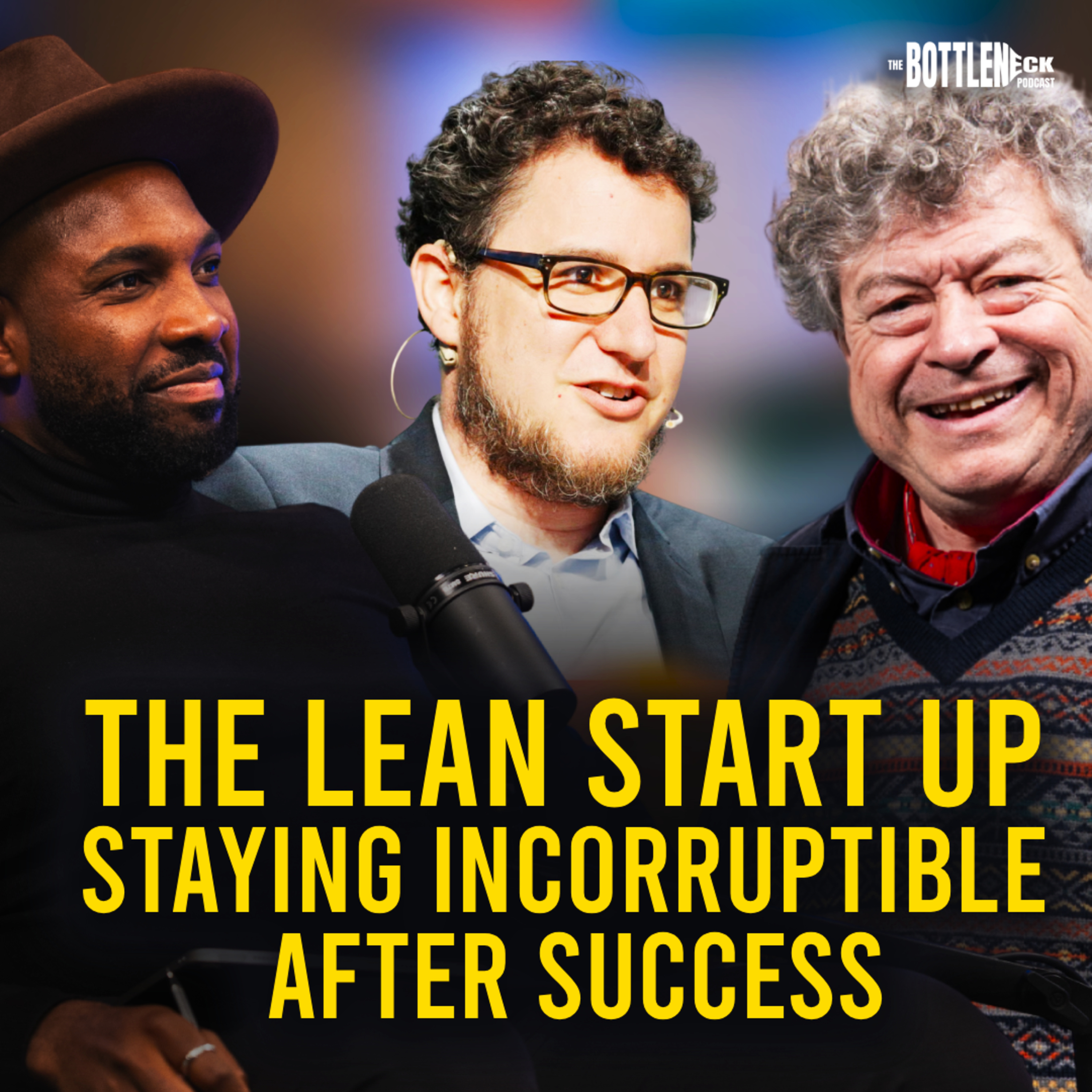
Eric Ries discusses Lean Startup principles for highly uncertain innovation, and contrasts them with modern “shareholder primacy” incentives that he argues systematically erode long-term company health. He also explores why some long-lived, customer-centric firms resist financial short-termism, using Costco as a central case, and connects these ideas to measurable organizational failures (e.g., green dashboards while companies collapse).
Written by AI. May contain mistakes.
Eric discusses his background, the inspiration behind The Lean Startup, and the challenges of management practices.
“I guess most people know me as the author of a book called The Lean Startup, which came out 15 years ago.”
Eric shares his surprising experiences and the polarized reactions to his Lean Startup ideas.
“So what you have to understand is when I was writing the Lean Startup, I was really writing it for myself.”
Discussion on outdated product development models and the misconceptions in the industry.
“And I was like, hey, I'm not saying that you should do that.”
Eric reflects on lessons learned from the Japanese auto industry and the importance of understanding systems.
“Then you'd have some kind of quality assurance, deployment operations.”
Rory discusses how successful entrepreneurs often share their methods and why many organizations struggle to adopt them.
“No, I mean, it's one of the most interesting things in business is in many, many cases, people who are immensely successful make absolutely no secret of their methods.”
Explore the difficulties entrepreneurs face in adopting long-term strategies amidst short-term pressures.
“But most people, of course, the short term pressures of daily life just make it absolutely impossible for them to adopt this approach, even though there is absolutely no secret made of how it's done.”
Understand how sharing knowledge can lead to advancements in industries, with examples from leaders like Toyota and Ford.
“It made absolutely perfect sense, but virtually no one actually thought, well, why don't we copy this in some other domain?”
Learn how family-run companies can foster better customer focus and long-term thinking.
“I get if you tried it, it didn't work, but no one's even tried.”
Examine Costco's unique governance and its long-term customer-centric approach amid investor pressure.
“investors it's a simple question of attention because for them that's where the money comes from timeframes.”
Delve into how investor influence can disrupt successful companies, using Costco's history as a key example.
“that can have this long-term, sustainable, customer-centric approach.”
Discover the story of FedMart's decline due to investor pressures.
“And to make a long story short, his investors tried to do to FedMart what investors still try to do to Costco to this day and succeeded.”
Learn how Costco's governance structure protects its mission.
“And he learned a really important lesson when he finally, you know, he quit in protest that day after Saul was fired because it was so unjust.”
Explore the impact of investor expectations on long-term company success.
“businesses and startups or do they just add unnecessary pressure, unnecessary distraction?”
Discuss the importance of accountability in corporate performance culture.
“And someone was complaining to her that it wasn't fair.”
Understand how uniform metrics can lead to a lack of innovation.
Examine how individual efforts can undermine collective goals.
“Too many of my friends, you have them dead to rights.”
Explore the flawed understanding of profit and its implications for companies.
“And most people will be like, no, no, no, you have to account for all the costs, right?”
Discuss how organizations prioritize costs over long-term customer value.
“By the way, the other thing that's happened in that period is the elevation of the finance function within an organization.”
Analyze the decline in customer service quality despite increased spending.
“Do you have that analogy in the U.S., the canary in the mine?”
Learn from the founding of Novo Nordisk and its unique corporate structure.
“Well, this is an example of like so many things in business, a situation where we're trying to calculate the ROI of a situation where the return is intangible, but the cost is tangible.”
Examine the benefits of alternative governance structures in companies.
“They didn't need Martin Screlly to teach them this idea.”
Learn about the concept of Perpetual Purpose Trusts and their implications for company longevity.
“I suppose, their attention to posterity and longevity.”
Discuss the consistent performance of family-owned and purpose-driven companies over time.
“And one of the most consistent findings is that in bad times during depressions and stuff like that, these companies, they're more likely to make investments.”
Critique the shortsighted optimization practices in Silicon Valley and their impact on culture.
“I was crossing the road in Menlo Park, and I was nearly run down by one of these miniature gasoline tankers.”
Explore whether modern society has truly progressed and how trust is measured in organizations.
“I mean, I always think about the fact that the ancient Romans would consider most of us slaves.”
Discover the ambitious goals behind the health insurance company Devoted Health and its potential to improve healthcare.
“People will tell us that we are in the best generation of our time.”
Explore the complexities of creating a new American healthcare system.
“Because his pitch to me was, I want to create a full stack alternate reality American healthcare system that would actually be good for you.”
Learn how embracing challenges can lead to greater success in business.
“Martin would call that integrative thinking, where you take two things which have always been seen as in opposition and you effectively resolve it.”
Discover how Devoted Health prioritizes customer care as a core value.
“It happens to be embodied as a technology company, as a healthcare company, as a doctor, just care delivery company.”
Understand how Costco's presence can uplift local businesses and communities.
“You're like, well, most finance people would be like, that sounds like much of marketing BS, right?”
Explore Costco's influence on food safety standards in America.
“When Costco moves into a community, yeah, Costco moves in community, the local small businesses up their game and improve their success outcomes.”
Reflect on principles for founders to create enduring companies.
“I can only imagine what the numbers look like now with the cuts they're making, savage cuts to things like food safety.”
Exploring the need to innovate in real life rather than on screens.
“AI is coming really, really ferociously.”
Discussing the failures of current institutions and the need for new ones.
“Like I could be talking about almost any category and you say, what is wrong with these people?”
Encouraging listeners to take initiative in building and creating change.
“Going back even further, you're a big fan of Robert Irwin.”
Analyzing the difficulties of sequential decision-making structures.
“We have to reverse some of these wrong ideas.”
Discussing how tech can uncover common ground in polarized debates.
“Driver is responsible for emergency and towing charges not covered by the policy.”
Exploring how AI can enhance decision-making in organizations.
“They had done this big survey of views about AI.”
Examining the evolution of player strategies in games with AI.
“But these LLMs for all their problems, and they have a lot of problems with hallucination and errors and all kinds of things.”
Explore how AI can augment human capabilities rather than replace them.
“Yeah, and the script then, you know, effectively responds accordingly.”
Learn the importance of questioning established norms and pursuing innovative solutions.
“See it as an augmentation, not a replacement.”

Get the gist, explore an idea or ask about something said.
 Claude
On The Bottleneck Podcast, what are the key points of this episode?
Searching your listeningAutomatic transcript. May contain errors.
0:00UKG is the workforce operating platform with unified HR, payroll and workforce management. Built to solve the unique challenges of frontline work. Powered by People First AI and decades of labor data, UKG turns workforce intelligence into real-time decisions around staffing, pay, compliance and productivity. Enabling every worker to confidently take action as work happens. Because when work works, everything works. Learn more at ukg.com slash work. UKG, HR, pay and workforce management. Are you ever shopping online and suddenly a discount that helps you save pops up? It makes your day, sometimes even your week.
0:38Want that feeling month after month? Well, new customers who save by switching their home and auto insurance to Progressive save hundreds. Cue your happy dance. Get your quote today at Progressive.com. Progressive Casualty Insurance Company affiliates and other insurers. Not available in all states. Well, a gas station is probably the only chance a Coda gets of actually meeting a girl. Okay, right. Oh no, we were doing so well. I did so well. This was a company murdered in the name of profit. All the dashboards are green and the companies are failing. You can raise the price of the hot dog, but just so you know, if you raise the price of the hot dog, I will effing kill you.
1:22Figure it out.
1:29I was really excited about this conversation as somebody that has founded A Lean Startup, doing a lot of research on Eric and realizing the origins of the books he's written. And also, all that he's contributed to the entrepreneurial industry has been phenomenal. So we're eager to have this conversation. Obviously, we're joined with Rory. but before we delve into the conversation, as a bottleneck tradition, we always like to make sure that our guests own that narrative and we give them the opportunity to introduce themselves to our audience that may not be familiar with your work. So it'll be great, Eric, to pass you the mic for you to give a bit of an intro in terms of what you're doing.
2:10And then we can delve into some of the bottlenecks that have been in your space and the works that you've been working on. So over to you, Eric. Oh, goodness. Thanks, guys. I really appreciate you having me. Gosh, where to start? I guess most people know me as the author of a book called The Lean Startup, which came out 15 years ago. I think maybe 15 years ago this month even. It's been quite a ride. My career before that was as a tech entrepreneur. I built a bunch of startups. Some succeeded, some failed. And yet I kept experiencing over and over again that that the best practices, like what I had been taught as like, this is how management works.
2:49This is what's supposed to happen. It didn't seem to work for me. You know, I would read these books about these great ideas that would work great in bigger companies. But when I would apply them in entrepreneurship, it would go awry. And to make a really long story short, I kept watching this over and over again, where incredibly talented people would build these amazing companies only to have them completely implode. And I just thought there's got to be a better way. So So remixing some ideas from lean manufacturing, that's where lean startup comes from, and a bunch of other fields and disciplines, I decided we needed to have our own branch of management science, entrepreneurial management, specifically for the highly uncertain situations that startups and innovators find themselves in.
3:28And that kind of changed my life. So before I had been a very introverted software engineer, I didn't go anywhere. I didn't talk to people. I just did my work. And all of a sudden I was being asked to travel and to opine as an expert on all manner of topics and to work with companies that grew. So almost the rest of my career has been kind of stumbling into problem after problem after problem that come from success. So originally I had been talking about failure. I want to help people avoid failure, but I hadn't really thought through how difficult life is if your organization grows, if it succeeds.
4:04And I helped a bunch of huge companies, multinationals and governments revitalize their management system, integrate innovation into the way that they think. Many of the companies that were like two kids in a garage when I met them, when they read The Lean Startup, became multinational companies in their own right. And so I did a lot of work trying to figure out how do we integrate this entrepreneurial management and general management together. and through the course of doing that of course i got radicalized if maybe this is for lack of a better word about how bad our modern economy is all the things that can go wrong with it because i got to see it up close people talk about short-term thinking and how bad it is and i got to walk the factory floor i got to sit with customers and boards and executives like i i felt like i was issued like a backstage pass to all of business so i could see its flaws you know very, very clearly.
4:55So anyway, so I've been working the last 10 years or so trying to see what could I do to make a dent in that problem. And I created the long-term stock exchange among many other companies, which have a mission to try and make progress. And of course, that is all culminated in the new book, which came out a few months ago, which I call incorruptible, which is trying to lay out a general purpose theory for what is this force that ruins so many companies? Why do we all have this like dismal expectation that when a company becomes successful, gets taken over by private equity, raises money, goes public.
5:29Like you would think logically that like, well, thanks to all those financial resources, the product's going to get a lot better. But we never see that. It's always the opposite. It's always the reverse. So why? So I've been trying to grapple with what causes this phenomenon and what, more importantly, what could we do about how can we build organizations structurally strong enough to resist it? And that kind of brings you up to the present moment. I am so excited about this conversation because these are all the questions that I've been asking as well, which is super cool. But I think to start with the Lean Startup, what were some of the things that you learned that you didn't expect throughout the process of putting that all together?
6:12All right. So what you have to understand is when I was writing the Lean Startup, I was really writing it for myself. I didn't have some grand theory of change that I thought we would build a social movement around. I hadn't gotten that far yet. And so when I first started writing about it, I was surprised how angry it made people. And from the vantage point of today, it's hard to understand because in a very short time, it's gone from heresy to orthodoxy. and many people who were criticizing it, they went from being angry about it to deciding it was overhyped and they were tired of hearing about it without ever passing through the intervening stage of finding out what it was and using it correctly.
6:56You know, it was like went straight from one to the other. So it has been very polarizing. I can remember conversations in Silicon Valley where I would come in and they would say, hey, could you give us some advice about this? And I was very naive in those days. You know, I just thought, oh, fun. How fun to be asked for advice. You know, I used to like that a lot. and I would come in and they would tell me this problem. And I would say, oh, well, you know, at my company that I just left, you know, we would ship software to production 50 times a day on average. Now, in the age of vibe coding, that doesn't sound very impressive.
7:24But back in those days, remember we used to put the year that a product came out in the name of the product, like Windows 2000 or even Windows Office 95. Like we used to ship software only a couple, once every couple of years and we were doing it 50 times a day. And people would yell at me. they'd be like, that can't possibly be true. That can never work. You know, you're lying. People get mad. And I was like, hey, I'm not saying that you should do that. I'm giving you my firsthand testimony of what I myself experienced. And they'd be like, no, you didn't. You know, they were so countercultural that they couldn't process it.
7:59And what's funny is that a lot of these meetings, I would have to stop and say, listen, you called me. You asked me, I don't work here. You're not paying me to have this conversation. You invited me to give you this advice. I'm giving it to you. And you're angry. You know, like life too short for this, man. Like I couldn't figure out why it made people so mad. Of course, and I look back on it in retrospect, it's very obvious. I was talking to people who had built their whole careers on a different set of ideas. And nobody wants to hear that the thing that they've learned their whole career is not right, not best, not optimal.
8:29And I was so naive. I would say, hey, would you like to come over here and look at the evidence that the thing you've been said success with your whole career is not true? The answer was always no. Nobody wants to look at the evidence. They're like, are you kidding me? It was an indoctrination. It was ideological. It wasn't really something that they were interested in. So I didn't expect it to be a thing. I was just trying to make sense of my own experience. And then it just absolutely took off. This all started right around the time of the great financial crisis in 08, 09. So the timing was excellent.
9:03I think I was a good spokesperson for it. I kind of looked the part. You know, like there were a lot of things came together to make it truly into a movement of people who embraced this and said, hey, we got to change this old set of ideas. We're sick and tired. And what? No one was more surprised. I was going to say, and I'm sure Rory's going to jump in in a second. What were some of the old set of ideas that people have almost accepted free the book coming out and the movement obviously kicking off? Are there certain things that we now look back at and you're like, that was completely ridiculous?
9:35And everybody thinks that's the same thing. But at the time, it was widely popular in Silicon Valley and beyond. Oh, yeah. I was taught, and many people, this still exists today. I see this in business school sometimes. I was taught what they called the manufacturing metaphor of product development. That product development is fundamentally a linear process that goes through stages. You begin with some kind of requirements gathering. you produce a requirements document, then you create, you know, customer specifications, a design, a technical, at least called the technical design document. Then you would have an implementation phase.
10:15I love how implementation is like one seventh of the process of actually making the thing. Then you'd have some kind of quality assurance, deployment operations. Like it was a very linear process. Now you can imagine how pissed off I was when I found out they don't even do that in manufacturing anymore. No. Like, like that is way obsolete. Manufacturing people would be like, what are you talking about? Like that's, That's like Henry Ford style. We figured this. Almost 100 years now we've abandoned this crazy set of ideas. Although, to be fair, the American auto industry was doing it right up until the 80s, stubbornly refusing to understand what had been figured out in Japan.
10:50And listen, Deming had to leave America to go to Japan to get his ideas adopted because they were so heretical. So this is not like business people are not really known for their open-minded embrace of new ideas. And he actually said, he said, they, they, they American automakers would go over to Japanese factories and they'd write down everything they saw done. But as he said, they try and copy everything, but they don't know what to copy. And part of what they needed to copy was the cultural shift. within the organization? I was obviously not there, but I can visualize it so clearly, these American auto executives going to these futuristic Toyota factories in the 80s and 90s.
11:32And if you read the books, like Taichi Ono and Shigeo Shingo and the geniuses who worked this out, they wrote about it in very humane terms. Like Taichi Ono called it auto-nomination, automation with a human touch. And they were very focused on the human character of the people, like taking care of the people who worked there. Anyway, I could go on and on about how brilliant they were. And you could just see that they would lecture these Americans, you know, I'm sure in the very humble Japanese style about the need to go and see for yourself. Right. To walk the factory floor is to understand they learn to see waste in the process.
12:07Taichi Ono used to make new hires at the factory who went to work for him. he would draw a circle on the ground in the factory like a five-foot circle and their first day he would say stand in this circle do not leave the circle and then come back to me at the end of the day tell me what you observed tell me what you saw like it was a perception thing it was a it was a humane thing anyway but they also were obviously the early pioneers of robotics and automation and you could just see these americans leaving the factory and be like yes respect for people yes culture yeah like could you see the robots you know like oh my right like oh we gotta go buy a bunch of robots and just you know americans automatic they spent so many billions on robots that the robots weren't bad but if you don't understand the system of it uh you're in trouble anyway i feel like the same thing's been going on um we see this uh saw this with the startup a lot people love to ape the surface level stuff without the actual understanding of the principles Rory, are you going to jump in there?
13:07That's really interesting. No, I mean, it's one of the most interesting things in business is in many, many cases, people who are immensely successful make absolutely no secret of their methods. You know, it would be true, say, of Amazon. It would be true of the Japanese car industry. It would be true of Warren Buffett and Charlie Munger. They were entirely happy to share their methodology. And, you know, at first glance, this seems like a crazy thing to do. If you have some fantastic advantage over other people, you'd think you'd absolutely keep it to yourself. But the reason they can share these things so comfortably is because most other organizations are culturally incapable of adopting them.
13:53I mean, obviously, there are devotees and followers of Munger and Buffett and so on and value investment and so on. But most people, of course, the short term pressures of daily life just make it absolutely impossible for them to adopt this approach, even though there is absolutely no secret made of how it's done. You know, the the I've learned now that this is actually a tell of the greatest, greatest entrepreneurs, greatest leaders, greatest companies. They actually, they're like, if you talk to them and you get them alone in private, they generally are disappointed at the level of competition.
14:33It's like a pro athlete. Imagine if there was no major leagues you could ever get to and you had to stay in the minor leagues forever. You'd enjoy being the best player in the league for a couple days. And after a while, you'd be like, but this is all there is. So I actually think like part of the reason why like obviously Toyota is very famous for having not only shared their ideas widely but spent incredible amounts of money to teach other people, including their competitors, how to do it. They took over a General Motors plant here in the Bay Area. They took a General Motors plant, same people, same management, same facility, same everything.
15:07They took it from the worst performing plant in the GM system to the best performing plant in the GM system. And GM executives would take a rotation through the NUMI plant. And they did everything possible to try to teach this to their most large, you know, existential competitor. Why? Well, you'd be like, that's so crazy. Why would you do it? Because the people that really have an ethos that stand for something, it's not about proprietary advantage. Like, yes, they reap an advantage from it, but that's like the exhaust that's coming out of a well-functioning engine. They want to see their mission enacted in the world at large.
15:42I call it mission transmission in the new book. And I just I feel like that the people who are kind of like got their secret and I got to I got to prevent other people from touching it. I got the NDA and I got to, you know, I'm going to squeeze every advantage out of it. Like I've now learned that is such a tell that it's not whatever it is. UKG is the workforce operating platform with unified HR, payroll and workforce management built to solve the unique challenges of frontline work. Powered by People First AI and decades of labor data, UKG turns workforce intelligence into real-time decisions around staffing, pay, compliance, and productivity, enabling every worker to confidently take action as work happens.
16:19Because when work works, everything works. Learn more at ukg.com slash work. UKG, HR, pay, and workforce management. Progressive's Accident Response can contact emergency services if you're in a major accident. The only thing worse than someone you love being in an accident is not being able to help them. So Progressive is here to help when you can't. So get peace of mind knowing your loved ones are protected with Progressive's accident response. Learn more at Progressive.com. Progressive Casualty Insurance Company and Affiliates. Limited availability in California. Driver is responsible for emergency and towing charges not covered by the policy.
16:55Coverage subject to policy terms and conditions. Got it. no that actually that was true of henry ford uh in the early days who who absolutely shared his innovations about the production line with everybody else there was absolutely no no attempt to keep it to yourself and um similarly you know amazon's decision making and well it certainly was i don't know to what extent it it survives the relative departure of the founder uh you know they were you know it was highly eccentric they were very public about how they did it. It made absolutely perfect sense, but virtually no one actually thought, well, why don't we copy this in some other domain?
17:35And it genuinely is peculiar. I mean - It puts to lie the idea that capitalism is like a system of perfect competition. It means we are, by my kingdom for some actual competition. I don't mean competition through regulatory capture. I mean, the real old-fashioned kind. I'll give you another example. I was at an event with one of the high-up people at Vanguard, financial services company. Vanguard is like this absolutely behemoth of financial services built on this really strong ethos that Jack Bogle had to try to save customers money, not have them be fleeced by stockbrokers. Anyway, they were celebrating at the time their 50th anniversary.
18:10And so the executive was telling me some stories about the history of Vanguard back in the day. So in 1975 or whatever it was, people thought it was so unlikely to succeed that they didn't bother fighting it. You know, like Wall Street didn't bother opposing it because it was such a dumb idea. But the little detail that he shared with me that really blew my mind, he said, in order to get it started, they actually had to go to the American regulators, the SEC, and get special permission to start the company because it's so customer favorable. There were no regulations. Like all the regulations are about what to do if you're in an adverse situation with your customers and they're trying to prevent you from fleecing them.
18:48And they said, well, we want the customers to have their bangor is technically a cooperative so the customers are themselves part of the the ownership structure the management structure of the funds themselves anyway they had to get this special exception they got it from the sec and they've been you know it's been a rocket ship ever since i asked him in the 50 years since has anyone else ever tried to get that same exception from the sec and he looked at me like oh yeah no no one's even in 50 years, no one's tried to copy the most successful financial services company of all time. Where's my competition?
19:22No one's even tried it. I get if you tried it, it didn't work, but no one's even tried. Because there's all these companies that we just treat as these exceptions to the rule. We admire them, but we don't emulate them. One of the things I was proposing is you could simply improve capitalism by producing... Okay, do you have which magazine in the United States? The Consumer Association? Okay, it's effectively a consumer magazine telling you what to buy. Okay, it sounds like Consumer Reports here in the US. You've got it exactly, Consumer Reports. Yeah. And to be honest, you would do a pretty good job heuristically of replicating that if you simply made a list of companies that were either privately owned or family owned or founder-led.
20:07you know if you if you just had a heuristic for the rest of your life wherever possible go and buy from companies that are either still led by the original founder or are owned by the by the family um the products you would buy and the service you would receive would be pretty much as good as if you spent hours of your life sort of pouring through consumer reports and witch magazine and and everything else and um you know if you look at the uk we you know the hero companies it tends to be you know i would cite you know optimus energy ocado ao um dyson obviously you know or t-bay services which is a kind of it's a kind of british version of bucky's which is also family project by the way and jim shark okay nearly nearly all the companies where you go wow how did you do that and as a consumer i'm really grateful you exist yeah um i mean you know i'm not expecting just just to be clear i'm not expecting rolls royce aero engines to be you know privately or run as a kind of you know as a narco syndicalist collective or something of that guy i get the fact i get the fact that if you're doing something that is just monumentally expensive you probably need that that external uh financial control but some very very simple things if you think about it a family-run company will be focused on its customers rather than its investors it's a simple question of attention because for them that's where the money comes from
21:46timeframes. A family-run company will probably have aspirations over a mixture of timeframes. They're not blind to the short term, but they don't have to sort of march to the beat of a completely artificial quarterly drum and so on and so forth. Yeah. Okay, so I've been dying to have this conversation with you because you have one of the many, many, many social media videos, clips of you that I get. The algorithm loves to send you. I'm sorry. I love it. I have no control. It's incredible. It's completely bizarre. I honestly don't know if it says more about the algorithm or about me that it loves to show me your clips.
22:23Okay. And I truly, I love them so much. Especially if you consider what other schlock is on social media. Like at least it's educational, you know? Okay. So you have a great clip in which you make the point that you just made. And then at the end, you're listing off great companies that fit the pattern. And then you're like, oh, and also Costco for some reason. Yes, because it is actually publicly run. Costco defies every one of the heuristics. It is publicly run. It's a$400 billion public company. They report quarterly. The founder is no longer involved in the business. They have had now three leaders who they hire and promote from within, but still, it's not the founder.
22:59They've even had turnover at the board level. And yet, Costco is like the exception to every business rule. And actually, that is one of the points that I really went deep into in the new book. Which is like, it doesn't, I'm not satisfied. To me, it's not enough to say, well, as long as we can have some of these exceptional companies outside of our financial system, then at least we have those. To me, I think it's a sign that something is deeply wrong with our financial system. That it makes it so difficult to build companies that can have this long-term, sustainable, customer-centric approach.
23:35And even worse, what about the Rolls-Royce and the engines and the semiconductor fab, what about the things that require investor capital to be made? You're saying, you know, not you, but like the conventional wisdom is like, yeah, all those are going to eventually be corrupted. That's just the devil's bargain you make with investors. No, I refuse. I think I agree. We have enough data now. We have the evidence that this era of shareholder primacy is basically a disaster. Yeah. Like it's not even good for shareholders. on the negative side. But on the positive side, we also have these exceptions.
24:12There's enough of them. They accumulate. You say, wait a minute. If this is inevitable, if this corruption is inevitable, how can an inevitable thing have an exception? It's impossible. So there must be some other principle that could be discovered. And that's really been my work of late. I think there might be something which is that Costco is so successful that somehow people are bright enough to go, we're not, I mean, there's a great Deming quote, which is to optimize the whole, you have to sub-optimize some of the parts. Of course. And the great tendency of the shareholder primacy-led business is that you attempt to optimize the whole by optimizing all the individual parts.
24:59And it's the difference between what you might call a loose fitness function and a tight fitness function. And it may simply be that the investors in Costco go, deep down viscerally, we don't like the way they do this. We would much prefer it if, for example, they made much more margin on fairly price elastic products and so on and so forth. But we're just wise enough to know that for whatever bizarre reason, they've got something right and we're not going to mess with it. I don't know. Oh, I do know. I'm going to answer your question. And I'm going to blow your mind right now because I thought like you too.
25:38I thought for sure the issue was that Costco is just too big, too successful. You know, Wall Street can't mess with it. And when I say something like that in New York, it's a laugh line. People laugh at me. They're like, you think there's something on this earth too big for Wall Street to mess with? Like, you got to be kidding me. So it turns out that every couple of years, Wall Street tries to discipline Costco and rein them in and force them to conform to the best practices. One of my favorite quotes in the book, this is just a little aside, but I just love it. There's a Wall Street analyst who writes, and I have to, for you, I have to explain, he means this as a criticism, because it may not be clear.
26:16So to be clear, a criticism of Costco. He says, Costco is a company that takes money that rightfully belongs to shareholders. and instead invest it in improving the customer experience.
26:31I wish I was making this up. You're not making that up. It's incredible, this myopic view that optimization is the only way to maximize returns. And in fact, in one of the campaigns that they attacked Costco, they literally attacked Costco on this basis. They said, well, your bad governance, Costco is considered to have bad governance, for those that don't know. Your bad governance leads to management entrenchment, which leads to poor performance. And I'm like, you can criticize a lot of companies on this planet for poor performance, but Costco is not one of them. Costco is one of the best performing stocks in the whole S &P since 1986 when it went public.
27:06And so what's really interesting to me about this idea is that it's not performance-based, it's ideological. So why almost every company when faced with a campaign like this folds, how come Costco doesn't fold? And it turns out that the reason Costco doesn't fold is precisely because it has a governance structure designed to resist. So when Jim Senegal set up Costco, see, a lot of people don't know the deep cut origin of Costco. Jim Senegal used to work for a guy named Saul Price, a company called FedMart. FedMart, yeah. Truly the original, like the inventor of modern big box. And then Price Club, wasn't it?
27:43And then Price Club. Yeah, Saul Price went on to create Price Club. Investors Amusingly, by the way, neither of us knew That the reason Price Club was called Price Club was because the founder was called Price I grew up I grew up around Price Club I shopped there hundreds of times My whole childhood was spent at Price Club I had no idea it was named after a guy Maybe Saul Price I thought it was just the low price club Where you went for low price And he meant he had this, his first company was called FedMart. And to make a long story short, his investors tried to do to FedMart what investors still try to do to Costco to this day and succeeded.
28:24FedMart was built as a standard corporation without special governance protections. And so Salt Price was ousted after 20 years of running FedMart. Just so you know, it took the investors only seven years to absolutely destroy FedMart once they got Salt Price out of there. So this This is the pattern that I come to again and again in my work. If we weren't so used to this, we would find it strange because this was a company murdered in the name of profit. And you're like, well, why would the investors want to murder their own? Like they're destroying the very engine that made the company worth investing in in the first place.
29:00That's what we see. That's our whole financial system has become optimized around this outcome. Anyway, Jim Senegal started working at FedMart as a stock boy, like on the floor of the retail stores. worked his way all the way up to corporate executive because Saul really believed in promoting and hiring from within. And so Jim Senegal was there the day investors betrayed FedBart. And he learned a really important lesson when he finally, you know, he quit in protest that day after Saul was fired because it was so unjust. And when he went on to start his own company, he vowed that that would not happen to him.
29:35And so the government, I call it a governance fortress that was built around Costco was built to prevent investors from interfering. And if you look at the investors, both the investors and the independents who sit on Costco's board in the early days, they would describe their responsibility to act as a bulwark against pressure instead of agents of shareholders. And that distinction may not seem like a big deal to most people, but for people who've been around business for a long time, you realize what a monumental asset it is to have a board who sees itself that way. It's really interesting because every single time I go on Instagram or YouTube or like anywhere, there's always these announcements about how much these new startups have raised and there's crazy valuations, et cetera, et cetera.
30:24And then they even now tell you who's the investors and they group them all up and everyone's supposed to celebrate. But it's not a good thing because what you keep seeing is it seems like the reason why a lot of organizations don't end up lasting 100 years and beyond is because they know what the right thing to do is. But if they cannot justify or satisfy the investors or the people that they owe money to, they will never be able to actually build the thing that's super, super very important. And do we believe like, like in, in an entirety, are investors a net positive to businesses and startups or do they just add unnecessary pressure, unnecessary distraction?
31:11It would be great to hear both your points. Okay. So I'm not anti-investor. I think investors perform a very important social function, um, which is especially venture investors. they transform extremely cowardly limited partner capital institutional capital is like more cowardly than you could possibly imagine believe me i spent a lot of time with people that manage these massive pools of capital they are insanely risk averse and i understand i'm actually very sympathetic because they have you know they have multi-generational obligations of course and you know if you run a pension fund your your members cannot eat the benchmark you have to generate cash on cash returns for them or else, you know, the thing collapses.
31:50So their cowardice is, I don't mean that in a pejorative way, that's just a fact. So venture capitalists and to some extent private equity funds have figured out how to pitch those people in such a way that they can get them to invest in risky stuff. And that's actually very, our society needs that. The problem isn't so much the investors themselves, but the system in which they operate, which creates this force I call financial gravity, this pressure that people feel to conform to these specific sociopathic practices, to treat every transaction as a form of extraction. In another one of my favorite Rory clips that I get from social media all the time, he says, we've built an economy where people are routinely rewarded for cutting costs without ever being held accountable to the downstream consequences of those choices, to brand, to quality, to design.
32:37Tell me if I paraphrase correctly that's absolutely right yeah that's an attack on procurement in particular which can claim the credit claim the credit for any reduction in cost without really being held accountable for the downstream consequences which can be loss of trust loss of quality not i mean including even the collapse of the whole enterprise i feel like you have these people who will be like celebrating and giving out promotions for their cost cutting as the whole as the as the titanic sinks to the bottom of the ocean they don't even notice because they themselves got rewarded so what you know what do they care about the about their stewardship of the whole thing it's by the way from digital media but it's true of lots of other things all the dashboards are green and the companies are failing totally oh my god it's like the original snafu it is all these metrics are looking fine okay but the actual company as a whole is catastrophic and um it it's it's really interesting i remember hearing a story from i want to say it was from Sheryl Sandberg or somebody like that, who had a very extreme performance management culture in the early days of Facebook.
33:41And someone was complaining to her that it wasn't fair. She would hold people accountable for the results of their project, regardless of the results of their individual contribution to that project. So if you got assigned to some dumb project that wasn't a good idea and it went down, you'd go down with it. It was like, everyone goes down with the shit. Someone was saying, that's not really fair. I did a great job. The code I wrote was really great. That's not fair. And she said, yeah, but listen, there were probably middle managers getting massive performance bonuses like in the last year of Kodak.
34:13And we're not going to have that here. Like we're just, you know, my belief is it's not acceptable to celebrate, as you said, the sub optimization, right? Like, okay, we did one part of it, right, without the whole thing being right. And I think we've kind of lost that. If you look at how we teach leadership, teach management, teach, you know, performance management, teach how to do incentive bonuses or compensation structures. Like everything is about the optimization to OKRs, the optimization to submetrics, to make the dashboard green. and there's nobody who's got their eyes on the whole thing.
34:47And, you know, as I know, you already agree with me. So I'm preaching to the choir here. But like, we're losing eyes on the most valuable and underrated asset in all of business, which is trustworthiness. Like we don't see it as an asset. Actually, two. I think there are two assets as well. And I was having a dig at Goldman Sachs for this because I just enjoy doing that kind of thing. Who wouldn't like to do that? Okay. Because of the need for comparison, the weird thing is investors, in my experience, are not dumb and are actually disappointed by the short-term behavior in many ways of the companies they invested and by their failure to innovate and so on.
35:28but there is a problem among investors which is if if you need endless and frequent comparison between different companies in the same sector what you'll do is you'll apply the same metrics to all of them for ease of comparison when those metrics as always happens end up becoming targets what you create is something called corporate isomorphism where because they've all been incentivized in exactly the same way those companies become more and more similar and less and less differentiated and then that's a similar case where everybody loses the investors lose because the overall value of the category is reduced the companies are involved in head-to-head competition usually at a price war and the consumer gets less choice so that's that's that always strikes me as a second price you pay there's short-termism but there's also the fact that there's a great book by a guy called, I think it's called Fishback, who's a UCLA law professor called, funnily enough, Bottlenecks, which partly inspired the name of this podcast, which is that when you apply the same criteria to everybody, you actually narrow the definition of success.
36:41Yeah. And the argument would be, if you make academic attainment the sole discriminator for who you employ, for example okay ostensibly the process is fair because it's a completely objective comparison but an enormous number of people who are otherwise extraordinarily talented get frozen out and fish back i think i i fish is a fishkin or fish fishkin it might be uh his argument is that you should optimize for plurality of opportunity not equality of opportunity and in the same way a really intelligent investor would say you know just as they they accept the fact that the car the car industry consists of luxury manufacturers mass manufacturers and it'd be pretty dumb to judge them on exactly the same criteria you know volume for example uh in in the same way understanding that actually there's a value to differentiation in and of itself and isomorphism is it's sort of it's from evolutionary biology i suppose oh and actually yeah and what you're talking about the Sheryl Sandberg approach is kind of group selection, isn't it?
37:49You actually select at the level of the group, not the level of the individual. Life is all about making decisions. Sometimes you make questionable ones, like buying a new TV that's too big for the wall because the electronics store employee was a little too good at their job. Then sometimes you make great ones, like protecting your home and auto with Progressive. You get customized coverage options so you can be sure you have the right coverage. Get your quote today at Progressive.com. Progressive Casualty Insurance Company affiliates and other insurers not available in all states. When it's time to scale your business, it's time for Shopify.
38:27Get everything you need to grow the way you want. Like all the way. Stack more sales with the best converting checkout on the planet. Track your cha-chings from every channel right in one spot and turn real-time reporting into big-time opportunities. Take your business to a whole new level. Switch to Shopify. Start your free trial today. So to be fair, Rory always talks about the concept of being micro-genius but macro-stupid. Yeah. Hey, hey. Hey. People do that, right? So they like to do things. Oh my God. I know. Too many of my friends, you have them dead to rights. Hey. And then you see the organization tanking.
39:14And it's really, really interesting as to why people do that, because really what you would want is for everybody to be heading towards the same goal and using their individual skills to contribute to that end goal. But really, a lot of the times, what you found out, so I run an agency and work a lot with brands, and you realize that people know what the answer is, right? They know what they need to do. Yeah, they can't do it. The job is less about like what needs to be done or what's wrong. It's more about how do you get everybody to see the same thing and for everybody to go and do it together.
39:49And that's the thing that prevents people from actually making a lot of progress. Like, is that what you've seen in your studies? Is it the bureaucracy, the individual motivations, a little bit of like territorialism happening? Like are all those things the thing that's tend to prevent or actually lead to the death of a lot of organizations going forward? Or is there other things that we may have missed? Yeah, so to me, optimization is not bad per se, but the monoculture of optimization to profit is bad. And so why is it bad? I think it's because we're conceiving of the goal in the wrong way. If you, I do this whole derivation in the book and I won't belabor the whole thing here, but just if you ask most people in business, like, what does it mean to make a profit?
40:35They'll look at you like, everybody knows that. I'm like, yeah, I know, but indulge me. What does it mean? And they'll be like, it's like whatever's left over after you spend, you know, if you make some money and what's left over if you pay for all your costs, right? It's just revenue minus expenses. I'm like, oh, I see. Okay, yeah, that is very simple. But, you know, what about like deferred liabilities? You know, what if, right? Like, what if I have run a Ponzi scheme? is that profitable? And they're like, no, no, no. Of course. As I think about it, I'm like, no, no. When I said it was simple, what I meant was revenue minus expenses minus deferred liabilities.
41:05But what about negative externalities? What if I pollute the river and other people get sick and die, but I don't have to pay for their healthcare? In fact, no one ever finds out that I did it. Is that really profitable? But most people would be like, no, right. Yes, you kind of tricked people, but you didn't really create value. So I said, ah, well, you said it was simple. You meant revenue minus expenses, minus deferred liabilities, minus negative externalities. But what about the input factors of production? Because people will be like, they always give me this example. I take a$50 piece of wood and turn it into a$200 table.
41:39I made$150 of profit. Okay, congratulations. Good job. But what if I steal a$200 piece of wood and I turn it into a$100 table? Have I made a profit? And they'll be like, well, that's illegal. I'm like, I know, but what if I got away with it? What if I made so much money doing it that I could get away with it? I could make it legal. Now what? And most people will be like, no, no, no, you have to account for all the costs, right? Like that's not, oh, I see. So when you said it was simple, right? Like it's actually incredibly complicated. And of course we have businesses today that literally treat a human life as an input factor of production.
42:15How do we account for that? Right? We're taking something of infinite value and destroying it to make a hundred dollars that's profitable really no so in the book i lay out an alternate definition of profit that i think is more correct than the one most people use it's more aligned with their intuitive understanding of economics rather than the nonsense they learned in school which is that to make a profit is literally to maximize human flourishing that's what a for-profit company is not what it should be or could be that's what it literally means to make a profit and people say that to me like eric you can't say that?
42:46Are you saying that most companies, by that definition, most companies today are not profitable? Like, yeah, look around. The average longevity of companies has collapsed in the last 50 years. The average tenure of executives has collapsed and the average holding period of stocks has collapsed. So we are in an era of temporary organizations led by temporary leaders for the benefit of temporary owners. Why? Like, if you look at those graphs, it's the same graph over and over again. And Rory, to your point, if you look at the graph of average trust in institutions over that same period, it's plummeted.
43:18It's the same graph. It's like these plummets all happened at the same time in the same way. So I think we can start to see that there's like a deeper root cause behind this. Like we have like basically made a civilization scale wrong turn. We started to conceive of organizations not as vital, living, beautiful things designed to create high quality products and make their customers' lives better for which they make money. I'm not against making money wonderful like that's the intuitive understanding that most people have about organizations and yet there's doctrine of shareholder primacy holds that oh you are a bunch of suckers that's what you think no no no no my friends an organization is nothing more than a financial instrument designed to enrich itself like that's all it is and i just think when you when you conceive of business in that way you're guaranteed to get that kind of monoculture problem you're guaranteed to get these extractive like roi driven stack ranking procedures like Like you've made a conceptual error from which all these other things become perfectly logical.
44:14But we don't have to do it that way. By the way, the other thing that's happened in that period is the elevation of the finance function within an organization. From being a monetary and advisory function to being a prescriptive and proscriptive function. That's, you know, being 60 years old. That's one of the strangest things that's happened over the course of my life. because I suddenly realized everybody under the age of 40 thinks this is the normal state of affairs. But part of the problem is they are in many ways risk-averse. They're obsessed with variance reduction and predictability. And consequently, you know, one of the things that really suffers, obviously I'm conscious of the fact that long-term brand building suffers, but innovation and R &D massively suffer typically.
45:04um and actually most of the things of course that suffer are probabilistic not deterministic so one of the other things by the way which is arguably a very valuable company activity which is highly profitable is simply uh the expansion of possible future opportunity whether that's through brand or trust or uh you know so there's an interesting distinction here between the sort of Chicago school definition of what a company is for, which is broadly speaking, giving people things they already knew they wanted at as low a price as possible. And the Austrian school is the purpose of a company is it's a discovery mechanism.
45:47Yeah. It's an exploration mechanism for discovering new and interesting adjacent forms of value exchange. And hence the Peter Drucker, you know, marketing and innovation, everything else is a cost, which would seem completely alien to anybody now, but presumably when Drucker said it, people took him seriously. Because the purpose of business is to find and keep a customer. The only two things of value are marketing and innovation. Everything else is at cost. Yeah, I think when you see business that way, you're able to transform cost centers, what we today call cost centers, into sources of value.
46:23So I just think most organizations are so massively underinvested in the things that really matter. Can I ask you to join me in my Royal Society for the Protection of Call Centers? Yeah. Don't get me started. Don't get me started. Oh, my God. Because the call center, I was thinking, is the canary in the mine here. Do you have that analogy in the U.S., the canary in the mine? Yes, yes, we do. I was just wondering whether you use some other more exotic bird in American mines. No, no, we borrowed it. We're not that creative with our expression. But the canary in the mine in the sense that it is basically considered a cost to be minimized.
47:05Now, if you look at your call center as a cost to be minimized, that only makes sense if you have no consideration of the future value of your existing customers. In other words, you've set your value, you know, you've set customer goodwill at zero and you progress from there. and it seems to me they're partly because the value they create is hard to quantify okay they're therefore going well we can't quantify their value so we'll just frame them as a cost but it seems to me that i mean octopus energy again founder led in the uk the largest energy provider to consumers in the uk um all their advertising focuses on the quality of their call centers fascinating so i have this in the book that because like one of the things i wanted to do in the book is to help people connect this phenomenon to their everyday life.
47:56This is not just about boards and complicated business stuff and whatever. Like this is the same reason why, yeah, why call centers are terrible, why sports teams, like why your local ownership of your sports team drives you crazy. It's why transit costs are out of control in certain countries. Like it's just like, it's actually like really creeping into every aspect of your life. And call center is one of the most tangible examples. So I dug into it. One of my favorite little tidbits is, I think it was in the 1970s. I think it was during the Nixon administration of all things. The government sponsored a survey of customer service, which they surveyed the broad public to ask them how they feel about customer service on average from business.
48:30And it was like a mega scandal that like 30 % of people said it was terrible. And that was like part of the revolution in professionalizing the call center, professionalizing customer support as a corporate function. We had the introduction of OKRs and all this investment. Like we spent billions of dollars on customer support in the last 50 years. And somebody repeated the study recently, the survey, and now it's like 70 % of people think it's terrible. Like we've made it twice as bad while spending all this money on it. Why? Well, this is an example of like so many things in business, a situation where we're trying to calculate the ROI of a situation where the return is intangible, but the cost is tangible.
49:08And we don't know how to do like the math doesn't math. We can't figure out how to put that into a spreadsheet. Of course, the answer is to don't put it in a spreadsheet. What are you doing? This is not like, again, people act like this is some newfangled thing. This is our most ancient wisdom. Okay. Like one of the things I learned while researching the book is that the word profit, okay, derives from the same Latin word, which is the same root for like manufacture, efficiency, like the making of things is the source of profit. As you say, like the discovering of new things, the discovery of adjacencies, like that's all wrapped up in making a profit.
49:41Finance, by the way, comes from the Latin word fini, meaning finish, confine, define. Like it should be the exhaust, the end product to check, to double check on the profit. The idea that we've reversed the polarity of these two things so that profit is used to serve the finance function. Like Aristotle would be like, what are you doing? Like this is not some crazy idea. But anyone in our great grandparents' generation would have had no trouble being like, that doesn't sound right. I think you're going to be in for big trouble. And they would easily be able to anticipate these problems. I'll give you another example.
50:14In the book, I tell the story of the founding of Nova Nordisk in the 1920s. And it's a cool story. A woman named Marie Krogh, who was like a really very pioneering woman, one of the first like credentialed doctors in Denmark. She got diabetes herself at a time when that was a fatal illness. And her husband, August, is the more famous one of the two because he won the Nobel Prize. So like it was like, what's a double whammy in your family? He wins the Nobel Prize. She gets diagnosed with this fatal illness. And he convinces her that they should go to America anyway because he's supposed to go to North America and give a lecture tour about his Nobel Prize.
50:51So she goes with him and they're having dinner with scientists like at every stop. You can imagine who comes to a Nobel Prize lecture. and one of the scientists they meet tells them about these crazy people in canada who have figured out how to isolate insulin for the first time like a potential cure for diabetes so it's like total serendipity that they she's like to august she's like we got to extend our trip and go see this technology for ourselves which they do anyway long story short they make an agreement with the canadians to license the the insulin creating process and they bring it back to denmark but all the scientists involved this is what i think is really interesting they had a concern this is in the 1920s okay this is more than 100 years ago they were like but what about if we start to manufacture a life-saving medicine in a for-profit company because they had to raise money to do this it was expensive this course yeah so we're gonna have to have investors we're not to build a for-profit what if one day some few we would never do this of course but what if some future manager says wait a second if i rory if i give you a life-saving medicine Why do I have to charge you a fair price?
51:57Couldn't I charge you whatever I want since you'll die if I don't give it to you? They could instantly see that if anyone in this organization ever misunderstood the purpose of it, if they reversed their priorities from saving lives and science of public trust to making money, it would be severely dangerous. They didn't need Martin Screlly to teach them this idea. they foresaw it so clearly and they wrote about it you could read their essays they're amazing it's like super clear like very straightforward this is something that could never happen so they created what they called the nordisk insulin laboratorium as a wholly owned subsidiary of a non-profit charitable foundation and that structure today that company is called novo nordisk that is one of the largest companies in europe as you all as everyone knows you know the inventors of glp1 and all this stuff they have maintained this integrity of science as a public trust for a century because they have this unusual structure except it's not that unusual so most people when they encounter the structure for the first time they're like wow that's crazy weird thing of course very famously you know when anthropic um tried to adopt a structure like this i was there a lot of investors were like huh well this is seems newfangled but i always have to remind people that just something just because something is new to you doesn't make it new okay the german optics company, Zeiss, had this structure in 1887.
53:18This is an old idea whose time has come. Anyway, if you've ever shopped at Ikea or have eaten a Hershey chocolate, this structure exists. It's around. And there's enough companies that have this structure to form a data set. And whenever there is data, the other thing is the law of nature that there will be academics who study the data. Yes? So there's a whole branch of academia who studies these so-called alternative governance structures. And here's what they found. Companies with this structure, which is called the industrial foundation structure, a nonprofit owning a for-profit subsidy. Companies with that structure are 500 % more likely to live to year 50 compared to companies with a conventional structure.
54:00500%. It's a massive difference. Why? For all the reasons we've been talking about. Well, if you have that structure, you can have investors. Novodorus is a publicly traded company. They can trade 2 million shares a day on the New York Stock Exchange. You can have investors, but investors don't call the shots. They don't set the priority of the parent organization. They have what I call a mission guardian who has the responsibility to make sure that the company never gets confused about ends and means. So I think it's time for these ideas to kind of have a comeback for us to start explicitly teaching these structures as a best practice to our business school and law school students.
54:38Progressive's Accident Response can contact emergency services if you're in a major accident. The only thing worse than someone you love being in an accident is not being able to help them. So Progressive is here to help when you can't. So get peace of mind knowing your loved ones are protected with Progressive's Accident Response. Learn more at Progressive.com. Progressive Casualty Insurance Company and Affiliates. Limited availability in California. Driver is responsible for emergency and towing charges not covered by the policy. Coverage subject to policy terms and conditions. When it's time to scale your business, it's time for Shopify.
55:11Get everything you need to grow the way you want. Like, all the way. Stack more sales with the best converting checkout on the planet. Track your cha-chings from every channel, right in one spot. And turn real-time reporting into big-time opportunities. Take your business to a whole new level. Switch to Shopify. Start your free trial today. I know people are exploring in the UK more and more ways which you can invest in privately held companies and provide them with access to capital, but your return comes in effectively a share in their profits long term, but you don't actually acquire any control over the running of the organization.
55:57Yeah, that's very important. You're happy to piggyback on their own effective, I suppose, their attention to posterity and longevity. In the US, we have a structure that is called the Perpetual Purpose Trust, which, as I understand, does not yet exist in the UK. UK, this is often accomplished through an employee ownership trust like at John Lewis. John Lewis, yeah. But the Perpetual Purpose Trust is a great solution to this problem. And for those that don't know, a Perpetual Purpose Trust is simply a separate entity, a mission guardian entity that has trustees, that has the power to appoint the directors of the subsidiary, but is not itself like a charitable foundation.
56:35There's no operations in itself. So Anthropic is famously governed this way with something they call the long-term benefit trust. And part of the reason, look, obviously it's early days for Anthropic, we'll see. But part of the reason I think why Anthropic is so much better trusted than its competitors is, and it so obviously has more courage than its competitors, is because it has this structure just like at Costco, when the board sees themselves as a bulwark, not as agents, you you get this ability to think long-term, to see trust as an asset, to resist the temptation, to optimize away all of your distinctiveness.
57:12That's fascinating. And there's another possible reason. If you look at family-owned or privately-owned companies, the general pattern seems to be they do slightly worse in good times, but significantly better in bad times. So that would explain the longevity. but you would also argue that actually if you're looking at their growth since 2 times 2 times 2 times 2 is a bigger number than 1 times 3 times 1 times 3 the constancy of their performance over a longer period of time is actually a big benefit in itself, isn't it? It's absolutely it's so consistent in the data that it made writing the book kind of hard because it's really boring it gets very repetitive if you study any of these structures If you study a purpose, trust, B Corps, employee ownership, trust, like companies that are highly trusted, if you know the firms of endearment study, like you see the same finding all.
58:06And one of the most consistent findings is that in bad times during depressions and stuff like that, these companies, they're more likely to make investments. They're less likely to lay people off. They're more likely to invest in R &D. They do all this stuff. And then because we act like depressions will last forever, but they always end. So whenever it ends, they're well positioned to take advantage on the upside. And what's really interesting to me is I was talking to an executive who worked for many years in the packaged goods. He worked at Campbell's and the old RJR back in the day. He really worked in that business for a long time.
58:42And he told me about having this fight with his investors one time when he was trying to convince them to do something long term. And he commissioned a study. This really blew my mind. He looked in their category, some food category. And they looked over three decades of data. Yeah. You know, every year, what was the top like every quarter? What was the top performing company in the quarter? What was the top performing company in the year? And he said that for every year, every quarter, it was basically random what the top performing stock would be. Yeah. Yet, if you looked over each of the three decades, it was the same three companies that had been the top performing stock of that decade.
59:18And none of those three companies ever were the top performing stock in any year or quarter. in any single year or quarter yeah just like i mean it was just they they never they were not they were stuck we're not that they were not seen as super successful on a quarterly track record but they were exceptionally successful at the 10-year horizon and i just thought god that is so right on that we we're just missing the forest for the trees because we're so we're just like we're optimizing for these short-term things we give people short-term compensation instruments and all these other mistakes like what i know you're a former um silicon valley coder but i I lost faith in the entire approach of Silicon Valley.
59:54I was crossing the road in Menlo Park, and I was nearly run down by one of these miniature gasoline tankers. They're like tiny little trucks. They look like an ordinary gasoline tanker, but, you know, reduced by about a factor of four. I said to my Californian host, basically, what the fuck is that? Okay. I said, oh, it's for the coders. It's for the coders. They go to the company car parks during the day, and they fill the cars with gasoline so that the people can spend more time coding and less time at a gas station. Okay. I remember thinking, okay, you've lost the plot at this point. In other words, you're optimizing the parts.
1:00:36First of all, a gas station is probably the only chance a coder gets of actually meeting a girl. Okay. Right. Right. Oh, no. We were doing so well. We were doing so well. No, no, no. But the point is that a gas station, first of all, you very rarely only buy gasoline at the gas station. This is my point. You also go and buy milk and bread and other things, and you might talk to somebody. But it strikes me that what you're doing is you're splitting life down into its individual components and optimizing for the component at the expense of the whole. Apart from the else, it is healthy for individuals to interact with the real world to some extent.
1:01:21You know, it's good for individuals to put the bins out to empty their own dishwasher because it's, you know, it simply, you know, varies your diet of time. And the idea that your time spent coding, by the way, the idea that the productivity of your coding is proportionate to the time you spend doing it. It's not even remotely true. It's not even remotely true anyway. And I was kind of thinking, okay, there's something, if this is genuinely a kind of vision of the future, which these people have, which is optimized for efficiency, not opportunity or randomness. There's something badly wrong with that somehow.
1:01:56Some idea of how you should live your life has taken hold in your mind and it's not quite right. Yeah. Oh, yeah. I mean, I always think about the fact that the ancient Romans would consider most of us slaves. Yes. Even those of us who have money spend all our time working anyway. Like we have no leisure anymore. We don't spend time on the higher contemplations of things. Like we only want to do negotium. Like we are negotiating our lives to this hyper psychotic degree. And I don't think it's good for the people that do it. Even if you only judge, like in the example of these certified firms, even if you just looked at the quality of the code and you cared about nothing else.
1:02:38Like how much high quality code do we churn out? having a life is actually like highly correlated with having insight with having wisdom with having the like the ability to see things beyond just the narrow thing in front of you and of course we're having this massive crisis as coding is turned into an ai generated field people because people think that turning out lines of code is the purpose i think we're seeing a lot of companies struggle where they're cranking out tons of code but they're not shipping any products they're not actually creating anything useful. They're stuck in this loop where they're like, oh, good, I can fire all the humans and replace them with AI.
1:03:15Wonderful. And now a bunch of those companies have had to hire the humans back when it goes badly because we need the chaos. We need the entropy of actual human experience in these processes. Yeah. Yeah. To add to that, so there's a funny story. I was in San Francisco and obviously the epicenter of tech as we've been sold, right? And so I was trying to fly out of San Francisco And I tried to change my flight And you can imagine the amount of money That's been poured into tech That you would think that just changing your seat Would be a simple exercise It took about 40 minutes Because the computer didn't allow the person to do it And they had to get an actual human to come in and look at it And all these things that are happening So really the big investment Going back to the whole conversation around profit And also by the definition that you mentioned about like the human benefit, enhancing human capability, human life, is supposed to actually be giving us freedom to live better lives.
1:04:15But really, we feel more enslaved. So have we really progressed? Right? People will tell us that we are in the best generation of our time. We're living through the best times around. Obviously, there's a lot of things that are happening like all over the world. But people would say that we've advanced. But going back to your point about the Roman saying that we actually are living a more enslaved life. So have we actually progressed? And that's question number one. And I guess question number two was all about the subject of trust. And how do we actually measure trust? Or what are the signals for trust that organizations should be looking out for so that at least they can be encouraged to keep making the right decisions?
1:04:55I think it'll be great to know, number one, have we progressed? And number two, what is trust? How do you know that trust is signaling so at least people have a compass towards the right direction? Oh, yeah. Listen, I don't my talk about the past. Don't don't get me mistaken for these mindless past worshippers. Like, no, not a single one of us would rationally trade places with a random person in any previous era. Like, yeah, no way. No. And I think like human progress, the story of human progress is really remarkable. It's something to be celebrated. I think the fact that we have a kind of like technophobic and kind of like a very grim, like anti-human popular culture at times is not, I have no sympathy for that whatsoever.
1:05:38I think we should celebrate and seek for progress. And in fact, part of the reason I think it's important to reform these ideas is that we have built a business culture that is antithetical to that progress. Like we're actually degrading human progress. The fact that we've made progress in spite of these ideas is pretty impressive, but the system is eating itself from the inside. We're just seeing more and more and more institutional collapse without which progress requires institutions. We have to do better. And obviously not to mention the catastrophic climate and other issues that we've left unaddressed for too long.
1:06:06There's a tiny pattern I occasionally, in my more Luddite moments, my only pattern that I try and resist is that a lot of technology is welcomed because it arrives as an option and then ends up as an obligation. Facebook, there's some, you know, very interestingly, if you ask people, how much would you pay to stay on Facebook? It's a positive amount of money. If you go to people and say, imagine you could come off Facebook, but so would everybody else you know, people would actually pay for that app. Totally. So that Facebook is really a FOMO business. I can't stand the idea that all my friends are communing with each other and I'm left out.
1:06:51But people would net-net prefer that it didn't exist at all. Now, that's only one piece of research. But I noticed that some technologies arrive, you know, parking apps, and they arrive as an obligation. You can either pay by coin or card or app. And then the next thing you know is the card and coin machine has been removed to save money. You have to use the app. And you have to use the app. And this will be true of self-checkout ticket machines at underground stations replacing, you know, manned ticket barriers. There's McDonald's where they, interestingly, McDonald's as generally marketing-led companies, McDonald's and the packaged goods companies, are at least sensitive enough to customer behavior to avoid the worst of the mistakes.
1:07:37McDonald's actually rode back on this, the idea that you'd have McDonald's where you went to a screen and the food appeared through a hatch. And they realized that fundamentally it's not a McDonald's anymore. Okay. It's very creepy. You feel like a lab rat, don't you? You push a lever and the thing comes out. Food appears through a hole. You're in some sort of slightly dystopian rat experiment from the 1960s. Totally. And so that's my only concern with technology, what it destroys. It often destroys technologies that we haven't quite finished with, put it that way. Yeah, like Chesterton's fence.
1:08:21Yeah, perfect. Let me go back to – let me tell a story that maybe can wrap up these threads too because I want to answer your question. And I was thinking back on the customer support question. One of the companies that I profile in the book is called Devoted Health. Devoted Health is a health insurance company here in the US, one of the fastest-growing private companies in the country. But they very much are under the radar. They don't seek any publicity. In fact, I think they would frankly prefer that I didn't talk about them all the time. But they're such an extraordinary company. I can't help it.
1:08:49And I remember, so Todd and Ed Park are the founders, founder of that company, some very similarities to Octopus Energy, actually. And he had served as the chief technology officer of the United States in the government under President Obama. So he was like a health, he had a very successful health entrepreneur, taken several companies public. He was hired by President Obama to come in and help modernize the U.S. government. And when he left government service, he was sitting on my couch. We were hanging out. He's a good friend of mine. And he was pitching me this idea for devoted health. And listen, I get pitched crazy ideas for a living.
1:09:26That's like, that's kind of my job. I mean, every single day someone's like, I got an idea for company. Let's have humans live forever or let's, you know, whatever. Like, I can tell you the crazy stuff. See, that's like completely normal. And it's like very, very, you know, some days like the other day I was like, I had a day where I was like a grocery store in the morning and we were doing like psychedelics for mental health in the afternoon and then someone was like an autonomous AI thing that's going to like either take over the world or be really great. Like we're not quite sure. It's a variety of things.
1:09:55So even I'm relatively jaded to crazy ideas, but even to me, I was like, Todd, this sounds too good to be true. This can't, like, what are you talking about? Because his pitch to me was, I want to create a full stack alternate reality American healthcare system that would actually be good for you. Like people would actually love it and it would keep people healthier. It would do Do all the stuff that we know in healthcare you have to do. And I'm like, Todd, who wouldn't want that? Of course, but you can't just solve that with a health insurance company. You'd have to change the whole system. You'd have to change how hospitals work, how doctors are compensated.
1:10:28You have to change all the technology, how it's rolled out. You have to change it. And he's like, right, that's my point. Doing just solving a little piece, that's not good enough for me. And I was like, but Todd, it's like you'd have to, you'd have to found several companies at once to do it. He's like, yeah. it's like it's hard enough to start one company it's going to cost hundreds of millions you have to raise a ton of money to do this he's like yeah but but you'd have to raise it from like truly mercenary investors who don't give a crap about this stuff who you know how are you gonna and you'd have to have some way to protect the ethos of the thing but he's like yeah good i'm glad you're starting to understand it he taught me this principle that i call harder is easier like by really trying to solve the problem in a deep way you create these counterintuitive or paradoxical advantages.
1:11:15So yes, it was way harder to get this company started than your average company. But on the other hand, the very best people are dying to work there. UKG is the workforce operating platform with unified HR, payroll, and workforce management built to solve the unique challenges of frontline work. Powered by People First AI and decades of labor data, UKG turns workforce intelligence into real-time decisions around staffing, pay, compliance, and productivity, enabling every worker to confidently take action as work happens. Because when work works, everything works. Learn more at UKG.com slash work.
1:11:49UKG, HR, pay, and workforce management. Progressive's Accident Response can contact emergency services if you're in a major accident. The only thing worse than someone you love being in an accident is not being able to help them. So Progressive is here to help when you can't. So get peace of mind knowing your loved ones are protected with Progressive's Accident Response. Learn more at Progressive.com. Progressive Casualty Insurance Company and Affiliates, limited availability in California. Driver is responsible for emergency and towing charges not covered by the policy. Coverage subject to policy terms and conditions.
1:12:22By the way, that's Roger L. Martin would call that integrative thinking, where you take two things which have always been seen as in opposition and you effectively resolve it. And Southwest Airlines, you know, low prices, very high standards of customer service. Yeah. And what seems contradictory once resolved is actually an extraordinary business. Incredible. And this is what I love about the greatest leaders. Like this is why Harder is Easier is one of my favorite principles. I meet these leaders like Todd, who ordinary leaders, like the way we teach business in business schools today is basically make everything as easy as possible.
1:12:59So if you encounter a difficulty, go around, you know, chicken out, right? Compromise. But the great leaders, right? The Steve Jobs of the world, the people like the Jim Senegal's of the world. When they encounter a difficulty, they love it. Someone's like, hey, I got, you know, that's obviously a very famous story of Jim Senegal and the famous Costco$1.50 hot dog, right? The COO is like, man, we can't keep selling this hot dog for$1.50. We're going to lose money on it. And Jim Senegal, you know, he said something that's now so famous, you could buy a t-shirt with this on it. He's like, okay, that's fine.
1:13:29You can raise the price of the hot dog. But just so you know, if you raise the price of the hot dog, I will effing kill you, figure it out. And this figure it out mindset is so key. It's like, look, yes, if we just continue on the current path or do the easy thing, we'll have trouble. But we have a principle. If you defend this principle, we have to find a way to make it work, as you say, to combine the opposites. I think about one of my favorite Steve Jobs stories. Steve Jobs got into this incredible fight with his engineers. This is the early days of Macintosh. They had a fight over the visual design layout of the cables inside a computer that Steve did not believe customers should be allowed to open.
1:14:13He went to great lengths. He said the customers are not allowed to open this case. And so the engineers would say, Steve, if the customer will never open the case, what does it matter what the design of the cables on the inside looks like? No one will ever know. And Steve would say, but we will know. See, design wasn't like a nice to have thing. It was it was part of his ethos, a deep principle. So anyway, at Devoted, they really embody this thinking. And I never forget, Todd explained to me that the product that they make is not healthcare or health insurance. The product is love. It happens to be embodied as a technology company, as a healthcare company, as a doctor, just care delivery company.
1:14:53And so they give an instruction to their employees. Like their whole employee manual effectively says, whenever you're encountering somebody, imagine it's someone from your family who you actually love. What would you do for them? And do that. And when people hear this outside of this context, people hear this for the first time, they're like, this sounds like a bunch of kumbaya bullshit. Like what? It's like, oh yeah, my company's my family or whatever. No, no, no. They take it really seriously. And this is their instruction. So now let's take it into the call center. I tell these stories and people kind of don't believe them.
1:15:25So I picked stories. If you read the book, every story is footnoted to an actual YouTube video where you can go watch the actual person tell the actual story because it's so unbelievable. The customers at Devoted call the customer service agents their guardian angels because if you call the hotline, they will do whatever they can to solve your problem, whether it has anything to do with Devoted Health or not. So for example, there was a woman who called in and she had been on her previous health insurance, had been repeatedly hospitalized for a very severe condition, like a life-threatening condition.
1:15:58So she was a really bad customer of health insurance because she was constantly having to get emergency treatment. And the customer service agent, she was just calling. She wasn't calling to complain. She was calling to schedule her next procedure. But the customer service agent looked at her history and said, this seems like very unusual. Why are you getting constantly readmitted? And she called her doctor and she got some more information. And anyway, long story short, they discovered that the reason she's constantly being hospitalized is that her house has toxic mold in it. So she's being reinfected by this toxic condition, and she's having it, and they're treating the symptom, not the root cause.
1:16:36And so next time she calls in, the agent says, listen, it seems like the problem is with your home. Why don't we get the toxic mold out of your house? She's like, well, I can't afford that. This is the only place I can afford to live, and I don't own this building. The landlord refuses to do anything about it. and so the customer service says well why don't we get you into a new home well but she's like well i can't afford a new home she's like well we got to find you a home that you can't afford and they engage in this incredible project where they like reached out to local housing non-profits and they they got her they moved her into a different house so that she wouldn't get the mold so anyways they literally saved her life you can see her on camera being like they also saved themselves money but they also saved themselves an incredible amount of money.
1:17:15Now, did somebody sit there with a spreadsheet to be like, I wonder what the ROI of saving this person? No, they don't need to do that. Think about all the meetings they didn't have to have because this person, this customer servant, there was nobody watching. She could easily have just been like, I will schedule you for your appointment. Thanks for calling and goodbye. But she had the time. She understood it was her job and she knew management would back her up. No one was going to be like, why did you spend extra money? And she understands what the responsibility is. Now, Now, how valuable is it for your customer service agents to be seen as guardian angels?
1:17:49How could this can't be? It's hard to calculate. You're like, well, most finance people would be like, that sounds like much of marketing BS, right? But I think about it this way. Imagine, I don't think her name was Dwayne. Imagine you were like a private equity asshole. And you're like, you know what I'm going to do? I'm going to drive Devoted Health out of business by doing a roll up of all the regional health insurance companies around them. and I'm going to cut prices, and I'm going to steal all their customers. Okay? That's a classic private equity. And then once it's devoted to out of business, they're not jacked the rates up again.
1:18:20So you call Duane, and you're like, hey, I'd like to talk to you about switching from your guardian angel to me, private equity asshole, to save a couple of bucks. Is she even going to take your call? Is she interested in what you have to say? No. When you build that bond of loyalty and trust with a customer, you literally shrink the total available market available to your competitors by one person they're not available anymore to be competed over so is it kumbaya love yes or is it the most ruthless business strategy on the planet also yes i'm not gonna go too much into it they say Pablo Escobar used to always like invest back in his community right no he did yeah right so so so people a lot of people realize that love is actually a strong business strategy right like If you actually deploy capital to demonstrate to the audience that you care about the problems that they have, then they will reward you with loyalty, right?
1:19:20What does it say about our world that we're asking corporate executives to raise their level of care about their surrounding human beings to the level of a notorious international drug dealer? Could we get it up to Pablo Escobar? I mean, what have we done? Okay, one other mind-bending fact from the book. Okay, so I think most people have heard of something called the Walmart effect, which is in the academic literature. We can measure the effect on a community when a Walmart supercenter opens in their community on average. And it's like a blast radius. Like if you look at small business success rates, every block further closer to the supercenter you move, the more likely it is the small businesses will go out of business.
1:20:06So Walmart has tremendous benefits for its customers who get the low prices and the high quality product, but it has all these negative effects for the community. It drives wages down, drives local business out of it. Will you be surprised to learn that there's something called the Costco effect, which is the opposite? When Costco moves into a community, yeah, Costco moves in community, the local small businesses up their game and improve their success outcomes. not only because um costco like costco raises wages and so everyone has to pay more wages but wages have spillover effects so all the everyone complains oh man now i have to pay people more but of course people who are paid more have more money to invest in their local community that's the economics literature has known this for many years um in but the other thing is that costco also becomes a service provider to the local business they will like they sell to local business as one of their business.
1:20:58So they actually drive, they raise, they cause you to wage wages, but they also bring your costs down. And the third effect that's been measured is Costco becomes a destination. People drive out of their way to shop at Costco because of the love they feel. So they actually bring more foot traffic into your neighborhood. And they think about that very consciously. Again, this is an example of mission transmission. So Costco has a bunch of these funny spillover effects. One of my absolute favorites is the stat that I had to kind of dig hard to find this one. Costco has extremely rigorous food safety standards.
1:21:29And so this is even before the current disaster we're having in our poor country here. But even a few years ago, when the government was still well run, Costco performed, I want to say something like 40 % of all of the food safety inspections in America. Like almost half as almost, almost as many as the United States federal government performed. And they actually inspect their facilities more frequently than our regulators require. They have higher standards than the regulators require. And they have what I call the no cherry picking rule. If you make a product in a facility and you sell it to Costco, they inspect your whole facility.
1:22:06You're not allowed to have the good standards only for the stuff you send to them. They won't work with a factory that like has salmonella in room A, but you know, it's clean in room B. They're like, no, it's an all or nothing proposition. So Americans, all of us, live under this massive shield of Costco's food safety program that benefits even those of us who never set foot in a Costco warehouse. I can only imagine what the numbers look like now with the cuts they're making, savage cuts to things like food safety. But thankfully, to me, that's business operating at its best. Using its values to lift up the communities in which it operates, seeing that both as savvy business strategy, but also as an essential part of what they stand for.
1:22:52And that's why people want to shop there. That's why people want to work there. That's why people want to invest there. It is a virtuous, holistic, integrated system that generates massive profits. Again, we're not getting rid of profit. We're simply using it in a way that creates true long-term value. you know what eric i think this is like obviously your two books that we're talking about starting from lean startup to basically why people don't get to 100 years um i think there's a lot of things lessons there that go back to just like the basic principles of being human and that profit is that more people benefit based on the existence of that organization uh even beyond its direct impact right and and i guess i'm gonna try to do that thing where you try to summarize lessons from book one to book two and you try to say the three lessons you would take out of that so that a a founder because right now we're in a place where so i'd like to say that a lot of people are complaining about the fact that things are changing obviously a lot of people are losing their job.
1:24:00AI is coming really, really ferociously. My IPOV on it has been that the last 10, 15 years, we've been distracted and convinced to build worlds in screens. Really, what we want is for people to get out of those screens and start to build things in real life. Leverage the technology and the understanding that we learned on screens. Let's start to innovate in real life, which therefore means that a lot of people, by choice, but just by being forced are going to have to start building, right? Because we have to build the future that we're going to go into. Now, there's going to be a lot of lean startups starting up, right?
1:24:38And the goal is for those that are purpose-driven to last 100 years. So for those lean startups that are coming, they have the right value system, they have the right intentions, they want to build a profitable business, what advice have you got for them to be able to last 100 years and be successful in that endeavor. Sure. Well, listen, just because it happens on a screen doesn't mean it's not real or real life. So what I would say is that we are living, we've lived through an era of institutional collapse, like we've been talking about, where I just feel like our general institutions are not strong and the people that lead them are not wise.
1:25:14And you don't even have to know who I'm thinking of. You're thinking of someone already, right? Like, am I talking about university presidents or law firms or corporations or governments or unions or hotels. Like I could be talking about almost any category and you say, what is wrong with these people? Do they not understand the stewardship responsibility that they have for the institution that they create? At the same time, we have a kind of learned helplessness, a sense of lack of agency when it comes time to build new institutions. Like I can't tell you how many times I've, I've helped a lot of people start companies.
1:25:43I mean, hundreds, thousands at this point, sometimes all I have to do, someone's like, I'm thinking about starting a company or I need to revise about something. And I'd be like, okay. And they're stuck on some intractable problem. I'm like, what is the problem? I just can't figure out what business to create. I'm like, okay, well, what's the category you're in? I'm in category X. I'm like, okay. Does anybody like any of the companies in category X? They're like, no, everyone hates their cable company. Everyone hates their electricity company. Everyone hates their, it's like, okay, well, what about, you know, I don't, I'm not a genius or anything, but how about a company in that category that people like instead of they hate it?
1:26:17And people are like, oh wait a minute i can make it's like you're off to the race it's like terrific but so many people when they're like but gosh like todd park like i was with todd park but gosh if i were to do that that seems like it'd be really hard yeah and i can't tell you people are like we say we should create a new political party i create a new stock exchange say we should create a new a new social movement we should create a new category we should create a new vendor we should create a new whatever so many people just had this feeling like, oh, we can't do that anymore. But like our grandparents did it.
1:26:49Most of the institutions that govern our civic life today date from the era of our grandparents, the great explosion of institution building that happened after the war. Why could they do something that we could not do? I'd also give a bit of credit to some 19th century institutions. Yeah, exactly. Going back even further, you're a big fan of Robert Irwin. Yeah. But also, for example, the Quaker founded businesses. Still around, a lot of them. A lot of them still around. They're pretty exemplary because there were peculiar aspects of Quakerism, plain dealing, fair dealing. Yeah, but they had the courage to embody those values in the institutions that they built.
1:27:29They weren't like, oh, I got to follow the best practices or whatever. But some of them were built with the protections necessary to endure. and others like Cadbury were not. And then look what happened. So, so I think we have a kind of like spree of institution building that is going to be required. And look, people get depressed about the state of the world today, rightfully so. We live in a time of rising fascism and so many other dark things that are happening. But I just, I try to remind people that our grandparents lived through much worse. Okay. So like we have to, we have to simultaneously fight.
1:27:59We can't be like waiting for someone else to fight these forces. We have to, we have to fight them ourselves. We have to see this as our responsibility, but we also have to be planning for the day when the dawn breaks. And we have to get to it to say this cannot be allowed to happen again. We have to get out of this mess. And so part of that is conceptual. We have to reverse some of these wrong ideas. Some of it is, as you say, like having the courage to get into the real world and to make change. And part of it is, of course, we have to build up the communities of practice and the sense of civic cohesion that allows us to make these things.
1:28:30So much so that like, oh, good. I've been intrigued to know, not only do we not build institutions in the way that our grandparents did, but I'm not sure we're very good at it either. And I sometimes wonder if, for example, if you take technologies like email, that tends to make decision-making sequential, not collective, for instance. And humans, I would argue, humans have a quarter of a million years' experience of sitting around some sort of fire and hammering things out in parallel. I'm not sure we're similarly good at designing decision-making structures which are sequential, for example.
1:29:11I'll give you an example. Someone with a very interesting innovation for the National Health Service, whom I met, discovered that in order for it to be approved for use in the NHS, it would have to be approved by 11 people in sequence. Any one of whom could kill the idea. If one of those 11 people, it wasn't a group of 11 people making a majority decision. It wasn't even a group of 11 or 12 people like a jury who had to, you know, reach unanimity. It was the simple fact that one person could say no on, you know, to be honest. I think our advice was, to be honest, find something else to do because the amounts of getting this through are so infinitesimally small.
1:29:54I know, so sad. And so there's something about it in that I don't think we've got a brilliant, intuitive understanding for how to make decisions in a high-tech environment. I can't put my finger on it, but there's some sort of – if you take an example of email, we've all done this, which is someone writes to us on Friday afternoon saying, could you write a paragraph of blurb for my book, or whatever it may be? And you go, yeah, I could do that. but oh shit i don't really feel like oh i know and you hit reply and you go yeah great when do you need it by and you've just thought you know by yourself two hours right and then you realize that if you if you basically multiply that by 15 exchanges you've actually added a month to a to to an activity which could have been near instantaneous you know and there's something wrong which is obviously evolution equipped us fairly well because i would say the original artificial intelligence was each other you know you know and we've somehow uh got bogged down in a technology which creates i suppose decision making structures for which our brains aren't fully prepared or don't fully understand yeah and i wonder if there's work needed in that Because my behavioral science experience tells me that individuals make reasonably good decisions, provided they don't have to justify them to somebody else.
1:31:43As work happens. Because when work works, everything works. Learn more at UKG.com slash work. UKG, HR, pay, and workforce management. Progressive's Accident Response can contact emergency services if you're in a major accident. The only thing worse than someone you love being in an accident is not being able to help them. So Progressive is here to help when you can't. So get peace of mind knowing your loved ones are protected with Progressive's Accident Response. Learn more at Progressive.com. Progressive Casualty Insurance Company and Affiliates. Limited availability in California. Driver is responsible for emergency and towing charges not covered by the policy.
1:32:21Coverage subject to policy terms and conditions. Oh, dear. Yeah, exactly. That puts the whole framework of managerial capitalism into an uproar. Yeah, because the whole managerial capitalism is about winning an argument, not about the quality of the outcome. And you must have someone looking over your shoulder to know you did a good job. Otherwise, we have standards. I'll give you one example that I don't get to talk about very often from the later chapters of the book. There's this very small nonprofit here in the U.S. called Polis, P-O-L dot I-S, that makes the technology behind things like community notes on Twitter, if you've known that.
1:32:57Yes. The fact check. People always look at that and they say, well, how can – because those fact checks are very good. I don't know. I don't think they've broken it yet. At least for many years, they were very good. Even on highly controversial polarizing topics, the fact check would be like, hey, this politician is lying to you. This is not true. How could you get people who are so polarized and acting in such bad faith to agree on the fact check? It seems like impossible. But it turns out that if you just do – if you ask people the questions in a very particular way and you aggregate the data in a very particular way, you can discover surprising points of agreement in a polity that normal democratic and social media mechanisms obscure.
1:33:35So it's like a very, it's a technological solution to a social problem. And they've used it in a lot of real world examples. Like it's famously used in Taiwan and their government. It was used, it was used in New Zealand. It's been used a couple of times now in real world situations where you have some contentious or polarizing debate. And I remember when they were showing me how the technology worked, they showed me an example. They had done this big survey of views about AI. And the way the technology works is you create these statements that are just yes or no. Do you agree with the statement?
1:34:02And they give, you know, it asks people these different questions. And the statements will be things like, do you think AI should be sensitive to diversity and inclusion? Do you think AI should give you an accurate answer all the time? Do you think AI should be owned by billionaires or whatever? The questions can be neutral, but some of the questions are quite polarizing in the way that they're answered. People say yes or no. The data, what you discover is that for most questions in our highly polarized age, people's answers cluster. So if you tell me that someone told me that they don't think AI should be woke, I can tell you like 50 other things.
1:34:36I can predict exactly what they're going to say to almost any other question I ask them. I instantly know. And same if they said no. People naturally cluster into these partisan groupings. But then you discover certain statements do not abide the cluster rule. so with ai they showed me one that was like do you agree that um ai should um not give you deceptive answers or something like that or should i think it was a safety thing it was like ai should be safe to use and that one doesn't cluster it bridges and it turns out that even in people who guys hate each other's guts that have gone through schismogenesis and you have two groups who just they define their existence by the fact that they had antipathy towards the other group or whatever whatever, even in such situations, we are more aligned and united than we realize.
1:35:26Our media, our social media, and our voting technologies reflect back to us a vision of ourselves that is not actually quite 100 % true. And so this technology is able to help. And I just feel like there's a lot of things like this. Like if you talk to the sortition people, they think democracy is a big mistake and that we should do everything the way we do juries, where you basically just pick a random set of people out of the population and have them do it. And I've gotten to the point where I'm like, man, a lot of boards, a lot of politicians, maybe a random person would be better. Like, geez, this is like, because, because we have this incentive problem that like the people who want to gain power are the least qualified to have it.
1:36:03That's a sign of the fact that they shouldn't have it is that they want it so badly. So anyway, I think if we could make a study, if I could riff on what you were saying, Rory, to like make a study of, of how do we create effective decision-making in these new class of institutions using the new technology and especially using the new technology of AI integrated. I think a lot of really cool things are going to become possible because so many of the institutional and managerial choices we made in the past were an artifact of the very limited human span of control. It's like, just like if I run a large organization, I can't possibly know what the 10 ,000 people that work for me are doing.
1:36:42But these LLMs for all their problems, and they have a lot of problems with hallucination and errors and all kinds of things. The one thing they're exceptionally good at, truly gifted at is summarizing. They are just incredible summarizing machines. Well, a lot of management is a summarization problem. Before we get to what should I do first is what is happening? What is going on? And if the thing is too big, it's hard to know what's going on. So imagine a world in which managers actually knew what was going on, where if you're like, I want to be the kind of company where this is our ethos. Your software could help you decide if you're actually doing it or not.
1:37:17Like, help me figure out if we're actually delivering. What is our customer service? Think about this problem we've talked about before, customer service, the surrogation, right? The metrics become a surrogate for the thing itself. So the metrics are green, the dashboard is green, but the service is terrible. Imagine if managers could actually understand how do people feel when they call our hotline? Like we could start to incorporate that into our decision-making in an explicit way. I just think new possibilities open up. And so I think we should be thinking and seeking and experimenting. The beginnings of that with AI call center, effectively entities that listen into calls and are very good at detecting the emotional state of the caller.
1:37:58Yeah, we have that technology now. Yeah, and the script then, you know, effectively responds accordingly. Yeah, very interesting. I think if you look at, So you look at the fields that were revolutionized by AI first. It's things like chess and Go, right? So when the first AI beat a human grandmaster, it was major news. In my world, Go is an even more difficult problem to solve. And when the first generative AI systems beat the most successful players in Asia, that was mega news in my world. And I think when people first encounter something like this, where an AI gets better than humans at something, like the first generation of players who encountered that, like Lee Seydal, who played those games, he retired.
1:38:41He was like, I don't want to play anymore. It ruined his motivation. But the next generation of players, they grew up with AI as their training partner. So they have a very different idea about it. And in fact, now, if you play a game of chess online, it goes the same way. it's now considered standard just completely standard that when your game ends you get an instantaneous ai analysis of how you did like it will tell you exactly which moves were a mistake which moves were brilliant like it will coach you right then not an hour later not a month later not at your annual performance instantaneous you get instantaneous feedback from a god level player this this would have been impossibly expensive to buy you couldn't for all the money in the world You couldn't buy getting Garry Kasparov to follow you around and tell you every move you made.
1:39:28It was impossible. Now it's completely free. So I think every kind of work is going to have this. If we can conceive of AI not as a replacement for human creativity, which it's really not good at, but rather as an augmenter of human creativity, we're going to see this thing. So imagine you get off the phone with a meeting. You just had a meeting. You instantly get God-level feedback on how you did. Was that meeting a waste of time or was it a good meeting? How many meetings have you left where you're like, am I the crazy one or was this meeting an absolute waste of time? Is it just me or was this stupid?
1:39:59Everyone gets to sit with their coach and be like, it's like a boxing match. You sit with the coach in the middle of the round. Coach, how do I do? It's like, okay, you got to get your – you'd be like, yeah, that meeting was a waste of time. Or no, actually, you acted like an asshole because you seemed to think it was a waste of time, but actually you didn't realize how important it was. So this is like to actually get active coaching on everything you do. I just think that stuff is going to actually be really interesting where we start to improve our own capabilities using this technology. But to do that, we have to stop having the hard-on for the idea that you can fire everybody because you have AI now.
1:40:32That's just so gross. So, yeah, enough of that. See it as an augmentation, not a replacement. Eric, you've been very generous with you. Sensational. You've been wonderful. Oh, it's my pleasure. Always fun to riff with you guys. I could have this coming for another hour, but we're not going to do that to you. but a parting message for our listeners. Well, gosh, I mean, you guys are always so fun to talk to. I think what I admire about the conversation, not just that we're having here, but that you guys have been doing for so many years, is there's certain truths that are like staring us in the face, but it requires someone to point it out.
1:41:10You'd be like, hey, actually, and I know so many young people especially who they can't imagine that the received wisdom is not brilliant because they're like i always i hear me all the time well if it was if it was such a bad idea surely someone would have noticed before me right if it surely there must be a reason why these things are the way that they are and i just like my big takeaway from all these years of research is yes sometimes it's there for a good reason sometimes and and it's worth trying to figure out what that reason is but a lot of times it's just older people being stupid you know you're like it's okay like it's okay to just say hey i think we could do better and how many places in our public life, do we all know what the answer is?
1:41:52Like, if you were, if there's so many problems where if you were, if you were emperor for a day, could you solve it? Could you solve climate change? Could you solve the epidemic crisis? Could you solve, like, you name it. For more things than I can possibly count, we know what needs to be done. We lack the courage, or to Roy's point, like, we just don't do it. For whatever reason, we don't do it. So I just think for people who have that moment of realization to say, wait, the emperor has no clothes, to just feel the courage, feel the empowerment to go pursue a solution, try to make it happen. And if you take that harder is easier principle, realize that the bigger the swing, the easier it'll be, not the other way around.
1:42:31So think big, start small, think big, scale fast. That's been the motto for a long time now. That's incredible. Thank you. Thank you very much indeed. My pleasure. It's always a pleasure, you guys. Thanks again. Stay in touch. Thank you ever so much. That was tremendous.
1:43:10around staffing, pay, compliance, and productivity, enabling every worker to confidently take action as work happens. Because when work works, everything works. Learn more at ukg.com slash work. UKG, HR, pay, and workforce management. Are you ever shopping online and suddenly a discount that helps you save pops up? It makes your day, sometimes even your week. Want that feeling month after month? Well, new customers who save by switching their home and auto insurance to Progressive save hundreds. Cue your happy dance. Get your quote today at Progressive.com. Progressive Casualty Insurance Company affiliates and other insurers.
1:43:51Not available in all states.
Eric Ries, author of The Lean Startup and Incorruptible and founder of the Long-Term Stock Exchange (LTSE), joins Rory and Elfried to ask why so many good companies go bad once they succeed, and how the great ones stay great.
He covers what he calls financial gravity, why Costco keeps resisting Wall Street's attempts to change it, why profit means far more than revenue minus expenses, and the ownership structures that help companies last a century.
Eric started out as a software engineer and tech entrepreneur. He borrowed ideas from lean manufacturing to create a discipline of entrepreneurial management, set out in The Lean Startup (2011), and has since founded the Long-Term Stock Exchange. His latest book is Incorruptible: Why Good Companies Go Bad and How Great Companies Stay Great (2026).
What we cover
From heresy to orthodoxy: Why The Lean Startup first made people angry, the executives who refused to believe his old company shipped software around 50 times a day, and the critics who went from furious to bored without ever trying it.
The Costco exception: Rory's rule of thumb of buying from founder-led and family-owned firms, and why Costco, a huge public company, breaks every rule. Eric traces it to FedMart, where Jim Sinegal watched investors oust Sol Price, and the board Sinegal later built at Costco to act as a bulwark against pressure.
Financial gravity: Eric on why investors aren't the villains, but the system pulls companies towards extraction. Rory on why "all the dashboards are green and the companies are failing", and on corporate isomorphism: judge every company by the same metrics and they all become the same. He credits Joseph Fishkin's book Bottlenecks, which partly inspired the show's name.
What profit really means: Eric builds from "revenue minus expenses" to his own definition: profit as maximising human flourishing.
Mission guardians: How the insulin maker that became Novo Nordisk has protected its mission for a century under foundation ownership, why the idea goes back to Zeiss in 1887, and Rory on why family firms seem to do slightly worse in good times but much better in bad.
Optimising the parts: Rory on the miniature petrol tankers that refuel Silicon Valley coders' cars, and what they say about optimising the parts at the expense of the whole.
Harder is easier: Eric on Devoted Health, whose customer service team helped move a member out of a mould-ridden home, and Jim Sinegal's famous warning about the price of Costco's $1.50 hot dog.
Building institutions again: Eric on our learned helplessness about building new institutions, Rory on an NHS innovation that needed 11 people to approve it in sequence, and why AI should be a coach, not a replacement.
Chapter Markers
(00:00:00) Episode Intro
(00:01:19) Meet Eric Ries
(00:04:54) The Lean Startup: heresy to orthodoxy
(00:08:19) Copying Toyota without the culture
(00:12:08) Why the best share their secrets
(00:17:35) Founder-led firms and Costco
(00:28:12) Financial gravity
(00:35:56) What profit really means
(00:43:31) Call centres and mission guardians
(00:55:51) Optimising the parts, not the whole
(01:04:24) Harder is easier
(01:18:12) Building institutions that last
(01:26:40) AI as a coach, not a replacement
Connect
Follow Rory
Instagram: @rorysutherland_clips
TikTok: @rorysutherlandclips
X: @rorysutherland
LinkedIn: https://www.linkedin.com/in/rorysutherland/
Follow Elfried
Instagram: @elfriedsamba
LinkedIn: https://www.linkedin.com/in/elfriedsamba/
Website: https://www.butterflyeffect.xyz/
Follow Eric Ries
LinkedIn: https://www.linkedin.com/in/eries/
X: https://x.com/ericries
Website: https://ericries.co/
Grab a copy of Incorruptible: https://www.penguin.co.uk/books/460881/incorruptible-by-ries-eric/9780241692028